
Macy’s Vendor Direct vs. Marketplace: Does Your 3PL Support the Right Program?
In this article
 14 minutes
- Start With the Macy’s Vendor Direct Program Your Brand Is Joining
- Verify the Connection All the Way to the Warehouse
- Shipping and Packing Settings Must Match the Program
- Shipment Completion Is Not Financial Completion
- Follow One Product Through Two Separate Workflows
- Resolve Gaps Before Accepting a Provider’s Macy’s Claim
- Discuss Your Macy’s Fulfillment Program With Cahoot
- Frequently Asked Questions
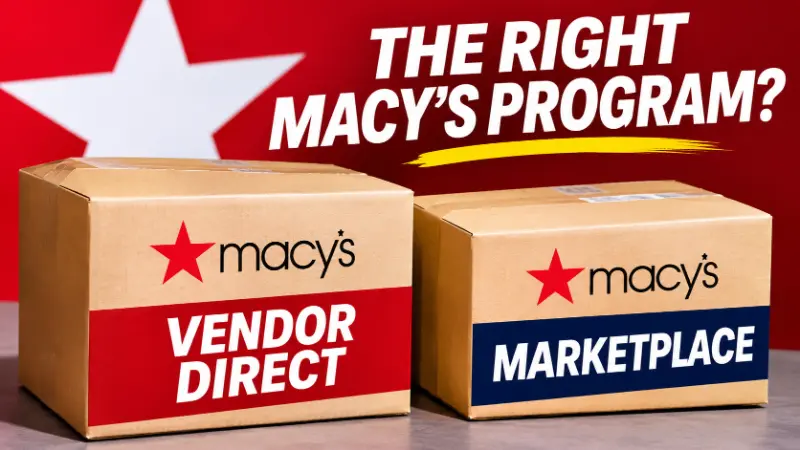
Macy’s Vendor Direct Fulfillment (VDF) and Macy’s Marketplace are separate selling programs with different order connections, shipping configurations, packing document requirements, and financial handoffs, so a 3PL that supports one is not automatically qualified for the other. If you’re a brand or seller comparing 3PL providers for a Macy’s program, verify the connection, warehouse instructions, shipping setup, packing documents, and settlement flow for the specific path your business is joining before you approve a provider.
That distinction matters because a fulfillment provider can be fully capable in one Macy’s workflow and misconfigured in the other. The order may arrive through a different connection, ship on a different carrier account, carry different documents in the carton, and close out through a different financial process. A Macy’s logo on a provider’s website or a broad “Macy’s integration” claim tells you none of that. What qualifies a provider is evidence that its setup matches your program from order receipt to the final invoice or settlement, which is exactly what this comparison checks so you can avoid costly fulfillment errors and align your operations to the right Macy’s program.
Three working rules guide this evaluation:
- Identify your Macy’s program before you assess the provider.
- Inspect representative outputs, such as a packed order and a shipping label, rather than accepting a logo or a capability list.
- Confirm the workflow all the way from order receipt to the financial handoff, not just through shipment.
Start With the Macy’s Vendor Direct Program Your Brand Is Joining
In Macy’s VDF program, a vendor ships customer orders directly from its own or its 3PL’s facility against a Macy’s purchase order, using Macy’s packing documents and a Macy’s-assigned UPS account, and then invoices Macy’s for the merchandise; it is typically invite-only, runs under strict brand standards, and may use CommerceHub workflows for order fulfillment. In macy’s marketplace, a brand sells on macys.com as a third-party seller, connects through Macy’s selected aggregators or a Mirakl integration, and uses that setup to manage its own product listings, prices, inventory, and catalog; sellers also set their own retail prices and promotions, absorb their own shipping, returns, and fulfillment costs, ship the orders themselves, and then pay close attention to the seller-payment process and remittance timing under their agreement.
Both programs end with a package at a Macy’s customer’s door, which is why they get blurred together. The operating instructions behind that package are not the same. The comparison below draws on Macy’s VDF Supplemental Standards (April 8, 2026 revision, listed in the current MacysNet vendor-standards index) and the Macy’s Marketplace FAQ. The evidence column is our recommendation for provider qualification, not an additional Macy’s requirement.
Macy’s also evaluates Marketplace sellers on product quality and operational capability before granting access.
| Area | Vendor Direct Fulfillment (VDF) | Macy’s Marketplace | Evidence to request from the 3PL |
|---|---|---|---|
| Connection | Direct EDI or Rithum/CommerceHub workflows | Selected aggregators or Mirakl integration | The program, the connector, and the full order-to-warehouse path |
| Outbound shipping | Assigned VDF UPS account with prescribed billing | Multiple outbound parcel carriers permitted | The applicable account, billing, and service configuration |
| Packing and documents | Branded packing list in each carton | Mostly unbranded packaging; listings on the site show a “Shipped and sold by [Seller]” badge | A representative packed order and the required documents |
| Financial handoff | Invoice submission to Macy’s | Marketplace seller-payment setup | A named owner and evidence of invoice or settlement reconciliation |
Read the table as a list of handoffs to verify, not a claim that every warehouse task differs. Receiving, storage, picking, and quality checks may look identical in both programs. The differences sit at the edges: how the order enters, how the label is generated, what goes in the box, and how the transaction is closed. Those edges are where a mismatched setup creates rework, especially when the online assortment and customer experience have to stay consistent.
Verify the Connection All the Way to the Warehouse
A generic “we integrate with Macy’s” statement does not say which program, which exchange, or which direction the data flows, or whether the setup can connect in a way that supports Macy’s compliance requirements rather than just pass data. For VDF, the standards describe a direct EDI integration, with Rithum/CommerceHub as the path some vendors may be required to use instead. EDI vendors exchange documents such as the 856 advance ship notice and the 810 invoice. For Marketplace, the FAQ points sellers to selected aggregators or a Mirakl integration. Those are different routes into different systems.
Your provider does not need a native connector for either route. An intermediary such as an order management system, an EDI provider, or a listing platform can carry the data, provided the full path is supported and tested. VDF vendors still have to meet strict onboarding requirements and remain compliant with Macy’s standards. A connection layer standardizes communication but does not pick or pack anything, a point we cover in our explanation of retailer connection platforms. Ask the provider to show:
- What system receives the Macy’s order, and for which program, and whether onboarding includes required resources and vendor credentials such as a GS1 certificate so the setup matches the vendor record.
- Which order fields reach the warehouse, including PO, order, and reservation numbers where the program requires them.
- How shipment confirmation and tracking return to Macy’s, and who monitors failed transmissions.
- Whether cancellations and inventory updates follow the same path.
Shipping and Packing Settings Must Match the Program
Shipping label configuration example
Shipping is where a qualification answer can sound right and still be incomplete, because Macy’s requires orders to be shipped within 2 business days of receiving the PO. The VDF standards require vendors to ship on the UPS account Macy’s assigns during onboarding, with Macy’s set up as the shipper and Bill Shipper (prepaid) billing selected. Third-party billing is no longer approved. Vendors also submit sample UPS labels to their VDF onboarding contact before going live, and the assigned accounts may only be used for Macy’s or Bloomingdale’s VDF orders.
Our inference from those rules: a provider that says “we can use your UPS account” has not yet answered the question. Many 3PLs ship UPS daily on their own or a client’s account. What VDF qualification requires is that VDF orders route to the assigned account, with the correct shipper and billing settings, that the label matches the applicable specifications, and that vendors maintain the ability to hit Macy’s requires 98.5% of orders to ship within two business days standard. Ask for a configuration walkthrough and a sample label checked against your program instructions.
For Marketplace, the FAQ permits sellers to use multiple outbound parcel carriers. That flexibility does not mean anything goes. This is really about how providers ship orders correctly and on time, not just which carrier they use. Confirm which carriers and services the provider will use for Marketplace orders, how tracking returns to the marketplace, and that VDF account rules do not bleed into Marketplace shipments, or the reverse.
Packing documents and pack-station execution
The VDF standards require a Macy’s or Bloomingdale’s branded packing list enclosed in each carton, showing the internet order number, reservation number, and PO numbers. If a vendor cannot generate it from the purchase order data, a third-party EDI provider can be used at the vendor’s expense, but the vendor or fulfillment partner still needs to be compliant with Macy’s packing-document requirements. The Marketplace FAQ describes mostly unbranded packaging with no promotional inserts. It does not establish a blanket ban on packing slips, so confirm your current seller instructions rather than assume one.
The practical test is whether the pack station receives the correct instruction for each order. That packing accuracy directly affects customer experience and long-term program success. Ask to see a representative packed order for your program, including the document in the carton, and how the warehouse prevents brand inserts or another channel’s slip from going into a Macy’s box, which can also contribute to defective or incorrect-item returns downstream.
Shipment Completion Is Not Financial Completion
A shipped order is not a closed order. Under VDF, the vendor submits invoices to Macy’s and is responsible for their accuracy, which directly affects revenue and broader business reporting. Under Marketplace, the seller is paid through the marketplace seller-payment setup and typically bears its own operating costs in that flow. Neither process belongs to the warehouse by default. Related return confirmations also need an owner, since Macy’s expects returns to be confirmed within 2 days of receipt.
Your 3PL usually produces the inputs: shipment confirmations, tracking numbers, and quantities shipped. Your finance team or an order platform may own the invoice or the settlement reconciliation. Shared ownership works when it is written down. Ask who triggers each invoice or confirms each settlement, which shipment record supports it, and who investigates when the numbers do not match.
Follow One Product Through Two Separate Workflows
Illustrative comparison, not a customer incident. Imagine a brand selling a small home accessory, such as a ceramic candle holder. This example does not imply the item is approved in either program, that a seller can list the same SKU in both, or that onboarding to one program enables the other. The product stays constant so the only changes are in the operating instructions.
In a VDF workflow configured for this item:
- Order source: a Macy’s purchase order arrives through EDI or Rithum/CommerceHub. Inspect the mapped order record the warehouse receives.
- Warehouse instructions: the order is flagged as VDF. Inspect the pick ticket and any special handling notes.
- Shipping configuration: the label prints on the assigned VDF UPS account with Bill Shipper billing. Inspect the label sample and the account settings.
- Packing document: a branded packing list with order, reservation, and PO numbers goes in the carton. Inspect a packed sample.
- Shipment record: a ship notice and tracking number return to Macy’s, and the fulfillment process has to support timely status updates back to Macy’s. Inspect the transmitted confirmation.
- Financial handoff: an invoice is submitted to Macy’s. Inspect who sends it and how it ties to the shipment.
In a Marketplace workflow configured for the same item:
- Order source: the order arrives through a selected aggregator or Mirakl integration, while the seller continues to manage its own catalog and inventory. Inspect the same order-to-warehouse path.
- Warehouse instructions: the order is flagged as Marketplace. Inspect the packaging and insert rules attached to it.
- Shipping configuration: the label prints on a carrier and service the seller has approved. Confirm which ones and on whose account.
- Packing document: packaging follows current Marketplace instructions, with no promotional inserts. Confirm whether a slip is expected.
- Shipment record: tracking returns to the marketplace. Inspect the confirmation.
- Financial handoff: the sale settles through seller payments. Inspect who reconciles payouts against shipped orders.
Same candle holder, same shelf, same picker. The same item can sit inside two different fulfillment processes with different approval and control points. A provider that runs one workflow well has demonstrated only that workflow.
Resolve Gaps Before Accepting a Provider’s Macy’s Claim
Request the evidence from the table and the illustration, then read the results honestly:
- The provider demonstrates the setup. Document the scope and ownership of each handoff in writing to protect a successful partnership once the provider is approved.
- An output is wrong. Identify whether it needs a mapping fix or an operating change, then repeat the test.
- A required service is unsupported, or the provider will not implement it. Evaluate another arrangement.
Marketplace may offer a faster onboarding process than Vendor Direct, but that speed does not replace verifying program-specific requirements.
A mismatch does not automatically mean moving inventory. A remapped field or a corrected carrier rule may be enough if the goal is an efficient setup that preserves the provider’s ability to stay approved. A missing capability, such as no way to route orders to a separate assigned account, is a different conversation.
Confirm related banners and return routes separately
Do not assume a Macy’s setup establishes Bloomingdale’s participation, even where a document covers both. Returns need the same scrutiny. The Marketplace FAQ and Macy’s customer-facing return policy describe store returns and direct-to-seller returns differently, so confirm your applicable return route, receiving location, inspection and processing steps, and escalation owner from your current seller instructions, including how defective merchandise is handled when applicable.
If you are still building a shortlist, our broader guide to choosing a Macy’s 3PL covers provider selection. This evaluation comes after that, once you know which program you are joining, or if you are a brand interested in narrowing options first.
Discuss Your Macy’s Fulfillment Program With Cahoot
Cahoot is an end-to-end ecommerce fulfillment operations suite. For a Macy’s program, that means looking at the whole workflow your brand needs rather than a single integration claim. Third-party logistics can let your team focus on core business activities while the provider handles execution, which is one of the clearest benefits when you need to leverage outside operations without losing control of service for customers. Configuring orders correctly from the start helps you save every penny through faster order processing, fewer avoidable errors, and lower handling costs. Connected order, shipping, and inventory workflows help you scale operations without adding complexity, which can also improve customer satisfaction. Program-aware execution helps you outperform on every sales channel, including the one Macy’s program you actually sell through.
We start by reviewing your specific setup, not by promising universal coverage. To discuss your Macy’s fulfillment program, share:
- Your program name and current onboarding instructions
- Your current connector and 3PL, if any
- Your SKU profile and expected volume
- Your ship-from locations
- Any unresolved handoffs, such as invoicing, settlement, or returns
Frequently Asked Questions
Are Macy’s Vendor Direct and Marketplace the same program?
No. Competitor sources use the naming inconsistently, with Vendor Direct described as launching in April 2018 and also as a marketplace expansion in September 2022, so treat that timeline as source context rather than a settled fact. Vendor Direct Fulfillment is a drop-ship program in which vendors ship against Macy’s purchase orders and invoice Macy’s. Marketplace lets third-party sellers sell on macys.com and receive seller payments. Competitor coverage also frames it as a priority for expanding assortment and future growth, citing over 2,000 brands in 2023 and claimed access to over 550 million annual customers. Because the connections, shipping setup, and financial handoffs differ, provider qualification must start by naming the program. Some sources also report that this broader program mix contributed to 3.3% same-store growth.
Does a Macy’s integration support both programs?
Not by name alone. VDF runs on direct EDI or Rithum/CommerceHub for order fulfillment, while Marketplace typically connects through selected aggregators or Mirakl software. Verify the specific connection, the exchanges it supports, and the path to the warehouse for each program you plan to run, and whether the software supports Macy’s compliance workflows.
Can a 3PL use the same shipping configuration for every Macy’s order?
Do not assume so. VDF orders use an assigned Macy’s UPS account with prescribed billing, and those accounts are limited to VDF orders; vendors should expect to ship complete orders within 2 business days. Marketplace permits multiple carriers. Check your program’s current instructions and ask for a sample label. Macy’s also expects 98.5% of orders to leave the warehouse in under 2 days, so your 3PL must be able to hit that service level consistently.
Does Macy’s Marketplace prohibit all packing slips?
The Marketplace FAQ reviewed for this article describes mostly unbranded packaging with no promotional inserts, but it does not establish a blanket packing-slip ban. Confirm your current seller instructions with Macy’s rather than relying on a general rule.
What should I ask a 3PL before launching a Macy’s program?
Ask for a representative order processed in your program, the correct shipping configuration with a sample label, the applicable packing documents, a transmitted shipment record, and a named owner for the invoice or settlement handoff. The 3PL should also explain how it will manage exceptions, returns, and escalations for the specific Macy’s program. Make sure your company and provider are equally clear on who will own account updates, service issues, and the customer-facing parts of the retail experience. Macy’s broader network includes 25 fulfillment centers across the U.S., so your provider should be clear about where its role starts and stops relative to Macy’s own retail operations.
Written By:

Manish Chowdhary
Manish Chowdhary is the founder and CEO of Cahoot, the most comprehensive post-purchase suite for ecommerce brands. A serial entrepreneur and industry thought leader, Manish has decades of experience building technologies that simplify ecommerce logistics—from order fulfillment to returns. His insights help brands stay ahead of market shifts and operational challenges.

Turn Returns Into New Revenue
Related Articles
Can Your Current 3PL Handle Target Plus Fulfillment?
A 3PL can handle Target Plus fulfillment when it can demonstrate the required workflow from the warehouse that will ship your orders and commit in writing to operating that workflo...
TikTok Shop Fulfillment Requirements: How Sellers Can Protect LDR, OTDR, and Delivery Performance
TikTok Shop fulfillment requirements center on speed, tracking, and delivery performance: sellers need to dispatch orders within 2 business days, upload valid tracking information,...

Nordstrom Dropship Fulfillment: What Your 3PL Should Handle and What May Still Fall on You
Nordstrom dropship fulfillment works best when you decide, before you sign, which daily tasks your 3PL will run and which will stay with your team.