
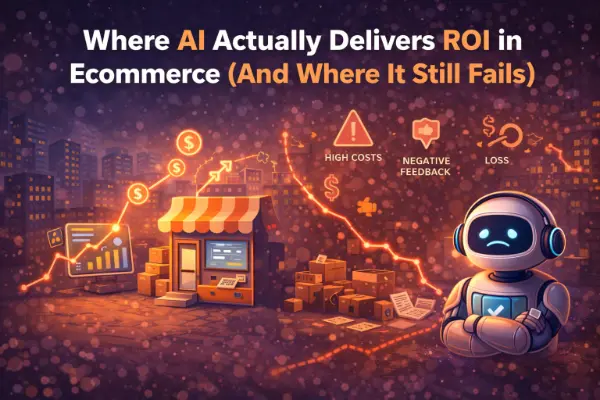
Where AI Actually Delivers ROI in Ecommerce (And Where It Still Fails)

Last updated on December 15, 2025
In this article
 5 mins
- Why “AI ROI” Is the Wrong Question for Ecommerce
- Where AI Is Delivering Real ROI Today
- The High-ROI AI Use Case Most Brands Ignore: Fee Recovery
- Where AI Still Breaks And Costs Brands Money
- Why AI Struggles More With Strategic Decisions
- How Ecommerce Operators Should Evaluate AI ROI Going Forward
- AI ROI Is About Precision, Not Promise
- Frequently Asked Questions
AI is everywhere in ecommerce conversations but ROI is not.
For every success story about automation and efficiency, there’s another quietly shelved AI project that failed to deliver meaningful results. The gap isn’t caused by bad technology. It’s caused by misplaced expectations.
The question ecommerce operators should be asking isn’t whether AI works. It’s where AI delivers real ROI today and where it still breaks down.
The difference matters. Especially now, when margin pressure, shipping costs, and operational complexity leave little room for experimentation without payoff.
Many of the examples in this article are drawn from real conversations with ecommerce operators, including insights shared during an Ugly Talk live panel co-hosted by Cahoot in New York. The discussion focused on where AI is delivering measurable ROI in ecommerce today—and where it’s quietly creating new problems. What emerged wasn’t hype, but a clear pattern: AI works best when it’s constrained to execution, not judgment.
Why “AI ROI” Is the Wrong Question for Ecommerce
AI does not produce universal ROI across all functions. It produces situational ROI.
When brands ask whether AI is “worth it,” they lump together radically different use cases: advertising optimization, pricing strategy, customer service, forecasting, logistics, and finance. These domains have different data structures, feedback loops, and risk profiles.
As a result, many AI initiatives fail not because the technology is flawed, but because it’s applied to problems that are not yet solvable (or not solvable) without human judgment.
Understanding AI ROI starts with understanding task suitability, not ambition.
Where AI Is Delivering Real ROI Today
Across ecommerce operations, AI consistently delivers strong returns in environments that share three traits:
- High data volume
- Repeatable decisions
- Clear feedback loops
Several use cases stand out.
Slash Your Fulfillment Costs by Up to 30%
Cut shipping expenses by 30% and boost profit with Cahoot's AI-optimized fulfillment services and modern tech —no overheads and no humans required!
I'm Interested in Saving Time and MoneyAdvertising Optimization at Scale
AI excels at identifying patterns humans cannot see across thousands of campaigns, creatives, and keywords. In paid media, this translates into faster iteration, more efficient spend allocation, and measurable performance lift.
This is one of the earliest areas where ecommerce brands see ROI, not because AI is “creative,” but because optimization at scale is fundamentally computational.
During the panel, one operator shared how AI surfaced unexpectedly high-performing niches that human teams had historically overlooked. A standout example was “pencil Christmas trees” which is a narrow, space-saving variant that didn’t register as a priority category for planners. AI detected strong conversion signals and unmet demand across marketplaces, enabling the brand to lean in early. The result wasn’t a creative breakthrough. It was executional awareness at scale, something humans are structurally bad at spotting.
Humans optimize around what they already know; AI optimizes around what the data reveals even when the opportunity looks small or uninteresting.
Demand Signals and Forecasting
While perfect forecasting remains elusive, AI-driven demand signals are already improving inventory planning and promotional timing. Even modest accuracy improvements can unlock meaningful cost savings by reducing stockouts and overstock scenarios.
Workflow Automation
AI delivers ROI by removing humans from low-value coordination tasks: data reconciliation, routing decisions, and exception triage. These gains don’t always show up as revenue growth, but they show up clearly in time saved and error reduction.
These wins form the backbone of AI ROI in ecommerce operations, especially when integrated across systems instead of deployed as isolated tools.
The High-ROI AI Use Case Most Brands Ignore: Fee Recovery
One of the most overlooked (and consistently profitable) AI applications in ecommerce is fee recovery.
Platforms and carriers process millions of transactions at scale. Errors are inevitable. What’s remarkable is not that errors exist, but that most brands never notice them.
AI is uniquely well-suited to this problem.
By continuously auditing transactions, reconciling invoices, and flagging anomalies, AI can recover revenue that would otherwise disappear unnoticed. This includes:
- Marketplace fee discrepancies
- Shipping overcharges
- Missed refunds
- Billing mismatches
These recoveries often feel “boring” compared to growth initiatives. But they deliver direct, bottom-line impact, especially in tight margin environments.
This is a prime example of AI delivering ROI quietly, without requiring behavioral change or customer-facing risk.
Looking for a New 3PL? Start with this Free RFP Template
Cut weeks off your selection process. Avoid pitfalls. Get the only 3PL RFP checklist built for ecommerce brands, absolutely free.
Get My Free 3PL RFPWhere AI Still Breaks And Costs Brands Money
For all its strengths, AI still struggles in several high-profile ecommerce applications.
Pricing Elasticity
Dynamic pricing remains one of the most overpromised AI use cases. While AI can react to competitor pricing or inventory levels, it still struggles to model true consumer elasticity. Particularly across brands, channels, and emotional buying contexts.
Incorrect price moves can damage brand perception or erode margins faster than they improve them.
Unverified Recommendations
One panelist shared a costly example of AI-driven content optimization gone wrong. AI identified “UV resistant” as a high-conversion keyword for artificial plants and began inserting it into product listings without anyone verifying whether the products were actually UV resistant. Conversions initially improved, but the downstream impact was severe: higher return rates, customer complaints, and expensive chargebacks once buyers realized the plants degraded outdoors. The AI did exactly what it was trained to do (optimize for conversion) but without human verification, it optimized straight into margin loss.
Over-Automation Without Escalation
AI systems that operate without human review in ambiguous scenarios often fail in subtle but costly ways. Customer frustration, misrouted returns, and incorrect resolutions accumulate quietly until they surface as reputation damage.
These failures don’t mean AI is ineffective. They mean the wrong tasks were automated too aggressively.
Why AI Struggles More With Strategic Decisions
AI performs best when outcomes are measurable and feedback is fast.
Strategic decisions like pricing architecture, brand positioning, customer trust; involve causality, emotion, and long-term tradeoffs. These are areas where human judgment still outperforms algorithms.
When AI is pushed into these domains without guardrails, ROI becomes unpredictable. Successful operators treat AI as a decision engine for execution, not vision.
This distinction separates disciplined AI adoption from expensive experimentation.
How Ecommerce Operators Should Evaluate AI ROI Going Forward
Evaluating AI ROI requires a shift in framing.
Instead of asking:
- “Will this AI tool grow revenue?”
Ask:
- Does this task repeat frequently?
- Is performance measurable?
- Is feedback timely?
- Is failure recoverable?
High-ROI AI initiatives tend to:
- Reduce cost leakage
- Improve consistency
- Compress learning cycles
- Eliminate manual coordination
Low-ROI initiatives often aim to replace judgment instead of supporting it.
Brands that apply this filter consistently avoid most AI disappointment and compound value faster.
Scale Faster with the World’s First Peer-to-Peer Fulfillment Network
Tap into a nationwide network of high-performance partner warehouses — expand capacity, cut shipping costs, and reach customers 1–2 days faster.
Explore Fulfillment NetworkAI ROI Is About Precision, Not Promise
AI is not a magic lever for ecommerce growth. It is a precision tool.
When applied to the right problems, AI delivers undeniable ROI: quietly improving margins, reducing waste, and accelerating execution. When misapplied, it creates false confidence and hidden risk.
The next phase of ecommerce will reward operators who deploy AI with discipline rather than ambition.
Not everywhere.
Not all at once.
But exactly where it works.
Frequently Asked Questions
What ecommerce use cases deliver the highest AI ROI today?
AI delivers the strongest ROI in repeatable, data-rich areas such as advertising optimization, fee recovery, forecasting, and operational automation.
Why does AI struggle with pricing optimization?
Pricing requires elasticity modeling, brand context, and consumer psychology. Basically areas where AI still lacks reliable causal understanding.
Is AI ROI easier to achieve for small ecommerce brands?
Often yes. Smaller teams can implement AI faster, test narrowly, and iterate without organizational friction.
How should ecommerce brands measure AI ROI?
Measure AI ROI by task-level outcomes: time saved, errors reduced, costs recovered, and learning speed. We should not abstract efficiency claims.
Written By:

Manish Chowdhary
Manish Chowdhary is the founder and CEO of Cahoot, the most comprehensive post-purchase suite for ecommerce brands. A serial entrepreneur and industry thought leader, Manish has decades of experience building technologies that simplify ecommerce logistics—from order fulfillment to returns. His insights help brands stay ahead of market shifts and operational challenges.

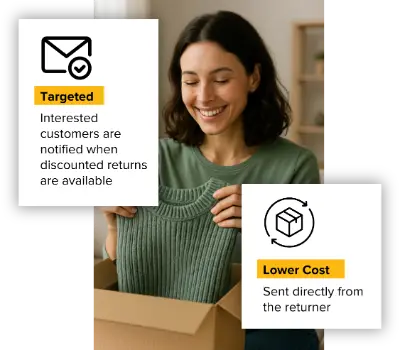
Turn Returns Into New Revenue
Related Articles
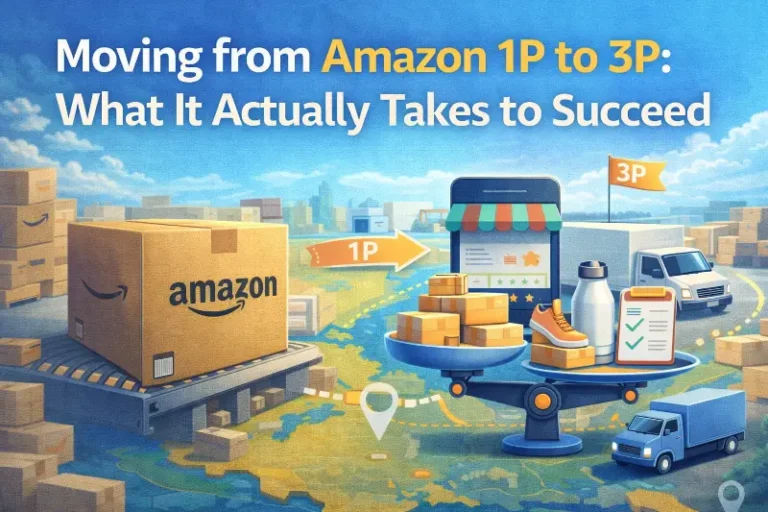
Moving from Amazon 1P to 3P: What It Actually Takes to Succeed
The decision to move from Amazon Vendor Central (1P) to Seller Central (3P) usually follows months of frustration with pricing control loss, erratic purchase orders, and margin com...
Why Amazon 1P Feels Out of Control — and Why That’s Not Your Fault
When your Amazon Vendor Central account starts generating problems faster than your team can fix them, the instinct is to treat each issue as a separate operational failure.
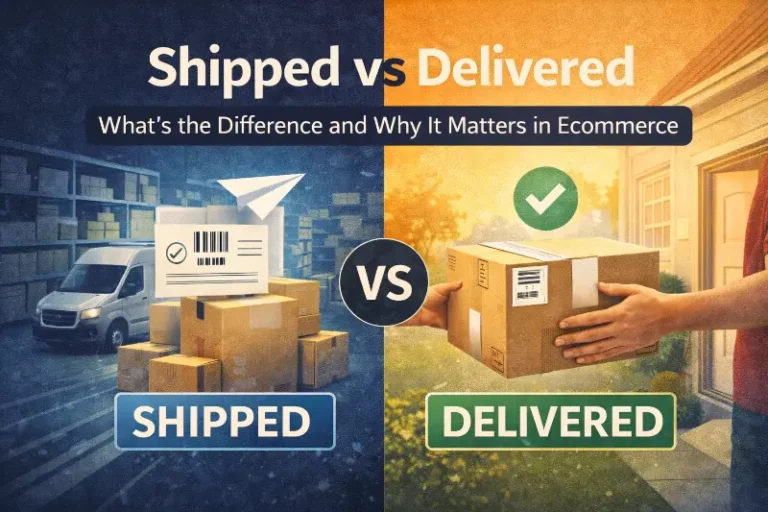
Shipped vs Delivered: What’s the Difference and Why It Matters in Ecommerce
“Shipped” and “delivered” are carrier status updates, not customer truth.