
Why Cross-Border DTC Brands Are Moving Fulfillment Inside the US
In this article
 18 minutes
- What the De Minimis Exemption Was and Why Its Removal Changes the Model
- The Aritzia Case: What Executing This Transition at Scale Looks Like
- What Relocation Operationally Requires
- This Is a Distribution Problem, Not a Manufacturing Problem
- When U.S. Domestic Fulfillment Makes Financial Sense
- Entering the U.S. Without a Long-Term Lease Commitment
- Frequently Asked Questions
Cross-border ecommerce fulfillment is the process of shipping ecommerce orders across national borders—often from warehouses outside the United States to U.S. consumers—and for brands built around direct-to-consumer parcel shipping, that model has lost its cost foundation. The elimination of the de minimis exemption has converted what was a variable, duty-free international shipping model into one that incurs import duties, customs processing fees, and brokerage costs on every single order. The rapid growth of global ecommerce and the surge in online shopping, especially during the COVID-19 pandemic, have increased both the complexity and importance of cross border ecommerce fulfillment. Rising consumer expectations for fast and affordable shipping are forcing brands, logistics managers, and ecommerce teams to rethink whether fulfilling U.S. customers from overseas still makes operational or financial sense.
For a growing number of cross-border DTC brands, the answer is no. The operational response is relocation: moving U.S. order fulfillment inside the country, shifting from a variable international shipping cost structure to fixed domestic infrastructure. This article examines what that shift looks like in practice, including the impact of de minimis removal, examples such as brands moving fulfillment closer to U.S. demand, the cost and working-capital tradeoffs of domestic fulfillment, tax and compliance requirements, and when flexible 3PL or distributed U.S. networks start to make sense. This is not a contingency plan. It is becoming the operational baseline for any brand with meaningful U.S. volume.
What the De Minimis Exemption Was and Why Its Removal Changes the Model
The de minimis exemption, codified under Section 321 of the U.S. Tariff Act, allowed imported shipments valued at $800 or less to enter the United States duty-free with minimal customs documentation. For cross-border DTC brands, this provision was the structural logic behind shipping individual consumer orders from a Canadian, European, or Asian warehouse directly to U.S. customers. The brand paid no duties on individual parcels below the threshold, kept fulfillment consolidated in one location, and the U.S. customer received their order without customs friction.
At its peak, more than 1 billion packages annually entered the United States under de minimis. The provision has now been eliminated for shipments from China and Hong Kong, and suspended globally, with permanent legislative repeal set for July 1, 2027. Every cross-border DTC parcel that previously entered duty-free now triggers import duties, customs duties, import taxes, per-shipment customs processing fees, and brokerage charges that can add $15 to $30 or more to the landed cost of a single consumer order.
The math breaks fast at any meaningful volume. A brand shipping 2,000 U.S. orders per month from Canada that previously paid zero duties on those shipments now faces a recurring monthly import cost that did not exist before. That cost does not scale down as the brand grows. It scales up. And unlike a carrier rate that can be negotiated or a warehouse lease that can be amortized, it hits on every order, every month, with no offset. Unexpected extra fees at checkout, such as customs duties and import taxes, can also lead to increased cart abandonment rates among U.S. customers.
The Aritzia Case: What Executing This Transition at Scale Looks Like
Aritzia, the Vancouver-based fashion retailer, is the most documented example of a cross-border brand executing a proactive U.S. fulfillment transition, similar to other brands highlighted in case studies on migrating fulfillment partners. The company had been fulfilling a portion of U.S. international orders from its Canadian distribution network, leveraging de minimis to ship individual parcels across the border duty-free.
Anticipating the exemption’s removal, Aritzia expanded its existing U.S. distribution center in Groveport, Ohio from roughly 240,000 square feet to approximately 560,000 square feet, more than doubling the physical footprint. This expansion allowed Aritzia to better serve the U.S. region. The company then transitioned from third-party to in-house operation of the facility, hired additional staff, and pulled forward equipment retrofitting work before the global suspension took effect in late August 2025.
When the exemption was removed, Aritzia had already relocated all U.S. order fulfillment to the Ohio facility. The company reported operating at triple the throughput capacity compared to its pre-transition baseline, with a path to quadruple capacity through further optimization. Critically, the company stated that service levels for U.S. customers were not impacted during the transition. Maintaining high service levels helped Aritzia retain its U.S. customer base throughout this period.
The financial disclosure was direct. Aritzia reported approximately 400 basis points of gross margin pressure from trade-related headwinds, with roughly one-third of that attributable specifically to the de minimis removal rather than broader tariff exposure. That is a real cost. It is also a cost the company absorbed without degrading delivery performance or customer experience, which is the operational benchmark other cross-border brands now have to work against.
The Aritzia case illustrates the central tension in this transition: the cost of relocating is visible and immediate, while the cost of not relocating compounds quietly until it becomes structural.
What Relocation Operationally Requires
Understanding that U.S. fulfillment is necessary is not the same as being ready to execute it. The transition involves several simultaneous operational changes, each with its own lead time and capital requirement.
Inventory repositioning is the first constraint. Effective supply chain management is crucial here, as brands must coordinate the movement of goods and maintain visibility across multiple locations. A brand that has been fulfilling U.S. demand from a home-country warehouse needs inventory management discipline to determine how much U.S.-facing inventory to pre-position domestically, establish inbound replenishment flows from suppliers or the origin warehouse to the new U.S. node, and manage the transition period when both locations are active, since maintaining inventory accuracy is critical for timely deliveries and avoiding out-of-stock situations during the transition. For seasonal or trend-driven categories, this requires demand-based planning rather than simply mirroring historical stock levels. That planning also depends on a deep understanding of market demand patterns and customer behavior. Regular inventory counts and close tracking of inventory movement are essential to keep accurate inventory records and reduce delayed shipments. Leveraging the resources of a third-party logistics provider can help ensure a smooth transition by providing the necessary infrastructure and expertise, especially when brands follow a structured approach to migrating to a new 3PL successfully and apply criteria for choosing the right 3PL company.
U.S. warehouse capacity is the second. Whether the brand is signing a direct lease or engaging a third-party logistics provider, securing space in a U.S. fulfillment center to receive and store inventory in a logistics-relevant market takes time, and brands targeting the Northeast corridor often look at New York order fulfillment services with fast regional coverage. National industrial vacancy has loosened from the historic lows of 2022, but well-located, smaller-format space in dense markets remains constrained. A five-year direct lease requires volume confidence that can be difficult to hold during a period of policy uncertainty. Third-party logistics arrangements on a per-order basis avoid that commitment but carry higher unit costs at scale, which is why many brands also evaluate alternative ecommerce fulfillment models beyond traditional 3PLs.
Carrier contract changes follow from the location shift. A brand that has been negotiating international shipping rates for Canada-to-U.S. parcels needs domestic parcel agreements with USPS, UPS, FedEx, or regional carriers. Domestic rates are negotiated based on origin, volume, zone distribution, and package profile. Starting from scratch on these negotiations means paying closer to published rates in the early months, which can inflate per-order shipping costs until volume builds.
Tax and compliance obligations expand immediately when a U.S. warehouse is opened. Physical presence in a state creates sales tax nexus in that state from the first day of operation, requiring registration, collection, and filing. The United States has more than 12,000 taxing jurisdictions. For a Canadian or European brand with no prior U.S. tax compliance history, this is a meaningful administrative and cost addition that requires either in-house capability or a qualified U.S. tax advisor before the warehouse opens, not after. It is also essential to comply with U.S. regulations regarding customs, duties, licensing, and customs clearance to avoid disruptions in cross border ecommerce fulfillment, and automation in customs processes helps maintain compliance by keeping documentation and tariff-code updates current.
Working capital requirements increase because pre-positioning domestic inventory means paying for goods and duties before they sell. A brand accustomed to fulfilling U.S. orders from shared home-country inventory now needs to fund a dedicated U.S. stock position. Carrying costs for U.S. inventory typically run 20 to 30 percent of inventory value annually when accounting for capital, storage, insurance, and obsolescence risk. For high-SKU-count or seasonal businesses, this working capital demand can be significant.
During the relocation, the right tools matter: ecommerce fulfillment software with inventory management software features can provide real time visibility through advanced technology to support inventory accuracy and compliance, particularly for brands evaluating Shopify-focused ecommerce fulfillment services.
This Is a Distribution Problem, Not a Manufacturing Problem
It is worth being precise about what kind of problem this is, because the solution set depends on it.
The de minimis removal is specifically a cross border fulfillment and cross border logistics issue. It affects brands that were shipping individual consumer orders from outside the United States and relying on the exemption to avoid per-shipment duty costs. The fix is a distribution change: moving the last-mile fulfillment origin inside the country. The brand’s manufacturing geography, supplier relationships, and product cost structure are separate questions with separate answers.
For cross border ecommerce brands, adapting their cross border operations is essential to remain competitive. A Canadian apparel brand that sources from Vietnam and was fulfilling U.S. orders from Toronto is not being asked to reshore manufacturing. It is being asked to establish a U.S. distribution node so that individual consumer shipments originate domestically. Those are operationally distinct projects. Conflating them leads to analysis paralysis, because reshoring manufacturing is a multi-year, capital-intensive decision, while establishing a third-party logistics relationship in the U.S. Midwest can be operational in 60 to 90 days.
When U.S. Domestic Fulfillment Makes Financial Sense
The decision to establish U.S. fulfillment infrastructure depends on variables that are specific to each brand’s operation. Brands must evaluate cost-effective shipping options and solutions to address their ecommerce needs, ensuring that their international logistics strategies align with business goals and customer expectations.
Volume is the primary threshold. The fixed costs of domestic fulfillment, whether a direct lease or a 3PL monthly minimum, require sufficient order volume to justify. Third-party logistics minimums average around $500 per month in 2025, but the real break-even is in order throughput. The general threshold at which U.S. domestic fulfillment becomes financially superior to cross-border shipping with duties is roughly 500 to 1,000 U.S. orders per month. At that volume, per-order duty and brokerage savings of $15 to $25 more than offset the fixed cost of a 3PL relationship, often with margin to spare.
Average order value intersects with duty exposure in a non-linear way. A brand with a $200 average order value already had limited de minimis benefit on higher-ticket items. A brand with a $45 average order value was capturing maximum benefit from the exemption on nearly every order. For the latter, the duty exposure per order as a percentage of revenue is substantially higher, and the case for domestic fulfillment is correspondingly stronger at lower volume thresholds.
Product category and tariff rate determine the actual per-order duty cost. Apparel from Canada faces different rates than electronics from Europe. Brands should model their specific duty exposure against their actual product mix and origin country before assuming a generic rate applies.
The cost variables that change when moving to domestic U.S. fulfillment are worth mapping explicitly. International shipping cost with duties is replaced by domestic pick-and-pack fees and domestic parcel rates. Variable per-shipment customs costs are replaced by fixed 3PL fees and amortized inbound bulk import costs. Working capital requirements increase. Tax compliance costs appear. Net per-order landed cost typically decreases materially for brands above the volume threshold. However, brands face key challenges and other challenges during this transition, such as navigating new compliance requirements, managing fluctuating shipping rates, and optimizing logistics. Choosing cost-effective solutions and the right shipping options can help overcome these challenges and ensure a smooth shift to domestic fulfillment.
Entering the U.S. Without a Long-Term Lease Commitment
The structural challenge for cross-border brands evaluating U.S. fulfillment in the current environment is that many businesses hesitate to pursue cross border ecommerce fulfillment due to the complexities of shipping internationally and managing operations across different countries and borders. Traditional entry paths require fixed-cost commitments at a moment when policy conditions are still evolving. A five-year warehouse lease is a significant bet on volume projections and stable regulatory conditions. Most mid-market brands are not in a position to make that bet with confidence right now.
Flexible, distributed fulfillment networks offer a lower-commitment alternative. Partnering with a third-party logistics partner that provides specialized order fulfillment services for ecommerce companies offers the services, support, and resources needed for international expansion and global expansion. Third-party logistics providers operating multi-client shared warehouse networks allow brands to access U.S. fulfillment capacity without signing multi-year leases, paying only for the space and labor they actually use, and a Cahoot vs. ShipMonk comparison illustrates how different networks can impact cost and delivery speed. This model carries higher per-unit costs than a dedicated facility at high volume, but it allows a brand to establish a U.S. footprint, validate the operational model, and build volume before making a capital commitment. Distributed fulfillment networks help ecommerce businesses reach new customers and enter new markets, including emerging markets and international markets, by providing the flexibility to test and scale in different regions, much like a strategically located national fulfillment services network that accelerates shipping and reduces costs.
Distributed networks add a further advantage beyond flexibility. International fulfillment solutions are designed to meet the needs of the end customer and address high demand periods. A brand that places inventory across two or three U.S. nodes rather than a single location can reduce average shipping distance to customers, which lowers carrier costs and compresses delivery times simultaneously. For a cross-border brand accustomed to two-to-five-day transit times from Canada, a distributed domestic network can actually improve delivery performance compared to a single-node domestic model, while the per-order economics continue to improve as volume builds across the network. International ecommerce and selling internationally require tailored strategies to serve consumers in various countries and regions, ensuring compliance and optimizing the customer experience, which is easier when your fulfillment stack includes robust order fulfillment integrations with ecommerce partners across marketplaces and carriers.
Cahoot’s shared fulfillment network and Cahoot Fulfillment Partner Program are designed specifically for this kind of entry. Their US fulfillment centers and ecommerce fulfillment services support business growth by enabling efficient shipping internationally and helping brands manage cross border logistics for international orders. Brands can access U.S. fulfillment nodes without long-term lease commitments, place inventory strategically across multiple locations, and scale capacity in line with actual U.S. demand rather than projected demand.
Frequently Asked Questions
What is the de minimis exemption and why did cross-border DTC brands depend on it?
The de minimis exemption under Section 321 of the U.S. Tariff Act allowed imported shipments valued at $800 or less to enter the United States duty-free with minimal customs documentation. Cross-border DTC brands fulfilling U.S. orders from overseas warehouses relied on this provision to ship individual consumer parcels without incurring import duties on each shipment. Its removal means every cross-border parcel now triggers duty costs, customs processing fees, and brokerage charges that did not previously apply.
How did Aritzia respond to the removal of the de minimis exemption?
Aritzia relocated all U.S. ecommerce order fulfillment from its Canadian distribution network to its existing facility in Groveport, Ohio, expanding that facility from approximately 240,000 square feet to 560,000 square feet before the exemption was suspended. The company reported operating at triple its prior throughput capacity and stated that U.S. customer service levels were not affected during the transition. Aritzia disclosed approximately 400 basis points of gross margin pressure from trade-related headwinds, with roughly one-third attributable specifically to the de minimis removal.
Is relocating U.S. fulfillment the same as reshoring manufacturing?
No. These are operationally distinct decisions. The de minimis removal is a distribution problem: it affects brands shipping individual consumer orders from outside the United States. The fix is moving the U.S. order fulfillment origin inside the country. A brand’s manufacturing geography, supplier relationships, and product cost structure are separate questions. A Canadian brand sourcing from Vietnam can relocate U.S. distribution to an Ohio 3PL without changing anything about how or where its products are made.
At what U.S. order volume does domestic fulfillment become financially superior to cross-border shipping?
The general threshold is approximately 500 to 1,000 U.S. orders per month, though this depends on average order value, product category, applicable duty rates, and shipment dimensions. At that volume, per-order savings from avoided duties and brokerage fees of $15 to $25 typically exceed the fixed cost of a U.S. third-party logistics relationship. Brands with lower average order values or higher duty exposure on their specific product categories may reach this threshold at lower volumes.
What does opening a U.S. fulfillment center do to a brand’s tax obligations?
Physical presence in a U.S. state creates sales tax nexus in that state from the first day of operation, requiring registration with the state tax authority, collection of sales tax on sales to customers in that state, and regular filing and remittance. The United States has more than 12,000 taxing jurisdictions with varying rates and rules. For cross-border brands without prior U.S. physical presence, this compliance obligation requires either in-house tax capability or a qualified U.S. tax advisor before the warehouse opens. Economic nexus rules established after South Dakota v. Wayfair may also create collection obligations in additional states based on sales volume alone.
What is the working capital impact of pre-positioning inventory in a U.S. warehouse on inventory management?
Pre-positioning U.S. inventory requires funding a dedicated stock position and paying inbound duties 30 to 90 days before those goods sell. Carrying costs for U.S. inventory typically run 20 to 30 percent of inventory value annually when accounting for capital costs, storage fees, insurance, and obsolescence risk. For brands accustomed to fulfilling U.S. demand from shared home-country inventory, this represents a meaningful increase in working capital requirements that should be modeled before committing to a domestic fulfillment strategy.
Why are distributed fulfillment networks better than a single U.S. warehouse for brands entering from outside the country?
A distributed network places inventory across multiple U.S. nodes rather than concentrating it in one location. This reduces the average shipping distance between inventory and customers, which lowers carrier costs, compresses delivery times, and improves service for customers worldwide by reducing lengthy delivery times and giving shoppers better tracking visibility. For a cross-border brand whose customers are spread across the continental U.S., a single Midwest warehouse may serve central markets well but adds two to three shipping zones for coastal customers. Distributing inventory across two or three strategically placed nodes can match or beat cross-border transit times while reducing per-order shipping cost. That speed and clarity support customer satisfaction and a seamless shopping experience. Distributed networks offered by third-party providers also avoid the multi-year lease commitments that come with dedicated facilities. Inventory inaccuracies can still hurt the buying experience when stock is split across nodes, so allocation has to stay precise. Strong execution in global order fulfillment also depends on keeping customers informed from shipment through delivery.
What cost variables change when a cross-border brand moves to domestic U.S. fulfillment?
The primary shift is from variable international shipping costs with per-shipment duty and brokerage expenses to fixed domestic infrastructure costs with bulk-import duty treatment. Specific variables that change include: international carrier rates replaced by domestic parcel rates; per-shipment customs fees and duties replaced by amortized inbound bulk import costs; zero U.S. sales tax nexus replaced by multi-state compliance obligations; shared home-country inventory replaced by a dedicated U.S. stock position requiring additional working capital; and returns handling added as part of the broader domestic-fulfillment model that supports global ecommerce fulfillment. For a target market in the U.S., local return processes can reduce reverse-logistics and shipping costs compared with sending returns abroad. Returns operations should inspect items for damage before restocking and ensure customers receive prompt refunds or exchanges when appropriate. Net per-order landed cost typically decreases materially for brands operating above the volume threshold where fixed costs are absorbed, and these domestic returns capabilities also support a smoother global marketplace experience for brands selling into the U.S.
Written By:

Rinaldi Juwono
Rinaldi Juwono leads content and SEO strategy at Cahoot, crafting data-driven insights that help ecommerce brands navigate logistics challenges. He works closely with the product, sales, and operations teams to translate Cahoot’s innovations into actionable strategies merchants can use to grow smarter and leaner.

Turn Returns Into New Revenue
Related Articles

Cheapest Shipping from USA to UK: What It Really Costs
Shipping from the USA to the UK is one of the most common international routes for ecommerce brands, and it is also one of the most misunderstood from a cost perspective.
Shopify Estimated Delivery Date: A Complete Guide for Ecommerce Stores
A Shopify estimated delivery date is the specific arrival date or date range shown on a product page before purchase, so shoppers know when an order is expected to arrive.
Save Money With Ecommerce Shipping Software: Next-Gen Solutions
Shipping costs are one of the biggest challenges for ecommerce businesses today, and understanding them is essential to reducing expenses and increasing profit margins.
Cheapest Shipping from USA to UK: What It Really Costs
In this article
17 minutes
- Carrier Options for USA to UK Shipping
- UK Import Rules: What Your Customer Actually Pays
- DDP vs DDU: The Decision That Shapes Customer Experience
- Transit Time vs Cost: The Real Tradeoff
- The Real Cost of Cheap Shipping
- How to Actually Reduce Costs Without Wrecking the Experience
- Frequently Asked Questions
Shipping from the USA to the UK is one of the most common international routes for ecommerce brands, and it is also one of the most misunderstood from a cost perspective. The carrier with the lowest label price is rarely the option with the lowest total cost once UK customs rules, duties, transit times, and the downstream impact on customer experience are factored in. Focusing exclusively on postage gets you a number that looks good in isolation and causes problems everywhere else.
This guide covers the major carrier options, how UK import rules shape what your customer actually pays, why the DDP versus DDU decision matters more than most brands realize, and what the real cost of cheap international shipping looks like when refunds, returns, and customer service volume are included.
Carrier Options for USA to UK Shipping
No single carrier is the right answer for every shipment. The correct choice depends on package weight, declared value, how much transit time matters to your customer, and whether you have negotiated rates or are shipping at retail.
USPS is the default starting point for small, lightweight packages. First-Class Package International handles items up to 4 lbs, with transit times of one to four weeks and limited tracking visibility once the package leaves US soil. Retail rates for packages under 4 lbs start in the $15 to $23 range. Priority Mail International offers better tracking and $200 of included insurance, with six to ten business-day delivery. Flat-rate Priority Mail boxes, starting around $32 to $45, can offer real savings for dense, heavy items, but you should evaluate whether flat-rate parcels or other services are truly the best way to ship heavy items for your product mix. Priority Mail Express International compresses transit to three to five business days with a money-back guarantee. All USPS international shipments hand off to Royal Mail for UK final-mile delivery, which can add one to three days and creates tracking gaps at the handoff point.
FedEx International Economy is consistently one of the strongest price-to-reliability options for ecommerce brands, with two- to five-day transit and full end-to-end tracking. Through aggregator platforms or negotiated accounts, rates on a 5 lb package run roughly $42 to $65. FedEx International Connect Plus is worth specific attention for B2C sellers because it eliminates residential delivery surcharges, saving $4 to $6 per package across high volumes. FedEx International Priority compresses transit further but at a meaningful cost premium.
UPS Worldwide Expedited delivers in two to five business days with full tracking and broker-inclusive customs clearance. Through third-party platforms, rates are broadly comparable to FedEx Economy at roughly $50 to $75 on a 5 lb package. UPS offers strong reliability and customs expertise, making it a solid default for brands that have not yet negotiated a carrier contract.
DHL Express is the premium option with the best tracking in the industry, fastest customs clearance, and the strongest European delivery network. At retail, DHL is prohibitively expensive for most ecommerce use cases. With a business account, discounts of 69 to 85 percent off retail are achievable, which brings DHL into competitive range for high-value or time-sensitive shipments. Without a business account, it rarely makes sense for routine ecommerce shipping.
Shipping aggregators are where most ecommerce brands should start before approaching any carrier directly. Pirate Ship offers its Simple Export Rate, which starts around $11 to $16 for packages under 4 lbs and includes up to 52 percent off USPS First-Class International at no cost to the seller. Easyship connects to more than 550 carriers with discounts up to 91 percent off retail and integrates landed cost calculation at checkout. Shippo and ShipStation offer similar multi-carrier access with automation features that matter at higher volumes. The consistent rule is that retail rates should never be the starting point for any significant shipping volume.
UK Import Rules: What Your Customer Actually Pays
The UK eliminated its low-value VAT exemption on January 1, 2021. There is no de minimis threshold for VAT on commercial imports. Every shipment, regardless of value, is subject to 20 percent UK VAT.
The £135 threshold applies specifically to customs duty, not VAT. For consignments with a certain value of goods at or below £135, no customs duty is charged at the border. However, the overseas seller is required to register for UK VAT and collect that 20 percent at the point of sale, remitting it directly to HMRC. When this is handled correctly, the package clears UK customs without any surprise charges reaching the recipient.
For consignments above £135, customs duty applies based on the product’s HS code and the country of origin. US goods face UK Global Tariff rates that average around 4 percent but vary significantly by product category, ranging from zero to 12 percent or more. Import VAT is then calculated on the combined value of goods, shipping, insurance, and any duty already assessed. A practical example: £200 of goods with £30 shipping and a 6.5 percent duty rate produces approximately £14.95 in duty, then 20 percent VAT on the combined £244.95 subtotal adds roughly £49 in VAT. The total border charge is approximately £64, plus any carrier handling fees if the shipment arrives unprepared.
The only remaining UK customs exemption applies to genuine gifts sent between private individuals, valued under £39. This has no application to commercial ecommerce sales and differs from goods sent for personal use by a business seller.
Customs documentation requirements are strict. CN22 forms apply to postal shipments under 2 kg and under £270 in value. CN23 forms are required for heavier or higher-value postal shipments. A Commercial Invoice is required for all private courier shipments via DHL, FedEx, and UPS. These customs documents and other customs paperwork must match the shipment details exactly. Every document must include accurate HS codes, detailed product descriptions, country of origin, and declared values. Vague descriptions or missing HS codes are the most common cause of UK customs holds and delays. A customs declaration is required for international shipments, and meeting customs requirements helps avoid delays.
For consignments above £135, customs duty applies based on the product’s HS code and the country of origin. US goods face UK Global Tariff rates that average around 4 percent but vary significantly by product category, ranging from zero to 12 percent or more. Import VAT is then calculated on the combined value of goods, shipping, insurance, and any duty already assessed. A practical example: £200 of goods with £30 shipping and a 6.5 percent duty rate produces approximately £14.95 in duty, then 20 percent VAT on the combined £244.95 subtotal adds roughly £49 in VAT. The total border charge is approximately £64, plus any carrier handling fees if the shipment arrives unprepared.
The only remaining UK customs exemption applies to genuine gifts sent between private individuals, valued under £39. This has no application to commercial ecommerce sales.
Customs documentation requirements are strict. CN22 forms apply to postal shipments under 2 kg and under £270 in value. CN23 forms are required for heavier or higher-value postal shipments. Commercial invoices are required for all private courier shipments via DHL, FedEx, and UPS. Every document must include accurate HS codes, detailed product descriptions, country of origin, and declared values. Vague descriptions or missing HS codes are the most common cause of UK customs holds and delays.
DDP vs DDU: The Decision That Shapes Customer Experience
DDP (Delivered Duty Paid) means the seller collects duties and taxes at checkout and prepays them before the shipment arrives at the UK border. The customer receives the package with no additional payment required and does not need to pay duties on delivery.
DDU (Delivered Duty Unpaid, now formally known as DAP) means duties and taxes are assessed at the UK border, with collection timing determined by the destination country’s border process, and the carrier contacts the recipient demanding payment before releasing the parcel. Royal Mail charges a flat £8 handling fee on top of the actual customs charge. UPS and FedEx charge brokerage advancement fees ranging from £11 to £50 or more depending on shipment value.
The downstream consequences of DDU for ecommerce are consistently underestimated. A customer who ordered a $35 product may face a VAT bill of £2.10 plus Royal Mail’s £8 handling fee, totaling nearly £10 in unexpected charges on a sub-$40 purchase. That customer does not think of this as a government tax. They think of it as a bad experience with your brand. The predictable chain of events is: refusal of delivery, a one-star review, a chargeback request, and no repeat purchase. Royal Mail holds refused parcels for 21 days, then returns them to the sender at the seller’s cost. The brand absorbs outbound shipping, return shipping, and any duties already advanced, on a transaction that generated zero revenue.
DDP removes all of this exposure. DDP packages clear customs automatically because duties are prepaid, avoiding the two- to five-day delay typical of DDU while carriers collect payment from uncertain recipients. Brands that implement DDP consistently report significantly fewer customs-related support inquiries and higher international conversion rates. Amazon requires DDP for all shipments through its platform, which is a signal of where industry expectations sit.
Implementing DDP requires registering for UK VAT, classifying products with accurate HS codes, and calculating landed costs at checkout. Tools such as Zonos, Easyship, and Global-e handle this automatically and integrate with major ecommerce platforms. DHL, FedEx, and UPS all support DDP at the carrier level, and the same carriers offer different shipping methods and shipping options depending on speed and cost. The upfront cost of implementing DDP is real. The cost of not doing it, across chargebacks, returns, and lost customer lifetime value, is reliably higher.
The downstream consequences of DDU for ecommerce are consistently underestimated. A customer who ordered a $35 product may face a VAT bill of £2.10 plus Royal Mail’s £8 handling fee, totaling nearly £10 in unexpected charges on a sub-$40 purchase. That customer does not think of this as a government tax. They think of it as a bad experience with your brand. The predictable chain of events is: refusal of delivery, a one-star review, a chargeback request, and no repeat purchase. Royal Mail holds refused parcels for 21 days, then returns them to the sender at the seller’s cost. The brand absorbs outbound shipping, return shipping, and any duties already advanced, on a transaction that generated zero revenue.
DDP removes all of this exposure. DDP packages clear customs automatically because duties are prepaid, avoiding the two- to five-day delay typical of DDU while carriers collect payment from uncertain recipients. Brands that implement DDP consistently report significantly fewer customs-related support inquiries and higher international conversion rates. Amazon requires DDP for all shipments through its platform, which is a signal of where industry expectations sit.
Implementing DDP requires registering for UK VAT, classifying products with accurate HS codes, and calculating landed costs at checkout. Tools such as Zonos, Easyship, and Global-e handle this automatically and integrate with major ecommerce platforms. DHL, FedEx, and UPS all support DDP as a shipping option at the carrier level. The upfront cost of implementing DDP is real. The cost of not doing it, across chargebacks, returns, and lost customer lifetime value, is reliably higher.
Transit Time vs Cost: The Real Tradeoff
USPS economy options are the lowest label price available for lightweight packages. They are also the slowest, with the least predictable transit times and the most limited tracking. For low-value items where the customer has low delivery expectations, economy postal shipping is appropriate.
For most ecommerce brands shipping branded products to UK customers who paid full price, the two- to four-week delivery window of economy postal service creates a structural customer experience problem. A customer who orders on day one and receives a vague customs delay notification on day eighteen is not comparing your delivery time to your posted estimate. They are comparing it to what they receive from every other brand they order from.
The cost gap between USPS Priority Mail International and FedEx International Economy through an aggregator platform is often smaller than it appears at retail. A five- to seven-day delivery upgrade may cost $10 to $20 more per shipment. Against the potential customer service cost of a single customs inquiry or the lost lifetime value of a dissatisfied first-time customer, that cost difference frequently represents the better investment.
The practical framework for most ecommerce brands: use economy postal options for low-value items under $25 where delivery expectations are set accordingly, use FedEx International Economy or UPS Worldwide Expedited as the standard service for most orders, and reserve DHL Express or other expedited shipping services for high-value shipments where fast customs clearance and end-to-end tracking justify the cost.
The Real Cost of Cheap Shipping
The label price of a shipment is one component of total shipping cost. The full cost stack includes dimensional weight pricing penalties for bulky packages, fuel surcharges adjusted weekly and spiking during peak periods, residential delivery fees, address correction charges, and carrier-imposed surcharges from carriers like UPS and FedEx and peak season shipping surcharges from major carriers that vary by route and season.
Customer service costs are where cheap international shipping destroys margin invisibly. Packages delayed at customs generate support tickets. Shipments with tracking gaps generate anxious customers who contact support before the window has even closed. International returns trigger the same inquiry volume as domestic returns but at two to three times the processing cost per unit. Cross-border return rates average around 25 percent, and more than 30 percent of returned items cannot be resold as new.
Each refused parcel under DDU terms costs the brand outbound shipping, return shipping, and any carrier advancement fees already incurred, against zero revenue. At scale, even a small percentage of refused DDU shipments represents a meaningful drag on international channel profitability.
How to Actually Reduce Costs Without Wrecking the Experience
Use a shipping aggregator. Never ship at retail rates. Pirate Ship, Easyship, Shippo, and ShipStation all provide access to commercial carrier pricing that individual sellers cannot negotiate directly, and multi-carrier shipping software for ecommerce makes it easier to compare and automate those options. The savings are immediate and require no volume commitment.
Optimize packaging. Dimensional weight pricing means that oversized packaging is a direct cost. Right-sizing boxes and switching non-fragile items to poly mailers eliminates DIM weight penalties. USPS flat-rate boxes eliminate dimensional weight entirely and are often the best option for small, dense products, and smart cartonization software can automate this optimization at scale.
Implement DDP before scaling UK volume. The conversion rate, chargeback, and customer lifetime value benefits of DDP typically justify the implementation cost at relatively modest UK order volumes. Waiting until customs complaints become a pattern means absorbing avoidable losses in the meantime.
Consider UK-based fulfillment for consistent volume. For brands with steady UK sales, shipping inventory in bulk to a UK third-party logistics provider converts expensive international per-package shipping into cheap domestic UK delivery. Customers receive orders in two to three days. Customs clearance happens once on the bulk inbound shipment rather than on every individual order. The landed cost per unit through a UK 3PL is frequently lower than direct international shipping once all costs are counted, but only if you understand 3PL pricing and cost structures and how to choose the right 3PL company or the best 3PL for small business for your operation.
Present tiered shipping at checkout. Give customers the choice between economy and standard delivery with honest timeframe communication. Setting accurate expectations at the point of purchase prevents the support volume that vague or optimistic delivery windows generate and supports pricing strategies that keep “free” shipping profitable.
Frequently Asked Questions
What is the cheapest way to ship a small package from the USA to the UK?
For packages under 4 lbs, USPS First-Class Package International and Pirate Ship’s Simple Export Rate are the lowest-cost options, starting around $11 to $23 depending on weight. They come with slow transit times of one to four weeks and limited tracking once the package leaves the US. For anything where delivery speed or tracking reliability matters to the customer, FedEx International Economy or UPS Worldwide Expedited through an aggregator platform typically offer a better total outcome at a modest price premium.
Do I need to pay customs duties when shipping from the USA to the UK?
Your customer may owe UK customs duties and VAT depending on the shipment value. All commercial imports are subject to 20 percent UK VAT regardless of value. Customs duty applies to shipments with a goods value above £135. Below that threshold, no duty is charged but VAT still applies. If you ship DDP, you collect and remit these charges on the customer’s behalf. If you ship DDU, the customer is billed by the carrier at delivery.
What is the difference between DDP and DDU shipping to the UK?
DDP (Delivered Duty Paid) means the seller prepays all UK duties and VAT before the shipment arrives at the border. The customer receives the package without any additional payment. DDU (Delivered Duty Unpaid) means duties and taxes are assessed at the UK border and the recipient must pay before the carrier releases the package. Royal Mail adds a flat £8 handling fee on top of the actual tax amount. Most ecommerce brands shipping B2C to the UK should use DDP to prevent refused deliveries, chargebacks, and customer dissatisfaction.
How long does it take to ship from the USA to the UK?
Transit times vary significantly by service. USPS First-Class International takes one to four weeks. USPS Priority Mail International delivers in six to ten business days. FedEx International Economy and UPS Worldwide Expedited typically take two to five business days. DHL Express delivers in one to three business days. All timelines can extend if customs clearance is delayed due to incomplete documentation.
What customs forms are required for shipping from the USA to the UK?
CN22 forms are required for postal shipments under 2 kg and under £270 in value. CN23 forms are required for heavier or higher-value postal shipments. Commercial invoices are required for all private courier shipments via DHL, FedEx, and UPS. All forms must include accurate HS codes, a detailed product description, country of origin, and declared value. Incomplete or vague documentation is the most common cause of UK customs delays.
Will the UK’s £135 customs duty threshold change?
The UK government confirmed in its November 2025 Autumn Budget that the £135 customs duty relief for low-value imports will be removed by March 2029 at the latest. A formal consultation ran from November 2025 through March 2026. The threshold remains in force today, but brands with significant UK volume should begin planning for a future where all imports face customs duty regardless of order value. Establishing UK-based fulfillment is one way to eliminate the exposure entirely.
Is it cheaper to use a shipping aggregator or ship directly with a carrier?
Shipping aggregators are almost always cheaper than shipping directly at retail rates, often by 30 to 60 percent or more. Platforms like Pirate Ship, Easyship, and Shippo access commercial carrier pricing that is not available to individual shippers without high-volume accounts. There is no meaningful downside to using an aggregator for standard ecommerce shipments. For very high-volume operations, negotiating directly with carriers can provide additional savings and service customization beyond what aggregator pricing delivers.
Written By:

Indy Pereira
Indy Pereira helps ecommerce brands optimize their shipping and fulfillment with Cahoot’s technology. With a background in both sales and people operations, she bridges customer needs with strategic solutions that drive growth. Indy works closely with merchants every day and brings real-world insight into what makes logistics efficient and scalable.
Turn Returns Into New Revenue
Related Articles

Why Cross-Border DTC Brands Are Moving Fulfillment Inside the US
Cross-border ecommerce fulfillment is the process of shipping ecommerce orders across national borders—often from warehouses outside the United States to U.
Crafting a Return Policy that Drives Customer Loyalty and Reduces Returns
Let’s talk about ecommerce returns policies.

Why Faster Refunds Made Returns More Expensive
Introduction Faster refunds feel like obvious progress.
Save Money With Ecommerce Shipping Software: Next-Gen Solutions
In this article
10 minutes
- Shipping Costs are One of the Biggest Challenges for Ecommerce Businesses Today
- Calculating Shipping Costs
- Savings: Stay Ahead and Boost Margins Despite Rising Costs
- Pick the Cheapest Label Automatically, Every Time
- Pay the Right Shipping Fees, Even on Complex Orders
- Ease of Use
- Summary: Why Next-Gen Shipping Software is Essential for Cost Savings
- Frequently Asked Questions
Shipping costs are one of the biggest challenges for ecommerce businesses today, and understanding them is essential to reducing expenses and increasing profit margins. With rising carrier fees, labor expenses, and warehouse leases, every dollar saved makes a difference. Shipping costs can vary greatly depending on several factors, including package weight, dimensions, destination, and shipping method. Traditional shipping software, built for a simpler time, often fails to optimize costs effectively, leaving businesses to absorb unnecessary expenses. By gaining a clear understanding of these costs, businesses can make informed decisions that help reduce shipping expenses and improve overall efficiency.
That’s where next-generation ecommerce shipping software comes in. Designed to reduce shipping costs at every stage, these advanced solutions automate key processes: choosing the most affordable shipping labels, optimizing package sizes to avoid dimensional weight fees, and streamlining fulfillment with minimal manual intervention. By leveraging automation and AI-driven decision-making, merchants can significantly cut costs while improving delivery efficiency.
In this article, we’ll explore how next-gen shipping software helps save money, eliminate cost leakages, and improve warehouse efficiency, giving businesses the competitive edge they need to succeed in ecommerce today.
Shipping Costs are One of the Biggest Challenges for Ecommerce Businesses Today
Shipping costs can be a significant challenge for ecommerce businesses, as they can eat into profit margins and affect customer satisfaction (and revenue) if they skimp on delivery speed. To reduce shipping costs, ecommerce businesses can implement various strategies, such as negotiating with shipping carriers, using discounted shipping supplies, and optimizing pricing strategies to make free shipping profitable. By taking proactive steps to manage shipping expenses, businesses can protect their profit margins and offer competitive shipping rates to their customers.
Calculating Shipping Costs
Calculating shipping costs involves considering all the factors mentioned above. To calculate shipping costs, ecommerce businesses can use shipping calculators, consult with shipping carriers, or connect to carrier APIs for real-time rate shopping to determine the most cost-effective option. It’s essential to factor in all shipping fees, including fuel surcharges, handling fees, delivery area surcharges, and insurance costs, among others. By accurately calculating shipping costs, businesses can set appropriate pricing strategies and avoid unexpected expenses.
Savings: Stay Ahead and Boost Margins Despite Rising Costs
We’ve now identified two key things that next-generation ecommerce shipping software must do — not all shipping software delivers the same level of efficiency or support for growth, so the right option must simplify operations in today’s complex world while also boosting your team’s productivity and freeing up their time to save time.
However, the biggest pressure merchants face today is around costs. With 2026 carrier rate and surcharge updates now in effect or announced across FedEx, UPS, and USPS, along with rising labor and warehouse costs, Sellers need to protect margins by reducing avoidable shipping spend. It can make the difference between going out of business and finding success.
Legacy software does a poor job of unlocking savings because it was built for a world where resource optimization or cost-cutting was not needed. We believe there are three key areas of the shipping workflow where software must be able to unlock cost savings:
- Does the software pick the cheapest shipping label every time?
- Does the software optimize packaging and shipping costs for large, complex orders?
- Is the software easy to use, with minimal human oversight? Can it work effectively with untrained, seasonal, or part-time labor?
Pick the Cheapest Label Automatically, Every Time
Legacy Software – You’ll Never Know if You’re Saving Money
As we’ve seen previously, legacy software requires many manual automation rules to support workflows. Printing shipping labels should happen automatically, not through manual, rule-heavy workflows. But why do merchants go to all this trouble? The answer is simple – to identify the cheapest shipping label on every order.
However, the automations (mapping SKUs and customer addresses to fulfillment locations and carrier services) are simply a means to an end, and they often fail to account for evolving FedEx and UPS surcharge mitigation strategies. There is no way to verify whether the rules ensure the cheapest option is picked every time.
To determine that, manual and deep cost comparison analysis is required. The possibility of cost leakage is real, and in a world where customers expect free and fast shipping on every order, every last dollar matters. You need certainty and confidence in the labels your shipping software selects. When the software consistently picks the lowest-cost service, batch label printing also speeds up the packing process.
Next-Gen Software – Savings on Every Label
Cahoot’s software removes the maze of complex, human-defined automation rules. It acts as a shipping platform for centralized shipping management, not just a label selector. With no rules to manage, you don’t need to worry about optimizing them for maximum savings. The system intelligently factors in all parameters to make the right choice every time.
It’s easy to overlook scenarios when defining rules manually. For example, a one-unit order might fall into USPS Ground Advantage’s lighter-weight pricing tiers, while a larger multi-unit order could shift to a different rate break or carrier-service combination. But what if someone orders three units or six units? Cahoot’s system considers all data to make the optimal decision. It can also compare multiple carriers automatically to identify the best shipping method for each order.
You no longer need to perform deep investigations to confirm savings. You can reduce the need for manual rate-checking and improve confidence that each order is routed to a cost-effective shipping option, improving the overall shipping process.
Pay the Right Shipping Fees, Even on Complex Orders
Legacy Software – Cost Leakages From Human Error
Manual packaging choices can hurt shipping operations because staff have to rely on judgment instead of system guidance, which can lead to cost leakages. Carriers charge based on dimensional weight, and oversized boxes increase costs beyond actual shipping rates. Manual data entry or manual packaging decisions also increase the chance of costly mistakes.
Without automation or guidance, package selection relies on human judgment, raising the risk of errors.
Next-Gen Software – Pay the Optimal Rate Every Time
Cahoot’s Intelligent Cartonization ensures optimal box selection for even the most complex orders, demonstrating how smart cartonization software helps efficient shippers save. As an ecommerce shipping solution, Cahoot is built to reduce packaging mistakes, while its shipping software solution logic helps minimize rate errors before labels are created. Barcode scanning can further reduce fulfillment errors on complex orders. You pay only the minimum required shipping rate, and errors are dramatically reduced.
Ease of Use
Legacy Software – Needs Staff to Babysit the Tool
Legacy software is clunky and requires constant manual data entry, workflow updates, and oversight. That gets even harder when an ecommerce store sells through multiple sales channels or marketplaces, since older tools often cannot automatically import orders from each source. Changes from carriers or product catalogs break automations, demanding dedicated resources to maintain the tool. Weak integrations also make order management harder because orders are not imported and synchronized automatically, even though modern ecommerce shipping software can manage all orders across multiple marketplaces.
Many Sellers hire teams just to configure and maintain their legacy shipping software, increasing staffing costs and diverting talent from more valuable work, especially when comparing Veeqo vs. Cahoot shipping software for automation.
Next-Gen Software – Anyone Can Use It
Cahoot automates most workflows, adapts to changes automatically, and requires minimal setup. As next-gen software for ecommerce, it supports seamless integration with connected systems so teams can keep operations moving without extra manual work. Untrained, part-time, or seasonal staff can quickly learn and use the system, reducing staffing costs and freeing teams to focus on higher-value tasks. Look for ecommerce software that shipping software integrates with on your store platform, while also supporting inventory management across multiple channels and leveraging robust order fulfillment integrations and ecommerce partners. This helps ecommerce order fulfillment run with fewer handoffs.
Summary: Why Next-Gen Shipping Software is Essential for Cost Savings
As an ecommerce business grows, the right shipping software matters because shipping expenses rise. Legacy software leads to cost leakages, inefficient packaging, and manual labor inefficiencies, harming profit margins.
Next-gen shipping software reduces costs with a shipping solution that simplifies shipping workflows by: ✅ Automatically selecting the cheapest label for every order ✅ Optimizing packaging to avoid dimensional weight fees ✅ Eliminating manual labor with intelligent automation, so shipping software automates routine fulfillment work ✅ Enabling untrained or seasonal staff to handle fulfillment easily
By embracing smarter shipping software, merchants can stop overpaying, streamline operations, and reinvest savings into growth.
This was Part 4 of our four-part Next-Generation Shipping Software Guide. To learn more, check out the other parts covering the old vs. new world, simplified fulfillment, and warehouse efficiency.
Frequently Asked Questions
What is the best shipping software?
It depends on your needs, because shipping software options vary widely. Legacy solutions like ShipStation handle basic label printing but have limitations, and popular shipping software platforms include ShipStation, Shippo, and Veeqo, while Cahoot is the next-gen option discussed here for automation and optimized shipping with built-in discounted rates.
How is Cahoot able to offer discounted shipping rates for small businesses?
Cahoot aggregates shipping volume across all users and partners with carriers and consolidators to negotiate best-in-class discounts, which we pass on to our users through order fulfillment services for ecommerce companies.
Through these network relationships, Cahoot can also offer carrier discounts and, where available, exclusive shipping discounts based on negotiated rates with major carriers.
What shipping carriers does Cahoot work with?
Cahoot’s public integrations currently include major shipping carriers and other major carriers such as UPS, FedEx, USPS, DHL eCommerce, DHL Express, Amazon Shipping, OSM Worldwide, OnTrac, and other carrier partners, so merchants can choose the shipping provider that best fits each order or pair them with ecommerce order fulfillment services that outclass traditional 3PLs. These shipping services support both domestic and international shipping. Check Cahoot’s live integrations page for the most current list.
How do I integrate Cahoot with my ecommerce platform?
Cahoot integrates with platforms including Shopify, WooCommerce, BigCommerce, Amazon, TikTok Shop, Rithum, and additional commerce and operations partners listed on its live integrations page.
Native integrations can streamline onboarding and help merchants access discounted shipping options with less implementation effort, especially when using Amazon Buy Shipping integration for ecommerce order fulfillment.
How quickly can I save on my shipping costs?
Once onboarding is complete, merchants can access pre-negotiated shipping rates that may help reduce shipping costs. Available pricing plans and customized pricing may depend on shipment volume and onboarding scope. Cahoot does not advertise a free plan or free starter plan for merchants who want to test the software before committing.
Do you provide customer support in case I need help?
Yes, Cahoot offers customer support along with self-service help resources to assist with onboarding, shipping questions, and operational issues. Support demand also tends to drop when real-time shipment tracking is available, because proactive customer communication improves the customer experience and reduces customer inquiries about order status. Our support team is here to assist you with everything from integrating your ecommerce platforms to choosing the best shipping options and navigating packaging costs.
Can ecommerce shipping software handle returns?
Yes, Cahoot supports returns-related workflows as part of the broader delivery process after an order is shipped, including reverse-logistics coordination, return label workflows for ecommerce, return tracking, and inventory-related processes. An integrated returns portal can improve customer experience and support stronger customer retention rates. For peer-to-peer returns—where unused items move directly from one customer to the next—see our Peer-to-peer ecommerce returns solution, powered by ecommerce fulfillment software built on a peer-to-peer network, which cuts return costs by 64%, increases turnaround by 4×, and reduces CO₂ emissions by 54% on average. Automated communications for returns keep customers informed and can turn some returns into second-chance sales. In cross-border cases, details like packing slips and customs forms can also matter.
Written By:
Rinaldi Juwono
Rinaldi Juwono leads content and SEO strategy at Cahoot, crafting data-driven insights that help ecommerce brands navigate logistics challenges. He works closely with the product, sales, and operations teams to translate Cahoot’s innovations into actionable strategies merchants can use to grow smarter and leaner.
Turn Returns Into New Revenue
Related Articles
Why Cross-Border DTC Brands Are Moving Fulfillment Inside the US
Cross-border ecommerce fulfillment is the process of shipping ecommerce orders across national borders—often from warehouses outside the United States to U.
Crafting a Return Policy that Drives Customer Loyalty and Reduces Returns
Let’s talk about ecommerce returns policies.
Cheapest Shipping from USA to UK: What It Really Costs
Shipping from the USA to the UK is one of the most common international routes for ecommerce brands, and it is also one of the most misunderstood from a cost perspective.
Shipping Software for Ecommerce Fulfillment: The Next Generation of Shipping Simplified
In this article
20 minutes
- What is Ecommerce Shipping Software?
- Benefits and Key Features
- Automatic Order Routing and Label Generation
- Multi-Warehouse Exception Handling with Multi-Carrier Shipping Software
- Multichannel Capabilities
- Integration With Fulfillment Networks
- Information Security and Data Protection
- The Future of Fulfillment is Here
- Frequently Asked Questions
Ecommerce has transformed the way people shop, but behind every seamless online purchase is a complex fulfillment operation. As consumer expectations for fast and affordable shipping continue to rise, merchants face increasing pressure to optimize their logistics. Managing inventory across multiple warehouses, coordinating with various carriers, and ensuring accurate, on‑time deliveries, all while keeping costs low, has become a daunting challenge.
Legacy shipping software was built for a simpler time when most businesses operated from a single warehouse and fulfilled orders through a few standardized shipping methods. But today’s ecommerce landscape is far more dynamic. Merchants must navigate multi‑channel sales, distributed fulfillment networks, and ever‑changing carrier rates, all while maintaining a smooth customer experience. Unfortunately, traditional shipping software often falls short, forcing businesses to rely on manual workarounds that are inefficient, error‑prone, and costly.
Next‑generation shipping software changes everything. By leveraging intelligent automation, real‑time decision‑making, and deep integration with fulfillment networks, modern shipping solutions eliminate the complexity of ecommerce logistics. These systems optimize order routing, reduce shipping costs, and ensure seamless fulfillment—without the need for endless configuration or constant oversight.
In this article, we’ll explore the major ways next‑generation shipping software simplifies ecommerce fulfillment, highlighting how it outperforms legacy systems in efficiency, accuracy, and scalability. Whether you’re a growing merchant or an established seller looking to streamline your operations, the future of shipping is here – and it’s built for success.
What is Ecommerce Shipping Software?
Ecommerce shipping software is a specialized technology solution designed to streamline and optimize the shipping process for online businesses. Its primary purpose is to help ecommerce businesses manage their shipping operations efficiently, reduce shipping costs, and improve customer satisfaction. By integrating with ecommerce platforms, inventory management systems, and shipping carriers, ecommerce shipping software provides a seamless and automated shipping experience. This integration ensures that orders are processed quickly and accurately, inventory levels are synchronized, and customers receive their purchases on time, enhancing overall customer satisfaction.
Benefits and Key Features
The benefits of using ecommerce shipping software are manyfold. Firstly, it significantly reduces shipping costs by enabling businesses to compare real-time rates from multiple carriers, including both domestic and regional carriers, and choose the most cost-effective option. This not only saves money but also ensures that customers receive their orders promptly. Improved customer satisfaction is another major benefit, as the software automates many aspects of the shipping process, reducing errors and delays.
Key features of ecommerce shipping software include real-time rate comparison, which allows businesses to find the best shipping rates instantly. Automated label printing streamlines the workflow for printing shipping labels, and carrier integrations connect with major carriers like USPS and FedEx, saving time and reducing the risk of errors. Inventory management features help keep track of stock levels across multiple warehouses, ensuring that products are always available when needed. Order tracking provides customers with real-time updates on their shipments, enhancing their shopping experience, while reporting tools help analyze shipping costs and identify bottlenecks.
Additionally, ecommerce shipping software supports international shipping, making it easier for businesses to expand their reach globally, and strong international shipping software should handle customs forms, international duties, and customs documentation efficiently. The software often provides exclusive shipping discounts, further reducing shipping expenses. Multi-carrier support and integration with multiple sales channels ensure that businesses can manage all their shipping needs from a single platform, improving efficiency and supply chain visibility. Businesses should evaluate shipping software based on features, customer support availability, long-term value, and the total costs in its pricing model.
Simplifying Operations: Making Today’s Complex Ecommerce Effortless
Based on original research we’ve conducted, a merchant seeking to cover the continental U.S. (the lower 48 states) with affordable 2‑day ground shipping requires inventory to be positioned in 4 strategically located warehouses. If they’re seeking to achieve 1‑day delivery, that number rises to 9 fulfillment centers.
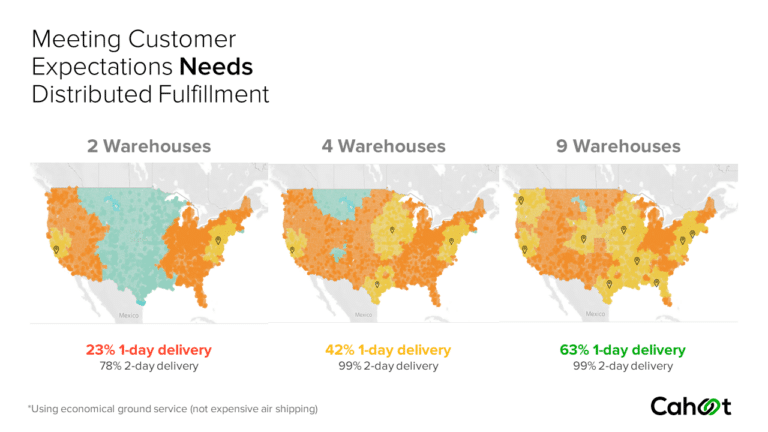
As the number of sales channels and warehouses increases, the operational complexity increases exponentially. Legacy shipping software was built for the old world, where fulfilling orders from just a single warehouse location was the norm. It was never built to handle the complexities of distributed fulfillment. Too many things at the core of the software would have to change to elegantly handle distributed fulfillment. This means merchants often try to get by with complex, convoluted workarounds that keep breaking. However, effective inventory management and synchronization can be achieved through the use of advanced fulfillment software, which streamlines operations, enhances accuracy, and addresses common challenges in the fulfillment lifecycle.
Today’s multi‑warehouse, multi‑channel environment creates many problem areas for Sellers to manage:
- When inventory is spread across such a large number of warehouses, which location should each order be routed to (you can’t draw a line down the middle of a map and expect to get the best shipping rate)?
- Distributed fulfillment offers possibilities if there are problems at any one warehouse location—such as receiving orders after the cut‑off time, running out of inventory, or inclement weather. How can software make identifying such exceptions and rerouting them easier?
- How can fulfillment be handled across multiple sales channels while ensuring a consistent, cohesive experience for customers?
- Can the system natively integrate with best‑in‑class fulfillment networks to unify your logistics technology and operations?
- With ecommerce growing all the time, online shoppers are sharing more sensitive data than ever. With an increased consumer demand for privacy protection, how does your shipping software keep personal information secure?
We’ll now take a look at each of these, examining the differences in the way legacy and next‑generation ecommerce shipping software handle them.
Automatic Order Routing and Label Generation
Legacy Software – Crude and Primitive Routing
Many of today’s popular legacy software have automated order routing features. However, do not be fooled—not all shipping software handles routing equally well, and these capabilities are often limited and prone to error, especially when handling diverse shipping options.
In systems like ShipStation, a “Ship From” location can be set based on specified criteria—such as the SKU ordered or the customer’s address. However, a large number of clunky automation rules have to be written—for example, writing a rule to have all orders from West Coast customers be shipped from your California warehouse. Similar rules mapping other states to respective fulfillment locations have to be manually written. Similarly, if you have certain SKUs available only in specific locations, you need to write rules to assign orders accordingly.
Creating such a large number of automation rules is an error‑prone, painful process for many reasons, and it often leads to more manual data entry when teams have to maintain routing logic and shipment details by hand. Here are a few of them:
- So much to configure. Merchants need to ensure they’ve captured every business process through a rule. If they forget to set up any rule (quite possible, given the high levels of operational complexity today), it can create problems and cost leakages. Even the simplest of workflows require rules to be defined. For example, imagine that you wish to use only certain carrier services to make deliveries to residential addresses. Even in that case, you need to define automation rules mapping the address type to appropriate services.
- You’re guessing and hoping. Because your rules are manually defined by mapping SKUs or customer addresses to fulfillment locations, there could always be cases where the rules don’t make the most optimal decision. Without doing a deep, time‑consuming manual investigation, you’ll never be able to actually tell.
- Requires constant maintenance. Rules become obsolete when carriers change or update their services. For example, when USPS introduced Ground Advantage, your rules didn’t automatically update to factor in the new service. This means you had to spend hours updating and rewriting them.
Slow process. Sellers don’t feel comfortable beginning shipping with the software until they’re confident they’ve captured all of their processes through automation rules. This delays go‑live, ultimately increasing your time to value—which is exactly why choosing the right shipping software matters for businesses trying to scale.
Next‑Gen Software – Intelligent, Powerful Routing Technology
Cahoot’s next‑generation shipping software comes with end‑to‑end intelligent automation. When you receive an order, the system intelligently compares multiple warehouse locations, inventory levels, carriers, and shipping services to pick the cheapest label that will meet the delivery SLA committed to the customer. In this way, the Cahoot shipping management software takes the thinking and error out of the rate shopping process, always providing the optimal shipping label, and improves shipping speed because it takes actual estimated real‑time delivery date into account based on ship date and day of the week.
With our technology, you won’t face the automation problems that we’ve highlighted with legacy software. Our intelligent order routing capabilities provide Sellers with many benefits:
- Nothing to configure – it just works. You don’t need to spend time worrying whether you’ve captured all your business workflows through automation rules. You don’t have to update rules and make sure they’re all compatible when business needs change. Cahoot factors in all variables like shipping services, warehouse locations, and inventory levels to pick the optimum fulfillment location on every order automatically.
- Based on the lowest cost, no more guessing. There’s no need to worry about whether your automations have been configured correctly to truly pick the best location every time. You can rest assured knowing that the decision is in the hands of technology, which makes the right choice for every order.
- No maintenance. The system automatically factors in any changes that carriers make to their services. There are no hand‑written automation rules to update or overwrite. When new services like Ground Advantage are launched, the system factors in this additional information and continues to automatically route orders correctly.
- Ready‑to‑go. Sellers can begin shipping in days or weeks with our software, not months. There’s no need to spend time wondering whether you’ve captured workflows through elaborate automations. This means you’ll be able to go live faster and shorten your time to value.
Multi‑Warehouse Exception Handling with Multi‑Carrier Shipping Software
Legacy Software – Limited Rerouting Capability
With legacy software, it’s difficult to plan for the unexpected. Let’s imagine you have 2 warehouses—one in Chicago, and the other in Southern California. Suppose a blizzard strikes the Chicago location.
When working with legacy systems, you don’t have an easy way to temporarily suspend locations. All you’re looking for is a way to temporarily put fulfillment from your Chicago location on hold, while you wait for the weather to improve.
In legacy systems like ShipStation, each SKU is mapped to a list of warehouses from where it can be shipped. You will need to update this mapping between SKUs and fulfillment locations to stop fulfillment from one of your warehouses. This is a painful workaround that you have to perform for a very short period of time—once the weather improves, you’ll have to repeat the process to restore the original configuration.
All this adds to what is already a stressful time, making it difficult for your business to quickly adjust to, and recover from unexpected events. Robust shipping software solutions can help manage these exceptions more effectively, ensuring smoother operations and better customer service.
Next Gen Software – Agile, Flexible Order Rerouting
With Cahoot’s next‑generation shipping software, adverse events don’t have to mean disaster for your business. If one of your fulfillment locations goes down, you can quickly toggle it off. The system will automate shipping from the remaining available locations, helping you keep your customer promises and continue selling.
There are other scenarios when you might require intelligent exception management which need not be emergencies. For example, if one of your warehouse locations needs to close for a holiday, the system can exclude that location and continue to simplify shipping for you across the other active locations.
There are no automations to undo or rewrite. You don’t have to spend a lot of time restoring your system to its original state once the affected location is back up and running again—it’s just a simple toggle to flip on and off. This ensures that your business can continue operating smoothly during such events, and quickly recover from them with minimal impact.
Multichannel Capabilities
Legacy Software – Many Integrations, but of What Value?
One advantage that legacy software has by virtue of having been around for a longer time is its long list of integrations. These tools, such as ShipStation, Shipwise (formerly DesktopShipper), and ShippingEasy all have a long list of integrations with shopping cart platforms, online marketplaces, and other tools that ecommerce Sellers use.
However, while this is definitely a positive, we think this is a case of winning the battle but losing the war. In the above sections, you’ve seen some of the limitations of these tools (keep reading to see more deficiencies), and how they can hamper your productivity and hurt your costs on every single order. You might save a little time with out‑of‑the‑box integrations to more platforms, but does it really matter if these tools negatively impact your bottom line?
Next‑Gen Software – All the Integrations You’re Used To
Cahoot’s next‑generation shipping software is tightly integrated with all leading online marketplaces and shopping cart platforms, including Amazon, Walmart, Shopify, eBay, BigCommerce, WooCommerce, and Adobe Commerce (formerly Magento 2). We’re also integrated with all leading shipping carriers and ecommerce tools that Sellers use today. Our ecommerce shipping solution provides robust integrations that streamline rate shopping, label creation, and order tracking, making shipping more efficient and cost effective for businesses of all sizes.
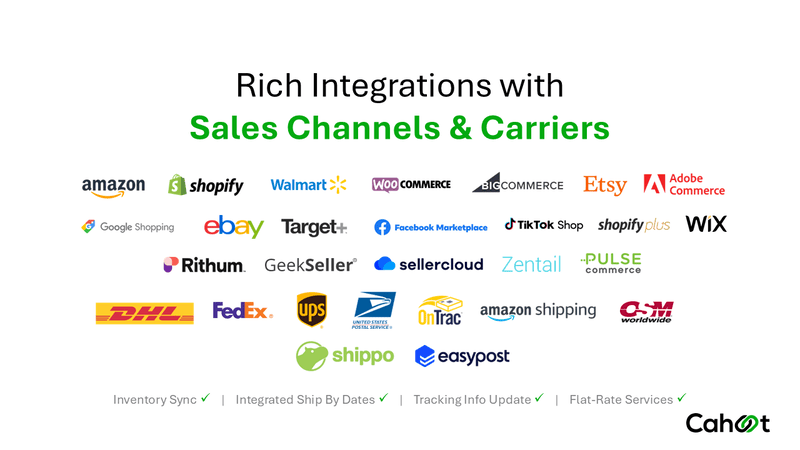
What really matters is the depth of integration between the channel and your shipping software. A simple integration may fetch orders from Shopify or Amazon into your shipping software, but fail to sync inventory or push back tracking information. With our integrations, Cahoot automatically fetches all information required to fulfill an order from the sales channel and intelligently pushes tracking information back to the channel. We also maintain an inventory sync, ensuring that you won’t accept orders on out‑of‑stock items, preventing overselling. The system also provides you with color‑coded alerts to quickly alert you to dipping inventory levels, enabling timely, proactive replenishment rather than reacting to customer frustration on canceled orders.
While our list of integrations might be comparatively smaller (but growing!), you won’t feel the difference—our API allows you to connect Cahoot with any other system you’re using. And as we’ve highlighted in the above sections (keep reading for more!), the system offers real cost savings and productivity gains on every single order.
Integration With Fulfillment Networks
Legacy Software – Cobbled Together and Disjointed
Legacy ecommerce shipping software is often framed as popular shipping software for simpler setups, and it works well if you’re fulfilling a small number of orders from your own warehouse location. However, if you’re partnering with multiple 3PLs, have a combination of in‑house and outsourced fulfillment, or are working with order fulfillment networks, cracks start to emerge. This stems from legacy software’s lack of native integration with fulfillment networks. Selecting the right shipping solution that seamlessly connects all fulfillment nodes is crucial for efficient order fulfillment and handoff to multiple carriers.
With tools like Flexport, you can’t expand nationwide coverage through their network while still running your own operations. For example—what if you wish to fulfill certain orders from your own warehouses if you have inventory and rates are cheaper? Flexport seeks to capture all volume even if it is inefficient to do so because they don’t integrate with all your fulfillment nodes. Many legacy software have a similar problem, where they find it difficult to manage a combination of in‑house and outsourced fulfillment. This may be workable for small businesses at lower complexity, but it breaks down as needs expand. Rather than the system intelligently identifying which orders need to be outsourced, the Seller has to define this—which is time‑consuming and error‑prone.
Other forms of chaos can emerge when you’re trying to force a legacy shipping software and 3PL vendor (like Flexe, for example) to work together. The 3PL might require you to figure out which orders you’re going to ship with them, generate a file with all that information, and send it over to them. If you’re trying to participate in a program like Seller Fulfilled Prime, you have tight cut‑off times and very little room to maneuver, which is why leveraging Amazon Buy Shipping integration for error‑free labels and stronger protection becomes critical. Imagine scrambling in the limited time you have between the cutoff time and the carrier pickup to collate and send over the information. You have to hope and pray that you haven’t made a mistake and that you’ve sent the information in time for your 3PL to process the shipments.
Lastly, let’s imagine a scenario where you’ve partnered with multiple 3PLs to achieve nationwide coverage. You have to either use the shipping software to print labels manually and hand that over to each of the 3PLs or share your credentials with all of them. This increases the number of parties your carrier credentials go to, increasing risk and vulnerability for your business.
If you’re experiencing some of these frustrations and want to migrate from your existing fulfillment partner after reviewing order fulfillment case studies from similar brands, we know that it’s easier said than done. The process can be uncertain, confusing, and stressful for your business. We’ve put together a step‑by‑step guide to help you make the switch from one fulfillment partner to another, which you can read here!
Next‑Gen Software – Natively Integrated
Cahoot’s shipping software is tightly integrated with our order fulfillment network (having over 100 warehouses in the US) that’s backed by extensive order fulfillment services reviews. The system is also flexible enough to accommodate any fulfillment locations you run your own operations from—making handling scenarios where there is a combination of in‑house and outsourced fulfillment easy to manage. In such cases, the system is able to intelligently and automatically identify the orders where fulfillment is cheaper through outsourcing rather than being handled at your own warehouse. This frees up your time and ensures you’re getting the best deal on every order.
You also don’t need to spend time acting as the middleman between your shipping software and 3PL, where you drown in busy work generating files and handing them over to your fulfillment partner. With Cahoot, your fulfillment partners see all orders instantly and can print labels in one click. This agility and simplified workflow are just two of the reasons that help Sellers using our fulfillment network meet and surpass the challenging cut‑off times and demanding performance metrics that Amazon expects them to meet on Seller Fulfilled Prime and succeed with Amazon Seller Fulfilled Prime requirements.
It’s not just SFP where requirements are challenging. On the Walmart marketplace and channels like Google Shopping delivery and fulfillment, merchants hoping to see increased conversion and sales must offer free nationwide 2‑day delivery with over 95% of orders expected to reach customers by the promised time.
And while you may scale to use many warehouses on the Cahoot network, none of our fulfillment partners know your carrier credentials—you share that only with us on the platform. As of March 31, 2025, PCI DSS v4.0.1 compliance is required, which raises the stakes for how shipping platforms handle payment-related data and access. This reduces risk and keeps your credentials safe while scaling nationwide fulfillment for you.
Information Security and Data Protection
Legacy Software – Poor Security and Privacy
Legacy ecommerce shipping software provides minimal data protection measures. Everything is fine if you own your own warehouses and are using these tools to fulfill orders. However, if you’re partnering with a 3PL (and they use legacy tools to process orders), you’ve handed over all your brand and customer data to them.
While you may sign agreements to prevent misuse, personally identifiable information about your customers (full name, address, email) and proprietary business data is openly available to your 3PL. While they may operate with good intentions, your confidential data is now at the mercy of their information security practices.
This increases the risk and exposure for your business, with little safeguards in place to protect sensitive information.
Next Gen Software – Robust Data Protection and Governance
With next‑generation shipping software, we ensure that only the essential information needed for order fulfillment is transmitted to Cahoot warehouses. We hold back or redact other information—for example, even on a shipping label, your fulfillment partner sees only the first initial of the customer’s last name—making it difficult for them to reconstruct personal customer data. And no data is copy/pasteable or exportable!
We also keep non‑essential customer, brand, and product information walled off and accessible only to you. This ensures that your data is secure and accessible to only one party—you.
The Future of Fulfillment is Here
Ecommerce logistics have evolved beyond the limitations of legacy shipping software. Today’s merchants need solutions that don’t just patch problems with complex rules and manual oversight but instead offer true automation, intelligence, and flexibility. The challenges of distributed fulfillment, multi‑channel sales, and increasing customer expectations demand technology that works for you—not against you.
Cahoot’s next‑generation shipping software isn’t just an upgrade; it’s a transformation. With intelligent automation, seamless integrations, and built‑in security, our system ensures that fulfillment is fast, cost‑effective, and effortlessly scalable. From real‑time order routing to automated packaging selection, every feature is designed to help you save time, reduce costs, and focus on growing your business rather than troubleshooting logistics.
The days of clunky, error‑prone software are over. The future belongs to merchants who embrace smarter, more efficient fulfillment—where technology does the heavy lifting, and businesses thrive. It’s time to leave behind outdated systems and step into a world where shipping works smarter, not harder.
Are you ready to experience the future of ecommerce fulfillment? The next generation of shipping starts now. If you’d like to learn more, check out our Next Generation Shipping Software Guide, Part 3: “Next‑Gen Warehouse Automation Software for Ecommerce: Fulfillment Efficiency”.
Frequently Asked Questions
Who uses shipping software?
Shipping software has features that can benefit various clients, including individual Sellers, ecommerce brands, retailers, and courier service providers. Feature‑rich software like Cahoot is autonomous and makes highly intelligent and scalable fulfillment and shipping accessible to retailers and brands of all sizes.
What is fulfillment optimization?
Fulfillment optimization is the process of determining the best options for sourcing and order fulfillment, which results in more efficient use of inventory and reduced costs.
What is a shipping platform?
A shipping platform helps you ship faster and cost‑effectively by organizing orders, offering pre‑negotiated shipping rates, enabling shipping rate comparison, and managing shipping workflow.
Written By:
Rinaldi Juwono
Rinaldi Juwono leads content and SEO strategy at Cahoot, crafting data-driven insights that help ecommerce brands navigate logistics challenges. He works closely with the product, sales, and operations teams to translate Cahoot’s innovations into actionable strategies merchants can use to grow smarter and leaner.
Related Articles
Why Cross-Border DTC Brands Are Moving Fulfillment Inside the US
Cross-border ecommerce fulfillment is the process of shipping ecommerce orders across national borders—often from warehouses outside the United States to U.
Cheapest Shipping from USA to UK: What It Really Costs
Shipping from the USA to the UK is one of the most common international routes for ecommerce brands, and it is also one of the most misunderstood from a cost perspective.
Save Money With Ecommerce Shipping Software: Next-Gen Solutions
Shipping costs are one of the biggest challenges for ecommerce businesses today, and understanding them is essential to reducing expenses and increasing profit margins.
10 Best European 3PLs for Ecommerce Sellers in 2026
In this article
33 minutes
- Key takeaways
- European 3PL comparison table
- How we evaluated the best European 3PLs
- Europe is not one fulfillment market
- The best European 3PLs for ecommerce sellers
- Other European 3PLs worth considering
- Which European 3PL fits your business?
- Questions to ask before signing with a European 3PL
- Final recommendation
- Frequently asked questions
Bigblue is the best overall choice among the best European 3PLs in this comparison: one provider with 11 fulfilment centres across France, Spain, Italy, the UK, and Germany, its own operating software, and post-purchase tools built in. everstox, Paxon (including Active Ants), Fulfillment-Box, and Bleckmann are also worth a look for specific needs: distributed fulfillment through one platform, large-scale automated operations, Amazon and marketplace selling, and fashion and lifestyle logistics. Bigblue earns the top spot for its balance of ecommerce fit and operating model, not because it runs the largest network or suits every brand. That qualification matters, because Europe is not one logistics market. A provider’s real fit depends on whether you sell into the EU, the UK, or both, where inventory is physically held, who operates each warehouse, which sales channels you run, what your catalog looks like, how much volume you ship, and what the full cost of the setup is once working capital, returns, and management time are counted.
Key takeaways
- Shipping coverage is not warehouse coverage. A provider that “delivers to 30 countries” may hold inventory in only one or two of them. Ask where stock physically sits.
- The EU and the UK are separate customs and tax environments. Serving both usually means inventory on each side, or accepting customs friction on every cross-border order.
- Directly operated sites and partner-network sites need different diligence. Platform-led networks offer reach and flexibility; directly operated networks offer tighter control. Neither is automatically better.
- More fulfillment nodes are not free. Each added location can shorten delivery times but splits inventory, raises safety stock, and adds transfers and management overhead.
- DTC, Amazon, marketplaces, B2B, and returns are distinct jobs. A strong FBA prep operation is not the same thing as a strong branded DTC operation.
- Use this list to build a shortlist, not to skip due diligence. Provider claims here are drawn from public sources and attributed; confirm current terms and capabilities directly.
European 3PL comparison table
| Provider | Distinction | Best fit | Operating model | Physical footprint (public summary) | Channel strengths | Watch-out |
| Bigblue | Best Overall European 3PL | DTC brands scaling in France, Spain, Italy, Germany, and the UK | Single provider running its fulfilment centres on one operating platform | 11 fulfilment centres across France, Spain, Italy, the UK, and Germany (confirmed by Bigblue to Cahoot, September 30, 2026) | DTC, B2B, branded tracking, returns portal | Model cross-border transit times to the Nordics and Central and Eastern Europe |
| everstox | Best for Distributed Fulfillment Through One Platform | Brands wanting multi-country inventory under one contract and one software layer | Platform connecting a network of partner 3PL warehouses | 70+ locations across Germany, the UK, France, Italy, Spain, Benelux, Poland, Switzerland, and the US (company-reported) | D2C, marketplaces, B2B, retail | Accountability and SLA consistency across partner sites |
| Paxon, including Active Ants | Best for Large-Scale Automated Fulfillment | High-volume and omnichannel brands needing automation and local depth | Group of directly operated 3PL businesses unified under one brand in 2026 | Active Ants lists centers in the Netherlands, UK, Belgium, Germany, and France; Staci and Radial add further sites | B2C, B2B, omnichannel, automated ecommerce | Scale and enterprise complexity may exceed what a smaller brand needs |
| Fulfillment-Box | Best for Amazon and Marketplace Sellers | Amazon-led and multi-marketplace sellers entering Europe | Provider with European and global warehouse locations; operating model per site not detailed publicly | Company describes eight warehouses in six European countries, with center pages for Germany, Poland, and the UK | FBA prep, FBM, SFP, marketplace integrations | Marketplace strength is not the same as branded DTC capability |
| Bleckmann | Best for Fashion and Lifestyle | Fashion, lifestyle, and beauty brands with seasonal, returns-heavy flows | Directly operated specialist logistics group | 40+ sites in the Netherlands, Belgium, Spain, the UK, and the US (company-reported) | Omnichannel, D2C, B2B wholesale, returns, value-added services | Enterprise and category depth may be more than a simple early-stage catalog requires |
| Huboo | Other notable provider | Small and mid-size brands wanting an accessible, tech-led model in the UK and EU | Company says it owns its warehouses and technology | UK (Bristol), Spain (Madrid), Netherlands, plus US | Marketplaces, webshops, 35+ integrations | Confirm EU site details and commercial minimums |
| fulfilmentcrowd | Other notable provider | Brands wanting one contract across UK, EU, and non-EU markets | Asset-light platform using partner-operated sites | 17 locations across the UK, France, Germany, the Netherlands, Ireland, the US, and Australia (company-reported) | Omnichannel, B2B, DTC, Amazon | Which entity runs each node, and how SLAs hold across partners |
| Salesupply | Other notable provider | Cross-border brands needing returns and customer service alongside fulfillment | Operating model per site not stated publicly | Fulfillment center pages in Belgium, France, Germany, Denmark, Spain, Poland, and the UK | Cross-border DTC, local returns, customer service outsourcing | Which services and facilities apply in each target country |
| FLEX. Fulfillment | Other notable provider | Amazon and non-EU sellers wanting FBA prep plus B2C fulfillment | Company describes its sites as its own warehouses | Six sites: three in Germany, one each in France, Poland, and the UK | FBA prep, FBM, marketplaces, webshops | Confirm country-specific scope, returns handling, and volume economics |
| Bolian Logistics | Other notable provider | Brands prioritizing Spain and Iberia with cross-border EU delivery | Spain-based 3PL | Spain (Barcelona-based operation) | Shopify and other webshops, B2C, B2B, returns | Regional fit rather than a pan-European node network |
How we evaluated the best European 3PLs
We assessed each provider against the questions an operator should ask when outsourcing logistics in Europe, weighted toward what actually changes cost, speed, and risk:
- Relevance to ecommerce: whether the provider’s public positioning, processes, and integrations are built for online order profiles rather than primarily pallet or freight flows.
- Physical European inventory footprint: where the provider says it holds stock, kept separate from where it ships.
- EU and UK reach: whether a provider can hold inventory on both sides of the EU and UK customs border.
- Operating model and accountability: directly operated facilities, a partner network, or a mix, and what that means for who answers when something goes wrong.
- Channel and workflow capability: DTC, marketplaces, Amazon FBA prep and merchant-fulfilled orders, B2B and wholesale, returns management, and value-added services such as kitting and custom packaging.
- Technology and integrations: shop platform and marketplace connectors, APIs, api integrations, and real time visibility into inventory and orders, supported by robust ecommerce partner integrations.
- Scalability: evidence the operation can absorb peak volume and additional markets without breaking inventory management discipline or wider supply chain operations.
- Customer-experience features: branded tracking, delivery options, and returns flows that affect customer satisfaction.
- Clarity of public information: whether the provider publishes enough detail for a buyer to verify claims.
This is research based on publicly documented capabilities and Cahoot’s experience evaluating fulfillment networks, and advanced analytics is essential for effective warehouse management, with modern ecommerce fulfillment software playing a central role in better operational decision-making. We did not place identical test orders through every provider, and we have not audited any provider’s facilities. Where a claim comes from a provider’s own website and could not be independently verified, we attribute it (“the company says”). Rankings reflect fit for the ecommerce operator described below, not an absolute judgment of quality. If you are new to outsourcing, our guide on how to choose the right 3PL covers the general framework this comparison builds on.
Europe is not one fulfillment market
Many US brands approach Europe the way they approach the lower 48 states: pick a central warehouse, turn on shipping, and expand. That model breaks down quickly. Europe has multiple customs regimes, dozens of national carriers, different consumer expectations around delivery and returns, and real differences in how far a parcel can travel in one or two days. The five distinctions below drive most of the difference between a good and a bad provider choice.
Treat the EU and the UK as two separate cross border markets
Since Brexit, goods moving between Great Britain and the EU cross a customs border. That means customs declarations, possible duties depending on product origin, separate VAT treatment, and slower, more exception-prone parcel flows than domestic or intra-EU shipping. Shipping DTC orders from a UK warehouse to Germany, or from a Dutch warehouse to London, puts customs clearance on every single order.
For most brands with meaningful demand in both regions, the practical answer is inventory on each side: at least one node in the UK market and at least one in the EU, which helps serve european consumers in both regions without repeated border friction. When comparing providers, check whether they operate on both sides and whether both sides run on the same systems and processes. This article does not give tax or customs advice; confirm VAT registration, importer-of-record arrangements, customs brokerage support, regulatory compliance, and how VAT representations and proper HS codes will be managed when goods move between the UK and EU with a qualified advisor or customs broker before choosing a setup, and pair that with a provider whose ecommerce order fulfillment services can execute reliably on your chosen structure.
Shipping coverage and warehouse coverage are different claims
A provider that says it serves “all of Europe” is usually describing delivery reach: the countries its carrier network can deliver to. That is not the same as having fulfillment centers in those countries or true pan European fulfillment capacity. A single warehouse in France can ship to Poland, but the parcel travels further, costs more, and takes longer than one shipped from a node in Central Europe.
Every profile below separates the two. When you evaluate providers, ask for a list of sites where your inventory could be stored, the transit time from each site to your top five destination countries, and the last mile delivery options available in each market (home delivery, pickup points, lockers). Central European hubs often support 1 to 3 day delivery to major EU member states.
For many brands, a two-node setup can reach about 90% of European consumers within 1 to 3 days, depending on carrier mix and inventory placement, similar to how US brands use distributed fulfillment center networks to hit 1–2 day delivery targets.
Direct operations and partner networks need different diligence
European 3PL companies broadly fall into three models. Some operate their own warehouses. Some are platforms that route your inventory and orders into a network of independent warehouses run by other logistics providers. Others mix the two.
Partner networks can give fast access to many locations and a single software layer. The tradeoff is that the warehouse floor at each location is run by a different company. That raises specific questions: who you contract with, whose SLA applies at each site, how inventory accuracy is measured across partners, and who pays when a partner misses. Directly operated networks usually offer tighter control and one accountable party, but fewer locations and less flexibility to add a new country quickly.
More inventory nodes and inventory management can raise total cost, not just lower transit time
Adding a second or third fulfillment center can cut delivery times and shipping costs for orders near each node. It also splits inventory into smaller pools and gives you access to more warehouse space. Each pool needs its own safety stock, so total inventory usually rises. Replenishment becomes more complex, stock transfers between sites add freight and handling, returns may land far from where the item sells next, and your team now manages more stock positions.
That is why inventory routing, meaning the decision about which SKUs to stock at which node and in what quantity, matters as much as the provider’s location count. A brand selling mostly into France and Spain may do better with deep inventory in one or two well-placed sites than with thin inventory spread across six countries. Model working capital, storage costs, transfers, returns, warehouse costs, and operational costs before assuming more nodes is better, especially because these inputs vary by region across Europe. European warehouse rates can range roughly from €45 to €150 per square meter per year, and Poland is one of the fastest-growing warehousing markets in Europe, which can affect where storing inventory makes sense.
DTC, Amazon, marketplaces, and B2B are different operations
A provider can be excellent at one workflow, especially order fulfillment services for ecommerce, and average at another. Branded DTC fulfillment emphasizes unboxing, tracking communication, and a smooth returns experience. Amazon FBA prep emphasizes labeling, carton and pallet compliance, and accurate transfers into Amazon’s network, which is a very different discipline. European marketplaces such as Zalando, bol.com, Otto, and Kaufland each have their own requirements. B2B and wholesale bring pallet orders, retailer compliance, and appointment scheduling.
For Shopify-led brands, e commerce logistics execution, integration quality, and order sync reliability usually matter most; our guide to choosing the best Shopify 3PL and broader advice on Shopify order fulfillment options covers what to test. Before shortlisting, list your channels by share of volume and ask each provider for evidence it runs your top two at scale, since a provider can be the right fulfillment partner for one workflow and a weak fit for another.
The best European 3PLs for ecommerce sellers
1. Bigblue: Best Overall European 3PL
What it is and why it made the list. Bigblue is a Europe-first third party logistics provider for ecommerce brands, built around modern DTC operators. The company says it serves more than 600 brands and supports both B2C and B2B fulfillment, allowing businesses to stay focused on their core business while the provider handles day-to-day logistics and growth support. It made the list because it combines a European warehouse network, its own operating software, and customer-experience features in a single relationship, which is what many brands entering Europe actually need.
Why it wins Best Overall. For a DTC brand selling into France, Spain, Italy, Germany, and the UK, Bigblue covers these core markets from one provider, with one contract, one operating platform, and a strong focus on the post-purchase experience, from delivery dates at checkout to branded tracking and returns. It is the most complete starting point for the typical ecommerce operator this article is written for. Other providers here may be a better fit when a specialized workflow or a different geographic footprint drives the decision.
Physical footprint versus countries served. Bigblue confirmed to Cahoot on September 30, 2026 that it runs 11 fulfilment centres across France, Spain, Italy, the UK, and Germany, including a fashion-oriented warehouse and an organic-certified facility in France. Delivery reach is much wider than the warehouse footprint: Bigblue ships from these sites across Europe and worldwide, including cross-border customs support. Brands with substantial demand in the Nordics or Central and Eastern Europe should model transit times and costs to those markets from Bigblue’s sites.
Operating model. Bigblue runs its fulfilment centres as a single network on its own platform, giving brands one contract and one system across sites.
Capabilities and channels. According to Bigblue’s website, capabilities include inventory management tools and:
- Branded tracking emails and delivery-date estimates shown before purchase. Bigblue reports that its Fast Tags and delivery estimates can lift checkout conversion by 26%; this is its reported result, not a guaranteed outcome for every brand.
- A self-serve returns portal with exchange, store credit, and refund options
- Connections to local carriers, including pickup-point and express options
- Branded and personalized unboxing, including rules-based inserts and samples
- Real time inventory tools with alerts and allocation across B2C and B2B
Best-fit customer. DTC brands, often Shopify-led, that sell primarily into France, Spain, Italy, Germany, and the UK, care about the delivery and returns experience, and want B2B or retail orders handled from the same inventory.
Considerations
- Brands whose largest markets are in the Nordics or Central and Eastern Europe should model transit times to those markets, served cross-border from Bigblue’s sites.
- Bigblue integrates with Amazon FBA and FBM; marketplace-led sellers should check the specific workflows they need.
Sources: bigblue.co | Fast Tags and ETAs | Amazon integration. The 11-centre count was confirmed directly by Bigblue on September 30, 2026.
2. everstox: Best for Distributed Fulfillment Through One Platform
What it is and why it made the list. everstox is a platform-led fulfillment provider that connects brands to a network of third-party logistics partners (third party logistics 3PL) through one software layer and one commercial relationship. It made the list because it offers the broadest access to European inventory locations of any provider here without requiring a brand to contract with each warehouse separately.
Why it wins its category. For brands that want inventory in several European countries, everstox reduces the management burden of running many separate 3PL relationships. The company says orders can be routed automatically to the best-placed fulfillment center based on configured rules, with carrier selection and optimized shipping routes helping improve delivery efficiency, and stock can be redistributed between warehouses, according to its multichannel fulfillment page.
Physical footprint versus countries served. The company’s locations page lists 70+ warehouse locations across Germany, the UK, France, Italy, Spain, Benelux, Poland, Switzerland, and the US. Germany is described as its densest market. Delivery reach extends beyond these countries through more than 15 carrier partnerships, the company says.
Operating model. Partner network. everstox describes itself as uniting an integrated network of 3PLs and carriers through a central platform, with shared operational standards across sites.
Capabilities and channels. D2C, marketplaces such as Amazon, Zalando, and eBay, B2B, and retail. The company says it is pre-integrated with 15+ systems, including Shopify, Shopware, WooCommerce, Amazon, Xentral, and Microsoft Dynamics, with an open API that supports custom api integrations and broader supply chain visibility across systems, per its integrations page.
Best-fit customer. Growth-stage and established brands, particularly with strong German-speaking demand, that want multi-country inventory placement and multi channel fulfillment without building their own partner network.
Considerations
- Ask how partner warehouses are selected for your account and whether you can choose or exclude specific sites.
- Confirm location-level SLAs, who is commercially accountable for a partner miss, and how inventory accuracy is audited across partners.
- Operating consistency across independent partners is the central diligence question for any network model.
Official source: everstox.com | Locations | Integrations | Multichannel
3. Paxon, including Active Ants: Best for Large-Scale Automated Fulfillment
What it is and why it made the list. Paxon is the unified 3PL brand, launched in 2026 by Belgium-based Bnode, that brings together Active Ants, Base Logistics, Radial, Staci, and their subsidiaries. Staci’s transition announcement, dated February 3, 2026, describes a gradual move to the single identity across Europe and North America through 2026, with double branding during the transition. Paxon says existing contracts, teams, and local contacts remain in place. Active Ants, well known to European ecommerce brands for robot-assisted fulfillment, is part of this group rather than a separate option.
Why it wins its category. Paxon combines ecommerce automation with deep local operations and B2B capability for enterprise-scale volumes and complexity. Active Ants says it uses AutoStore storage and robotics for picking. A June 2026 Bnode press release describes an automated ecommerce site near Lyon combining Active Ants technology with Staci infrastructure, including automated right-sized packaging. Staci contributes omnichannel and B2B depth, according to Bnode.
Physical footprint versus countries served. Active Ants lists fulfillment centers in the Netherlands, the UK, Belgium, Germany, and France, with further operations outside Europe. Staci and Radial add European sites. Paxon does not publish a consolidated site count, so request the specific facilities that would handle your account.
Operating model. Directly operated facilities within one corporate group, now aligning under one brand.
Capabilities and channels. B2C and B2B, omnichannel, returns, webshop integrations with major platforms, and automated ecommerce operations.
Best-fit customer. High-volume brands and omnichannel retailers that need automation, peak capacity, and scalable solutions across several European markets.
Considerations
- Scale and enterprise complexity may be more than a smaller brand needs, and it may not get the level of account manager attention expected from a large operation.
- During the 2026 brand transition, confirm which legal entity contracts with you and which operating team runs your sites.
- Capabilities differ across the legacy businesses; verify that the specific site proposed offers the automation described.
Official source: Paxon | Active Ants | Transition
4. Fulfillment-Box: Best for Amazon and Marketplace Sellers
What it is and why it made the list. Fulfillment-Box describes itself as part of a German holding with warehouses in multiple countries. It made the list because its public offer is built around Amazon and marketplace workflows, which many sellers entering Europe rely on first, and it is often used for international expansion into European marketplaces.
Why it wins its category. The company lists FBM, Seller Fulfilled Prime, and FBA prep center services, including storage, labeling, repackaging, forwarding to Amazon fulfillment centers, and returns handling. It says its Ysell.pro software connects to Amazon, eBay, Shopify, WooCommerce, Kaufland, and Otto, giving marketplace sellers one view of inventory and orders.
Physical footprint versus countries served. Fulfillment-Box’s Europe page describes eight warehouses in six European countries. Its fulfillment centers page includes location pages for Germany (Bremen and Kodersdorf are named on the Germany page), Poland, and the UK, plus operations in Turkey, Canada, the US, and China. The company says each European center provides reverse logistics.
Operating model. Public sources do not clearly state which sites are directly operated. Ask.
Capabilities and channels. Amazon FBA prep, FBM and SFP, eBay, Otto, Kaufland, Shopify, WooCommerce, kitting and sets, and returns.
Best-fit customer. Amazon-first and multi-marketplace sellers, including non-European brands, that need prep, storage, and merchant-fulfilled orders in Germany and neighboring markets, especially sellers expanding their customer base through Amazon-led entry into Europe.
Considerations
- Marketplace expertise and branded DTC experience are different capabilities; validate unboxing, tracking communication, and brand control if DTC matters.
- Public figures on location counts vary across pages; confirm current sites and market-level SLAs.
- Confirm how returns are graded and restocked in each country.
Official source: fulfillment-box.com | Europe | Centers
5. Bleckmann: Best for Fashion and Lifestyle
What it is and why it made the list. Bleckmann is a logistics specialist for fashion brands, lifestyle, and beauty. It made the list because fashion is one of the hardest ecommerce categories to run in Europe: high return rates, seasonal peaks, large SKU counts, and a mix of DTC, wholesale, and retail replenishment.
Why it wins its category. Bleckmann combines category focus with the full chain around it. The company lists warehousing and fulfillment, value-added services such as custom packaging and personalization, omnichannel distribution, reverse logistics, customs solutions, and freight forwarding. Its brand journey page describes support from early growth (including its Bscale offer) through multi-region scale, and circular services for unsold and returned inventory.
Physical footprint versus countries served. The company says it operates 40+ sites in the Netherlands, Belgium, Spain, the UK, and the US, with more than 1.3 million square meters of operational space. Delivery reach extends across Europe and beyond through its transport services, which is relevant for brands planning broader European operations.
Operating model. Directly operated specialist logistics group.
Capabilities and channels. D2C, B2B wholesale, retail replenishment, returns processing, value-added services, and customs. For beauty or other climate-sensitive SKUs, validate any temperature control requirements directly with the provider.
Best-fit customer. Fashion, footwear, lifestyle, and beauty brands with seasonal collections, meaningful return volumes, and a mix of wholesale and ecommerce.
Considerations
- Enterprise-grade depth may be more than a simple early-stage catalog needs; ask how the Bscale offer differs in service and pricing.
- The footprint is weighted toward the Benelux; model transit to Southern and Eastern Europe.
- Confirm minimum volumes and onboarding timelines.
Official source: bleckmann.com | Brand journey
Other European 3PLs worth considering
These five providers did not receive a category distinction, but each is a credible option for specific situations.
6. Huboo
Huboo is a technology-led fulfillment provider known for an accessible model aimed at small and growing ecommerce brands. Its “Hub” approach, as the company describes it, organizes work so pickers do not cross large warehouses, which it says reduces walking distance and cost. Huboo says it owns its warehouses and technology stack, and the company says it shipped over 32 million products last year.
Its locations page lists two fulfillment centers in Bristol (UK), one in Madrid (Spain), one in the Netherlands, and a US facility in the Fort Worth area. Delivery reach is wider through courier partners, and this setup can support growing European logistics needs for small and mid-size brands. The company reports 35+ integrations to marketplaces, channels, and systems.
Best fit: small and mid-size brands wanting a UK base plus an EU node, with transparent onboarding.
- Considerations: confirm which EU site would hold your stock and its capabilities; validate commercial terms and monthly minimums (the site lists a starting monthly figure); confirm returns and cross-border shipping scope in writing.
Official source: huboo.com | EU fulfilment | Locations | About
7. fulfilmentcrowd
fulfilmentcrowd is a recognizable ecommerce fulfillment network offering many location options through one provider and one platform, including strategically located warehouses that can support cross-border delivery planning. It says it supports 250+ brands and handles DTC and B2B.
Its warehouse locations page lists 17 sites: six in the UK, sites in France, Germany, the Netherlands, and Ireland, plus the US and Australia. Its business model page explains that it partners with regional logistics operators who run the physical sites on fulfilmentcrowd’s technology and standards. That makes it closer to everstox’s network model than to a directly operated 3PL, so the same accountability questions apply.
Best fit: brands that want UK, EU, and non-European coverage under one contract and one system, or prefer one central hub relationship across those markets.
- Considerations: ask which partner operates each node; confirm SLA consistency and how misses are remedied; check location-specific capabilities before placing stock.
Official source: fulfilmentcrowd.com | Locations | Europe
8. Salesupply
Salesupply combines fulfillment with cross-border ecommerce services that support broader supply chain needs around the warehouse: international returns, outsourced customer service, and localization of delivery options. The company says it serves 250+ online brands and retailers.
Its fulfillment centers page lists European sites across Western Europe in Belgium, France, Germany, Denmark, Spain, Poland, and the UK. Separately, the company says its returns solution offers local return addresses in more than 20 countries, which is a different footprint from where orders ship. For a brand testing a new market, a local return address can matter to shoppers as much as a local warehouse.
Best fit: brands entering several European markets that need local returns and native-language customer service alongside fulfillment, especially when trying to manage significant challenges across multiple country launches.
- Considerations: public pages do not state which sites are directly operated; validate which services and facilities apply in each target country.
Official source: salesupply.com | Fulfillment | Returns | Centers
9. FLEX. Fulfillment
FLEX. Fulfillment is a flexible European operator serving ecommerce and Amazon sellers, with specific guidance for UK, US, and non-EU sellers setting up EU operations from outside the region. It says it is an Amazon Service Provider Network partner for FBA prep.
The company lists six of its own warehouses: three in Germany (Magdeburg, Wilhelmshaven, Lotte), one in France, one in Poland, and one in the UK. Services include B2C and B2B fulfillment, FBA prep, FBM, returns, and kitting. Its integrations guide covers marketplaces such as Amazon, eBay, OTTO, Kaufland, Allegro, and Cdiscount, and webshops including Shopify and WooCommerce.
Best fit: Amazon-heavy and non-EU sellers wanting FBA prep and merchant-fulfilled orders in Germany, Poland, and France, with support for international expansion for UK, US, and non-EU sellers needing a straightforward EU setup.
- Considerations: verify the direct footprint and which services run at each site; confirm returns handling and volume economics at your order profile.
Official source: flexfulfillment.eu | FBA prep | Integrations
10. Bolian Logistics
Bolian Logistics is a Spain-based ecommerce fulfillment provider focused on Spain and Iberia, with cross-border delivery into the rest of Europe. Spain is a large ecommerce market in its own right, and local carrier relationships there can make a real difference in delivery reliability. It is best understood as a regional-fit option, not a pan-European node network, and can work well as a regional fulfillment partner for Iberia-focused brands.
The company describes its Spain fulfillment operation as Barcelona-based and ships to other European markets through carriers including GLS, Correos, SEUR, MRW, DHL, CTT Express, and DPD. It says it offers B2C and B2B fulfillment, returns handling, real-time inventory control, and integrations with Shopify, WooCommerce, PrestaShop, and Magento. That said, Spain-based fulfillment may not be ideal for all EU member states, since transit times typically rise as you move into Northern and Central Europe.
Best fit: brands whose European demand centers on Spain and Portugal, or that want a Southern Europe node alongside a primary warehouse elsewhere.
- Considerations: cross-border transit times from Spain to Northern and Central Europe; no UK node; confirm capacity for peak volume.
Official source: bolianlogistics.com | Spain | Europe
Which European 3PL fits your business?
Use your largest channel, your top markets, and your catalog to narrow the list for supply chain fit:
- DTC brand selling mainly into France, Spain, Italy, Germany, and the UK: start with Bigblue, which covers these markets from one provider.
- Brand wanting inventory in many countries through one relationship: compare everstox and fulfilmentcrowd for pan European fulfillment, and focus diligence on partner accountability.
- High-volume or omnichannel retailer: Paxon (Active Ants and Staci) for automation and B2B depth.
- Amazon-first or multi-marketplace seller: Fulfillment-Box and FLEX. Fulfillment for FBA prep and marketplace workflows.
- Fashion, footwear, lifestyle, or beauty: Bleckmann for category depth, returns, and value-added services.
- Cross-border brand needing returns and customer service in local languages: Salesupply.
- Spain and Portugal as the core market: Bolian Logistics, possibly alongside a Northern or Central Europe node.
If your answers point to two or three providers, request quotes built on your real order data: order lines per order, SKU count, units stored, destination mix, and return rate. Comparing total 3PL costs, including receiving, storage, pick and pack, packaging, shipping, returns processing, and account fees, shows differences a headline pick fee hides and clarifies the value of modern ecommerce order fulfillment services.
Questions to ask before signing with a European 3PL
Footprint and operating model
- Which specific facilities would hold my inventory, and in which countries?
- Is each facility operated by your staff or by a partner? If a partner, who is my contract with, and whose SLA applies?
- In the locations proposed for my account, are the warehouses directly operated or partner-run?
- Do you hold inventory in both the EU and the UK, and are both on the same systems?
Service levels and performance
- What are your contracted SLAs for receiving, same-day ship cutoff, order accuracy, and inventory accuracy, per site?
- What happens commercially when an SLA is missed?
- What is your peak season plan, and what capacity is reserved for my volume?
- What sustainability capabilities do you offer, and how do you measure them?
Channels and workflows
- Can you show live examples of my top two channels (for example, Shopify DTC and Amazon FBA prep or Wayfair order fulfillment workflows) running at similar volume?
- How do you handle B2B orders, retailer compliance, and pallet shipments?
- How are returns received, graded, restocked, and reported, and how quickly do customer refunds trigger?
Technology
- Which integrations are native, and which require middleware or custom api integrations to fit existing supply chain operations?
- What real time tracking and inventory data can my team see, and at what frequency, especially if we connect to a regional node such as a New York order fulfillment service?”
Commercial terms
- What are the minimums, onboarding fees, and notice periods?
- How are storage, packaging, and carrier surcharges billed, and how does this compare to best practices for warehousing services?”
- What are the exit terms and data export rights if we leave?
Our 3PL contract guide covers the clauses that most often cause disputes. If you are replacing a provider, plan the cutover carefully; the guide to migrating to a new 3PL outlines inventory transfer, systems testing, and running parallel operations, and customer reviews of order fulfillment services can highlight real-world transition risks.
Final recommendation
Bigblue is the strongest starting point for a DTC ecommerce brand selling into France, Spain, Italy, Germany, and the UK. everstox, Paxon, Fulfillment-Box, and Bleckmann are also worth comparing when your needs are dominated by distributed placement, scale and automation, marketplaces, or fashion. The five other providers are credible for specific regional or workflow needs.
Whichever you shortlist, make the decision on where inventory physically sits, who runs each site, which channels are proven there, and what the full cost looks like after safety stock, transfers, and returns. A shorter list of well-placed nodes run by an accountable operator will often beat a longer list of locations you cannot manage. Very large players like Rhenus, with 1,330 locations and 41,000 employees in Europe, and ceva logistics, which employs 110,000 people globally and specializes in food logistics, were not ranked here because this list prioritizes ecommerce fit over sheer scale, even when hub choice points toward major gateways such as Rotterdam, one of the top ports in Europe and near Europe’s largest port; industry developments like Cahoot in the news illustrate how innovation, not just footprint, increasingly shapes fulfillment choices.
For US operations and connected channel management, Cahoot is an end-to-end ecommerce fulfillment operations suite with a distributed US fulfillment center network built to help brands save every penny, scale operations without adding complexity, and outperform on every sales channel. It does not operate European warehouses; the providers above are where to look for European inventory.
Frequently asked questions
What is the best European 3PL for ecommerce sellers in 2026?
In this comparison, Bigblue is the best overall European 3PL for DTC brands selling into France, Spain, Italy, Germany, and the UK, based on its balance of warehouse coverage, one-platform operating model, and customer-experience features. everstox, Paxon (including Active Ants), Fulfillment-Box, and Bleckmann are also worth comparing when distributed placement, scale and automation, marketplace workflows, or fashion specialization drives the decision.
Do I need separate warehouses for the EU and the UK?
Most brands with meaningful demand in both markets use inventory on each side. Since Brexit, parcels moving between the UK and the EU cross a customs border, which adds declarations, possible duties, and delays to every order. Confirm your specific VAT and customs obligations, customs brokerage, and filing needs with a qualified advisor.
What is the difference between a 3PL that ships to a country and one with a warehouse there?
Shipping coverage means the provider can deliver orders to that country, usually from a warehouse elsewhere. Warehouse coverage means your inventory can be stored in that country, which typically shortens transit times and lowers last mile costs; it also affects where storing inventory can trigger local VAT and compliance considerations. Many providers deliver to far more countries than they hold stock in.
Is a partner-network 3PL riskier than one that runs its own warehouses?
Not necessarily, but it requires different diligence. Partner networks offer more locations and flexibility; directly operated networks offer tighter control and a single accountable party. With a network model, confirm who runs each site, whose SLA applies, and who is commercially responsible for a miss.
How many fulfillment centers should I use in Europe?
There is no fixed number. More nodes can reduce delivery times but split inventory, raise safety stock, and add transfer and management costs. Many brands start with one EU node near their largest market and one UK node, then add locations when order data shows a clear speed or cost benefit. Many also start with a central European node because it can reach major EU member states quickly.
Which European 3PLs are best for Amazon FBA prep and reverse logistics?
In this list, Fulfillment-Box and FLEX. Fulfillment put Amazon workflows at the center of their public offers, including FBA prep, merchant-fulfilled orders, and marketplace integrations. FLEX. Fulfillment says it is an Amazon Service Provider Network partner. Confirm prep capabilities at the specific site you would use.
What happened to Active Ants?
Active Ants is part of Paxon, the unified 3PL brand Bnode introduced in 2026 to bring together Active Ants, Base Logistics, Radial, Staci, and their subsidiaries. The companies are transitioning to the Paxon name through 2026, and Paxon says existing contracts and contacts remain in place.
Written By:
Rinaldi Juwono
Rinaldi Juwono leads content and SEO strategy at Cahoot, crafting data-driven insights that help ecommerce brands navigate logistics challenges. He works closely with the product, sales, and operations teams to translate Cahoot’s innovations into actionable strategies merchants can use to grow smarter and leaner.
Turn Returns Into New Revenue
Related Articles
Why Cross-Border DTC Brands Are Moving Fulfillment Inside the US
Cross-border ecommerce fulfillment is the process of shipping ecommerce orders across national borders—often from warehouses outside the United States to U.
Crafting a Return Policy that Drives Customer Loyalty and Reduces Returns
Let’s talk about ecommerce returns policies.
Cheapest Shipping from USA to UK: What It Really Costs
Shipping from the USA to the UK is one of the most common international routes for ecommerce brands, and it is also one of the most misunderstood from a cost perspective.
UCP Isn’t About Checkout. It’s About Who Gets to Understand Demand

In this article
18 minutes
- Universal Commerce Protocol is a plumbing layer, not the strategy
- LLM explainability limits are the core constraint, not a protocol oversight
- The real thesis: UCP removes the right to observe decision-making, not just data fields
- Historical continuity: merchants have been living through this progression across the entire commerce ecosystem
- The Nike DTC lesson: transparency was desirable, never sufficient
- Reframing merchant choice realistically
- Execution is the remaining differentiation surface
- A careful speculation: platforms that centralize insight tend to monetize access
- UCP Governance: Who Decides Who Gets to See What?
- Conclusion
- Frequently Asked Questions
Merchants are about to transact through AI agents without learning how the decision happened. Universal Commerce Protocol is less about making checkout easier and more about who gets to understand demand. The operational reality is that insight is moving upstream into AI systems, while execution stays with merchants.
Universal Commerce Protocol does not remove optional merchant data as much as it formalizes a deeper shift: merchants lose visibility into how decisions are made, not because of a design flaw, but because modern commerce depends on opaque intermediaries and LLM systems that centralize learning. The real change is not the loss of transparency, but who controls insight and how merchants must operate without it.
Universal Commerce Protocol is a plumbing layer, not the strategy
Universal Commerce Protocol (UCP) is being discussed as a commerce protocol, an agent payments protocol, and a common language that helps AI assistants complete transactions across the commerce ecosystem. The framing often lands on checkout flows: fewer redirects, less integration complexity, easier account linking, smoother payment methods across multiple payment providers, and cleaner order management.
Google’s Universal Commerce Protocol is a new open standard, co-developed with industry leaders such as Shopify, Etsy, Wayfair, Target, and Walmart, and endorsed by over 20 global partners across the ecosystem, including Adyen, American Express, Best Buy, Flipkart, Macy’s, Mastercard, Stripe, The Home Depot, Visa, and Zalando. UCP is an open-source project that invites developers, businesses, and platform architects to contribute and provide feedback. UCP was co-developed to ensure low-lift integration that aligns with existing business logic and is designed to be neutral, vendor-agnostic, and compatible with existing retail infrastructure and protocols like AP2, A2A, and MCP. Its core commerce building blocks and core capabilities include checkout, product discovery, cart management, and post-purchase workflows, serving as the foundation for the next generation of agentic commerce. UCP is designed to collapse the N x N integration bottleneck and keep the full customer relationship front and center for both retailers and customers.
All of that matters, especially for complex checkout flows and business onboarding across existing retail infrastructure. But focusing on checkout misses the operational consequence that matters most to ecommerce founders and operations leaders: UCP makes it normal for a consumer surface to decide, compare, and commit, while the merchant receives only the output.
UCP is designed for agentic commerce: AI agents discover, compare, and complete transactions on behalf of a customer. If that becomes a primary path through google search, google ai mode, the gemini app, google wallet, google pay, or other ai platforms, then the key question is no longer “how do we optimize checkout?” It becomes “who gets to understand preference formation?”
LLM explainability limits are the core constraint, not a protocol oversight
If you are looking for a missing field in UCP that would restore transparency, you are solving the wrong problem.
Limited visibility into decision-making is inherent to LLM systems. Even the AI platforms operating these systems cannot fully reconstruct why a recommendation occurred in a specific instance. The model’s output is produced by high-dimensional internal representations and probabilistic inference, not a human-auditable chain of reasons.
You can sometimes get a plausible narrative explanation, and in some cases you can extract partial signals that correlate with behavior. But that is not the same as knowing why the model selected Product A over Product B at that moment, for that user, given that context.
This is not a fixable protocol oversight. It is a property of how LLMs reason, not a bug merchants can opt out of.
So when merchants ask, “Will UCP remove optional merchant data?” the more accurate question is, “Will we still be able to observe decision-making?” And under agentic commerce, the answer is increasingly no, because the decision-making lives inside opaque intermediaries that are not designed to be interrogated at a granular level.
The real thesis: UCP removes the right to observe decision-making, not just data fields
Most debates get stuck at the data layer: what fields are passed, what product data is shared, how identity linking works, whether loyalty programs can be applied, which business capabilities can be invoked, how secure agentic payments support is implemented, and how verifiable credentials or cryptographic proof might validate a checkout session.
Those details matter. But they are not the core thesis.
The refined thesis is this: UCP removes the right to observe decision-making, not just data fields. The merchant does not just lose a few tracking signals. The merchant loses the feedback loop that makes learning possible.
To make that distinction operational, it helps to separate three things merchants often conflate:
- Data: raw facts you can store, like a purchase, a return, a shipping address, a product type, a customer service ticket, a cart value, or a delivery timestamp.
- Insight: interpreted meaning, like “customers abandon when delivery dates slip” or “size variations in this category create dissatisfaction.”
- Learning: a system’s internal ability to improve future decisions based on experience, including preference formation, ranking, and recommendation behavior.
Analytics and dashboards are mostly insight tooling. They summarize and visualize data so humans can interpret it. Learning is different. Learning is what determines future choices, and in agentic commerce the learning happens inside the agent and the platform surfaces, not inside the merchant.
That is why the loss is not “we lose a dashboard.” Merchants lose feedback loops, not dashboards. You can still have performance reporting. You might still see conversion rates and aggregate search results behavior. What you lose is the capacity to observe the deliberation: which alternatives were evaluated, which tradeoffs mattered, what language the shopper used, and which preference cues drove the final selection.
Historical continuity: merchants have been living through this progression across the entire commerce ecosystem
UCP should not be framed as a disruption. It is continuity.
Commerce has been moving toward opaque intermediaries for decades. The sequence is familiar:
Keyword black boxes in search
Merchants built strategies around google search, only to learn that the most valuable signals were never fully visible. Rankings were opaque. Then more query data disappeared, and merchants learned to operate with proxies.
Marketplaces owning the interface and relationship
Marketplaces made it obvious that customer relationship is mediated. A seller can optimize product variations, parent child relationship structures, and product detail page content, but the marketplace owns the interface. The merchant gets orders, not full context.
Attribution loss through privacy and aggregation
Privacy changes pushed attribution into modeled data and aggregation. The comfort of a fully observable funnel already eroded. Teams adapted by shifting measurement from precision to directionality.
AI agents owning discovery, comparison, and preference formation
Agentic commerce pushes this one step further. Increasingly, agentic commerce is happening on AI surfaces, such as Google Search AI Mode and the Gemini app, where conversational commerce is starting to shape how people search, compare, and buy. AI assistants do the browsing, the comparison, the narrowing, and the final selection inside a consumer surface. By adopting the Universal Commerce Protocol (UCP), merchants can enable seamless, agentic commerce actions across Google’s AI surfaces that turn AI interactions into direct sales, including real-time catalog searches and order execution via conversational prompts. UCP also supports real-time inventory checks and dynamic pricing, which complements operational setups like Google Shopping-focused order fulfillment that translate agent decisions into fast, reliable delivery. By the time the merchant is involved, the decision is already made.
Final shift: centralized learning with decentralized execution
The platform centralizes learning across the entire commerce ecosystem. Merchants execute: inventory, fulfillment, order fulfillment, post-purchase support, returns, and exception handling. The insight about demand formation is centralized. The operational burden is distributed.
UCP is simply the open protocol designed to make that execution layer interoperable, while businesses remain the Merchant of Record for all transactions.
The Nike DTC lesson: transparency was desirable, never sufficient
Some merchants will respond to this by reaching for a familiar counter-move: reclaim transparency via direct channels. Own the interface. Own the customer relationship. Build first-party data. Reduce dependency.
That instinct is understandable, and it is not new.
Nike’s DTC push is a useful lesson, not as nostalgia, but as proof. Large brands attempted to reclaim transparency and control by prioritizing direct purchases and direct relationships. But transparency alone could not sustain growth. Distribution, physical experience, and intermediaries still mattered, as shown by how fast-growing logistics innovators regularly appear in industry news about ecommerce fulfillment networks.
Meanwhile, newer challengers gained share by executing within existing channels. They met customers where customers already were. They accepted that the interface was mediated and focused on out-executing within the rules of those surfaces, often by building region-specific advantages such as New York-focused order fulfillment services that align tightly with local demand patterns.
Key takeaway: Transparency has always been desirable. It has never been sufficient.
UCP reinforces the same lesson. You can build your own channel, but if consumer surfaces shift toward AI-owned discovery, the gravitational pull is toward the intermediary again.
Reframing merchant choice realistically
The wrong framing is: “Do we choose transparency or scale?”
That choice is fading.
Merchants no longer choose between transparency and scale. They choose how to operate without transparency. This is a forced condition, not a strategic preference.
For ecommerce operators, this means planning for a world where demand signals arrive as outputs rather than narratives. You will receive purchases without receiving the full story behind purchase decisions. You will see outcomes without seeing deliberation.
The operational question becomes: what do we optimize when we cannot observe the decision-making layer?
Execution is the remaining differentiation surface
This is where the conversation often collapses into fatalism. It should not.
Opaque discovery does not remove competition. It changes the arena. Execution becomes the primary remaining signal merchants still control, and in agentic commerce, execution is not passive. It is measurable and learnable by intermediaries even when merchants cannot see the learning process, which is why flexible models like peer-to-peer order fulfillment networks are emerging as strategic levers rather than back-office utilities.
If an agent must choose between two eligible retailers offering the same product, the tie-breakers trend toward reliability and trust. That puts pressure on operational fundamentals that many brands have treated as secondary to growth, especially for programs like Amazon FBM shipping and fulfillment services where performance directly influences eligibility and ranking.
Execution differentiation shows up in:
- Availability: accurate stock, fewer cancellations, fewer substitutions, stable inventory across child listings and variation listings.
- Reliability: consistent delivery promises, fewer damaged shipments, fewer late orders, fewer fulfillment errors.
- Fit, returns, and post-purchase trust: expectation-setting that reduces negative reviews and return rates, clear sizing for size variations, accurate product differences across variation relationships, honest product details that match what arrives.
- Fulfillment speed and exception handling: faster ship times, proactive issue resolution, clean handling of lost packages, efficient order management when something breaks. Integrations like Cahoot’s Amazon Buy Shipping fulfillment illustrate how operational tooling can directly improve these post-purchase outcomes.
In practical terms, if AI agents are optimizing for customer confidence and lower regret, then the merchants that win are those with fewer downstream failures. The agent may not explain why it chose you, but it can learn from outcomes. And outcomes are deeply influenced by operations.
This is also where the distinction between insight and learning matters. You might not get the insight narrative, but the platform’s learning will still reflect your operational performance. Execution becomes your lever.
A careful speculation: platforms that centralize insight tend to monetize access
There is an economic precedent worth stating plainly.
When platforms centralize insight, they historically monetize access to it. Not in a conspiratorial way, but because the platform is bearing the cost of building the system and has the leverage of being the interface.
A plausible evolution in future agentic commerce is that merchants are offered summarized, abstracted context as a paid layer. Not raw transcripts of conversations. Not full explainability. More likely patterns, signals, and generalized explanations: what themes appeared in preference formation, what objections were common, what comparisons were frequent, what attributes influenced selection in aggregate.
That would be consistent with how marketplaces monetize search results placements and how ad platforms monetize targeting. It would also be consistent with a world where LLM explainability limits prevent true transparency, but a platform can still offer “helpful” approximations.
The key risk is simple: merchants may eventually have to buy back a filtered version of their own demand. In that world, choosing between fulfillment partners becomes an explicitly strategic decision, and many brands will benchmark options using comparisons of leading order fulfillment providers.
This is not a promise. It is a plausible evolution grounded in economic precedent. And it is worth preparing for mentally, because it reinforces the central argument: the locus of learning moves upstream, and access to learning is not guaranteed.
UCP Governance: Who Decides Who Gets to See What?
As agentic commerce becomes the new normal, the question of who gets to access, influence, and evolve the Universal Commerce Protocol (UCP) is no longer academic—it’s foundational. UCP is positioned as an open standard, designed to enable agentic commerce across the entire commerce ecosystem. But “open” is only as meaningful as the governance that backs it.
The governance of the Universal Commerce Protocol UCP is intentionally structured to be transparent, fair, and inclusive. This means that the rules for how the protocol evolves, who can participate, and what changes are made are not dictated by a single company or closed group. Instead, the governance model invites input from a broad spectrum of stakeholders: merchants, payment providers, AI platforms, credential providers, business agents, and even consumer advocates. The goal is to ensure that the protocol serves the needs of the entire digital commerce landscape—not just the largest players or the earliest adopters.
In practice, UCP governance operates through open forums, working groups, and public documentation. Proposals for changes or new features to the commerce protocol are discussed in the open, with clear processes for review, feedback, and consensus-building. This approach is designed to prevent any one party from unilaterally deciding who gets to see what data, which business logic is supported, or how agentic commerce is enabled across different consumer surfaces. Retailers publish machine-readable profiles on supported services in UCP, creating a shared language for the capabilities agents can discover.
For merchants and other ecosystem participants, this governance structure is more than a technicality—it’s a safeguard. It means that the evolution of universal commerce is not locked behind closed doors, and that the rules of engagement for AI agents, payment handlers, and business backends are shaped by collective input. It also means that as new challenges emerge—such as balancing privacy with operational transparency, or supporting new payment options and loyalty programs—the protocol can adapt in a way that reflects the interests of the broader community. For individual brands, questions about how to participate often start with concrete conversations with specialized order fulfillment partners who sit at the execution layer.
Ultimately, UCP governance is about trust. In a world where the mechanics of commerce are increasingly mediated by AI and complex protocols, having an open standard with transparent, participatory governance is what gives businesses flexible ways to adapt and compete. It’s not just about enabling agentic commerce; it’s about ensuring that the future of universal commerce is built on a foundation that is open, accountable, and responsive to the needs of the entire ecosystem.
Conclusion
Universal Commerce Protocol is not primarily about checkout. It is about who gets to understand demand.
Merchants will still have data. They will still have sales. They will still have dashboards. What they increasingly will not have is the right to observe decision-making, because decision-making is being mediated by opaque intermediaries and LLM systems that centralize learning.
This is not something a protocol can solve. Limited visibility is inherent to LLM systems. Even AI platforms cannot fully reconstruct why a recommendation occurred. That is a property of how these systems reason, not a bug merchants can opt out of.
The way forward is not outrage, and it is not false optimism. It is acceptance and adaptation.
The loss of transparency is not the end of commerce. It is the end of pretending transparency was ever guaranteed. Merchants who win will be the ones who stop optimizing for perfect visibility and start optimizing for the remaining controllable surface: execution. Availability, reliability, fit, returns, post-purchase support, and exception handling will increasingly determine whether intermediaries learn to trust you as the safest outcome for the customer. Social proof—like order fulfillment service reviews from other merchants—becomes a proxy signal for that operational trust in a world where the decision-making logic itself is hidden.
In a world of centralized learning with decentralized execution, the merchant’s role becomes sharper. You may not own the story of demand, but you can still own the quality of delivery. And that, operationally, is the most durable advantage left.
FAQ
What is Universal Commerce Protocol?
Universal Commerce Protocol is an open commerce protocol intended to help AI agents and consumer surfaces connect to merchant systems to enable agentic commerce, including product discovery and completing transactions.
Why does Universal Commerce Protocol matter if it is just about checkout?
Because the larger shift is not checkout mechanics. It is that AI agents increasingly own discovery, comparison, and preference formation, leaving merchants with less visibility into how purchase decisions were made. UCP can also support a checkout feature beyond the website, including embedded buying flows. These flows may use native checkout in AI interfaces or embedded checkout for more customized implementations.
Why can’t merchants get full transparency into why an AI recommended their product?
Limited visibility into decision-making is inherent to LLM systems. Even AI platforms cannot fully reconstruct why a specific recommendation occurred. This is a property of how LLMs reason, not a fixable protocol oversight.
What is the difference between data, insight, and learning in agentic commerce?
Data is raw facts like orders and returns. Insight is human-interpretable meaning derived from analysis. Learning is the model’s internal improvement that drives future recommendations, and it is not the same as analytics or dashboards.
How does Universal Commerce Protocol change merchant feedback loops?
Merchants may still receive transaction data, but they lose the ability to observe the decision-making journey that produced the purchase. That reduces feedback loops that historically informed optimization.
Is this trend new or disruptive compared to past platform shifts?
It is continuity. Merchants have already lived through keyword black boxes in search, marketplaces owning the interface, attribution loss through privacy and aggregation, and now AI owning discovery and preference formation.
What does the Nike DTC shift teach merchants about transparency?
Nike’s DTC push showed that transparency is desirable but not sufficient to sustain growth. Distribution and intermediaries still matter, and brands can gain share by executing within existing channels.
What choices do merchants actually have in an AI-mediated commerce ecosystem?
Merchants no longer choose between transparency and scale. They keep customer relationships through fulfillment, service, and post-purchase touchpoints. They choose how to operate without transparency. This is a forced condition, not a strategic preference. Even when discovery happens on consumer interfaces, they retain full ownership of those relationships.
What is the main way merchants can still differentiate if discovery is opaque?
Execution. Availability, reliability, fit and returns performance, post-purchase trust, fulfillment speed, and exception handling are the primary remaining signals merchants still control. Strong execution also supports more seamless agentic experiences once a shopper is matched to a merchant. Consumer interfaces increasingly judge merchants by how reliably they can fulfill what the agent selected.
Will platforms monetize access to demand insight in the future?
It is plausible based on economic precedent. Platforms that centralize insight often monetize access to abstracted patterns and signals, rather than raw transcripts or full explainability. The risk is that merchants may have to buy back a filtered view of their own demand. If platforms package that insight for resale, it may be surfaced through existing agent frameworks and related tooling rather than raw model outputs.
Written By:

Manish Chowdhary
Manish Chowdhary is the founder and CEO of Cahoot, the most comprehensive post-purchase suite for ecommerce brands. A serial entrepreneur and industry thought leader, Manish has decades of experience building technologies that simplify ecommerce logistics—from order fulfillment to returns. His insights help brands stay ahead of market shifts and operational challenges.
Turn Returns Into New Revenue
Related Articles
Why Cross-Border DTC Brands Are Moving Fulfillment Inside the US
Cross-border ecommerce fulfillment is the process of shipping ecommerce orders across national borders—often from warehouses outside the United States to U.
Crafting a Return Policy that Drives Customer Loyalty and Reduces Returns
Let’s talk about ecommerce returns policies.
Cheapest Shipping from USA to UK: What It Really Costs
Shipping from the USA to the UK is one of the most common international routes for ecommerce brands, and it is also one of the most misunderstood from a cost perspective.
Cahoot vs ShipStation: Exploring ShipStation Alternatives
In this article
9 minutes
- The Hidden Cost of Holding On to ShipStation
- ⚠️ ShipStation Isn’t a Shipping Platform. It’s a Liability.
- 🧩 Disconnected Tools Create Real Damage
- 📦 Inventory Management — The Overlooked Engine of Fulfillment
- 🧠 Cahoot Is Built for Intelligent Commerce
- 🔥 Real Costs. Real Damage.
- 🛠️ Your Shipping Stack Shouldn’t Be a Frankenstein
- 🧱 PE-Owned, Product-Stalled: Why ShipStation Won’t Catch Up
- ⏳ Upgrade Before It Hurts
- 🚀 Ready for Shipping That Actually Saves You Money?
- Frequently Asked Questions
The Hidden Cost of Holding On to ShipStation
If you’re using ShipStation in 2025, you’re not shipping smarter — you’re bleeding margin. When teams evaluate ShipStation alternatives, names like Veeqo and Easyship often come up, but the best alternative to ShipStation varies based on specific operational needs. Cahoot is one of the best ShipStation alternatives if you need stronger fulfillment economics, but the right alternative depends on your operation, volume, and complexity.
⚠️ ShipStation Isn’t a Shipping Platform. It’s a Liability.
If you’re searching for ShipStation alternatives, the real answer is platforms like Cahoot that go beyond label printing with intelligent automation across fulfillment, shipping, inventory, and returns — because ShipStation’s recent policy changes, pricing, and API restrictions now create real operational limits for a growing ecommerce business. ShipStation was built when ecommerce was simple — one warehouse, one carrier, one label — but modern operations run across multiple locations, channels, and systems, and API access now matters as much as carrier rates because it powers the custom integrations and automation workflows that keep orders moving without manual work.
ShipStation can’t keep up. Its free plan allows just 10 shipments a month, paid plans start at $14.99 for 50 shipments, costs can climb past $1,499/month at higher volume, and API access starts at $29.99/month with limits that can make custom integrations harder to justify. For ecommerce brands trying to protect margins and customer experience, that combination of higher costs, shipping errors, disconnected inventory, and limited operational flexibility is exactly why smarter ShipStation alternatives matter. This comparison breaks down where ShipStation falls short, how Cahoot’s AI-powered approach changes the economics of fulfillment, shipping, inventory, and returns, and which option makes more financial and operational sense as your business grows.
🧩 Disconnected Tools Create Real Damage
ShipStation is a single-player tool in a multiplayer world. Here’s what happens when your ops stack doesn’t talk to itself:
|
Operational Failure
|
ShipStation Problem
|
Financial Impact
|
|---|---|---|
|
Wrong box used for shipping
|
No cartonization logic; using the wrong box increases dim weight. Choosing the right box and minimizing void fill reduces dimensional weight and saves on shipping costs.
|
Higher DIM → inflated label cost → lower margin
|
|
Overnight air shipment from wrong warehouse
|
Limited orchestration for rate comparison across carriers; some platforms let businesses connect own carrier accounts and other carrier accounts, support both those accounts and platform rates, and compare them to optimize shipping costs, while ShipStation allows access to negotiated carrier rates.
|
$100+ per order to salvage reputation or avoid SFP strike
|
|
Duplicate effort during peak
|
No barcode verification, no smart routing
|
Mis-picks, reships, angry customers, team burnout
|
📦 Inventory Management — The Overlooked Engine of Fulfillment
Inventory management isn’t just a back-office task—it’s the engine that powers your entire fulfillment machine. In today’s ecommerce landscape, the way you manage inventory directly impacts shipping costs, customer satisfaction, and your ability to scale across multiple sales channels.
When inventory levels are dialed in, you avoid costly stockouts and overstock situations, ensuring that every order can be fulfilled quickly and accurately. This precision streamlines your order fulfillment workflow, slashing delays and keeping customers happy. Efficient inventory management also means you can optimize packaging materials and reduce dim weights, so you’re not paying extra to ship empty space.
Smart companies know that inventory isn’t just about what’s on the shelf—it’s about how fast and efficiently you can move it. By connecting inventory decisions to broader shipping logistics, you unlock new levels of efficiency, cut fulfillment costs, and support multi-channel growth. Stronger systems like Veeqo also provide real-time inventory management across multiple sales channels—the kind of visibility growing ecommerce operations need to stay accurate and scalable, especially when paired with dedicated ecommerce fulfillment software.
🧠 Cahoot Is Built for Intelligent Commerce
Cahoot’s system isn’t just about label printing or helping you print labels. It makes real-time decisions to improve performance, drive cost savings, efficiently fulfill orders with multi-carrier shipping software for ecommerce, strengthen post-purchase and returns outcomes, protect your margins, enhance your customer experience, and keep your brand future-proof.
|
Cahoot Advantage
|
Result
|
|---|---|
|
AI-powered cartonization tied to packaging inventory
|
Lower DIM + no delays + better unboxing
|
|
SLA-aware shipping logic (Amazon SFP, Walmart 2-Day, etc.)
|
No late orders, no guesswork
|
|
Real-time warehouse reassignment + exception handling
|
Lower costs + higher reliability
|
|
Peer-to-peer fulfillment network
|
Scale with flexibility + resilience
|
|
Integrated post-purchase tools
|
Higher NPS, lower WISMO, verified return fraud detection
|
🔥 Real Costs. Real Damage.
Let’s talk numbers:
- $2.75 per order lost due to wrong packaging (on average) — savings that add up quickly when you implement smart cartonization software to right-size packaging
- $98.00 for every overnight air label due to warehouse mismatch
- $1.20 per order from return fraud via unverified return systems
- Thousands in lost SFP eligibility revenue
Your software cost should match your operation, because different shipping solutions fit different business sizes, budgets, and operational goals when you evaluate total cost. Veeqo offers free shipping and inventory management with no monthly fees, Pirate Ship offers discounted USPS and UPS rates without a monthly subscription, and Shippo charges $199 per month for 5,001–10,000 labels, so subscription costs can vary widely.
Multiply that by 10,000 orders — and ShipStation’s “cheap” software just cost you a six-figure headache.
🛠️ Your Shipping Stack Shouldn’t Be a Frankenstein
Most ShipStation users bolt on plugins, Excel workarounds, and Slack fire drills. That’s not software — it’s survival mode.
Cahoot unifies core order fulfillment services for ecommerce companies:
- Fulfillment operations that outperform traditional 3PLs
- Smart shipping software tightly integrated with major ecommerce and carrier partners
- Automated shipping workflow, including rate-shopping and packaging selection
- Post-purchase visibility, including tighter protection on marketplaces through Amazon Buy Shipping integration
- AI-powered returns management and fast delivery programs for channels like Google Shopping order fulfillment
…in one connected, AI-first single platform instead of a patchwork of point solutions, improving efficiency, reducing costs, and enhancing customer satisfaction. Shopify brands, for example, can consolidate tech debt by using Shopify-focused fulfillment services that plug directly into their storefront while still benefiting from network-wide optimization. Some other ShipStation alternatives solve narrower needs: EasyPost is a developer-focused shipping API for custom fulfillment shipping workflows, while ShippingEasy adds built-in customer marketing tools for small businesses. If those are your priorities, they may fit better than other alternatives built for broader operational control, and fast-growing brands comparing providers often look at a dedicated Cahoot vs. ShipMonk comparison.
🧱 PE-Owned, Product-Stalled: Why ShipStation Won’t Catch Up
ShipStation is owned by a private equity firm (Stamps.com). Innovation has slowed to a crawl. Meanwhile, the complexity of ecommerce logistics is accelerating. Buyers now also weigh international shipping needs more heavily: Sendcloud focuses on European operations with advanced VAT and customs handling, Easyship calculates duties and taxes accurately at checkout, and carrier access like royal mail matters more for global shipping. If your ops are growing, ShipStation will hold you back.
“Good enough” isn’t good enough when you’re scaling.
⏳ Upgrade Before It Hurts
The longer you wait, the more expensive it gets. As order volume grows, support quality matters more, because high volume operations need responsive help and real response times during peak periods. The right platform should also connect you to a real person when issues threaten fulfillment, since platforms built for high-volume operations treat support as core infrastructure, not an extra expense. Every missed SLA, every mistyped label, every oversized box chips away at your brand and your margins for most businesses.
🚀 Ready for Shipping That Actually Saves You Money?
Switch to Cahoot.
Smarter automation. Fully integrated. Built for the next generation of ecommerce brands.
Frequently Asked Questions
What are the main problems with ShipStation, including API Access?
ShipStation was built for simpler ecommerce operations. It’s also harder to justify for growing businesses that need API access and automation rules without premium-tier restrictions, since API access should not be locked behind premium tiers. It lacks intelligent cartonization, dynamic warehouse reassignment, SLA-aware shipping logic, and integrated fraud-resistant returns—all critical for modern ecommerce brands scaling across multiple nodes and channels.
How does Cahoot compare to ShipStation as a ShipStation Alternative?
Cahoot combines multi-node fulfillment, smart shipping software, and returns management in a single AI-powered platform. Unlike ShipStation, which requires bolt-on plugins and manual workarounds, Cahoot automates decision-making and reduces operational errors that cost brands thousands. That said, lighter shipstation alternatives like Shippo can make more sense for smaller teams that mainly need straightforward shipping, with a free tier, api access included on all plans, and even the free tier supporting basic integration needs.
Can Cahoot replace ShipStation completely?
Yes. Cahoot offers all the key functions of shipping software—rate shopping, label generation, cartonization, SLA routing—plus fulfillment and returns in one platform, making it a full replacement for brands with more complex operations that need strong feature depth. Some teams may prefer Shippo if they are small-to-midsize businesses focused on straightforward label creation and an intuitive interface, especially if lower-friction API access matters, since API access on ShipStation starts at $29.99 per month; choosing the right platform depends on how much complexity you actually need.
Is Cahoot only for large brands?
No. Cahoot supports brands at all stages—from growing DTC shops with a single warehouse to enterprise retailers with nationwide fulfillment needs.
That said, not every smaller seller needs Cahoot-level complexity: a free plan or free shipping software can be a better fit for basic needs, and pirate ship offers discounted USPS and UPS rates without a monthly subscription while Veeqo offers free shipping and inventory management with no monthly fees.
Our peer-to-peer fulfillment model makes advanced logistics accessible without massive overhead.
What’s the ROI and Transparent Pricing of Switching from ShipStation to Cahoot?
Brands typically see savings from reduced DIM weight, fewer SLA violations, fewer mis-picks and reships, and better returns fraud detection. These benefits add up quickly—often leading to six-figure annual savings depending on order volume. Switching still takes careful planning, but many businesses complete the move in 1–2 days with minimal disruption before fully committing. During high-volume periods, protecting ROI also depends on responsive customer support.
Written By:

Jeremy Stewart
Jeremy Stewart leads customer success at Cahoot, helping merchants achieve high-performance logistics through smart technology and process optimization. With a background in both ecommerce operations and client services, Jeremy ensures that every merchant using Cahoot gets measurable results—whether they’re scaling from one warehouse to many or managing complex returns.
Turn Returns Into New Revenue
Related Articles
Why Cross-Border DTC Brands Are Moving Fulfillment Inside the US
Cross-border ecommerce fulfillment is the process of shipping ecommerce orders across national borders—often from warehouses outside the United States to U.
Cheapest Shipping from USA to UK: What It Really Costs
Shipping from the USA to the UK is one of the most common international routes for ecommerce brands, and it is also one of the most misunderstood from a cost perspective.
Save Money With Ecommerce Shipping Software: Next-Gen Solutions
Shipping costs are one of the biggest challenges for ecommerce businesses today, and understanding them is essential to reducing expenses and increasing profit margins.
The End of Traditional Ecommerce Returns
In this article
41 minutes
- PART I — THE PROBLEM
- Why Returns Didn’t Just Break — They Were Never Built for This
- PART II — WHY TODAY’S SOLUTIONS FAIL
- How Better Tools, Bigger Networks, and More Scale Preserved the Wrong System
- PART III — THE SHIFT ALREADY UNDERWAY
- Why the Old Returns Model Is Breaking Before Peer-to-Peer Even Arrives
- Why This Moment Is Different
- PART IV — PEER-TO-PEER RETURNS
- The Structural Rewrite
- Core Takeaway
- PART V — LIMITATIONS, REALITY, AND CREDIBILITY
- Where Peer-to-Peer Does Not Work
- Why This Chapter Matters
- PART VI — STRATEGY & EXECUTION
- The Executive Case for Change
- Core Takeaway
- PART VII — CONCLUSION
- Let's Conclude
PART I — THE PROBLEM
Why Returns Didn’t Just Break — They Were Never Built for This
Returns are ecommerce’s dirty secret: a billion-dollar bonfire that most brands prefer not to look at directly. Traditional ecommerce returns are built on a warehouse-centric model: products are shipped back to centralized facilities for inspection, triage, restocking, liquidation, or disposal — a system that made sense when ecommerce was smaller, simpler, and less return-heavy, but is now structurally misaligned with current volume, product mix, and customer behavior.
For years, returns were framed as a customer-friendly perk — a small, acceptable cost in exchange for higher conversion rates and buyer trust. Free returns reduced friction, calmed purchase anxiety, and helped normalize buying sight unseen. In the early days of ecommerce, that tradeoff worked. Returns existed, but they were episodic. Manageable. Contained. That is no longer the reality facing ecommerce executives, operations leaders, marketers, and board members responsible for margins, customer experience, fraud exposure, and sustainability.
What changed is not that returns suddenly became a problem. What changed is that ecommerce outgrew the system that was quietly absorbing them.
Returns didn’t just increase. Ecommerce return rates are projected to reach 12.1% by 2029, driven by factors like bracketing, sizing issues, and shifting customer behavior that many retailers still struggle to manage effectively as they address the rise of ecommerce return rates. They escaped the design assumptions that once kept them under control. This article examines where traditional ecommerce returns break down, why incremental fixes keep failing, how peer-to-peer returns are emerging as a structural alternative, and what that shift means for economics, fraud, sustainability, compliance, and adoption strategy.
Returns Were Never Designed for Ecommerce at Scale
The original returns model was built for a very different version of commerce.
Early ecommerce assumed lower order volumes, fewer SKUs, and limited product complexity. Apparel was not yet dominant. Size and fit issues existed, but they were not industrialized. Purchases were made by humans, at human speed, with human hesitation. Warehouses processed returns as exceptions, not as a parallel supply chain.
In that environment, free returns made economic sense. The occasional inbound shipment could be absorbed by warehouse labor. Returned inventory could be inspected, restocked, and resold without catastrophic value loss. Reverse logistics was a nuisance, not a structural threat.
That world no longer exists.
By the mid-2020s, ecommerce had transformed into something else entirely. SKU counts exploded. Shipping networks stretched nationwide and then global. Apparel, footwear, and home goods — the categories with the highest return rates — became core growth drivers. In the past year, 25% of U.S. online shoppers returned clothing. Consumer expectations hardened around instant refunds and no-questions-asked policies. At the same time, purchasing behavior accelerated. What used to be deliberation turned into experimentation. Bracketing — buying multiple sizes or variations with the intention of returning most of them — became normalized.
Returns stopped being incidental. They became structural.
The data makes this shift impossible to ignore. In 2018, total U.S. retail returns were estimated at $396 billion. In 2019, that figure dipped to $309 billion, with $27 billion attributed to fraud and abuse. Then COVID detonated the system. In 2020, returns jumped to $428 billion, representing more than 10% of all retail sales. In 2021, they surged 78% year over year to $761 billion. By 2022, returns reached $816 billion — 16.5% of retail sales. After a brief dip in 2023, returns climbed again in 2024 to a record $890 billion.
In less than four years, returns nearly doubled — without adjusting for inflation, ecommerce penetration, or SKU growth.
This is not volatility. It is structural escalation.
Why Free Returns Worked — Briefly
As retailers now recognize the true cost and sustainability impact of so-called “free” returns, the tradeoffs that once felt marginal are redefining how return policies are structured.
Free returns didn’t fail because they were a bad idea. They failed because the environment underneath them changed.
COVID accelerated ecommerce adoption by years. It normalized bracketing behavior and retrained consumers to expect instant resolution. Even as shoppers returned to physical stores, online return habits stuck, with rising customer expectations helping keep return behavior elevated. By mid-2025, ecommerce stabilized at roughly 16.3% of U.S. retail — matching pandemic peaks — yet return rates remained elevated.
That contradiction matters. Ecommerce growth plateaued. Returns did not.
The industry never recalibrated free returns for this new reality. Policies designed for edge cases quietly became default behavior. What once reduced friction began quietly manufacturing loss.
The Warehouse-Centric Reverse Logistics Loop
At the center of the modern returns crisis sits a single, outdated assumption: every return must go back to a warehouse.
This assumption created the canonical reverse logistics loop that still dominates today. A customer initiates the returns process through a portal or support workflow. The item ships back to a distribution center. Warehouse staff receive it, inspect it, repackage it, and decide its fate — restock, resale, liquidation, or destruction.
Two shipping legs are unavoidable. Labor is unavoidable. Delay is unavoidable. Markdown risk is unavoidable.
Most brands manage this process through Returns Management Systems. These platforms have undeniably improved the front end of returns. Customers get branded portals, faster approvals, QR codes, and cleaner communication; those portals often let them initiate returns and generate a return label or shipping labels automatically. Operations teams gain visibility through return merchandise authorization (RMA), disposition codes, and basic analytics.
But these systems sit on top of the same warehouse-centric loop.
Inbound shipping still happens. Inspection labor still happens. Repackaging still happens. Inventory still waits. Markdown exposure still accumulates. In practice, modern returns software often accelerates volume into the most expensive part of the system.
The tools got better. The economics did not.
Any meaningful step-change in return economics requires changing routing — not just improving policy UX, because faster approvals do not necessarily make processing returns cheaper when routing stays warehouse-bound.
The Hidden Economics of Returns
Returns hurt not because they exist, but because their true cost is systematically underestimated.
Most retailers track an “average cost per return.” That number is misleading. Averages flatten volatility and hide tail risk. Returns behave less like a steady expense and more like a margin-destroying outlier that compounds at scale. Return policies often determine who absorbs shipping costs.
Across multiple industry analyses, the cost layers stack quickly. Return shipping often costs $7–$9 per leg and is a major cost driver. Warehouse labor for intake, inspection, repackaging, and restocking commonly adds $10–$15 per unit. When all operational costs are included, the average cost per return lands around $40. In many categories, returns consume 17–30% of the item’s original sale price — before markdowns, fraud, or wasted acquisition spend are considered.
Consider a $59.99 apparel item. When it sells and is kept, it might generate roughly $18 in margin. When it is returned and deemed unsellable, the loss can exceed $50. Even when it is successfully resold at a discount, the transaction often still produces a $20-plus loss once shipping, labor, and markdowns are accounted for.
And logistics is only part of the damage.
Customer acquisition costs do not reverse when an item comes back. Seasonal inventory misses its resale window. Frequent returns correlate with lower lifetime value. When CAC is included, a $100 sale can quietly turn into an $80–$90 loss.
Returns don’t nibble at margins. They eat them alive.
Sustainability Is Not Separate From Economics
The environmental cost of returns mirrors the financial one.
Every return doubles shipping emissions. Nearly half of apparel returns never reenter inventory. Items are liquidated, incinerated, or dumped. At the same time, regulatory pressure is rising — extended producer responsibility laws, landfill restrictions, and Scope 3 emissions disclosure requirements are no longer theoretical.
Economic loss and environmental cost are two sides of the same coin. The same inefficiencies that destroy margin also generate waste.
Fraud Thrives Where Systems Are Opaque
Return fraud is often framed as a customer behavior problem. In reality, it is a systems problem. In ecommerce, ecommerce return fraud creates both direct financial loss and abuse within the returns flow, as outlined in analyses of returns fraud and refund fraud as a silent profit killer.
Between 2019 and 2023, return fraud ballooned from roughly $27 billion to more than $100 billion, with projections approaching $125 billion by 2025. In 2025, 11% of online returns were classified as abusive, and fraud and abuse are the biggest pain point for 44% of brands. The reason is structural. Warehouse-centric returns create opacity. Delayed verification, multiple handoffs, and pooled inventory make abuse difficult to detect in real time.
Wardrobing, item swapping, empty-box scams, and triangulation fraud all exploit the same weakness: distance between the return event and its verification. For example, 42% of men admitted lying about not receiving purchases. Traditional countermeasures — serial matching, receipt validation, AI risk scoring — now often include the AI tools 85% of retailers use to detect fraudulent returns, but they do not close the loop. Fraud adapts faster than controls.
More volume plus more handoffs equals more opportunity.
Fraud is not an anomaly in the returns system. It is an emergent property of it.
Where This Leaves the Industry
By 2025, returns have become all of the following at once:
A margin destroyer. A fraud accelerator. A sustainability liability. A trust-eroding customer experience that also weakens customer satisfaction, with 71% of shoppers less likely to buy again after a poor returns experience.
This crisis did not arrive overnight. It was built year by year, through well-intentioned decisions layered onto an outdated model, including attempts to craft the perfect ecommerce returns program around policies and workflows rather than structural change. To understand why today’s solutions keep falling short — and why incremental fixes cannot solve a structural problem — we need to examine how the industry tried to patch returns instead of rewriting them.
That is where the story goes next.
PART II — WHY TODAY’S SOLUTIONS FAIL
How Better Tools, Bigger Networks, and More Scale Preserved the Wrong System
Part I showed why returns broke: ecommerce outgrew a warehouse-centric model that was never designed for volume, speed, or modern consumer behavior.
Part II explains why the industry’s response — better software, more infrastructure, and massive consolidation — has failed to fix that breakage.
Not because these efforts were naive.
But because they optimized around the problem instead of removing it.
The common failure mode is simple:
most solutions make the warehouse loop more efficient, more visible, and more palatable — without questioning whether it should exist at all.
Returns Software Is a Band-Aid
Over the last decade, ecommerce returns management matured into a serious software category. What began as ad hoc workflows became full-fledged platforms promising smoother customer experiences, clearer policies, and better analytics. On the surface, this looks like progress — and in many ways, it is.
Modern returns software excels at the front end. Customers get branded portals instead of email chains. Policies are enforced consistently. Exchanges are encouraged. A returns management software platform powers those branded flows and the better analytics behind them. Labels are generated automatically. Return reasons are captured and categorized, and some systems also automate return requests to reduce the operational burden of manual reviews. Communication improves.
But none of this changes where returned items go.
In almost every implementation, returns software still routes inventory back to the same endpoints: brand-owned warehouses, third-party logistics providers, centralized inspection hubs, or carrier-managed reverse networks. The most expensive parts of the process — inbound freight, inspection labor, repackaging, and resale delay — remain intact.
This is the critical disconnect. Visibility is not recovery. Knowing why an item was returned does not eliminate inbound shipping. Dashboards do not reduce labor. Better UX does not prevent markdown decay. Fraud analytics do not erase the cost of delayed verification.
In fact, better tooling often increases return velocity. When returns become easier, faster, and more frictionless, volume rises. The customer experience improves — but the cost curve does not bend. In many cases, it steepens.
Returns software did exactly what it was designed to do: polish the on-ramp to a broken system. It was never built to challenge the assumption that every return must re-enter a warehouse before it can move forward again.
The tools improved. The economics did not.
Scale Is Not a Solution
When software failed to meaningfully reduce cost per return, the industry turned to its oldest lever: scale.
More warehouses.
More drop-off locations.
More carrier partnerships.
More volume.
The belief was intuitive. If outbound fulfillment benefits from economies of scale, returns should too. Larger networks should lower unit costs, speed processing, and improve recovery.
That belief turned out to be wrong.
Returns are fundamentally different from outbound logistics. They are physical, labor-intensive, and exception-heavy. They do not flow predictably. They arrive in bursts. They require inspection, judgment, and manual handling. As volume increases, congestion increases faster than efficiency.
At scale, fixed costs rise. Labor becomes harder to staff and train. Transit distances often grow, not shrink. Inventory pooling delays increase markdown risk. Fraud detection becomes harder as identical SKUs move through anonymous intake queues.
The cost curve flattens.
It does not bend.
Scale improves throughput. It does not remove waste.
Why Carrier-Led Returns Are Symbolic, Not Structural
The consolidation of drop-off networks illustrates this failure perfectly.
Happy Returns began as a convenience innovation: box-free, label-free returns that lowered friction for customers. In 2021, PayPal acquired the company. In 2023, PayPal sold it to UPS. By 2024 and 2025, Happy Returns was fully integrated into the UPS Store network and widely cited as an example of the advantages and disadvantages of carrier-led drop-off returns.
The network expanded dramatically. Consumer convenience improved. Adoption surged.
And yet, the underlying economics barely changed.
Returned items still entered centralized networks. They still required handling, consolidation, and downstream routing back into warehouses or resale pipelines, even if local drop-off consolidation can help omnichannel sellers cut shipping costs when items are returned nearby instead of mailed back long distances. The innovation improved the first mile, not the entire journey.
The fact that Happy Returns now partners with returns software platforms instead of competing directly with them is telling. Its value lies in physical access points, not systemic cost elimination.
FedEx’s launch of FedEx Easy Returns in 2025 confirmed the pattern. major retailers and carriers alike are racing to own return entry points, not to eliminate reverse logistics itself. The industry is consolidating control over the loop — not breaking it.
Why Cost Curves Don’t Bend With Size
There is a simple reason scale fails to solve returns: physics.
Returns require space.
They require labor.
They require transport.
They require time.
No amount of software, capital, or carrier leverage removes those constraints if the item still has to travel backward through the system. Even perfectly optimized warehouses cannot escape the fact that returned goods lose value the longer they sit idle.
Returns suffer from diseconomies of scale. As volume increases, complexity multiplies faster than efficiency. Fraud increases. Inspection accuracy declines. Inventory velocity slows precisely when speed matters most.
This is why the industry’s favorite escape hatch — “we’ll fix it when we’re bigger” — keeps failing.
This realization is uncomfortable.
It removes the promise that growth alone will make the problem go away.
Sustainability and Regulation Remove Optionality
For years, returns were treated as a purely economic problem. That framing no longer holds.
Returns are now a visible sustainability liability.
Every return doubles transportation emissions. Packaging waste multiplies. Roughly 44% of apparel returns never reenter inventory. Reverse logistics emissions are increasingly captured in ESG reporting under Scope 3.
Outside the U.S., regulation has already moved. France banned the destruction of unsold non-food goods in 2022, forcing retailers to build resale, donation, and recycling pathways. The EU has advanced landfill restrictions and circular economy mandates. The UK’s right-to-repair laws have shifted how electronics returns are handled.
These policies are not abstract ideals. They impose real operational cost and reporting requirements.
The U.S. is lagging — but not idle. California has explored EU-style anti-waste legislation. Draft SEC climate disclosure rules include Scope 3 emissions. The FTC has begun scrutinizing “free returns” language where the environmental reality contradicts the marketing promise.
The direction is clear. Returns are moving from optional optimization to mandatory accountability.
Doing nothing is no longer neutral.
What This Section Proves
Despite better software, more scale, more capital, and more analytics, the industry has not materially reduced:
Cost per return.
Fraud exposure.
Environmental impact.
Time to recovery.
The failure is not execution.
It is architecture.
Modern solutions orbit the same assumption: that returns must go backward before they can move forward again. As long as that assumption remains intact, improvements will be incremental at best — and overwhelmed by volume at worst.
To move forward, the industry needs more than better tools or bigger networks. It needs a structural rewrite.
That rewrite begins by questioning whether returns need to go back at all.
PART III — THE SHIFT ALREADY UNDERWAY
Why the Old Returns Model Is Breaking Before Peer-to-Peer Even Arrives
Up to this point, the argument has been diagnostic. Returns broke because ecommerce outgrew a warehouse-centric system. Software and scale failed because they optimized around that system instead of replacing it.
Part III moves from diagnosis to inevitability.
The traditional returns model is not waiting to be disrupted. It is already cracking under pressure. Not because of one bold innovation, but because tolerance for its failures is collapsing simultaneously across platforms, retailers, carriers, regulators, investors, and consumers.
What follows are not “news events.” They are signals. And signals matter more than announcements, because they reveal where the system is no longer stable.
The Market Is Repricing Returns in Public
For most of ecommerce history, returns were invisible. Customers initiated them quietly. Brands absorbed the cost quietly. Marketplaces treated them as background noise, and generous free-return policies were rarely questioned until mounting losses forced retailers to ask whether free returns were coming to an end.
That era is ending.
In 2024 and 2025, Amazon quietly began surfacing return behavior directly to shoppers. Products with unusually high return rates now carry warnings such as “Frequently Returned Item” badges directly on product pages, shaping purchase confidence before checkout. Internally, sellers with elevated return rates face penalties and scrutiny.
This is a subtle but foundational shift. Returns are no longer a private operational problem; they are a public signal of product quality, fit, and trustworthiness. High return rates are being reframed as a failure upstream, not just a downstream inconvenience.
Once returns become visible, they become reputational. And once they become reputational, they cannot be ignored or quietly subsidized.
At the same time, major apparel retailers began doing something that would have been unthinkable just a few years earlier: charging for returns.
Zara introduced return fees in multiple markets starting in 2022, typically around four dollars per return. Critics predicted backlash. It largely didn’t happen. H&M, Anthropologie, J.Crew, and others followed. What was once considered customer-hostile became normalized almost overnight.
The lesson was not that consumers suddenly enjoy paying for returns. It was that expectations reset when the entire market moves together. Free returns stopped being treated as a moral right and began to be understood as a priced service.
This matters because expectation resets are sticky. Once customers adapt to paid returns in one place, resistance elsewhere weakens. The social contract changes.
Returns are no longer sacred.
Consumers Are Adjusting Faster Than Retailers Expected
For years, the industry assumed that tightening return policies would trigger mass churn. That assumption underestimated how adaptable consumers actually are.
Today’s shoppers routinely accept shorter return windows, with the typical return window now ranging from 30 to 90 days after delivery or shipping, conditional refunds that often require items to be unworn and in original packaging, paid returns, and slower reimbursements — as long as those constraints are applied consistently and transparently. What once felt punitive now feels normal.
At the same time, consumers have become more comfortable with “open box” and “like new” goods. Marketplaces normalized resale. Price-sensitive shoppers actively seek discounted returns. Sustainability-conscious buyers prefer reuse over waste.
The result is a paradox: customers still demand convenience, but they no longer demand that convenience be free, invisible, or wasteful.
This is a critical shift. It creates space for new return flows that would have been rejected outright five years ago.
Boards and Investors Have Stopped Treating Returns as a Footnote
Internally, the pressure is just as intense.
Returns are no longer buried inside fulfillment line items. They are showing up in board conversations about margin durability, working capital drag, fraud exposure, and sustainability risk.
Executives are asking questions that were rarely articulated before: Why do returns cost what they cost? Which portion of this expense is actually controllable? What happens if return volume continues to grow faster than revenue? How exposed are we to regulatory or disclosure risk?
These questions matter because they signal a loss of patience. When boards stop accepting “that’s just the cost of ecommerce” as an answer, the burden shifts from operations to strategy.
Returns are no longer an operational nuisance. They are part of a broader returns strategy and a governance issue, and boards are increasingly asking for a formal returns management strategy tied to profitability and risk.
Sustainability Has Turned Returns Into a Liability, Not a Tradeoff
The sustainability dimension accelerated everything.
Returns are a carbon multiplier. Every additional shipment, box, and handling step compounds emissions and waste. In categories like apparel, where nearly half of returned items never reenter inventory, the optics are especially poor.
Outside the U.S., regulation has already forced action. France’s anti-waste laws prohibit the destruction of unsold non-food goods. The EU has advanced landfill bans and circular economy mandates. The UK’s right-to-repair laws are reshaping electronics returns.
These policies did not emerge in a vacuum. They reflect a growing consensus that waste at scale is no longer acceptable, regardless of convenience.
In the U.S., formal regulation lags, but the signals are unmistakable. Scope 3 emissions are creeping into disclosure frameworks. States are experimenting with extended producer responsibility rules. “Free returns” claims are facing scrutiny when the environmental reality contradicts the marketing narrative.
The direction is one-way. Returns are becoming measurable, reportable, and eventually regulated.
The Warehouse Is the Wrong Endpoint — Permanently
Taken together, these pressures expose a deeper truth: the warehouse is no longer a viable default endpoint for returns.
Warehouses made sense when return volume was low, labor was cheap, consumer patience was high, and waste was invisible. None of those conditions exist today.
No amount of software can change the physics of two shipping legs. No amount of scale can eliminate inspection labor. No amount of consolidation can prevent time from destroying resale value.
Sending goods backward through the supply chain is structurally misaligned with how modern ecommerce operates: fast, distributed, demand-driven, and increasingly conscious of waste.
This is the point of no return.
The industry has tried every way to escape without challenging this assumption. Resale, drop-offs, BORIS, exchanges, AI prevention, insurance, consolidation — each addresses a symptom. None remove the underlying cause.
They buy time.
They do not change trajectory.
Why This Moment Is Different
What makes this moment different is not innovation. It is convergence.
Platforms are making returns visible and punitive.
Retailers are pricing returns explicitly.
Carriers are consolidating without lowering cost.
Regulators are framing returns as waste.
Consumers are recalibrating expectations.
Boards are demanding accountability.
When pressure comes from every direction at once, systems don’t adapt slowly. They break.
The industry is no longer asking how to optimize returns. It is beginning to ask a more dangerous question:
Why do returns have to work this way at all?
That question is the opening peer-to-peer steps into.
PART IV — PEER-TO-PEER RETURNS
The Structural Rewrite
Up to this point, every attempt to fix returns has shared one unexamined assumption: that returned goods must travel backward through the supply chain before they can move forward again.
Peer-to-peer returns begin by rejecting that assumption.
They do not optimize the existing system. They do not make warehouses faster or returns portals friendlier. They change the direction of the flow itself.
What Peer-to-Peer Returns Actually Are
At its core, peer-to-peer returns are not a new policy or a new customer experience. They are a routing decision.
In the traditional model, a return is a detour. An item leaves the forward supply chain, enters a warehouse for inspection and processing, and only later—if it survives—reenters the market. Time, labor, and value are lost in the gap.
Peer-to-peer returns eliminate that detour.
Instead of sending an eligible return back to a warehouse, the system forwards that item directly from the returning customer to the next buyer who wants it. The return does not boomerang. It continues moving forward.
Mechanically, the process looks familiar at the surface. A customer initiates a return through a branded self service returns portal, just as they would today. Eligibility is evaluated using criteria the retailer already understands: SKU type, condition thresholds, return reason, demand signals, and regulatory constraints, with policy rules sometimes offering exchange or store credit before a refund.
What changes happens next.
If the item qualifies, a “like new” or “open box” version of that SKU is created and surfaced directly on the same product page as the new item, clearly labeled and modestly discounted. When another customer purchases it, the original returner is issued a shipping label addressed not to a warehouse, but to that next buyer.
Once the item is shipped and delivery is confirmed, refunds, inventory records, and financials update automatically; in traditional flows, refunds are generally issued to the original payment method following inspection, while peer-to-peer changes the timing mechanics. In some implementations, returners receive small incentives for proper preparation and condition compliance, aligning behavior with outcomes.
Nothing about ecommerce needs to be rebuilt for this to work. Checkout stays the same. Customer support stays the same. Carrier infrastructure stays the same.
Only the routing logic changes.
That distinction is critical. Peer-to-peer returns are not a new stack. They are a different assumption inside the existing stack, and that routing logic can sit inside the merchant’s ecommerce platform.
What Peer-to-Peer Removes From the System
The power of peer-to-peer returns comes not from what they add, but from what they remove entirely.
In the warehouse-centric model, every return enters the most expensive environment in retail. It must be received, inspected, reprocessed, re-shelved, or disposed of. Even “good” returns sit in queues, waiting for labor, losing value with each passing day.
Peer-to-peer removes warehouse intake altogether for eligible items. There is no inbound dock. No receiving crew. No inspection backlog. Returned goods never enter the costliest part of the system.
It also removes redundant shipping. Traditional returns require at least two legs: outbound to the customer, inbound back to the warehouse, and often a third leg if the item is resold or liquidated. Peer-to-peer collapses this into a forward-only flow. The return ships once more, directly to demand.
Time disappears as a cost driver. In traditional flows, delay silently destroys value through markdowns and missed selling windows. In peer-to-peer, resale happens immediately. Inventory records update automatically, and removing intake lag can improve inventory accuracy. Discounts are intentional and transparent, not reactive and compounding.
Opacity disappears as well. Instead of separating the customer experience, the physical product, and the financial settlement into disconnected timelines, peer-to-peer ties them together. Refunds are faster. Tracking is clearer. Accountability improves.
These are not efficiency gains. They are stage eliminations.
What Peer-to-Peer Adds to the System
Removing stages creates room for new advantages.
Speed is the most obvious. Items move faster. Refunds arrive sooner. Inventory velocity increases. What once took weeks compresses into days, and faster refunds with clearer outcomes can strengthen customer loyalty.
Recovery becomes the default outcome rather than the exception. Because items are resold before value decays, fewer products fall into liquidation or destruction. More inventory stays productive.
Accountability tightens. Direct point-to-point shipping reduces anonymous handling and shrinks opportunities for fraud. Refunds tied to confirmed delivery make abuse harder to execute quietly.
Perhaps most importantly, incentives realign. In the traditional model, returners are detached from outcomes. The item disappears into “the system.” In peer-to-peer flows, customers understand that condition matters, because another person is receiving the item. This mirrors the behavioral shift seen in ride-sharing and resale platforms, where mutual accountability reduces abuse without heavy policing and helps protect the customer journey.
The system becomes more human, not more bureaucratic.
The Economics of Peer-to-Peer Returns
The economic case for peer-to-peer returns is part of effective ecommerce returns management and follows directly from the structural changes.
In a traditional return, roughly thirty to forty dollars of value are lost for every hundred dollars of returned merchandise once shipping, labor, markdowns, and shrinkage are fully accounted for. These losses are not anomalies; they are systemic.
Peer-to-peer returns remove entire cost layers. There is no warehouse labor. No intake processing. No repeated markdown cycles. Shipping is reduced to a forward leg rather than a round trip.
In practice, this cuts average return losses by more than half for eligible items. Even conservative scenarios show losses dropping from roughly thirty-seven dollars per hundred to closer to fifteen.
This matters because returns losses are not evenly distributed. A large share of total return cost is concentrated in recoverable items that are still perfectly sellable. Peer-to-peer does not need to handle every return to deliver disproportionate value.
In real operations, routing just thirty to sixty percent of returns peer-to-peer captures most of the economic upside. The cost curve bends early.
Warehouses still exist. They simply stop being the default destination for items that never needed to go there in the first place, while stronger recovery and repeat trust can lift customer lifetime value over time.
Sustainability Is a Consequence, Not a Feature
Peer-to-peer returns were not designed as a sustainability initiative. Sustainability is the byproduct of removing wasteful motion.
Traditional returns multiply emissions by doubling or tripling transportation and packaging. Peer-to-peer removes at least one shipment and one box from the loop.
Across millions of returns, this reduction is material. More importantly, it is measurable. Scope 3 emissions decline in ways that can be reported, not inferred. Waste decreases because more items stay in active use.
In a regulatory environment moving toward disclosure and accountability, this matters more than green marketing ever did.
Fraud Becomes Harder Because the System Is Simpler
Fraud thrives in complexity. Every handoff, delay, and anonymous queue creates an opening.
Peer-to-peer reduces those openings. Fewer touchpoints mean fewer opportunities for swaps, wardrobing, and empty-box scams. Refunds tied to delivery confirmation close timing gaps that fraudsters exploit.
This does not eliminate fraud entirely. No system does. But it shifts the balance. Fraud prevention becomes structural rather than reactive, blocking abuse without creating unnecessary friction for legitimate customers.
Peer-to-Peer Is Not Universal — and That’s the Point
Not every SKU belongs in a peer-to-peer flow. Fragile goods, regulated products, defective items, and certain seasonal edge cases will always require centralized handling.
This is not a weakness. It is the reason the model is credible.
Peer-to-peer returns are a hybrid strategy. They coexist with warehouses. They respect constraints. They focus on the portion of returns where the waste is obvious and the economics are broken.
That restraint is precisely what makes the model scalable.
Core Takeaway
Peer-to-peer returns work because they change where returns go, not how politely they are processed.
Traditional returns turn every return into a cost center.
Peer-to-peer turns a large share of them into margin protectors.
This is not optimization.
It is escape velocity.
PART V — LIMITATIONS, REALITY, AND CREDIBILITY
If peer-to-peer returns were presented as a universal solution, it would immediately fail the credibility test.
Retail logistics does not reward absolutes. Any model that claims to work for every product, every category, and every scenario is either naïve or dishonest. Peer-to-peer returns are neither. They are powerful precisely because they are constrained.
This section exists to draw those boundaries clearly.
Where Peer-to-Peer Does Not Work
Peer-to-peer returns succeed by removing unnecessary stages. But not all returns are unnecessary, and not all products can safely bypass centralized handling.
Some goods simply cannot tolerate a second shipment when packed by consumers. Fragile items—glassware, ceramics, consumer electronics—carry an unacceptable risk of damage if they are forwarded without professional repackaging. In these cases, controlled inspection and standardized outbound protection remain the safer option. Warehouses still earn their keep here.
Regulatory constraints create another hard boundary. Categories such as cosmetics, personal care, medical devices, and consumables face legal and compliance requirements that restrict resale or re-routing. Chain-of-custody matters. Inspection is non-negotiable. Until regulations evolve, peer-to-peer adoption in these verticals will remain limited, regardless of economic appeal.
Then there are damaged or defective items. Not every return is a recoverable asset. Products that arrive broken, incomplete, or non-functional must be verified, diagnosed, and routed into repair, replacement, or claims workflows. Peer-to-peer is not designed to handle failure cases. It is designed to recover value from inventory that is still viable.
Timing matters as well. End-of-season apparel, event-driven merchandise, and trend-sensitive SKUs lose relevance quickly. If downstream demand no longer exists, forwarding offers no advantage. In those scenarios, liquidation, recycling, or disposal may still be the least bad option.
These limits do not undermine the model. They define its operating envelope. A system that knows where to stop is far more trustworthy than one that claims to replace everything.
The Hybrid Reality
No serious retailer should aim for 100% peer-to-peer adoption; the stronger model is a hybrid approach to managing returns. And none will achieve it.
In real operations, a meaningful share of returns will always require traditional handling. Items arrive damaged. Categories are restricted. Some returns occur too late in the selling cycle to be recoverable. Expecting otherwise is fantasy.
What matters is where the losses actually live.
Across most ecommerce businesses, the majority of return-related losses are concentrated in a subset of recoverable items: products that are intact, in-demand, and returned for non-defect reasons. These are customer returns that do not need centralized handling and that bleed margin when routed through warehouses unnecessarily.
In practice, this often represents roughly sixty percent of returns. That is where peer-to-peer delivers its leverage. The remaining forty percent continue through traditional reverse logistics, handled by warehouses that now specialize in exceptions rather than serving as default endpoints.
This hybrid model outperforms both extremes. Pure warehouse-centric systems maximize cost. Pure peer-to-peer systems are operationally fragile. Hybrid models capture the upside without overreach.
Warehouses do not disappear. Their role changes.
Common Objections — and Why They Miss the Point
Most objections to peer-to-peer returns argue against the wrong thing. They assume replacement, when the actual goal is rerouting.
The first objection is customer acceptance. The concern is that shoppers will reject anything that deviates from familiar return flows. But customer behavior has already shifted. Paid returns are now common. “Open box” goods are normalized across major marketplaces, and the most successful brands already use alternative return outcomes to preserve margin and trust. Sustainability awareness is rising. Acceptance hinges not on routing diagrams, but on outcomes: faster refunds, clear labeling, fair pricing, and transparency.
When those conditions are met, customers respond to benefits, not backend mechanics, and balanced policies should protect loyal customers, not just suppress abuse.
Another objection is friction. The assumption is that peer-to-peer adds steps. In reality, traditional returns already impose friction—repackaging, label printing, long refund delays—much of which is invisible only because customers have been conditioned to tolerate it. Peer-to-peer can reduce steps rather than add them, particularly when refunds are faster and outcomes are clearer.
Returns software is often cited as a reason peer-to-peer is unnecessary. This misunderstands the role of software. Returns management systems optimize requests, policies, and visibility. They do not change where inventory flows. Peer-to-peer does not compete with returns software. It complements it by altering the most expensive decision the software currently does not make.
Finally, there is the belief that scale will eventually fix returns. This has already been tested. More warehouses did not reduce per-return cost. Carrier consolidation did not eliminate labor. Volume amplified fraud and markdown risk rather than containing it. Scale improves throughput. It does not remove structural waste.
Peer-to-peer does not promise infinite scale. It changes direction.
Why This Chapter Matters
This section exists to prevent overclaiming. It enables pragmatic adoption. It arms operators, executives, and boards with clear answers to predictable pushback. Most importantly, it reinforces trust with skeptical readers.
Peer-to-peer returns are not universal—and they do not need to be.
They work because they target recoverable inventory, coexist with warehouses, and eliminate entire cost layers where doing so is both safe and rational.
The question is not whether peer-to-peer replaces everything.
It is whether retailers can afford to keep sending clearly recoverable returns back to places they never needed to go.
PART VI — STRATEGY & EXECUTION
What to Do Next — and Why Delay Is the Riskiest Option
By this point, three facts should be unambiguous.
First, returns are structurally broken.
Second, incremental fixes—better software, tighter policies, more scale—have failed to correct that breakage.
Third, peer-to-peer returns represent a credible structural alternative, not because they optimize the existing system, but because they change its direction.
This section answers the only question that matters now: what should leaders actually do?
The Executive Case for Change
Returns are no longer a back-office detail. They sit at the intersection of finance, operations, customer experience, and the broader customer lifetime of the relationship, and an exceptional returns program can directly influence loyalty and repeat purchase behavior by turning returns into a trust-building moment. That makes them a board-level issue, whether they are discussed explicitly or not.
From a finance perspective, returns represent silent margin erosion. They introduce downside risk that is rarely modeled properly, trap working capital in slow-moving inventory, and quietly erase customer acquisition spend. CFOs care less about return rates than about fully loaded cost per return, recovery rates, and predictability of cash flow. Peer-to-peer matters here because it removes entire cost categories rather than attempting to manage them more efficiently. The financial question is no longer whether returns are expensive. It is whether the organization is structurally equipped to make them cheaper.
Operations teams feel the pressure first. Warehouse-centric returns create inbound congestion, labor volatility, exception-heavy workflows, and seasonal bottlenecks that scale poorly precisely when demand spikes. For COOs, peer-to-peer is not about replacing infrastructure. It is about protecting core operations from being overwhelmed by exceptions. By shifting recoverable returns out of centralized intake, peer-to-peer reduces operational drag where it hurts most.
Marketing leaders see returns as part of the brand experience, not a logistics afterthought. Customers increasingly expect fast refunds, transparency, and credible sustainability narratives. Defending outdated returns policies is becoming harder as waste becomes visible and fees normalize across the market. Peer-to-peer supports faster refunds, clearer messaging, and discounted “Like New” options that align price sensitivity with sustainability while also supporting online sales. For CMOs, the risk is not changing returns. The risk is explaining why nothing has changed.
At the board level, returns intersect with margin durability, regulatory exposure, ESG commitments, and long-term competitiveness. Boards are beginning to ask why return costs are rising faster than revenue, which portions of those costs are actually controllable, and what happens if regulation moves faster than internal systems. Peer-to-peer does not answer every question. But it changes the direction of travel, which is ultimately what boards care about.
A Pragmatic Adoption Roadmap
The goal is not disruption for its own sake. The goal is measurable progress with controlled risk.
Any credible adoption begins with baseline measurement. Before changing routing, organizations must understand their current returns P&L and benchmark the average ecommerce return rate against category norms as part of that baseline. That means breaking down cost per return into shipping, labor, markdowns, fraud, and refund cycle time. It means using returns data to understand return rates by SKU, identify high-return products and customer segments, and assess recovery rates of returned inventory. Without this baseline, improvements remain anecdotal and ROI cannot be defended. Measurement is not a finance exercise. It is the foundation of strategic decision-making.
The next step is defining SKU eligibility. Not all products should follow the same return path. High-fit peer-to-peer candidates typically share stable resale value, durable packaging, predictable demand, and lower regulatory constraints. Fragile, regulated, custom, or perishable goods remain in traditional flows. Clear eligibility rules prevent overreach and protect customer trust.
Successful programs start with pilots, not rollouts. A disciplined pilot focuses on a narrow SKU set, limited geography, or specific customer segment. Economics, customer experience, and fraud signals are tracked closely. The goal is evidence, not optimism, and these measurement steps are core best practices for building a defensible program. Executives expand confidently when pilots produce data rather than anecdotes.
Guardrails must evolve alongside adoption. Peer-to-peer shifts where risk can occur, not whether risk exists. Effective controls include condition proof at initiation, AI-assisted risk scoring for edge cases, support ticket workflows for exceptions that fall outside automated rules, refunds tied to confirmed delivery, and incentives for proper preparation. These safeguards should tighten as volume grows, not lag behind it.
Once validated, expansion becomes normalization. SKU coverage increases. Geographic scope widens. Peer-to-peer becomes a default returns process for eligible items rather than a special program. At scale, it fades into the background as infrastructure, not initiative.
The Future of Returns
The future of traditional ecommerce returns will evolve with or without proactive action. The question is who shapes that evolution.
In a best-case scenario, peer-to-peer adoption becomes widespread. More than half of recoverable returns bypass warehouses. Return costs shrink materially. Scope 3 emissions decline measurably. Returns become a loyalty and margin lever rather than a tolerated tax.
In a middle-case scenario—arguably the most likely—hybrid models dominate. Thirty to forty percent of returns route peer-to-peer. Warehouses handle true exceptions. Meaningful savings are achieved without full reinvention, making hybrid adoption a practical best practice for any ecommerce business seeking lower costs and better resilience. This outcome alone represents a major improvement over today’s status quo.
The worst-case scenario is not failure of peer-to-peer. It is delay. Regulation outpaces innovation. Return restrictions tighten before systems modernize. Costs rise faster than revenue. Brands face compliance risk and margin compression simultaneously. In this world, returns remain a liability—and late adopters pay the highest price.
Delay is not neutral. Every year locks in avoidable cost, increases regulatory exposure, normalizes inefficient behavior, and weakens competitive position. Structural problems do not self-correct.
Core Takeaway
Returns are shifting from a tolerated cost to a strategic capability.
The question facing retailers is no longer, *“Can we afford to change how returns work?”
*It is, “Can we afford not to?”
Peer-to-peer returns are not a trend. They are a structural response to a system that no longer fits modern commerce. The companies that act early will shape the standard. Those that wait will inherit it.
PART VII — CONCLUSION
Returns Don’t Need to Go Back. They Need to Go Forward.
Let’s Conclude
For more than a decade, ecommerce treated returns as a necessary inconvenience—something to be absorbed, optimized around, or hidden behind policy language. Even as return volumes exploded, margins thinned, fraud accelerated, and sustainability pressure mounted, the underlying mindset stayed intact. Returns were framed as an execution problem.
This work shows that framing was wrong.
Returns did not break because retailers executed poorly. They broke because the system they were built on no longer fits how commerce actually operates.
The original design assumptions made sense in another era: lower volumes, slower decision-making, cheaper labor, invisible waste, and centralized infrastructure that could quietly absorb exceptions. Modern ecommerce operates under none of those conditions. Yet the industry responded by layering software on top of warehouses, expanding physical networks, consolidating carriers, tightening policies, and shifting risk onto customers. Each response bought time. None changed direction.
What actually changes outcomes is not better tooling or stricter rules. It is changing the routing logic itself.
Peer-to-peer returns matter because they challenge the most fundamental assumption in reverse logistics: that goods must travel backward before they can move forward again, improving the overall returns process rather than just individual transactions. By rerouting eligible returns directly to the next buyer, entire cost layers disappear. Inventory velocity improves. Fraud opportunities shrink. Waste declines. Sustainability becomes measurable instead of rhetorical.
This is not optimization. It is structural realignment.
The shift toward peer-to-peer returns is not happening in isolation. It is emerging at the intersection of forces that can no longer be ignored, with consequences that now extend beyond operations into the entire ecommerce business model. Platforms are making returns visible and punitive. Retailers are normalizing return fees. Carriers are consolidating without reducing cost. Regulators are targeting waste and emissions. Consumers are recalibrating expectations. Boards are asking harder questions.
Taken together, these forces mean the old model is not merely inefficient—it is unstable. Stability will not return by doing more of the same.
Peer-to-peer returns are not a feature, a tool, or a policy tweak. They represent a different way of thinking about returns, and a new approach to ecommerce returns management: as forward-moving transactions, as recoverable value flows, as moments of shared accountability, and as strategic infrastructure rather than operational cleanup. They coexist with warehouses. They respect constraints. They do not pretend to solve everything.
That restraint is their strength.
Every retailer now faces the same decision, whether explicitly or by default. Continue absorbing return losses and hope incremental fixes keep pace—or redesign returns as a system that reflects how commerce actually works today, building a durable return policy for modern commerce rather than treating the choice as policy alone. Doing nothing is not neutral. It is a decision to let costs, fraud, and waste compound.
Returns are no longer a back-office problem. They are a test of whether ecommerce infrastructure can evolve without breaking under its own weight.
Peer-to-peer returns do not promise perfection. They offer something more valuable: a credible path out of a system that no longer works.
Returns don’t need to go back. They need to go forward.
Written By:
Manish Chowdhary
Manish Chowdhary is the founder and CEO of Cahoot, the most comprehensive post-purchase suite for ecommerce brands. A serial entrepreneur and industry thought leader, Manish has decades of experience building technologies that simplify ecommerce logistics—from order fulfillment to returns. His insights help brands stay ahead of market shifts and operational challenges.
Turn Returns Into New Revenue
Related Articles
Why Cross-Border DTC Brands Are Moving Fulfillment Inside the US
Cross-border ecommerce fulfillment is the process of shipping ecommerce orders across national borders—often from warehouses outside the United States to U.
Crafting a Return Policy that Drives Customer Loyalty and Reduces Returns
Let’s talk about ecommerce returns policies.
Cheapest Shipping from USA to UK: What It Really Costs
Shipping from the USA to the UK is one of the most common international routes for ecommerce brands, and it is also one of the most misunderstood from a cost perspective.
What Is Zone Skipping in Ecommerce Shipping?
Zone skipping is a shipping strategy that helps ecommerce business owners and high-volume shippers cut parcel costs and speed up delivery by consolidating orders going to the same region into one bulk shipment that bypasses multiple shipping zones before entering a carrier’s facility near the final delivery area. Instead of sending parcels individually from the origin zip code across several zones at higher parcel rates, retailers combine orders heading to the same area into a truckload or less-than-truckload shipment at a central facility or warehouse. That bulk shipment moves across the main haul, is handed off to a regional carrier or national carrier near the destination region, and is then sorted for final delivery at the carrier’s sorting facility.
For companies shipping large parcel volumes, especially packages under 10 pounds going long distances or internationally, this approach can lower per-package shipping expense, reduce handling damage, and often deliver packages 1–2 days faster by avoiding multiple carrier hubs. It also supports sustainability goals by reducing fuel use and carbon footprint. The sections that follow explain how shipping zones affect cost, how zone skipping works, when it makes financial sense, how to implement it through carrier selection, forecasting, and consolidation, and where its limits show up, including gaps in tracking visibility that can affect customer experience.
To implement zone skipping, organizations may select regional carriers with competitive rates or those that best serve the destination region. Key elements of successful zone skipping include demand forecasting, careful carrier selection, and efficient consolidation at a central facility. For high-volume shippers, zone skipping can significantly cut per-package costs and transit time, because it “lowers transportation costs [and] shortens transit times” by reducing zones and touchpoints.
Understanding Shipping Zones
Carriers like UPS, FedEx and USPS divide the country into numbered shipping zones to calculate rates based on distance. The number of zones a shipment will cross is determined by comparing the origin ZIP code and the destination region. A local shipment might fall in Zone 1 or 2, while a cross-country parcel could reach Zone 7 or 8. In practice, each zone corresponds to groups of ZIP codes by distance from the ship-from ZIP. The farther a package travels, the higher its zone and the higher the cost. Importantly, zones are dynamic: the same destination ZIP code could land in different zones when shipped from different origin locations. Shipping directly from the origin ZIP code to the destination region without consolidation can result in higher costs if shipments cross multiple zones.
Understanding this is key, since skipping intermediate zones can reduce how many zones a shipment crosses. Distributed fulfillment, which involves storing inventory in multiple warehouses or sorting hubs across different regions, can help reduce shipping costs and transit times by minimizing the number of zones crossed.
How Zone Skipping Works by Bypassing Multiple Shipping Zones
Zone skipping is a shipping strategy where retailers bundle shipments bound for one region into a single freight load and then deliver them locally. The process generally involves these steps:
- Consolidation: Gather all orders headed to the same broad area at a central facility and combine them into a consolidated truckload or less-than-truckload shipment. For example, an ecommerce site might load all California-bound packages onto one pallet or truck.
- Regional Transport: Ship that consolidated truckload directly to the carrier’s sorting facility or carrier’s facility near the destination region. This direct transport skips multiple zones at once by land freight, bypassing the carrier’s intermediate sortation.
- Last-Mile Delivery: Once the shipment arrives at the carrier’s sorting facility, the carrier sorts the parcel shipments for final delivery to the delivery point, using a regional carrier or local delivery service as needed.
By skipping intermediate zones and reducing handling touchpoints, zone skipping cuts transit time and handling costs. In effect, it leverages a cheaper bulk freight rate for the long haul and only the local parcel rate on the final leg. This mix of bulk shipping and local delivery means businesses pay lower average rates per mile and still meet customer delivery expectations.
Zone skipping works best when the cost of the consolidated truckload or less-than-truckload carrier plus the expense related to the local delivery of the packages is lower than shipping parcels individually from the origin. To achieve the best possible benefits, your company’s shipments must also cross multiple zones. Zone skipping is ideal for high-volume e-commerce companies with parcel shipments below 10 pounds, especially for long-distance or multi-country deliveries.
Key elements of successful zone skipping include efficient consolidation at a central facility, careful carrier selection (including regional carriers), and accurate demand forecasting for parcel shipping and shipping parcels.
Implementing Zone Skipping
Implementing zone skipping as a shipping strategy requires a thoughtful approach to your supply chain and shipping process. The goal is to reduce shipping costs and improve delivery times by bypassing multiple shipping zones and consolidating shipments headed to the same region. Here’s how ecommerce business owners can put zone skipping into action for greater cost savings and a better customer experience.
1. Analyze Your Shipping Data and Strategy Start by reviewing your order volume and shipping patterns. Identify regions where you consistently ship a high number of parcels. Review customer orders by region to evaluate whether zone skipping makes sense and to pinpoint opportunities to consolidate shipments and reduce the number of shipping zones your packages need to cross. By focusing on high-volume destination regions, you can maximize the benefits of zone skipping and lower your total shipping costs.
2. Consolidate Shipments for Bulk Freight Once you’ve identified your target region, the next step is consolidating shipments into consolidated packages. This means sending consolidated shipments in a single bulk freight load to the destination region. Using smart cartonization software to right-size packages further enhances this shipping method and allows you to take advantage of lower bulk freight rates for the main haul, reducing the per-package price and overall transportation costs.
3. Partner with Logistics Providers and Local Carriers Work with a logistics provider or 3PL to determine the most cost-effective shipping routes and to manage the consolidation process, keeping in mind the key criteria for choosing the right 3PL company. As part of a broader logistics strategy, this also helps optimize shipping operations. Once your bulk shipment reaches the injection point near the final delivery location, local carriers can handle last mile delivery. Leveraging local carriers for final mile delivery not only reduces shipping costs but also helps ensure faster delivery and improved transit times.
4. Implement an Inventory Placement Program To further streamline your shipping process, consider an inventory placement program powered by ecommerce fulfillment software with smart inventory placement. By strategically positioning inventory in multiple fulfillment center locations or distribution centers closer to your customers, you can ship parcels from the closest facility, reducing the number of zones crossed and speeding up delivery times while supporting smoother logistics operations. This approach is especially effective for online stores with diverse sales channels and high order volume.
5. Monitor and Optimize Your Zone Skipping Operations Regularly review your shipping data and costs to ensure your zone skipping strategy is delivering the expected cost savings and efficiency. For example, shipping 2,000 packages individually can cost $20,000 versus $17,000 with zone skipping. Adjust your consolidation practices, shipping routes, and carrier partnerships as needed to keep meeting customer expectations and maintaining higher profit margins.
When Zone Skipping Makes Sense for Cost Savings
Zone skipping is most effective when your shipping pattern fits certain criteria. It generally makes sense for retailers that ship high volumes consistently into one or a few destinations, even when orders are spread across multiple regions. For example, if an online store regularly ships hundreds of packages each week to the West Coast, consolidating those orders into one freight run can be far cheaper, especially when supported by ecommerce order fulfillment services built for high-volume shipping. Those shippers benefit from zone skipping because it helps reduce costs and improve delivery speed. For example, shipping 3,000 packages this way can save up to $6,000. Zone skipping can lower shipping costs, reduce transportation costs, and save money by consolidating shipments and minimizing the total cost of delivery. Analysts recommend checking your shipping data to see if a large share of orders go to one destination. If so, zone skipping lets you bypass multiple zones in one shipment and only pay the local parcel rate for delivery in the target ZIP codes.
Other factors that help zone skipping work include:
- Regular, high-volume demand: You need enough orders to fill a bulk shipment. Small or sporadic orders may have to wait until enough are accumulated, reducing the benefit. Zone skipping works best when the cost of a full truckload or less-than-truckload plus local delivery is lower than sending individual packages from the origin.
- High shipping spend: Zone skipping delivers more savings when you have large or heavy shipments. The higher the original per-package rate, the more you save by moving those packages via freight.
- Local delivery network: There must be reliable parcel carriers or distribution hubs in the target region to handle the last-mile. Zone skipping still relies on those carriers, so they must accept and sort your consolidated shipments.
Zone skipping is particularly beneficial for high-volume e-commerce companies with parcel shipments below 10 pounds. To achieve the best possible benefits and reduce overall shipping costs for higher profit margins, your company’s shipments must also cross multiple zones.
Limitations and Trade-Offs
Despite its benefits, zone skipping has important trade-offs. Key limitations include the need for robust warehousing services and providers that can support consolidation and regional inventory strategies:
- Operational complexity: Implementing zone skipping often requires new infrastructure (extra sorting centers or warehouse space), system changes, and more planning for consolidating parcels to handle grouped shipments. Additionally, zone skipping can lead to gaps in shipment tracking visibility, which may negatively affect customer experience and make it harder to meet customer expectations.
- Volume requirements: The strategy only pays off when you regularly ship large, concentrated loads to one region. Without sufficient volume, you may need to hold or delay orders to assemble a full shipment, potentially slowing delivery—this is especially important for sellers that rely on 3PLs for marketplace-specific fulfillment like Wayfair orders.
- Carrier coordination: Zone skipping still depends on parcel carriers for final delivery. You must partner with carriers or regional hubs in the destination zone to accept and sort your consolidated freight, potentially including specialized Amazon 3PL shipping companies, and the regional cost advantage depends on injecting it close enough to the destination for parcel movement to stay within the same zone.
Frequently Asked Questions
What is zone skipping in shipping?
Zone skipping is a strategy where multiple packages bound for the same region are consolidated into one bulk shipment to a nearby carrier hub, allowing the shipper to skip intermediate zones. Each package then goes out for local delivery from that hub. This reduces the number of zones crossed and can lower overall shipping costs.
How do shipping zones affect shipping costs and delivery costs?
Shipping zones measure the distance between the origin ZIP and destination ZIP. Carriers charge higher rates for higher zone numbers, so parcels that cross more zones (farther distances) generally cost more and take longer to deliver. Zone skipping cuts down the zone count per package by moving them closer before handing off to the carrier.
When should an ecommerce business use zone skipping?
Zone skipping is best for an ecommerce business owner who ships a high volume of orders to specific regions on a regular basis. If most of your packages go to one or two areas (for example, a particular state or region), then consolidating those packages can save money. It is generally not useful if shipments are few or spread across many different zones.
What are the downsides of zone skipping?
Zone skipping requires planning and infrastructure changes, including setting up direct line haul and the capacity to consolidate shipments by destination. You need enough order volume to justify it. It also depends on reliable carriers in the target zone for last-mile delivery. If orders are too small, infrequent or widely dispersed, the savings may vanish and orders could be delayed while waiting for consolidation.
Written By:
Indy Pereira
Indy Pereira helps ecommerce brands optimize their shipping and fulfillment with Cahoot’s technology. With a background in both sales and people operations, she bridges customer needs with strategic solutions that drive growth. Indy works closely with merchants every day and brings real-world insight into what makes logistics efficient and scalable.
Turn Returns Into New Revenue
Related Articles
Why Cross-Border DTC Brands Are Moving Fulfillment Inside the US
Cross-border ecommerce fulfillment is the process of shipping ecommerce orders across national borders—often from warehouses outside the United States to U.
Cheapest Shipping from USA to UK: What It Really Costs
Shipping from the USA to the UK is one of the most common international routes for ecommerce brands, and it is also one of the most misunderstood from a cost perspective.
Save Money With Ecommerce Shipping Software: Next-Gen Solutions
Shipping costs are one of the biggest challenges for ecommerce businesses today, and understanding them is essential to reducing expenses and increasing profit margins.
Best Shipping Software: A Complete Guide to Features, Benefits, and Choosing the Right Solution

In this article
10 minutes
- What Is Shipping Software?
- What Differentiates One Shipping Software from Another?
- Key Features of the Best Shipping Software
- Benefits of Using Shipping Software
- Ecommerce Store Integration and Automation
- Carrier Rates and Discounts
- Pros and Cons of Using Shipping Software
- How to Choose the Best Shipping Software for Your Business
- Final Thoughts
- Frequently Asked Questions
Efficiency in ecommerce shipping operations can make or break a business. With today’s customer expectations, businesses must ensure fast, reliable, and cost-effective deliveries. This is where shipping software can help. But with so many options available, how do you determine the best shipping software for your business?
nbsp;
In this guide, we’ll break down what shipping software is, what differentiates them from one another, the essential features to look for, the benefits of using one, the pros and cons to consider before making a selection, and how to choose shipping software tailored to your business needs.
What Is Shipping Software?
Shipping management software is a digital solution designed to streamline and optimize shipment management, from order fulfillment to delivery. It integrates with carriers, ecommerce platforms, and order and inventory management systems to automate shipping label creation and printing, rate comparison, tracking, and returns, ensuring that businesses can handle shipping operations efficiently and cost-effectively.
Whether you run an online store, a warehouse, or a fulfillment center, shipping management software helps you manage high-volume shipments with ease while reducing errors, improving delivery times, and ensuring a positive customer experience.
What Differentiates One Shipping Software from Another?
Not all shipping software is created equal. Some are built specifically for small businesses, while others are designed for enterprise-level logistics. Here’s what sets them apart:
- Integration Capabilities – Some software solutions work best with specific platforms like Shopify, WooCommerce, or Amazon, while others offer multi-channel integrations for businesses operating across multiple platforms.
- Carrier Support – Certain software tools partner with a select few carriers, while others provide multi-carrier support for hundreds of carriers worldwide. Considering multi-carrier shipping software allows small and medium-sized businesses to compete against larger players by making rate shopping and delivery speed analysis across different providers accessible.
- Automation Features – Some shipping solutions focus on automated workflows, helping businesses print labels in bulk, send automated tracking updates, and apply custom shipping rules based on order details.
- Scalability – Enterprise-level solutions offer advanced analytics, AI-driven decision-making, and warehouse management features, whereas smaller solutions might focus on cost-effectiveness and simplicity.
- Customization & User Experience – Some businesses require highly customizable workflows, while others prefer an easy-to-use interface with plug-and-play features.
Choosing the right software depends on the unique needs of your business, including your order volume, shipping destinations, preferred carriers, and technology stack.
Key Features of the Best Shipping Software
To determine which shipping software is best for your business, start by evaluating various shipping software options tailored to your specific needs. Look for the following must-have features:
1. Multi-Carrier Rate Shopping
Shipping costs can vary significantly across carriers. The best software allows you to compare rates in real-time, ensuring you get the most cost-effective option without compromising delivery speed.
2. Automation & Bulk Processing
Manually processing hundreds or thousands of orders is time-consuming and a poor use of resources. Look for software that offers bulk label creation and printing, automatic carrier selection, and preset shipping rules to streamline your operations.
3. Order Management & Tracking
The ability to sync orders from multiple sales channels and track shipments in real time is essential. Many shipping platforms customer-facing tracking tools and automated email updates, and some also support SMS notifications. Many solutions also support international shipping workflows, but capabilities such as duty calculation and customs-document preparation vary by platform, carrier, and configuration.
4. Address Validation & Error Reduction
Incorrect addresses lead to failed deliveries and costly reshipments and/or cancelled orders. Advanced software provides address validation to minimize errors and prevent shipping delays.
5. International Shipping & Returns Management
A smooth returns process is critical for customer satisfaction. For international shipments, verify that the software supports current customs-data requirements, including detailed item descriptions on USPS customs forms. Top shipping software includes automated return labels, customer-friendly return portals, and tracking capabilities for returned goods.
6. Shipping Analytics & Reporting
Understanding your shipping costs and performance is crucial. The best tools provide detailed analytics, cost breakdowns, and carrier performance reports to help optimize logistics decisions.
7. Integration with Ecommerce & Accounting or ERP Systems
For seamless operations, your shipping software should integrate with your ecommerce platform (e.g., Shopify, Adobe Commerce, Pulse Commerce, WooCommerce), marketplace (e.g., Amazon, eBay, TikTok Shop), and accounting or ERP systems to ensure smooth order fulfillment. If Adobe Commerce is part of your stack, confirm that USPS-related functionality is using current USPS APIs rather than the retired Legacy Web Tools APIs. For Shopify-connected workflows in particular, evaluate whether the software’s integration is aligned with Shopify’s current GraphQL Admin API requirements, because Shopify’s REST Admin API is now legacy for new app development.
8. Custom Branding & Shipping Labels
Businesses looking for brand recognition should look for software that allows customized packing slips, branded tracking pages, and personalized notifications to engage the shopping audience.
Benefits of Using Shipping Software
1. Cost Savings on Shipping Rates
By accessing discounted carrier rates and comparing many options for each shipment, businesses can significantly reduce shipping costs, resulting in higher profit margins. Additionally, evaluating free shipping software versus paid options can help small businesses understand long-term cost implications and potential hidden costs, ensuring they choose the best solution to drive revenue effectively.
2. Improved Efficiency & Time Savings
Automating tedious tasks like label generation, tracking, and bulk processing helps businesses save hours of manual work, allowing them to focus on growth and customer service.
3. Enhanced Customer Experience
Providing customers with accurate tracking, estimated delivery dates, and easy return options improves satisfaction and fosters brand loyalty.
4. Reduced Human Errors
Mistakes in shipping can be costly. Features like address verification, automation, and real-time tracking help minimize human errors that lead to delivery failures.
5. Scalability for Business Growth
As businesses grow, handling increasing order volumes manually becomes impossible. Shipping software scales with demand, ensuring smooth operations as your company expands.
Ecommerce Store Integration and Automation
Importance of Seamless Integration with ecommerce Platforms
Seamless integration between your shipping software and ecommerce platform is not just a luxury—it’s a necessity. When your shipping software integrates effortlessly with platforms like Shopify, WooCommerce, and BigCommerce, it transforms your shipping workflow into a well-oiled machine. Technology integrations allow you to automate shipping workflows, print shipping labels, and track shipments directly from your ecommerce platform, significantly reducing the risk of manual errors. The result? A streamlined shipping process that saves you time and makes your customers happy. By eliminating the need for manual data entry and reducing the chances of errors, you can focus more on growing your business and less on the nitty-gritty of shipping logistics.
Automating Shipping Workflows for Enhanced Efficiency
Automation is the cornerstone of efficient shipping management. With the right shipping software, you can automate a myriad of tasks, from printing shipping labels to sending tracking updates and updating order statuses. Imagine setting up shipping rules based on weight, dimensions, and destination, ensuring that each order is shipped using the most cost-effective and timely method every time. Why re-enter the same shipment weights and dimensions for the same products over and over again? Solutions like Cahoot remember the data you entered the first time and use it to automatically rate shop and create a label using the same data in perpetuity. This level of automation not only supercharges productivity and reduces manual errors but also boosts productivity. By automating your shipping workflows, you can handle higher order volumes with ease, reduce shipping costs, and provide a seamless experience for your customers. In essence, automation transforms your shipping process from a potential bottleneck into a competitive advantage.
Carrier Rates and Discounts
Understanding and Negotiating Carrier Rates for Better Deals
Shipping costs can significantly impact your bottom line, making it crucial to understand and negotiate carrier rates effectively. Shipping software plays a pivotal role in this process by allowing you to compare rates from various carriers, negotiate discounts, and optimize your shipping costs. By analyzing your shipping data, you can identify patterns and areas where you can negotiate better rates with carriers. Additionally, many shipping software solutions provide access to discounted shipping rates, further reducing your shipping costs. This not only improves your profitability but also allows you to offer competitive shipping options to your customers. In an industry where every dollar counts, leveraging shipping software to secure the best rates can make a substantial difference to your business’s financial health.
Pros and Cons of Using Shipping Software
How to Choose the Best Shipping Software for Your Business
With so many options available, choosing the right shipping software requires careful consideration. Here are a few key factors to help you decide:
- Business Size & Order Volume – Small businesses might need a user-friendly, budget-friendly solution, while enterprises require scalable, feature-rich software.
- Carrier Preferences – Ensure the software supports your preferred carriers and offers the best rates. Consider solutions that integrate with the United States Postal Service for cost-effective shipping, especially for small businesses.
- Automation Needs – If handling a high volume of orders, choose software with workflow automation, bulk processing, and smart routing features.
- Integration Requirements – Confirm compatibility with your ecommerce platform, inventory management system, and accounting or ERP software.
- Budget Considerations – Compare pricing structures, including monthly fees, per-label costs, and any hidden fees to ensure it fits your budget.
- Customer Support & Reliability – Look for solutions with strong customer support, reliability, and security features to ensure smooth operation.
Final Thoughts
The best shipping software is the one that fits your business’s specific needs, whether that means cost-effective shipping rates, automation, seamless integrations, or enterprise-level scalability. By carefully assessing your shipping volume, carrier preferences, and automation needs, you can select a platform that optimizes your fulfillment workflow, enhances customer experience, and maximizes profitability.
Investing in the right shipping software is a strategic decision that can lead to significant time and cost savings, making your shipping operations smoother and more efficient. Whether you’re a growing ecommerce brand or a large-scale fulfillment center, the right software can help streamline logistics and improve bottom-line results.
Now, it’s time to assess your shipping challenges and find the software that best supports your business goals! Reach out to learn more.
Frequently Asked Questions
What factors should I consider when choosing shipping software?
Look for features such as multi-carrier rate shopping, automation capabilities, order tracking, seamless ecommerce integrations, and cost-effectiveness. Consider your business size, shipping volume, and customer needs to find the best fit.
How does shipping software help reduce costs?
Shipping software compares carrier rates in real-time, provides bulk shipping discounts, and automates workflows to reduce manual labor. Some platforms also offer negotiated rates that can significantly cut down shipping expenses.
Is free shipping software a good option for small businesses?
Free shipping software can be a great starting point for small businesses, but they may have limitations in features, integrations, or carrier options. Evaluate long-term scalability and hidden costs before deciding.
Can shipping software handle international shipping?
Yes, many shipping solutions offer international shipping support, including customs documentation, duty calculations, and multi-carrier options. Ensure the software integrates with global carriers for seamless cross-border logistics.
What are the biggest challenges when implementing shipping software?
Common challenges include software integration with existing systems, learning curves for employees, upfront costs, and carrier limitations. Choosing a user-friendly solution with strong customer support can ease the transition.
Written By:
Indy Pereira
Indy Pereira helps ecommerce brands optimize their shipping and fulfillment with Cahoot’s technology. With a background in both sales and people operations, she bridges customer needs with strategic solutions that drive growth. Indy works closely with merchants every day and brings real-world insight into what makes logistics efficient and scalable.
Turn Returns Into New Revenue
Related Articles
Why Cross-Border DTC Brands Are Moving Fulfillment Inside the US
Cross-border ecommerce fulfillment is the process of shipping ecommerce orders across national borders—often from warehouses outside the United States to U.
Cheapest Shipping from USA to UK: What It Really Costs
Shipping from the USA to the UK is one of the most common international routes for ecommerce brands, and it is also one of the most misunderstood from a cost perspective.
Save Money With Ecommerce Shipping Software: Next-Gen Solutions
Shipping costs are one of the biggest challenges for ecommerce businesses today, and understanding them is essential to reducing expenses and increasing profit margins.