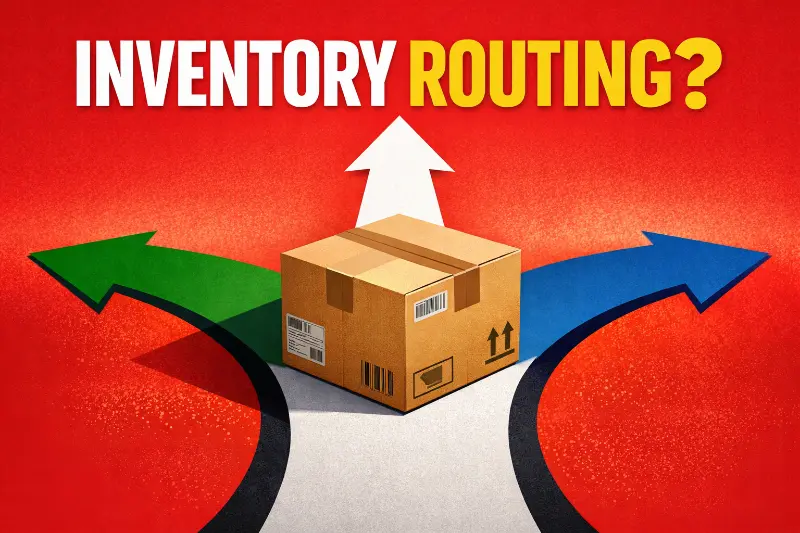
What Is Inventory Routing? How Brands Decide Where Inventory Should Live

Last updated on January 7, 2025
In this article
 17 minutes
- Understanding the Inventory Routing Problem
- Why the Inventory Routing Problem Matters
- Common Inventory and Vehicle Routing Strategies
- Inventory Routing vs. Order Routing
- Tools and Technology for Managing Transportation and Inventory Costs in Inventory Routing
- Real-World Examples
- Frequently Asked Questions
Inventory routing (often called inventory allocation) is the process of determining how to distribute products across a brand’s network of warehouses, fulfillment centers, and partner locations. In practical terms, it means deciding where each product should live in order to meet customer demand efficiently. Brands monitor each customer’s inventory and inventory levels to ensure products are available where needed and to prevent stockouts. For example, a growing brand might choose to stock certain fast-selling items in fulfillment centers on both coasts so that most orders ship quickly nationwide. In short, it’s about putting the right inventory in the right place at the right time.
This strategy is different from order routing, which is the process of deciding after an order is placed which location should ship that specific order. Order routing algorithms automatically match each incoming order to the closest warehouse with stock. By contrast, inventory routing is a proactive planning step: it determines how much inventory to pre-position at each location. Delivery scheduling also plays a key role in ensuring timely replenishment and optimal stock placement as part of this process. As one supply-chain analysis notes, “deciding where inventory should live (for example, across different warehouses or 3PL partners) is a key part of planning”. Done well, inventory routing ensures products are available in high-demand regions without tying up too much cash in slow-moving stock.
Understanding the Inventory Routing Problem
The inventory routing problem (IRP) is a central challenge in modern logistics operations, combining the complexities of vehicle routing and inventory management to minimize total costs across the supply chain. At its core, the IRP asks: how can a business deliver products from a supplier to multiple customers or locations over a set time horizon, while keeping transportation and inventory costs as low as possible? This involves making smart decisions about shipment quantities, delivery schedules, and inventory levels at each site, all while respecting constraints like maximum inventory levels and fluctuating demand.
A key aspect of the IRP is balancing the trade-offs between transportation costs (such as fuel, fleet management, and direct shipping costs) and inventory costs (like holding, stockouts, and replenishment). For example, delivering larger quantities less frequently can reduce transportation costs but may increase inventory holding costs. Conversely, more frequent deliveries can keep inventory levels lean but drive up logistics costs. Vendor managed inventory (VMI) strategies are often used to optimize this balance, allowing suppliers to take responsibility for their customers’ inventory decisions and streamline replenishment policies.
The IRP becomes even more complex when dealing with uncertainties in demand and supply, leading to what’s known as the stochastic inventory routing problem. Here, advanced models such as Markov decision models and stochastic dynamic programming are used to account for unpredictable variables, helping businesses maintain service levels while minimizing total cost. In warehouse multiple retailer systems, integrated inventory allocation and combined vehicle routing approaches are essential for coordinating shipments across multiple locations and retailers, ensuring efficient distribution strategies and optimal shipments.
Periodic inventory routing problems focus on scheduling deliveries at given frequencies, which is especially important for products with regular consumption patterns or in systems with continuous moves and single link distribution. On-line computerized routing and real-time scheduling tools have become invaluable, enabling dynamic route design and rapid response to changing conditions. Direct shipping strategies and discrete shipping policies are also analyzed to determine the best mix of direct shipping costs and inventory components, often using a price-directed approach or decomposition approach to solve short period problems and optimize distribution policies.
Solving IRP instances efficiently requires advanced optimization algorithms, such as branch and cut algorithms, decomposition heuristics, and artificial intelligence techniques like tabu search and local search integrated with network flow. These quantitative methods, often published in technical reports and journals like Management Science, Transportation Science, and Production Economics, provide computational comparisons and performance measurements to evaluate different solution approaches. Research in this field covers a wide range of applications, from supermarket chains to industrial gases distribution, illustrating how IRP solutions can reduce logistic costs and improve service in real-world scenarios.
Ultimately, understanding the inventory routing problem and leveraging the latest advances in operations research, management science, and artificial intelligence allows businesses to optimize their logistics operations. By carefully balancing inventory decisions, vehicle routing, and production costs, companies can minimize total cost, enhance customer satisfaction, and stay competitive in today’s fast-moving supply chain environment.
Why the Inventory Routing Problem Matters
Effective inventory routing can greatly improve delivery speed, reduce shipping costs, and protect against disruptions. Keeping stock closer to customers means orders travel shorter distances. For instance, ShipBob found that by expanding from a single West Coast warehouse to include Midwest and East Coast facilities, a merchant cut its average shipping “zone” from 6.38 to 3.58. This reduced the average shipping cost per order by about $0.30, saving roughly $18,000 per year. In practical terms, that might translate to offering 2-day delivery to far more customers without paying extra for expedited shipping. Inventory routing strategies are specifically designed to minimize transportation costs and total inventory cost by optimizing shipment frequency, vehicle routing, and inventory levels at both customer locations and the supplier.
Distributing inventory also spreads risk. If one warehouse faces an outage (weather, natural disaster, etc.), stock in other locations can keep orders flowing. As one fulfillment manager observed, “storing inventory in different regions is key to reducing costs and transit times” and also provides backup if one location goes offline. In short, inventory routing helps balance cost and service: it can lower freight costs and delivery times while maintaining product availability where demand is highest. Inventory routing reduces transportation costs by optimizing fuel and labor expenditures, and it minimizes excess inventory holding costs.
Slash Your Fulfillment Costs by Up to 30%
Cut shipping expenses by 30% and boost profit with Cahoot's AI-optimized fulfillment services and modern tech —no overheads and no humans required!
I'm Interested in Saving Time and MoneyCommon Inventory and Vehicle Routing Strategies
Brands use several strategies to decide how to place inventory. Often these approaches blend forecasting and real-time demand:
- Push (forecast-driven allocation): Send inventory to locations based on predicted demand. For example, a skincare brand might “push” extra sunscreen to southern states before summer, anticipating higher sales. This is effective when demand is relatively predictable and lead times are long. In push systems, a replenishment policy is set to determine when and how much inventory to send, and a maximum inventory level is established at each location to avoid stockouts and prevent overstocking.
- Pull (demand-driven allocation): Only move or order inventory when sales trigger it. A retailer might restock a product only after it sells out at a location. This is useful when demand is unpredictable or products have short shelf lives. Pull strategies also rely on replenishment policies and maximum inventory levels to ensure efficient restocking without exceeding storage capacity.
- Just-In-Time (JIT): Time deliveries so inventory arrives exactly when needed, minimizing holding costs. For example, an electronics manufacturer might arrange components to arrive at an assembly line just as production ramps up. The planning time horizon is critical in JIT systems, as it determines when and how much inventory should be allocated to meet production or sales needs without excess.
- Rules-Based Allocation: Apply fixed rules or percentages based on store/channel performance. For instance, a fashion brand might allocate 50% of a new jacket style to high-volume regions and split the rest among smaller markets. These rules can be simple (by geography or sales band) or complex (using multiple factors). The planning time horizon also influences these rules, as allocation decisions are often made for specific periods to align with demand cycles.
- Store/Warehouse Grading: Rank locations (e.g. Grade A, B, C) by factors like sales volume or traffic, then allocate stock accordingly. Top-performing centers get more inventory, ensuring prime spots don’t run dry.
- Hybrid Approaches: Many businesses combine methods. They might use forecast-based pushes for seasonal peak items and pull or replenishment triggers to move stock during the season. Data analytics is often involved: by analyzing historical sales (e.g. “Product A sells 30% more in the Northeast in winter”), a team can decide to allocate additional winter coats to northeastern warehouses in October. Hybrid approaches may also incorporate discrete shipping strategies, where shipments are scheduled at specific times, and direct shipping policies, which can streamline logistics and reduce costs by sending inventory directly to customers or stores.
Modern technology also plays a role. Some logistics platforms include placement tools to recommend inventory locations. For example, UPS’s Ware2Go offers “network-wide placement tools that recommend where to stage inventory for cost and speed efficiency”. In practice, that means software can suggest moving stock to a new fulfillment center if it predicts cost savings or faster delivery. Advanced systems may even use AI to continuously rebalance stock: algorithms monitor inventory levels and sales rates, automatically redirecting shipments or adjusting replenishment orders so no location is chronically under- or over-stocked. In fact, effective inventory-routing logic is designed to “avoid both overstocking and understocking”, ensuring balanced stock levels across the network. These advanced systems also consider the inventory component, such as current stock levels, replenishment policies, and maximum inventory levels, when recommending allocation decisions.
Inventory Routing vs. Order Routing
It’s important not to confuse inventory routing with order routing. Order routing occurs at the moment an order is placed: the system evaluates factors like proximity, available stock, and warehouse capacity, then chooses which fulfillment center will ship that order. For example, if a customer in Chicago orders boots that are available in both the Chicago and Miami warehouses, an order-routing algorithm will usually send it from the closer Chicago facility to minimize transit time.
By contrast, inventory routing happens well before any order comes in. It determines where the boots (and all other products) should sit in advance. In other words, inventory routing decides how many boots to stock in Chicago, Miami, or elsewhere, based on sales forecasts and strategic goals. As part of this process, routing decisions are made proactively to ensure optimal stock placement across the network, taking into account factors like customer’s inventory needs, vehicle capacity, and cost minimization. Order routing is a short-term fulfillment decision; inventory routing is a long-term stock planning decision. Both are necessary: good inventory routing makes order routing more efficient and ensures customers receive orders quickly, while poor inventory routing can leave even smart order-routing engines with insufficient stock in key locations.
Tools and Technology for Managing Transportation and Inventory Costs in Inventory Routing
Implementing inventory routing usually requires good visibility and planning tools. An order management system (OMS) or integrated inventory management platform can centralize stock data across all channels. Real-time tracking of inventory levels is essential. With up-to-date information on how much stock is on-hand and incoming at each location, an OMS can trigger transfers or purchases when thresholds are met.
Forecasting software is also common. Many brands use analytics (and even AI) to predict demand by SKU and region, then plan inventory accordingly. Real-time data improves demand forecasting and reduces errors, ensuring correct product availability. These tools can automate much of the labor-intensive planning: for example, they might recommend sending extra units of a holiday gift set to warehouses that historically sell out fastest. Some 3PL networks and multi-warehouse solutions come with built-in allocation tools.
By contrast, a standard Warehouse Management System (WMS) primarily manages inventory within each warehouse (locations, picking, putaway, etc.). A WMS ensures efficient operations locally but typically doesn’t decide between multiple sites. In other words, a WMS supports executing the inventory strategy, while inventory routing itself is a higher-level strategic decision (often made in an OMS or planning tool, sometimes with human oversight). Leading solutions now integrate forecasting, inventory allocation rules, and order/routing logic so that fulfilling an order benefits from both a smart inventory placement plan and the best current routing decision. Modern inventory routing software often incorporates advanced optimization algorithms, including column generation, valid inequalities, and decomposition heuristics, to efficiently solve large-scale allocation and routing problems.
Real-World Examples
- Regional Warehouses: Many ecommerce brands with national customers open warehouses in key regions. For instance, a DTC apparel brand might stock fast-selling items in both East and West Coast fulfillment centers. This way, most orders ship from the nearest center (improving speed and cutting costs) rather than a single central warehouse. In addition to primary warehouses, brands often use satellite facilities as auxiliary storage locations to further support distribution networks and improve delivery efficiency. The ShipBob example above illustrates this: by adding two more warehouses, a brand dramatically cut its average shipping distance and cost.
- Seasonal Pre-Staging: A cosmetics company anticipates a holiday promotion and pushes extra inventory to its busiest fulfillment centers ahead of time. They use historical sales data to decide which centers need more stock. When the promotion hits, most local orders ship immediately. After the rush, unsold stock is redistributed or held for the next event. This approach also helps address the short period problem, as brands conduct frequent inventory reviews and enable rapid redistribution to manage inventory levels and meet demand spikes within limited time frames.
- Omnichannel Allocation: A retailer selling both online and in brick-and-mortar might route part of its inventory to store shelves and part to warehouses. For example, if a new sneaker has high demand, the allocation plan might send 60% of units to the online DC and 40% to flagship stores, based on sales forecasts.
- Marketplace vs. Direct Channels: Brands often keep separate inventory for Amazon FBA and direct sales. A small kitchenware brand might send a cushion of inventory to Amazon’s warehouses (so Amazon Prime orders ship fast) but also stock its own 3PL for Shopify and wholesale orders. Deciding the split is an inventory routing decision that considers fees, sales channels, and fulfillment capabilities. To learn more about how strategies like these build a multichannel fulfillment and sales strategy, see the resources from Cahoot.
- Supermarket Chain Example: A supermarket chain with multiple retail outlets uses warehousing services to optimize stock placement across its network. By analyzing sales data and delivery schedules, the chain coordinates shipments from central warehouses and satellite facilities to individual stores, reducing transportation costs and ensuring shelves remain stocked. This strategy helps the chain manage inventory efficiently and improve service levels for customers.
- Risk Mitigation: During a regional disruption (like a port delay or weather event), brands may quickly rebalance. For example, if an East Coast warehouse falls behind, additional inventory might be pulled from a West Coast location to maintain service levels. Having a multi-site strategy built in advance allows this flexibility. Brands also use satellite facilities as backup locations to further mitigate risk and maintain delivery continuity.
These examples show that inventory routing is about using data and strategy to place stock intelligently. In practice, the right approach depends on factors like product lifecycles, seasonality, lead times, and customer expectations. Inventory routing also addresses the vehicle routing problem and total inventory cost, helping brands optimize logistics and reduce expenses in real-world supply chain operations.
Looking for a New 3PL? Start with this Free RFP Template
Cut weeks off your selection process. Avoid pitfalls. Get the only 3PL RFP checklist built for ecommerce brands, absolutely free.
Get My Free 3PL RFPFrequently Asked Questions
What is inventory routing?
Inventory routing (or allocation) is a supply chain strategy that decides where to place inventory across a network of warehouses, fulfillment centers, or partners. The goal is to have the right products in locations that best serve customers’ needs, balancing delivery speed against inventory and transportation costs. Think of it as pre-planning your inventory’s home, rather than reacting to each incoming order.
How is inventory routing different from order routing?
Inventory routing is about stock placement before orders arrive, whereas order routing is about fulfilling each order after it’s placed. Order routing algorithms assign each order to the best warehouse at that moment. Inventory routing decides how much inventory to put at each warehouse in advance. In short, order routing answers “Which location ships this order?”; inventory routing answers “Which products should live in that location?”.
Why should I use inventory routing?
Proper inventory routing improves customer experience and lowers costs. By positioning stock close to customers, brands cut shipping distances and times. ShipBob found that using multiple fulfillment centers significantly increased 2-day shipping coverage and reduced costs. It also mitigates risk (a disaster at one warehouse won’t knock out your entire supply). Overall, a smart inventory routing plan helps prevent stockouts in high-demand areas and avoids excess inventory in slow-moving regions.
What are some common inventory routing strategies?
Typical approaches include push strategies (forecast demand and pre-stock accordingly, e.g. send swimwear to warm-climate warehouses ahead of summer) and pull strategies (move stock in response to actual sales, restocking only when needed). Other tactics are just-in-time (JIT) deliveries timed to demand, FIFO allocation for perishable goods, and rule-based rules that allocate stock based on historical performance or store grades. Many brands blend these: for example, they might forecast for major seasonal campaigns but use sales triggers to rebalance during the season.
What tools can help with inventory routing?
Effective inventory routing relies on good data systems. An Order Management System (OMS) or inventory management platform is key for visibility. These systems track stock in all locations in real time. Forecasting software or analytics tools can predict demand trends, helping determine where to send goods. Some 3PL networks and fulfillment providers also offer built-in inventory placement recommendations. However, a basic WMS alone usually doesn’t handle multi-location allocation; it focuses on operations within one warehouse. For inventory routing, look for tools that integrate across your entire distribution network.
Do I always need multiple warehouses or 3PLs?
Not always. If you sell locally or have very low volume, a single warehouse may suffice. But as you grow, a multi-location approach often pays off. If most of your customers are far from your sole warehouse, shipping times (and costs) will be high. Splitting stock across locations can speed up delivery and keep fulfillment costs down. Also consider factors like market coverage, shipping zones, and risk. If one region has most of your customers, you’ll benefit from a nearby warehouse. But managing more locations adds complexity, so weigh the trade-offs.
How often should I adjust my inventory routing plan?
Ideally, inventory routing is dynamic. You should review plans regularly or when conditions change. Many brands reassess allocation monthly or quarterly, and definitely before major events (holidays, promotions, new product launches). Use your real-time data: if one location sells through stock faster than predicted, send more next time. Conversely, if another location has excess, slow future shipments there. The best practice is to use a system that can adapt automatically or alert you when rebalance thresholds are hit.
Can a Warehouse Management System (WMS) handle inventory routing?
A WMS is mainly for in-warehouse operations (picking, packing, putaway, location tracking, etc.), not for network-level planning. Inventory routing is a higher-level function that usually lives in an OMS or supply-chain planning tool. While a WMS ensures efficient handling at each site, you still need separate processes or software to decide how to distribute products across multiple sites.
How do I measure if my inventory routing is working?
Key metrics include stockout rate (how often products sell out), order transit time, and carrying costs. You should see reductions in delivery times and shipping fees after improving your routing. Monitor your fulfillment speed (percentage of orders delivered in 2-3 days, for example) and your inventory turnover rates by location. Also track costs: for example, compare total freight spend and fulfillment costs before and after changes in distribution. If adjusting your inventory routing leads to higher service levels (fewer stockouts or late shipments) and lower costs, it’s a sign it’s working.
These FAQs should help clarify inventory routing for ecommerce leaders. Ultimately, effective inventory routing means using data and strategy to place products where they best serve your customers and business goals.
Written By:

Indy Pereira
Indy Pereira helps ecommerce brands optimize their shipping and fulfillment with Cahoot’s technology. With a background in both sales and people operations, she bridges customer needs with strategic solutions that drive growth. Indy works closely with merchants every day and brings real-world insight into what makes logistics efficient and scalable.
Turn Returns Into New Revenue