
AI Shopping And Returns: Getting Recommended Is Only Half The Sale

Last updated on November 10, 2026
In this article
 15 minutes
- AI Purchases And AI Returns Are Happening. The Survey Does Not Tell Us Which Orders Stick.
- Manage The Gap Between Product Facts, Recommendations, Experience, And Customer Retention
- What You Tell AI: Make The Exact Product And Its Limits Understandable
- What AI Tells Shoppers: Audit The Use Cases You Should Win
- What Customers Experience: Investigate The Return And Return Fraud Before Choosing A Fix
- Close The Loop With Returns Management: A Correction, An Owner, And A Retest
- Frequently Asked Questions
AI shopping returns are best managed as a feedback loop with three stages: what your brand tells AI about a product, what AI tells shoppers, and what customers experience after they buy. For retail brands, ecommerce teams, and marketers, the goal is not just to win recommendations but to make sure the product matches the promise, because inaccurate AI guidance shows up later as customer dissatisfaction and higher return rates.
That makes returns a useful operating signal, not just a post-purchase metric. Public AI assistants do not retrain themselves from your private return data, so improvement is not automatic. It comes from deliberate brand action: audit AI recommendations, clarify product information, investigate why items came back, then correct and retest so future AI advice is more accurate.
AI Purchases And AI Returns Are Happening. The Survey Does Not Tell Us Which Orders Stick.
Blue Yonder’s survey, released October 27, 2026, and covered by Retail Dive on November 3, puts numbers on a question many retail teams are already asking. Of 2,000 U.S. respondents, 24% said they had purchased a product after an AI recommendation. That is not the share of Americans who use AI for shopping in general. It is the share who bought something an AI recommended.
Among those purchasers, 46% said they had returned at least one AI-recommended purchase in the past year. The denominator matters here. This is a share of shoppers who bought on AI advice, not a share of orders or units. It says nothing about whether AI-recommended orders come back more often than other orders. Respondents who gave reasons most often cited items that were different than described (36%) and incorrect size or fit (23%). Those reasons are self-reported, and shoppers could select more than one, so the percentages should not be added together.
It also helps to be clear about what the survey cannot show. It is a vendor-sponsored survey, not transaction-level return data. It does not establish sales lift, a higher return rate, causality, or that incomplete merchant data caused any return. Blue Yonder’s suggestion that product data is part of the problem is a hypothesis worth testing, and the reasons shoppers reported point to the same place: an expectation gap between what a product is and what the shopper thought they were buying.
That makes this a retail returns question as much as a visibility question. A recommendation that sends the wrong shopper to the right product still produces a return, a support contact, and a worse customer experience.
Manage The Gap Between Product Facts, Recommendations, Experience, And Customer Retention
The loop has three stages, and the brand operates all three even though it controls only one directly.
- What you tell AI: your product pages, structured data, and product feeds. You own this information.
- What AI tells shoppers: the answers assistants give, drawn from your content and from reviews, blogs, listicles, and other sources you do not own. You can observe it and influence it, but not control it.
- What customers experience: the product, the delivery, and the return evidence that comes back afterward. This is your ground truth.
Success is not maximum mentions. It is accurate visibility for the use cases a product suits. A brand that appears in answers for needs it cannot meet is collecting future returns.
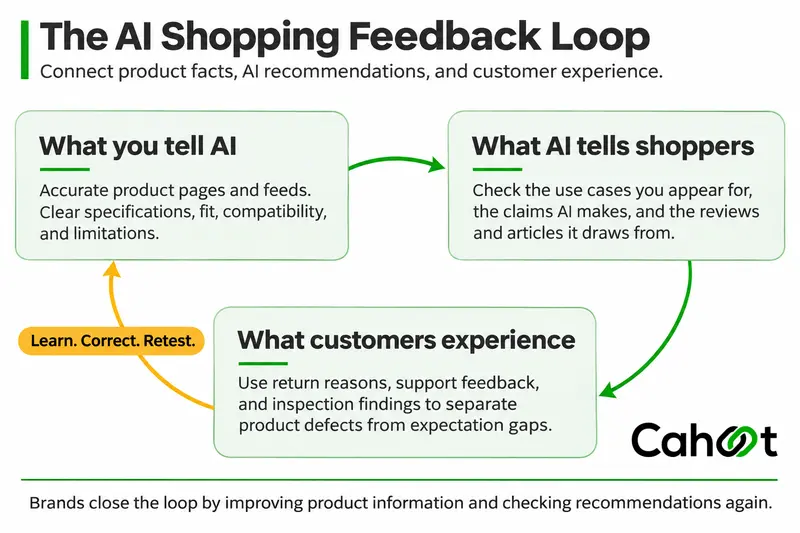
Caption: Brands close the loop by checking recommendations against product facts and customer experience.
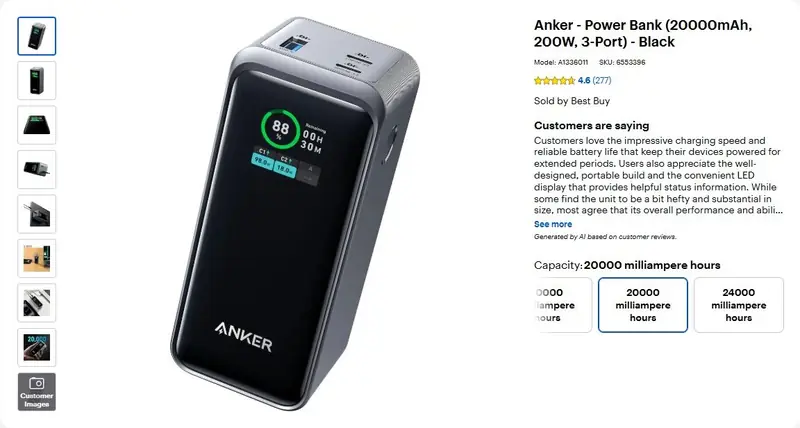
To keep this concrete, the rest of this article follows one product: the Anker Prime 20,000mAh Power Bank (200W), model A1336. Its Best Buy listing carries the model number A1336011. The distinction that matters is this: the A1336 delivers up to 200W total output, but a maximum of 100W from either USB-C port. Both Anker’s official specifications and the retailer listing explain this, so nothing here suggests the information is hidden. The point is that “200W” and “100W per port” answer different shopper questions. A larger Anker model with 27,650mAh and 250W, and newer 20K models rated at 220W, are different products and should not be mixed with it.
What You Tell AI: Make The Exact Product And Its Limits Understandable
Product content has to do more than describe a product. It has to let a reader, or a machine, match the exact model to a specific need and rule it out for others, which is why product descriptions need to make the exact item and its limits unmistakable.
For the A1336, that means stating the model, the 20,000mAh capacity, two USB-C ports and one USB-A port, 200W maximum total output, and 100W maximum from each USB-C port. It also means being clear that combined output is not single-port output. A shopper who wants to charge two laptops that each accept 100W over USB-C has a use case this product can serve. Clearer specs also help reduce return rates by ruling out unsuitable use cases before purchase. A shopper who needs 140W to one laptop does not.
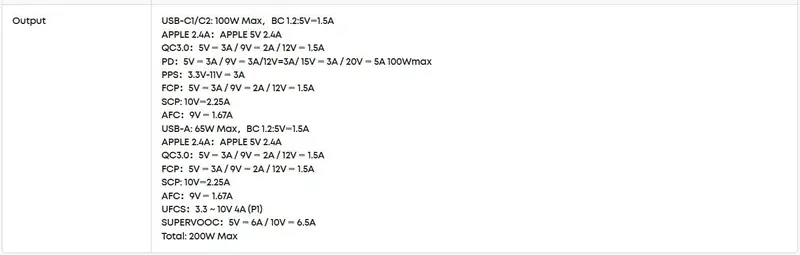
Caption: Anker specifies 100W maximum per USB-C port and 200W maximum combined output.
The same discipline applies to variants, units, compatibility, and exclusions. Color, capacity, and wattage variants should be separate and correctly labeled. Units should be consistent. Compatibility notes should tell consumers what a product will not do as clearly as what it will.
No single format guarantees that every AI shopping system interprets your catalog the same way. Several layers work together:
| Layer | What It Does | Limit |
|---|---|---|
| Readable product pages | Gives shoppers and crawlers the plain-language facts | Only helps if the facts are specific and correct |
| Product and Offer structured data | Marks up price, availability, and attributes for merchant listings in Google | Not a guarantee of AI discovery or recommendation accuracy |
| Merchant Center feeds | Supplies platform-supported fields, including correct variant attributes, that should stay consistent with your site | Applies to Google surfaces and depends on feed quality |
| ChatGPT product feeds | A separate, documented catalog route for ChatGPT shopping | Direct feed onboarding is available to approved partners, so a public specification does not mean every brand can submit one |
Structured data cannot fix a wrong fact. If the page is vague, the markup will be vague too.
Missing detail on your own page weakens your first-party evidence, but it does not mean AI cannot know the fact. Assistants may find it on a retailer listing, a review, or a third-party article, and that source may be less precise than yours.
What AI Tells Shoppers: Audit The Use Cases You Should Win
Once your information is in good shape, check what shoppers are actually told by artificial intelligence. Start with three kinds of prompts for one product: a suitable use, an unsuitable use, and an ambiguous one.
For the A1336, the proposed set is:
- “Recommend a power bank for two laptops that each accept 100W USB-C charging” (suitable)
- “Can the Anker Prime A1336 deliver 140W to one laptop?” (unsuitable)
- “What does 200W mean on the Anker Prime A1336?” (ambiguous)
Only the first has been captured. The second and third are proposed audit prompts, not observed AI failures.
Here is what the captured answer shows. On November 9, 2026, one AI shopping response to the two-laptop prompt called for at least 200W combined output and two USB-C connections capable of 100W simultaneously. It listed a UGREEN option first and a separate Anker 27,650mAh/250W listing next. The A1336 20,000mAh/200W listing was partly visible lower down.
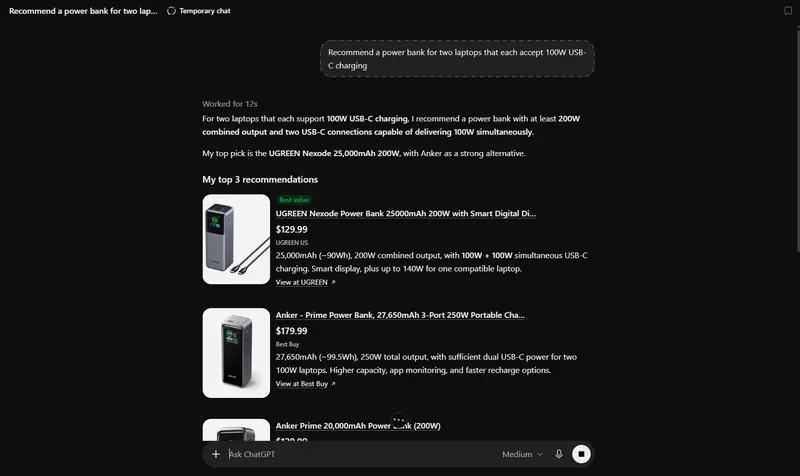
Caption: One captured response to a two-laptop shopping request, captured November 9, 2026. The answer and visible recommendations are a point-in-time sample.
This is one answer, not a study or an endorsement. It is an example of how the audit works. It does not show which model produced it, and it does not show an error. What it does illustrate is how the audit works: the stated requirement was framed correctly, and the A1336 fits it on paper. A brand reviewing this answer would ask whether the product appeared where it should, whether its capabilities were described accurately, and which sources the answer relied on. Over time, improving that accuracy can become a competitive advantage by reducing mismatched purchases.
Third-party interpretation matters too. Best Buy’s listing includes a customer-review summary that the retailer labels as AI-generated.
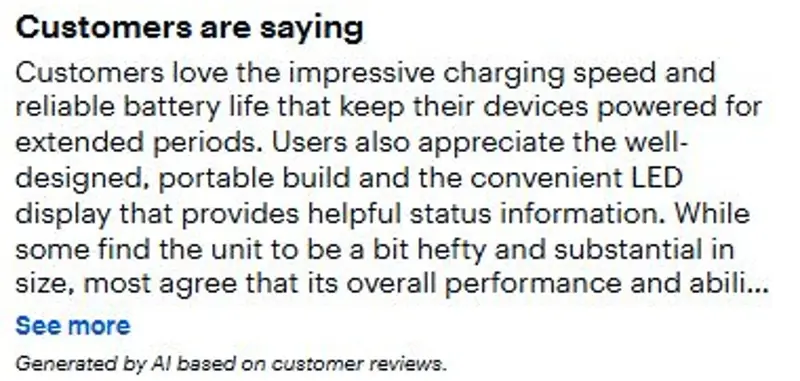
Caption: Best Buy labels this summary as AI-generated from customer reviews. It is not the same as an independent shopping-assistant recommendation. Captured November 9, 2026.
A review summary is a retailer’s interpretation of customer opinion, not a verified product test and not an independent assistant recommendation. Treat it as another surface to audit.
For each prompt run, record:
- the exact prompt, date, locale, and platform
- the model if the interface shows it
- the full answer and the exact product or model recommended
- any cited URLs
- whether the use case suits the product
- whether each claim is accurate
Review the cited pages, not imagined hidden reasoning. You can see what an answer cites. You cannot see everything the assistant considered. An absence from an unsuitable-use prompt can be the right result, and a brand mention is not a win if the capabilities are misstated.
Manual checks work for a first pass. Prompt-tracking tools, such as Semrush’s, can help retailers monitor custom prompts and cited sources to improve recommendations, though the vendor describes its AI visibility data as directional, since answers vary and tools cannot see every real shopper conversation. Treat any sample as a sample.
What Customers Experience: Investigate The Return And Return Fraud Before Choosing A Fix
Returns are where the third stage becomes evidence. The goal is not to assume AI is to blame. It is to learn what actually happened and who should fix it. Cahoot’s guide to average ecommerce return rates and their drivers covers the broader diagnostic approach; here the focus is on one product.
Consider a hypothetical return, not Anker customer data. A buyer says the unit is “not charging at the speed I expected.” A single reason code like that is a clue, not a diagnosis, and it may conceal issues ranging from ordinary expectation gaps to sophisticated returns and refund fraud schemes. A careful review would pair it with several pieces of evidence:
- Receiving: confirm the model and variant that came back, and the physical condition.
- Technical checks, where appropriate: a qualified check with a known-compatible device and a suitable cable can compare actual performance with the published specification. Visual inspection alone cannot establish electrical performance.
- Follow-up: ask what speed the buyer expected and where that expectation came from.
- Support and review records: look for similar contacts about the same item or variant.
If a functioning unit with 100W per port went to a buyer who needed 140W from one port, that points to a suitability or expectation issue, which is a common driver of rising ecommerce return rates across categories, but only after other causes are ruled out. Device negotiation, cable limits, an incorrect item or variant, transit damage, and a defective unit all remain possible, as do edge cases of ecommerce return and refund fraud. Customer inspection evidence is not proof the customer is wrong. If the cause stays unclear, record it as unknown rather than forcing a diagnosis, while monitoring for patterns that could indicate ecommerce returns fraud and abuse.
Not every eligible return needs to reach a warehouse. Inspection and specialist testing can happen wherever they are available, and the point is to get evidence before choosing a fix while staying aligned with marketplace ecommerce returns policy requirements.
Three outcomes usually emerge: a defect, a fulfillment error, or an expectation gap. Each belongs to a different owner, and specialized returns management software for ecommerce can help route and act on each outcome consistently.
Close The Loop With Returns Management: A Correction, An Owner, And A Retest
A finding only helps if it leads to a correction, a named owner, and a retest. In practice, this is where returns management turns findings into operational decisions and follow-up checks. Coordinate across teams rather than sending every issue to copywriting.
Modern AI returns systems can handle return eligibility checks in real time and reduce manual review before teams act on what the evidence shows.
| Observed Issue | Corroborating Evidence | Correction And Owner | Next Check |
|---|---|---|---|
| Correct product, unrealistic use-case expectation | Returned unit performs to specification; buyer describes an unmet need; repeated pattern | Clarify combined versus per-port output on pages and feeds (merchandising and feed owner); adjust returns policies and policy rules for eligibility or routing based on customer history and observed risk (operations); request evidence-based corrections from publishers where appropriate (marketing) | Rerun the prompts; compare similar returns over a comparable window |
| Wrong item or variant shipped | Receiving records and order data show a mismatch | Fix picking, labeling, or variant records (operations) | Check later orders for the same variant |
| Confirmed physical defect | Technical check shows underperformance against specification | Escalate to supplier or quality review (product and quality) | Monitor returns by SKU and reason |
| Unresolved cause | Mixed or incomplete evidence | Log as unknown and keep collecting evidence (support and operations) | Revisit when more records accumulate |
Start small. Pick one SKU, run three shopping requests (suitable, unsuitable, and ambiguous), and review a small recent batch of related support and return records. This is a starting scope, not a statistically representative sample.
Faster automation can reduce return processing and refund processing from hours to seconds, which matters when handling refunds can cost retailers $10 to $30 per ticket and fully “free” returns can carry significant operational and environmental costs, as explored in the sustainability of free ecommerce returns.
Proposed measures, to be tracked rather than assumed:
- Suitable-use visibility: qualifying appearances divided by sampled relevant prompt runs.
- Claim accuracy: correct audited claims divided by audited claims.
- Sampled mismatch frequency: how often answers misstate a capability.
- Returns by SKU and reason: with orders or units chosen explicitly as the denominator.
- Retained revenue or recovery: where reliable data exists.
Do not compare these order-level measures with the survey’s shopper percentage. They measure different things. Label unknown discovery sources as unknown, compare periods and cohorts cautiously, and avoid causal claims from before-and-after changes alone. When tracking corrections, use customer history to inform return policies instead of relying only on blanket changes. Correcting owned information and requesting corrections to inaccurate third-party material is legitimate. Fabricating reviews or buying praise is not. No update guarantees a result. For deeper background on returns prevention, see Cahoot’s Returns Resource Center.
Frequently Asked Questions
Does The Survey Show That 46% Of AI Shopping Orders Are Returned?
No. The 46% describes purchasers of AI-recommended products who said they returned at least one such purchase within a year. It is a share of shoppers, not of online orders or units, and the survey does not establish a higher order-level return rate than other purchases or measure product returns at the order level.
Is There A Universal Product-Data Format For AI Shopping?
No format guarantees consistent interpretation. Brands work with several layers: readable page content, Product and Offer markup, Merchant Center feeds, and platform-specific feeds, and requirements can differ across other platforms. Confirm each platform’s eligibility requirements. Structured data also cannot correct a wrong fact, so accuracy comes first, and what works in one platform setup does not always carry over.
How Can A Brand Check Whether AI Recommends Its Products Correctly?
Test suitable, unsuitable, and ambiguous use cases. Record the exact prompt, date, model recommended, claims made, and cited sources, then repeat after corrections. Prompt-monitoring tools can help but are optional. Results are samples and do not reveal every shopper conversation.
Can Return Reasons Prove That AI Caused A Return?
No. A reason code or return reason is a clue. Combine the customer’s account, discovery-source information where voluntarily shared, the exact order and variant, the context captured at return initiation, and inspection or testing. Include relevant customer communication as evidence, keep attribution marked unknown when evidence is thin, and keep competing causes open.
Does Updating A Product Page Automatically Retrain AI Shopping Assistants?
No. Updating accessible pages and supported feeds as part of the broader returns process, requesting corrections where appropriate, and retesting are the brand’s levers. Retrieval, indexing, source selection, and answer generation vary by system, and private return data does not automatically reach or train public assistants. Better making returns can turn a cost center into a lever for customer retention, and a poor flow also hurts customer satisfaction—71% of shoppers avoid retailers after poor returns experiences. Retrieval, indexing, source selection, and answer generation vary by AI system, and private return data does not automatically reach or train public assistants.
Written By:

Manish Chowdhary
Manish Chowdhary is the founder and CEO of Cahoot, the most comprehensive post-purchase suite for ecommerce brands. A serial entrepreneur and industry thought leader, Manish has decades of experience building technologies that simplify ecommerce logistics—from order fulfillment to returns. His insights help brands stay ahead of market shifts and operational challenges.

Turn Returns Into New Revenue
Related Articles

Warehouse Legal Liability Insurance: Does Your 3PL Actually Have It?
Before you send a warehouse your inventory, ask for proof of warehouse legal liability insurance.

Chewy Dropship Fulfillment: What to Ask Your 3PL and What to Verify
To evaluate a 3PL for Chewy dropship fulfillment, ask it to prove it can meet your current supplier requirements: written dispatch deadlines, DSCO data flows, labels on the retaile...

Amazon FBM Prepaid Return Labels What Changes December 18 and What Sellers Should Do
Starting December 18, 2026, covered US seller-fulfilled Amazon returns require a prepaid return label, and heavy and bulky items are temporarily excluded, according to a seller not...