
Discovery, Conversion, and AI: The New Ecommerce Optimization Stack

Last updated on March 12, 2026
 9 minutes
During Cahoot’s Ugly Talk: Selling in a World Run by Algorithms panel in New York, the conversation kept circling back to a simple but powerful observation: ecommerce operators today are optimizing for more systems than ever before.
For years, the playbook was relatively straightforward. If a brand wanted customers to find its products online, the focus was on visibility. Traditional product discovery relied on manual research, interviews, and fragmented workflows that often slowed down the process.
Product pages needed to appear in search results when shoppers were looking for something specific.
But as the discussion unfolded during the panel, it became clear that modern ecommerce optimization has grown more complicated than that.
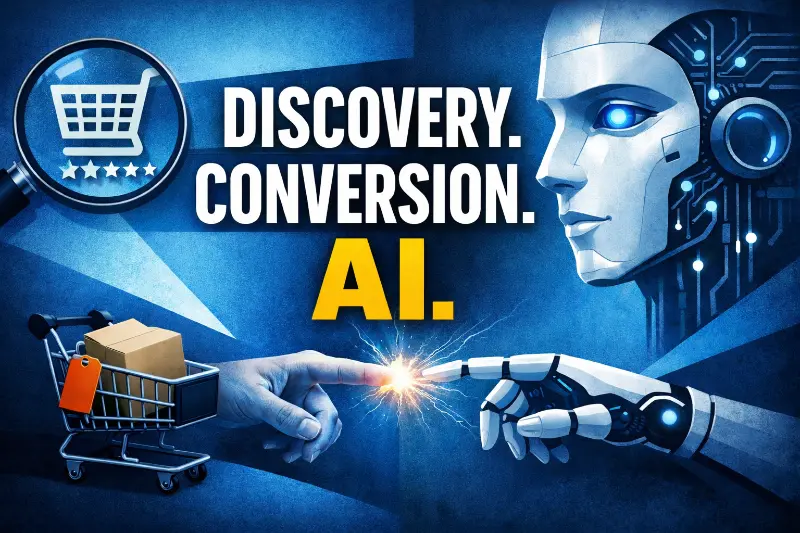
Today, brands are effectively balancing three different optimization layers at once. In the past, teams often used separate tools for research, feedback, and analysis, which led to silos and inefficiencies.
First, they need to be discovered. Then they need to convince a human shopper to buy. And increasingly, they may also need to be understood by AI systems that interpret and recommend products.
Each of these layers evaluates product information differently.
And sometimes, optimizing for one layer can make another harder.
This article is part of a series inspired by Ugly Talk: Selling in a World Run by Algorithms, a live panel hosted by Cahoot in New York. The discussion brought together operators and technology leaders including Manish Chowdhary of Cahoot, Nihar Kulkarni of Roswell NYC, Frank Pacheco of Nearly Natural, and YiQi Wu of Aimerce.
Throughout the conversation, the panel explored how artificial intelligence, recommendation systems, and platform algorithms are changing how ecommerce brands compete for visibility and customers. Endless alignment meetings were a common pain point in traditional product discovery processes, often stalling progress and delaying decisions.
These ideas are part of a broader framework for understanding how AI is reshaping ecommerce. Modern teams are adopting new workflows and AI-driven approaches to overcome the limitations of traditional methods. For a complete breakdown of how discovery systems, product pages, brand authority, behavioral data, and fulfillment infrastructure interact, see The AI Commerce Playbook for Ecommerce Brands.
Layer One: Product Discovery Process
The first layer of ecommerce optimization is discovery.
Search engines and marketplace search systems determine which products appear when customers look for something online. Whether a shopper searches on Google, Amazon, or another marketplace, the underlying process is similar: algorithms analyze product data and match it to search queries, which makes disciplined keyword research and seasonal optimization of Amazon product listings increasingly important. “Structured data is the necessary first step. It’s similar to traditional SEO — you have to index for the term before anything else matters.” — Frank Pacheco
For years, brands have optimized their listings around this system. Product titles, descriptions, and attributes are structured to match the phrases customers are likely to search for, especially on marketplaces like Amazon where investing in marketplace and product research can dramatically improve performance. Using high quality images is also crucial, as they improve visibility in visual search and AI-powered shopping platforms.
This approach has proven incredibly effective. Strong keyword optimization can dramatically improve visibility and drive significant traffic.
But discovery is only the first step in the buying process.
Appearing in search results does not guarantee that a shopper will actually purchase the product.
Layer Two: Conversion and Customer Behavior
Once a customer lands on a product page, a completely different challenge begins.
The goal is no longer simply to match keywords. The goal is to help a human shopper understand what the product is, why it matters, and whether it solves their problem.
During the panel discussion, one theme that surfaced repeatedly was the tension between discovery optimization and conversion clarity.
Product pages optimized heavily for search algorithms can sometimes become long lists of keywords and feature descriptions designed primarily to improve ranking. But when a human shopper arrives on that page, the information may not actually help them make a decision.
Customers rarely read product pages the way algorithms do. They look for signals of trust, clarity, and relevance. They want to understand quickly whether a product fits their needs.
To deliver real value to shoppers, brands must prioritize which features and content are truly worth building, ensuring that every element on the product page addresses genuine user needs rather than just boosting search visibility, a theme explored in depth across Cahoot’s educational ecommerce strategy webinars.
That means successful ecommerce content must often balance two competing goals: satisfying discovery algorithms while still telling a clear story to the human reading the page.
Layer Three: AI Interpretation and Human Judgment
A third layer is now beginning to emerge.
AI-driven discovery systems are starting to interpret product information in new ways. Instead of simply returning lists of search results, conversational interfaces can generate recommendations based on context and intent, further blurring the line between owned channels like Shopify and dominant marketplaces such as Amazon that DTC brands must learn to compete with strategically.
A shopper might ask an AI assistant for the best suitcase for international travel, or for a comfortable chair for working long hours at a desk. AI assistants now leverage large language models to simulate customer queries and provide highly personalized recommendations, enhancing the overall product discovery experience.
Rather than providing links alone, the AI may summarize reviews, compare features, and recommend specific products. “Research has shown that the exact same AI query produces the same result less than one percent of the time. The system is trying to produce a unique answer based on context.” — Nihar Kulkarni, Roswell NYC
In this environment, product visibility may depend less on matching exact keywords and more on how well the system understands the context of the product. “What you’re optimizing for now is the probability of visibility, not necessarily a fixed ranking.” — Nihar Kulkarni
Descriptions, reviews, and product data all become signals that help the AI determine whether an item is relevant to the shopper’s request. AI product discovery tools and product discovery AI platforms are enabling faster, smarter, and more autonomous product recommendations by integrating with existing workflows and learning from vast amounts of data, especially when they plug into robust ecommerce fulfillment and integration partners.
For ecommerce brands, this introduces yet another dimension to optimization. AI discovery allows brands to rapidly test ideas and validate concepts before investing significant resources, giving them a competitive edge in the market.
While AI product discovery and AI product platforms can automate and enhance many aspects of the process, they cannot fully replace humans or the need for human judgment. AI is best used to support rather than replace human judgment, surfacing insights and patterns that empower product teams to make smarter, faster decisions.
Customer and Competitive Intelligence
In today’s fast-moving ecommerce landscape, customer and competitive intelligence have become foundational to a successful product discovery process. Modern brands can no longer rely solely on intuition or manual research—AI tools are now essential for surfacing the insights that drive smarter decisions.
AI-driven product discovery tools can analyze massive volumes of data from multiple sources, including customer feedback, usage data, and real-time market signals. This enables product teams to gain a nuanced understanding of customer behavior, preferences, and pain points, while also keeping a close eye on competitor moves and emerging trends, which is critical when designing a resilient multichannel fulfillment and sales strategy.
Generative AI and advanced analytics platforms can sift through customer research, support tickets, app reviews, and even social media chatter to identify patterns and themes that might be buried in the noise. By leveraging AI-powered product discovery, brands can spot unmet customer needs, validate ideas, and prioritize opportunities with far greater speed and accuracy than traditional methods allow.
AI-powered shopping assistants and chatbots also play a key role in capturing customer intelligence. By analyzing interactions throughout the shopping journey, these systems provide valuable insights into user intent, preferences, and friction points—helping product teams refine offerings and optimize the customer experience.
However, while AI can surface patterns and provide recommendations, human judgment remains irreplaceable. Product managers and teams must use their expertise to validate assumptions, make strategic calls, and ensure that AI-driven insights align with broader business goals. The most effective discovery process combines the efficiency of AI with the critical thinking and creativity of human analysis.
When it comes to competitive intelligence, AI can monitor competitor moves, track shifts in market signals, and analyze customer feedback at scale. This empowers brands to identify areas of opportunity, anticipate market changes, and stay ahead of the competition, especially when paired with fulfillment innovations from Cahoot’s ecommerce logistics network.
Balancing Three Different Audiences in Product Discovery
The challenge for modern ecommerce operators is that none of these layers are disappearing.
Search algorithms still determine whether a product is discovered.
Human shoppers still decide whether to purchase.
And AI systems may increasingly influence which products are recommended during the discovery process.
In practice, that means ecommerce product pages are now being interpreted by three different audiences at the same time:
search engines
human shoppers
and AI systems
Each audience evaluates information differently. Making the right judgment calls is essential for balancing the needs of search engines, shoppers, and AI systems.
Understanding how to balance those signals may become one of the most important strategic challenges for ecommerce brands in the coming years. Meeting the table stakes of visibility, clarity, and AI-readiness is necessary but not sufficient for success.
Ultimately, great discovery is what differentiates leading ecommerce brands in a crowded market. Next, learn how AI systems become more capable of interpreting context, which means increasingly relying on signals that reflect brand credibility.
Written By:

Manish Chowdhary
Manish Chowdhary is the founder and CEO of Cahoot, the most comprehensive post-purchase suite for ecommerce brands. A serial entrepreneur and industry thought leader, Manish has decades of experience building technologies that simplify ecommerce logistics—from order fulfillment to returns. His insights help brands stay ahead of market shifts and operational challenges.

Turn Returns Into New Revenue

Related Articles

Why Returns Look Manageable Until They Suddenly Aren’t
Returns management is the retail process of handling customer returns across reverse logistics, cost control, and customer experience—and it rarely fails the way leadership expects...

The Economics of Peer-to-Peer Returns
Traditional returns management has one fundamental flaw: it optimizes a process that should not exist in its current form.

The Myth of “Efficient” Reverse Logistics
Efficient reverse logistics is treated as a goal worth chasing.