
Why Peer-to-Peer Returns Scale When Warehouses Don’t

Last updated on June 26, 2026

In this article
 12 minutes
- Warehouse Returns Scale by Adding More Capacity
- Peer-to-Peer Returns Scale by Increasing Match Density
- More Volume Can Strengthen the Network Instead of Congesting It
- Fixed Assets and Network Density Solve Different Problems
- Scalability Is One of the Biggest Structural Differences Between P2P Lending and Traditional Financial Institutions
- P2P Does Not Need to Replace Every Return to Outscale the Warehouse Model
- The Bottom Line on Scalability and Credit Risk
- Frequently Asked Questions
A returns system is not defined by what it costs at low volume. It is defined by what happens when volume grows. That is where warehouse-based returns and peer-to-peer returns diverge most sharply, and where most operators get the comparison wrong.
The instinct is to treat peer-to-peer returns as a cheaper version of the same warehouse loop. It is not. The two models absorb growth in fundamentally different ways. Warehouses scale by adding capacity. Peer-to-peer scales by increasing density. One model leans harder on fixed assets and labor as volume rises. The other leans on verification, eligibility logic, and matching opportunity across a denser network. For ecommerce operators trying to figure out how returns will behave at twice their current volume, that distinction is the entire argument.
Warehouse Returns Scale by Adding More Capacity
The warehouse-centric returns loop is an infrastructure problem dressed up as a logistics problem. Every additional return requires a physical destination, a person to receive it, space to hold it, and time to process it. The math is brutally linear. More volume means more docks, more labor hours, more inspection stations, more put-away cycles, and more square footage absorbing inventory that has not yet been resold.
This is what fixed-capacity scaling actually looks like in practice:
- More space to stage and inspect inbound returns
- More labor to handle intake, inspection, repackaging, and restocking
- More processing overhead to keep refund cycles from slipping
- More infrastructure strain during peak periods when outbound and inbound volume collide
The uncomfortable part is that warehouse capacity does not flex. You cannot half-build a receiving dock or hire a quarter of a supervisor. Capacity gets added in expensive chunks, and those chunks usually arrive after the pain has already shown up in cycle times and refund delays. By the time the new capacity is online, return volume has often moved again.
There is also a second-order effect that rarely gets discussed. Warehouse returns are competing for the same labor, space, and management attention as outbound fulfillment. When return volume spikes, it does not just cost more on its own line item. It quietly degrades outbound throughput, which is where the actual revenue lives. That is fixed-capacity scaling at its worst: more volume, more strain, and the strain shows up in places the P&L does not immediately reveal.
Peer-to-Peer Returns Scale by Increasing Match Density
Peer-to-peer returns scale through a different mechanism entirely. Rather than a returns optimization solution that requires more fixed capacity for every increment of growth, what are peer-to-peer returns at the core is a verification-first system that matches eligible returned items to new demand before warehouse processing occurs. The system is not just moving products differently. It is screening for eligibility, evaluating condition, checking for fraud signals, and then matching verified returned inventory to a real buyer who already wants that item.
Once the model is verification-first, growth behaves differently. More activity across the network means more eligible verified returns entering the matching pool and more demand signals to match them against. That is what match density actually means: a denser graph of eligible returned items and willing buyers, with routing intelligence sitting between them deciding which match is best.
The inputs that drive scaling are not square footage and headcount. They are:
- More eligible returns flowing through the verification layer
- More buyers generating demand for items that already exist in the network
- More routing intelligence shaping which verified returned items get matched to which orders
- More opportunities to recover value before unnecessary reverse logistics occurs
This is the part that takes a minute to fully internalize. In a warehouse model, every additional return is an additional cost event. In a peer-to-peer model, every additional eligible return is also a potential supply event, because that verified returned item can be matched to a new buyer and fulfilled from a verified return source rather than from primary stock. The unit of scale is matching opportunity, not intake capacity.
For a deeper walk-through of the underlying mechanics, how peer-to-peer returns actually work covers the step-by-step process, including how eligibility is determined and how verified returned inventory gets routed. The mechanics matter, but the point for this article is narrower: the inputs that make a peer-to-peer system better are the same inputs that grow as the business grows.
More Volume Can Strengthen the Network Instead of Congesting It
The contrarian insight at the center of this comparison is not lower cost. Lower cost is downstream. The real advantage is a different scaling logic. Warehouses get more congested as return volume grows. Peer-to-peer networks, for the eligible slice of returns, get denser, which is closer to the opposite of congestion.
Think about what happens in each model when monthly return volume doubles.
In a warehouse model, doubled volume means doubled inbound parcels at the dock, doubled inspection queues, doubled put-away work, and doubled exposure to markdown decay while items sit waiting for processing. Cycle times stretch. Refund speed degrades. Labor schedules get harder to manage. The system absorbs the growth, but it absorbs it as strain, which is why many operators look for ways to optimize reverse logistics long before they hit breaking points. More volume produces more friction at exactly the moment the business needs the loop to move faster.
In a peer-to-peer model, doubled eligible volume changes the math for the eligible slice. There are more verified returned items in the matching pool, which means more chances that any given new order can be fulfilled from a verified return source rather than from primary inventory. The probability of a successful match for any individual eligible return goes up, not down, as activity grows. Growth feeds the matching layer instead of clogging the intake layer.
This is not a claim that volume is unlimited or that every return will find a buyer. It is a claim about direction. Warehouse models tend to get worse at scale on the dimensions that matter most to operators: speed, cost, and labor stability. Network-density models tend to get better at scale on the dimensions that matter most to recovery: match probability, time to recovery, and recovery before loss compounds.
Fixed Assets and Network Density Solve Different Problems
This is the line worth remembering. Warehouses solve scale with infrastructure. Peer-to-peer solves scale with network participation and routing intelligence. They are not two flavors of the same approach. They are two different scaling logics aimed at two different problems.
A warehouse is fundamentally a throughput machine. It exists to receive, process, and move physical goods through a controlled environment. When you ask a warehouse to absorb more returns, you are asking it to do more of what it was built to do, and that requires more of what it was built from: space, equipment, and labor. Infrastructure-based scaling is real, and for some categories of returns, it is the right answer, including models like Happy Returns’ drop-off return network that still depend on centralized processing behind the scenes.
A peer-to-peer system is fundamentally a matching machine. It exists to verify eligibility, evaluate condition, and match verified returned inventory to new demand before that inventory has to be handled in a centralized facility. When you ask a peer-to-peer system to absorb more eligible volume, you are not asking it to do more handling. You are giving it a larger pool of inputs to match against. Network-based scaling is also real, and for the eligible slice of returns, it produces different economics over time, similar to how peer-to-peer fulfillment is reshaping forward logistics for merchants competing in the Amazon era.
The strategic point is that operators get to choose which problem they want to solve at the margin. If the next 30% of return growth is going to be absorbed by adding warehouse capacity, the cost curve looks one way. If the eligible portion of that growth is absorbed by network density instead, the cost curve looks meaningfully different, especially when paired with the right returns management software for 2025 to orchestrate verification and routing logic. This is upstream of the cost comparison itself. The economics of peer-to-peer returns deserves its own treatment, and there is a full article on that. But the economics are downstream of the scaling logic, not the other way around.
Scalability Is One of the Biggest Structural Differences Between P2P Lending and Traditional Financial Institutions
Operators sometimes treat scalability as a footnote inside the broader peer-to-peer vs warehouse returns comparison. That underweights it. Most of the structural differences between the two models, including cost, fraud exposure, and refund speed, are downstream of how each system absorbs growth, and they show up differently in software-first tools like Return Prime’s return management solution that stop at policy and routing rather than full reverse logistics.
A few comparisons make the structural divergence clearer:
- How growth is absorbed. Warehouses absorb growth by adding capacity. Peer-to-peer absorbs eligible growth by adding density.
- What more volume creates. In warehouses, more volume usually creates more strain. In peer-to-peer, more eligible volume usually creates more matching opportunity.
- What the system depends on. Warehouse scaling depends on physical infrastructure. Peer-to-peer scaling depends on verification, eligibility, and demand matching.
- What stays true regardless. Not every return qualifies for peer-to-peer, and exceptions still need a path through the standard warehouse flow.
That last bullet is the bridge to the next section, and it matters more than the rest. A model is only credible if it knows where it ends.
P2P Does Not Need to Replace Every Return to Outscale the Warehouse Model
The realism check is non-negotiable. Not all returns qualify. Some fail verification. Some arrive damaged. Some are not sold in time. Some are simply unsuitable for resale because of the category, the condition, or the regulatory context. Those returns continue through the standard warehouse flow, and they should. There are specific scenarios where where peer-to-peer returns don’t work is the more useful frame, and the limitations article covers those in detail.
The point is that peer-to-peer does not need to absorb every return to change the scaling math. It needs to absorb the eligible slice. For that slice, more network density creates more matching opportunity, and that compounds as activity grows. The remaining returns continue through traditional reverse logistics, which is exactly what warehouses are good at, especially when paired with the right partner in the broader peer-to-peer network vs traditional 3PL fulfillment debate on the outbound side.
This is also why the right adoption goal is rarely 100%. There is a separate argument for why 100% p2p adoption is the wrong goal, and hybrid models tend to be what wins in practice. A selective optimization layer sitting on top of a working warehouse flow produces a different cost curve than either model in isolation. The warehouse handles what it is built for. The peer-to-peer layer handles the eligible verified returns where density and matching intelligence change the economics.
The structural rewrite is not that warehouses go away. It is that the eligible slice no longer scales the same way as the exceptions, much like how peer-to-peer order fulfillment services beat legacy 3PLs without eliminating the need for traditional infrastructure altogether.
The Bottom Line on Scalability and Credit Risk
Warehouses scale by building more infrastructure around the same loop. Peer-to-peer scales by making recovery opportunities denser and smarter around eligible verified returns. The advantage is not just cheaper unit economics, though those follow. The advantage is that the two models behave differently as the business grows. One absorbs growth as strain. The other absorbs the eligible portion of growth as opportunity.
For operators planning the next phase of return volume, that is the comparison that actually matters, and it rhymes with the choices brands face when evaluating the world’s first peer-to-peer fulfillment network for their forward logistics.
Frequently Asked Questions
Why do peer-to-peer returns scale differently from warehouse returns?
Warehouse returns scale by adding fixed capacity such as space, labor, and processing overhead. Peer-to-peer returns scale by increasing network density and matching opportunities for eligible verified returned items. The two models absorb growth through different mechanisms, which is why their cost and recovery curves diverge as volume grows.
Does more return volume make a peer-to-peer system better?
For the eligible slice of returns, more activity can create more matching opportunity because there are more verified returned items in the pool and more demand signals to match them against. This does not mean every return will be matched, but the probability of recovery before unnecessary warehouse processing tends to improve with density.
Do warehouses get cheaper per return as volume grows?
In most operations, warehouse returns do not benefit from economies of scale the way outbound fulfillment does. More volume tends to create more congestion, more labor strain, and more pressure on cycle times, particularly during peak periods when returns compete with outbound fulfillment for the same capacity.
Does peer-to-peer eliminate the need for warehouses?
No. Not all returns qualify for peer-to-peer. Some fail verification, are damaged, are not sold in time, or are unsuitable for resale. Those continue through the standard warehouse flow. Peer-to-peer is a selective optimization layer for eligible verified returns, not a replacement for warehouse-based reverse logistics.
What makes a return eligible for a peer-to-peer flow?
Eligibility typically depends on verification, condition evaluation, fraud screening, resale suitability, and whether there is demand for the item in the network. Peer-to-peer is a verification-first system, which means eligible items are matched to new demand only after the relevant checks have been completed.
Is the real advantage of peer-to-peer just lower cost?
Lower cost is part of it, but it is downstream. The deeper advantage is a different scaling logic. Warehouses scale through fixed assets. Peer-to-peer scales through network density and routing intelligence. The cost difference at any given volume is largely a result of how each model absorbs growth.
Written By:

Manish Chowdhary
Manish Chowdhary is the founder and CEO of Cahoot, the most comprehensive post-purchase suite for ecommerce brands. A serial entrepreneur and industry thought leader, Manish has decades of experience building technologies that simplify ecommerce logistics—from order fulfillment to returns. His insights help brands stay ahead of market shifts and operational challenges.

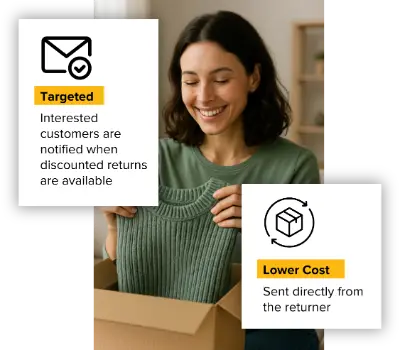
Turn Returns Into New Revenue
Related Articles
Save Money With Ecommerce Shipping Software: Next-Gen Solutions
Shipping costs are one of the biggest challenges for ecommerce businesses today, and understanding them is essential to reducing expenses and increasing profit margins.
10 Best European 3PLs for Ecommerce Sellers in 2026
Bigblue is the best overall choice among the best European 3PLs in this comparison: one provider with 11 fulfilment centres across France, Spain, Italy, the UK, and Germany, its ow...
Why Returns Are Becoming a Board-Level Topic
Returns have quietly become one of the most consequential financial problems in ecommerce, and boards are finally being forced to confront what operators have known for years: retu...