
De Minimis Explained: What It Means for Ecommerce, Tariffs, and Cross-Border Shipping

Last updated on August 20, 2026
In this article
 23 minutes
- A Single Customs Rule Quietly Powered Cross-Border Ecommerce
- The $54 Package That Built a $66 Billion Trade Channel
- Domestic Brands Faced a Structural Disadvantage They Didn't Create
- Enforcement Gaps and Safety Concerns Accelerated Policy Change
- Cross-Border Shipping to Other Countries
- European Union Regulations
- What the End of De Minimis Means for Ecommerce Strategy Now
- Preparing for the New Landscape Requires Concrete Steps
- De Minimis Was Never Permanent
- Frequently Asked Questions
De minimis is not a loophole. The term de minimis is a Latin expression meaning “pertaining to minimal things” or “with trifles.” It is a legal doctrine by which a court refuses to consider trifling matters, encapsulated in the phrase de minimis non curat lex, meaning “the law does not concern itself with trifles.” The legal history of de minimis dates back to the 15th century in civil law. It is a trade policy threshold that has quietly reshaped global ecommerce, enabled ultra-low-cost cross-border shipping, and created uneven competitive dynamics between domestic sellers and foreign marketplaces. Most brands misunderstand how fragile and temporary this advantage may be.
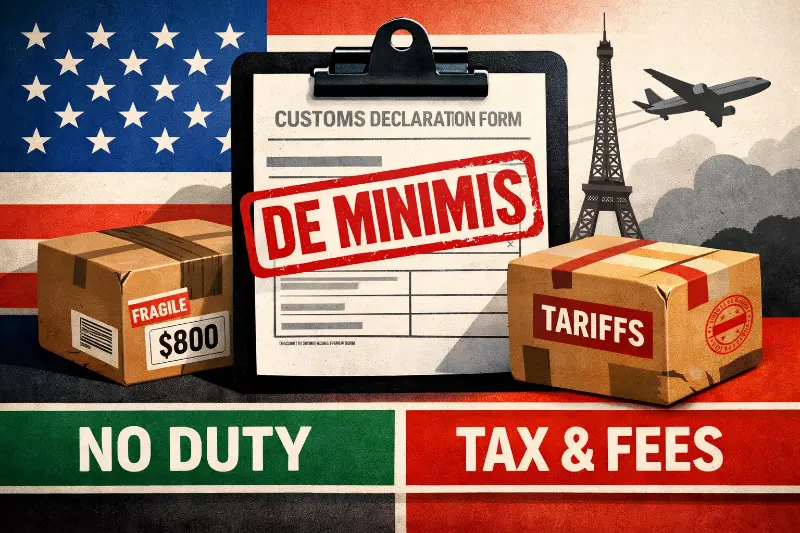
The de minimis exemption (the customs rule that let goods valued under $800 enter the U.S. duty-free with almost no paperwork) is gone. Suspended globally by executive order in August 2025 and permanently repealed effective July 2027, de minimis was the invisible policy engine behind the explosive growth of ultra-cheap cross-border ecommerce. Its elimination reshapes competitive dynamics, supply chain economics, and strategic planning for every ecommerce brand touching international trade. The importance of the de minimis threshold extends beyond trade, influencing legal services, regulatory standards, and the way minimal impacts are treated in law. Whether you benefited from de minimis or competed against those who did, the changes demand attention.
August 2026 update: On August 13, 2026, the U.S. Court of International Trade upheld the president’s authority under the International Emergency Economic Powers Act (IEEPA) to suspend duty-free de minimis treatment. The ruling makes a near-term return of the $800 exemption far less likely before Congress’s permanent repeal takes effect on July 1, 2027.
A Single Customs Rule Quietly Powered Cross-Border Ecommerce
De minimis (Latin for “about minimal things”) is a customs concept with a straightforward premise: when the cost of collecting duties on a low-value shipment exceeds the revenue generated, it makes more sense to let the package through. The U.S. codified this idea in Section 321 of the Tariff Act of 1930, setting a value threshold below which imported goods skip customs duties, import taxes, and most of the bureaucratic machinery of formal customs entry.
The threshold started small (just $1 in 1938) and stayed low for decades. Congress bumped it to $5 in 1978 and $200 in 1993. Then came the pivotal change: the 2016 Trade Facilitation and Trade Enforcement Act raised the threshold to $800, four times the previous level and one of the most generous de minimis thresholds in the world. For comparison, the EU’s duty threshold sat at €150, Canada’s at CAD $150, Mexico’s at $50, and China’s at roughly $7.
What made de minimis powerful wasn’t just the duty savings. It was the entire layer of friction it removed. Under normal formal customs entry, an importer must file extensive documentation—including a complete commercial invoice and customs bond, entry summaries, 10-digit tariff classification codes—and pay merchandise processing fees, harbor maintenance fees, and applicable duties. This process typically requires a licensed customs broker and can take days. De minimis shipments skipped virtually all of it. A qualifying package needed only basic manifest data (origin, destination, description, value) and cleared customs in hours, often same-day, with zero duty and zero fees.
Having a business account with a shipping provider like DHL Express can help small and medium enterprises (SMEs) better understand tariffs and streamline logistics processes, making compliance with de minimis regulations more efficient.
This distinction matters enormously at scale. A domestic retailer importing a container of apparel pays 23.8% average tariff on the shipment value, plus brokerage fees, processing fees, and compliance costs. A foreign seller shipping that same apparel as individual $30 packages directly to consumers paid nothing. Same product, radically different cost structures.
Additionally, the IRS allows companies to immediately expense certain tangible property under a de minimis threshold, simplifying asset management and reducing administrative burden for qualifying purchases.
The $54 Package That Built a $66 Billion Trade Channel
The 2016 threshold increase coincided with something no one fully anticipated: the rise of Chinese direct-to-consumer ecommerce platforms. Shein, Temu, and AliExpress built fulfillment models that treated de minimis not as an incidental benefit but as a core operational advantage. The surge in de minimis shipments was largely attributed to the rise of direct-to-consumer e-commerce platforms, particularly those like Shein and Temu. Orders placed by American consumers were routed directly to factories and warehouses in Guangzhou and Shenzhen, packed as individual shipments, and flown to the U.S. where they cleared customs under Section 321 with minimal friction.
The numbers tell the story of explosive growth. De minimis shipments entering the U.S. rose from 134 million in 2015 to over 1.36 billion in 2024 (roughly a tenfold increase in under a decade). By 2024, CBP was processing more than 4 million de minimis packages per day, and these shipments represented 92% of all cargo entries into the country by volume. The average declared value was just $54 per package, well below the $800 threshold.
China dominated the flow. More than 60% of all de minimis shipments originated from China, and the scale of individual platforms was staggering. The House Select Committee on the Chinese Communist Party estimated that Shein and Temu together shipped approximately 600,000 packages per day to U.S. consumers (accounting for roughly 30% of all daily de minimis entries). China’s low-value package exports grew from $5.3 billion in 2018 to $66 billion in 2023, more than a tenfold increase.
The business model de minimis enabled went beyond duty avoidance. Foreign sellers gained cash flow advantages (no need to pre-purchase bulk inventory), eliminated warehousing costs and inventory risk (goods shipped only after consumer orders), and leveraged lower labor costs for pick-and-pack operations. Consumers received products at prices domestic competitors couldn’t match. Coresight Research found these platforms offered products at roughly one-third the price of comparable goods on Amazon. Standard delivery times of 7 to 14 days were acceptable for price-sensitive shoppers.
Domestic Brands Faced a Structural Disadvantage They Didn’t Create
The competitive asymmetry de minimis created was not subtle. Two companies selling the same $30 t-shirt to the same American consumer operated under fundamentally different economic rules. The domestic brand importing inventory through normal channels paid full duties, customs brokerage fees, merchandise processing fees, and bore the costs of compliance with product safety and labor standards. The foreign seller shipping individual packages under de minimis paid none of these costs and faced minimal regulatory scrutiny (CBP physically inspected fewer than 1% of de minimis shipments). The de minimis exemption previously allowed the importation of cheap goods, benefiting American buyers seeking affordable products.
The disparity extended beyond tariffs. The Retail Industry Leaders Association pointed out that domestic retailers collected and remitted sales taxes and complied with consumer protection laws, while foreign sellers often bypassed these obligations. The House Select Committee found that Temu conducted zero audits for compliance with the Uyghur Forced Labor Prevention Act, which requires importers to demonstrate goods were not produced with forced labor (a compliance burden domestic importers bear on every shipment).
Forever 21’s March 2025 bankruptcy filing became the most visible casualty. The company explicitly blamed Shein and Temu’s de minimis-enabled pricing in court filings, noting it had lost over $400 million across three fiscal years. Data showed 43% of Forever 21 shoppers also shopped at Shein, spending $253 per year on the platform (up 17% year over year) while their Forever 21 spending dropped 12%. The National Council of Textile Organizations attributed the closure of 18 U.S. yarn-spinning and clothing factories over 18 months partly to de minimis-fueled import competition.
For the buyer, perception of a company’s ability to deliver quality products and maintain credibility plays a significant role in purchasing decisions, especially when choosing between domestic and foreign sellers. The product categories hit hardest were fast fashion and apparel (where average tariffs reach 23.8%), small consumer electronics, home goods, and beauty products (precisely the categories where Chinese platforms concentrated their offerings).
Enforcement Gaps and Safety Concerns Accelerated Policy Change
Pressure to reform de minimis built from multiple directions simultaneously, drawing bipartisan support in Congress and action from both the Biden and Trump administrations.
The enforcement picture was alarming. CBP reported that in fiscal year 2024, 90% of all cargo seizures originated as de minimis shipments. That included 98% of narcotics seizures by case count, 97% of intellectual property rights seizures (31 million counterfeit items), and 77% of health and safety seizures (over 20 million prohibited items including weapons parts). CBP investigators found fentanyl in international mail parcels averaging over 90% purity (compared to less than 10% at the land border). The sheer volume of packages made meaningful inspection impossible; at JFK Airport alone, the international mail facility received up to one million de minimis packages daily.
Revenue losses compounded the concern. The government estimated it forfeited $3 to 4 billion annually in uncollected tariffs on de minimis shipments. The White House projected that ending the exemption could generate up to $10 billion per year in additional tariff revenue.
The policy response came in stages. The Biden administration proposed enhanced data requirements for low-value shipments in September 2024. Bipartisan bills emerged in Congress, including the FIGHTING for America Act and the Closing the De Minimis Loophole Act, co-sponsored by senators from both parties. Then the changes accelerated sharply:
- May 2, 2025: Executive order eliminated de minimis for goods from China and Hong Kong
- July 2025: The “One Big Beautiful Bill Act” permanently repealed and amended the statutory de minimis provision, effective July 1, 2027
- August 29, 2025: Executive order suspended de minimis for all countries globally
- February 20, 2026: The Supreme Court ruled that IEEPA does not authorize the president to impose new tariffs, but it did not decide whether IEEPA permits the withdrawal of de minimis treatment
- August 13, 2026: The U.S. Court of International Trade ruled that IEEPA does authorize the president to rescind the de minimis exemption
August 2026 Court Ruling Keeps De Minimis Closed
On August 13, 2026, a three-judge panel of the U.S. Court of International Trade issued its decision in Axle of Dearborn, Inc. v. Department of Commerce, rejecting a challenge brought by the auto-parts importer that does business as Detroit Axle. The company argued that IEEPA—the emergency-powers law the administration relied on—did not authorize the president to eliminate the exemption. Its case gained significance after the Supreme Court ruled in February 2026 that IEEPA does not authorize the president to impose tariffs.
The trade court drew a narrower distinction. Congress expressly described de minimis treatment as a “privilege,” and IEEPA authorizes the president to nullify or void the exercise of certain privileges during a declared national emergency. According to the court, withdrawing de minimis treatment does not create a new tariff; it makes low-value imports subject to duties already established by Congress. The court also held that the federal agencies carrying out the president’s directive acted ministerially, so their implementation was not reviewable under the Administrative Procedure Act.
For ecommerce operators, the practical takeaway is straightforward: the court upheld the current suspension, closing the most direct legal route to restoring the $800 exemption before the statutory repeal takes effect on July 1, 2027. Further review or policy changes remain possible, but brands should not build pricing or fulfillment plans around de minimis returning. Low-value imports should be modeled as fully subject to applicable duties, customs data requirements, and entry procedures.
De minimis provisions are designed to prevent minor, technical breaches from resulting in legal action, ensuring that only significant violations trigger enforcement.
The U.S. is not alone. The EU reached political agreement in November 2025 to abolish its €150 duty exemption, implementing a flat €3-per-item duty starting July 2026 (explicitly citing the U.S. elimination and concern about diverted ecommerce flows). The UK signaled removal of its £135 threshold by 2029. The global trend toward eliminating low-value import exemptions is unmistakable.
Cross-Border Shipping to Other Countries
When it comes to cross-border shipping, the de minimis rule is a critical factor that can shape the cost, speed, and complexity of international trade. The de minimis exemption allows shipments valued below a certain threshold to enter a country without being subject to customs duties or import taxes, making it easier and more affordable for businesses and buyers alike. However, the de minimis threshold varies widely from country to country, and understanding these differences is essential for any company engaged in global ecommerce.
For example, Canada enforces a de minimis threshold of just USD 20, meaning that any shipment valued above this amount is subject to import duties and taxes. In contrast, the European Union sets an average de minimis value around USD 190, though individual member states may have their own specific limits. These thresholds directly impact the landed price of goods, the duties owed, and the overall shipping strategy a business must adopt. If a shipment’s value exceeds the de minimis level in a given country, it becomes subject to additional customs duties, taxes, and regulatory requirements, which can increase costs and cause delays.
Businesses must pay close attention to the de minimis rules in each target market to ensure compliance and avoid costly penalties or shipment seizures. This means not only understanding the face value thresholds but also staying up to date with any changes in regulations, as these can shift with new trade agreements or policy updates. Factoring in the de minimis exemption when setting product prices and shipping policies can help companies remain competitive while minimizing risk.
The de minimis rule also affects the buyer’s experience. If customers are unaware of potential duties or taxes that may apply when the de minimis threshold is exceeded, they may face unexpected charges upon delivery, leading to disputes or dissatisfaction. To mitigate this risk, it’s important for businesses to clearly communicate all terms, including any applicable duties, taxes, and the de minimis level for the destination country, at the point of purchase. By proactively managing compliance and customer expectations, companies can streamline cross-border shipping, reduce penalties, and build trust in international markets.
European Union Regulations
The European Union has established its own framework for the de minimis exemption, aiming to balance the facilitation of trade with the need to prevent abuse and ensure fair competition across member states. The de minimis rule in the EU is rooted in the legal principle “de minimis non curat lex”—the law does not concern itself with trifling matters. In practice, this means that shipments valued below the de minimis threshold are generally exempt from customs duties and, in some cases, from certain taxes. However, the application of the de minimis exemption in the EU is nuanced and subject to ongoing regulatory changes.
Within the EU, the de minimis threshold for customs duties typically ranges from EUR 10 to EUR 150, depending on the country and the nature of the goods. While shipments under this value are usually exempt from customs duties, they may still be subject to value-added tax (VAT) or excise duties, which can vary by member state. This layered approach means that even if a shipment is considered de minimis for customs purposes, it may still incur other charges under EU tax law.
To prevent misuse of the de minimis exemption, the European Union has implemented stricter controls and monitoring of low-value shipments. This includes enhanced data requirements, increased scrutiny of declared values, and targeted enforcement to ensure that businesses comply with all relevant rules and regulations. Companies shipping to the EU must be diligent in understanding the specific de minimis threshold and exemption rules for each country, as failure to comply can result in penalties, fines, or even reputational harm.
Navigating the EU’s de minimis regulations requires a thorough understanding of both the letter and the spirit of the law. Businesses should regularly review their compliance processes, seek professional advice when necessary, and stay informed about regulatory updates that may affect their cross-border shipping strategy. By doing so, they can take full advantage of the de minimis rule where applicable, while minimizing the risk of penalties and ensuring smooth, efficient trade within the European Union.
What the End of De Minimis Means for Ecommerce Strategy Now
The practical consequences are already visible. Cross-border parcel volumes entering the U.S. dropped 54% following the global suspension. Shein and Temu saw 11 to 23% declines in U.S. sales and cut advertising spend by roughly 20%. Average delivery times from China stretched from 7 to 10 days to 14 to 21 days. Nearly 40% of online shoppers reported they would abandon carts when faced with tariff surcharges at checkout.
Both Shein and Temu pivoted rapidly to U.S.-based fulfillment, bulk-importing inventory to domestic warehouses (the same model domestic retailers have always used). Temu announced in May 2025 that all U.S. orders would ship from locally based sellers. Consumer Edge research from April 2025 showed domestic retailers including Old Navy, Nordstrom Rack, and Ulta Beauty capturing meaningful spending as shoppers shifted away from Chinese platforms.
For ecommerce operators, the strategic calculus has shifted in several concrete ways. Brands that sourced products internationally and shipped directly to consumers under de minimis must now model fully loaded landed costs (duties, brokerage fees typically $3 to $15+ per shipment, compliance documentation, and longer clearance times). If a shipment exceeds the de minimis threshold, it triggers additional regulatory requirements and duties. A $50 product with a 17.5% duty and broker fee sees landed cost rise to approximately $62, a 23.5% increase that must be absorbed or passed through to consumers. Recalculating landed costs helps businesses understand true shipping costs per order and adjust retail pricing accordingly.
Domestic brands that competed against de minimis-advantaged sellers now operate on a more level playing field, though they should note that some domestic brands also used de minimis for certain fulfillment flows. In business tax planning, understanding income thresholds and taxable income is crucial, as de minimis rules can affect state income tax and other financial regulations. Additionally, under U.S. tax regulations, small amounts of market discount on bonds are treated as de minimis, meaning they may be subject to different tax treatment compared to larger discounts. Wells Fargo estimated a $0.90 to $1.10 EPS headwind for Lululemon, and Tapestry (parent of Coach) projected over $160 million in profit reduction from the change.
Preparing for the New Landscape Requires Concrete Steps
The elimination of de minimis is not a temporary disruption. It is a structural change to the cost of cross-border commerce. Brands that built supply chains, pricing models, or competitive strategies around the exemption need to adapt.
The most critical step is auditing de minimis exposure across your product catalog. Audit your exposure. Identify which SKUs, shipping lanes, and fulfillment flows previously relied on sub-$800 entries. Calculate the duty impact by product category and origin country (tariff rates vary enormously, from single digits to over 50% depending on product classification and country of origin).
Operationally, the shift favors bulk importing with domestic fulfillment over direct-to-consumer cross-border shipping. Ocean container freight remains far more cost-effective per unit than paying duties on individual parcels (where flat-rate fees of $80 to $200 per package can exceed the product’s value). Exploring express shipping consolidation can also cut costs by combining multiple shipments under one customs entry. Investing in U.S.-based warehousing and third-party logistics relationships is increasingly essential. Opening a DHL Express Business Account can help SMEs navigate tariffs and de minimis changes more efficiently.
Recalculate your unit economics. Landed cost modeling must now incorporate duties, customs brokerage, compliance overhead, and potentially longer fulfillment timelines. For brands with thin margins, this recalculation may reveal that certain products or sourcing arrangements are no longer viable.
Invest in compliance infrastructure. Accurate tariff classification (HTS codes) is now required for every shipment regardless of value. Misclassification triggers penalties (the new law established civil penalties of $5,000 for first offenses and $10,000 for subsequent violations). Working with a licensed customs broker and investing in automated classification tools is no longer optional for brands shipping internationally. The majority of businesses are adopting best practices such as regular compliance audits and staff training to minimize risk. Utilizing services like compliance support and logistics providers can help companies adapt to the evolving regulatory landscape.
Explore structural advantages. Foreign Trade Zones and bonded warehouses allow duty deferral or elimination until goods enter domestic commerce. Duty drawback programs can recover duties on goods that are re-exported or returned. These mechanisms have long existed for large importers but are increasingly relevant for ecommerce-scale operations.
Monitor implementation and any further appeals, but do not plan around the exemption returning. The Court of International Trade rejected the primary challenge to the executive suspension in August 2026, and Congress’s statutory repeal takes effect on July 1, 2027. The remaining uncertainty is more likely to involve duty rates, customs procedures, enforcement mechanisms, and country-specific trade actions than a dependable revival of the $800 exemption.
For employees, de minimis fringe benefits—such as occasional coffee, snacks, or other small perks provided by the employer—are not considered taxable income under current US tax rules. These small-scale benefits are generally excluded from an employee’s gross income, making them a practical and compliant way to offer minor perks.
Finally, build duties transparently into your pricing and checkout experience. Delivered Duty Paid workflows that show consumers the full landed cost upfront reduce cart abandonment and returns friction. Offering duty/tax prepayment and real-time tracking builds customer trust in a brand. Surprising customers with unexpected duties at delivery is a fast path to losing them.
De Minimis Was Never Permanent
De minimis was never a permanent feature of trade. It was a policy threshold, set by statute and adjusted repeatedly over nine decades.
The dramatic expansion of De minimis in 2016 and subsequent exploitation by cross-border ecommerce platforms created a temporary competitive environment that reshaped consumer expectations and retail economics. A domestic brand importing apparel from China faced combined tariff rates that could exceed 40% (base duty plus Section 301 tariffs), plus $150 to $250 per formal customs entry, plus warehousing costs of $6 to $15 per pallet per month. A Shein or Temu seller shipping the same garment directly to the consumer paid zero on all of these line items. The domestic brand’s only advantage was faster delivery (one to five days versus seven to fourteen), but for price-sensitive consumers, that tradeoff increasingly favored the cross-border seller. Absorbing duties and taxes upfront can reduce cart abandonment caused by surprise doorstep fees, helping a company improve customer experience and conversion rates.
Its elimination in 2025 represents an equally significant shift, underscoring the importance of understanding this policy change for businesses engaged in global trade. The end of the de minimis exemption presents a significant challenge but also an opportunity for businesses to craft a global shipping strategy. The brands best positioned going forward are those that understand de minimis not as an entitlement that was taken away or a loophole that was closed, but as a variable in the operating environment that has changed and will likely continue to change. Building supply chain flexibility, maintaining accurate compliance systems, and modeling scenarios around evolving trade policy are now baseline requirements for any ecommerce operation with international exposure.
Frequently Asked Questions
What is de minimis in ecommerce and cross-border shipping?
De minimis is a customs threshold that allowed imported goods below a certain value to enter a country without paying customs duties, taxes, or filing formal entry paperwork. In the U.S., Section 321 of the Tariff Act of 1930 established this exemption. From 2016 until its suspension in 2025, the U.S. threshold was $800 per shipment, meaning packages valued under that amount cleared customs with minimal documentation and zero duties. This made cross-border direct-to-consumer shipping economically viable at scale for foreign sellers.
How did de minimis affect ecommerce shipping costs and delivery speed?
De minimis eliminated customs duties, brokerage fees, and processing fees for qualifying shipments, dramatically reducing the landed cost of imported goods. It also removed the need for formal customs entry documentation, allowing packages to clear customs in hours rather than days. This enabled foreign platforms like Shein and Temu to offer products at roughly one-third the price of domestic competitors while maintaining 7 to 14 day delivery times. Domestic retailers importing through normal channels paid full duties (averaging 23.8% for apparel) plus brokerage and compliance costs that de minimis shipments avoided entirely.
Why did the U.S. eliminate the de minimis exemption?
The elimination resulted from multiple converging pressures: competitive concerns (domestic brands faced structural disadvantages they couldn’t control), enforcement gaps (90% of cargo seizures originated as de minimis shipments, including narcotics and counterfeit goods), safety issues (CBP inspected fewer than 1% of the 4 million daily de minimis packages), revenue loss ($3 to 4 billion annually in uncollected tariffs), and compliance circumvention (foreign sellers bypassed labor, safety, and tax standards domestic companies must meet). The change drew bipartisan support and executive action from both Biden and Trump administrations.
When does the de minimis elimination take effect?
The elimination is already in force. An executive order removed de minimis for goods from China and Hong Kong on May 2, 2025, and the exemption was suspended globally on August 29, 2025. Congress also permanently repealed the statutory provision effective July 1, 2027. On August 13, 2026, the U.S. Court of International Trade upheld the president’s authority under IEEPA to maintain the suspension, making a near-term revival of the $800 exemption substantially less likely.
What did the August 2026 de minimis court ruling decide?
The U.S. Court of International Trade ruled that IEEPA allows the president to rescind duty-free de minimis treatment because Congress expressly defined it as a “privilege.” The court distinguished that action from imposing a new tariff: removing the exemption simply makes low-value imports subject to duties already authorized by Congress. The ruling therefore left the current suspension in place, although further appellate review remains possible.
How did marketplaces like Shein and Temu use de minimis?
These platforms built their entire U.S. business model around de minimis. Orders from American consumers routed directly to factories in China, where items were packed as individual sub-$800 shipments and air-freighted to the U.S. This eliminated the need to bulk-import inventory, maintain U.S. warehouses, or pay customs duties. Shein and Temu together shipped approximately 600,000 packages per day to U.S. consumers under de minimis (30% of all daily de minimis entries). The model enabled pricing roughly one-third lower than domestic competitors, with acceptable 7 to 14 day delivery times.
What happens to cross-border ecommerce shipments now that de minimis is suspended?
All commercial shipments entering the U.S., regardless of value, now require formal customs entry with full documentation, tariff classification, duty payment, and brokerage. A $50 product with 17.5% duty and brokerage fees sees landed cost rise to approximately $62 (a 23.5% increase). Customs clearance takes days instead of hours. Many foreign sellers have shifted to U.S.-based fulfillment (bulk-importing inventory to domestic warehouses), eliminating the direct-from-factory model. Cross-border parcel volumes dropped 54% following the global suspension, and platforms like Shein and Temu saw 11 to 23% sales declines.
How should domestic ecommerce brands respond to the de minimis elimination?
Domestic brands that competed against de minimis-advantaged sellers now operate on a more level playing field. However, some domestic brands also used de minimis for certain fulfillment flows and must adapt. Key actions include auditing which SKUs and shipping lanes previously relied on sub-$800 entries, recalculating unit economics with duties and brokerage fees included, investing in customs compliance infrastructure (accurate HTS codes are now required for all shipments), exploring Foreign Trade Zones or bonded warehouses for duty deferral, and monitoring ongoing policy developments as trade rules continue to evolve through 2027.
What are the ongoing risks and uncertainties around de minimis policy?
The Court of International Trade upheld the executive suspension in August 2026, so the ruling did not restore de minimis. Further appellate review or policy changes remain possible, and Congress’s statutory repeal does not take effect until July 1, 2027. The more immediate uncertainties concern applicable duty rates, customs procedures, enforcement, and possible country-specific trade actions. Other markets are also tightening low-value import rules: the EU is eliminating its €150 threshold in July 2026, and the UK plans to remove its £135 threshold by 2029.
Written By:

Indy Pereira
Indy Pereira helps ecommerce brands optimize their shipping and fulfillment with Cahoot’s technology. With a background in both sales and people operations, she bridges customer needs with strategic solutions that drive growth. Indy works closely with merchants every day and brings real-world insight into what makes logistics efficient and scalable.

Turn Returns Into New Revenue
Related Articles

Save Money With Ecommerce Shipping Software: Next-Gen Solutions
Shipping costs are one of the biggest challenges for ecommerce businesses today, and understanding them is essential to reducing expenses and increasing profit margins.
Shipping Software for Ecommerce Fulfillment: The Next Generation of Shipping Simplified
Ecommerce has transformed the way people shop, but behind every seamless online purchase is a complex fulfillment operation.

10 Best European 3PLs for Ecommerce Sellers in 2026
Bigblue is the best overall choice among the best European 3PLs in this comparison: one provider with 11 fulfilment centres across France, Spain, Italy, the UK, and Germany, its ow...