
What Is JIT Management? Benefits, Risks, and When It Works

Last updated on April 29, 2026
 17 minutes
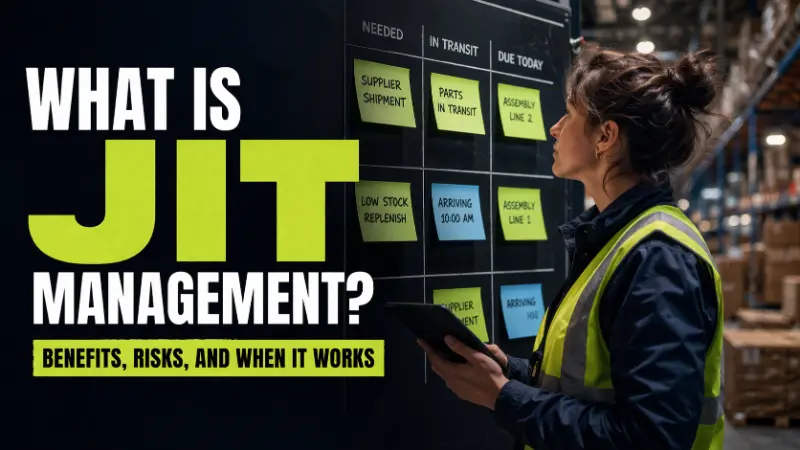
JIT management, short for Just-in-Time, is an inventory and production approach where goods are acquired, produced, or replenished only when they are needed to fulfill demand, rather than being stockpiled in anticipation of future orders. JIT is a strategy for optimizing business operations by streamlining workflows and improving efficiency across the company. The core premise is simple: just-in-time inventory held in a warehouse costs money without generating revenue, so the goal is to have as little of it as possible while still meeting customer demand.
In practice, JIT is not primarily an inventory strategy. It is a bet on supply chain reliability. The JIT inventory methodology is a production and inventory management strategy focused on minimizing inventory levels by producing and ordering goods only as needed. The entire model functions on the assumption that suppliers will deliver on time, that demand can be forecast accurately enough to trigger replenishment at the right moment, and that nothing in the chain between raw material and customer will break. When those assumptions hold, JIT delivers real and measurable operational advantages. When they do not, the absence of buffer inventory means the impact of any disruption is immediate and total.
How JIT Management Works
JIT operates on a pull system rather than a push system. In a traditional push inventory model, a business forecasts what it expects to sell, builds or orders that quantity, and pushes it into stock ahead of demand. In a JIT pull model, production or replenishment is triggered by actual demand signals rather than forecasts. Nothing is made or ordered until something downstream signals that it is needed.
The most well-known implementation is Toyota’s Production System, developed in Japan in the 1950s and 1970s. Toyota used Kanban cards, visual signals that triggered replenishment of components on the production line only when existing supply was depleted. The JIT manufacturing and manufacturing process at Toyota are optimized using the JIT method, which focuses on producing goods only as needed to minimize excess inventory and reduce costs. The goal was to produce exactly what was needed, in exactly the right quantity, at exactly the right time. Toyota received components from suppliers often within hours of installation on the assembly line, eliminating the warehouse of parts that most manufacturers assumed was necessary.
Dell provides the most widely cited modern example. Rather than building computers in advance and hoping customers would buy the configurations in stock, Dell assembled machines only after customers placed orders. Dell uses expected sales to align inventory with demand, ensuring components are ordered and stocked based on anticipated customer purchases. Components were delivered from suppliers in tight windows aligned with the production schedule. This allowed Dell to avoid the inventory obsolescence that plagued competitors who stocked finished goods that were already outdated by the time they sold.
For ecommerce and retail operations, JIT translates into ordering replenishment inventory from suppliers in smaller, more frequent batches timed to current sales velocity, rather than large periodic orders based on forecasted future demand. Inventory management systems and advanced ecommerce shipping software and ecommerce fulfillment software with smart inventory placement help monitor stock levels and reduce inventory waste by providing real-time tracking and automated alerts, ensuring that inventory is replenished only as needed. The warehouse or fulfillment center carries less on hand at any given time, which reduces storage costs, cuts the risk of dead stock, and keeps working capital from being locked in unsold goods.
The mechanics require three things to function: accurate demand forecasting to know when to trigger a replenishment order, reliable suppliers who can deliver within tight lead-time windows, and real-time inventory visibility to know when stock is reaching the reorder point. The importance of time JIT inventory is critical in ensuring timely replenishment, as goods must arrive exactly when needed to avoid stockouts and minimize inventory waste. Remove any one of those and the system begins to fail.
Supply Chain Considerations
Implementing a JIT inventory system hinges on the strength and reliability of your entire supply chain. Unlike traditional inventory strategies that rely on buffer stock to absorb shocks, JIT inventory management demands that every link in the chain—from raw materials to finished goods—operates with precision and minimal delay. This means that even minor supply chain disruptions, such as transportation delays or supplier hiccups, can halt production and jeopardize customer satisfaction, which is why robust order fulfillment integrations with marketplaces and shipping carriers are so important for real-time coordination.
To build a resilient JIT inventory management system, businesses must prioritize relationships with reliable suppliers who can consistently deliver on tight schedules. Establishing clear communication channels and performance expectations with suppliers is essential, as is developing contingency plans for unexpected disruptions. For example, identifying alternative suppliers or diversifying sourcing regions can help mitigate the risk of a single point of failure in your supply chain, and addressing key obstacles to building an efficient supply chain helps ensure your lean strategy remains resilient.
Accurate demand forecasting is another cornerstone of effective JIT inventory management. By analyzing sales trends, seasonality, and market shifts, businesses can align production schedules and inventory levels more closely with actual customer demand. This reduces the risk of excess inventory and unsold stock, while ensuring that enough inventory is always available to meet customer orders. Leveraging inventory management software with real-time inventory tracking and automated alerts can further enhance visibility and control, allowing businesses to respond quickly to changes in demand or supply chain conditions.
The Toyota Production System (TPS) exemplifies how integrating continuous improvement and waste reduction into every aspect of the production process—including supply chain management—can yield substantial cost savings and efficiency gains. TPS’s focus on minimizing waste, streamlining inventory movements, and fostering a culture of ongoing improvement has set the standard for JIT inventory systems worldwide. By adopting similar principles, businesses can tailor their JIT strategy to their unique operational needs, driving both production efficiency and customer satisfaction.
For ecommerce businesses, managing a JIT inventory system presents unique challenges. Inventory must often be tracked across multiple sales channels and fulfillment centers, making real-time visibility and coordination even more critical. Implementing robust inventory management software, leveraging order fulfillment services for ecommerce companies, and choosing the right warehousing services provider can automate replenishment, monitor inventory levels across locations, and help manage inventory during demand spikes—ensuring that customer demand is met without accumulating excess stock or incurring unnecessary storage costs.
Ultimately, the success of a JIT inventory management system depends on the ability to manage inventory proactively across the entire supply chain. By investing in reliable supply chain partnerships, leveraging technology for real-time inventory control, and continuously refining supply chain processes, businesses can reduce inventory costs, minimize waste, and improve production efficiency. Staying current with logistics, fulfillment, and supply chain events and educational webinars on ecommerce logistics and multi-channel fulfillment can also inform strategic improvements. This not only enhances customer satisfaction but also provides a competitive edge in today’s fast-paced markets.
The Real Benefits of JIT
The financial case for JIT is straightforward when the conditions support it.
Reduced inventory holding costs are the most direct benefit. Inventory sitting in a warehouse generates costs that accumulate continuously: storage fees, insurance, labor to manage and count it, and the risk of deterioration or obsolescence. Industry estimates consistently place inventory carrying costs at 20 to 30 percent of inventory value per year. A business holding $500,000 in average inventory is spending $100,000 to $150,000 annually just to keep it there. JIT reduces the average inventory on hand, which compresses those costs proportionally. Additionally, JIT helps minimize labor costs by reducing the amount of handling and storage required, streamlining operations and lowering overall labor expenses.
Improved cash flow follows directly. Capital that would have been tied up in excess stock is freed for other uses: marketing, product development, operational improvements, or debt reduction. For growth-stage ecommerce brands where cash flow is often the binding constraint, this is a meaningful advantage. Every dollar not sitting on a shelf is a dollar available to fund growth. By maintaining minimal inventory, JIT helps reduce costs and improve efficiency, ensuring resources are used more effectively across the business.
Reduced dead stock and obsolescence risk is a benefit that compounds over time. Brands that consistently overorder relative to demand accumulate slow-moving inventory that eventually becomes unsellable. JIT’s discipline of ordering to actual demand rather than optimistic forecasts prevents the structural overbuying that generates dead stock. For product categories with short life cycles, like consumer electronics, seasonal apparel, or trend-driven goods, this is operationally significant. Regularly identifying and clearing obsolete inventory is also crucial for optimizing storage space, reducing costs, and improving overall inventory efficiency.
Improved quality control emerges as a secondary benefit, particularly in manufacturing contexts. When production runs are smaller and more frequent, defects are identified faster because there is less in-process inventory to absorb and conceal them. A production defect on a batch of 100 units is caught after 100 units. On a batch of 10,000 units, it may not surface until the entire batch has moved downstream. JIT practices contribute to minimizing costs and improve efficiency throughout the production process by enabling faster detection and correction of issues.
The Risks That Are Systematically Underweighted
The risks of JIT are not theoretical. They are structural, and recent supply chain history has illustrated them at scale.
Supply chain disruption is the defining vulnerability. JIT eliminates the buffer inventory that absorbs shocks. When a supplier misses a delivery, when a port is congested, when a weather event delays inbound freight, or when a carrier capacity crunch extends lead times, a JIT operation has no reserve to draw from. Production halts. Fulfillment pauses. Customer orders cannot ship. The 1997 Aisin fire, which destroyed the sole facility supplying Toyota’s brake valves, nearly brought the entire Toyota production network to a standstill within days because there was no safety stock. The COVID-19 pandemic produced the same phenomenon at global scale, exposing how many industries had adopted JIT principles without building the supplier redundancy and geographic diversification that Toyota spent decades developing alongside its lean practices. Additionally, if demand drops unexpectedly, the lack of buffer inventory can result in unsold inventory that cannot be easily stored or managed—an issue frequently highlighted in news about evolving ecommerce fulfillment networks and partnerships.
Demand forecasting error is amplified, not buffered. In a JIT system, an unexpected demand spike cannot be met from stock because there is no meaningful stock to draw from. When demand exceeds forecast, the response is entirely dependent on how fast the supply chain can accelerate. If supplier lead times are four weeks and demand spikes in week one, customers wait four weeks or go elsewhere. Brands that adopt JIT without significantly investing in forecast accuracy essentially exchange one operational risk for another.
Single-supplier dependency is a concentration risk. JIT typically requires close, reliable relationships with a small number of preferred suppliers to achieve the lead-time precision the model demands. That concentration creates fragility. A supplier experiencing a labor dispute, a quality failure, a financial crisis, or a natural disaster puts the entire JIT-dependent operation at risk. Toyota’s own experience during semiconductor shortages in 2021 and 2022 demonstrated that even decades of supply chain mastery cannot fully immunize against disruption when the failure is systemic across an entire industry.
Loss of volume discounts is a real but often overlooked cost. JIT’s smaller, more frequent orders sacrifice the per-unit pricing advantage that comes with large batch purchases. Depending on the product and supplier relationship, this cost can partially or fully offset the holding cost savings that JIT is supposed to deliver. However, for businesses with limited storage space, the benefits of reducing inventory levels and minimizing the need for additional storage space may outweigh the loss of volume discounts.
JIT also helps optimize storage space by reducing the need for large warehouses, allowing businesses to operate more efficiently and lower their storage costs.
The Contrarian View: JIT Is Widely Misunderstood
One of the most persistent misconceptions about JIT is that its core purpose is to minimize inventory. This framing is wrong, and it is the source of much of the criticism JIT received following supply chain failures during the pandemic. While maintaining minimal inventory is a visible feature of JIT systems, the true goal is to create a responsive, efficient process that meets customer demand without unnecessary waste.
Toyota did not design JIT to minimize inventory. It designed JIT to expose waste and eliminate the root causes of production problems. Inventory, in Toyota’s framework, is a form of waste because it masks defects, covers up process inefficiencies, and hides supplier reliability issues. JIT forces problems to the surface by removing the buffer that conceals them. When a supplier is chronically unreliable, a JIT system will surface that unreliability immediately. In a high-inventory environment, the same unreliability can remain invisible for months because excess stock absorbs the delays. Just-in-time manufacturing, as developed in the Toyota Production System, focuses on waste reduction and continuous process improvement, not simply on reducing inventory levels.
The companies that adopted JIT principles purely to reduce inventory costs, without building the supplier relationships, process discipline, and continuous improvement culture that Toyota spent decades developing, were running a cost-reduction program, not a JIT program. They assumed the benefits without accepting the systemic commitments that make those benefits sustainable. When disruptions hit, they had the vulnerabilities of JIT without its underlying resilience mechanisms.
This matters for ecommerce brands evaluating JIT because the question is not whether to order less inventory. It is whether the entire operational and supplier ecosystem can support a lean model reliably enough to justify the absence of a buffer. For Amazon-focused brands, this includes aligning JIT practices with FBA constraints and maintaining a healthy Inventory Performance Index (IPI) score so storage limits do not undermine lean inventory strategies.
JIT in Ecommerce vs Manufacturing
JIT originated in manufacturing, where production cycles are relatively predictable, supplier relationships are long-term and deeply integrated, and demand signals from the assembly line are clear and continuous. These conditions are not replicated in most ecommerce environments, particularly in warehouse processes like pick and pack fulfillment for ecommerce orders.
Manufacturing JIT works because the trigger for replenishment is a physical signal in a controlled production process. Ecommerce JIT is working against consumer demand variability, longer and less predictable supplier lead times, seasonal and promotional spikes, and a customer base that expects immediate fulfillment regardless of what is in stock.
That does not mean JIT principles have no application in ecommerce. For stable, high-velocity SKUs with reliable supplier lead times, ordering in smaller, more frequent batches rather than large quarterly positions reduces holding costs and dead stock risk. For perishable goods or products with short shelf lives, JIT is essentially a necessity rather than a choice. For brands with limited warehouse space, reducing on-hand inventory through tighter replenishment cycles is operationally valuable. JIT also helps businesses optimize storage space by minimizing the amount of inventory kept on hand, freeing up valuable warehouse capacity and improving overall efficiency, which may eventually justify shifting from an in-house warehouse to a third-party logistics (3PL) provider.
Where JIT creates acute risk in ecommerce is in seasonal or trend-sensitive products where demand is inherently spiky and unpredictable, or where supplier lead times are long enough that a reorder triggered by current demand cannot arrive before stock depletes. The classic scenario: a brand operating near-JIT gets a viral social moment that drives 10x normal order volume. Supplier lead time is six weeks. The brand stocks out within 48 hours and spends six weeks apologizing to customers and watching competitors capture the demand they generated.
The practical ecommerce application of JIT is typically a hybrid: lean inventory positions on stable SKUs, with deliberately maintained safety stock on seasonal items, promotional inventory, and SKUs where the cost of a stockout in lost sales and customer lifetime value exceeds the carrying cost of the buffer. Effective time inventory management is crucial here, as coordinating replenishment and fulfillment based on real-time demand and operational timing helps minimize costs and increase efficiency and can even help turn ecommerce order fulfillment into a profit driver. The goal is not purity of the JIT model. It is the right amount of inventory for each SKU given its demand profile and supply chain reliability.
Frequently Asked Questions
What does JIT management mean?
JIT stands for Just-in-Time. JIT management is an inventory and operations approach where goods are ordered, produced, or replenished only when they are needed to fulfill actual demand, rather than being stocked in advance. The goal is to minimize inventory on hand while still meeting customer orders without delay.
Where did JIT originate?
JIT was developed as part of Toyota’s Production System in Japan in the decades following World War II. Toyota refined the approach through decades of supplier relationship building, process discipline, and continuous improvement culture. It became widely adopted in manufacturing globally during the 1980s and has since been adapted for retail and ecommerce contexts.
What are the main benefits of JIT inventory management?
The primary benefits are reduced inventory holding costs, improved cash flow from freeing capital previously tied up in stock, lower risk of dead stock and obsolescence, and greater operational efficiency. In manufacturing, JIT also tends to surface quality defects faster because smaller batch sizes make problems immediately visible.
What are the biggest risks of JIT?
The defining risk is supply chain disruption. JIT eliminates the buffer inventory that absorbs delays, so any failure in the supply chain, whether a supplier issue, a transportation delay, or a demand spike, has an immediate and direct impact on fulfillment. Overreliance on demand forecast accuracy, single-supplier concentration, and loss of volume discount pricing are additional structural risks.
Does JIT work for ecommerce businesses?
JIT principles can be applied in ecommerce, but rarely in their pure form. Ecommerce demand is more variable than manufacturing production schedules, and supplier lead times are often too long to support true JIT replenishment for all SKUs. Most ecommerce operations benefit from a hybrid approach: lean inventory positions on stable, predictable SKUs and deliberately maintained safety stock on seasonal, trend-sensitive, or high-value items where stockout costs are significant, especially for brands evaluating their Shopify order fulfillment options and 3PL strategies.
How is JIT different from just-in-case inventory management?
Just-in-case inventory management is the traditional approach of holding safety stock and buffer inventory to protect against demand variability and supply chain disruption. JIT replaces that buffer with reliable supply chains and accurate demand signals. JIT prioritizes cost efficiency and eliminates waste. Just-in-case prioritizes service continuity and resilience. Most sophisticated operations today use elements of both depending on the product and risk profile.
What conditions need to be in place for JIT to work effectively?
JIT requires accurate demand forecasting, reliable suppliers with consistent lead times, real-time inventory visibility, and strong supplier relationships. It also requires an organizational commitment to continuous improvement and the process discipline to identify and address problems before buffer inventory can mask them. Businesses without these foundations in place are taking on JIT’s risks without the operational infrastructure to manage them.
Written By:

Indy Pereira
Indy Pereira helps ecommerce brands optimize their shipping and fulfillment with Cahoot’s technology. With a background in both sales and people operations, she bridges customer needs with strategic solutions that drive growth. Indy works closely with merchants every day and brings real-world insight into what makes logistics efficient and scalable.

Turn Returns Into New Revenue

Related Articles

Why Returns Look Manageable Until They Suddenly Aren’t
Returns management is the retail process of handling customer returns across reverse logistics, cost control, and customer experience—and it rarely fails the way leadership expects...

The Economics of Peer-to-Peer Returns
Traditional returns management has one fundamental flaw: it optimizes a process that should not exist in its current form.

The Myth of “Efficient” Reverse Logistics
Efficient reverse logistics is treated as a goal worth chasing.