
What Is eBay Dropshipping? Rules, Risks, and How It Works

Last updated on June 22, 2026
In this article
 16 minutes
- Introduction to Dropshipping: Definition and Benefits
- Setting Up an eBay Dropshipping Business
- What eBay's Dropshipping Policy Actually Says
- The Retail Arbitrage Model and Why It Gets Sellers Suspended
- The Wholesale Supplier Model: What Allowed Actually Looks Like
- Discovering Winning Products
- Managing Orders and Shipping
- Marketing and Promoting Products
- Practical Risks Beyond Policy Violations
- What the eBay Policy Explicitly Prohibits: A Clear Summary
- Is eBay Dropshipping Worth It?
- Frequently Asked Questions
eBay dropshipping is a fulfillment model where a seller lists products on eBay without holding physical inventory, and when a sale is made, the order is fulfilled by a third-party supplier who ships directly to the eBay customer. The appeal is low upfront capital requirement and the ability to list a large product catalog without owning stock. The reality is that eBay’s dropshipping policy is narrow and specific, and many of the most common dropshipping practices that exist across the broader ecommerce ecosystem are explicitly prohibited on eBay.
Sellers who do not understand exactly where the line is between allowed and prohibited dropshipping on eBay are running accounts that are vulnerable to suspension. The policy has always had restrictions, but enforcement has tightened, and the consequences of violations range from listing removals to permanent account closure.
Introduction to Dropshipping: Definition and Benefits
Dropshipping is a flexible online business model that enables entrepreneurs to launch an eBay dropshipping business without the need to hold any store inventory. Instead of buying stock upfront, eBay sellers partner with a wholesale supplier who handles the storage and shipping of products directly to customers. This approach allows sellers to offer a wide variety of products in their online store without the risks and costs associated with managing inventory. One of the biggest advantages of dropshipping is the low barrier to entry—it’s possible to start making money online with minimal upfront investment. Sellers can focus their efforts on marketing and growing their business, while the supplier takes care of fulfillment. This makes dropshipping an attractive option for those looking to build an online business, expand their product range, and reach more customers on eBay without the traditional challenges of inventory management.
Setting Up an eBay Dropshipping Business
Launching a successful eBay dropshipping business starts with a simple strategy: find a reliable wholesale supplier that offers dropshipping services. Sellers can use online tools like SaleHoo or Worldwide Brands to research and connect with reputable suppliers. Once a supplier is chosen, the next step is to create an online store and start listing products on eBay. It’s important to ensure that each listing is optimized for search results, with competitive pricing and clear, compelling descriptions. Understanding and following eBay’s dropshipping policy is crucial—compliance helps avoid account issues and ensures a smooth operation. Sellers should also prioritize fast shipping, excellent customer satisfaction, and efficient management of returns. By focusing on these key areas, sellers can build a strong foundation for their dropshipping business and create a positive experience for their customers.
What eBay’s Dropshipping Policy Actually Says
eBay permits one specific form of drop shipping: selling goods sourced from a legitimate wholesale supplier, where the supplier fulfills the order by shipping directly to the buyer. eBay allows drop shipping only under strict conditions—sellers must comply with eBay’s dropshipping policy and ensure all inventory is sourced from wholesale suppliers, not retailers or marketplaces.
The policy language is straightforward on the permitted model. A seller who has a genuine wholesale relationship with a supplier, lists that supplier’s products, and has orders fulfilled directly by that supplier is operating in a way eBay formally allows. Dropshippers must avoid sourcing from other retailers and must send items directly from wholesale suppliers to comply with eBay’s rules. The seller takes full responsibility for the transaction from the buyer’s perspective, including delivery timelines, item condition, and any returns or disputes.
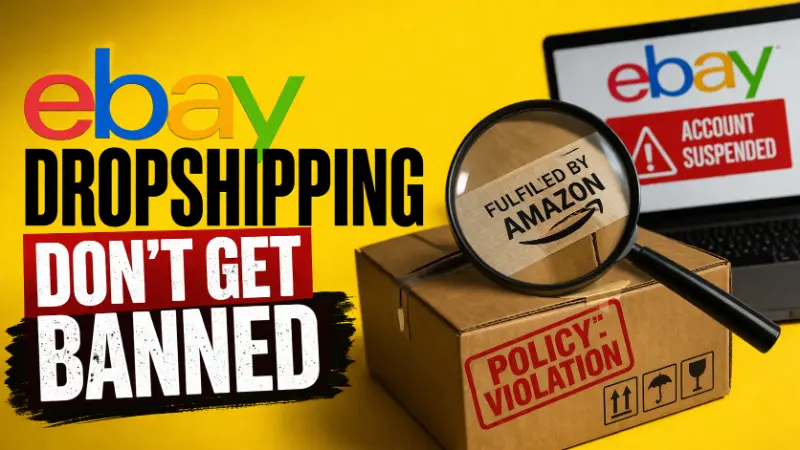
The policy is equally direct on what is not permitted. eBay explicitly prohibits purchasing items from another retailer or marketplace to fulfill orders. The prohibition covers Amazon, Walmart, AliExpress, and any other retail channel where a seller would buy a single unit to fulfill an eBay order. eBay also prohibits dropshipping from any source where the item would arrive in packaging that identifies a different retailer, such as an Amazon-branded box, as the origin of the shipment. eBay’s dropshipping policy was updated in January 2019 to specifically prevent sellers from sourcing products from large retailers like Walmart and Amazon.
The distinction eBay draws is between wholesale dropshipping, which involves genuine B2B sourcing relationships with suppliers, and retail arbitrage dropshipping, which involves using consumer retail platforms as fulfillment sources. The first is permitted with conditions. The second is prohibited.
The Retail Arbitrage Model and Why It Gets Sellers Suspended
The most common form of eBay dropshipping that new sellers attempt is listing products they find on Amazon, Walmart, or AliExpress, then purchasing from those platforms when an eBay order comes in. This practice is called retail arbitrage dropshipping, and it violates eBay policy directly.
The problems this creates go beyond policy compliance. When a seller sources from Amazon to fulfill an eBay order, the buyer receives an Amazon-branded package. The buyer, who has no idea they are dealing with a dropshipper, sees that they purchased on eBay but received an Amazon box with a receipt showing a lower price than they paid. This creates confusion, generates negative feedback, and often triggers buyer disputes that claim misrepresentation.
eBay’s systems detect indicators of this model at scale. An account that ships exclusively via retail courier tracking numbers from Amazon or Walmart logistics networks, that has delivery timelines inconsistent with stated handling times, or that generates high volumes of buyer complaints about packaging and delivery source is flagged algorithmically. Account suspension follows, and for sellers whose eBay account is their primary or sole revenue channel, that suspension is a significant business disruption.
The risk extends beyond individual listings. eBay permanently bans accounts found to be systematically in violation of the dropshipping policy, and attempts to create new accounts after a ban using the same personal or business details result in those accounts being suspended as linked to the original banned account.
The Wholesale Supplier Model: What Allowed Actually Looks Like
Permitted eBay dropshipping requires a genuine wholesale relationship with a supplier. That means the seller has established a business account with a manufacturer, distributor, or wholesale supplier, has agreed to pricing terms that differ from retail, and is sourcing product at a per-unit cost that allows a margin to exist after eBay fees and the fulfillment cost. Partnering with reliable suppliers that comply with eBay’s rules is crucial for dropshipping success.
In practice, this model works as follows. A seller identifies products in demand on eBay, sources them through a reliable wholesale supplier with a direct fulfillment arrangement, lists the products at a price that covers the wholesale cost plus eBay selling fees plus any margin target, and submits the buyer’s shipping address to the supplier when an order is placed. The supplier ships the item directly to the eBay buyer, typically with neutral packaging rather than packaging that identifies the supplier as the origin. Sellers must ensure their suppliers can meet the required delivery time frame, specifically that items are delivered to buyers within 30 days after the eBay listing ends, as required by eBay, and many rely on fast, reliable eBay fulfillment solutions to consistently hit these targets.
For this model to function correctly, several conditions need to be in place consistently. The supplier must be able to fulfill within the delivery timeframe the seller has committed to on eBay. If the seller has listed items with a three-to-five business day delivery window and the supplier routinely ships in seven to ten days, the seller will consistently miss their stated delivery timeline, which generates negative feedback and risks violating eBay’s minimum seller performance standards.
The supplier must ship in neutral packaging or the seller’s own branded packaging if the seller arranges it. A wholesale supplier shipping in their own business packaging is typically fine. A wholesale supplier who also operates as a retail platform and ships in retail-branded packaging creates the same buyer experience problem as the retail arbitrage model.
The seller bears full responsibility for the transaction in eBay’s system regardless of what the supplier does. If the supplier ships the wrong item, ships a damaged item, fails to ship at all, or ships to the wrong address, the eBay seller owns the buyer’s complaint and is responsible for making it right. The supplier’s failure is not a defense in an eBay dispute, and eBay’s buyer protection framework is oriented entirely around holding the seller accountable. Sellers must also take full responsibility for customer service, including handling returns and refunds, when dropshipping on eBay.
Discovering Winning Products
Finding winning products is essential for any dropshipping business aiming for consistent sales on eBay. Sellers need to conduct thorough product research to identify items that are in high demand but face low competition, applying the same disciplined approach used in Amazon market and product research. Tools like Google Trends, Amazon Best Sellers, and eBay’s own market research features can help pinpoint trending products and emerging market opportunities. It’s important to ensure that any product chosen complies with eBay’s selling restrictions and can be sourced reliably from a trusted supplier. Staying up to date with market trends and regularly reviewing product performance allows sellers to adjust their listings and stay ahead of the competition. By focusing on discovering and offering winning products, sellers can drive more sales and grow their dropshipping business effectively.
Managing Orders and Shipping
Efficiently managing orders and shipping is a cornerstone of a successful dropshipping business, and partnering with specialized ecommerce order fulfillment services can help sellers keep operations scalable and cost-effective. Sellers must ensure that every order is fulfilled promptly, whether by using a third-party provider or handling manual fulfillment. Providing safe delivery and making sure products are shipped directly to customers is essential for maintaining trust and satisfaction, and quickly resolving carrier shipment exceptions and delays is a key part of protecting that experience. A robust system for managing returns and refunds, as well as handling customer inquiries and complaints, is also vital, and standardized documents like accurate, well-designed packing slips play an important role in keeping these workflows organized. By prioritizing excellent customer service and reliable shipping, sellers can build a loyal customer base and encourage repeat business, all while keeping their dropshipping operations running smoothly, especially when they integrate tools like Amazon Buy Shipping for streamlined label creation and tracking.
Marketing and Promoting Products
Effective marketing and promotion are key to attracting more buyers and increasing sales in any dropshipping business. Sellers should leverage a mix of strategies, including promoted listings on eBay, social media campaigns, and email marketing, to reach a wider audience. Optimizing product listings with relevant keywords and high-quality product images helps improve visibility in search results and draws in potential buyers, but sellers also need flexible ecommerce fulfillment software to keep up with the increased order volume their marketing generates. Expanding to other marketplaces, such as a Shopify store with the right fulfillment strategy or Amazon, can further boost exposure and sales opportunities. By developing a comprehensive marketing plan and consistently promoting their products, sellers can drive more traffic to their store, increase sales, and build a successful online business.
Practical Risks Beyond Policy Violations
Even sellers operating a technically compliant wholesale dropshipping model on eBay face structural risks that are worth understanding before committing to this as a business model.
Margin compression is the persistent financial challenge. eBay charges selling fees that vary by category but typically range from 10 to 15 percent of the transaction value. Payment processing adds another 2 to 3 percent. When these costs are applied to a product sourced at wholesale pricing, the margin available to the seller often ranges from thin to nonexistent, particularly in categories where eBay’s search results surface many competing listings driving prices toward parity with other channels. Dropshipping on eBay can lead to low profit margins, requiring sellers to sell a large volume of products to break even.
Price parity with other channels creates a structural problem. If a wholesale supplier’s products are also available through their own website, through other distributors, or through retailers on Amazon and eBay, the seller is competing against listings with potentially better pricing, more reviews, and more established seller ratings. eBay customers often shop around for lower prices and multiple sellers may list identical products, making it harder for new sellers to stand out. A new dropshipping account competing against established sellers on the same product has a structurally disadvantaged position.
Supplier reliability risk is fully borne by the eBay seller. A supplier who runs out of stock, changes their pricing without notice, or experiences a logistics failure creates problems for the seller’s eBay account metrics regardless of the underlying cause, much like marketplaces such as Amazon face scrutiny over how they handle third-party seller responsibility for defective products. Sellers who rely on a single supplier for a significant portion of their listings are concentrated in that supplier’s reliability.
Account performance metrics are the governing constraint on any eBay selling account. eBay measures defect rate, cases closed without seller resolution, and late shipment rate. Sellers who fall below eBay’s minimum standards enter a below standard status that reduces listing visibility in search results significantly and can ultimately result in selling restrictions being applied to the account. A dropshipping model where the seller does not control fulfillment is inherently more exposed to late shipment rate issues than a seller shipping from their own inventory.
While dropshipping can provide extra income, competition in the eBay dropshipping space is intense due to low barriers to entry, making it difficult for new sellers to differentiate their stores.
What the eBay Policy Explicitly Prohibits: A Clear Summary
Because the line between permitted and prohibited is the most practically important thing to understand, a direct summary is useful:
Prohibited dropshipping practices on eBay include purchasing from Amazon, Walmart, AliExpress, or any other retailer or marketplace to fulfill individual eBay orders; shipping items to buyers in packaging from another retailer; listing products the seller has no established supply arrangement for and sourcing them on demand from wherever a lower price can be found; and using any method that results in the buyer receiving a package that does not correspond to the seller’s represented identity and supply chain.
Permitted dropshipping on eBay includes selling goods sourced from a genuine wholesale supplier or manufacturer under a business account arrangement, where the supplier ships directly to the buyer within the seller’s committed handling and delivery timeframes, in neutral or seller-branded packaging, with the seller accepting full responsibility for all buyer-facing aspects of the transaction.
Is eBay Dropshipping Worth It?
This is a question of fit rather than a universal answer. For a seller who already has wholesale supplier relationships from an existing wholesale or distribution business, adding eBay as a direct fulfillment channel can be an incremental revenue stream with manageable additional complexity. Sellers must buy stock or purchase inventory from suppliers to fulfill orders, and dropshipping products requires effort and careful management to make the business profitable.
For a seller approaching eBay dropshipping as a zero-inventory business model that can be started with no supplier relationships and no product sourcing groundwork, the risks are stacked against success. The permitted model requires establishing real wholesale relationships, which takes time and requires meeting minimum order volume thresholds that many wholesale suppliers impose on new accounts. The entire process of dropshipping involves product research, supplier selection, and fulfillment, all of which are crucial for success. The prohibited model is the faster path to listing but leads reliably to account suspension for sellers who pursue it at volume.
The sellers who successfully operate compliant wholesale dropshipping on eBay tend to treat it as one channel within a broader ecommerce operation rather than as a standalone business built entirely on eBay’s platform. Concentration of revenue in a single marketplace account that can be suspended is a structural business risk regardless of how carefully the account is operated. You research products and establish relationships with suppliers, like AliExpress or specialized dropshipping wholesalers.
Frequently Asked Questions
Is dropshipping allowed on eBay?
Yes, in a specific and limited form. eBay permits dropshipping from legitimate wholesale suppliers where the supplier fulfills orders directly to eBay buyers. eBay prohibits dropshipping that involves purchasing from retail platforms or other marketplaces to fulfill individual orders.
What happens if eBay detects policy-violating dropshipping?
eBay may remove individual listings, restrict selling privileges, or permanently suspend the account depending on the severity and scale of the violation. Sellers who attempt to create new accounts after a ban using the same identifying information are typically suspended as linked to the original account.
Can I dropship from Amazon to eBay?
No. eBay explicitly prohibits purchasing from Amazon or any other retailer or marketplace to fulfill eBay orders. This is one of the most commonly attempted and most clearly prohibited practices in eBay dropshipping.
What is a legitimate wholesale supplier for eBay dropshipping?
A legitimate wholesale supplier is a manufacturer, distributor, or wholesaler with whom the seller has a formal business account relationship, with pricing that differs from retail and terms that allow direct-to-buyer fulfillment. The supplier should ship in neutral or seller-branded packaging within the seller’s committed delivery timeframe.
Who is responsible for buyer complaints in eBay dropshipping?
The eBay seller bears full responsibility for all buyer-facing aspects of the transaction, including delivery time, item condition, and dispute resolution. If the supplier makes an error, the eBay seller is still accountable to the buyer and to eBay’s performance metrics.
Can my eBay account be permanently banned for dropshipping violations?
Yes. eBay permanently bans accounts found to be systematically violating dropshipping policy. Repeated violations or operating a high-volume prohibited dropshipping model are the most common triggers for permanent bans.
Is eBay dropshipping profitable?
Profitability depends on the product category, the wholesale pricing achieved, and the seller’s ability to compete on price and reputation against other eBay listings. eBay selling fees ranging from 10 to 15 percent plus payment processing fees compress margins significantly on many product categories, particularly those with high competition and price transparency across channels.
Written By:

Rinaldi Juwono
Rinaldi Juwono leads content and SEO strategy at Cahoot, crafting data-driven insights that help ecommerce brands navigate logistics challenges. He works closely with the product, sales, and operations teams to translate Cahoot’s innovations into actionable strategies merchants can use to grow smarter and leaner.

Turn Returns Into New Revenue
Related Articles
FedEx 2027 Rate Increase: How 5.9% Becomes 32.4% on One Package
FedEx’s announced 2027 rate increase averages 5.
Seller Fulfilled Prime for Oversized Items: The FBA vs. SFP Math Sellers Need to Run
Seller Fulfilled Prime can work for oversized and bulky items, but it is not automatically cheaper than FBA.

Why Returns Look Manageable Until They Suddenly Aren’t
Returns management is the retail process of handling customer returns across reverse logistics, cost control, and customer experience—and it rarely fails the way leadership expects...