
Why Returns Outsourcing Didn’t Solve the Problem

Last updated on June 20, 2026
In this article
 14 minutes
- Introduction
- Outsourcing Solves a Real Operational Pain
- But the Item Still Travels Backward Through the Same Reverse Logistics Loop
- Outsourcing Returns Management Changes Who Handles the Return, Not What the Return Costs
- A 3PL Can Absorb the Work Without Delivering the Benefits of Outsourcing
- Hidden Costs Become Someone Else's Workflow, Not a Different System
- The Wrong Loop Stays Wrong Even When Someone Else Runs It
- Conclusion
- Frequently Asked Questions About Customer Satisfaction
Introduction
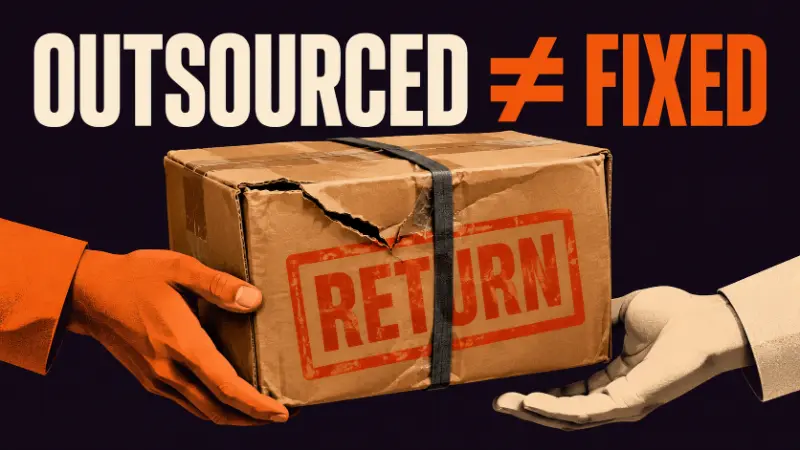
Returns outsourcing changes who performs the work, not how the system works. A merchant can hand the entire returns operation to a 3PL and feel real relief, yet still lose the same margin on every returned item, because the underlying loop never changed.
That distinction is the whole point of this article. Outsourcing returns is often sold as a fix, and for a specific set of internal problems it genuinely is. Staffing pressure eases. The warehouse stops drowning in inbound boxes during peak. Process discipline improves when a weak internal team hands the function to someone who does it for a living. But none of those gains touch the part that actually destroys value. The item still moves backward. It still gets received and inspected at a central node. It still sits while value decays. Recovery still happens late, after markdown pressure has already done its work.
So the honest framing is this: outsourcing changed who did the work. It did not change what the work was. If you finish this piece still believing that moving returns to a partner repaired the economics, the article has failed.
Outsourcing Solves a Real Operational Pain
Start with the part that is true, because credibility depends on it.
For a lot of brands, returns are an internal mess long before they are an economic one. Inbound boxes pile up at the dock. Seasonal spikes create high volumes tied to holiday rushes and product launches, pulling labor away from outbound fulfillment exactly when speed matters most. A small ops team ends up improvising disposition decisions it was never trained to make. In that environment, handing returns to a third party is not a mistake. It is a sensible operational decision.
Outsourcing delivers genuine local relief across a few predictable dimensions:
- Staffing burden falls. The merchant no longer has to hire, train, and retain trained professionals for intake, inspection, and restocking, work that is volatile and hard to staff precisely when demand peaks.
- Warehouse congestion eases. Returned items stop competing with outbound orders for dock space, shelf space, and attention.
- Operational complexity drops. Return merchandise authorization, refunds, policy enforcement, return label generation, and disposition routing become part of someone else’s standardized workflow instead of an internal scramble.
- Discipline improves where internal teams are weak. An outsourcing partner can handle returns with improved efficiency, usually running a tighter, more consistent process than a brand treating the work as a side task.
These are not trivial wins. For a founder watching the warehouse choke during Q4, outsourcing can look like obvious progress, and in operational terms, it is. The problem is what people conclude from that relief.
But the Item Still Travels Backward Through the Same Reverse Logistics Loop
Here is where the reasoning usually breaks.
When internal pain goes down, it is easy to assume the cost went down with it. It didn’t. The relief is real, but it is operational, not structural. Underneath the new arrangement, the canonical reverse logistics loop is fully intact: the customer ships the item back, it lands at a centralized facility, it gets received and inspected, it gets repackaged or held, and only then does it move toward resale, liquidation, or disposal. Unlike forward logistics, this reverse logistics process adds inspection, sorting, and recirculation steps that make returns harder to manage.
Outsourcing does nothing to that sequence. It is the same loop with a different operator. Specifically:
- Backward shipping still happens. The item still travels in reverse before it can move forward again. That return leg is a cost no matter whose name is on the invoice.
- Centralized intake still happens. Goods still funnel into a central node for receiving and inspection, the most labor-intensive step in the entire chain. In practice, returns handling can require up to 20% more warehouse space than forward movement because inspection and exception workflows take more room.
- Delayed recovery still happens. The item still waits in a queue. Time is the silent killer of return value, and a partner’s queue erodes value the same way an internal one does.
- Markdown drag still happens. Every day an item sits, seasonal demand decays and resale value drops, forcing repeated discounts to clear it.
This is the broader pattern behind the myth of “efficient” reverse logistics: the goal of making the backward journey smoother is not the same as questioning whether the journey should happen at all. Brands focused on optimizing reverse logistics can certainly streamline steps and improve visibility, but outsourcing optimizes who runs the trip. It does not change the direction of travel, and that cost ripples across the supply chain.
Outsourcing Returns Management Changes Who Handles the Return, Not What the Return Costs
This is the line that matters most, so it is worth stating plainly.
Outsourcing is a transfer of labor and responsibility. In other words, outsourcing returns management changes who handles customer returns, not what they cost. The merchant may no longer touch the box, but the box still has to be shipped, received, inspected, processed, and recovered, and every one of those steps still costs what it costs. The cost classes are unchanged. They have simply moved off the merchant’s org chart and onto a partner’s.
Consider the real cost layers in a traditional return. Shipping runs roughly seven to nine dollars per leg. Intake, inspection, repackaging, and restocking labor add another ten to fifteen dollars. The blended operational cost lands around forty dollars per return, and total return cost commonly runs seventeen to thirty percent of the item’s original sale price, before markdowns or fraud enter the picture; those costs matter because they shape the post purchase experience and customer satisfaction. A $59.99 hooded sweatshirt that nets about $18 in margin when kept becomes roughly a $55 loss when it comes back unsellable, or about a $24 loss even when it is successfully resold at thirty percent off.
Outsourcing does not delete any of those line items. It rebadges them. The intake labor still exists; the partner does it and bills for it. The inbound shipping still exists; it shows up in a service fee instead of a carrier invoice. Same work, different hands. A clear, simple return policy with an easy process helps customers, can meet customer expectations, and supports customer loyalty built on an exceptional returns program; in fact, 96% of consumers say they would return to a retailer with an easy process. The economics that make a returned item a loss are properties of the loop, not of the operator running it.
A 3PL Can Absorb the Work Without Delivering the Benefits of Outsourcing
This is the sharpest version of the argument.
A 3PL is very good at absorbing operational pain. That is the service. It can absorb the work and deliver some benefits of outsourcing, especially when paired with returns management software, but it does not eliminate structural waste. Conflating the two is how merchants end up surprised by their returns P&L a year into an outsourcing arrangement.
Watch what actually happens to the cost when a partner takes over:
- Partner fees replace direct labor. The intake and processing work doesn’t vanish. It gets priced into a per-return or per-unit fee. You stopped paying your own staff and started paying someone else’s, often with a margin layered on top.
- Reconciliation slows down. Seamless data flow is the backbone of efficient returns management, but returns data and financial settlement now live partly outside your systems. They should offer complete visibility over the return lifecycle, from when a customer initiates a label to when the item hits the warehouse floor, and you should request examples of standard reporting dashboards while establishing clear benchmarks and strict Service Level Agreements around processing time, inventory discrepancy rates, and customer satisfaction scores tied to returns. Strong platforms can auto-generate return labels, support issuing refunds, and update inventory levels in real time. Choosing the best returns management software for your stack and using an automated return portal can also help customers track returns independently, but better tooling still does not change the underlying economics.
- Recovery stays slow. A partner’s queue is still a queue. Items still wait for inspection and disposition, and that delay still pushes goods toward markdown and liquidation rather than full-value resale.
- Resale value still erodes. Roughly forty-four percent of apparel returns never reenter inventory in the traditional model. Handing the flow to a 3PL does not change the timing or the handling that drives that outcome, so margin erosion persists.
This is the same trap brands hit when they assumed scale and consolidation would reduce returns. Bigger networks and specialized operators optimize throughput. They do not bend the cost curve, because the waste is structural. By partnering with a 3PL, businesses can access advanced technology for tracking returns and managing customer communications, and that is one of the key benefits. But the benefits of outsourcing stop short of cost reduction: smoother operations do not equal lower costs. A more capable operator running the wrong loop still runs the wrong loop, just more smoothly.
Hidden Costs Become Someone Else’s Workflow, Not a Different System
Here is the contrarian point, and it is the one most likely to be missed: outsourcing can remove operational burden without removing structural waste, and in doing so it can make the waste harder to see.
When managing returns in house, some costs stay visible, while outsourcing can bury operational expenses and overhead costs. When returns are handled internally, the pain is visible. You see the labor hours, the congested dock, the markdown reports. That visibility is uncomfortable, but it is honest. Outsourcing wraps those costs into a partner’s workflow and a partner’s invoice. The dock clears. The headcount drops. The reports get cleaner. And the cost, now bundled into fees, becomes much easier to overlook. Ask for transparent breakdowns of per-return fees, labor, storage, and charges for restocking items.
That is the real risk. Outsourcing can hide cost better than it removes cost. The same economics, lower visibility. A merchant feels relief and reads it as repair, when in fact the only thing that changed is where the pain is filed. This is also why automation gets misread the same way; better tooling and a capable partner both improve the experience of the loop without changing its economics, which is the core of why more automation didn’t lower return costs. For many ecommerce brands, crafting the perfect e-commerce returns program becomes an exercise in balancing that customer experience against unit economics. Smoother is not cheaper. Quieter is not fixed, and understanding the billing model is critical because reverse logistics is inherently time consuming and labor-intensive.
The Wrong Loop Stays Wrong Even When Someone Else Runs It
Strip everything down and you are left with one idea: architecture determines the ceiling of improvement, and the operator does not.
Outsourcing helps locally, and the right partner may improve operations, but it cannot change the architecture. That is not in dispute, and a brand drowning in returns should not feel bad about reaching for it. But the deeper bottleneck is structural. As long as the model assumes every return must travel backward to a central node before it can move forward again, the cost layers, shipping, handling, delay, and markdown, will keep showing up no matter who is on the other end of the contract. Choosing a provider also means checking whether its returns management process and software integrate natively with platforms like Shopify, Magento, or Salesforce, and understanding whether options like the Return Prime returns solution fit your volume, geography, and operational complexity.
The point of no return in the logic is simple. Software cannot change physics, and neither can a vendor relationship. Distance, time, and handling compound cost regardless of how disciplined the operator is. The only thing that meaningfully bends the curve is changing where returns go, which is the case for why returns need to go forward, not back rather than backward through a warehouse at all. Even capable companies that can manage restocking, refurbishing, liquidation, donation, or responsible recycling, or run sophisticated portals such as the ZigZag returns management solution, still operate inside the same backward loop. Outsourcing keeps the backward journey and changes the driver, while a business still needs to control strategy and focus internally. A structural rewrite changes the journey.
That is the difference between operational relief and structural repair, and it is the difference this entire article exists to make obvious.
Conclusion
Outsourcing returns is a reasonable response to a real problem. It eases staffing pressure, clears warehouse congestion, and brings discipline to a function many teams struggle to run well. Those gains are genuine, and no one should pretend otherwise.
But reducing burden is not the same as removing cost. The item still moves backward. It still gets processed centrally. It still recovers late, after markdown drag has already eaten into its value. Outsourcing changed who did the work. It did not change what the work was. The same warehouse-first economics remain, simply relocated onto a partner’s workflow where they are easier to ignore.
If returns are quietly draining margin, the question is not who should run the loop. It is whether the loop should exist in its current form at all.
Frequently Asked Questions About Customer Satisfaction
Does outsourcing returns to a 3PL lower the cost per return?
Not structurally. A 3PL absorbs the operational work, but the underlying cost classes, backward shipping, centralized intake, inspection labor, delayed recovery, and markdown drag, all remain. Those costs get repriced as partner fees rather than eliminated, which is why cost savings, significant cost savings, and cost reduction claims are often really repricing claims. The cost per return is a property of the warehouse-first loop, not of who operates it.
What is the difference between burden transfer and structural redesign in returns?
Burden transfer moves the work from the merchant to a third party while keeping the same process intact. Structural redesign changes the process itself, for example by rerouting eligible returns forward to the next buyer instead of backward to a warehouse. Outsourcing is burden transfer. It can free internal resources and lead to better service, but it changes ownership, not architecture.
If outsourcing helps, why isn’t it a real solution to returns economics?
It is a real solution to internal operational pain such as staffing strain and warehouse congestion. For some ecommerce brands, it can also be a cost effective way to manage free returns, offset shipping costs, and create fewer headaches around customer expectations by leveraging convenient networks like Happy Returns’ reverse logistics solution, even if it does not structurally reduce costs. It is not a solution to the economics, because the item still travels backward through a centralized loop and still suffers delay, handling cost, and markdown erosion before value is recovered. Local relief is not the same as structural repair.
Why can outsourcing make returns costs harder to see?
When returns are handled internally, the labor, congestion, and markdown losses are visible. Outsourcing bundles those costs into partner fees and shifts reconciliation onto the partner’s reporting cadence. The dock clears and headcount drops, so the pain feels resolved, even though the same economics persist with lower visibility.
Are 3PLs bad for handling returns?
No. A capable 3PL often runs a tighter, more disciplined returns process than an internal team, and for many brands that is valuable. The key is choosing a partner that helps with controlling costs, limits return fraud, maintains quality control, and protects quality, whether through careful fee structures, restocking fee strategies and alternatives, or smarter disposition rules. The argument is narrower: a 3PL can absorb the work without removing the waste, because the waste is built into the backward-moving loop rather than into the operator running it.
Written By:

Manish Chowdhary
Manish Chowdhary is the founder and CEO of Cahoot, the most comprehensive post-purchase suite for ecommerce brands. A serial entrepreneur and industry thought leader, Manish has decades of experience building technologies that simplify ecommerce logistics—from order fulfillment to returns. His insights help brands stay ahead of market shifts and operational challenges.

Turn Returns Into New Revenue
Related Articles
FedEx 2027 Rate Increase: How 5.9% Becomes 32.4% on One Package
FedEx’s announced 2027 rate increase averages 5.
Seller Fulfilled Prime for Oversized Items: The FBA vs. SFP Math Sellers Need to Run
Seller Fulfilled Prime can work for oversized and bulky items, but it is not automatically cheaper than FBA.

Why Returns Look Manageable Until They Suddenly Aren’t
Returns management is the retail process of handling customer returns across reverse logistics, cost control, and customer experience—and it rarely fails the way leadership expects...