
Why Faster Refunds Made Returns More Expensive

In this article
 14 minute
- Introduction
- Refund Faster Solutions Solved a Real Customer Satisfaction Pain
- Speed Removed Friction From the Wrong Part of the Loop
- The Money Goes Out via Direct Deposit Before the Operational Costs Come Back
- Better Refund CX Did Not Mean Better Returns Management Process Economics
- The Industry Optimized Reassurance Before Reverse Logistics Recovery
- Faster Refunds Made a Broken System Feel Better, Not Work Better
- What Operators Should Take From This
- Conclusion
- Frequently Asked Questions
Introduction
Faster refunds feel like obvious progress. For shoppers, they often are. For merchants, they also quietly made an already fragile system more expensive. The money started going out faster. The value did not start coming back faster.
That gap is the entire story of modern returns management. Over the last decade, the industry poured energy into smoothing the refund experience, shrinking the wait from weeks to days to instant. Customer reassurance climbed. Recovery did not climb at the same pace. The emotional loop closed faster while the economic loop stayed open just as long, sometimes longer. In 2023, consumers returned retail purchases worth a staggering $743 billion—about 14.5% of all sales—highlighting the significant financial impact of returns, especially in e-commerce. This article unpacks that tradeoff, why it matters operationally, and why a smoother refund is not the same thing as a healthier return.
Ultimately, the returns process—the sequence of steps from customer initiation to final resolution—plays a crucial role in shaping both customer experience and business outcomes.
Refund Faster Solutions Solved a Real Customer Satisfaction Pain
Before going further, it is worth saying clearly: faster refunds fixed something real.
Research shows that 91% of customers say the overall ease of their returns experience impacts their willingness to shop with a retailer again, highlighting how critical a seamless returns experience is for customer satisfaction and loyalty.
Customers dislike waiting for their own money. A refund that takes two or three weeks creates anxiety, distrust, and support tickets. People wonder if the package arrived. They wonder if the merchant is stalling. They wonder if they will need to dispute the charge. Every day the refund sits in limbo is a day the brand feels less trustworthy. A clear and concise returns policy helps set customer expectations and builds customer trust, reducing misunderstandings and fostering loyalty.
Faster refunds reduced that anxiety. They improved perceived service quality. They gave customers a reason to take a chance on a brand they had not bought from before, because the downside risk felt small and well-managed. In a category where buying sight unseen is the default, that reassurance has measurable conversion value.
So this is not an argument that refund speed is bad, or that customers should be made to wait longer. The point is narrower and more uncomfortable: refund speed solved a customer experience problem and, in the process, accelerated a financial problem that was already present.
Speed Removed Friction From the Wrong Part of the Loop
Returns have always involved friction. Some of it was bad friction, the kind that frustrated customers and damaged loyalty. Some of it was structurally useful, the kind that slowed casual or low-intent return behavior, including behaviors like ordering multiple sizes with the intent to return most of them, simply because the returns process had a few rough edges.
When refunds sped up, the bad friction came down. So did the useful friction, making processing returns an even greater operational challenge.
A seamless returns process is crucial for building a positive relationship with your customers. In fact, 70% of North American consumers stated they purchased more from a retailer after a positive return experience, highlighting the impact of customer returns on loyalty and repeat business.
A refund that lands the moment a tracking event fires, or even at the moment a return is initiated, removes hesitation from the most behaviorally sensitive part of the loop. The decision to return becomes lighter. Bracketing becomes easier. Casual returns, the ones a shopper might have shrugged off when refund pain was higher, become routine. None of this is a moral failing on the part of customers. It is a predictable response to a smoother experience.
The center of the issue is this: refund-speed improvements reduced emotional friction without fixing the underlying recovery problem. The loop felt smoother. It did not become structurally healthier. This is one of the reasons why returns software doesn’t actually fix returns on its own. Better portals, faster approvals, and instant credit improve the front end of returns while leaving the expensive back end intact.
The Money Goes Out via Direct Deposit Before the Operational Costs Come Back
This is the part most refund-speed conversations skip.
Every return has two clocks. One is the refund clock, the time from return initiation to the customer seeing their money. The other is the recovery clock, the time from return initiation to the merchant actually recapturing value, whether through resale, restock, liquidation, or write-down.
For a long time, those two clocks ran somewhat in parallel. A return came in, the warehouse processed it, inventory updated, the refund issued, the item went back on the shelf. Slow on both sides, but at least synchronized.
Faster refunds severed that link. Consider what a typical returned item still has to go through on the merchant side, a process that involves optimizing reverse logistics across the network for the physical movement of goods and careful inventory management to track and restock returned merchandise:
- Inbound shipping back to a distribution center (reverse logistics)
- Intake and queue time at the dock
- Inspection, grading, and disposition of returned merchandise
- Repackaging or relisting as part of order fulfillment
- Restocking, resale at a discount, liquidation, or destruction, all requiring accurate inventory management
None of that happens at refund speed. Inbound freight takes days. Intake queues swell during peak. Inspection labor is finite. Markdown decisions take time, and every day an item sits unsold, its resale value erodes. Delays in these steps increase operational costs, impacting overall efficiency and profitability, especially in categories where high ecommerce return rates directly erode already thin profit margins. The result is a widening gap. Cash leaves the business in hours. Value comes back in weeks, partially, or sometimes not at all.
It’s important to note that returns management is the process of overseeing returned products to ensure a seamless experience for both customers and businesses, covering everything from authorizing returns to restocking items or disposing of products that can’t be resold. While reverse logistics focuses on the physical transportation and handling of returned products, returns management encompasses the broader strategic management of returns, including their impact on inventory, order fulfillment, and customer experience.
That timing mismatch is the economic heart of the problem. It is also one of the quieter reasons returns became a silent margin killer inside many ecommerce P&Ls. The cost is not in any single line item. It is in the gap between two timelines that used to move together and now don’t.
Better Refund CX Did Not Mean Better Returns Management Process Economics
It is tempting to assume that if customer satisfaction with returns is up, the returns system itself must be healthier. However, the financial impact of returns is substantial—average ecommerce return rates often range from 15% to 30%, and consumers returned retail purchases worth approximately $743 billion in 2023, representing about 14.5% of all sales. This highlights the critical importance of effective returns management for e-commerce profitability.
A useful way to see it:
- What improved: customer reassurance, perceived trust, speed of emotional resolution, post-purchase NPS.
- What did not improve proportionally: recovery timing, value recapture, fraud exposure from returns and refunds, inventory velocity, cost per return, operational efficiency.
A shopper can have a five-star refund experience on a return that costs the merchant more than the original margin on the sale. The customer’s loop closed in 30 seconds, often due to streamlined processing refunds as part of the returns management process. The merchant’s loop is still open, accruing shipping, labor, markdown, and opportunity cost. From the customer’s perspective, the return is done. From a finance perspective, it has barely started.
This is why refund speed and return health are easy to confuse and important to separate. A smoother return feeling is not the same as a healthier loop, and dashboards that only track refund time and CSAT will systematically miss the part of the system that is actually leaking money. Friction removal at the front end was real progress for shoppers. It was also part of the reason free returns were always a loss leader in the way most brands implemented them, paid for in margin nobody was watching.
Returns management focuses on the customer-facing side of the process, ensuring returns are handled quickly, accurately, and with minimal friction to prioritize customer satisfaction and operational efficiency, often through dedicated returns management software that automates these workflows. In contrast, reverse logistics deals with the full journey of a product moving back through the supply chain for repair, refurbishment, recycling, or resale, focusing on maximizing asset recovery and environmental responsibility. Both are critical components of modern e-commerce.
The Industry Optimized Reassurance Before Reverse Logistics Recovery
Step back from any individual brand and the pattern across the industry becomes obvious. The emotional experience of returns improved much faster than the economic structure underneath it, even as companies began to focus on returns management best practices and best practices to optimize order fulfillment, reduce costs, and improve customer satisfaction.
Self-serve portals, branded return pages, automated approvals, instant credit, label-free drop-off, real-time refund notifications—all of these arrived years before the industry seriously revisited where returned items actually go and how quickly value can be recovered. While reassurance got the budget, returns management software that automates and analyzes these flows and addressing operational inefficiencies in manual returns processing often lagged behind, even in complex environments like Amazon FBA where sellers must actively analyze return patterns to protect profitability. Regularly reviewing returns data is essential for optimizing returns management strategies, improving customer satisfaction, and reducing costs.
That is not an accident. Reassurance is visible. It shows up in conversion rates, support ticket volume, review scores, and retention metrics. Recovery is invisible until somebody adds up the cost-per-return, the markdown decay, the fraud losses, and the working capital tied up in items waiting to be processed. By the time those numbers get attention, the customer-facing experience has already been rebuilt around the assumption that refunds will be near-instant.
The loop felt better before it worked better. That is the line worth remembering.
Faster Refunds Made a Broken System Feel Better, Not Work Better
This is the part that ties everything together. While faster refunds provide valuable symptom relief in the returns management process, they do not address the underlying structural issues. Improving the returns management process involves more than just speeding up refunds—it requires optimizing each step, from customer initiation to inspection, inventory updates, and logistics coordination.
Symptom relief is what happens when:
- The portal is faster than the warehouse
- The notification is faster than the inspection
- The credit is faster than the restock
- The customer feels resolved before the inventory is
However, focusing only on symptom relief can mask inefficiencies such as long processing times and increased risk of human error. Automating tasks like issuing return shipping labels and other documentation, updating inventory, and processing refunds—whether through in-house tools or specialized returns solutions built for platforms like Shopify—can significantly reduce processing times and minimize human error, leading to greater operational efficiency.
Structural repair is something different. It addresses where returns go, how value is recovered, and how quickly the economic loop can actually close. Selecting the right technology—such as returns management systems, barcode scanners, warehouse management systems, and machine learning tools—can further enhance the returns management process. For some brands, that includes evaluating network-based options like Happy Returns’ drop-off reverse logistics model or SaaS-based portals such as ZigZag’s returns management solution. For example, machine learning tools can assign risk scores at checkout to identify chronic returners or suspicious patterns, helping to prevent fraud and streamline operations. It is the conversation that begins when a brand stops asking “how do we make refunds faster?” and starts asking “why do returns have to take this path at all?” That is the deeper shift, and the case that returns need to go forward, not back belongs to a different article. This piece has a narrower job: to make clear that faster refunds, on their own, do not get a brand there.
What Operators Should Take From This
A few practical takeaways for anyone running, financing, or rethinking a returns program—and for anyone trying to use returns as a lever for stronger loyalty through an exceptional returns program:
- Track refund time and recovery time as two separate metrics. If only one is improving, the gap is widening, and often that gap widens fastest when ecommerce return rates climb due to issues like poor fit or bracketing behavior or when returns fraud quietly inflates the apparent volume and cost of returns.
- Resist the urge to read rising refund CSAT as evidence that the returns system is getting healthier. Those signals can move in opposite directions.
- When evaluating returns software or refund-speed initiatives, ask explicitly what the change does to recovery timing, not just refund timing. If the answer is nothing, the underlying economics will not improve.
- Treat refund speed as a customer experience input, not a returns strategy. The strategy lives downstream, in how value is recaptured.
- Implement a returns portal to streamline the returns process. Self-service online portals provide a frictionless experience for customers to initiate returns, receive instant QR codes, and access return shipping labels, improving efficiency and satisfaction—while still allowing you to revisit whether free returns remain sustainable at scale, whether tools like restocking fees or alternative incentives make more sense, or whether they need to evolve as more retailers rethink or roll back blanket free-return policies.
- Prioritize clear customer communication and swift customer resolution throughout the returns process to build trust and encourage repeat business.
- Analyze return data to identify trends, such as frequently returned products, and use these insights to cut costs and reduce costs by addressing inefficiencies and improving product quality, while also aligning with eco-friendly returns practices that reduce waste and logistics emissions and maintaining clear, customer-friendly return policies across marketplaces like Amazon.
None of this argues for slower refunds. It argues for honest accounting of what speed did and didn’t fix.
Conclusion
Faster refunds were a real win for customers and a real shift in what people expect from ecommerce. They were also one of the cleanest examples in retail of an experience improvement outpacing an economic one. The money started going out faster. The value did not come back faster. The emotional loop closed quickly. The economic loop stayed open just as long.
Recognizing that gap is not an argument against customer experience. It is an argument for measuring the loop honestly, on both sides, and for understanding that a smoother refund is the beginning of the conversation about returns economics, not the end of it.
Frequently Asked Questions
Are faster refunds bad for ecommerce businesses?
No. Faster refunds solved a real customer pain and improved trust, conversion, and perceived service quality. The issue is not that refunds got faster. It is that refund timing pulled away from value-recovery timing, and many brands track only the first. The cost shows up in the gap between the two.
What does tax refund timing have to do with returns economics?
Refund timing controls when cash leaves the business. Recovery timing controls when, and how much, value comes back. When refunds accelerate but inbound shipping, inspection, restocking, and resale stay on their original timelines, the merchant absorbs a longer interest-free liability on every return.
Is this the same problem as free returns?
It is related but distinct. Free returns is a subsidy question, whether the merchant absorbs the round-trip shipping cost. Refund speed is a timing question, how quickly cash goes out relative to when value is recovered. The two compound, but they are separate levers.
Can returns software fix this?
Returns software can make refunds faster, smoother, and more consistent. It does not, on its own, change where returned items go or how quickly value is recovered. That is a routing and structural question, not a portal question.
Should brands slow down refunds to protect margin?
Slowing refunds is not the answer. It would damage trust without fixing the underlying recovery problem. The more useful move is to measure refund timing and recovery timing separately, and to focus structural investment on the recovery side, where most return losses actually compound.
Written By:

Manish Chowdhary
Manish Chowdhary is the founder and CEO of Cahoot, the most comprehensive post-purchase suite for ecommerce brands. A serial entrepreneur and industry thought leader, Manish has decades of experience building technologies that simplify ecommerce logistics—from order fulfillment to returns. His insights help brands stay ahead of market shifts and operational challenges.

Turn Returns Into New Revenue
Related Articles

The Shipping Speed Paradox: Why DTC Brands Are Slowing Down
Everyone’s talking about faster delivery.
Ecommerce Profit Leaks: The Hidden Ones That AI Is Finally Closing
Most ecommerce brands believe they understand their margins.
Crafting a Return Policy that Drives Customer Loyalty and Reduces Returns
Let’s talk about ecommerce returns policies.
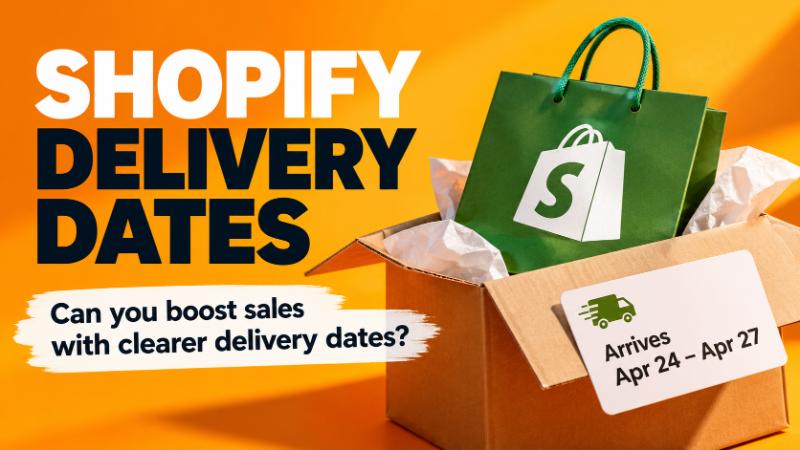
Shopify Estimated Delivery Date: A Complete Guide for Ecommerce Stores
In this article
14 minutes
- Give Your Website Customers an Amazon-Like Delivery Experience
- What Is an Estimated Delivery Date?
- Why Are Estimated Delivery Dates Important for Ecommerce?
- Benefits of Adding Estimated Delivery Dates to Shopify Stores
- How to Add Estimated Delivery Dates on Shopify Using Code
- Pro Tips for Accurate Estimated Delivery Dates
- Final Thoughts
- Frequently Asked Questions
A Shopify estimated delivery date is the specific arrival date or date range shown on a product page before purchase, so shoppers know when an order is expected to arrive. For Shopify merchants who want clearer delivery messaging, more trust, fewer “where is my order” tickets, and better conversion rates, adding that estimate can remove hesitation at the moment a customer is deciding whether to buy, and most stores can do it with a short block of Liquid code instead of another paid app.
Shopify can calculate delivery dates at checkout when your shipping settings are configured for it, but it does not put a delivery promise on the product page by default. That gap matters because shoppers increasingly expect precise timing similar to what they see on Amazon, and a vague “ships in 3 to 7 business days” line does little to make a store feel organized or reliable. This guide explains what a Shopify estimated delivery date is, why it matters for ecommerce, the benefits of adding one, how to add it to product pages with custom Liquid code, and how to keep the estimate accurate.

Give Your Website Customers an Amazon-Like Delivery Experience
Amazon trained online shoppers to expect a specific arrival date on every product page. “FREE delivery Thursday” is a promise, not a range, and shoppers now bring that expectation to every ecommerce business they buy from. When your product page says nothing about timing, the shopper fills the silence with doubt or opens another tab to compare.
The good news is that matching this experience on your own site is easier and less expensive than most merchants assume. You do not need a same-day fulfillment network to show a delivery date. You need honest processing and transit time numbers and a clear way to present them. For a deeper look at how independent stores compete on delivery, view the on-demand webinar and explore Cahoot’s library of educational ecommerce logistics webinars.
What Is an Estimated Delivery Date?
An estimated delivery date (EDD) is the projected day or date window when a customer can expect an order to arrive after placing it. It differs from a generic shipping estimate. “Ships in 3 to 5 business days” leaves the shopper to do the math. An EDD does the math for them: “Arrives between Oct 7 and Oct 9” or “Get it by Friday, Oct 9.”
A reliable Shopify estimated delivery date is built from four inputs:
- Processing time: How long it takes your team or 3PL to pick, pack, and hand the order to a carrier. This includes your daily order cutoff time, which advanced ecommerce order fulfillment services with late same-day cutoffs can help you consistently meet or exceed.
- Shipping method: The service level and carrier, such as ground versus two-day, and the transit time each one realistically delivers.
- Customer destination: How far the shopper is from your warehouse. A customer two zones away and one across the country should not see the same date.
- Holidays and weekends: Days when your warehouse is closed or carriers do not pick up or deliver, which push the arrival date out.
When those inputs are accurate, the EDD becomes a promise you can keep. When they are guesses, it becomes a source of complaints.
Why Are Estimated Delivery Dates Important for Ecommerce?
Delivery timing is part of the product. Shoppers weigh it alongside price, and when it is missing, they either assume the worst or go looking for a store that answers the question. That is why unclear shipping information shows up so often as a reason for abandoned carts.
Estimated delivery dates matter for a few operational reasons:
- They reduce hesitation before checkout. A shopper buying a gift for Saturday needs to know whether it will arrive by Saturday. If the product page cannot tell them, many will not risk it.
- They set expectations your operation can plan around. A published date forces your team to define real processing times and cutoffs, which tightens ecommerce fulfillment overall and often reveals where ecommerce fulfillment software for smarter inventory placement can make those promises easier to keep.
- They shift support volume. “When will my order arrive?” is one of the most common questions a store receives. Answering it before purchase removes a large share of those tickets.
- They make your store look organized. A specific date signals that someone is watching the warehouse and the carriers, which is what shoppers want to believe before handing over a card number.
Speed still matters, but predictability often matters more. A shopper will usually accept a four-day delivery window if the date is clear and the order shows up on time. Cahoot’s guide to shipping speed covers when faster service levels are worth the extra shipping costs.
Benefits of Adding Estimated Delivery Dates to Shopify Stores
For merchants running on Shopify, a product page EDD is one of the lowest-effort changes that touches both revenue and cost. The benefits show up in four places.
Customer trust
A specific date tells the shopper you know your own operation and helps build trust. Trust compounds: customers who receive orders on or before the promised date are more likely to buy again without comparison shopping. That consistency also supports customer loyalty.
Conversion rates
Displaying estimated delivery dates is one of the simplest ways to remove friction. 73% of shoppers let a visible date guide their purchase. Adding that clarity on the product page, instead of waiting until checkout, keeps the buying experience moving. EDDs also support time-sensitive messaging such as “Order within 3 hours for delivery by Friday,” which is useful during gifting seasons and can lift sales.
Customer satisfaction
Satisfaction is shaped by the gap between what a customer expected, how well you set customer expectations, and what happened. A clear, conservative EDD narrows that gap. An order that arrives inside the promised window feels like a satisfying shopping experience, which can lead to a more satisfying shopping experience overall.
Reduced support inquiries
Every “where is my order” email costs time, and clear communication about delivery timing reduces that burden. When the delivery window is on the product page, in the confirmation email, alongside more delivery details on the tracking page, customers have fewer reasons to write in, and your support team can focus on issues that need a person.
How to Add Estimated Delivery Dates on Shopify Using Code
Shopify’s native delivery dates appear at checkout, and only when you use updated shipping settings, set a fulfillment time, and use eligible rate types inside your shopify store; to show an estimate earlier, merchants usually need to add one on the product page. To show an estimate on the product page, you can add a small block of Liquid code to your theme. The approach below skips weekends, respects a daily cutoff, and does not depend on a third-party app unless code is not the best fit and you decide the right app makes more sense.
Step 1: Identify Your Shipping Timeframes
Before touching code, write down the numbers the code will use for delivery time. Pull them from real order data, not from carrier marketing pages.
- Processing time in business days: For example, 1 business day if orders placed before noon ship the next day.
- Daily cutoff hour: The hour after which an order counts as the next business day.
- Minimum and maximum transit time: For example, 3 to 5 business days for standard ground to most of your customer base.
- Regional or service-level differences: Note whether some destinations or shipping methods need their own ranges, including cases where different shipping zones require different estimates, or whether partnering with order fulfillment services for ecommerce companies could support region-specific delivery promises.
Step 2: Open Shopify’s Theme Code Editor
Work on a copy of your theme so a mistake never reaches live shoppers.
- In Shopify admin, go to Online Store > Themes.
- Next to your current theme, open the … menu and select Duplicate.
- On the duplicate, open the … menu and select Edit code.
- If you prefer not to use coding, browse the Shopify App Store for a Shopify app like an estimated delivery date app or delivery date app instead; that is the no-coding path for stores that want setup through the admin.
Step 3: Add Custom Code to the Product Page
Locate the `product.liquid` file (or `product-template.liquid` in Shopify 2.0 themes) and insert the following code snippet where you want the estimated delivery date to appear:
    {% assign processing_time = 2 %} <!-- Adjust processing time in days -->
    {% assign shipping_time_min = 3 %} <!-- Minimum shipping time in days -->
    {% assign shipping_time_max = 5 %} <!-- Maximum shipping time in days -->
    {% assign min_days = processing_time | plus: shipping_time_min %}
    {% assign max_days = processing_time | plus: shipping_time_max %}
    {% assign today_date = 'now' | date: '%Y-%m-%d' %}
    {% assign min_delivery_date = today_date | date: '%s' | plus: min_days | date: '%b %d' %}
    {% assign max_delivery_date = today_date | date: '%s' | plus: max_days | date: '%b %d' %}
<p><strong>Estimated Delivery:</strong> {{ min_delivery_date }} - {{ max_delivery_date }}</p>
The loop steps forward one day at a time, counts only Monday through Friday, and records the dates where the minimum and maximum business-day counts land. An order placed on a Wednesday afternoon with the settings above would show “Wed, Oct 7 to Fri, Oct 9.” This basic approach does not account for inventory or destination-specific rules unless you extend it.
Next, place the snippet on the product page. In Online Store 2.0 themes such as Dawn, open sections/main-product.liquid. In older themes, look for templates/product.liquid or sections/product-template.liquid. Add this line where you want the message to appear, usually just below the price or above the Add to Cart button; merchants who need different messages for specific products usually move beyond one global snippet:
{% render 'estimated-delivery' %}
If you prefer not to edit section files, most 2.0 themes let you add a Custom Liquid block to the product template in the theme editor and paste the render line there.
Step 4: Customize the Message
Change the text inside the <p> tag to match your brand voice, turning it into a customizable delivery message such as “Order today, arrives Wed, Oct 7 to Fri, Oct 9.” You can also use that same block to enhance product-page clarity without changing the rest of the template. Adjust the date format in the date: filters if you want full month names, and add styling for the estimated-delivery class in your theme’s CSS so this feature is easy to spot near the price.
Step 5: Save & Preview the Changes
- Click Save in the code editor.
- Use Preview on the duplicate theme and open several product pages.
- Check the message on mobile, where it is most likely to be pushed below the fold.
Step 6: Test Different Scenarios
Before publishing, confirm the dates hold up against reality.
- Change the processing and transit values and confirm the output moves as expected.
- Check behavior before and after your cut-off hours, and on a Friday afternoon, when weekend skipping matters most.
- Compare the displayed window against actual delivery dates from recent orders to the same destinations, especially if you need separate delivery rules or broader delivery rules by destination.
These tests help produce accurate estimates before publishing.
One technical note: Shopify’s documentation states that ‘now’ reflects the time the Liquid was last rendered, which may not update on every page view because of caching. If you see a date that lags behind, especially around your cutoff time, the same calculation can be moved into a small JavaScript file that runs in the shopper’s browser.
Pro Tips for Accurate Estimated Delivery Dates
A date that is wrong does more damage than no date at all. These practices keep your Shopify estimated delivery date honest.
- Business days: Count only days your warehouse ships and carriers deliver. Add known holidays to your logic, or pad the maximum during peak weeks.
- Location-based estimates: One national range is a starting point. If most of your orders ship regionally, show tighter windows by region. For international orders, account for customs clearance and possible customs delays, and show a wider range for cross border ecommerce shipments while preparing for carrier shipment exceptions and how to fix them fast.
- Multiple shipping options: If you offer standard and express, show a date for each. Shoppers who need speed will see what they are paying for. The same applies to local fulfillment methods like local delivery or in store pickup, which need their own estimates instead of sharing the standard shipping window.
- Carrier delays: Revisit your transit numbers when shipping carriers announce service disruptions, weather events, or peak-season surcharges and slowdowns. Update the settings instead of letting stale numbers overpromise, and consider tools like Amazon Buy Shipping-integrated ecommerce order fulfillment to monitor and respond to delays more effectively.
- Clear customer communication: If an order will miss its window, tell the customer before they ask, which supports the entire shopping journey. Cahoot’s guide to automated shipment monitoring and proactive notification explains how to catch delayed shipments early.
It also helps to connect the estimate to stock levels; for some brands, comparing options like Cahoot vs. ShipMonk for fulfillment performance and cost is part of choosing a network that can actually meet those inventory-linked promises. A more complete setup ties those dates to stock and warehouse status, so a product that ships from a secondary warehouse or needs to be restocked does not show the same date as an item sitting on the shelf.
Final Thoughts
Adding a Shopify estimated delivery date to your product pages is a small change with a direct effect on customer experience, conversion rates, support volume, and cart abandonment. Custom Liquid code gives you control over how the estimate is calculated and displayed without adding another app to your stack.
The code is the easy part. The real work is knowing your processing time, cutoff, and transit windows well enough to publish them. Start with conservative numbers, measure them against actual deliveries, and tighten the window as your data improves. A delivery promise you consistently keep will do more for customer trust than a faster one you occasionally miss, because accurate promises help shoppers feel confident enough to complete a purchase.
Frequently Asked Questions
What is a Shopify estimated delivery date?
A Shopify estimated delivery date is the projected day or date range when a customer’s order is expected to arrive. It is calculated from processing time, shipping method, transit time, destination, and non-shipping days such as weekends and holidays, giving shoppers a direct answer about when the order should arrive.
Does Shopify show estimated delivery dates by default?
Shopify can show delivery dates at checkout when you use updated shipping settings, set a fulfillment time, and use eligible shipping rates. It does not display a delivery estimate on product pages by default, so merchants add one through theme code or an app; for example, tools such as S Estimated Delivery Date Plus can also show dates on checkout pages, while external partners offering Amazon FBM shipping and order fulfillment services help you keep those dates realistic across channels.
Where should I display an estimated delivery date?
The product page is the most important location because it influences the buying decision. The next-most-important touchpoint is the cart page, so repeat the estimate there, at checkout, in the order confirmation email, and on the tracking page so the customer sees a consistent promise.
Can I add estimated delivery dates to Shopify without an app?
Yes. You can create a Liquid snippet that adds your processing and transit days to the current date, skips weekends, and renders the result on the product page. Test it on a duplicate theme before publishing.
How do I keep estimated delivery dates accurate?
Base your settings on actual delivery data, count only business days, account for holidays and your order cutoff, and update transit times when carriers experience delays. Showing a slightly wider window is better than missing a narrow one.
Should international orders show a different estimated delivery date?
Yes. International shipping usually involves longer transit times and customs clearance, so cross border orders should show a separate, wider range than domestic orders.
Written By:

Indy Pereira
Indy Pereira helps ecommerce brands optimize their shipping and fulfillment with Cahoot’s technology. With a background in both sales and people operations, she bridges customer needs with strategic solutions that drive growth. Indy works closely with merchants every day and brings real-world insight into what makes logistics efficient and scalable.
Turn Returns Into New Revenue
Related Blog Posts
UCP Isn’t About Checkout. It’s About Who Gets to Understand Demand

In this article
18 minutes
- Universal Commerce Protocol is a plumbing layer, not the strategy
- LLM explainability limits are the core constraint, not a protocol oversight
- The real thesis: UCP removes the right to observe decision-making, not just data fields
- Historical continuity: merchants have been living through this progression across the entire commerce ecosystem
- The Nike DTC lesson: transparency was desirable, never sufficient
- Reframing merchant choice realistically
- Execution is the remaining differentiation surface
- A careful speculation: platforms that centralize insight tend to monetize access
- UCP Governance: Who Decides Who Gets to See What?
- Conclusion
- Frequently Asked Questions
Merchants are about to transact through AI agents without learning how the decision happened. Universal Commerce Protocol is less about making checkout easier and more about who gets to understand demand. The operational reality is that insight is moving upstream into AI systems, while execution stays with merchants.
Universal Commerce Protocol does not remove optional merchant data as much as it formalizes a deeper shift: merchants lose visibility into how decisions are made, not because of a design flaw, but because modern commerce depends on opaque intermediaries and LLM systems that centralize learning. The real change is not the loss of transparency, but who controls insight and how merchants must operate without it.
Universal Commerce Protocol is a plumbing layer, not the strategy
Universal Commerce Protocol (UCP) is being discussed as a commerce protocol, an agent payments protocol, and a common language that helps AI assistants complete transactions across the commerce ecosystem. The framing often lands on checkout flows: fewer redirects, less integration complexity, easier account linking, smoother payment methods across multiple payment providers, and cleaner order management.
Google’s Universal Commerce Protocol is a new open standard, co-developed with industry leaders such as Shopify, Etsy, Wayfair, Target, and Walmart, and endorsed by over 20 global partners across the ecosystem, including Adyen, American Express, Best Buy, Flipkart, Macy’s, Mastercard, Stripe, The Home Depot, Visa, and Zalando. UCP is an open-source project that invites developers, businesses, and platform architects to contribute and provide feedback. UCP was co-developed to ensure low-lift integration that aligns with existing business logic and is designed to be neutral, vendor-agnostic, and compatible with existing retail infrastructure and protocols like AP2, A2A, and MCP. Its core commerce building blocks and core capabilities include checkout, product discovery, cart management, and post-purchase workflows, serving as the foundation for the next generation of agentic commerce. UCP is designed to collapse the N x N integration bottleneck and keep the full customer relationship front and center for both retailers and customers.
All of that matters, especially for complex checkout flows and business onboarding across existing retail infrastructure. But focusing on checkout misses the operational consequence that matters most to ecommerce founders and operations leaders: UCP makes it normal for a consumer surface to decide, compare, and commit, while the merchant receives only the output.
UCP is designed for agentic commerce: AI agents discover, compare, and complete transactions on behalf of a customer. If that becomes a primary path through google search, google ai mode, the gemini app, google wallet, google pay, or other ai platforms, then the key question is no longer “how do we optimize checkout?” It becomes “who gets to understand preference formation?”
LLM explainability limits are the core constraint, not a protocol oversight
If you are looking for a missing field in UCP that would restore transparency, you are solving the wrong problem.
Limited visibility into decision-making is inherent to LLM systems. Even the AI platforms operating these systems cannot fully reconstruct why a recommendation occurred in a specific instance. The model’s output is produced by high-dimensional internal representations and probabilistic inference, not a human-auditable chain of reasons.
You can sometimes get a plausible narrative explanation, and in some cases you can extract partial signals that correlate with behavior. But that is not the same as knowing why the model selected Product A over Product B at that moment, for that user, given that context.
This is not a fixable protocol oversight. It is a property of how LLMs reason, not a bug merchants can opt out of.
So when merchants ask, “Will UCP remove optional merchant data?” the more accurate question is, “Will we still be able to observe decision-making?” And under agentic commerce, the answer is increasingly no, because the decision-making lives inside opaque intermediaries that are not designed to be interrogated at a granular level.
The real thesis: UCP removes the right to observe decision-making, not just data fields
Most debates get stuck at the data layer: what fields are passed, what product data is shared, how identity linking works, whether loyalty programs can be applied, which business capabilities can be invoked, how secure agentic payments support is implemented, and how verifiable credentials or cryptographic proof might validate a checkout session.
Those details matter. But they are not the core thesis.
The refined thesis is this: UCP removes the right to observe decision-making, not just data fields. The merchant does not just lose a few tracking signals. The merchant loses the feedback loop that makes learning possible.
To make that distinction operational, it helps to separate three things merchants often conflate:
- Data: raw facts you can store, like a purchase, a return, a shipping address, a product type, a customer service ticket, a cart value, or a delivery timestamp.
- Insight: interpreted meaning, like “customers abandon when delivery dates slip” or “size variations in this category create dissatisfaction.”
- Learning: a system’s internal ability to improve future decisions based on experience, including preference formation, ranking, and recommendation behavior.
Analytics and dashboards are mostly insight tooling. They summarize and visualize data so humans can interpret it. Learning is different. Learning is what determines future choices, and in agentic commerce the learning happens inside the agent and the platform surfaces, not inside the merchant.
That is why the loss is not “we lose a dashboard.” Merchants lose feedback loops, not dashboards. You can still have performance reporting. You might still see conversion rates and aggregate search results behavior. What you lose is the capacity to observe the deliberation: which alternatives were evaluated, which tradeoffs mattered, what language the shopper used, and which preference cues drove the final selection.
Historical continuity: merchants have been living through this progression across the entire commerce ecosystem
UCP should not be framed as a disruption. It is continuity.
Commerce has been moving toward opaque intermediaries for decades. The sequence is familiar:
Keyword black boxes in search
Merchants built strategies around google search, only to learn that the most valuable signals were never fully visible. Rankings were opaque. Then more query data disappeared, and merchants learned to operate with proxies.
Marketplaces owning the interface and relationship
Marketplaces made it obvious that customer relationship is mediated. A seller can optimize product variations, parent child relationship structures, and product detail page content, but the marketplace owns the interface. The merchant gets orders, not full context.
Attribution loss through privacy and aggregation
Privacy changes pushed attribution into modeled data and aggregation. The comfort of a fully observable funnel already eroded. Teams adapted by shifting measurement from precision to directionality.
AI agents owning discovery, comparison, and preference formation
Agentic commerce pushes this one step further. Increasingly, agentic commerce is happening on AI surfaces, such as Google Search AI Mode and the Gemini app, where conversational commerce is starting to shape how people search, compare, and buy. AI assistants do the browsing, the comparison, the narrowing, and the final selection inside a consumer surface. By adopting the Universal Commerce Protocol (UCP), merchants can enable seamless, agentic commerce actions across Google’s AI surfaces that turn AI interactions into direct sales, including real-time catalog searches and order execution via conversational prompts. UCP also supports real-time inventory checks and dynamic pricing, which complements operational setups like Google Shopping-focused order fulfillment that translate agent decisions into fast, reliable delivery. By the time the merchant is involved, the decision is already made.
Final shift: centralized learning with decentralized execution
The platform centralizes learning across the entire commerce ecosystem. Merchants execute: inventory, fulfillment, order fulfillment, post-purchase support, returns, and exception handling. The insight about demand formation is centralized. The operational burden is distributed.
UCP is simply the open protocol designed to make that execution layer interoperable, while businesses remain the Merchant of Record for all transactions.
The Nike DTC lesson: transparency was desirable, never sufficient
Some merchants will respond to this by reaching for a familiar counter-move: reclaim transparency via direct channels. Own the interface. Own the customer relationship. Build first-party data. Reduce dependency.
That instinct is understandable, and it is not new.
Nike’s DTC push is a useful lesson, not as nostalgia, but as proof. Large brands attempted to reclaim transparency and control by prioritizing direct purchases and direct relationships. But transparency alone could not sustain growth. Distribution, physical experience, and intermediaries still mattered, as shown by how fast-growing logistics innovators regularly appear in industry news about ecommerce fulfillment networks.
Meanwhile, newer challengers gained share by executing within existing channels. They met customers where customers already were. They accepted that the interface was mediated and focused on out-executing within the rules of those surfaces, often by building region-specific advantages such as New York-focused order fulfillment services that align tightly with local demand patterns.
Key takeaway: Transparency has always been desirable. It has never been sufficient.
UCP reinforces the same lesson. You can build your own channel, but if consumer surfaces shift toward AI-owned discovery, the gravitational pull is toward the intermediary again.
Reframing merchant choice realistically
The wrong framing is: “Do we choose transparency or scale?”
That choice is fading.
Merchants no longer choose between transparency and scale. They choose how to operate without transparency. This is a forced condition, not a strategic preference.
For ecommerce operators, this means planning for a world where demand signals arrive as outputs rather than narratives. You will receive purchases without receiving the full story behind purchase decisions. You will see outcomes without seeing deliberation.
The operational question becomes: what do we optimize when we cannot observe the decision-making layer?
Execution is the remaining differentiation surface
This is where the conversation often collapses into fatalism. It should not.
Opaque discovery does not remove competition. It changes the arena. Execution becomes the primary remaining signal merchants still control, and in agentic commerce, execution is not passive. It is measurable and learnable by intermediaries even when merchants cannot see the learning process, which is why flexible models like peer-to-peer order fulfillment networks are emerging as strategic levers rather than back-office utilities.
If an agent must choose between two eligible retailers offering the same product, the tie-breakers trend toward reliability and trust. That puts pressure on operational fundamentals that many brands have treated as secondary to growth, especially for programs like Amazon FBM shipping and fulfillment services where performance directly influences eligibility and ranking.
Execution differentiation shows up in:
- Availability: accurate stock, fewer cancellations, fewer substitutions, stable inventory across child listings and variation listings.
- Reliability: consistent delivery promises, fewer damaged shipments, fewer late orders, fewer fulfillment errors.
- Fit, returns, and post-purchase trust: expectation-setting that reduces negative reviews and return rates, clear sizing for size variations, accurate product differences across variation relationships, honest product details that match what arrives.
- Fulfillment speed and exception handling: faster ship times, proactive issue resolution, clean handling of lost packages, efficient order management when something breaks. Integrations like Cahoot’s Amazon Buy Shipping fulfillment illustrate how operational tooling can directly improve these post-purchase outcomes.
In practical terms, if AI agents are optimizing for customer confidence and lower regret, then the merchants that win are those with fewer downstream failures. The agent may not explain why it chose you, but it can learn from outcomes. And outcomes are deeply influenced by operations.
This is also where the distinction between insight and learning matters. You might not get the insight narrative, but the platform’s learning will still reflect your operational performance. Execution becomes your lever.
A careful speculation: platforms that centralize insight tend to monetize access
There is an economic precedent worth stating plainly.
When platforms centralize insight, they historically monetize access to it. Not in a conspiratorial way, but because the platform is bearing the cost of building the system and has the leverage of being the interface.
A plausible evolution in future agentic commerce is that merchants are offered summarized, abstracted context as a paid layer. Not raw transcripts of conversations. Not full explainability. More likely patterns, signals, and generalized explanations: what themes appeared in preference formation, what objections were common, what comparisons were frequent, what attributes influenced selection in aggregate.
That would be consistent with how marketplaces monetize search results placements and how ad platforms monetize targeting. It would also be consistent with a world where LLM explainability limits prevent true transparency, but a platform can still offer “helpful” approximations.
The key risk is simple: merchants may eventually have to buy back a filtered version of their own demand. In that world, choosing between fulfillment partners becomes an explicitly strategic decision, and many brands will benchmark options using comparisons of leading order fulfillment providers.
This is not a promise. It is a plausible evolution grounded in economic precedent. And it is worth preparing for mentally, because it reinforces the central argument: the locus of learning moves upstream, and access to learning is not guaranteed.
UCP Governance: Who Decides Who Gets to See What?
As agentic commerce becomes the new normal, the question of who gets to access, influence, and evolve the Universal Commerce Protocol (UCP) is no longer academic—it’s foundational. UCP is positioned as an open standard, designed to enable agentic commerce across the entire commerce ecosystem. But “open” is only as meaningful as the governance that backs it.
The governance of the Universal Commerce Protocol UCP is intentionally structured to be transparent, fair, and inclusive. This means that the rules for how the protocol evolves, who can participate, and what changes are made are not dictated by a single company or closed group. Instead, the governance model invites input from a broad spectrum of stakeholders: merchants, payment providers, AI platforms, credential providers, business agents, and even consumer advocates. The goal is to ensure that the protocol serves the needs of the entire digital commerce landscape—not just the largest players or the earliest adopters.
In practice, UCP governance operates through open forums, working groups, and public documentation. Proposals for changes or new features to the commerce protocol are discussed in the open, with clear processes for review, feedback, and consensus-building. This approach is designed to prevent any one party from unilaterally deciding who gets to see what data, which business logic is supported, or how agentic commerce is enabled across different consumer surfaces. Retailers publish machine-readable profiles on supported services in UCP, creating a shared language for the capabilities agents can discover.
For merchants and other ecosystem participants, this governance structure is more than a technicality—it’s a safeguard. It means that the evolution of universal commerce is not locked behind closed doors, and that the rules of engagement for AI agents, payment handlers, and business backends are shaped by collective input. It also means that as new challenges emerge—such as balancing privacy with operational transparency, or supporting new payment options and loyalty programs—the protocol can adapt in a way that reflects the interests of the broader community. For individual brands, questions about how to participate often start with concrete conversations with specialized order fulfillment partners who sit at the execution layer.
Ultimately, UCP governance is about trust. In a world where the mechanics of commerce are increasingly mediated by AI and complex protocols, having an open standard with transparent, participatory governance is what gives businesses flexible ways to adapt and compete. It’s not just about enabling agentic commerce; it’s about ensuring that the future of universal commerce is built on a foundation that is open, accountable, and responsive to the needs of the entire ecosystem.
Conclusion
Universal Commerce Protocol is not primarily about checkout. It is about who gets to understand demand.
Merchants will still have data. They will still have sales. They will still have dashboards. What they increasingly will not have is the right to observe decision-making, because decision-making is being mediated by opaque intermediaries and LLM systems that centralize learning.
This is not something a protocol can solve. Limited visibility is inherent to LLM systems. Even AI platforms cannot fully reconstruct why a recommendation occurred. That is a property of how these systems reason, not a bug merchants can opt out of.
The way forward is not outrage, and it is not false optimism. It is acceptance and adaptation.
The loss of transparency is not the end of commerce. It is the end of pretending transparency was ever guaranteed. Merchants who win will be the ones who stop optimizing for perfect visibility and start optimizing for the remaining controllable surface: execution. Availability, reliability, fit, returns, post-purchase support, and exception handling will increasingly determine whether intermediaries learn to trust you as the safest outcome for the customer. Social proof—like order fulfillment service reviews from other merchants—becomes a proxy signal for that operational trust in a world where the decision-making logic itself is hidden.
In a world of centralized learning with decentralized execution, the merchant’s role becomes sharper. You may not own the story of demand, but you can still own the quality of delivery. And that, operationally, is the most durable advantage left.
FAQ
What is Universal Commerce Protocol?
Universal Commerce Protocol is an open commerce protocol intended to help AI agents and consumer surfaces connect to merchant systems to enable agentic commerce, including product discovery and completing transactions.
Why does Universal Commerce Protocol matter if it is just about checkout?
Because the larger shift is not checkout mechanics. It is that AI agents increasingly own discovery, comparison, and preference formation, leaving merchants with less visibility into how purchase decisions were made. UCP can also support a checkout feature beyond the website, including embedded buying flows. These flows may use native checkout in AI interfaces or embedded checkout for more customized implementations.
Why can’t merchants get full transparency into why an AI recommended their product?
Limited visibility into decision-making is inherent to LLM systems. Even AI platforms cannot fully reconstruct why a specific recommendation occurred. This is a property of how LLMs reason, not a fixable protocol oversight.
What is the difference between data, insight, and learning in agentic commerce?
Data is raw facts like orders and returns. Insight is human-interpretable meaning derived from analysis. Learning is the model’s internal improvement that drives future recommendations, and it is not the same as analytics or dashboards.
How does Universal Commerce Protocol change merchant feedback loops?
Merchants may still receive transaction data, but they lose the ability to observe the decision-making journey that produced the purchase. That reduces feedback loops that historically informed optimization.
Is this trend new or disruptive compared to past platform shifts?
It is continuity. Merchants have already lived through keyword black boxes in search, marketplaces owning the interface, attribution loss through privacy and aggregation, and now AI owning discovery and preference formation.
What does the Nike DTC shift teach merchants about transparency?
Nike’s DTC push showed that transparency is desirable but not sufficient to sustain growth. Distribution and intermediaries still matter, and brands can gain share by executing within existing channels.
What choices do merchants actually have in an AI-mediated commerce ecosystem?
Merchants no longer choose between transparency and scale. They keep customer relationships through fulfillment, service, and post-purchase touchpoints. They choose how to operate without transparency. This is a forced condition, not a strategic preference. Even when discovery happens on consumer interfaces, they retain full ownership of those relationships.
What is the main way merchants can still differentiate if discovery is opaque?
Execution. Availability, reliability, fit and returns performance, post-purchase trust, fulfillment speed, and exception handling are the primary remaining signals merchants still control. Strong execution also supports more seamless agentic experiences once a shopper is matched to a merchant. Consumer interfaces increasingly judge merchants by how reliably they can fulfill what the agent selected.
Will platforms monetize access to demand insight in the future?
It is plausible based on economic precedent. Platforms that centralize insight often monetize access to abstracted patterns and signals, rather than raw transcripts or full explainability. The risk is that merchants may have to buy back a filtered view of their own demand. If platforms package that insight for resale, it may be surfaced through existing agent frameworks and related tooling rather than raw model outputs.
Written By:
Manish Chowdhary
Manish Chowdhary is the founder and CEO of Cahoot, the most comprehensive post-purchase suite for ecommerce brands. A serial entrepreneur and industry thought leader, Manish has decades of experience building technologies that simplify ecommerce logistics—from order fulfillment to returns. His insights help brands stay ahead of market shifts and operational challenges.
Turn Returns Into New Revenue
Related Articles
Top 12 Shipping Strategies For Making Free Shipping Profitable
For ecommerce sellers, shipping is more than just getting a package from point A to point B — it’s the invisible backbone, quietly shaping customer satisfaction, operational costs,...
The Shipping Speed Paradox: Why DTC Brands Are Slowing Down
Everyone’s talking about faster delivery.
Ecommerce Profit Leaks: The Hidden Ones That AI Is Finally Closing
Most ecommerce brands believe they understand their margins.
AI Search Optimization: How AEO and GEO Are Reshaping Ecommerce SEO

In this article
8 minutes
- What Is AEO and GEO?
- Old SEO vs. New AI Search: What’s Actually Changing
- Why This Matters for Ecommerce Brands
- What We’ve Learned from Cahoot’s Own Content Shift
- The 4 Rules of AEO-Friendly Content
- AI Search Optimization for Shopify Brands
- Where to Focus First
- Let Me Be Blunt
- Final Thoughts: The Content You Publish Now Shapes How You Show Up Later
- Frequently Asked Questions
If your SEO strategy still revolves around exact-match keywords, you’re already behind.
AI search optimization in ecommerce means adapting your content and ecommerce AI SEO strategy for answer engines and generative search, so artificial intelligence tools like Google’s AI results, ChatGPT, and Perplexity can understand, summarize, and surface your product and category pages. It’s changing everything: how your blog posts rank, whether your product pages get seen, and how AI-driven search environments replace clicks with answers. I’ve been neck-deep in ecommerce content for years, and I can tell you this shift is not incremental. It’s existential.
For ecommerce brands, Shopify sellers, marketers, and content teams, the old SEO playbook is no longer enough. This guide breaks down what AEO and GEO actually mean, how AI search differs from traditional SEO, why that shift changes ecommerce discovery and sales, and which practical moves matter first—from clearer, intent-focused copy to structured data, FAQs, and other AI SEO strategy updates that help your pages earn visibility in AI-generated results.
What Is AEO and GEO?
First, let’s unpack the acronyms everyone’s whispering about:
- AEO (Answer Engine Optimization): Optimizing for AI-generated answers, not blue links. Think Google’s AI Overview or Perplexity’s sidebar; these don’t link out unless they’re confident your content is the definitive source.
- GEO (Generative Engine Optimization): Tailoring your content to feed large language models the best possible structured, semantically rich information. GEO is about writing for the model, not just the human.
Together, these represent a massive evolution in how ecommerce content needs to be structured, written, and distributed.
Old SEO vs. New AI Search: What’s Actually Changing
Let’s say you sell eco-friendly cookware. Under traditional SEO, you’d rank by optimizing for terms like “non-toxic frying pans” or “ceramic skillet USA made.” That still matters, but not in the same way.
In AI search:
- The model decides relevance, not just keywords.
- It often summarizes your content, not just links to it.
- If you’re not structured to answer the exact intent behind the query, you don’t show up, even if you rank.
So even if your article ranks #3 in Google, the AI Overview might feature a competitor who has better contextual clarity, semantic structure, or schema.
Why This Matters for Ecommerce Brands
Ecommerce brands often underestimate how many categories, products, and help articles become part of zero-click AI summaries, and how much smarter ecommerce order fulfillment as a profit driver needs to be in that environment. Unlike traditional search engines, AI-driven search changes how product discovery happens in Google Search and other AI platforms, including conversational prompts that shape ai generated responses before a shopper ever clicks. If a shopper asks:
“Are silicone baking mats safe?”
In AI search:
- modern search bars use natural language processing to handle conversational queries, and visual search lets shoppers upload images to find similar items
- ai generated results and ai responses can appear directly in the interface, shifting ai visibility toward sources with strong citations and clear ai mentions
- user generated content like reviews, customer photos, and unboxing clips can strengthen trust and authority signals
AI Overviews and AI-generated summaries now appear in about 20% of US searches, reducing click-through rates by 58% and increasing zero-click searches, a trend that’s front and center at major ecommerce logistics and fulfillment events.
And your product page buries the answer in the 5th paragraph, or worse, doesn’t address it directly, you’re not getting surfaced. Another brand will.
Even worse? The AI might quote you but link to someone else, a review site, a Quora thread, even Reddit. That also means AI search compresses the traditional multi-touchpoint funnel, since shoppers can refine queries, compare options, and discover products without leaving the interface.
That’s what AEO punishes: weak content architecture and lack of clarity.
What We’ve Learned from Cahoot’s Own Content Shift
We started optimizing Cahoot’s ecommerce blog content for AEO/GEO in late 2024. It wasn’t about stuffing more keywords, it was about:
- Answering the core query in the first 100 words.
- Structuring posts semantically with proper H2, H3, and H4 usage and section labeling.
- Repeating intent-rich phrases like “shipment exception,” “multi-node fulfillment,” or “Walmart DSV shipping compliance” multiple times in natural ways.
- Embedding FAQs that mirror real-world queries (not just made-up ones).
The result? We’re seeing way more snippets, longer dwell times, and better AI Overview inclusion, without obsessing over backlinks.
The 4 Rules of AEO-Friendly Content
If you’re creating blog posts, product pages, shipping policy FAQs, or comparison tables, here’s what you need to bake in:
- Write Like You’re Explaining to AI
Models need clarity, consistency, and repetition. Don’t be clever, be direct. Use terms like “Walmart Fulfillment Services fees” multiple times, and make every section serve a question. - FAQs Are Gold
These are your AEO frontline. Phrase each as a real query (think: “Is FedEx Ground faster than UPS?”) and answer them in tags, not in complicated tables or drop-downs. - Don’t Hide Your Answers
Don’t bury key product differentiators or return policy rules halfway down the page. AI isn’t scrolling, it’s scanning. - Schema Still Matters
Mark up reviews, pricing, FAQs, and organization details with structured data. You’re not doing it for Google’s web crawler, you’re doing it for ChatGPT, Perplexity, Claude, and whatever next model ingests your site.
AI Search Optimization for Shopify Brands
Shopify sellers are especially vulnerable here. Why?
Because most rely on thin content + generic templates, even though strong ecommerce SEO still depends on clear product content, structured pages, and technically sound site architecture on an ecommerce site, and matching shopper intent tends to drive higher conversion rates better than chasing keywords alone, especially when supported by scalable order fulfillment services for ecommerce companies. If your product page is just:
- Title
- bullet points
- “Ships in 3–5 days”
Then AI search skips right over you, especially if your Shopify order fulfillment strategy doesn’t support fast, reliable delivery.
Add in:
- Clear long-form descriptions
- Embedded questions + answers
- Shipping and return terms in plain language that align with your eBay fulfillment and fast-shipping strategy
- Customer reviews with quoted concerns and results
For an online store, those FAQ sections should give direct answers in short paragraphs or bullet points that AI can extract easily. Don’t hide your answers lower on category pages; surface product details and core product data near the top of the page. Schema still matters, so validate it in Search Console and Google’s Rich Results Test, and keep a merchant center feed, product feed, or complete product feed aligned with on-page markup. If you sell through google shopping, keep google merchant center synced so the same product data appears consistently across the ecommerce site. That also makes user generated content easier to trust in context.
…and suddenly you’re more summarizable. More quotable. More linkable. Consistent schema helps AI rely less on crawlable URLs alone.
Where to Focus First
If you don’t have time to redo everything, prioritize:
- Help Center articles (these get quoted often)
- Shipping & Return policies (Google surfaces these directly)
- Category-level content (for “best [category] for [need]” searches)
- Comparison pages (Perplexity loves these)
Then build forward-looking posts that clearly address queries like:
- “Is Shopify or Amazon better for small brands?”
- “What is Walmart DSV?”
- “How do I create a return policy for cosmetics?”
Because guess what? AI answers those, and who it quotes is not random. That matters more as google ai overviews and other ai platforms reshape product discovery. AI-powered recommendations, behavioral data, past-purchase patterns, and automated merchandising can improve relevance and raise higher average order values, especially if you’re also mitigating rising FedEx and UPS surcharges in 2025.
Let Me Be Blunt
AI Search doesn’t reward clever. It rewards clear. It doesn’t care how beautifully your paragraph reads if it doesn’t match the user’s intent, because ai systems are looking for structure they can interpret fast.
Most ecommerce brands are still optimizing for CTR in search when the real game is placement in the AI summary. Category-level content should support product discovery and “best for” shopping queries, and product pages should give direct answers with clear specs, comparisons, and use cases.
You want to be the quote, not the footnote. Prioritize the AI platforms most likely to surface your products, including experiences tied to Google Shopping and Google AI Overviews.
Final Thoughts: The Content You Publish Now Shapes How You Show Up Later
Most LLMs ingest web content with a delay, so what you publish in August affects your visibility in October and beyond. If you’re planning for holiday, Prime Day, or peak, you need AEO-friendly content on the web today, because AI systems reward direct answers that clearly match intent, not elegant copy that avoids the point.
This is the new moat. In practice, ecommerce ai seo is less about polishing prose and more about giving machines clean, usable answers, while ai visibility becomes the discipline of tracking how often your brand is mentioned, cited, or recommended in generated results. Every article, every policy page, every FAQ that answers a real query in a structured, repetitive way, makes you more visible in the generative layer of search.
If you’re not writing for LLMs, you’re already losing traffic you never knew you were missing.
Frequently Asked Questions
What is the difference between AEO and traditional SEO?
AEO (Answer Engine Optimization) focuses on how content is summarized and surfaced in AI-generated answers, while traditional SEO focuses on ranking in search engine result pages. AEO prioritizes clarity, intent-matching, and semantic structure.
How does AI search impact ecommerce product pages?
AI search pulls from product pages that clearly answer user intent. Unlike traditional search engines that focus more on ranking links, AEO prioritizes direct answers, and both sit within a broader AI SEO approach. Thin content or vague product descriptions are ignored. Pages with detailed explanations, structured data, and embedded FAQs are favored in AI Overview and zero-click answers, but only if ai crawlers and ai bots can access product details such as price, availability, and reviews.
Why are FAQ sections so important for AI Search Optimization?
FAQs mirror how people phrase questions in AI searches and voice assistants, including conversational search. Structuring your site with keyword-rich, clearly answered FAQs improves your chances of being featured or cited in AI-generated summaries. AI crawlers and other AI bots need access to visible product details, and brands with strong E-E-A-T signals are preferred by AI crawlers because they better understand user intent.
Do I need to change my blog format for AI search optimization?
Yes. Blog articles should lead with clear answers, since conversational search lets shoppers refine questions naturally through dialogue and FAQ wording helps brands understand user intent; use consistent subheadings, add bullet points where they clarify key details, and avoid burying information. Writing for LLMs means making your content easily digestible and extractable, with direct answers that are easy for AI systems to surface.
Is structured data (schema) still relevant with AI search?
Absolutely. Structured data helps models understand your content’s context, pricing, reviews, organization, FAQs, and increases the chance of your content being quoted correctly or summarized accurately by AI tools. Use bullet points where helpful so blog posts present direct answers in extractable formats, then validate markup in google’s rich results test and search console. Also make sure ai bots and ai crawlers can access that markup by checking robots.txt, your content delivery network, and any web application firewall rules.
Written By:

Jeremy Stewart
Jeremy Stewart leads customer success at Cahoot, helping merchants achieve high-performance logistics through smart technology and process optimization. With a background in both ecommerce operations and client services, Jeremy ensures that every merchant using Cahoot gets measurable results—whether they’re scaling from one warehouse to many or managing complex returns.
Turn Returns Into New Revenue
Related Articles
The Shipping Speed Paradox: Why DTC Brands Are Slowing Down
Everyone’s talking about faster delivery.
Ecommerce Profit Leaks: The Hidden Ones That AI Is Finally Closing
Most ecommerce brands believe they understand their margins.
Crafting a Return Policy that Drives Customer Loyalty and Reduces Returns
Let’s talk about ecommerce returns policies.
How Businesses Ship So Cheap: The Reality Behind Commercial Shipping Rates
In this article
23 minutes
- Introduction to Shipping
- Retail rates versus commercial pricing is real but overestimated
- Negotiated discounts matter far less than merchants assume
- Service-level overspend destroys margins silently
- Zone reduction through inventory placement is the biggest lever
- Cartonization and dimensional efficiency eliminate waste
- Returns and reshipment costs are silent margin killers
- Rate-focused versus decision-focused shipping in practice
- Choosing the Right Shipping Carriers
- International Shipping
- USPS Shipping Options
- Software and systems make operational decisions scalable
- Conclusion
- Frequently Asked Questions
When small ecommerce merchants compare their shipping costs to what large brands appear to pay, the gap feels insurmountable. A package that costs $15 at retail rates seems to ship for $4 or $5 for major retailers. The assumption is that big businesses have access to secret carrier contracts that smaller merchants cannot obtain. While it may look like large brands simply get cheaper shipping rates, the real advantage is not just discounted rates or pre-negotiated discounts. The real advantage is software-driven decision-making that eliminates waste at every step: shorter distances through inventory placement, tighter packaging that avoids dimensional weight penalties, ground service instead of unnecessary air, and operational excellence that prevents returns and reshipments. These advantages are accessible to mid-market merchants, but only if they stop chasing rate discounts and start managing the operational levers that actually control cost.
Introduction to Shipping
Shipping is more than just getting products from point A to point B—it’s a fundamental part of running a successful business. As e-commerce continues to grow, shipping costs have become a major factor in determining a company’s profitability. Every dollar spent on shipping expenses directly impacts your bottom line, making it essential to understand and manage these costs effectively.
Key concepts like flat rate shipping, average shipping cost, and shipping discounts play a crucial role in shaping your shipping strategy. Flat rate shipping offers predictable pricing, which can help you control costs and simplify the checkout process for customers. Knowing your average shipping cost per order allows you to set accurate product prices and maintain healthy profit margins. Taking advantage of shipping discounts—whether through carrier programs or shipping software—can further reduce shipping costs and give your business a competitive edge.
Ultimately, a well-planned shipping strategy not only helps reduce shipping costs but also enhances customer satisfaction by offering reliable, affordable delivery options. By understanding the basics of shipping expenses and the tools available to manage them, businesses can create a shipping process that supports growth and keeps customers coming back.
Retail rates versus commercial pricing is real but overestimated
The difference between walking into a post office and shipping through a commercial carrier account is real. The retail price refers to the published list rates intended for consumers mailing individual packages. In contrast, commercial accounts access discounted rates, which are base rates offered to businesses with carrier accounts. These discounted shipping rates can range from roughly 20% to 40% below the retail price depending on carrier and service level, with ground services typically receiving smaller discounts than air.
For a 5-pound package shipped 1,000 miles, retail pricing might be $18 to $22. The same shipment on a commercial account drops to $12 to $15 thanks to discounted rates. This is meaningful, but it is also the baseline. Every ecommerce business with a Shopify store and a carrier integration (UPS, FedEx, or USPS through Stamps.com or similar) already has access to discounted shipping rates through these platforms. However, the final price a business pays includes not just the base rate but also surcharges, which can diminish the impact of discounted shipping rates.
The gap between what a small merchant pays and what a large brand pays is not primarily explained by negotiated rate cards. It is explained by operational decisions that happen before the package ever reaches a carrier.
Negotiated discounts matter far less than merchants assume
Volume-based negotiated discounts do exist. A merchant shipping 10,000 packages per month can negotiate 5% to 15% off commercial base rates depending on mix, weight, and zones. A merchant shipping 100,000 packages per month might push that to 20% to 30% off. However, many shipping platforms now offer pre-negotiated discounts and pre-negotiated rates, allowing merchants to access lower costs and cost savings without having to negotiate directly with carriers. These pre-negotiated rates are available regardless of shipping volume and can help businesses save money on shipping expenses. But these discounts apply to the base rate before surcharges, and surcharges now represent 35% to 50% of the final invoice. Fuel surcharges, residential delivery fees, delivery area surcharges, address correction fees, and dimensional weight adjustments are not typically discounted, meaning a 20% discount on base rates translates to roughly 10% to 12% on total spend.
More importantly, negotiated discounts evaporate quickly when operational inefficiencies dominate. Focusing on operational improvements—such as optimizing packaging, analyzing order history, and strategically placing inventory—leads to greater cost savings and helps businesses save money and lower costs more effectively than relying solely on rate negotiations. A merchant with a 25% rate discount who ships oversized boxes across the country in Zone 7 and 8 will spend more per package than a merchant with standard commercial rates who right-sizes packaging, places inventory regionally, and ships in Zones 2 to 4. The math is not close. A Zone 8 shipment with dimensional weight of 30 pounds costs $35 to $42 even with a 20% discount. A Zone 3 shipment with actual weight of 5 pounds costs $8 to $11 at standard commercial rates.
This is why businesses that appear to ship cheaply are not primarily benefiting from carrier contracts. They are benefiting from systems that ensure most shipments are short-distance, ground service, right-sized packages. Those operational wins compound across thousands of orders in ways that rate discounts cannot match.
Service-level overspend destroys margins silently
One of the most common silent cost drivers is service-level misalignment. Merchants should balance cost with shipping speed instead of defaulting to 2-Day Air or Next Day Air for every shipment because they believe customers expect fast shipping. While fast shipping options like UPS® 2nd Day Air and USPS Priority Mail Express are available for quick delivery, they significantly increase costs and should be used strategically. Ground service from a well-placed warehouse reaches 85% of the U.S. within two to three business days. Air service is only necessary for the remaining 15% of distant customers or for time-sensitive orders.
The cost difference is dramatic. A 5-pound package shipped ground 800 miles costs approximately $10 to $13. The same package via 2-Day Air costs $22 to $28. Next Day Air costs $35 to $45. Merchants who use air service by default are spending an extra $12 to $32 per package when ground would have delivered within the same customer expectation window.
Large brands solve this through automated service-level selection. Their warehouse management systems calculate the furthest shipping zone a package can reach via ground and still meet the promised delivery date. Only packages that cannot meet that window are upgraded to air. This single decision can reduce average shipping cost per order by 30% to 50% for brands that were previously using air service broadly.
Small and mid-market merchants often lack this automation. They either manually select service levels (which leads to inconsistent, overly conservative choices) or they set a blanket policy (usually defaulting to faster, more expensive options to be safe). Offering free shipping can support the customer experience, but margins depend on aligning service levels with delivery promises while also managing rising return rates and shipping costs. The result is systematic overspend. The software to automate service-level selection based on destination, promised delivery date, and carrier transit time maps exists and is accessible through most modern shipping platforms and 3PLs. Implementing it is one of the highest-return operational improvements available.
Zone reduction through inventory placement is the biggest lever
Of all the factors that make businesses appear to ship cheaply, inventory placement is by far the most impactful. Shipping zones are based on distance. Zone 2 covers roughly 50 to 150 miles. Zone 8 is coast to coast. A package to Zone 2 costs 50% to 60% less than the same package to Zone 8, and dimensional weight penalties are identical across zones, meaning zone reduction saves money on every package regardless of size or weight.
A business with one warehouse on the East Coast will ship 60% to 70% of packages to Zones 5 through 8 if their customer base is distributed nationally. A business with three warehouses (West Coast, Central, East Coast) will ship 85% of packages to Zones 2 through 4. The cost impact is profound. At 5,000 orders per month, shifting average zone from 6 to 3 can save $25,000 to $40,000 monthly.
This is why large brands with distributed inventory appear to have impossibly low shipping costs. They are not negotiating better rates on long-distance shipments. They are eliminating long-distance shipments entirely. Their systems route each order to the fulfillment center closest to the customer, ensuring that nearly every package travels less than 500 miles. Using many carriers can further optimize shipping zones, since merchants can compare region-specific options and improve reliability by choosing the best fit for each shipping scenario.
For mid-market merchants, distributed inventory and the right warehousing services provider or order fulfillment service designed for ecommerce companies become economically viable at 50 to 100 orders per day or roughly $3 million to $5 million in annual revenue. Below that threshold, the fixed costs of operating multiple warehouse locations (duplicate safety stock, split inventory management, technology integration) can outweigh the savings. While multiple warehouses can increase operational costs, the savings from reduced shipping distances and zone optimization often outweigh these expenses for businesses above a certain volume. But above that threshold, the math strongly favors two to three fulfillment locations over a single centralized warehouse.
Merchants who cannot yet justify multiple warehouses can still optimize single-warehouse location. A centrally located warehouse (Kansas, Missouri, Tennessee, or similar) minimizes average distance to customers compared to a coastal location. This is a lesser version of the same principle, and it still delivers meaningful savings.
Cartonization and dimensional efficiency eliminate waste
Dimensional weight pricing means carriers charge for space, not just weight. To calculate dimensional weight, measure the package’s length, width, and height in inches, multiply these dimensions together, and then divide by the carrier’s DIM factor (139 for UPS and FedEx, 166 for USPS). If the calculated dimensional weight exceeds the actual weight, the higher number determines the price. These dimensional weight charges make box size especially important for bulky but light shipments.
Businesses that appear to ship cheaply have solved the packaging optimization problem. This involves two components: cartonization (selecting the right box size for each order) and material efficiency (eliminating excess void fill and overly large protective packaging). Minimizing packaging cost is a key strategy for reducing overall shipping expenses.
Cartonization is the process of matching box dimensions to order contents. A merchant with 10 box sizes can fit most orders into a box that minimizes dimensional weight while still protecting the product. A merchant with three box sizes (small, medium, large) will consistently use boxes that are too big, inflating dimensional weight. Software-based cartonization tools analyze order contents (dimensions and weight of each SKU) and recommend the optimal box from available inventory in real time. This is standard in large fulfillment operations and increasingly available through 3PL partners for mid-market brands that leverage ecommerce fulfillment software with smart inventory placement.
The savings are not trivial. A 3-pound order in an 18x14x8 inch box calculates to 14 pounds of dimensional weight. The same order in a 12x10x6 inch box calculates to 5 pounds. At commercial rates, that is the difference between $11 and $8 per shipment, a 27% cost reduction achieved purely through packaging choice.
Material efficiency also matters. Excess void fill (bubble wrap, air pillows, packing peanuts) increases box size, which increases dimensional weight. Brands that use poly mailers for soft goods instead of boxes eliminate dimensional weight entirely on those orders, as mailers typically fall under the dimensional weight threshold. Rigid mailers for books and documents accomplish the same goal. USPS Priority Mail Cubic is often cheaper for small, dense packages. These decisions happen during fulfillment, not during rate negotiation, and they compound across thousands of shipments. Businesses can also take advantage of free packaging supplies offered by carriers to further reduce costs. USPS flat-rate boxes can ship items up to 70 lbs, which helps when weight is high but box size is controlled.
Using a postage scale to accurately measure package weight is essential so you avoid rating errors, additional fees, and surcharges by getting precise shipping charges every time.
Returns and reshipment costs are silent margin killers
The average ecommerce return rate is 20.4%, and returns are a hidden shipping cost multiplier. Every return incurs an outbound shipment cost and a return shipment cost, but only one of those shipments generated revenue. This effectively doubles the transportation cost on 20% of orders.
Return processing costs go beyond shipping. The full cost of processing a return includes the return label ($8 to $12), inspection and receiving labor ($5 to $8), restocking ($2 to $4), and customer service overhead ($2 to $5), totaling $17 to $29 per return. Only 48% of returned products are resold at full price, meaning inventory depreciation adds another 10% to 40% of the product’s value on top of processing costs.
Businesses that appear to ship cheaply have invested in return rate reduction and in crafting an effective e-commerce returns program. This means better product photography, accurate sizing information, detailed product descriptions, and return flow design that encourages exchanges instead of refunds. Effective return management not only reduces costs but also supports customer retention by improving satisfaction and encouraging repeat business. An apparel brand that reduces return rate from 30% to 20% through better size guides and fit recommendations eliminates returns on 1,000 orders annually at $20 to $30 per return, saving $20,000 to $30,000 in direct return costs. The shipping budget savings alone (eliminating 1,000 return labels at $10 each) is $10,000.
Additionally, businesses with tight quality control and accurate order fulfillment avoid the reshipment costs that occur when wrong items are sent or products arrive damaged. A 2% error rate on 10,000 monthly orders means 200 reshipments, costing $2,000 to $3,000 monthly in redundant shipping charges. Operational excellence that drives error rates below 0.5% eliminates most of this waste.
Rate-focused versus decision-focused shipping in practice
The distinction between rate-focused and decision-focused shipping becomes clearest through direct comparison. Consider two hypothetical merchants, each shipping 3,000 orders monthly with an average order value of $80 and average product weight of 3 pounds.
Merchant A (rate-focused) negotiates a 15% discount off commercial base rates through volume commitments. They ship from a single warehouse in California. They use three standard box sizes (10x8x6, 14x12x8, and 18x16x10) and default to 2-Day Air service to ensure fast delivery. Their packaging includes substantial void fill for protection. They offer free returns with prepaid labels. Their average shipping cost per order is $16.50, resulting in $49,500 in monthly shipping spend.
Merchant B (decision-focused) uses standard commercial rates without volume discounts. They ship from two warehouses (California and Pennsylvania). They use eight box sizes selected through cartonization software and poly mailers for 30% of orders. Their warehouse management system selects ground service unless air is required to meet the promised delivery date, resulting in 82% ground usage. They use minimal void fill and right-sized packaging. They encourage exchanges over refunds and charge return shipping for buyer’s remorse returns. Their average shipping cost per order is $8.20, resulting in $24,600 in monthly shipping spend.
Merchant B spends $24,900 less per month on shipping despite having no negotiated discounts. The savings come from inventory placement ($12,000 monthly), service-level optimization ($8,000 monthly), packaging efficiency ($3,000 monthly), and return reduction ($1,900 monthly). Over a year, Merchant B saves $298,800 compared to Merchant A, an amount that no carrier negotiation could replicate.
Small business owners can adopt similar decision-focused strategies—such as using right-sized packaging, optimizing service levels, and strategically placing inventory—to help small businesses save money on shipping, even without large-scale negotiated discounts, especially when paired with marketing strategies that make free shipping profitable.
This example is not hypothetical in principle. It reflects the actual operational patterns that separate businesses that ship efficiently from those that ship expensively while assuming the problem is carrier pricing, including how they structure free shipping to remain profitable.
Choosing the Right Shipping Carriers
Selecting the right shipping carriers is a critical step in keeping shipping costs low and ensuring your products reach customers quickly and reliably. With a variety of shipping carriers to choose from—including major carriers like usps ups fedex and DHL, as well as regional carriers—businesses have more options than ever to find the most cost effective shipping solution.
To find the best fit, businesses should compare shipping rates across carriers because they use varying pricing structures. USPS is often the cheapest shipping for packages under 15 pounds. UPS Ground Saver often becomes the cheapest option for packages over 15 pounds. Major carriers offer a range of shipping services, from ground shipping for everyday deliveries to express delivery for urgent orders and international shipping for global customers. Regional carriers can be especially valuable for shorter shipping distances, often providing significant savings and faster delivery within specific areas.
When evaluating carriers, it’s important to look beyond just the base shipping rates. Additional expenses such as fuel surcharges, packaging costs, and extra fees for residential or remote deliveries can add up quickly. By understanding the full picture—including how each carrier handles shipping zones and surcharges—you can make informed decisions that reduce shipping costs and improve your shipping operations.
Merchants should compare shipping rates regularly to maintain competitive pricing and reduce your shipping costs, while leveraging multi-carrier shipping software to compare rates in real time and reviewing shipping data to unlock significant savings. The right mix of carriers and services will depend on your shipping volume, product types, and customer locations, but a thoughtful approach can lead to more cost effective shipping and better customer satisfaction.
International Shipping
Expanding your business internationally opens up new markets, but businesses have a few options for international shipping depending on budget and delivery requirements. International shipping costs can be significantly higher than domestic rates, so it’s essential to develop a shipping strategy that keeps expenses in check while ensuring reliable delivery.
Choosing the right international shipping service is key. Flat rate shipping options are one way to keep international shipping costs more predictable. Options like USPS Priority Mail Express, FedEx International Economy, and DHL Express each offer different delivery speeds, coverage areas, and pricing structures. Using flat rate boxes and poly mailers can help minimize packaging costs and avoid unexpected shipping fees, especially for lightweight or compact items.
Accurately calculating dimensional weight is crucial for international shipments, as carriers often charge based on the greater of actual weight or dimensional weight. Using shipping software can simplify this process by giving you access competitive rates, helping you compare international services, print shipping labels, and stay compliant with international shipping regulations. Review tracking capabilities alongside price when choosing international delivery services. Staying up to date on customs requirements and documentation will also help you avoid delays and extra costs.
By optimizing your packaging materials, leveraging cost effective shipping services, and using technology to streamline your shipping operations, you can reduce international shipping costs and offer competitive rates to customers around the world.
USPS Shipping Options
The United States Postal Service (USPS) provides a variety of shipping options that can help businesses reduce shipping costs and improve customer satisfaction, especially for Shopify merchants who complement USPS services with specialized Shopify fulfillment services offering fast nationwide shipping. Understanding the strengths of each USPS service allows you to choose the most cost effective option for every order.
USPS First Class Mail is ideal for lightweight parcels, offering affordable rates and reliable delivery for packages up to 16 ounces. For heavier or time-sensitive shipments, USPS Priority Mail provides fast delivery and includes tracking and insurance at no extra cost, and Priority Mail Flat Rate can be a useful option for heavier items that fit standardized packaging. If you’re shipping books, CDs, or other media items, USPS Media Mail offers significant savings, making it a great choice for eligible products.
One of the advantages of using USPS is access to free shipping supplies, such as flat rate boxes and envelopes, which can further reduce your packaging costs. By selecting the right USPS service and taking advantage of free shipping supplies, businesses can keep shipping expenses low while maintaining high levels of customer satisfaction.
Software and systems make operational decisions scalable
The common thread across all of these operational advantages is that they require real-time decision-making at scale. A human cannot manually select the optimal box for every order, calculate the cheapest carrier and service level for every destination, or route each order to the closest warehouse. These decisions require software.
Modern warehouse management systems, order management platforms, and shipping software automate these choices. They integrate with inventory systems to know which warehouse holds which products. They access carrier rate tables to compare shipping rates across carriers and service levels in real time to identify the cheapest shipping method for each order. They apply cartonization algorithms to recommend packaging. They flag high-risk orders for quality checks to prevent reshipment costs.
For mid-market merchants, this ecommerce shipping software is accessible through three paths, whether they choose general multi-carrier platforms, specialized ecommerce fulfillment software built around a peer-to-peer network, or compare options like Veeqo versus more advanced fulfillment-focused solutions. First, many 3PL providers include these capabilities in their warehouse management systems as part of their service, so merchants should understand how to choose the best 3PL for their Shopify store and how 3PL cost structures work for ecommerce fulfillment. Second, standalone shipping platforms and multi-carrier shipping software support business shipping by automating labels, rate shopping, and routing for merchants fulfilling in-house. Third, modern ecommerce platforms like Shopify are increasingly building shipping optimization into their native fulfillment tools, helping merchants save time while choosing the cheapest way to ship based on destination and service level, especially when supported by a solid Shopify order fulfillment strategy.
The cost of this software is not trivial, but it is small relative to the savings it enables. A $500 to $2,000 monthly software cost that saves $10,000 to $30,000 monthly in shipping spend is a clear positive return. The businesses that appear to ship cheaply have made these investments. The businesses struggling with high shipping costs typically have not.
Conclusion
Reducing shipping costs is an ongoing process that requires a strategic approach to every aspect of your shipping operations. By carefully selecting shipping carriers, using cost effective packaging materials, and negotiating for better rates, businesses can significantly reduce shipping expenses and unlock significant savings.
Understanding international shipping options, leveraging shipping software, and staying current with shipping regulations are also essential for streamlining your shipping process and keeping costs under control. Calculating dimensional weight accurately, accounting for fuel surcharges, and factoring in packaging costs will help you find the most cost effective shipping solutions for your business.
For small businesses, these strategies can lead to improved profit margins, faster delivery speed, and higher customer satisfaction and retention. By making smart shipping decisions and continuously optimizing your shipping strategy, you can reduce shipping costs, offer competitive rates—even free shipping—and position your business for long-term success.
Frequently Asked Questions
Do large businesses really get secret carrier rates that small businesses cannot access?
No. Large businesses do receive volume-based negotiated discounts of 20% to 30% off commercial base rates, but these are not secret and are accessible to mid-market merchants shipping 10,000+ packages monthly. However, these discounts apply only to base rates before surcharges. Since surcharges now represent 35% to 50% of the final invoice, a 20% base rate discount translates to only 10% to 12% total savings. More importantly, businesses that appear to ship cheaply achieve their advantage through operational decisions (inventory placement, packaging optimization, service-level selection) that save more than negotiated discounts ever could.
What is the biggest operational factor that makes businesses ship cheaply?
Inventory placement is the single largest operational lever. Shipping zones are based on distance, and a package to Zone 2 (50-150 miles) costs 50% to 60% less than the same package to Zone 8 (coast to coast). A business with three warehouses (West Coast, Central, East Coast) ships 85% of packages to Zones 2-4, while a business with one coastal warehouse ships 60%-70% to Zones 5-8. At 5,000 orders monthly, shifting average zone from 6 to 3 saves $25,000 to $40,000 per month. This advantage is accessible to mid-market merchants at 50-100+ orders daily or $3-$5 million+ annual revenue.
How much does packaging optimization actually save on shipping costs?
The cheapest way depends on package weight, dimensions, and packaging choice, not just published rates, because packaging optimization eliminates dimensional weight waste and can reduce shipping costs 20% to 40% on affected shipments. A 3-pound order in an 18x14x8 inch box calculates to 14 pounds of dimensional weight at commercial rates ($11 per shipment). The same order in a 12x10x6 inch box calculates to 5 pounds ($8 per shipment), a 27% savings. Software-based cartonization tools that match box size to order contents and poly mailers for soft goods eliminate this waste. For merchants shipping 3,000 orders monthly, proper packaging saves $6,000 to $12,000 per month.
Why do some businesses default to air service when ground is cheaper?
Businesses default to air service (2-Day or Next Day Air) because they lack automated service-level selection and overestimate customer delivery expectations. However, ground service from a well-placed warehouse reaches 85% of the U.S. within 2-3 business days. Air service costs 40% to 60% more per package: a 5-pound package costs $10-$13 ground versus $22-$28 for 2-Day Air versus $35-$45 for Next Day Air. Automated warehouse management systems calculate whether ground meets the promised delivery date and only upgrade to air when necessary, reducing average shipping cost 30% to 50% for merchants who were using air broadly.
How do returns affect the true cost of shipping?
Returns double the transportation cost on affected orders because both outbound and return shipments cost money but only one generates revenue. At an average ecommerce return rate of 20.4%, processing a return costs $17-$29 including return label ($8-$12), inspection ($5-$8), restocking ($2-$4), customer service ($2-$5), and, on higher-value returns or outbound orders, shipping insurance to limit losses from damage or theft. Only 48% of returned products resell at full price, adding 10%-40% inventory depreciation. Reducing return rate from 30% to 20% through better product information eliminates 1,000 annual returns at $20-$30 each, saving $20,000-$30,000 in direct costs plus $10,000 in return shipping labels.
Can small businesses access the same shipping advantages as large brands?
Yes, but small businesses can access similar advantages once their shipping needs are clear enough to match tools, carriers, and warehouse strategy to order volume, though some gains only appear above certain thresholds. Commercial pricing (20%-40% off retail rates) is accessible immediately through carrier accounts and ecommerce platforms. Automated service-level selection and cartonization software is available through 3PLs or shipping platforms at $500-$2,000 monthly. Distributed inventory becomes economically viable at 50-100 orders daily or $3-$5 million annual revenue. Below these thresholds, merchants can still optimize single warehouse location (central U.S. instead of coastal), right-size packaging manually, and reduce returns through better product information. The core advantage is not secret rates but operational decisions that minimize distance, dimensional waste, and service overspend.
What should merchants prioritize: negotiating better rates or improving operations?
Merchants should prioritize operational improvements, even though they can negotiate discounted rates and reduce costs that way; a 20% negotiated discount on base rates translates to only 10%-12% total savings after surcharges, and those savings erode as carriers implement annual 8%-12% effective rate increases. The best shipping discounts still matter only after the underlying shipping process is efficient.
Meanwhile, shifting average shipping zone from 6 to 3 through inventory placement saves 40%-50% per order. Right-sizing packaging saves 20%-40% on dimensionally-charged shipments. Service-level optimization saves 30%-50% versus defaulting to air. Return rate reduction eliminates double shipping costs on 20%+ of orders. These operational wins are larger, more durable, and compound across thousands of shipments in ways rate discounts cannot match.
What software or tools enable businesses to ship more efficiently?
Efficient shipping requires warehouse management systems with automated order routing (to nearest fulfillment center), cartonization algorithms (optimal box selection), and service-level selection (ground versus air based on transit time and delivery promise). Efficient tools help merchants find the cheapest shipping and support offering free shipping without losing control of margins. Multi-carrier shipping software provides real-time rate shopping across carriers. These capabilities are available through: (1) 3PL providers who include these features in their warehouse management systems; (2) Standalone shipping platforms for in-house fulfillment; (3) Native ecommerce platform tools (Shopify, etc.). Typical cost is $500-$2,000 monthly, which saves $10,000-$30,000+ monthly in shipping spend for merchants at scale, delivering clear positive ROI.
Written By:
Indy Pereira
Indy Pereira helps ecommerce brands optimize their shipping and fulfillment with Cahoot’s technology. With a background in both sales and people operations, she bridges customer needs with strategic solutions that drive growth. Indy works closely with merchants every day and brings real-world insight into what makes logistics efficient and scalable.
Turn Returns Into New Revenue
Related Articles
Top 12 Shipping Strategies For Making Free Shipping Profitable
For ecommerce sellers, shipping is more than just getting a package from point A to point B — it’s the invisible backbone, quietly shaping customer satisfaction, operational costs,...
The Shipping Speed Paradox: Why DTC Brands Are Slowing Down
Everyone’s talking about faster delivery.
Ecommerce Profit Leaks: The Hidden Ones That AI Is Finally Closing
Most ecommerce brands believe they understand their margins.
UPS Ground Saver vs UPS Ground: Costs, Speed, Limits, and When to Use Each

In this article
17 minutes
- UPS Ground Saver vs UPS Ground: The Short Answer
- UPS Ground Saver vs UPS Ground Comparison Table
- What Is UPS Ground Saver?
- What Is UPS Ground?
- Ground Saver Saves Money by Trading Away Speed and Flexibility
- UPS Ground Offers a Faster and More Capable Standard Service
- USPS May Handle the Final Delivery for Ground Saver
- The $50 Coverage Limit Makes Shipment Value a Deciding Factor
- Package Weight, Size, and Address Eligibility Can Rule Out Ground Saver
- A Cheaper Label Can Create Higher Customer-Service Costs
- When Ecommerce Sellers Should Use UPS Ground Saver
- When Ecommerce Sellers Should Keep UPS Ground
- How to Automate the Decision at Scale
- Frequently Asked Questions
UPS Ground Saver vs UPS Ground: The Short Answer
UPS Ground Saver is the lower-cost economy option for lightweight, low-value, non-urgent residential shipments, with final delivery handled by UPS or the U.S. Postal Service depending on the destination. UPS Ground is the standard ground service run end-to-end through the UPS network, typically with faster transit, fewer restrictions, and a better fit for heavier packages, higher-value orders, commercial addresses, or tighter delivery promises. The two services are not interchangeable, and choosing between them by base rate alone almost always misreads the total cost.
For ecommerce operators deciding how to ship orders efficiently and cost-effectively, the real comparison goes beyond price. Shipment value, package profile, address type, delivery speed, final-mile handling, coverage limits, and service eligibility all affect which option makes sense and how reliably you meet customer expectations. A lightweight, low-value, non-urgent residential parcel is a strong Ground Saver candidate; a $300 electronics order with a tight delivery promise belongs on UPS Ground. At scale, this decision should be automated using order attributes rather than made per-label.
Let AI Optimize Your Shipping and Boost Profits
UPS Ground Saver vs UPS Ground Comparison Table
| Attribute | UPS Ground Saver | UPS Ground |
|---|---|---|
| Typical delivery timing | Comparable to UPS Ground plus approximately 1 to 2 additional business days, Monday through Saturday | 1 to 5 business days depending on origin and destination zone |
| Cost tendency | Generally lower base rate on suitable lightweight residential shipments; not universally cheaper once surcharges and package profile are considered | Higher base rate; often more predictable total cost on heavier, longer-zone, or higher-value shipments |
| Final-mile carrier | UPS or USPS depending on destination | UPS end-to-end |
| Address type | Designed for residential delivery | Residential and commercial |
| PO Boxes | Eligible U.S. PO Boxes supported through USPS final delivery | Not delivered |
| APO, FPO, DPO addresses | Supported through USPS final delivery | Not delivered |
| Origin and destination coverage | Picked up within the 48 contiguous states; delivered to the 48 contiguous states, Alaska, Hawaii, Puerto Rico, U.S. Territories, U.S. PO Boxes, and APO/FPO/DPO addresses; not international | All 50 states and Puerto Rico |
| Maximum weight | Positioned for lighter packages; verify current maximum against your UPS contract and the UPS Ground Saver Terms and Conditions | Up to 150 lbs per package |
| Package size | Narrower size envelope than UPS Ground | Up to 108″ length and up to 165″ length plus girth |
| Tracking | Package-level tracking via UPS tracking number; visibility may continue during USPS final delivery | Package-level tracking via UPS tracking number, end-to-end within the UPS network |
| Included loss or damage coverage | Up to $50 per package, subject to UPS terms and conditions | Standard included coverage per UPS terms; declared value can be increased on eligible shipments |
| Best use case | Lightweight, low-value, non-urgent residential orders; PO Box and military addresses through USPS participation | Heavier or higher-value orders, commercial addresses, tighter delivery promises, and shipments needing broader UPS service capabilities |
| Main risk | Longer transit variability and lower included coverage relative to shipment value | Higher label cost when the shipment does not require the additional speed or capability |
| Contract-specific weight, dimension, and surcharge rules can vary, so confirm your account terms before assigning shipments at scale. |
What Is UPS Ground Saver?
UPS Ground Saver is UPS’s economy ground shipping option, positioned as an economical alternative for businesses that need a lower-cost option than standard UPS Ground for non-urgent packages. It is a contract-only service, so it must be enabled on your UPS account rather than selected ad hoc at a retail counter.
The service was previously called UPS SurePost. UPS rebranded and restructured the product, and Ground Saver has continued to evolve. Under the current model, UPS handles UPS ground transportation, and final delivery is completed by either UPS or the U.S. Postal Service depending on the destination. That last-mile split shapes last mile delivery, makes eligible PO Box and military addresses reachable, and is why Ground Saver behaves differently from a pure UPS-only service.
The intended shipment profile is residential, with a flexible delivery window, and Ground Saver is designed for lightweight packages and less urgent packages. UPS describes typical transit times as comparable to UPS Ground plus approximately one to two additional business days, with delivery generally Monday through Saturday. There is no expedited version, no signature-required option, and no service guarantee comparable to UPS’s time-definite air services, so it is not built for urgent deliveries.
What Is UPS Ground?
UPS Ground is the broader UPS Ground service most sellers already know. It moves entirely within the UPS network from pickup to delivery, covers all 50 states and Puerto Rico, and offers day-definite delivery in one to five business days depending on the zone. It accepts packages up to 150 pounds, up to 108 inches in length, and up to 165 inches in combined length and girth.
Because UPS Ground stays inside a single network, tracking is continuous, exception handling is simpler, and value-added service options are broader. Commercial deliveries, residential deliveries, signature requirements, address changes through UPS My Choice, and higher declared value are all easier to support. That capability is why UPS Ground remains the default for most B2C and B2B shipments where cost and delivery speed both matter.
Ground Saver Saves Money by Trading Away Speed and Flexibility
Ground Saver’s savings come from the combination of an economy service tier and a delivery model that includes USPS participation on certain lanes. For less urgent deliveries, the base rate is often lower than UPS Ground on qualifying lightweight residential parcels, especially when cost matters more than speed. That is where the appeal starts and, for many sellers, where the analysis stops, even though the lower price only makes sense in the right order context.
The problem is that carriers do not price parcels only by base rate. Residential delivery, fuel, delivery area, dimensional weight, additional handling, and peak-season fees can all be layered onto ground shipments. A cheaper label with a heavier surcharge profile can end up producing a similar or higher total cost than UPS Ground on the same package. Any serious comparison has to consider shipping surcharges and total landed shipment cost, not the label price alone.
This is one of several economy shipping levers available to ecommerce sellers, and it is worth testing economy shipping strategically against your actual package mix and lanes rather than assuming savings will materialize evenly.
UPS Ground Offers a Faster and More Capable Standard Service
UPS Ground earns its place when the shipment carries more risk, more value, or a more sensitive delivery promise. The extra cost buys tighter transit, end-to-end UPS handling, broader address coverage, and access to features Ground Saver does not offer.
Keep UPS Ground for orders that meet any of the following conditions:
- The customer expects a tighter delivery window than Ground Saver’s plus-one-to-two-day range comfortably supports.
- Shipment value is meaningfully above the $50 included coverage on Ground Saver.
- The package is heavier or larger than Ground Saver’s eligibility envelope.
- The order requires signature on delivery or another service capability that Ground Saver does not provide.
- The destination is commercial.
- Ground Saver savings are small, and any operational issue would erase them.
USPS May Handle the Final Delivery for Ground Saver
Ground Saver packages travel through UPS ground transportation. On qualifying destinations, UPS hands the parcel to USPS for the final leg of last mile delivery. On others, UPS completes the delivery itself. The mix varies by destination and by ongoing operational changes to the service.
The USPS handoff is what makes eligible U.S. PO Boxes and APO, FPO, and DPO addresses reachable through Ground Saver, which UPS Ground does not serve, and that final-delivery model is especially relevant for qualifying residential addresses. That single capability is often the deciding factor for sellers with military customers or buyers who prefer PO Box delivery, particularly for Amazon sellers who also rely on Amazon Buy Shipping integrated fulfillment workflows.
The tradeoff is operational visibility. Tracking is provided through a UPS tracking number and is designed to keep ups ground saver shipments visible through final delivery, but a carrier handoff introduces more potential points where an update can lag or a scan can be missed. That has direct downstream effects on how your team needs to manage delivery exceptions, since a customer looking at a tracking page that has not updated for a day does not care which carrier is on the road at that moment.
The $50 Coverage Limit Makes Shipment Value a Deciding Factor
UPS Ground Saver includes up to $50 of loss or damage coverage per package, subject to UPS’s terms and conditions. That number is not a placeholder. It is the ceiling for what is included, and it is the single most important service constraint for shipment selection.
Included coverage is not equivalent to conventional insurance, and the terms specific to Ground Saver may differ from other UPS services. What matters practically is this: if the retail value of the shipment exceeds $50 and you do not carry independent parcel insurance or elevated declared value coverage, you are exposed on any loss or damage above that threshold.
That makes Ground Saver structurally unsuited to jewelry, higher-end electronics, luxury apparel, or any product where a replacement will cost more than the coverage limit. Assigning those SKUs to Ground Saver to save a small amount per label is a bet that no shipment will go wrong. Some will, and the ones that do can erase the year’s savings on that lane.
Package Weight, Size, and Address Eligibility Can Rule Out Ground Saver
Ground Saver is designed for a narrower package profile than UPS Ground, so optimizing how you pack orders with efficient smart cartonization tools can directly affect which service each shipment qualifies for. UPS Ground accepts packages up to 150 lbs, 108 inches long, and 165 inches in combined length and girth. Ground Saver is limited to packages under 70 pounds and 60 inches in length and is not intended for heavy or oversized items. The intended profile is packages under 10 pounds and under one cubic foot. Confirm the exact current thresholds in the UPS Ground Saver Terms and Conditions and against your negotiated contract before setting up automated service selection rules.
Address eligibility also filters shipments out. Ground Saver requires an origin within the 48 contiguous states. Destinations include the 48 contiguous states, Alaska, Hawaii, Puerto Rico, U.S. Territories, U.S. PO Boxes, and APO/FPO/DPO addresses. International packages are not supported. Commercial delivery is not the service’s intended use case. Any of these can quietly disqualify shipments your operations team assumed were eligible, which is why your warehousing services and provider choice need to align with your carrier rules and service mix.
A Cheaper Label Can Create Higher Customer-Service Costs
Label cost is not the same as total operational cost. A Ground Saver shipment that saves fifty cents on postage but generates a “where is my order” support ticket, a replacement, or a negative review because the package did not arrive when the customer expected has produced a net loss for the business.
The costs that do not appear on the label include:
- Support tickets and chat inquiries from customers watching a tracking page that has gone quiet during a carrier handoff.
- Labor spent investigating shipment exceptions and coordinating with two carriers instead of one.
- Replacements or refunds on late deliveries when a customer-facing delivery estimate does not match the service you selected, especially if the promised delivery speed set a different expectation.
- Negative reviews and marketplace metrics damage when the delivery experience feels slower or less predictable than the customer expected.
- Lifetime-value erosion from customers who quietly stop reordering.
None of these are unique to Ground Saver, but the service concentrates the risk in a specific segment of orders. A small per-label saving needs a large number of clean shipments to pay for a single mishandled one, especially when you factor in the extra effort required to resolve carrier shipment exceptions quickly.
When Ecommerce Sellers Should Use UPS Ground Saver
Consider assigning an order to Ground Saver when all of the following are true and the tradeoff makes sense for that shipment:
- Shipment value sits comfortably under the $50 included coverage, or you have independent insurance covering the gap so you can maintain control through coverage rules.
- The package is lightweight and within Ground Saver’s eligible size envelope for lightweight packages.
- The destination is a residential address for residential deliveries, a qualifying U.S. PO Box, or an APO, FPO, or DPO address.
- The customer-facing delivery estimate at checkout accommodates the additional one to two business days.
- Signature confirmation is not required.
- The order is not tied to a strict promised delivery date.
- The rate comparison, including surcharges, shows a meaningful net saving over UPS Ground on this specific package and lane.
Example: a low-value household item weighing under two pounds, going to a residential customer with a “delivered in 5 to 8 business days” estimate at checkout. That order does not need the additional speed or coverage of UPS Ground, and the savings are worth taking. Another candidate: a qualifying lightweight shipment going to a PO Box or military address, including those generated from Google Shopping order fulfillment workflows. UPS Ground does not deliver to those addresses at all, so USPS participation through Ground Saver is often the operational reason to use the service.
When Ecommerce Sellers Should Keep UPS Ground
Keep UPS Ground on any order that meets any of the following, especially when slower economy transit is not appropriate for urgent deliveries:
- Merchandise value is materially above $50 and the coverage gap matters.
- The order was sold with a specific or tight delivery promise.
- The package is heavier or larger than the Ground Saver envelope.
- The order requires signature on delivery.
- The destination is a commercial address.
- Ground Saver savings are small once surcharges are included.
- The customer segment is sensitive to tracking gaps, delivery timing, or brand experience.
Sample profile: a $300 electronics order. The label saving from Ground Saver is a rounding error next to the cost of a lost or damaged shipment, a support escalation, or a replacement, so paying more for UPS Ground makes sense when timing sensitivity or replacement risk is high. UPS Ground’s end-to-end handling, broader coverage options, and predictable transit are worth the extra postage.
How to Automate the Decision at Scale
Once an operation moves past a few hundred orders per day, choosing a shipping service manually stops being viable, and many brands turn to specialized order fulfillment services for ecommerce companies to keep decisions consistent. The decision needs to be enforced by rules that look at the actual order rather than the label alone, giving merchants more control over shipping choices at scale. That rule set should also be easy to adjust when carrier rules change.
A workable rate-shop model compares, at minimum, and is usually easiest to execute with multi-carrier shipping software for ecommerce:
- Eligible services for the destination, including PO Box, military-address filters, and other qualifying residential addresses.
- Actual label cost by service, including known surcharges rather than base rate only.
- Package weight and dimensions against each service’s eligibility.
- Order value against included coverage, plus any external insurance policy.
- Residential or commercial classification at the destination.
- The customer-facing delivery estimate shown at checkout, so the selected service does not silently break the promise of when the order is expected to arrive.
- Any customer-selected shipping method paid for at checkout, which typically overrides the rate shop.
That is the layer ecommerce shipping software and ecommerce order fulfillment services that outclass traditional 3PLs are built for, and it helps merchants control how options appear to customers at checkout. Instead of assigning Ground Saver to every order that would fit it on paper, the system evaluates each order against the criteria above and picks the service that produces the best result on total cost and delivery expectation. Cahoot helps merchants automate this kind of service selection so the right orders get the economy service and the wrong ones do not, including qualification rules tied to how shipments are tendered and packages picked.
It is also worth pairing service selection with regular surcharge and contract reviews, especially when you are working to bring overall order fulfillment costs for ecommerce down. Sellers with meaningful UPS volume often benefit from a periodic effort to mitigate UPS and FedEx surcharges alongside service-mix optimization, and understanding the broader factors that drive parcel costs such as zones, fuel, residential delivery, and remote-area fees helps determine which orders truly benefit from an economy tier.
Frequently Asked Questions
Is UPS Ground Saver cheaper than UPS Ground?
Ground Saver is often cheaper on qualifying lightweight residential shipments, but it is not universally cheaper. Surcharges, dimensional weight, and package profile can narrow or reverse the base-rate advantage. Compare actual all-in cost, not published base rates.
How much slower is UPS Ground Saver?
UPS describes Ground Saver transit times as typically comparable to UPS Ground plus approximately one to two additional business days. Actual transit varies by origin, destination, and when the shipment is tendered to UPS. Delivery generally occurs Monday through Saturday.
Does USPS deliver UPS Ground Saver packages?
Sometimes. This handoff is part of the service’s last mile delivery model. UPS Ground Saver packages may be delivered by UPS or by USPS depending on the destination. USPS participation is what allows eligible PO Boxes and military addresses to be served, but USPS does not handle every Ground Saver package.
Does UPS Ground Saver include tracking?
Yes. Ground Saver shipments include package-level tracking through a UPS tracking number, with visibility available while the package is in the UPS network and, where applicable, during USPS final delivery.
What happened to UPS SurePost?
UPS SurePost was renamed UPS Ground Saver. The core positioning as an economy option for less-urgent shipments carried over, but service details, delivery model, coverage, and eligibility have been updated. Do not apply old SurePost rules to Ground Saver without verifying against current UPS documentation.
Can UPS Ground Saver deliver to PO Boxes?
Yes. Eligible U.S. PO Boxes are supported through USPS participation in final delivery. UPS Ground does not deliver to PO Boxes, so Ground Saver is often the practical option for those addresses.
Can UPS Ground Saver deliver to APO, FPO, and DPO addresses?
Yes. APO, FPO, and DPO addresses are supported through USPS final delivery. UPS Ground does not serve those addresses directly.
What is the coverage limit for UPS Ground Saver?
UPS Ground Saver includes up to $50 of loss or damage coverage per package, subject to UPS’s terms and conditions. Shipments worth more than $50 should either move to a different service or carry independent parcel insurance to cover the gap.
Is UPS Ground Saver reliable?
Ground Saver is a production UPS service with package-level tracking and defined transit expectations. It can be reliable for the shipment profile it was designed for. It is less reliable as a general-purpose service, particularly when assigned to heavier, higher-value, or delivery-promise-sensitive orders it was not designed to carry.
Which service is better for ecommerce sellers?
Neither service is universally better. UPS Ground Saver is an economical alternative for lightweight, lower-value, non-urgent residential orders and qualifying PO Box and military-address shipments. UPS Ground fits heavier, higher-value, commercial, or delivery-promise-sensitive orders where delivery speed matters more. The right answer at scale is to automate the selection using order attributes rather than defaulting the entire book of business to either service.
Written By:
Indy Pereira
Indy Pereira helps ecommerce brands optimize their shipping and fulfillment with Cahoot’s technology. With a background in both sales and people operations, she bridges customer needs with strategic solutions that drive growth. Indy works closely with merchants every day and brings real-world insight into what makes logistics efficient and scalable.
Turn Returns Into New Revenue
Related Articles
Top 12 Shipping Strategies For Making Free Shipping Profitable
For ecommerce sellers, shipping is more than just getting a package from point A to point B — it’s the invisible backbone, quietly shaping customer satisfaction, operational costs,...
The Shipping Speed Paradox: Why DTC Brands Are Slowing Down
Everyone’s talking about faster delivery.
Ecommerce Profit Leaks: The Hidden Ones That AI Is Finally Closing
Most ecommerce brands believe they understand their margins.
What Is eBay Dropshipping? Rules, Risks, and How It Works
In this article
16 minutes
- Introduction to Dropshipping: Definition and Benefits
- Setting Up an eBay Dropshipping Business
- What eBay's Dropshipping Policy Actually Says
- The Retail Arbitrage Model and Why It Gets Sellers Suspended
- The Wholesale Supplier Model: What Allowed Actually Looks Like
- Discovering Winning Products
- Managing Orders and Shipping
- Marketing and Promoting Products
- Practical Risks Beyond Policy Violations
- What the eBay Policy Explicitly Prohibits: A Clear Summary
- Is eBay Dropshipping Worth It?
- Frequently Asked Questions
eBay dropshipping is a fulfillment model where a seller lists products on eBay without holding physical inventory, and when a sale is made, the order is fulfilled by a third-party supplier who ships directly to the eBay customer. The appeal is low upfront capital requirement and the ability to list a large product catalog without owning stock. The reality is that eBay’s dropshipping policy is narrow and specific, and many of the most common dropshipping practices that exist across the broader ecommerce ecosystem are explicitly prohibited on eBay.
Sellers who do not understand exactly where the line is between allowed and prohibited dropshipping on eBay are running accounts that are vulnerable to suspension. The policy has always had restrictions, but enforcement has tightened, and the consequences of violations range from listing removals to permanent account closure.
Introduction to Dropshipping: Definition and Benefits
Dropshipping is a flexible online business model that enables entrepreneurs to launch an eBay dropshipping business without the need to hold any store inventory. Instead of buying stock upfront, eBay sellers partner with a wholesale supplier who handles the storage and shipping of products directly to customers. This approach allows sellers to offer a wide variety of products in their online store without the risks and costs associated with managing inventory. One of the biggest advantages of dropshipping is the low barrier to entry—it’s possible to start making money online with minimal upfront investment. Sellers can focus their efforts on marketing and growing their business, while the supplier takes care of fulfillment. This makes dropshipping an attractive option for those looking to build an online business, expand their product range, and reach more customers on eBay without the traditional challenges of inventory management.
Setting Up an eBay Dropshipping Business
Launching a successful eBay dropshipping business starts with a simple strategy: find a reliable wholesale supplier that offers dropshipping services. Sellers can use online tools like SaleHoo or Worldwide Brands to research and connect with reputable suppliers. Once a supplier is chosen, the next step is to create an online store and start listing products on eBay. It’s important to ensure that each listing is optimized for search results, with competitive pricing and clear, compelling descriptions. Understanding and following eBay’s dropshipping policy is crucial—compliance helps avoid account issues and ensures a smooth operation. Sellers should also prioritize fast shipping, excellent customer satisfaction, and efficient management of returns. By focusing on these key areas, sellers can build a strong foundation for their dropshipping business and create a positive experience for their customers.
What eBay’s Dropshipping Policy Actually Says
eBay permits one specific form of drop shipping: selling goods sourced from a legitimate wholesale supplier, where the supplier fulfills the order by shipping directly to the buyer. eBay allows drop shipping only under strict conditions—sellers must comply with eBay’s dropshipping policy and ensure all inventory is sourced from wholesale suppliers, not retailers or marketplaces.
The policy language is straightforward on the permitted model. A seller who has a genuine wholesale relationship with a supplier, lists that supplier’s products, and has orders fulfilled directly by that supplier is operating in a way eBay formally allows. Dropshippers must avoid sourcing from other retailers and must send items directly from wholesale suppliers to comply with eBay’s rules. The seller takes full responsibility for the transaction from the buyer’s perspective, including delivery timelines, item condition, and any returns or disputes.
The policy is equally direct on what is not permitted. eBay explicitly prohibits purchasing items from another retailer or marketplace to fulfill orders. The prohibition covers Amazon, Walmart, AliExpress, and any other retail channel where a seller would buy a single unit to fulfill an eBay order. eBay also prohibits dropshipping from any source where the item would arrive in packaging that identifies a different retailer, such as an Amazon-branded box, as the origin of the shipment. eBay’s dropshipping policy was updated in January 2019 to specifically prevent sellers from sourcing products from large retailers like Walmart and Amazon.
The distinction eBay draws is between wholesale dropshipping, which involves genuine B2B sourcing relationships with suppliers, and retail arbitrage dropshipping, which involves using consumer retail platforms as fulfillment sources. The first is permitted with conditions. The second is prohibited.
The Retail Arbitrage Model and Why It Gets Sellers Suspended
The most common form of eBay dropshipping that new sellers attempt is listing products they find on Amazon, Walmart, or AliExpress, then purchasing from those platforms when an eBay order comes in. This practice is called retail arbitrage dropshipping, and it violates eBay policy directly.
The problems this creates go beyond policy compliance. When a seller sources from Amazon to fulfill an eBay order, the buyer receives an Amazon-branded package. The buyer, who has no idea they are dealing with a dropshipper, sees that they purchased on eBay but received an Amazon box with a receipt showing a lower price than they paid. This creates confusion, generates negative feedback, and often triggers buyer disputes that claim misrepresentation.
eBay’s systems detect indicators of this model at scale. An account that ships exclusively via retail courier tracking numbers from Amazon or Walmart logistics networks, that has delivery timelines inconsistent with stated handling times, or that generates high volumes of buyer complaints about packaging and delivery source is flagged algorithmically. Account suspension follows, and for sellers whose eBay account is their primary or sole revenue channel, that suspension is a significant business disruption.
The risk extends beyond individual listings. eBay permanently bans accounts found to be systematically in violation of the dropshipping policy, and attempts to create new accounts after a ban using the same personal or business details result in those accounts being suspended as linked to the original banned account.
The Wholesale Supplier Model: What Allowed Actually Looks Like
Permitted eBay dropshipping requires a genuine wholesale relationship with a supplier. That means the seller has established a business account with a manufacturer, distributor, or wholesale supplier, has agreed to pricing terms that differ from retail, and is sourcing product at a per-unit cost that allows a margin to exist after eBay fees and the fulfillment cost. Partnering with reliable suppliers that comply with eBay’s rules is crucial for dropshipping success.
In practice, this model works as follows. A seller identifies products in demand on eBay, sources them through a reliable wholesale supplier with a direct fulfillment arrangement, lists the products at a price that covers the wholesale cost plus eBay selling fees plus any margin target, and submits the buyer’s shipping address to the supplier when an order is placed. The supplier ships the item directly to the eBay buyer, typically with neutral packaging rather than packaging that identifies the supplier as the origin. Sellers must ensure their suppliers can meet the required delivery time frame, specifically that items are delivered to buyers within 30 days after the eBay listing ends, as required by eBay, and many rely on fast, reliable eBay fulfillment solutions to consistently hit these targets.
For this model to function correctly, several conditions need to be in place consistently. The supplier must be able to fulfill within the delivery timeframe the seller has committed to on eBay. If the seller has listed items with a three-to-five business day delivery window and the supplier routinely ships in seven to ten days, the seller will consistently miss their stated delivery timeline, which generates negative feedback and risks violating eBay’s minimum seller performance standards.
The supplier must ship in neutral packaging or the seller’s own branded packaging if the seller arranges it. A wholesale supplier shipping in their own business packaging is typically fine. A wholesale supplier who also operates as a retail platform and ships in retail-branded packaging creates the same buyer experience problem as the retail arbitrage model.
The seller bears full responsibility for the transaction in eBay’s system regardless of what the supplier does. If the supplier ships the wrong item, ships a damaged item, fails to ship at all, or ships to the wrong address, the eBay seller owns the buyer’s complaint and is responsible for making it right. The supplier’s failure is not a defense in an eBay dispute, and eBay’s buyer protection framework is oriented entirely around holding the seller accountable. Sellers must also take full responsibility for customer service, including handling returns and refunds, when dropshipping on eBay.
Discovering Winning Products
Finding winning products is essential for any dropshipping business aiming for consistent sales on eBay. Sellers need to conduct thorough product research to identify items that are in high demand but face low competition, applying the same disciplined approach used in Amazon market and product research. Tools like Google Trends, Amazon Best Sellers, and eBay’s own market research features can help pinpoint trending products and emerging market opportunities. It’s important to ensure that any product chosen complies with eBay’s selling restrictions and can be sourced reliably from a trusted supplier. Staying up to date with market trends and regularly reviewing product performance allows sellers to adjust their listings and stay ahead of the competition. By focusing on discovering and offering winning products, sellers can drive more sales and grow their dropshipping business effectively.
Managing Orders and Shipping
Efficiently managing orders and shipping is a cornerstone of a successful dropshipping business, and partnering with specialized ecommerce order fulfillment services can help sellers keep operations scalable and cost-effective. Sellers must ensure that every order is fulfilled promptly, whether by using a third-party provider or handling manual fulfillment. Providing safe delivery and making sure products are shipped directly to customers is essential for maintaining trust and satisfaction, and quickly resolving carrier shipment exceptions and delays is a key part of protecting that experience. A robust system for managing returns and refunds, as well as handling customer inquiries and complaints, is also vital, and standardized documents like accurate, well-designed packing slips play an important role in keeping these workflows organized. By prioritizing excellent customer service and reliable shipping, sellers can build a loyal customer base and encourage repeat business, all while keeping their dropshipping operations running smoothly, especially when they integrate tools like Amazon Buy Shipping for streamlined label creation and tracking.
Marketing and Promoting Products
Effective marketing and promotion are key to attracting more buyers and increasing sales in any dropshipping business. Sellers should leverage a mix of strategies, including promoted listings on eBay, social media campaigns, and email marketing, to reach a wider audience. Optimizing product listings with relevant keywords and high-quality product images helps improve visibility in search results and draws in potential buyers, but sellers also need flexible ecommerce fulfillment software to keep up with the increased order volume their marketing generates. Expanding to other marketplaces, such as a Shopify store with the right fulfillment strategy or Amazon, can further boost exposure and sales opportunities. By developing a comprehensive marketing plan and consistently promoting their products, sellers can drive more traffic to their store, increase sales, and build a successful online business.
Practical Risks Beyond Policy Violations
Even sellers operating a technically compliant wholesale dropshipping model on eBay face structural risks that are worth understanding before committing to this as a business model.
Margin compression is the persistent financial challenge. eBay charges selling fees that vary by category but typically range from 10 to 15 percent of the transaction value. Payment processing adds another 2 to 3 percent. When these costs are applied to a product sourced at wholesale pricing, the margin available to the seller often ranges from thin to nonexistent, particularly in categories where eBay’s search results surface many competing listings driving prices toward parity with other channels. Dropshipping on eBay can lead to low profit margins, requiring sellers to sell a large volume of products to break even.
Price parity with other channels creates a structural problem. If a wholesale supplier’s products are also available through their own website, through other distributors, or through retailers on Amazon and eBay, the seller is competing against listings with potentially better pricing, more reviews, and more established seller ratings. eBay customers often shop around for lower prices and multiple sellers may list identical products, making it harder for new sellers to stand out. A new dropshipping account competing against established sellers on the same product has a structurally disadvantaged position.
Supplier reliability risk is fully borne by the eBay seller. A supplier who runs out of stock, changes their pricing without notice, or experiences a logistics failure creates problems for the seller’s eBay account metrics regardless of the underlying cause, much like marketplaces such as Amazon face scrutiny over how they handle third-party seller responsibility for defective products. Sellers who rely on a single supplier for a significant portion of their listings are concentrated in that supplier’s reliability.
Account performance metrics are the governing constraint on any eBay selling account. eBay measures defect rate, cases closed without seller resolution, and late shipment rate. Sellers who fall below eBay’s minimum standards enter a below standard status that reduces listing visibility in search results significantly and can ultimately result in selling restrictions being applied to the account. A dropshipping model where the seller does not control fulfillment is inherently more exposed to late shipment rate issues than a seller shipping from their own inventory.
While dropshipping can provide extra income, competition in the eBay dropshipping space is intense due to low barriers to entry, making it difficult for new sellers to differentiate their stores.
What the eBay Policy Explicitly Prohibits: A Clear Summary
Because the line between permitted and prohibited is the most practically important thing to understand, a direct summary is useful:
Prohibited dropshipping practices on eBay include purchasing from Amazon, Walmart, AliExpress, or any other retailer or marketplace to fulfill individual eBay orders; shipping items to buyers in packaging from another retailer; listing products the seller has no established supply arrangement for and sourcing them on demand from wherever a lower price can be found; and using any method that results in the buyer receiving a package that does not correspond to the seller’s represented identity and supply chain.
Permitted dropshipping on eBay includes selling goods sourced from a genuine wholesale supplier or manufacturer under a business account arrangement, where the supplier ships directly to the buyer within the seller’s committed handling and delivery timeframes, in neutral or seller-branded packaging, with the seller accepting full responsibility for all buyer-facing aspects of the transaction.
Is eBay Dropshipping Worth It?
This is a question of fit rather than a universal answer. For a seller who already has wholesale supplier relationships from an existing wholesale or distribution business, adding eBay as a direct fulfillment channel can be an incremental revenue stream with manageable additional complexity. Sellers must buy stock or purchase inventory from suppliers to fulfill orders, and dropshipping products requires effort and careful management to make the business profitable.
For a seller approaching eBay dropshipping as a zero-inventory business model that can be started with no supplier relationships and no product sourcing groundwork, the risks are stacked against success. The permitted model requires establishing real wholesale relationships, which takes time and requires meeting minimum order volume thresholds that many wholesale suppliers impose on new accounts. The entire process of dropshipping involves product research, supplier selection, and fulfillment, all of which are crucial for success. The prohibited model is the faster path to listing but leads reliably to account suspension for sellers who pursue it at volume.
The sellers who successfully operate compliant wholesale dropshipping on eBay tend to treat it as one channel within a broader ecommerce operation rather than as a standalone business built entirely on eBay’s platform. Concentration of revenue in a single marketplace account that can be suspended is a structural business risk regardless of how carefully the account is operated. You research products and establish relationships with suppliers, like AliExpress or specialized dropshipping wholesalers.
Frequently Asked Questions
Is dropshipping allowed on eBay?
Yes, in a specific and limited form. eBay permits dropshipping from legitimate wholesale suppliers where the supplier fulfills orders directly to eBay buyers. eBay prohibits dropshipping that involves purchasing from retail platforms or other marketplaces to fulfill individual orders.
What happens if eBay detects policy-violating dropshipping?
eBay may remove individual listings, restrict selling privileges, or permanently suspend the account depending on the severity and scale of the violation. Sellers who attempt to create new accounts after a ban using the same identifying information are typically suspended as linked to the original account.
Can I dropship from Amazon to eBay?
No. eBay explicitly prohibits purchasing from Amazon or any other retailer or marketplace to fulfill eBay orders. This is one of the most commonly attempted and most clearly prohibited practices in eBay dropshipping.
What is a legitimate wholesale supplier for eBay dropshipping?
A legitimate wholesale supplier is a manufacturer, distributor, or wholesaler with whom the seller has a formal business account relationship, with pricing that differs from retail and terms that allow direct-to-buyer fulfillment. The supplier should ship in neutral or seller-branded packaging within the seller’s committed delivery timeframe.
Who is responsible for buyer complaints in eBay dropshipping?
The eBay seller bears full responsibility for all buyer-facing aspects of the transaction, including delivery time, item condition, and dispute resolution. If the supplier makes an error, the eBay seller is still accountable to the buyer and to eBay’s performance metrics.
Can my eBay account be permanently banned for dropshipping violations?
Yes. eBay permanently bans accounts found to be systematically violating dropshipping policy. Repeated violations or operating a high-volume prohibited dropshipping model are the most common triggers for permanent bans.
Is eBay dropshipping profitable?
Profitability depends on the product category, the wholesale pricing achieved, and the seller’s ability to compete on price and reputation against other eBay listings. eBay selling fees ranging from 10 to 15 percent plus payment processing fees compress margins significantly on many product categories, particularly those with high competition and price transparency across channels.
Written By:

Rinaldi Juwono
Rinaldi Juwono leads content and SEO strategy at Cahoot, crafting data-driven insights that help ecommerce brands navigate logistics challenges. He works closely with the product, sales, and operations teams to translate Cahoot’s innovations into actionable strategies merchants can use to grow smarter and leaner.
Turn Returns Into New Revenue
Related Articles
The Shipping Speed Paradox: Why DTC Brands Are Slowing Down
Everyone’s talking about faster delivery.
Ecommerce Profit Leaks: The Hidden Ones That AI Is Finally Closing
Most ecommerce brands believe they understand their margins.
Crafting a Return Policy that Drives Customer Loyalty and Reduces Returns
Let’s talk about ecommerce returns policies.
Why Fraud Detection Alone Will Never Stop Returns Abuse

There is a line from operations that captures this cleanly: more volume plus more handoffs equals more opportunity. Every time a return changes hands, from the customer to the carrier, from the carrier to the warehouse dock, from the dock to the inspection station, from inspection to the refund system, a new gap opens where the truth about that return can blur.
This is the structural weakness that the common fraud vectors all exploit. Common examples of return fraud include returning stolen goods for cash, wardrobing, and swapping high-value items for counterfeit or cheaper alternatives. Wardrobing works because the wear on a returned item is not verified at the moment of refund. Switch fraud works because the substitution happens in the gap between shipment and scan, including cases where a fraudster returns the same item’s damaged or broken version instead of the sold unit. Empty box scams work because nobody confirmed the weight or contents against the order before the refund cleared; empty box fraud also includes bricking, where valuable components are removed before return and only a physical inspection will catch it, which is why step-by-step guides to detecting and preventing ecommerce returns fraud emphasize tightening verification before refunds are issued. In a retail store, price switching happens when someone swaps price tags so a lower-value product can be returned as a higher priced item at a higher price. Triangulation fraud works because the order looks legitimate at every checkpoint that only validates the transaction, not the goods.
These are not four different problems requiring four different tools. They are four expressions of the same vulnerability: a window of ambiguity between the return event and the verified truth of what came back. Add handoffs and you widen that window. The fraud does not need to be clever. It just needs the system to look away at the right moment, and a warehouse-centric loop with many touchpoints looks away constantly.
Brands Face a Bad Refund Abuse Verification Tradeoff
Here is where a common misconception needs correcting. The problem is not that brands cannot verify returns. They can. The problem is that loosely designed return policies and refund policies create a bad tradeoff between verifying well and verifying affordably.
A disciplined brand can inspect every return before issuing a refund. That approach catches abuse at the point it matters most, before money leaves the building. But it is expensive and resource-intensive. It requires labor, trained inspectors, queue management, and process rigor, and it slows refunds enough to frustrate honest customers who now wait while their item sits in a verification backlog.
The alternative is to refund quickly and inspect later. This protects the customer experience and keeps the warehouse moving, but it routinely catches abuse too late, after the refund has already cleared and the loss is locked in, which is why marketplaces like Amazon enforce strict returns policy standards for sellers to keep abuse and inconsistency in check. Common fraud prevention measures include a shorter return window, restocking fees, or final-sale exclusions, but they also add friction for legitimate customers, especially as brands already struggle with rising e-commerce return rates that strain operations and margins. The tradeoff gets sharper under real conditions. When warehouse resources are thin, inspection quality drops. When a 3PL handles returns, scrutiny is often lower because the provider is optimizing for throughput, not for catching your fraud. The financial incentive to inspect carefully belongs to the brand, but the hands doing the inspecting frequently belong to someone else.
So the honest framing is not that verification is impossible. It is that the system makes good verification either too expensive, too slow, or too late to prevent the loss. A detection tool dropped into that environment inherits the same constraint. It can flag the suspicious return, but if the refund already cleared three days ago, the flag is a record of a loss, not a prevention of one, and those losses can force higher prices because only 48% of returned items are typically resold at full price, which can erode customer loyalty.
Disconnected Returns Systems Make Abuse Easier to Repeat
The verification tradeoff gets worse when the systems involved do not talk to each other, and in most warehouse-centric operations they do not. The result is a set of predictable, concrete failures.
- A return portal disconnected from the warehouse approves returns based on what the customer claims, while the people who actually receive the goods have no real-time link back to confirm whether the claim held up. The approval and the proof live in separate systems, and clear return policies should define timing, item condition, and proof-of-purchase expectations, backed by actionable strategies for preventing return and refund fraud.
- There is often no system to prevent repeated abusers. A customer flagged for fraud in one channel or one season simply tries again, because the return history, transaction data, and automated systems that could flag serial returners across channels never cross the gap between the portal, the warehouse, and the customer record, though overreliance can also wrongly affect good customers or delay legitimate returns.
- Auto-approvals increase fraud while manual reviews cost time and trust. Approve everything automatically and you invite abuse. Review everything by hand and you slow refunds, annoy honest customers, and burn staff hours; employee training helps staff spot red flags, especially on high value items or returns with missing parts. Neither setting fixes the underlying gap; they just move the pain around.
- Return labels are frequently untracked or uncapped, so ecommerce retailers offering free returns in online shopping environments eat both shipping and verification costs when fraud slips through. The label gets paid for whether or not a legitimate item ever comes back.
Each of these is a systems failure, not a screening failure. You could bolt the smartest risk-scoring engine in the market onto this setup and it would still be reasoning from incomplete, delayed, and fragmented data. Detection is only as good as the visibility feeding it, and a disconnected loop starves it on purpose.
The Real Fix Is Structural, Not Just Better Screening
The contrarian point underneath all of this is straightforward. Detection can flag abuse, but it cannot erase the conditions that produce abuse. As long as the return loop depends on opacity, delay, and stacked handoffs that push extra handling onto warehouse and logistics teams, every tool you add is reacting inside an environment built to generate the very problem it is trying to catch.
This is why the more durable approaches focus on the structure of the loop itself rather than on screening harder at the end of it. There is a growing body of thinking on why peer-to-peer returns reduce fraud by design, which is worth reading as the structural counterpoint to detection-only strategy, because it changes the conditions rather than reacting to them, much like drop-off network models such as Happy Returns and similar solutions attempt to redesign the loop for convenience and control. The honest version of that conversation also acknowledges where peer-to-peer returns don’t work, and addresses the common objections to peer-to-peer returns around trust and verification head on. Stepping back further, all of this connects to a broader category argument that returns need to go forward, not back. Those pieces carry the structural answer in full; the point here is narrower.
The point here is only this: better screening cannot close an open loop. If your verification is late, fragmented, or outsourced to a partner with no skin in the game, no detection layer will compensate for it, especially when processing a single return can cost between $10 and $65 in direct operational expenses and fraudulent returns disrupt supply chains, leaving companies with unsellable or missing stock before anything is even confirmed, turning them into a silent profit killer of returns and refund fraud. The fix has to change the conditions, not just watch them more carefully, if you want to combat return fraud.
Frequently Asked Questions
Why does return fraud keep rising even as detection technology improves?
Because detection is reactive. Return fraud rose from $27 billion in 2019 to $101 billion in 2023 and is approaching $125 billion by 2025, while 13.7% of eCommerce returns were fraudulent in 2023 and rising return volume added more cost and pressure. The losses keep climbing because tools react to abuse after it occurs while the underlying system, built on opacity, delayed verification, and multiple handoffs, keeps recreating the conditions that make abuse possible.
Is return fraud mostly caused by dishonest customers?
No. A share of customers will always try to exploit lenient policies, but the size of your loss is determined by the system, not the shopper. Fraud is not a customer problem, it is a systems problem. The relevant variables are how much opacity, delay, and handoff complexity your returns process contains, because those are what give abuse room to operate.
What is the difference between serial matching, receipt validation, and AI risk scoring?
Serial matching confirms the returned unit is the one that was sold. Receipt validation ties a return to a legitimate purchase. AI risk scoring flags accounts or patterns that look abnormal. All three are useful, but they add friction without closing the loop. Each activates after a return is already in motion, so they react to abuse rather than removing the structural conditions that enable it.
Can brands actually verify what was returned?
Yes, but the system usually forces a bad tradeoff. Inspecting every return before issuing a refund catches abuse early but is expensive and labor-intensive. Refunding first and inspecting later protects the customer experience but often catches abuse too late to prevent the loss. The problem is not that verification is impossible; it is that good verification tends to be too costly, too slow, or too late, especially when warehouses are under-resourced or a 3PL handles returns with less scrutiny.
How do disconnected systems make return fraud worse?
When the return portal and the warehouse operate as separate systems, approvals and physical proof live in different places, so repeat abusers are rarely caught across channels. Auto-approvals increase fraud while manual reviews cost time and trust, and return label costs often go untracked, meaning merchants pay shipping on fraudulent or never-completed returns, a dynamic that helps explain why truly free returns are becoming unsustainable for many merchants. More volume plus more handoffs equals more opportunity for abuse to hide.
What types of return fraud exploit these system gaps?
Wardrobing, item swapping, empty box scams, and triangulation fraud are the common examples. They look like four separate schemes but exploit the same weakness: a window of ambiguity between when a return is initiated and when its contents are actually verified, and as fraud rides rising volumes it amplifies the underlying cost of “free” ecommerce returns that many brands are already struggling to absorb. Widening that window with more handoffs makes all of them easier, which is why the fix is structural rather than a matter of cataloging scam types.
Written By:
Manish Chowdhary
Manish Chowdhary is the founder and CEO of Cahoot, the most comprehensive post-purchase suite for ecommerce brands. A serial entrepreneur and industry thought leader, Manish has decades of experience building technologies that simplify ecommerce logistics—from order fulfillment to returns. His insights help brands stay ahead of market shifts and operational challenges.
Turn Returns Into New Revenue
Related Articles
The Shipping Speed Paradox: Why DTC Brands Are Slowing Down
Everyone’s talking about faster delivery.
Ecommerce Profit Leaks: The Hidden Ones That AI Is Finally Closing
Most ecommerce brands believe they understand their margins.
Crafting a Return Policy that Drives Customer Loyalty and Reduces Returns
Let’s talk about ecommerce returns policies.
Why Scale and Consolidation Failed to Reduce Returns
In this article
14 minutes
- Introduction
- Scale Solved Some Local Problems
- But Scale Did Not Change the Loop
- Consolidation Optimized Reverse Logistics Handling, Not Structural Waste
- Bigger Networks Can Magnify the Same Inefficiencies
- Bigger Footprints Did Not Mean Better Economics
- The Importance of Customer Experience
- Product Quality and Returns
- The Real Constraint Was Architecture, Not Network Size
- Future Outlook
- Frequently Asked Questions
Introduction
Bigger networks and more consolidation did not solve returns. Scale improved local execution, throughput, and bargaining power, but it did not change the warehouse-first logic underneath the system, which means the structural costs of returns management stayed exactly where they were.
That distinction matters because most operators still assume size will eventually fix the math. It hasn’t. The industry built bigger footprints, tighter carrier relationships, and more centralized recovery hubs, and per-return economics barely moved. In some cases, scale spread the same inefficiencies across a wider footprint. If you’re trying to figure out why returns kept getting more expensive even as return networks grew, the answer is architectural, not operational.
Scale Solved Some Local Problems
It’s worth being fair about what scale actually did.
Many brands have experienced real, measurable gains from scaling their returns operations. Bigger return networks delivered specific improvements in key areas. More nodes meant broader geographic reach. Higher consolidated volume meant smoother throughput during peaks and troughs. Larger players negotiated better rates with carriers and earned better terms with downstream recovery partners. Process consistency and reporting improved as more returns operations flowed through standardized intake and disposition workflows.
These are not trivial wins. A returns operation that can absorb a holiday surge without crippling delays is genuinely better than one that can’t. A network that can move returned inventory between regional hubs to balance load is genuinely more resilient. A buyer with enough volume to negotiate carrier surcharges down by a few percentage points is genuinely better off.
The problem isn’t that scale did nothing. The problem is what scale didn’t do.
But Scale Did Not Change the Loop
Every one of those improvements happens inside the same structural pattern: an item moves through the return flow, traveling backward from the customer, landing at a centralized recovery facility, getting handled, and waiting for value to be restored before it can move forward again.
Network size does not change direction. A return routed through a bigger system is still a return routed backward. A drop-off network with more locations is still a funnel into the same warehouse-centric pipeline. A carrier with more reach is still moving the same package through the same number of legs to reach the same kind of endpoint.
The most labor-intensive parts of returns management—such as inbound freight, intake, inspection, repackaging, and restocking—are all components of returns processing that sit on the back end of that loop. They are not solved by adding nodes to the front end of it. This is the heart of the warehouse-centric return loop, and no amount of network expansion changes its physics.
Consolidation Optimized Reverse Logistics Handling, Not Structural Waste
Consolidation gets framed as a structural fix because it sounds like one. Combine more volume under fewer roofs, the thinking goes, and unit economics will bend.
What consolidation actually does is optimize handling. It coordinates more activity across more places. It reduces some duplication in administration and overhead. It creates leverage in negotiation. These are coordination gains, and they show up as marginally lower per-handle costs, slightly faster throughput, and modestly improved disposition rates.
Picture a brand that consolidates returns from three regional partners into one national reverse logistics provider. Intake gets standardized. Disposition codes line up across regions. Carrier rates drop a few points because total volume is now negotiable as a single block. Reporting improves because the data lives in one system, making it easier to track key metrics such as ROI, cost per return, and customer experience indicators. These are real wins, and they show up cleanly in operating reviews.
What does not show up in those reviews is the cost layer that did not move. The returned item still travels backward from the customer to a recovery facility. It still waits in a queue. It still loses resale value while it waits. It still gets repackaged before it can move forward again. Consolidation made the handling of those steps more efficient. It did not eliminate any of them.
That distinction is easy to lose when coordination metrics improve year over year and leadership concludes the system is getting better. The metrics are improving. The system is not. As we’ve covered in the myth of “efficient” reverse logistics, process efficiency inside the wrong system is not the same as system-level cost reduction.
Bigger Networks Can Magnify the Same Inefficiencies
This is the sharpest point in the argument, and it tends to surprise operators who haven’t traced the math through.
Shipping still happens. Handling still happens. Delay still happens. Markdown drag still happens. None of these go away because the network got bigger. What changes is how widely they get distributed. A bigger network means more nodes participating in the same backward flow, more carrier legs absorbing the same redundant shipping, more facilities holding the same aging inventory while resale value decays. Scale spreads the pattern, it doesn’t break it.
Consider the cost layers that survive every consolidation move:
- Inbound freight from customer to recovery node
- Labor at intake and inspection, now distributed across more facilities
- Time-driven markdown exposure, now affecting more units in transit
- Outbound freight when items eventually move to resale or liquidation
- Fraud and shrinkage opportunities, multiplied across more handoffs, with significant financial implications for profitability as these risks and costs accumulate at scale
A bigger network with the same loop means more touchpoints exposed to the same risks. This is why first-mile improvements like expanded drop-off networks haven’t bent the curve either. They’re a real convenience win for customers, but as we’ve explained in why drop-off networks improve UX but don’t fix economics, they preserve the same downstream recovery logic and do little to address how a high ecommerce return rate impacts profit margins. The consumer-facing friction goes down. The structural cost stays put.
The pattern repeats with automation. Faster sorters, better scanners, smarter routing inside the warehouse. Each of these tools makes the existing loop run more smoothly without making the loop itself shorter or cheaper, which is the territory we cover in why more automation didn’t lower return costs.
Bigger Footprints Did Not Mean Better Economics
Here’s a useful test. Look at the major returns network expansions and consolidations of the past few years. Carriers acquiring drop-off specialists. Reverse logistics platforms rolling up under enterprise supply chain stacks. Brand networks expanding regional intake capacity. In nearly every case, the strategic narrative was the same: scale will deliver structural cost improvement.
The economics tell a different story. Per-return cost has not materially declined across the industry. Recovery rates—the percentage of returned goods successfully resold—have not meaningfully improved. The true cost of returns, which includes not just the refund amount but also markdown drag, lost cost of goods, and the additional sales needed to compensate for returns, still consumes a large portion of returned value, particularly in apparel and seasonal goods, where time-to-resale is the single most important variable in determining whether a return becomes a partial recovery or a near-total loss.
What got better was reach. What got better was throughput coordination. What got better was the ability to negotiate. None of those things change the equation that says a return traveling backward through a centralized recovery process loses value at every stage, regardless of how big the network handling it is.
A returns network can add carriers, add nodes, add volume, and improve regional execution. Every one of those returns still travels backward through the same recovery logic before value is restored. The business has made the same loop bigger. It has not made the loop smarter.
The Importance of Customer Experience
Customer experience sits at the heart of effective ecommerce returns management. In today’s competitive landscape, the returns process is no longer just a backend operation—it’s a defining moment in the customer journey. When ecommerce brands deliver a seamless, transparent, and hassle-free returns process, they build customer trust and foster brand loyalty through an exceptional returns program that encourages customer loyalty. Customers who feel confident that returns will be handled smoothly are far more likely to make repeat purchases and recommend the brand to others.
On the flip side, a complicated or slow returns process can quickly erode customer satisfaction. Delayed refunds, unclear return eligibility, or cumbersome return requests can turn a single return into a lost customer. For ecommerce brands, this means that returns management is not just about controlling costs; it’s about protecting and enhancing the overall customer experience while understanding the true cost of offering free returns and whether that promise is sustainable.
Best-in-class ecommerce returns management prioritizes streamlined returns processes, clear communication, and flexible options. Features like free returns, extended return windows, and in-store returns give customers the confidence to buy, knowing they have control if something isn’t right. By making the returns process as frictionless as possible, brands can turn what was once seen as a pain point into a strategic advantage—driving customer satisfaction, repeat purchases, and long-term loyalty.
Product Quality and Returns
Product quality is a foundational driver of returns in ecommerce. High-quality products not only delight customers but also significantly reduce the volume of returns, minimizing the need for costly reverse logistics and return shipping. When product quality slips, returns spike—triggering a cascade of operational inefficiencies, increased shipping costs, and lost revenue.
Ecommerce brands that treat returns management as a strategic function use returns data to identify patterns and root causes behind returns. By analyzing which products are most frequently returned and why, brands can make targeted improvements in product design, manufacturing, and quality control. This data-driven approach not only reduces returns but also enhances customer satisfaction and loyalty, as customers receive products that meet or exceed expectations.
Ultimately, investing in product quality pays dividends across the entire returns lifecycle. Fewer returns mean lower operational costs, less strain on reverse logistics, and a stronger reputation for reliability. For ecommerce brands, focusing on quality is not just about reducing returns—it’s about building a foundation for sustainable growth and customer loyalty in a crowded market, especially in categories where understanding the average ecommerce return rate is critical to planning and performance.
The Real Constraint Was Architecture, Not Network Size
The reason scale didn’t bend the curve is that the bottleneck was never network size in the first place. It was the architecture of the loop.
Footprint is not the same as redesign. A bigger system that still routes every return backward through centralized recovery is solving the wrong problem at a larger scale. The constraint is structural: the assumption that returned items must travel backward before they can move forward again. Until that assumption changes, network growth produces local improvements without producing structural cost relief.
This is the bridge to a deeper rethink, which we’ve laid out in our argument that returns need to go forward, not back. It’s also why the wider innovation cycle in returns has plateaued in the way we describe in why reverse logistics innovation plateaued. The vendors and networks running the existing loop have largely optimized what they can optimize. The remaining cost is locked into the architecture itself, and returns management at this stage risks becoming just damage control rather than a source of strategic value.
For operators evaluating returns management strategy, the implication is concrete. If your case for cost relief depends on getting bigger, getting more nodes, or signing better carrier contracts, you will get marginal improvement and call it progress. If your case for cost relief depends on changing where returns go, you will move the line that actually matters.
Scale and consolidation made returns networks bigger and sometimes smoother. They did not make the warehouse-first model fundamentally cheaper. The architecture is what determines whether the next dollar spent on returns produces real recovery or just another lap around the same loop.
Future Outlook
The future of ecommerce returns management is being shaped by a shift in mindset: from viewing returns as just a cost center to recognizing them as a strategic priority and potential competitive advantage, where crafting the perfect e-commerce returns program becomes part of core customer and margin strategy. As customer expectations continue to rise, ecommerce brands must invest in returns processes that deliver both operational efficiency and exceptional customer experience, often by adopting modern returns management software for 2025 that can automate and orchestrate the loop more intelligently.
Emerging technologies are at the forefront of this transformation. AI and machine learning are enabling smarter return authorization, real-time inventory accuracy, and personalized customer communication, often delivered through platforms like the Return Prime returns solution that plug directly into ecommerce stacks. Automation is reducing manual processes and human error, speeding up refund cycles and improving the overall returns process. At the same time, sustainability is becoming a key consideration, with brands exploring ways to recycle, refurbish, or resell returned units to minimize environmental impact and design eco-friendly returns practices that align cost management with customer expectations.
Brands that treat returns management as more than just a cost—by leveraging returns data, optimizing the returns flow, and prioritizing customer satisfaction—will be best positioned to turn returns into a source of significant value. By making returns a strategic priority, ecommerce brands can drive customer loyalty, unlock new revenue streams, and secure a lasting competitive advantage in an ever-evolving market. As the industry continues to innovate, those who invest in efficient, customer-centric returns management will lead the way in shaping the future of ecommerce.
Frequently Asked Questions
Did scale and consolidation make returns cheaper?
Not structurally. Scale produced local gains in throughput, bargaining power, and process consistency, but it did not lower per-return economics in a meaningful way. The cost layers built into backward flow, inbound freight, intake labor, delay-driven markdowns, and late recovery, remained intact regardless of how big the network became.
Why doesn’t a bigger returns network bend the cost curve?
Because the cost is structural, not operational. Per-return economics are dictated by where the item has to go before value is restored. A bigger network with the same warehouse-first routing moves more items through the same backward path. It can move them more smoothly, but it can’t make the path shorter or cheaper.
Is consolidation pointless for returns management?
No. Consolidation produces real coordination gains and can improve handling efficiency across a wider footprint. The point is that handling efficiency is not the same as removing structural waste. Consolidation should be evaluated for what it actually delivers, which is operational coordination, not for what it doesn’t, which is architectural redesign.
What’s the difference between scale and structural redesign in returns?
Scale changes how much volume the system can absorb and how efficiently it coordinates handling. Structural redesign changes where returned items go in the first place. Scale optimizes the existing loop. Structural redesign questions whether the loop needs to exist in its current form.
Can scale magnify returns problems instead of fixing them?
Yes. A bigger network means more nodes participating in the same backward flow, more carrier legs absorbing the same redundant shipping, and more facilities holding aging inventory while value decays. Without changing the underlying routing logic, scale can spread the same inefficiencies across a wider footprint rather than removing them.
What actually reduces returns cost if scale doesn’t?
Changing the routing itself. The most meaningful cost reductions come from rerouting eligible returns out of the warehouse-first loop entirely, rather than running them through a bigger or more consolidated version of it. The architecture determines the economics, not the footprint.
Written By:
Manish Chowdhary
Manish Chowdhary is the founder and CEO of Cahoot, the most comprehensive post-purchase suite for ecommerce brands. A serial entrepreneur and industry thought leader, Manish has decades of experience building technologies that simplify ecommerce logistics—from order fulfillment to returns. His insights help brands stay ahead of market shifts and operational challenges.
Turn Returns Into New Revenue
Related Articles
The Shipping Speed Paradox: Why DTC Brands Are Slowing Down
Everyone’s talking about faster delivery.
Ecommerce Profit Leaks: The Hidden Ones That AI Is Finally Closing
Most ecommerce brands believe they understand their margins.
Crafting a Return Policy that Drives Customer Loyalty and Reduces Returns
Let’s talk about ecommerce returns policies.
Why More Automation Didn’t Lower Return Costs
In this article
15 minutes
- Introduction
- Automation Solved Real Execution Problems
- But Return Cost Was Never Just a Labor Problem
- Automation Improved Throughput Inside the Wrong Loop
- Faster Processing Did Not Remove Reverse Logistics, Shipping, Delay, or Markdown Drag
- Improving Customer Experience in the Returns Process
- Understanding Return Data and Its Impact on Costs
- Automating a Broken Flow Scales Waste
- The Real Constraint Was Architecture, Not Effort
- Frequently Asked Questions
Introduction
Returns automation has done a lot of useful things over the past decade. It cut manual touches, smoothed out intake, sped up sorting, and made workflow execution far more consistent. What it did not do is materially lower the cost of a return. The bills got paid faster. They did not get smaller.
That gap, between operational improvement and structural cost relief, is the thing most operators underestimate when they evaluate automation pitches. Speed inside a warehouse-first reverse loop is not the same as a cheaper returns system. The biggest cost layers in a return are not labor. They are shipping, time, markdown drag, and recovery lag, and none of those move when you put a faster conveyor under the same broken design. This article explains why automation made returns smoother to process without making them fundamentally cheaper to have, and why the real constraint was always the architecture, not the effort.
Automation Solved Real Execution Problems
Let’s be fair to the technology. Returns automation actually delivered on the operational promises it made, with the ability to streamline workflows, automate complex processes, and enhance the overall customer experience. Returns automation increases efficiency by simplifying and speeding up the returns process, eliminating the need for manual handling of each return request and saving significant time.
Inside the four walls of a returns center, automation reduced manual effort, improved consistency, and accelerated the steps that used to be the most painful: intake scanning, disposition routing, condition grading, label generation, refund triggering, system updates. Automated returns processing uses intelligent business rules to trigger actions, update inventory in real-time, and provide a seamless interface for both warehouse teams and customers, replacing slow, error-prone human touches and reducing human error, much like dedicated returns management software for ecommerce businesses. Automation also frees up the customer service team to focus on more complex issues, rather than routine return requests. Throughput went up. Errors went down. Seasonal spikes became survivable. For operators who had been drowning in paper RMAs and Excel disposition logs five years earlier, that was real progress.
This is the part that gets glossed over by automation skeptics, and it shouldn’t be. The frontline experience of running returns is meaningfully better with modern tooling than it was without it. Local efficiency gains at the warehouse line are real. The customer-facing portal experience is real. The data visibility is real.
The problem is not that automation failed to do what it said. The problem is what people assumed would follow.
But Return Cost Was Never Just a Labor Problem
Here is the contrarian piece most automation business cases skip: manual labor was never the dominant cost in a return.
When you decompose what a return actually costs, the line items stack up across categories that have nothing to do with how fast a worker can scan a box:
- Shipping in both directions, often two full freight legs before an item is even ready for resale
- Handling returns and inspection, including the queue time before inspection happens
- Delay, which silently destroys resale value while the item sits
- Markdown drag, because by the time the item is ready to relist, the window has shifted
- Recovery lag, the gap between when cash left the business and when any of it comes back
- Exception complexity, which scales nonlinearly with volume
Manual labor is in there, but it is one slice of a much larger pie. Even if automation drove manual labor cost on a return to zero, which it can’t, the rest of those layers would still be sitting on the P&L. Automating the returns process can help reduce costs associated with handling returns by minimizing manual work and saving on labor and operational expenses, especially when brands adopt modern returns management software platforms. This is the heart of the myth of “efficient” reverse logistics: the assumption that the work itself is worth preserving, when in fact the work is a symptom of routing the item the wrong direction in the first place.
If you’ve ever looked at a fully loaded cost-per-return number and wondered why it barely budged after a six-figure tooling investment, this is the answer. You optimized the smallest cost layer.
Automation Improved Throughput Inside the Wrong Loop
Every modern returns platform, whether it sits at the portal layer or the warehouse layer, was built on top of one assumption: the item goes back to a centralized facility. Intake, inspection, repackaging, restocking, and disposition all happen at a node that is not where the next buyer lives.
While automation made that node run faster, it did not change the fact that the node exists, or that the item has to physically travel there. However, automated returns processing can help reduce costs by optimizing transportation routes, increasing labor productivity, and accelerating time-to-resale, thereby preventing product depreciation.
So the warehouse-first architecture stayed exactly the same. Two shipping legs, still there. Centralized intake, still there. Time-to-relist measured in days or weeks, still there. The item still moves backward through the same expensive chain. The only thing that changed is that the chain runs more smoothly.
This is a different problem from what returns management software doesn’t actually fix, and it’s worth being precise about the distinction. Software-layer tools mostly relieve symptoms in the customer-facing flow, like portals, policies, and exchange UX. Operations automation, especially in a returns process based on specific rules and triggers, can use intelligent business rules to trigger actions such as real-time inventory updates and customer notifications, providing a seamless interface for both warehouse teams and customers. Both are useful. Neither changes routing. The item still goes backward, and going backward is what’s expensive.
Faster Processing Did Not Remove Reverse Logistics, Shipping, Delay, or Markdown Drag
Here is the practical version of the argument, and it’s the one CFOs respond to.
A returns operation can automate intake, speed up sorting, reduce manual touches, and standardize disposition decisions. Automation also enables real-time tracking of the status of each return, providing transparency throughout the process. These gains are real and measurable. Additionally, returns automation provides real-time updates on inventory levels, which aids in restocking and relisting returned items efficiently. This leads to faster restocking cycles, ensuring that returned items are processed and relisted quickly, maintaining product value and reducing the risk of markdowns. What stays unchanged after all of that:
- The inbound freight cost on the return leg
- The outbound freight cost when the item resells (assuming it does)
- The days the item spends in motion or in queue, during which its market value decays
- The markdown the merchandising team eventually has to take to move it
- The gap between refund-out and revenue-in
You can run the most automated returns center on the continent and still not touch any of those numbers. They are properties of the routing decision, not the processing speed. A 30-second intake versus a 3-minute intake doesn’t change what the carrier charges, doesn’t change how long the item has been off-shelf, and doesn’t change the price the next buyer is willing to pay for last season’s color.
This is why per-return cost curves have flattened, not bent, across the industry. Local efficiency hit a ceiling that the architecture defined.
Improving Customer Experience in the Returns Process
A positive customer experience in the returns process is no longer a nice-to-have—it’s a competitive advantage for any online store, and an exceptional ecommerce returns program is often the foundation of that advantage. Customers expect a hassle-free returns experience, and how a business manages returns can directly impact customer loyalty and customer lifetime value. When the returns process is smooth, transparent, and quick, customers are more likely to return for future purchases, even after a return.
Implementing a robust returns management system is key to delivering this seamless experience. Automated notifications keep customers informed at every stage, from the moment they submit a return request to when their refund, store credit, or exchange is processed. Clear return instructions and an intuitive return portal reduce confusion and frustration, making it easy for customers to process returns without needing to contact the support team for routine tasks.
Offering flexible options—such as store credit or coupon codes—can turn a return into an opportunity for more revenue, encouraging customers to shop again rather than walk away. A streamlined exchange process also helps retain sales that might otherwise be lost. Ultimately, a well-designed returns management approach not only increases customer satisfaction but also builds long-term customer loyalty, driving value for both the customer and the business.
Understanding Return Data and Its Impact on Costs
Return data is a powerful asset for any business looking to optimize its returns management solution and reduce costs, and it directly shapes how ecommerce return rates impact profit margins. By systematically collecting and analyzing return data through returns management software, businesses can uncover the underlying return reasons—such as product defects, inaccurate descriptions, or sizing issues—that drive customer returns and contribute to the rise of ecommerce return rates. Addressing these root causes can significantly reduce the volume of returns, saving money on reverse logistics and improving operational efficiency.
Beyond cost savings, return data provides valuable insights into the customer journey. By understanding patterns in customer behavior, businesses can refine their product offerings, improve descriptions, and enhance the overall customer experience. This data-driven approach allows companies to proactively identify pain points in the returns process and implement targeted improvements, leading to higher customer satisfaction and a more efficient returns process.
Leveraging returns analytics not only helps manage returns more effectively but also informs broader business decisions, from inventory management to product development. In a competitive e-commerce landscape, using return data to drive continuous improvement in returns management can be a game changer—helping businesses save time, reduce costs, and craft a more effective ecommerce returns program that keeps customers happy.
Automating a Broken Flow Scales Waste
This is the sharpest version of the point, and it’s worth sitting with.
If the underlying flow is structurally wrong, then making it faster doesn’t fix it. It just lets the business handle more of the wrong motion in less time. Throughput of returned products goes up. The cost-per-unit of the wrong motion stays roughly where it was. The system gets better at handling waste without eliminating it.
Returns automation tools streamline the returns process by simplifying return requests, tracking inventory, and providing timely updates, which reduces operational costs for eCommerce stores while enhancing customer satisfaction. However, even with reduced manual intervention, automation alone cannot solve structural issues in the returns process.
This is the same trap behind why scale and consolidation failed to reduce returns. More volume through the same loop, even with better tools, doesn’t bend the cost curve. It widens it. A bigger network running a faster version of the wrong process is still running the wrong process, just at scale.
Efficiency, in other words, is not the same as design. You can be highly efficient at moving items in a direction that destroys value. The output looks impressive (units processed per hour, dwell time at intake, days-to-disposition) right up until you compare it to the actual recovered margin per return, at which point the gains evaporate.
The problem isn’t that automation is bad. The problem is that automation inside a structurally expensive loop produces structurally expensive results, just faster.
The Real Constraint Was Architecture, Not Effort
Tools help. Effort matters. Better execution beats worse execution every time. None of that is in dispute.
What’s worth being honest about is the ceiling. The ceiling on how much you can lower return cost through automation alone is set by the architecture of the loop you’re automating. If the loop sends items backward through a centralized chain before they can move forward again, then the maximum savings available through automation are bounded by how much labor and process friction sit inside that chain. Once you’ve squeezed those out, you’re done. The shipping, delay, and markdown layers are still there, untouched, because they aren’t effort problems. They are routing problems.
Integrating returns automation with your ecommerce platform is crucial, as seamless connections between your online store and fulfillment services can streamline order management and scaling. Optimizing the returns process in this way can help protect profit margins by reducing unnecessary costs and inefficiencies. Rethinking the architecture can also help businesses save money by minimizing waste and operational expenses.
This is why the more interesting conversations in returns right now are about whether returns need to go forward, not back in the first place. Not as a marketing pivot, but as a structural question: what would the cost curve actually look like if the item didn’t have to be routed through the centralized loop at all? That’s a different argument than this one, and it deserves its own treatment. The point here is narrower: automation cannot answer that question, because automation operates inside whatever architecture you give it.
If the architecture is the constraint, the architecture is what you have to change. Automating around it gets you a smoother version of what you already have.
Frequently Asked Questions
Did returns automation lower costs at all?
Yes, but mostly at the labor and process-friction layer. Automation reduced manual touches, sped up workflow execution, and improved consistency, which translated into measurable savings on the smallest portion of the total cost of a return. Automating the returns process also allows customers to easily initiate return requests, print return labels, and track the status of their returns, significantly improving customer experience. Key features of returns automation systems include automatic label generation and real-time tracking updates, which further streamline the process. The larger cost layers, including shipping, delay, markdown drag, and recovery lag, were largely unaffected because they are determined by routing rather than by processing speed.
What’s the difference between returns automation and returns software?
Returns automation usually refers to operational tooling at the warehouse and workflow layer, including intake, sorting, disposition, and refund triggering. Returns software more often refers to the customer-facing portal layer, including return initiation, policy enforcement, and exchange flows. Implementing returns automation involves transitioning to a system-led approach centered on a self-service returns portal, which empowers customers to manage their own returns efficiently. An integrated knowledge base is also an important component of returns automation, enabling self-service, improving customer satisfaction, and supporting seamless customer support. Both improve specific parts of the experience. Neither changes whether the item has to travel back to a centralized facility, which is where most of the cost lives.
Why didn’t automation reduce shipping costs on returns?
Because shipping cost is a function of carrier rates, distance, and the number of legs in the journey. Automation can speed up what happens between shipments, but it doesn’t eliminate the shipments themselves. However, integrating with shipping APIs can provide discounted rates for return shipments, helping to reduce costs. Additionally, offering drop-off returns at designated locations, such as Return Bar® locations, can further reduce shipping costs and improve convenience for customers. As long as the architecture requires an inbound leg back to a warehouse and often an outbound leg again afterward, the freight bill stays roughly the same regardless of how fast the warehouse runs.
Is the argument that automation is bad for returns?
No. Automation produced real, durable improvements in execution and is worth the investment for what it does well. Returns automation provides valuable data and can provide insights into customer behavior and operational efficiency, helping businesses optimize the process. Additionally, collecting and analyzing customer feedback is important for monitoring and continuously improving the returns automation process. The argument is narrower: automation cannot deliver structural cost reduction in a system whose biggest costs are structural. Recognizing that limit is what separates a useful automation strategy from one built on overstated expectations.
What does it take to actually lower return costs materially?
Material cost reduction in returns generally requires changing the routing of the item rather than the speed of processing it. That means looking at whether eligible returns have to travel backward through a centralized loop at all, or whether some portion of them can move forward to the next buyer directly. That conversation is about architecture, not tooling, and it’s where the larger cost layers actually live. Providing customers with seamless return options, such as drop-off returns at Happy Returns-style Return Bars and in-store returns at a physical store, can greatly enhance the post-purchase experience. A robust returns solution can automatically approve or reject return requests based on specific conditions, streamlining the process and reducing manual intervention. Optimizing the returns process not only helps protect profit margins by minimizing manual work, increasing accuracy, and saving time and resources, but also significantly improves customer experience—leading to increased loyalty and higher customer lifetime value, even as merchants confront the real cost of offering free ecommerce returns. In fact, 65% of customers say the speed and ease of refunds affect where they choose to buy from, so a streamlined and automated returns process can have a direct impact on conversion rates and customer retention. Improving the returns process can also positively influence online purchases and retail sales by building trust and making the customer journey more convenient.
Written By:
Manish Chowdhary
Manish Chowdhary is the founder and CEO of Cahoot, the most comprehensive post-purchase suite for ecommerce brands. A serial entrepreneur and industry thought leader, Manish has decades of experience building technologies that simplify ecommerce logistics—from order fulfillment to returns. His insights help brands stay ahead of market shifts and operational challenges.
Turn Returns Into New Revenue
Related Articles
The Shipping Speed Paradox: Why DTC Brands Are Slowing Down
Everyone’s talking about faster delivery.
Ecommerce Profit Leaks: The Hidden Ones That AI Is Finally Closing
Most ecommerce brands believe they understand their margins.
Crafting a Return Policy that Drives Customer Loyalty and Reduces Returns
Let’s talk about ecommerce returns policies.