
What Is a Flash Sale? Benefits, Risks, and Operational Challenges

Last updated on May 27, 2026
 12 minutes
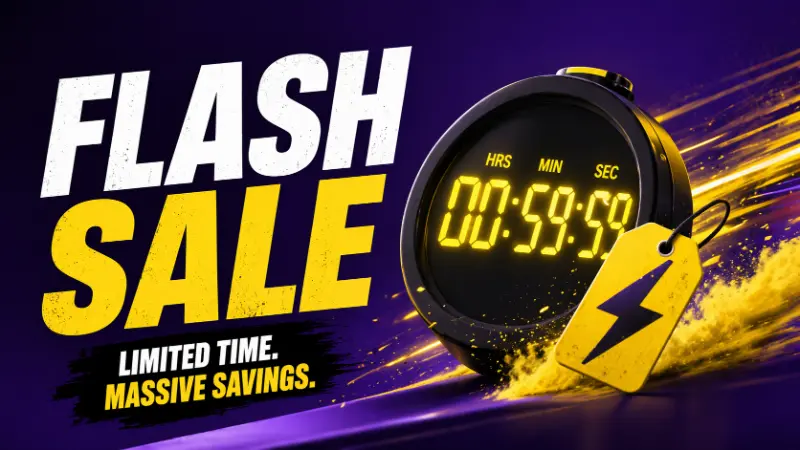
A flash sale is a short-duration promotional event in which a brand offers discounted prices on select items for a defined window of time, typically anywhere from a few hours to 48 hours. The design is deliberate: urgency created by time limits and limited quantities drives consumers to make purchasing decisions faster than they otherwise would, compressing demand into a concentrated burst of order volume. The thrill of winning a great deal during flash sales adds an element of entertainment and excitement for consumers.
For ecommerce brands, understanding the benefits and advantages of a well-executed flash sale is key—it can clear excess inventory, boost brand awareness, create a competitive edge, and bring in new customers while boosting sales and brand visibility. Flash sales are used by both online and brick-and-mortar stores to drive traffic. For example, limited-time apparel discounts and surprise sales from retailers like Zulily or Gilt are classic flash sales. Retailers often employ countdown timers to create urgency, and the extreme time limit can reduce decision fatigue for consumers. The primary goal of a flash sale is to encourage impulse purchases by creating urgency and leveraging the fear of missing out among consumers. A poorly planned one can crash a website, overwhelm fulfillment capacity, trigger a wave of returns, and deliver margin outcomes that look worse after the event than before it.
Why Brands Run Flash Sales to Clear Excess Inventory
The appeal of the flash sale format is straightforward. Time pressure converts browsers into buyers. Scarcity signals create excitement that standard promotional pricing does not. And the concentrated format makes flash sales easier to promote with urgency across email, SMS, and social channels than an indefinite sale with no clear endpoint.
Ecommerce brands use flash sales for several distinct purposes, and the reason behind the event shapes how it should be structured:
Clearing excess inventory is one of the most operationally sound uses of a flash sale. A brand sitting on overstock of a slow-moving SKU, seasonal leftover, or a product being discontinued can use a flash sale with deep discounts on those specific items to convert dead stock into cash and recover warehouse space. The margin hit is absorbed on inventory that was not moving anyway.
Rewarding loyal customers through exclusive early access or member-only flash sales builds relationship value without the margin erosion that comes from running public discounts. A flash sale visible only to email subscribers or loyalty members provides the perception of exclusivity and the feeling of being valued without training the broader market to wait for deals.
Driving new customer acquisition is a legitimate goal, but it requires careful analysis of unit economics. Flash sales often attract new customers and first-time buyers, but a major challenge is converting these shoppers into loyal customers after the sale ends, as many may not return for future purchases. Additionally, flash sales can be used to re-activate dormant email subscribers, bringing them back into the customer journey. A customer acquired through a 50 percent discount on a first purchase has to return and buy at full price for that acquisition to make financial sense. Flash sales that acquire customers who are discount-motivated and never return at full price are not growth events. They are margin-eroding promotions that inflate order counts. Brands should focus on strategies that maximize the impact of flash sales for new customer acquisition.
Generating revenue during slow periods gives brands a tool for activating demand during historically low-traffic windows. An off-season flash sale can bridge revenue gaps, though the cost in margin per order needs to be weighed against what that demand would look like at standard pricing without the promotional push.
Slash Your Fulfillment Costs by Up to 30%
Cut shipping expenses by 30% and boost profit with Cahoot's AI-optimized fulfillment services and modern tech —no overheads and no humans required!
I'm Interested in Saving Time and MoneyThe Demand Spike Problem
The defining operational feature of a flash sale is the demand spike. Demand that would have been distributed across days, weeks, or months is collapsed into hours. The concentrated volume is precisely what makes the format effective from a marketing standpoint and precisely what makes it dangerous from an operations standpoint.
A brand that processes 200 orders per day and runs a flash sale that generates 2,000 orders in four hours has not just had a good day. It has presented its fulfillment infrastructure with a challenge it was not designed to handle at that ratio. Unless capacity was explicitly prepared in advance, every system that touches order processing comes under simultaneous stress: the website, the inventory management system, the warehouse pick-and-pack workflow, the carrier pickup volume, and the customer service queue.
Website performance failures during flash sales are common enough to be an expected risk rather than an edge case. A spike in concurrent sessions that exceeds server capacity produces slow load times or outright downtime at exactly the moment when customer intent is highest. Every second of downtime during a flash sale is lost revenue and broken brand credibility. Brands running flash sales on Shopify benefit from the platform’s infrastructure, but third-party apps, custom integrations, and poorly optimized themes can still produce performance degradation under load. Load testing before a high-volume event is not optional preparation. It is standard practice for any brand expecting meaningful traffic.
Inventory management during a flash sale requires real-time accuracy. Overselling, where a product sells more units than are physically in stock, is a frequent flash sale failure mode. A customer who completes a purchase and receives a cancellation notification a day later because the item was already sold out when they ordered has had a worse experience than if they had simply seen the item as unavailable. Overselling also drives a disproportionate share of post-sale customer service volume, refund processing, and negative reviews.
Fulfillment Bottlenecks
The order processing spike from a flash sale creates downstream pressure on fulfillment that often does not become visible until days after the event ends. Warehouse teams that were staffed for normal daily volume face a backlog of orders that arrive simultaneously rather than in a steady flow. Pick-and-pack throughput has a ceiling regardless of order volume. Packing stations, label printers, carrier pickups, and staging areas all have physical capacity limits.
Brands that run flash sales without pre-staging inventory near packing stations, without adding temporary labor or scheduling existing staff for extended shifts, and without coordinating increased carrier pickup volumes in advance will discover these limits painfully. The result is shipping delays that stretch beyond the delivery windows communicated to customers at checkout. Customers who purchased during a flash sale expecting two to three day delivery and received their order eight days later are not likely to return at full price. During and after a flash sale, it is crucial to provide excellent customer service to maintain customer satisfaction and foster loyalty. Excellent customer service can help mitigate negative experiences caused by fulfillment delays and ensure a positive perception of the company.
Third-party logistics providers are a partial solution to the capacity problem, but they require advance notification to prepare. A 3PL that is not told about an upcoming flash sale until the orders start flowing has the same capacity constraints as an in-house warehouse, which is especially problematic for small businesses relying on third-party logistics for warehousing and fulfillment. Communication with fulfillment partners well before the event, including a projected order volume range and a timeline, allows the partner to staff appropriately and pre-position inventory.
Carrier capacity is a separate constraint that brands frequently overlook. Scheduling a carrier pickup that is ten times the normal daily volume without coordination may result in a partial pickup or a missed pickup entirely. A brand shipping via UPS, FedEx, or a regional carrier should contact their account manager before a high-volume flash sale event to confirm pickup capacity and, if needed, schedule a supplemental pickup or arrange a drop-off to a hub facility, since broader supply chain inefficiencies and carrier reliability issues can amplify flash-sale-related bottlenecks.
Looking for a New 3PL? Start with this Free RFP Template
Cut weeks off your selection process. Avoid pitfalls. Get the only 3PL RFP checklist built for ecommerce brands, absolutely free.
Get My Free 3PL RFPMargin Erosion: The Math Brands Skip
Flash sales feel like revenue events. The order volume is high. The revenue number is large. The margin story is often quietly worse than it appears.
A product with a standard unit margin of 40 percent sold at a 40 percent discount is generating zero gross margin on every sale. When warehousing costs, payment processing fees, and shipping costs are applied against that order, the unit economics are negative. A flash sale that generates $80,000 in revenue at negative margin is not a success. It is an expensive exercise in revenue with no profit.
The break-even analysis for a flash sale requires calculating the actual gross margin at the discounted price after all variable costs, not just comparing the revenue to the cost of goods sold. For inventory clearance purposes, some margin sacrifice is rational because the alternative is holding costs and eventual write-off. For demand generation purposes, the margin arithmetic needs to close in a realistic customer lifetime value model.
The returns impact is often not modeled into flash sale planning at all. Flash sales generate higher return rates than standard purchase events for several reasons: customers buy impulsively under time pressure, customers purchase items they are less certain about because the low price reduces the psychological cost of a mistake, and some customers purchase multiples intending to return the sizes or styles that do not work. A flash sale with a 25 percent return rate has a meaningfully different margin profile than one with a 10 percent return rate. Return processing costs, restocking labor, and the possibility that returned items arrive in unsellable condition all reduce the effective margin of the event further.
The Contrarian View: Flash Sales Can Undermine Brand Positioning
Many ecommerce brands treat flash sales as a tactical revenue lever without considering their effect on brand perception and customer pricing expectations.
A customer who buys from a brand for the first time during a 60 percent off flash sale has established a reference price. When they return to the site and see standard pricing, they have a decision to make: pay the full price, wait for the next sale, or abandon the brand. Brands that run flash sales frequently are implicitly telling their customers that the real price is the sale price. Over time, this erodes willingness to pay at full price, suppresses organic demand, and creates a customer base that is structurally dependent on promotional events to engage.
This is not a theoretical risk. It is the documented pattern of brands that over-rely on promotional pricing as a demand driver. The flash sale format accelerates this dynamic because the urgency mechanics make the discount even more salient in the customer’s memory than a standard promotion would.
However, a positive flash sale experience can strengthen the company’s reputation and foster greater customer loyalty, as customers associate the company with value and excitement. Brands with strong brand equity, a loyal customer base, and disciplined promotional cadence can run flash sales without these consequences. Staying informed about ecommerce logistics and fulfillment trends through industry events and conferences can also help brands refine their flash sale strategies over time. The risk is highest for brands that use flash sales as a primary growth mechanism rather than as a deliberate, selective tool.
Scale Faster with the World’s First Peer-to-Peer Fulfillment Network
Tap into a nationwide network of high-performance partner warehouses — expand capacity, cut shipping costs, and reach customers 1–2 days faster.
Explore Fulfillment NetworkHow to Run a Flash Sale Without Breaking Operations
For brands that have evaluated the economics and determined a flash sale makes sense, preparing your ecommerce store and store infrastructure is crucial for smooth execution. Robust ecommerce fulfillment software with real-time visibility and smart inventory placement can make that checklist far easier to execute at scale.
Flash Sale Operational Preparation Checklist:
- Identify your target audience and understand their preferences and buying behavior to maximize the effectiveness of your flash sale.
- Use multiple channels—such as email, social media, and website banners—to promote the flash sale, build anticipation, and drive customers to shop.
- Leverage flash sales as an effective way to sell products quickly and clear excess or slow-moving inventory from your ecommerce store.
- Set inventory limits per SKU and use platform-level inventory caps to prevent overselling. If a flash sale is limited to 500 units of a product, the system should stop accepting orders at 500, not at some downstream point after the warehouse has already committed to fulfillment.
- Communicate with all operational partners before the event: warehouse team or 3PL, carriers, customer service. Each group needs to know the expected volume, the timing, and what elevated response looks like for their function.
- Test the website under load before the event goes live. Tools that simulate concurrent users against a staging environment can identify performance bottlenecks before they affect real customers.
- Build the return policy for the event explicitly and display it prominently. A flash sale with no stated return policy creates customer service ambiguity that costs more to resolve than a clear policy stated upfront.
- Define a realistic shipping window at checkout that reflects actual fulfillment capacity during the event period, not standard processing time. Underpromising delivery time and meeting it is far better than overpromising and failing.
- Monitor order flow and inventory in real time during the event. Having a team member watching live order volume and inventory levels allows rapid intervention if a SKU sells out faster than expected or if a fulfillment bottleneck is emerging.
Frequently Asked Questions
What is a flash sale?
A flash sale is a short-duration promotional event where a brand offers steep discounts on select products for a defined time window, typically a few hours to 48 hours. The combination of limited time and limited quantities is designed to create urgency and drive concentrated purchase activity.
How long should a flash sale last?
Most flash sales run between four hours and 24 hours. The optimal duration depends on the size of the audience being reached and the depth of inventory available. Shorter windows create stronger urgency but require a larger active audience to generate meaningful volume. Longer windows give more customers the opportunity to participate but reduce the urgency signal.
Are flash sales good for ecommerce brands?
They can be, when used selectively with a clear objective, properly modeled unit economics, and adequate operational preparation. Used frequently or without planning, flash sales erode margins, train customers to expect discounts, and create fulfillment problems that damage customer experience.
What is the biggest operational risk of a flash sale?
Demand spikes that exceed fulfillment capacity are the most common operational failure mode. When orders arrive faster than a warehouse or 3PL can process them, shipping delays follow, customer expectations are broken, and customer service volume spikes. The second most common risk is overselling, where orders are accepted for inventory that is no longer available.
How do flash sales affect returns?
Flash sales typically generate higher return rates than standard purchases because customers buy under time pressure and with less deliberation than usual. Brands should model expected return rates into the margin analysis for any flash sale event and ensure reverse logistics capacity is available to handle the post-event return flow.
How can a brand avoid overselling during a flash sale?
Set hard inventory limits in the ecommerce platform or order management system that prevent additional orders once the allocated quantity is sold. Real-time inventory tracking during the event is essential. Brands using multiple sales channels simultaneously must ensure inventory is not double-allocated across channels without a centralized inventory pool.
Should flash sales be exclusive to existing customers?
For brands concerned about training the broader market to wait for discounts, offering flash sale access exclusively to existing email subscribers or loyalty members is a better-positioned strategy. It rewards loyalty, maintains urgency, and avoids the brand perception problems that come from making deep discounts visible to the general public.
Written By:

Rinaldi Juwono
Rinaldi Juwono leads content and SEO strategy at Cahoot, crafting data-driven insights that help ecommerce brands navigate logistics challenges. He works closely with the product, sales, and operations teams to translate Cahoot’s innovations into actionable strategies merchants can use to grow smarter and leaner.

Turn Returns Into New Revenue
Related Articles
What Is a Perpetual Inventory System? How It Works in Ecommerce
A perpetual inventory system is an inventory management approach in which stock levels are updated continuously and automatically every time a transaction occurs.

Why Faster Refunds Made Returns More Expensive
Introduction Faster refunds feel like obvious progress.
Common Objections to Peer-to-Peer Returns (And the Mistake Behind Each)
Most objections to peer to peer returns mistakes sound practical on the surface, but when you trace them back to their source, they are usually aimed at the wrong mental model of w...