
Why Faster Refunds Made Returns More Expensive

Last updated on October 08, 2026
In this article
 14 minute
- Introduction
- Refund Faster Solutions Solved a Real Customer Satisfaction Pain
- Speed Removed Friction From the Wrong Part of the Loop
- The Money Goes Out via Direct Deposit Before the Operational Costs Come Back
- Better Refund CX Did Not Mean Better Returns Management Process Economics
- The Industry Optimized Reassurance Before Reverse Logistics Recovery
- Faster Refunds Made a Broken System Feel Better, Not Work Better
- What Operators Should Take From This
- Conclusion
- Frequently Asked Questions
Introduction
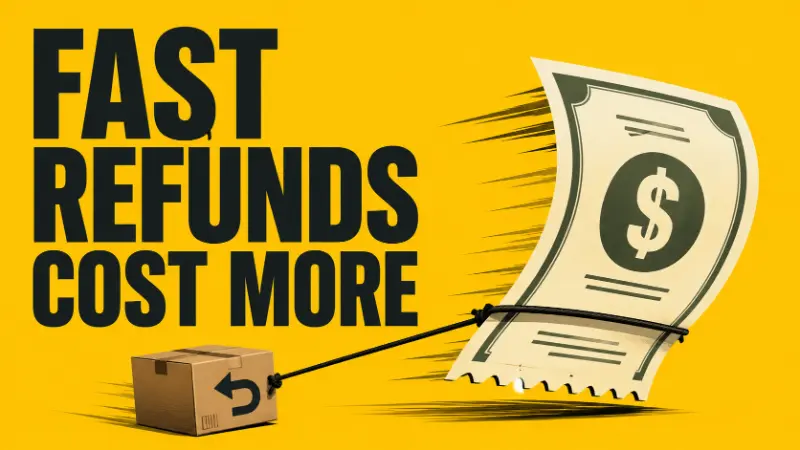
Faster refunds feel like obvious progress. For shoppers, they often are. For merchants, they also quietly made an already fragile system more expensive. The money started going out faster. The value did not start coming back faster.
That gap is the entire story of modern returns management. Over the last decade, the industry poured energy into smoothing the refund experience, shrinking the wait from weeks to days to instant. Customer reassurance climbed. Recovery did not climb at the same pace. The emotional loop closed faster while the economic loop stayed open just as long, sometimes longer. In 2023, consumers returned retail purchases worth a staggering $743 billion—about 14.5% of all sales—highlighting the significant financial impact of returns, especially in e-commerce. This article unpacks that tradeoff, why it matters operationally, and why a smoother refund is not the same thing as a healthier return.
Ultimately, the returns process—the sequence of steps from customer initiation to final resolution—plays a crucial role in shaping both customer experience and business outcomes.
Refund Faster Solutions Solved a Real Customer Satisfaction Pain
Before going further, it is worth saying clearly: faster refunds fixed something real.
Research shows that 91% of customers say the overall ease of their returns experience impacts their willingness to shop with a retailer again, highlighting how critical a seamless returns experience is for customer satisfaction and loyalty.
Customers dislike waiting for their own money. A refund that takes two or three weeks creates anxiety, distrust, and support tickets. People wonder if the package arrived. They wonder if the merchant is stalling. They wonder if they will need to dispute the charge. Every day the refund sits in limbo is a day the brand feels less trustworthy. A clear and concise returns policy helps set customer expectations and builds customer trust, reducing misunderstandings and fostering loyalty.
Faster refunds reduced that anxiety. They improved perceived service quality. They gave customers a reason to take a chance on a brand they had not bought from before, because the downside risk felt small and well-managed. In a category where buying sight unseen is the default, that reassurance has measurable conversion value.
So this is not an argument that refund speed is bad, or that customers should be made to wait longer. The point is narrower and more uncomfortable: refund speed solved a customer experience problem and, in the process, accelerated a financial problem that was already present.
Speed Removed Friction From the Wrong Part of the Loop
Returns have always involved friction. Some of it was bad friction, the kind that frustrated customers and damaged loyalty. Some of it was structurally useful, the kind that slowed casual or low-intent return behavior, including behaviors like ordering multiple sizes with the intent to return most of them, simply because the returns process had a few rough edges.
When refunds sped up, the bad friction came down. So did the useful friction, making processing returns an even greater operational challenge.
A seamless returns process is crucial for building a positive relationship with your customers. In fact, 70% of North American consumers stated they purchased more from a retailer after a positive return experience, highlighting the impact of customer returns on loyalty and repeat business.
A refund that lands the moment a tracking event fires, or even at the moment a return is initiated, removes hesitation from the most behaviorally sensitive part of the loop. The decision to return becomes lighter. Bracketing becomes easier. Casual returns, the ones a shopper might have shrugged off when refund pain was higher, become routine. None of this is a moral failing on the part of customers. It is a predictable response to a smoother experience.
The center of the issue is this: refund-speed improvements reduced emotional friction without fixing the underlying recovery problem. The loop felt smoother. It did not become structurally healthier. This is one of the reasons why returns software doesn’t actually fix returns on its own. Better portals, faster approvals, and instant credit improve the front end of returns while leaving the expensive back end intact.
The Money Goes Out via Direct Deposit Before the Operational Costs Come Back
This is the part most refund-speed conversations skip.
Every return has two clocks. One is the refund clock, the time from return initiation to the customer seeing their money. The other is the recovery clock, the time from return initiation to the merchant actually recapturing value, whether through resale, restock, liquidation, or write-down.
For a long time, those two clocks ran somewhat in parallel. A return came in, the warehouse processed it, inventory updated, the refund issued, the item went back on the shelf. Slow on both sides, but at least synchronized.
Faster refunds severed that link. Consider what a typical returned item still has to go through on the merchant side, a process that involves optimizing reverse logistics across the network for the physical movement of goods and careful inventory management to track and restock returned merchandise:
- Inbound shipping back to a distribution center (reverse logistics)
- Intake and queue time at the dock
- Inspection, grading, and disposition of returned merchandise
- Repackaging or relisting as part of order fulfillment
- Restocking, resale at a discount, liquidation, or destruction, all requiring accurate inventory management
None of that happens at refund speed. Inbound freight takes days. Intake queues swell during peak. Inspection labor is finite. Markdown decisions take time, and every day an item sits unsold, its resale value erodes. Delays in these steps increase operational costs, impacting overall efficiency and profitability, especially in categories where high ecommerce return rates directly erode already thin profit margins. The result is a widening gap. Cash leaves the business in hours. Value comes back in weeks, partially, or sometimes not at all.
It’s important to note that returns management is the process of overseeing returned products to ensure a seamless experience for both customers and businesses, covering everything from authorizing returns to restocking items or disposing of products that can’t be resold. While reverse logistics focuses on the physical transportation and handling of returned products, returns management encompasses the broader strategic management of returns, including their impact on inventory, order fulfillment, and customer experience.
That timing mismatch is the economic heart of the problem. It is also one of the quieter reasons returns became a silent margin killer inside many ecommerce P&Ls. The cost is not in any single line item. It is in the gap between two timelines that used to move together and now don’t.
Better Refund CX Did Not Mean Better Returns Management Process Economics
It is tempting to assume that if customer satisfaction with returns is up, the returns system itself must be healthier. However, the financial impact of returns is substantial—average ecommerce return rates often range from 15% to 30%, and consumers returned retail purchases worth approximately $743 billion in 2023, representing about 14.5% of all sales. This highlights the critical importance of effective returns management for e-commerce profitability.
A useful way to see it:
- What improved: customer reassurance, perceived trust, speed of emotional resolution, post-purchase NPS.
- What did not improve proportionally: recovery timing, value recapture, fraud exposure from returns and refunds, inventory velocity, cost per return, operational efficiency.
A shopper can have a five-star refund experience on a return that costs the merchant more than the original margin on the sale. The customer’s loop closed in 30 seconds, often due to streamlined processing refunds as part of the returns management process. The merchant’s loop is still open, accruing shipping, labor, markdown, and opportunity cost. From the customer’s perspective, the return is done. From a finance perspective, it has barely started.
This is why refund speed and return health are easy to confuse and important to separate. A smoother return feeling is not the same as a healthier loop, and dashboards that only track refund time and CSAT will systematically miss the part of the system that is actually leaking money. Friction removal at the front end was real progress for shoppers. It was also part of the reason free returns were always a loss leader in the way most brands implemented them, paid for in margin nobody was watching.
Returns management focuses on the customer-facing side of the process, ensuring returns are handled quickly, accurately, and with minimal friction to prioritize customer satisfaction and operational efficiency, often through dedicated returns management software that automates these workflows. In contrast, reverse logistics deals with the full journey of a product moving back through the supply chain for repair, refurbishment, recycling, or resale, focusing on maximizing asset recovery and environmental responsibility. Both are critical components of modern e-commerce.
The Industry Optimized Reassurance Before Reverse Logistics Recovery
Step back from any individual brand and the pattern across the industry becomes obvious. The emotional experience of returns improved much faster than the economic structure underneath it, even as companies began to focus on returns management best practices and best practices to optimize order fulfillment, reduce costs, and improve customer satisfaction.
Self-serve portals, branded return pages, automated approvals, instant credit, label-free drop-off, real-time refund notifications—all of these arrived years before the industry seriously revisited where returned items actually go and how quickly value can be recovered. While reassurance got the budget, returns management software that automates and analyzes these flows and addressing operational inefficiencies in manual returns processing often lagged behind, even in complex environments like Amazon FBA where sellers must actively analyze return patterns to protect profitability. Regularly reviewing returns data is essential for optimizing returns management strategies, improving customer satisfaction, and reducing costs.
That is not an accident. Reassurance is visible. It shows up in conversion rates, support ticket volume, review scores, and retention metrics. Recovery is invisible until somebody adds up the cost-per-return, the markdown decay, the fraud losses, and the working capital tied up in items waiting to be processed. By the time those numbers get attention, the customer-facing experience has already been rebuilt around the assumption that refunds will be near-instant.
The loop felt better before it worked better. That is the line worth remembering.
Faster Refunds Made a Broken System Feel Better, Not Work Better
This is the part that ties everything together. While faster refunds provide valuable symptom relief in the returns management process, they do not address the underlying structural issues. Improving the returns management process involves more than just speeding up refunds—it requires optimizing each step, from customer initiation to inspection, inventory updates, and logistics coordination.
Symptom relief is what happens when:
- The portal is faster than the warehouse
- The notification is faster than the inspection
- The credit is faster than the restock
- The customer feels resolved before the inventory is
However, focusing only on symptom relief can mask inefficiencies such as long processing times and increased risk of human error. Automating tasks like issuing return shipping labels and other documentation, updating inventory, and processing refunds—whether through in-house tools or specialized returns solutions built for platforms like Shopify—can significantly reduce processing times and minimize human error, leading to greater operational efficiency.
Structural repair is something different. It addresses where returns go, how value is recovered, and how quickly the economic loop can actually close. Selecting the right technology—such as returns management systems, barcode scanners, warehouse management systems, and machine learning tools—can further enhance the returns management process. For some brands, that includes evaluating network-based options like Happy Returns’ drop-off reverse logistics model or SaaS-based portals such as ZigZag’s returns management solution. For example, machine learning tools can assign risk scores at checkout to identify chronic returners or suspicious patterns, helping to prevent fraud and streamline operations. It is the conversation that begins when a brand stops asking “how do we make refunds faster?” and starts asking “why do returns have to take this path at all?” That is the deeper shift, and the case that returns need to go forward, not back belongs to a different article. This piece has a narrower job: to make clear that faster refunds, on their own, do not get a brand there.
What Operators Should Take From This
A few practical takeaways for anyone running, financing, or rethinking a returns program—and for anyone trying to use returns as a lever for stronger loyalty through an exceptional returns program:
- Track refund time and recovery time as two separate metrics. If only one is improving, the gap is widening, and often that gap widens fastest when ecommerce return rates climb due to issues like poor fit or bracketing behavior or when returns fraud quietly inflates the apparent volume and cost of returns.
- Resist the urge to read rising refund CSAT as evidence that the returns system is getting healthier. Those signals can move in opposite directions.
- When evaluating returns software or refund-speed initiatives, ask explicitly what the change does to recovery timing, not just refund timing. If the answer is nothing, the underlying economics will not improve.
- Treat refund speed as a customer experience input, not a returns strategy. The strategy lives downstream, in how value is recaptured.
- Implement a returns portal to streamline the returns process. Self-service online portals provide a frictionless experience for customers to initiate returns, receive instant QR codes, and access return shipping labels, improving efficiency and satisfaction—while still allowing you to revisit whether free returns remain sustainable at scale, whether tools like restocking fees or alternative incentives make more sense, or whether they need to evolve as more retailers rethink or roll back blanket free-return policies.
- Prioritize clear customer communication and swift customer resolution throughout the returns process to build trust and encourage repeat business.
- Analyze return data to identify trends, such as frequently returned products, and use these insights to cut costs and reduce costs by addressing inefficiencies and improving product quality, while also aligning with eco-friendly returns practices that reduce waste and logistics emissions and maintaining clear, customer-friendly return policies across marketplaces like Amazon.
None of this argues for slower refunds. It argues for honest accounting of what speed did and didn’t fix.
Conclusion
Faster refunds were a real win for customers and a real shift in what people expect from ecommerce. They were also one of the cleanest examples in retail of an experience improvement outpacing an economic one. The money started going out faster. The value did not come back faster. The emotional loop closed quickly. The economic loop stayed open just as long.
Recognizing that gap is not an argument against customer experience. It is an argument for measuring the loop honestly, on both sides, and for understanding that a smoother refund is the beginning of the conversation about returns economics, not the end of it.
Frequently Asked Questions
Are faster refunds bad for ecommerce businesses?
No. Faster refunds solved a real customer pain and improved trust, conversion, and perceived service quality. The issue is not that refunds got faster. It is that refund timing pulled away from value-recovery timing, and many brands track only the first. The cost shows up in the gap between the two.
What does tax refund timing have to do with returns economics?
Refund timing controls when cash leaves the business. Recovery timing controls when, and how much, value comes back. When refunds accelerate but inbound shipping, inspection, restocking, and resale stay on their original timelines, the merchant absorbs a longer interest-free liability on every return.
Is this the same problem as free returns?
It is related but distinct. Free returns is a subsidy question, whether the merchant absorbs the round-trip shipping cost. Refund speed is a timing question, how quickly cash goes out relative to when value is recovered. The two compound, but they are separate levers.
Can returns software fix this?
Returns software can make refunds faster, smoother, and more consistent. It does not, on its own, change where returned items go or how quickly value is recovered. That is a routing and structural question, not a portal question.
Should brands slow down refunds to protect margin?
Slowing refunds is not the answer. It would damage trust without fixing the underlying recovery problem. The more useful move is to measure refund timing and recovery timing separately, and to focus structural investment on the recovery side, where most return losses actually compound.
Written By:

Manish Chowdhary
Manish Chowdhary is the founder and CEO of Cahoot, the most comprehensive post-purchase suite for ecommerce brands. A serial entrepreneur and industry thought leader, Manish has decades of experience building technologies that simplify ecommerce logistics—from order fulfillment to returns. His insights help brands stay ahead of market shifts and operational challenges.

Turn Returns Into New Revenue
Related Articles

Shopify Estimated Delivery Date: A Complete Guide for Ecommerce Stores
A Shopify estimated delivery date is the specific arrival date or date range shown on a product page before purchase, so shoppers know when an order is expected to arrive.
Save Money With Ecommerce Shipping Software: Next-Gen Solutions
Shipping costs are one of the biggest challenges for ecommerce businesses today, and understanding them is essential to reducing expenses and increasing profit margins.