
Why P2P Returns Are Not “Recommerce”

Last updated on May 14, 2026
In this article
 16 minutes
- Introduction to P2P Returns
- Recommerce Usually Means Used Goods
- P2P Returns Preserve Like-New Inventory
- Think Fitting Room, Not Flea Market
- Logistics and Operations: How P2P Returns Work in Practice
- Why the Distinction Matters for Trust and Margin
- Environmental Benefits of P2P Returns
- P2P Can Coexist With Recommerce, But It Is Not Recommerce
- The Mental Model That Actually Fits
- Frequently Asked Questions
Peer-to-peer returns are a logistics model, not a resale channel. When people hear that a returned item goes from one customer directly to another, they often reach for the nearest familiar category and file it under recommerce. That instinct is understandable, but it is strategically wrong, and the distinction matters more than most ecommerce operators realize. In this context, recommerce refers specifically to the process of reselling pre-owned or surplus products, emphasizing its role in secondhand ecommerce and circular economy initiatives.
Recommerce is built around the idea of selling goods that have already moved into a secondary-market frame: used items, recovered inventory, refurbished stock. It comes into play after something has already been classified as a used good. Recommerce providers and recommerce platforms play a crucial role in facilitating these transactions for brands and consumers, managing resale logistics, refurbishment, and consumer engagement. The business model of recommerce is structured around resale and recovery, aligning sustainability and profitability within a company’s overall operations. Peer-to-peer returns, by contrast, are about preventing that classification from happening at all. A like-new item that skips the trip back to the warehouse is not recommerce. It is first-sale inventory that moved directly to its next owner before anyone had a chance to treat it like used goods.
The global recommerce market is valued at $100 billion, growing at a rate five times faster than the broader retail market, and is expected to represent 23% of all retail by 2030.
Introduction to P2P Returns
Peer-to-peer (P2P) returns are transforming the landscape of ecommerce returns by streamlining the way products move between customers. Traditionally, when a customer wanted to return an item, it would travel back to a central processing center or warehouse before being restocked or resold. This process often led to increased shipping costs, excess packaging waste, and a slower returns process that could frustrate customers.
With P2P returns, the process is reimagined: instead of sending the item back to the merchant, the returning customer ships it directly to the next buyer. This peer-to-peer approach not only accelerates the returns process but also significantly reduces the resources required for each transaction. Customers benefit from faster resolutions and improved customer satisfaction, while ecommerce businesses see a reduction in operational costs and packaging waste. By keeping products in circulation and out of the warehouse, P2P returns offer a more efficient and customer-centric solution to the challenges of ecommerce returns.
Recommerce Usually Means Used Goods
The word recommerce has a specific gravity. When operators hear it, they picture resale platforms, secondary-market channels, trade-in programs, and refurbished inventory. That mental picture is accurate for what recommerce actually is. The resale business, built on the resale business model, leverages resale platforms to facilitate the sale of pre-owned and used products, enabling the efficient movement of goods within the circular economy.
Recommerce typically describes situations where goods have already fallen into a different value category. The item has been owned, used, returned through traditional recovery channels, and then made available again through a resale structure. Pre-owned, pre-owned items, and used products are sourced and processed through trade-ins, trade-in credit, and store credit programs, allowing consumers to exchange their goods for value and supporting sustainable consumption. The business logic is about recovering value that has already degraded. Resale as a service and third-party platforms enable brands to participate in the resale industry by managing resale operations, while various resale models support both peer-to-peer and take-back programs. Reverse commerce is another term used to describe the resale or reuse of previously owned items, highlighting its connection to sustainable supply chain practices. That is a legitimate and growing category of commerce, but it is a downstream activity.
The mental image it produces matters. “Recommerce” conjures flea markets, liquidation lots, and thrift-store bins. It implies that the item’s best days as a sellable product are behind it, and that the challenge now is to extract what residual value remains. The growth of the resale industry is driven by individual consumers actively participating in these programs, as well as many retailers and many brands recognizing the importance of integrating recommerce and reverse logistics into their business strategies.
The culture of disposable fashion generates around 17 million tons of textile waste annually in the U.S., with only 14-15% of discarded items being recovered, emphasizing the need for sustainable practices like recommerce to mitigate waste. During the holiday season of 2023, the resale market is expected to contribute to the prevention of 32 billion pounds of waste from ending up in landfills, showcasing the environmental benefits of recommerce. Implementing resale initiatives could lead to a reduction of annual carbon emissions by approximately 15-16% by the year 2040, highlighting the long-term sustainability benefits of recommerce.
That framing is completely wrong for the scenario peer-to-peer returns actually describe. If you want to understand what peer-to-peer returns are at a foundational level, the core definition is worth reading before going further.
P2P Returns Preserve Like-New Inventory
Here is the scenario peer-to-peer returns actually describe.
A customer orders a pair of pants online. They try them on once. The fit is wrong. They initiate a return. Another new customer has already found that same item, wants it at an open-box discount, and is ready to buy. In a P2P model, the first customer ships the item directly to the second customer. The merchant’s warehouse is never involved.
That item never went through a recovery loop. It was not inspected, re-tagged, put in a bin, or processed through a reverse logistics facility. It is the same highly sellable product it was when it shipped the first time, and it has moved to a new customer who wanted it. Quality control is maintained by minimizing handling, helping preserve the like-new condition of the item.
That is not recommerce. There is no secondary market. No resale channel. No recovery logic. The item retained its like-new condition and moved to its next buyer while that condition was still intact.
Peer-to-peer returns can enhance customer satisfaction by providing a quicker and more efficient returns process, as customers receive refunds faster than traditional models. When combined with an exceptional returns program that builds customer loyalty, this speed and simplicity can become a powerful differentiator. Items returned through a P2P system can often find a new home in just a few days, leading to faster inventory turnover.
Think Fitting Room, Not Flea Market
The fitting room analogy makes this concrete.
When someone tries on a shirt in a physical store and puts it back on the rack, no one treats that shirt as used merchandise. The item was tried on. It is back in circulation. It is still fully sellable. Retailers do not mark it down to clearance price and ship it to a liquidator because a customer touched it.
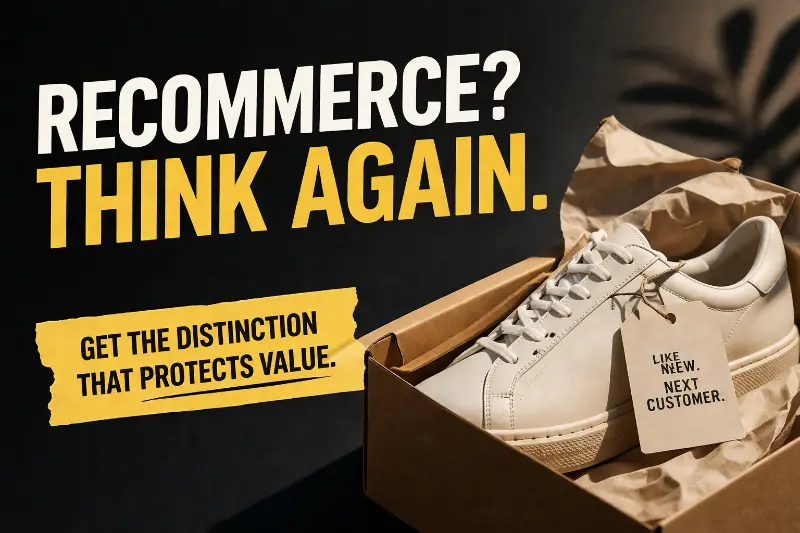
P2P Returns operate on the same logic. The item was tried on at home. The fit or the color was not right. Another buyer is willing to take it at an open-box discount and considers it like-new because, functionally, it is. The difference from a traditional return is that the item goes directly to that buyer instead of first going back to the warehouse to begin the traditional recovery process. This positive returns experience can foster repeat purchases, drive loyalty, and build customer loyalty by making the process seamless and trustworthy for customers.
Trade-in programs also effectively encourage customers to make repeat purchases, thereby increasing overall customer lifetime value, especially when they are designed as part of a broader ecommerce returns program that balances loyalty and costs.
Recommerce is the flea market at the end of that process, not the fitting room at the beginning of it.
What P2P returns protect is the item’s value before it enters any recovery system. A like-new returned item that gets dragged through the full warehouse loop will receive a markdown, a reprocessing cost, and a new classification as “used” or “open-box warehouse return” before it ever reaches its next buyer. P2P removes all of that friction by moving the item earlier in the chain, while the value is still fully intact. Additionally, P2P returns can reduce operational costs by eliminating the need for warehouse intake, inspection, and repackaging.
Logistics and Operations: How P2P Returns Work in Practice
The operational backbone of peer-to-peer returns relies on a sophisticated logistics process designed to maximize efficiency and minimize costs. When a customer initiates a return, the system first assesses the item’s condition and matches it with demand from other customers. If the item qualifies, a shipping label is automatically generated, directing the original customer to send the product straight to the next buyer—bypassing the traditional warehouse or processing center entirely.
This streamlined approach dramatically reduces reverse logistics costs, as items no longer need to be shipped back and forth between distribution centers. Logistics companies and technology providers play a pivotal role in enabling this process, offering the infrastructure and digital tools necessary to coordinate shipments, track inventory, and ensure a seamless customer experience, especially when they follow best practices for optimizing reverse logistics in ecommerce. By eliminating unnecessary steps in the reverse logistics process, P2P returns help ecommerce brands achieve greater operational efficiency and reduce the overall burden on their supply chain.
Why the Distinction Matters for Trust and Margin
Calling P2P returns recommerce is not just an imprecise label. It creates a real problem for how buyers perceive the item and how merchants price it.
When an item is framed inside a recommerce or resale mental model, buyers expect used-goods pricing and condition. They assume the item has passed through several hands and processes before reaching them. They discount the perceived value accordingly. Merchants who let their P2P offering drift into a recommerce frame are effectively giving away value they did not have to give away.
The economics of peer-to-peer returns depend on that value being preserved. The model works because a like-new item retains pricing power that a warehouse-processed open-box item does not. An item positioned as like-new and sold directly buyer-to-buyer commands a meaningfully different price than the same item that has been through a full returns processing cycle and relabeled as refurbished. Preserving this value leads to increased sales, higher profits, and more revenue generated for merchants, as digital recommerce platforms enable cost efficiencies and new income streams compared to traditional resale methods, especially in categories where ecommerce return rates can erode profit margins.
Merchants who mislabel P2P as recommerce also muddy the internal business case. The value proposition of P2P is that it skips the warehouse loop and keeps highly sellable inventory from being treated like recovered stock. P2P returns help reduce costs and avoid storage fees associated with traditional returns, further improving profit margins. In fact, P2P returns can cut return logistics costs by up to 60%, and cost reduction strategies can lower return-related losses from an average of $37 down to $15 per $100 item, which is especially important as many retailers struggle with the rise of ecommerce return rates. Ecommerce brands can also cut shipping and processing costs by up to 70% by implementing peer-to-peer returns, transforming a significant cost center into a revenue growth driver.
The label is not cosmetic. It shapes how the program is priced, positioned, and measured.
Environmental Benefits of P2P Returns
Beyond operational gains, peer-to-peer returns deliver substantial environmental benefits. By keeping products in active circulation and reducing the need for new manufacturing, P2P returns help cut down on packaging waste and lower carbon emissions associated with shipping and processing. This model is especially impactful for fashion retailers, who face mounting pressure to address the environmental impact of excess inventory and return waste and to implement eco-friendly returns practices that align with consumer expectations.
Encouraging customers to participate in P2P returns supports sustainable consumption habits, as it extends the lifecycle of products and reduces the demand for new goods. As more ecommerce brands and recommerce models adopt these practices, the industry moves closer to a circular economy—one where resources are used more efficiently and waste is minimized, mirroring broader shifts like the evolution of thrifting and mainstream secondhand shopping. For customers and businesses alike, P2P returns represent a practical step toward reducing environmental impact while maintaining high standards of service and satisfaction.
P2P Can Coexist With Recommerce, But It Is Not Recommerce
None of this means recommerce is irrelevant or that the two approaches are in conflict. A well-designed returns strategy often includes multiple paths for returned inventory, and a robust recommerce channel, built on a recommerce business model, is integrated into overall company strategy to maximize value recovery and sustainability.
Items that are not P2P-eligible, whether because of condition, category, or timing, may eventually find their way into recommerce or liquidation channels. That is appropriate. P2P handles the high-value portion of the return flow. Traditional downstream channels, often involving a distribution center and a logistics provider for inspection, restocking, or disposal, handle the rest, sometimes supported by a returns management solution like ZigZag or a platform such as Return Prime that focuses on the digital side of processing. For a full picture of where P2P fits and where it does not, where peer-to-peer returns don’t work is worth reviewing.
Approximately 30 to 60 percent of returns across most ecommerce operations are viable candidates for peer-to-peer routing or recommerce, depending on SKU mix, return reasons, and product categories.
But the point is that they serve different purposes at different points in the value chain. P2P comes first. It captures value before the item loses its like-new standing. Recommerce comes later and works with inventory that has already moved into a different category, allowing brands to participate directly in both P2P and recommerce processes for greater lifecycle management and sustainability.
These two approaches can coexist without being the same thing. They are not interchangeable.
The Mental Model That Actually Fits
P2P Returns are a logistics architecture, not a resale program. In the context of an ecommerce business, this architecture leverages advanced returns management systems and the expertise of a service provider to facilitate efficient, direct item transfers between customers. The defining feature is not that a second buyer gets the item. It is that the item moves directly to that buyer while still in highly sellable condition, before the warehouse handling and recovery processing that would otherwise erode its value and perception. Integrating resale software with existing systems, such as ERP, further streamlines these operations and enhances scalability.
A customer who receives a like-new item with no visible wear, shipped directly from the original buyer, has not purchased a used good in the way recommerce implies. They have purchased an item that was tried once and redirected before anyone processed it as a return. Throughout this process, the merchandise sold is carefully tracked and subjected to quality control measures to ensure a seamless experience and maintain high standards, much like store-based options such as Happy Returns’ drop-off reverse logistics model aim to simplify the customer experience.
Directly shipping the item reduces transit time and lowers carbon emissions, enhancing sustainability. The peer-to-peer returns model minimizes the environmental impact associated with traditional ecommerce returns by reducing the number of shipments and packaging waste. Waste reduction is a key benefit of the P2P model, supporting broader sustainability and circular economy goals.
That is a fundamentally different kind of transaction. It belongs in a fundamentally different mental category.
The moment you call it recommerce, you invite the wrong assumptions: used condition, depreciated value, secondary-market frame. Those assumptions are wrong, and they cost real margin when they shape how the program is built and communicated.
Frequently Asked Questions
What is the difference between peer-to-peer returns and recommerce?
Recommerce involves selling goods that have already moved into a secondary market or recovery channel, typically used, refurbished, or post-disposition inventory. Peer-to-peer returns involve like-new or open-box items that go directly from the returning customer to the next buyer without first going back to the merchant’s warehouse. The two approaches operate at different points in the value chain and serve different purposes.
Does calling P2P returns recommerce actually matter?
Yes. The label shapes buyer expectations, pricing logic, and how the business case is framed internally. When P2P is positioned as recommerce, buyers assume used-goods conditions and pricing, and merchants understate the value of the logistics model. The distinction directly affects margin and trust.
Are P2P returns the same as resale?
No. Resale and recommerce typically describe the sale of goods after they have been used, owned, or recovered. P2P returns describe a logistics model where a like-new returned item moves directly to the next customer instead of entering the traditional return processing loop. The item retains its like-new condition and value because it never went through warehouse recovery.
Can a brand use both peer-to-peer returns and recommerce?
Yes. The two approaches can coexist in a broader returns strategy. P2P returns handle the portion of return volume where items are still in highly sellable condition. Recommerce or other downstream recovery channels handle inventory that does not meet P2P eligibility criteria. They are complementary, not identical.
Is an open-box item sold through P2P considered a used good?
Not in the way recommerce implies. An item that was tried on once and shipped directly to the next buyer has not been through the handling, inspection, and reprocessing steps that typically define used or refurbished goods in a resale context. It is better understood as like-new inventory that moved to its next owner before the traditional return loop could degrade its value.
Where can I learn more about how peer-to-peer returns work in practice?
A detailed breakdown of how peer-to-peer returns actually work covers the operational mechanics step by step. For the financial case, the economics of peer-to-peer returns explains why skipping the warehouse preserves value and removes cost layers.
Written By:

Manish Chowdhary
Manish Chowdhary is the founder and CEO of Cahoot, the most comprehensive post-purchase suite for ecommerce brands. A serial entrepreneur and industry thought leader, Manish has decades of experience building technologies that simplify ecommerce logistics—from order fulfillment to returns. His insights help brands stay ahead of market shifts and operational challenges.

Turn Returns Into New Revenue
Related Articles

The Hidden Economics of a $100 Return
The cost of returns is one of the most systematically underestimated figures in ecommerce finance.
What Is Demand Planning? How It Impacts Inventory, Forecasting, and Profitability
Demand planning is the process of estimating future customer demand so that a business can align its inventory, procurement, and operations to meet that demand without carrying mor...
Why 100% P2P Adoption Is the Wrong Goal
Peer-to-peer returns let customers send eligible returned items directly to other customers instead of routing every package back through the warehouse, cutting shipping and proces...