
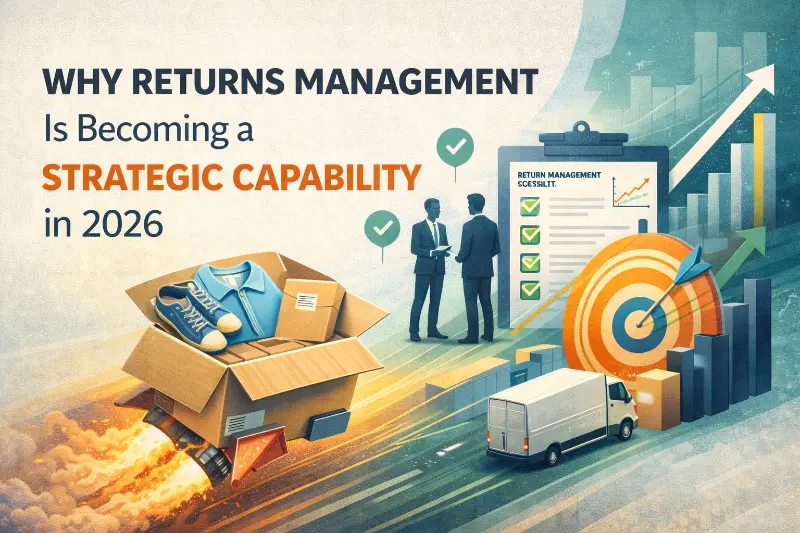
Why Returns Management Is Becoming a Strategic Capability in 2026

Last updated on January 29, 2026
In this article
 25 minutes
- Why returns were treated as a necessary evil
- What changed going into 2026
- Visibility isn't the same as recovery
- Restocking speed is the new KPI
- The hidden cost of traditional reverse logistics
- Customer initiates the return: the new first impression
- Customer resolution and support: turning returns into loyalty
- Reducing fraudulent returns in a digital-first era
- What a strategic returns management process actually looks like
- Technology’s role in next-generation returns management
- Continuous improvement: building a future-proof returns operation
- Why customer satisfaction will separate winners from everyone else
- Frequently Asked Questions
In 2026, product returns management is no longer just about processing refunds. As margins tighten and volumes rise, the ability to restock faster, recover inventory value, and reduce waste is becoming a strategic capability. Most returns platforms optimize for visibility and convenience, but brands that optimize for recovery are gaining a measurable advantage. The National Retail Federation projects $850 billion in merchandise returns for 2025, representing nearly one-quarter of all online sales. In 2023 alone, consumers returned retail purchases worth $743 billion, about 14.5% of all sales, highlighting the massive scale and complexity of ecommerce returns. For ecommerce operators, the question has shifted from “how do we make returns convenient” to “how do we turn returned inventory back into sellable stock before it loses value.”
To address rising return volumes and evolving customer expectations, businesses need a comprehensive returns strategy and an effective returns management strategy that covers logistics, inventory management, and customer support. This distinction matters because the operational gap between processing a return and recovering its value determines whether returns function as a controllable cost or an uncontrolled margin drain. Operations leaders and ecommerce founders who recognize this difference are restructuring reverse logistics around recovery speed, not just customer satisfaction scores. A positive returns experience can also drive future growth—70% of North American consumers say they purchased more from a retailer after a good return experience, underscoring the importance of meeting or exceeding customer expectations.
Why returns were treated as a necessary evil
For most of ecommerce’s history, the customer returns process existed as a customer experience function. The logic was straightforward: online shopping required trust, and generous return policies built that trust. Amazon normalized free returns, Zappos built its brand on hassle-free exchanges, and the entire industry converged on the idea that friction-free returns were table stakes for customer acquisition and retention.
This framing positioned returns as a cost of doing business in the service of customer loyalty. Retailers invested in return portals, prepaid labels, extended windows, and streamlined refund processing. Clear, transparent policies reduce friction in the returns process, making them easy to find and understand, which is essential for a positive customer experience. The operational goal was speed to refund, not speed to recovery. Processing returns meant getting money back to customers quickly to preserve satisfaction scores and avoid chargebacks.
The underlying economics were tolerable when margins were healthier and return volumes were lower. Ecommerce return rates hovered around 15-20% industry-wide, concentrated in specific categories like apparel and footwear where fit issues drove predictable return patterns. Accurate product information, including comprehensive descriptions and high-resolution images, helps prevent returns due to mismatches in these categories. Brands absorbed the cost as customer acquisition expense, measuring success through Net Promoter Scores and repeat purchase rates rather than inventory recovery metrics.
Warehouse operations reflected these priorities. Returned products entered the same receiving queues as new inventory, got triaged when capacity allowed, and often sat in holding areas waiting for inspection and disposition decisions. The focus was compliance (did we issue the refund within policy?) rather than velocity (how fast can we get this back on the virtual shelf?). For many operations, a two-week return processing cycle seemed acceptable if customer-facing resolution happened in 48 hours.
What changed going into 2026
Multiple structural forces converged to make this approach unsustainable. Return volumes accelerated beyond historical norms, with online sales now experiencing 24.5% return rates compared to 8.9% for physical retail. The gap reflects fundamental differences in purchase behavior when customers can’t touch, try, or examine products before buying. Categories like fashion see returns reaching 30-40%, while electronics, home goods, and beauty products all trend above 20%. These high return rates present unique challenges for ecommerce businesses, requiring tailored returns management strategies to address the specific difficulties of online retail.
Margin pressure intensified across ecommerce. Digital customer acquisition costs rose 222% between 2013 and 2024, climbing from roughly $9 to $29 per customer. Simultaneously, carriers implemented 5.9% rate increases in 2024 with additional surcharges for peak seasons, rural delivery, and oversized packages. Brands operating on 30-40% gross margins discovered that absorbing both outbound and return shipping costs on a 25% return rate left little room for profitability. Operational inefficiencies, especially those caused by manual or outdated returns processes, further erode margins by introducing delays and errors in returns management and inventory updates.
The resale and recommerce market matured into a $200+ billion global industry, creating new expectations around product lifecycle value. Customers increasingly view returns not as failures but as part of normal shopping behavior, with 67% of online shoppers checking return policies before making purchase decisions. This normalization increased return frequency while simultaneously raising the stakes for recovery, as competitors with faster restocking could capture secondary sales that slower operators missed. Analyzing return reasons is now critical—collecting and reviewing data on why items are returned helps identify common causes such as sizing issues, product quality, and wrong items sent. High return rates are often driven by these factors, as well as poor product descriptions, making it essential for brands to address them to reduce returns and improve customer satisfaction.
Sustainability scrutiny added regulatory and reputational pressure. An estimated 5.8 billion pounds of returned goods end up in landfills annually in the U.S. alone, with some estimates suggesting that up to 25% of returns are ultimately destroyed rather than resold. Brands facing Extended Producer Responsibility legislation in Europe and increasing consumer activism around waste found that returns management directly impacted environmental commitments and public perception.
The emergence of AI shopping agents introduced a new dynamic. As automated purchasing tools evaluate inventory availability in real-time, returned items sitting in processing limbo represent invisible stockouts. Products marked as available but actually tied up in reverse logistics create failed purchase attempts when agents try to complete transactions. This means slow returns processing now directly impacts future conversion, not just current customer satisfaction.
Make Returns Profitable, Yes!
Cut shipping and processing costs by 70% with our patented peer-to-peer returns solution. 4x faster than traditional returns.
See How It WorksVisibility isn’t the same as recovery
The returns management software market responded to growing complexity with dashboards, analytics, and process automation. However, an efficient returns management process requires more than just visibility; it transforms returns from a challenge into an opportunity by protecting profit margins and enhancing customer trust. Most platforms focus on visibility: tracking return requests, monitoring refund timing, analyzing return reasons, and providing customers with status updates. This creates the appearance of control without necessarily improving the underlying economic outcome.
A returns management system, as a comprehensive, cloud-based software solution, automates key tasks throughout the returns process—from authorization to inventory updates and customer notifications—enhancing efficiency, data analysis, and integration with other logistics and warehouse management systems. Implementing returns management software automates tasks such as generating return labels and processing refunds, increasing speed and accuracy. Automating returns also involves using software for return authorization, tracking, and initial inspection validation, which streamlines the process and reduces manual errors. Keeping customers updated on their return status is crucial for effective communication and maintaining customer trust.
Visibility tells you that 3,000 units are in return transit. Recovery gets those units back into sellable inventory within 72 hours. Visibility shows you that apparel returns average 35%. Recovery reduces the time between customer return initiation and product availability from 14 days to 3 days. Visibility provides a dashboard showing return reasons. Recovery implements disposition logic that routes items directly to the right endpoint (restock, outlet, liquidation, disposal) without manual intervention.
The distinction matters because time is the enemy of inventory value. Research from the reverse logistics industry shows that products lose approximately 1-2% of value per week they spend in return processing. A $100 item returned in Week 1 might restock at full price. The same item processed in Week 8 may require a 15-20% markdown to clear. For fashion and seasonal goods, this depreciation accelerates dramatically as trends shift and seasons change.
Processing speed also determines working capital efficiency. When $500,000 in inventory sits in return processing for two weeks, that capital is neither generating revenue nor available for reinvestment. For brands operating on tight cash cycles, the difference between 3-day and 14-day return processing can determine whether they have budget to restock bestsellers or run out of cash before the next sales cycle.
Current returns platforms typically optimize for metrics that don’t correlate with recovery value: customer satisfaction with the return experience (95%+ regardless of restocking speed), refund processing time (usually 2-5 days, independent of inventory recovery), return request completion rate (measures portal functionality, not operational outcome), and return reason analytics (useful for product improvement but disconnected from reverse logistics velocity).
Recovery-focused metrics look different: median time from customer handoff to inventory availability (measures full-cycle speed), percentage of returns restocked at full value versus marked down (measures value preservation), inventory availability impact from in-process returns (measures opportunity cost), and working capital tied up in reverse logistics at any given time (measures financial efficiency).
Restocking speed is the new KPI
Return authorization is the first step in the returns process, where the customer initiates the return request. The operational reality of returns creates a hidden constraint on inventory availability. When a customer returns a product, it typically enters a multi-stage process: after return authorization, the return shipment is sent as the customer ships the item back to the returns center. Once the product arrives at the warehouse, it is received and checked in. At this point, the item undergoes a thorough inspection and quality control to ensure it meets standards and to prevent fraudulent returns or restocking of damaged goods. The disposition decision then determines the next step (restock, repair, liquidate, dispose), and finally, approved items get added back to available inventory. The need to ship the product back to the business after authorization adds to the cost and time associated with returns.
Industry data shows this process averages 10-14 days for most ecommerce operations, with many taking 3-4 weeks during peak seasons. For high-velocity SKUs, this creates a perpetual availability gap. A product selling 100 units weekly with a 25% return rate has 25 units constantly in reverse logistics limbo. If processing takes two weeks, that’s 50 units of phantom inventory, equivalent to 3.5 days of lost sales.
This compounds during peak seasons when both sales and returns spike simultaneously. Holiday 2024 data showed return rates surging from 17.6% to 20.4% during peak periods, with processing backlogs extending to 30+ days at some operations. Brands that couldn’t clear this backlog entered January with their bestselling items showing as out-of-stock despite warehouses full of returned inventory awaiting processing.
The competitive advantage of speed becomes clear in marketplace dynamics. On Amazon, products experiencing stockouts lose organic ranking by 30-50% after just 7 days, requiring 3-4 weeks of consistent availability to recover. A brand that restocks returns in 3 days maintains continuous availability and ranking. A competitor taking 14 days experiences repeated micro-stockouts that trigger algorithmic penalties, requiring higher advertising spend to maintain visibility.
The math scales with volume. A brand processing 10,000 returns monthly at $75 average order value has $750,000 in inventory circulating through reverse logistics at any given time. Cutting processing time from 14 days to 5 days frees up approximately $480,000 in working capital while simultaneously improving availability across the catalog. For brands operating on tight margins, this capital efficiency directly determines growth capacity.
Restocking speed also impacts the ability to fulfill new orders from existing inventory. Distributed Order Management systems can’t route orders to inventory that’s physically present but systemically unavailable due to return processing status. This forces brands to carry higher safety stock to buffer against the availability gap created by slow reverse logistics, increasing storage costs and inventory carrying costs.
The hidden cost of traditional reverse logistics
Standard warehouse operations treat returns as a secondary priority behind outbound fulfillment. This makes operational sense when measured by revenue per labor hour (outbound generates revenue, returns represent costs), but it creates systematic delays that quietly erode profitability and disrupt the overall supply chain.
Returned items typically arrive at the same receiving dock as new inventory. During high-volume periods, they wait in queues behind vendor deliveries and FBA shipments. Once received, returns enter holding areas awaiting quality inspection. Inspection teams work through backlogs based on available capacity, which shrinks during peak seasons when warehouses prioritize pick, pack, and ship operations. Items requiring cleaning, minor repair, or repackaging wait for these services to be performed. Disposition decisions often require manual review and approval, creating bottlenecks when operations managers are focused on outbound performance.
This structure creates a predictable failure mode during growth phases. As sales volume increases, warehouse capacity gets consumed by outbound operations. Return processing teams get pulled to help with fulfillment. The return queue grows longer, processing times extend, and the percentage of returns ultimately marked down or liquidated increases because products age out of full-price sellability while sitting in processing.
The financial impact manifests in several ways. Markdown costs average 15-30% of original value for products that can’t be restocked at full price. Liquidation channels typically recover 10-25% of retail value. Disposal costs range from $5-15 per unit depending on product category and disposal method. Storage costs accumulate at roughly $5-8 per cubic foot monthly for inventory sitting in return processing areas.
Labor inefficiency compounds these costs. Traditional return processing requires manual inspection of each item, individual disposition decisions, separate workflows for different return reasons, and manual data entry to update inventory systems. This manual approach increases the risk of human error, leading to mistakes in processing and inventory records. Automation and technological tools can help reduce human error, resulting in more efficient and accurate returns management. Industry benchmarks show that processing a single return can consume 15-30 minutes of labor time depending on product complexity. At $20/hour fully loaded labor costs, that’s $5-10 per return in processing expense before accounting for any markdown or liquidation losses.
Quality control failures create additional exposure. Items restocked without proper inspection may get returned again, doubling reverse logistics costs. Products with defects that slip through inspection and get resold generate negative reviews that impact future conversion. Missing or damaged items create customer service escalations and potential fraud losses. Achieving operational excellence in returns management requires robust quality control and process improvement to minimize these risks. Implementing a system for inspecting and evaluating returned products, along with a clear and well-defined returns management process, can help verify the authenticity of returns and reduce return fraud. The industry estimates that fraudulent returns (returning used, damaged, or counterfeit items) account for 5-10% of all returns, representing tens of billions in annual losses.
Convert Returns Into New Sales and Profits
Our peer-to-peer returns system instantly resells returned items—no warehouse processing, and get paid before you refund.
I'm Interested in Peer-to-Peer ReturnsCustomer initiates the return: the new first impression
When a customer initiates a return, it marks the beginning of the returns management process—and sets the stage for the entire customer experience. This initial step is more than just a transaction; it’s a critical moment that can shape customer satisfaction and influence future loyalty. A well-designed returns process, with clear instructions and transparent policies, reassures customers that their concerns will be addressed efficiently. By providing customers with straightforward return options and proactive communication, businesses can transform a potentially negative situation into a positive one. This approach not only resolves immediate issues but also demonstrates a commitment to customer care, turning the returns process into an opportunity to build trust and foster long-term customer loyalty.
Customer resolution and support: turning returns into loyalty
Delivering effective customer resolution and support is essential for a successful returns management process. When customers reach out with a return, they expect responsive, empathetic service that addresses their needs quickly. By offering flexible solutions such as store credit or easy exchanges, businesses can encourage customers to remain engaged, even after a return. Implementing returns management best practices—like timely communication, clear status updates, and personalized support—ensures operational efficiency and reinforces customer satisfaction. Additionally, gathering and acting on customer feedback allows companies to continuously refine their returns management strategy, turning each return into a chance to strengthen relationships and drive repeat business.
Reducing fraudulent returns in a digital-first era
Fraudulent returns have become a significant challenge for online retailers, especially as ecommerce continues to grow. To protect both margins and customer trust, businesses must leverage return data and advanced analytics to identify suspicious patterns and prevent abuse. Implementing robust verification steps—such as tracking return histories, flagging high-risk transactions, and using AI-driven fraud detection—can help reduce the incidence of fraudulent returns. Transparent communication about return policies and the consequences of dishonest behavior further discourages abuse, while maintaining a fair and respectful environment for genuine customers. By proactively addressing fraudulent returns, companies can safeguard their operations and uphold the integrity of their returns management process.
What a strategic returns management process actually looks like
Returns management focuses on a comprehensive approach that prioritizes both customer experience and operational efficiency, ensuring that every aspect of the returns process is optimized for satisfaction and business outcomes. Recovery-focused returns management starts with a fundamental reframing: returned inventory is an asset to be recovered, not a problem to be processed. This shifts operational priorities from customer service metrics to economic outcomes, and highlights the importance of forward logistics in integrating inventory management and customer service to streamline the return process and product reintegration.
The first element is speed-optimized routing. Rather than sending all returns to a central warehouse where they compete for attention with outbound operations, strategic operators route returns to facilities with dedicated reverse logistics capacity. This might mean regional return centers near major population clusters, partnerships with 3PLs specializing in return processing, or in some cases, leveraging distributed networks where returns can be inspected and restocked at the nearest location to where they’ll be resold. As a business grows, managing returns and logistics becomes increasingly complex, often requiring specialized vendors or third-party logistics providers to handle scaling operations efficiently.
Disposition automation eliminates the manual review bottleneck. Rule-based systems can make instant decisions on straightforward cases: unopened items in original packaging auto-approve for full-price restock, minor wear items route to outlet channels, products with specific defect types go to repair partners, and SKUs below minimum resale value route directly to liquidation. This reduces manual touches from 100% of returns to perhaps 15-20% of edge cases requiring human judgment. Automation and process improvements like these help reduce costs by streamlining workflows and minimizing manual intervention.
Parallel processing replaces sequential workflows. Traditional operations inspect items, then make disposition decisions, then execute the chosen action. Strategic operators inspect, photograph, and process items simultaneously, updating inventory systems in real-time as products move through quality control. This collapses multi-day processes into same-day cycles and helps transform returns from a challenge into a strategic advantage by improving customer experience, optimizing operations, and gaining a competitive edge.
Value preservation becomes an explicit goal. This means implementing cleaning and refurbishment capabilities for products that can be restored to full-price condition, maintaining relationships with multiple liquidation channels to ensure competitive bids on items that can’t be restocked, and tracking which return reasons correlate with successful full-price restocking versus markdowns (to identify product quality issues or listing problems that can be fixed). Effective strategies for managing product returns involve proactive prevention, clear policies, automation, technology use, data analysis, and excellent customer communication. Reducing unnecessary returns through customer education and accurate product information is also crucial for operational efficiency and cost reduction. For example, improving product listings with high-quality images, detailed descriptions, accurate sizing, and materials helps set correct expectations and prevent avoidable returns. Additionally, virtual try on tools can reduce return rates by enabling customers to better visualize products and make more accurate purchase decisions.
Working capital metrics get tracked with the same rigor as customer satisfaction scores. Strategic operators monitor total inventory value in reverse logistics, average processing cycle time by category, percentage of returns restocked at full value, and days of sales lost due to return processing delays. These metrics get reviewed in the same operational meetings where outbound fulfillment performance is discussed. Regularly analyzing returns data helps identify trends and issues that inform future improvements.
Cross-functional coordination treats returns as a full-lifecycle concern. Product teams receive feedback on which items generate high return rates or fail quality inspection. Marketing teams factor return rates and processing speeds into promotional planning. Finance teams incorporate return processing efficiency into margin analysis and cash flow forecasting. Warehouse operations receive clear SLAs for return processing speed, not just accuracy.
Technology integration enables visibility and execution simultaneously. Systems that connect return portals, warehouse management systems, inventory management platforms, and ecommerce backends ensure that restocked items become available for purchase the moment they’re approved for restock, rather than waiting for batch updates or manual data entry.
Technology’s role in next-generation returns management
Modern returns management is powered by technology that streamlines every stage of the returns process, from return initiation to final resolution. Integrated technology solutions automate routine tasks like generating return labels, processing refunds, and updating inventory, reducing manual effort and operational costs. Advanced analytics and machine learning provide deep insights into customer behavior, enabling businesses to identify trends, improve product quality, and enhance customer communication. Technology also supports omnichannel returns, allowing customers to initiate returns online, in-store, or via mobile, and receive consistent, high-quality support across all touchpoints. By embracing integrated technology, businesses can deliver a seamless returns experience that boosts customer satisfaction and drives operational efficiency.
Continuous improvement: building a future-proof returns operation
To stay ahead in the competitive ecommerce landscape, businesses must view their returns management process as a dynamic, evolving capability. Continuous improvement means regularly evaluating returns operations, incorporating customer feedback, and adopting a strategic approach that aligns with changing consumer behavior. Investing in scalable, cloud-based returns management systems enables companies to adapt quickly to market shifts and support business growth. By focusing on reducing operational costs, enhancing customer satisfaction, and leveraging data-driven insights, businesses can transform their returns management into a true competitive advantage. This commitment to innovation and agility ensures that returns operations not only meet today’s demands but are also prepared for the challenges and opportunities of tomorrow.
No More Return Waste
Help the planet and your profits—our award-winning returns tech reduces landfill waste and recycles value. Real savings, No greenwashing!
Learn About Sustainable ReturnsWhy customer satisfaction will separate winners from everyone else
The competitive separation happens along three dimensions: margin preservation, inventory efficiency, and algorithmic advantage.
On margin preservation, efficient returns management is critical. The gap between operators processing returns in 3 days versus 14 days translates directly to bottom-line performance. A brand with $10M in annual returns, operating on 35% gross margins, and experiencing 20% markdown rates on slow-processed returns loses approximately $400,000 annually to avoidable markdowns. Cutting processing time in half might reduce markdown rates to 8%, recovering $240,000 in annual margin. At scale, this difference determines whether the business is profitable.
On inventory efficiency, faster return processing means lower working capital requirements and higher inventory turnover. Brands that excel at recovery can operate with 10-15% less total inventory while maintaining the same in-stock rates, because they don’t need to buffer against the availability gap created by slow reverse logistics. This capital efficiency creates compounding advantages: less inventory requires less warehouse space, lower storage costs, and freed capital to invest in growth initiatives or weather cash flow challenges. Efficient returns management also helps reduce returns by enabling proactive measures such as quality control, accurate product descriptions, and clear customer communication.
The algorithmic advantage manifests in marketplace performance. Platforms like Amazon, Walmart, and emerging channels increasingly use availability consistency as a ranking factor. Products that maintain high in-stock rates, avoid frequent stockouts, and demonstrate reliable fulfillment earn better organic positioning. Returns that restock in 3 days instead of 14 reduce stockout frequency by roughly 75%, directly improving algorithmic treatment and reducing the paid acquisition costs needed to maintain visibility.
As AI shopping agents become more prevalent, the advantage intensifies. Agents evaluating purchase options in real-time can’t select products that show as available but are actually tied up in return processing. The agent moves to the next seller with verified inventory. Brands that recover return inventory faster capture these automated purchases that slower competitors never even see as lost opportunities.
The environmental and regulatory dimension will increasingly matter for brand reputation and compliance. Operations that minimize return-to-landfill rates, maximize product lifecycle value, and transparently report on waste reduction will meet both consumer expectations and emerging regulatory requirements. This isn’t just reputation management, it’s risk mitigation against Extended Producer Responsibility legislation and waste disposal restrictions expanding globally.
The strategic insight is that managing returns optimization compounds over time rather than providing a one-time benefit. Every percentage point improvement in restock rates, every day reduced from processing cycles, and every markdown avoided flows through to both immediate profitability and long-term competitive positioning. Analyzing return patterns and customer feedback is essential for reducing future returns and maximizing profitability. Brands that treat returns as a strategic capability rather than a customer service cost center are building systematic advantages that competitors will find increasingly difficult to match. Efficient returns management not only keeps customers happy by providing a smooth experience, but a well-managed returns process can turn a dissatisfied customer into a loyal advocate. In addition, returns management can enhance brand reputation, as a smooth returns process can turn dissatisfied customers into loyal advocates.
Frequently Asked Questions
What is the difference between returns visibility and returns recovery?
Returns visibility focuses on tracking and reporting: knowing where returns are in the process, monitoring refund timing, and analyzing return reasons through dashboards and analytics. Returns recovery focuses on economic outcomes: how quickly returned inventory becomes sellable again, what percentage restocks at full value versus markdown, and how much working capital is tied up in reverse logistics. Most returns platforms optimize for visibility metrics like customer satisfaction and refund speed. Strategic operators optimize for recovery metrics like time-to-restock and value preservation. The distinction matters because visibility alone doesn’t improve profitability.
How does return processing speed impact inventory availability and sales?
Products lose approximately 1-2% of value per week in return processing. A high-velocity SKU selling 100 units weekly with 25% returns has 25 units constantly in reverse logistics. If processing takes two weeks, that creates a 50-unit availability gap equivalent to 3.5 days of lost sales. On Amazon, stockouts reduce organic ranking by 30-50% after 7 days, requiring 3-4 weeks to recover. Brands processing returns in 3 days versus 14 days maintain higher availability, better marketplace rankings, and lower advertising costs while reducing the working capital tied up in inventory limbo.
What are the hidden costs of traditional reverse logistics approaches?
Traditional warehouse operations treat returns as secondary to outbound fulfillment, creating systematic delays. Returns compete with new inventory at receiving docks, wait in queues for inspection, require manual disposition decisions, and often take 10-14 days to process (extending to 30+ days during peak). This creates markdown costs of 15-30% for aged inventory, liquidation recovery of only 10-25% of retail value, storage costs of $5-8 per cubic foot monthly, and labor costs of $5-10 per return for manual processing. For a brand processing 10,000 returns monthly at $75 AOV, slow processing ties up $750,000 in working capital while generating avoidable markdown losses.
What operational changes enable faster returns recovery?
Strategic operators implement speed-optimized routing to dedicated reverse logistics facilities instead of central warehouses, disposition automation using rule-based systems to eliminate manual review bottlenecks (reducing manual touches from 100% to 15-20% of cases), parallel processing that inspects and updates inventory systems simultaneously rather than sequentially, cleaning and refurbishment capabilities to restore items to full-price condition, and real-time inventory system integration so restocked items become available immediately. These changes can reduce processing cycles from 10-14 days to 3-5 days while increasing the percentage of returns restocked at full value.
Why does returns management increasingly impact competitive positioning?
Returns management affects three competitive dimensions simultaneously. First, margin preservation: cutting processing time from 14 days to 5 days can reduce markdown rates from 20% to 8%, recovering hundreds of thousands in annual margin. Second, inventory efficiency: faster processing requires 10-15% less total inventory to maintain in-stock rates, freeing working capital and reducing storage costs. Third, algorithmic advantage: maintaining availability through faster restocking improves marketplace rankings and reduces paid acquisition costs. As AI shopping agents become prevalent, they select sellers with verified inventory availability, making recovery speed directly impact conversion for automated purchases.
How do return volumes and economics differ between online and physical retail?
Online sales experience 24.5% return rates compared to 8.9% for physical retail, reflecting fundamental differences when customers can’t examine products before purchase. Fashion categories see 30-40% online return rates, while electronics, home goods, and beauty trend above 20%. The National Retail Federation projects $850 billion in merchandise returns for 2025. With ecommerce gross margins typically 30-40% and carriers implementing 5.9% rate increases plus surcharges, absorbing both outbound and return shipping on 25% of sales leaves minimal profitability. An estimated 5.8 billion pounds of returned goods reach U.S. landfills annually, with up to 25% of returns destroyed rather than resold.
Written By:

Indy Pereira
Indy Pereira helps ecommerce brands optimize their shipping and fulfillment with Cahoot’s technology. With a background in both sales and people operations, she bridges customer needs with strategic solutions that drive growth. Indy works closely with merchants every day and brings real-world insight into what makes logistics efficient and scalable.

Turn Returns Into New Revenue
Related Articles
HTS Code Explained: What It Is, Why It Matters, and How Ecommerce Brands Use It
HTS codes (Harmonized Tariff Schedule codes) are standardized numerical classifications that identify imported products for U.
Inventory Turnover Ratio: What It Is, How to Calculate It, and How Ecommerce Brands Improve It
Inventory turnover ratio (also called stock turnover) measures how many times a company sells and replaces its inventory during an accounting period.
HTS Code Explained: What It Is, Why It Matters, and How Ecommerce Brands Use It
Cost of Goods Sold (COGS) represents the direct costs attributable to producing the goods a company sells during an accounting period.