
Shipping Surcharges Ecommerce: Why Rising Carrier Surcharges Are Quietly Rewriting Margins in 2026

Last updated on December 22, 2025
In this article
 6 minutes
- The Rise of Shipping Surcharges as a “Margin Tax”
- Common Carrier Surcharges and Their Impact on Ecommerce Shipping
- Why Carrier Surcharges Keep Climbing – And Aren’t Going Away
- The Quiet Impact on Ecommerce Margins (Hidden Fees Eroding Profit)
- The Visibility Gap: Why Many Brands Are Flying Blind on Surcharges
- Shipping Companies and Their Role in the Surcharge Landscape
- Ecommerce Business Models: Who Gets Hit Hardest by Surcharges?
- Strategies to Mitigate the Surcharge Squeeze
- Frequently Asked Questions
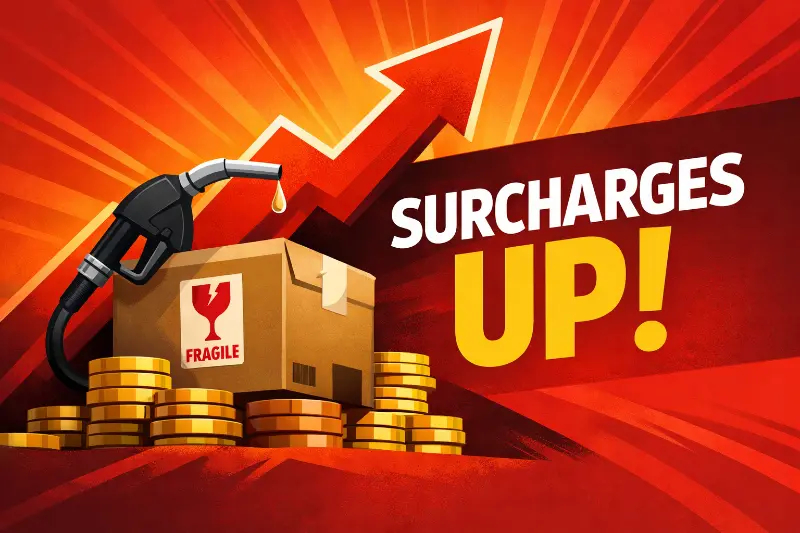
Introduction: In 2026, shipping surcharges are emerging as a permanent “margin tax” on ecommerce operations, quietly eroding online retailers’ profit margins. Once considered edge-case fees, carrier surcharges like fuel, residential delivery, and seasonal peak charges have become routine, and many brands lacking real-time visibility are blindsided by these extra costs.
Operations and logistics leaders can no longer treat surcharges as a minor nuisance; they now demand strategic attention. This article frames how rising carrier surcharges are rewriting ecommerce margins in 2026 and why it’s crucial to detect, forecast, and control these fees. We’ll dive into the types of surcharges impacting shipping costs, explain why they keep climbing, show the hidden impact on profit, and provide practical strategies (from packaging tweaks to carrier negotiations) that experienced operators use to defend their margins.
The Rise of Shipping Surcharges as a “Margin Tax”
Carrier surcharges have shifted from occasional add-ons to a significant, permanent cost factor in ecommerce shipping. In practice, accessorial fees and surcharges have become the real engines of parcel cost inflation, often outpacing the well-publicized annual rate increases. The base shipping cost, meaning the standard fee charged by carriers before any surcharges or additional fees, still matters, but it is no longer the number that determines profitability. Surcharges are now layered on top, and they are increasingly where carriers “find” revenue growth when base rates and volumes are constrained.
This is why operations teams feel like shipping costs are rising faster than their carrier contracts suggest. A published general rate increase might be a single digit percentage, but the actual invoice impact can be meaningfully higher once large package logic, residential fees, delivery area coverage, and fuel tables are applied across a real order mix. Surcharges have effectively become a margin tax because they attach to the shipment after the customer has already paid, and they are often discovered only at audit time, which is too late to recover the margin.
From the carrier’s perspective, surcharges serve three purposes: (1) offset costs that fluctuate or concentrate in specific lanes, (2) segment pricing by package characteristics and geography, and (3) reduce reliance on base rate increases that are easier for shippers to benchmark and negotiate against. For ecommerce brands, that adds up to an uncomfortable operational reality: you can “win” a rate negotiation and still lose margin if you are not controlling the surcharge surface area that sits downstream of the base rate.
Common Carrier Surcharges and Their Impact on Ecommerce Shipping
To grasp why surcharges are rewriting margins, it’s important to understand the common shipping surcharges and how they drive up shipping costs. These fees cover scenarios beyond the basic transport of a package, and each comes with a price tag that can erode profit if not managed. Here are some of the key surcharges hitting ecommerce shippers in 2026:
- Fuel Surcharges: Percentage-based or table-driven add-ons that change with fuel indexes and carrier formulas.
- Residential Delivery Surcharges: Flat fees for delivery to a home address, often increased annually and sometimes reclassified by address type.
- Delivery Area & Extended Area Surcharges: ZIP-based fees for remote, rural, or low-density delivery zones.
- Additional Handling Surcharges: Fees for heavy packages, unusual packaging, or dimensions that create handling friction inside carrier networks.
- Oversize / Large Package Surcharges: High-cost penalties for packages exceeding size thresholds or crossing cubic triggers.
- Address Correction Surcharge: Fees when carriers correct or complete invalid addresses, often tied to compliance rules.
- Peak Season and Demand Surcharges: Temporary surcharges during high-volume shipping periods that can become recurring programmatic costs.
- Other Accessorial Fees: Including signature, Saturday delivery, declared value, special pickup, and invoice-related fees.
As we can see, surcharges cover a wide range of scenarios, and they are no longer trivial. For many ecommerce shipments, one or several of these fees will apply, adding meaningful cost beyond the base rate. The operational mistake is treating these as “exceptions.” At scale, they become a predictable part of the shipping bill that needs to be measured, forecasted, and controlled with the same seriousness as COGS.
Let AI Optimize Your Shipping and Boost Profits
Cahoot.ai software selects the best shipping option for every order—saving you time and money automatically. No Human Required.
See AI in ActionWhy Carrier Surcharges Keep Climbing and Why They Stick
It’s reasonable to ask why carriers charge so many surcharges and why those fees keep rising. The answer is not one single factor. It is a combination of cost structure, network optimization, and pricing strategy that has matured over the last several years. The key shift is that surcharges are no longer treated as rare “special situations.” They are now a standardized pricing layer that lets carriers monetize complexity.
Fuel is the clearest example. Fuel surcharges are not just a pass-through of fuel prices. They are defined by carrier tables and formulas that can be updated independent of the underlying fuel trend. When carriers change the calculation method, the impact can show up even if diesel is stable. That is why operators track both the market index and the carrier’s table changes, because the invoice outcome is driven by the carrier’s math, not your intuition.
Large package and handling fees are the second major driver. Carriers have invested heavily in automation, but big, awkward, and heavy parcels still create mechanical friction. These shipments consume conveyor capacity, require more manual touches, increase damage risk, and reduce route density. Instead of raising base rates across all shipments, carriers increasingly target the packages that stress the network. That is rational pricing, and it is exactly why ecommerce brands with bulky SKUs feel like they are subsidizing the entire parcel system.
Geography-based fees are the third layer. Delivery Area and Extended Area surcharges are designed to price in route inefficiency. Low-density ZIPs mean longer drive time per stop, lower drop density, and higher cost per delivered package. As carriers refine ZIP code lists and classification rules, more addresses get captured by these programs. If your brand ships nationally and you have meaningful rural exposure, geography-based surcharges become a structural margin issue, not a rounding error.
The operational takeaway is simple: once a surcharge becomes normalized, it rarely disappears. It might change names, shift thresholds, or move between categories, but it stays because it is a reliable pricing lever for carriers. Brands that treat surcharge escalation as “temporary noise” end up planning with false assumptions.
The Quiet Impact on Ecommerce Margins
Surcharges do the most damage when they arrive after the commercial decision has already been made. The customer has checked out. The shipping promise has been set. The order routing decision has been executed. Then the invoice lands with unexpected accessorials that turn what looked like a profitable order into a margin loss.
This is why surcharges “quietly” rewrite margins. The loss is distributed across thousands of orders and shows up as a gradual decline in contribution margin, not a single visible event. Teams often notice it as “shipping seems higher lately” rather than as a specific root cause. By the time finance reconciles the invoices, the brand has already shipped the orders and cannot retroactively fix packaging, address quality, or carrier selection.
Three patterns tend to create the biggest surprise:
- Pricing assumes average cost, but invoices reflect distribution tails. A small percentage of oversize orders can account for a disproportionate share of surcharge spend.
- Operational decisions create surcharge triggers indirectly. A packaging change, a new kitting process, or a warehouse carton shortage can push packages over dimensional thresholds.
- Geography shifts without anyone noticing. A new paid channel, marketplace expansion, or campaign can change your destination mix and increase delivery area exposure.
When you combine those patterns with free shipping offers or tight shipping subsidies, surcharges become a direct threat to your CAC payback model. This is not a carrier problem. It is an operational measurement problem. If you cannot see surcharge drivers in near real time, you cannot control them at the pace the business is moving.
ShipStation vs. Cahoot: 21x Faster, Real Results
Get the inside scoop on how a leading merchant switched from ShipStation to Cahoot—and what happened next. See it to believe it!
See the 21x DifferenceThe Visibility Gap: Why Brands Fly Blind on Shipping Surcharges
Most mid-market ecommerce brands are not flying blind because they are careless. They are flying blind because surcharge data is fragmented across systems and arrives late. Labels are created in the shipping tool. Addresses live in the ecommerce platform. Cartons and weights live in WMS workflows. Surcharges live on invoices that show up days or weeks later. Without instrumentation, you cannot connect the invoice outcome to the operational decision that caused it.
This creates three common failure modes:
- Invoice-only detection. Teams discover surcharges only after reconciliation, which means the learnings apply to last month’s shipments, not today’s.
- Spreadsheet forecasting. Finance attempts to model surcharges using static assumptions even as carrier tables, thresholds, and ZIP lists change.
- No trigger-level attribution. Even when teams know surcharge totals, they cannot attribute them to specific SKUs, cartons, lanes, or warehouses.
Closing the visibility gap requires more than “better reporting.” It requires a feedback loop that ties surcharge outcomes to shipment-level signals like dimensional weight, packaging selection, address type, service level, zone, and delivery geography. If you can attribute surcharge spend to the drivers, you can change the drivers.
If your team regularly fights late deliveries and billing surprises, it is worth tightening your exception workflows as well. This guide is useful context: shipment exception management for ecommerce shipping.
Shipping Companies and Their Role in the Surcharge Landscape
Shipping companies define surcharge structures as a way to price operational variability. Fuel volatility, labor cost swings, peak capacity constraints, and the rise of residential delivery all create network stress. Surcharges are the mechanism carriers use to price that stress without rewriting base rates every time conditions change.
For ecommerce operators, the key is to understand that carriers are optimizing their networks for cost and service reliability. Surcharges are used to discourage certain shipment profiles, such as very large parcels or low-density deliveries, or to ensure those profiles are priced high enough to remain economically viable.
This matters because it reframes how you respond. The goal is not to argue with the existence of surcharges. The goal is to control your exposure by designing shipping operations that reduce surcharge triggers. That is a solvable operational problem, but only if you treat surcharges as measurable inputs rather than unpredictable penalties.
Which Ecommerce Business Models Get Hit Hardest
Not every ecommerce model experiences surcharge pressure equally. The hardest-hit brands tend to share one of the following characteristics:
- Free shipping or flat-rate shipping baked into merchandising. When shipping is subsidized, surcharge growth directly compresses margin unless pricing is adjusted.
- Bulky catalog or high dimensional weight exposure. Home goods, wellness equipment, large apparel bundles, and subscription kits often drift into oversize triggers as assortments change.
- High residential percentage. Most DTC brands ship primarily residential, so residential and delivery area programs land on a large share of shipments.
- Long-tail geographic exposure. If your customer base is widely distributed, a meaningful percentage of shipments will fall into extended delivery areas.
- High returns and reships. Each extra label creates another opportunity for address correction, residential add-ons, or peak fees to attach.
The operational consequence is that “shipping cost per order” averages are misleading. Two brands with the same AOV can have radically different margin outcomes based on package profile and destination distribution. That is why surcharge tooling is a competitive advantage in 2026. It lets you segment the portfolio and make decisions SKU-by-SKU and lane-by-lane.
For brands exposed to rising ground costs, this related breakdown is useful: how ecommerce teams combat higher ground shipping costs.
Cut Costs with the Smartest Shipping On the Market
Guranteed Savings on EVERY shipment with Cahoot's AI-powered rate shopping and humanless label generation. Even for your complex orders.
Cut Costs TodayStrategies to Mitigate the Surcharge Squeeze
Surcharges cannot be eliminated entirely, but they can be controlled. The strongest operators treat surcharge mitigation as a systems problem, not a one-time carrier conversation. The right mix is usually (1) reduce triggers, (2) improve detection, and (3) renegotiate from a position of data.
1) Packaging and cartonization discipline
Large package and additional handling fees are often driven by a small number of carton choices that push parcels across thresholds. Tightening packaging discipline usually yields the fastest payoff because it changes the physics of the shipment. Practical moves include using more carton sizes, enforcing carton selection rules in WMS, reducing void fill that inflates dimensions, and auditing “emergency cartons” that warehouses use when preferred boxes run out.
The important operator insight is that surcharge exposure often comes from inconsistency. A single SKU can ship in three different cartons depending on location, packer habit, or inventory constraints. That variability turns surcharge forecasting into guesswork. Standardize the pack plan first, then optimize it.
2) Address quality and classification control
Address correction fees are the most avoidable surcharge category, and they often mask upstream issues like poor form validation, missing apartment numbers, or customer autofill errors. Implementing strict address validation at checkout and re-validating before label creation can reduce both correction fees and delivery exceptions.
Residential and delivery area exposure also benefits from better classification. If your systems cannot reliably categorize address type and destination geography before label purchase, you are choosing carriers and services with incomplete information. That is a solvable problem with the right data enrichment.
3) Carrier mix and service-level optimization
Carrier diversification is not about chasing the cheapest label. It is about matching shipment profiles to the carrier best suited for them. Some carriers price oversize more aggressively. Others have different delivery area coverage. Regional carriers can reduce delivery area fees in certain lanes. Postal consolidators can lower residential exposure for lightweight parcels. The win comes from routing logic that selects a service based on total expected cost, not just base rate.
4) Contract negotiation using surcharge reality, not averages
Negotiation outcomes improve when you bring evidence of surcharge distribution and the operational steps you are taking to control it. Carriers respond to shipper maturity. If you can show that you understand your large package mix, your rural exposure, and your actual billed weight patterns, you can negotiate more targeted concessions. This is where many mid-market brands underperform because they negotiate on volume tiers without quantifying the accessorial layer that actually drives invoice totals.
This negotiation guide is helpful background for building that posture: shipping rate negotiation for small and mid-sized businesses.
5) Automation as the core mitigation lever
The biggest structural advantage in 2026 is automation that detects and controls surcharges in near real time. Specifically, automation should do four things:
- Detect: flag shipments likely to trigger large package, additional handling, residential, or delivery area fees before label purchase.
- Forecast: estimate total landed shipping cost using the correct carrier tables, not static averages.
- Route: select carrier and service based on total cost and SLA, including expected accessorial exposure.
- Audit: compare billed surcharges to expected surcharges to catch misapplied fees and recurring root causes.
Without that loop, surcharge management becomes reactive. You find the problem in the invoice, then you try to fix it operationally weeks later, and the business has already moved on. Automation closes the time gap between cause and effect, which is what makes it the most durable mitigation lever.
Frequently Asked Questions
What are shipping surcharges and why do carriers charge them?
Shipping surcharges are additional fees applied on top of base shipping rates to cover specific operational conditions or shipment attributes, such as fuel volatility, residential delivery, remote locations, special handling, or oversized packages. Carriers use them to price variability and network friction without applying one blanket increase to every shipment.
What are the most common shipping surcharges ecommerce brands should monitor?
The most common surcharge categories that consistently impact ecommerce shipments are fuel surcharges, residential delivery fees, delivery area and extended area surcharges, additional handling fees, large package or oversize surcharges, and address correction fees. Peak and demand surcharges can also become material during high-volume periods.
Why do surcharges impact profit margins more than base rate increases?
Base rates are typically modeled in shipping budgets and pricing decisions, but surcharges often show up after the shipment decision is already made. They also concentrate on the most expensive shipment profiles, such as oversized cartons or rural lanes, which means a relatively small share of orders can create a disproportionate share of total shipping cost inflation.
How can ecommerce businesses manage carrier surcharges?
Businesses can manage surcharges by reducing trigger conditions (packaging and cartonization discipline), improving address quality and validation, diversifying carriers and services by shipment profile, negotiating contracts with surcharge distribution data, and implementing automation that detects and forecasts surcharge exposure before label purchase.
What does “real-time surcharge visibility” actually mean?
Real-time visibility means you can identify which shipments are likely to trigger specific surcharges before you buy the label, and you can attribute billed surcharges back to the operational drivers that caused them (SKU, carton, warehouse, lane, service, address type). That lets teams fix root causes quickly instead of discovering issues only during invoice reconciliation.
What is the first operational change that typically reduces surcharge spend?
For most brands, the fastest initial win is tightening packaging consistency and carton selection rules. A small reduction in dimensional weight exposure and large-package triggers often produces outsized savings because those surcharges are high and attach to the most expensive shipments.
Written By:

Manish Chowdhary
Manish Chowdhary is the founder and CEO of Cahoot, the most comprehensive post-purchase suite for ecommerce brands. A serial entrepreneur and industry thought leader, Manish has decades of experience building technologies that simplify ecommerce logistics—from order fulfillment to returns. His insights help brands stay ahead of market shifts and operational challenges.

Turn Returns Into New Revenue
Related Articles
HTS Code Explained: What It Is, Why It Matters, and How Ecommerce Brands Use It
HTS codes (Harmonized Tariff Schedule codes) are standardized numerical classifications that identify imported products for U.
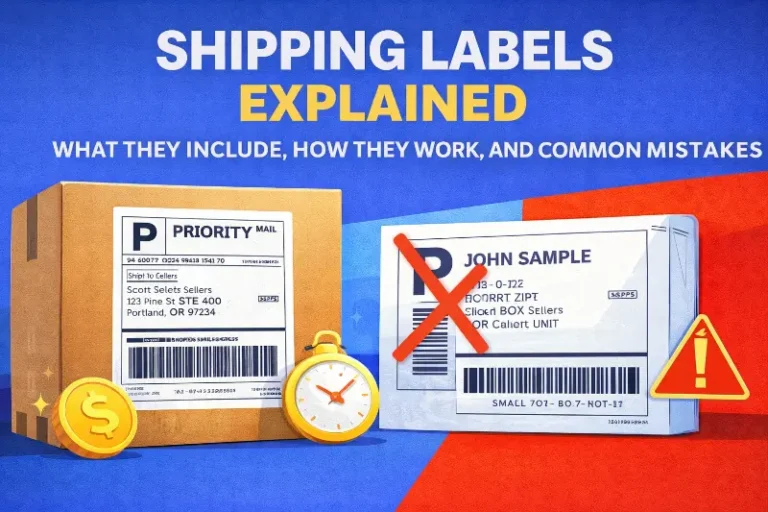
Shipping Labels Explained: What They Include, How They Work, and Common Mistakes
Shipping labels are the operational backbone of ecommerce fulfillment, a small piece of paper that determines whether packages reach customers successfully or trigger costly failur...
USPS Click-N-Ship Explained: How It Works, Costs, and When Sellers Should Use It
USPS Click-N-Ship is the postal service’s free online label-printing tool, and for most Shopify sellers shipping more than 50 packages monthly, it’s already time to move beyond it....