
Walmart Officially Allows Amazon Multi-Channel Fulfillment (MCF)
In this article
 9 minutes
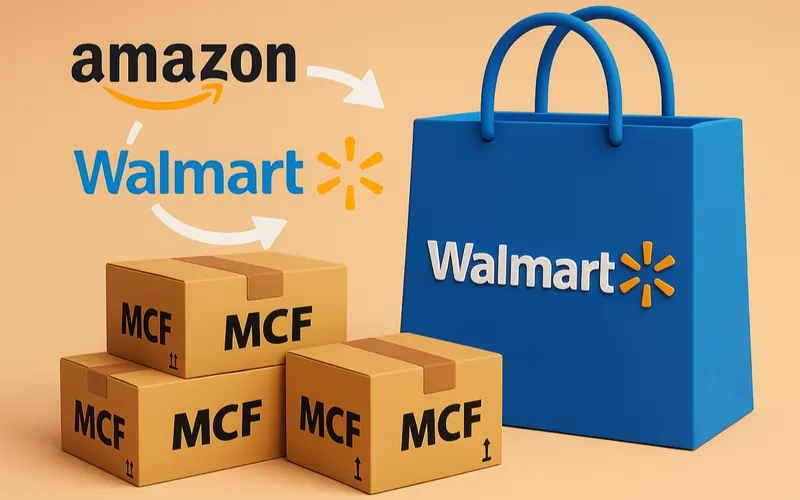
Big news for multichannel sellers: Walmart now officially allows Amazon Multi-Channel Fulfillment (MCF), Amazon’s service for using its fulfillment network to ship orders from multiple sales channels, including Walmart, when sellers follow rules such as neutral packaging and no Amazon branding. For sellers managing products across Amazon, Walmart, and other marketplaces, that opens up a practical way to streamline fulfillment, cut operational overhead, and keep delivery speed competitive without building a separate logistics stack for every channel.
The policy change also comes with tradeoffs. Below, we break down what Walmart now permits, the compliance requirements sellers need to meet, the main benefits and drawbacks of using Amazon MCF for Walmart orders, and the cost, efficiency, and customer-experience factors to weigh before making it part of your multichannel strategy.
What’s Changed?
Previously, Walmart prohibited the use of Amazon MCF for order fulfillment. However, as of May 15, 2025, Walmart’s updated Shipping & Fulfillment policy states, and this also reflects that MCF integrates with platforms like Walmart Marketplace and a Shopify store across other sales channels:
“You may use Multi-Channel Fulfillment as long as you ship in neutral packaging using unbranded delivery vehicles, which means neither can display any logos, trademarks, or branding of the other retailer.”
This policy shift allows sellers to leverage Amazon’s robust fulfillment network to process walmart marketplace orders, or compare it with Walmart Fulfillment Services (WFS), provided they adhere to the neutral packaging and carrier requirements (they don’t want Amazon logos on packaging, tape, trucks, driver uniforms, etc.).
Why Now?
Walmart’s decision reflects the evolving landscape of ecommerce, where flexibility and efficiency are paramount. By permitting Amazon MCF, Walmart acknowledges the needs of ecommerce sellers and marketplace sellers that sell on multiple channels, including their own website and other marketplaces. It also recognizes MCF as a logistics service that can streamline fulfillment and simplify ecommerce operations across those sales channels, making it a powerful tool within a broader multichannel fulfillment and sales strategy. This move aligns with broader trends in retail logistics, emphasizing interoperability and seller convenience.
What It Means for Sellers
Pro Tips for Sellers
1. Inventory Management:Maintain accurate inventory levels in Amazon’s fulfillment centers to prevent stockouts on Walmart orders. You’ll also need to send inventory into the amazon fulfillment network and watch monthly storage fees, including storage fees of $0.78 per cubic foot for standard-size items and $2.40 from October to December. Avoid committing inventory too early, since FBA inventory limits can reduce stock available for MCF orders; improving your Inventory Performance Index (IPI) score can also help ease some storage-type limits.
2. Carrier Settings: Configure your Amazon MCF settings to block Amazon Logistics for Walmart orders, complying with Walmart’s delivery requirements. In Seller Central, your seller central account is also where you manage carrier settings, submit and monitor orders, and connect an order management system for automated order processing that reduces manual data entry from non-Amazon sales channels by mapping each channel’s shipping method to Amazon’s options. MCF also connects with Shopify, BigCommerce, and WooCommerce, plus major ecommerce platforms and other ecommerce platforms through pre-built apps and APIs, so you can pair it with a hybrid FBA vs FBM fulfillment approach.
3. Packaging Compliance: Ensure all shipments to Walmart customers are in neutral packaging, devoid of any Amazon branding.
4. Cost Analysis: Regularly assess the cost-effectiveness of using Amazon MCF for Walmart orders, considering the additional surcharges and fees and whether a third-party logistics (3PL) ecommerce fulfillment alternative could lower overall costs. Review mcf pricing with Amazon’s calculator because MCF fulfillment fees and other fulfillment fees vary by order size, destination, shipping method, and multi unit orders, and MCF fulfillment fees increased by $0.30 on January 15, 2026. Also remember referral fees do not apply to MCF orders, but shipping costs, cross border fulfillment, and international shipping fees still matter, and remote-area surcharges can be steep, including 100% for standard-size shipments to Alaska and Hawaii.
5. Monitor Performance: Keep an eye on delivery times and customer feedback to ensure the fulfillment process meets Walmart’s standards. When using MCF across multiple sales channels, clearly share shipping details and expected delivery timelines with customers, and consider Merchant Fulfilled Prime or other FBA alternative fulfillment options as a contingency if MCF performance slips.
Final Thoughts
Walmart’s policy update to allow Amazon MCF is a significant development for multichannel sellers, giving eligible sellers and other online businesses a third party logistics option for orders across other sales channels. It offers an opportunity to streamline operations, reduce some overhead expenses, and enhance customer satisfaction with potentially faster delivery from distributed fulfillment; Amazon fulfillment can also support international fulfillment, with MCF supporting order fulfillment from 11 countries and posting a 97% on-time delivery rate, while solutions like Amazon FBM shipping and order fulfillment services can provide additional flexibility for non-Walmart channels, though businesses with broader supply chain needs should still compare hybrid models and alternative providers. However, it’s crucial to navigate the associated requirements carefully to fully leverage the benefits of this new fulfillment option. And fulfillment costs will need to be monitored closely to make sure that it makes sense to use MCF. If not, businesses evaluating other sales channels should compare fulfillment fees and storage fees with another distributed fulfillment provider such as Cahoot before choosing the best fit.
Frequently Asked Questions
Does Walmart allow Amazon Multi-Channel Fulfillment (MCF)?
Yes. Under Walmart’s Shipping & Fulfillment policy update effective May 15, 2025, sellers may use Amazon MCF for Walmart Marketplace orders. The policy requires neutral packaging and unbranded delivery vehicles, so neither Amazon nor Walmart logos, trademarks, or branding can appear on the shipment.
What are the compliance requirements for using Amazon MCF for Walmart orders?
Walmart orders must ship in neutral packaging with no Amazon logos, trademarks, or branding on boxes, tape, inserts, delivery vehicles, or driver uniforms. Sellers must also configure MCF to block Amazon Logistics as a carrier on those orders. Both requirements need ongoing monitoring, because a setting change or a packaging mistake can put the account out of compliance.
How do I block Amazon Logistics for Walmart orders?
You manage this in your Seller Central account, where you set carrier preferences for MCF orders. If you use an order management system or a connected platform, confirm that Walmart orders are submitted with the unbranded packaging and carrier-blocking settings applied. Test a few orders and check the carrier and packaging details before scaling volume.
Is there a surcharge for blocking Amazon Logistics?
Amazon has applied a 5% surcharge on MCF fees when sellers block Amazon Logistics. Amazon has also stated that this surcharge is waived through January 14, 2027. Because the terms can change, confirm the current surcharge status in Amazon’s MCF fee documentation before you build it into your cost model.
How much does Amazon MCF cost compared with FBA?
MCF is generally more expensive than FBA, and in many cases roughly two to three times the cost. That can be hard to justify in low-margin categories. MCF fees vary by order size, destination, shipping speed, and multi-unit orders, and they increased by $0.30 on January 15, 2026. Use Amazon’s calculator with your own catalog, and compare the result against a 3PL or Walmart Fulfillment Services.
Does Amazon prioritize FBA orders over MCF orders?
Yes. Amazon prioritizes FBA orders, so MCF orders can be delayed during peak periods. If Walmart delivery performance matters to your account, monitor on-time delivery and customer feedback closely. Keep a backup fulfillment option ready in case MCF performance slips.
Who handles customer service for Walmart orders fulfilled through Amazon MCF?
You do. Amazon handles picking, packing, and shipping, but the seller remains responsible for customer service, returns decisions, and communication on Walmart orders. You are also responsible for staying compliant with both Walmart’s and Amazon’s policies.
Is Amazon MCF the right fulfillment option for Walmart sellers?
It depends on your margins, volume, and inventory strategy. MCF can make sense if you want to consolidate inventory in Amazon’s network and keep delivery fast without adding warehouse space or staff. If higher fees, FBA inventory limits, or delivery risk are concerns, compare it with Walmart Fulfillment Services and a distributed 3PL network before committing.
Written By:

Jeremy Stewart
Jeremy Stewart leads customer success at Cahoot, helping merchants achieve high-performance logistics through smart technology and process optimization. With a background in both ecommerce operations and client services, Jeremy ensures that every merchant using Cahoot gets measurable results—whether they’re scaling from one warehouse to many or managing complex returns.

Turn Returns Into New Revenue
Related Articles
What Is Demand Planning? How It Impacts Inventory, Forecasting, and Profitability
Demand planning is the process of estimating future customer demand so that a business can align its inventory, procurement, and operations to meet that demand without carrying mor...
Why 100% P2P Adoption Is the Wrong Goal
Peer-to-peer returns let customers send eligible returned items directly to other customers instead of routing every package back through the warehouse, cutting shipping and proces...

Why More Automation Didn’t Lower Return Costs
Returns automation does improve returns operations: it cuts manual touches, smooths intake, speeds sorting, and makes workflow execution more consistent.
Shopify Subscription Payment Change: Why It Could Hurt Reactivation
In this article
15 minutes
- The 24-Hour Window and What It Changes
- What Happens Inside the Compressed Window
- The Contrarian View: This Exposes What Was Already Broken
- What Strong Post-Purchase Design Actually Protects, Including the Use of a Backup Payment Method
- What Merchants Should Actually Do to Encourage Customers to Add Payment Method
- Frequently Asked Questions
Shopify changed how subscription payment information is handled at cancellation. When a customer cancels a subscription, their payment details, including credit card information, are now deleted after 24 hours. Shopify will delete all payment details from the account, ensuring that no card information remains linked to the subscription or payment profile. Customers can access their account to view or update their payment method at any time. If that customer decides to return after the window closes, they have to re-enter their payment information from scratch. Shopify does not allow updating details on an existing card; instead, customers must add a new payment method if their card details change. The frictionless reactivation path that previously existed, where a former subscriber could be brought back with minimal steps, is now shorter and more conditional.
The coverage of this change has mostly framed it as a billing workflow update or a security improvement. Both characterizations are plausible. Neither one addresses what actually matters for merchants operating subscription businesses on Shopify who are trying to protect retention and make reactivation easier after cancellation.
The real issue is behavioral. This change compresses the window in which a merchant can recover a canceling customer before the relationship becomes significantly harder to restart. Users can manage their payment method by signing into their customer account and accessing subscription details. And when that window shrinks, the downstream effect is not just on reactivation flows. It changes how merchants need to think about retention, shortened win-back timing, post-purchase relationships, and payment method management once the 24-hour window closes.
The 24-Hour Window and What It Changes
Before this change, payment details persisted after a subscription cancellation. A customer who canceled but had their information stored could be reactivated through a single click or confirmation, without re-entering a card number. That path was convenient for the customer and operationally simple for the merchant. Win-back campaigns could work on longer timelines because the friction of returning was low.
The 24-hour deletion window changes the economics of that timeline. A merchant now has a brief period in which a canceled customer can be recovered with low friction intact. After that window closes, the customer must re-enter payment information to restart, which is a meaningful friction increase. If a payment card is removed, the subscription will continue to bill according to its existing schedule, and the user will be notified by email summarizing their active subscriptions. Some portion of customers who might have reactivated passively will not complete the re-entry step. The effective recovery rate on post-24-hour win-back campaigns drops for behavioral reasons entirely separate from offer quality or messaging relevance.
For subscription-heavy brands, this matters more than it might appear. Subscription businesses are often built on the assumption that a certain percentage of cancellations are soft churns, customers who paused for budget reasons, life circumstances, or momentary dissatisfaction, who will return without significant intervention if the path back is easy. The 24-hour window does not eliminate those customers as potential reactivations. It increases the effort required from them and from the merchant to close the return. Users will receive a notification if their payment card is removed.
What Happens Inside the Compressed Window
The following are typical merchant responses to a shorter recovery window: compressing their save and reactivation strategy into that window. More urgency, more messaging, more offers, all concentrated into 24 hours of communication after a cancellation.
That sounds like a reasonable adaptation. In practice it often produces worse outcomes than it prevents.
Rushed save flows created in response to a compressed timeline tend to be noisier and less personalized than well-designed retention communication. A merchant whose save strategy was built for a longer win-back arc is not going to build a better 24-hour version overnight. They are going to take the same elements, compress the timeline, and increase the volume. The customer who just canceled receives multiple messages, often multiple emails, in a short window. The pressure reads as desperation rather than value.
Discounting under time pressure is the most common lazy response to a tightened reactivation window. If the standard tool for win-back is a discount offer, and the window to deploy it is now 24 hours instead of several weeks, the offer gets sent faster and at higher urgency. The customer learns to expect a discount when they cancel, which trains churn behavior rather than reversing it. Customers who would have stayed without an offer now learn to cancel and wait for one.
Customer messaging density in the 24-hour window can cross into a territory that harms the brand relationship rather than repairing it. Merchants often send multiple emails within this period. A customer who canceled because they felt the subscription was no longer relevant to their life does not typically need three emails and two SMS messages in the same day to be persuaded otherwise. What they need is a reason to reconsider, delivered in a way that respects the relationship. Time pressure rarely produces that. It produces noise.
Lower-quality win-back strategy is the downstream result when merchants optimize for speed rather than substance. The 24-hour window does not create the conditions for thoughtful, segmented retention communication. It creates the conditions for a reactive campaign designed to avoid losing payment details, which is a different objective than actually understanding why a customer left and whether the brand can credibly address that.
The Contrarian View: This Exposes What Was Already Broken
Here is the argument that matters more than the tactical implications of the 24-hour window.
For merchants whose reactivation strategy was primarily working because re-entry was frictionless, the Shopify subscription payment change does not create a new problem. It surfaces an existing one.
A subscription that a customer is canceling is a relationship that has already failed to demonstrate enough value to be worth keeping. Customers can manage their subscription contract directly through the store or shop interface, where they have the ability to update payment methods, modify products, change product quantity, and adjust delivery frequency. Modifying these aspects of the subscription contract also updates the billing frequency. The fact that some percentage of those customers came back when reactivation was effortless does not mean the merchant had a retention strategy. It means they had a frictionless pathway. Those are not the same thing. One is built on the quality of the product and the relationship. The other is built on reducing the activation energy required to return.
When the platform removes that frictionless pathway, the merchants who are most exposed are the ones who were relying on it as a retention mechanism rather than as a nice-to-have convenience. Their numbers will look worse after this change. But the change did not make their business worse. It made visible something that was already weak.
The merchants least affected by this change are those who had built the relationship well enough before cancellation that a customer returning later is willing to re-enter their payment information. That is not a high bar. It is the bar for having a subscription product the customer actually values. If the customer values the product but had a timing or budget issue, they will come back and they will fill in a card number. The willingness to take that small step is a signal of relationship quality that frictionless reactivation was previously masking.
What Strong Post-Purchase Design Actually Protects, Including the Use of a Backup Payment Method
The Shopify subscription payment change is a small instance of a larger dynamic: platform dependency creates exposure whenever the platform changes its surface, and the merchants most exposed are those whose business model depends on specific platform behaviors rather than on the quality of the customer relationship. Merchants can use the Shopify admin to access the Subscriptions section of the billing page, where Shopify will show the active subscriptions. Users can click a link to navigate directly to the subscription management page from the billing page to view or modify their subscription details.
This connects to the pattern visible in agentic commerce shifts and in how marketplaces and platforms reshape merchant economics through interface and workflow changes rather than through explicit fee increases. The merchant whose retention relied on frictionless reactivation was not paying attention to where the leverage actually sat. The leverage was with the platform, not with the relationship.
Strong post-purchase relationship design is the structural hedge against this kind of exposure, and merchants can deepen that capability by leveraging educational webinars on ecommerce fulfillment strategy and peak-season performance. A customer who feels well-served, whose expectations were set accurately, whose questions were answered without friction, and who trusts the brand to deliver consistently, is a different kind of subscription risk than a customer who stayed subscribed because canceling and returning was roughly symmetrically effortless.
The post-purchase communication design, including onboarding sequences for new subscribers, milestone acknowledgments, product education, proactive status communications, and an exceptional returns program that builds loyalty, is what builds the relationship that makes reactivation less dependent on frictionless payment mechanics. Merchants who have invested in that communication layer are less affected by the 24-hour deletion because their customers were never primarily staying out of inertia.
For subscription brands that also manage fulfillment complexity, Shopify and multi-channel ecommerce partner integrations, and broader supply chain obstacles they need to overcome, there is an additional compounding pressure worth noting. A customer who cancels partly because of a delivery experience problem is not a candidate for a 24-hour win-back no matter how the payment handling works. The underlying delivery and fulfillment cost pressures that affect the post-purchase experience, including decisions about whether to lean on programs like Amazon’s Buy with Prime for DTC brands, alternative merchant-fulfilled Prime options and FBA alternatives, or peer-to-peer fulfillment networks that respond to the Amazon Prime effect and outperform traditional 3PL fulfillment services, are a separate but related set of forces that shape whether subscription customers stay or leave in the first place. Addressing those operational fundamentals is upstream of any retention window conversation.
What Merchants Should Actually Do to Encourage Customers to Add Payment Method
The practical response to the Shopify subscription payment change is not to build a better 24-hour save flow. The save flow matters, but it is the last line of defense, not the primary strategy.
A key step is ensuring the store owner or staff with the appropriate permissions update the payment methods in the Shopify account to avoid potential service interruptions. If a primary payment method fails, Shopify will attempt to charge any backup payment methods on file, so adding a backup payment method is recommended, and another method must be on file before an old one can be deleted. Managing payment methods means setting a primary method and a backup method, and merchants can add multiple payment methods when needed. To update billing information, open the settings menu, select billing, open the billing profile in Shopify billing, choose add payment method, and click add payment method. Users can add a new billing payment method, such as a PayPal account, in the billing section of the Shopify admin. Charges for third-party apps are billed separately but usually use the same primary billing method set for the Shopify store. A Shopify plan can affect the charges tied to that payment method. To manage payment methods, use the Shopify admin go navigation (e.g., Apps > Subscriptions), select the contract associated with your subscription, and edit the billing payment method rather than customer-facing checkout payments in your account settings. You can switch payment methods for your subscription contracts, and Stripe integration may be involved in updating or creating new payment methods with different providers. Support resources are available for troubleshooting payment method issues, including those related to Stripe, just as evaluating fulfillment partners such as Cahoot vs. ShipMonk for scalable order fulfillment, understanding order fulfillment costs and ecommerce fulfillment pricing, or broader order fulfillment services for ecommerce companies and ecommerce fulfillment software built on a peer-to-peer network is part of reducing operational friction. Automated subscription management saves time and reduces operational costs, especially when paired with Amazon Buy Shipping integrations that streamline ecommerce order fulfillment and fulfillment partner programs that monetize existing warehouse capacity.
The response is to invest in the relationship quality that makes the 24-hour window less consequential in the first place.
That means building onboarding communication that helps new subscribers understand the full value of what they have subscribed to, before they reach a point of considering cancellation. It means designing pause and defer options that give customers a lower-friction exit than cancellation, capturing the intent to return without requiring the full exit and re-entry cycle. It means segmenting the subscriber base by engagement signals and identifying at-risk subscribers before they reach the cancellation decision, rather than after.
For the 24-hour window itself, a simple, non-pressured single communication that acknowledges the cancellation, offers a genuine reason to reconsider without urgency or excessive discounting, and makes the path to return clear and easy is better than multiple messages attempting to manufacture urgency. The goal is to make the brand present and accessible, not to recreate the pressure of a time-limited offer.
For customers who do not return within the window, a longer-arc win-back sequence that focuses on product updates, new offerings, relevant reasons to reconsider, and convenient touchpoints such as thoughtfully designed returns and exchanges through solutions like Happy Returns’ reverse logistics network can still convert them when paired with an order fulfillment strategy that acts as a profit driver, including best-in-class Shopify fulfillment services and a strategic guide to choosing Shopify order fulfillment options. The friction of re-entering payment information is real, but it is not prohibitive for a customer who genuinely wants to return. Addressing that step explicitly, by making the re-entry process as clear and simple as possible, removes the technical barrier without requiring the brand to panic-message in the first 24 hours.
Frequently Asked Questions
What is the Shopify subscription payment and billing information change?
Shopify changed how payment details are handled when a customer cancels a subscription. Here’s a brief step by step guide for a customer accessing their subscription details and billing settings. Users can manage their Shop Pay subscriptions and payment methods by signing in to their Shopify account through a web browser, including on a mobile device. Payment information is now deleted 24 hours after cancellation. Customers who want to reactivate after that window closes must re-enter their payment details, whereas previously their stored information remained available.
Why does the 24-hour deletion window matter for merchants?
It shortens the window in which a merchant can recover a canceling customer without requiring them to re-enter payment information. After 24 hours, any reactivation attempt involves more friction for the customer, which reduces the likelihood that soft churns, customers who might have returned naturally, will complete the return. For example, a subscriber who only paused because of a temporary budget concern may have come back easily before, but now drops off when asked to enter a different payment method.
What is the biggest mistake merchants make in response to this change?
Compressing their entire save strategy into the 24-hour window with more urgency, more messaging, and more discounting. This approach tends to produce lower-quality retention behavior that harms the brand relationship rather than repairing it, and trains customers to cancel in anticipation of a discount offer.
How does strong post-purchase communication reduce exposure to this change?
Customers who have had a high-quality post-purchase experience, including clear communication, accurate expectations, and genuine perceived value, are more willing to re-enter payment details when they want to return. The 24-hour window is less consequential for merchants whose subscribers stayed because of product and relationship quality rather than frictionless inertia. Stronger retention also tends to improve key performance indicators such as recurring revenue retention and subscriber churn.
Is this change specific to Shopify Subscriptions, Shopify Payments, or does it affect third-party subscription apps?
The change affects how Shopify handles subscription payment contracts at the platform level. The specific behavior for third-party subscription apps may vary depending on how they integrate with Shopify’s payment infrastructure. Merchants using apps built on Shopify’s native subscription APIs are most directly affected, and before switching payment providers, they may need to verify how the app works with their payment provider or other supported providers.
Should merchants prioritize win-back campaigns within the 24-hour window?
A single, calm, non-pressured communication within the window is appropriate. Stacking multiple messages with escalating urgency is likely to produce worse outcomes than saying nothing because it signals desperation and may damage the relationship further. The window is an opportunity for a clear, low-pressure acknowledgment rather than a compressed retention campaign. The goal here is not to optimize checkout or force a default payment method, but to make the return path clear when customers choose to come back.
Written By:

Rinaldi Juwono
Rinaldi Juwono leads content and SEO strategy at Cahoot, crafting data-driven insights that help ecommerce brands navigate logistics challenges. He works closely with the product, sales, and operations teams to translate Cahoot’s innovations into actionable strategies merchants can use to grow smarter and leaner.
Turn Returns Into New Revenue
Related Articles
What Is Demand Planning? How It Impacts Inventory, Forecasting, and Profitability
Demand planning is the process of estimating future customer demand so that a business can align its inventory, procurement, and operations to meet that demand without carrying mor...
Why 100% P2P Adoption Is the Wrong Goal
Peer-to-peer returns let customers send eligible returned items directly to other customers instead of routing every package back through the warehouse, cutting shipping and proces...
Walmart Officially Allows Amazon Multi-Channel Fulfillment (MCF)
Big news for multichannel sellers: Walmart now officially allows Amazon Multi-Channel Fulfillment (MCF), Amazon’s service for using its fulfillment network to ship orders from mult...
Why Cross-Border DTC Brands Are Moving Fulfillment Inside the US
In this article
18 minutes
- What the De Minimis Exemption Was and Why Its Removal Changes the Model
- The Aritzia Case: What Executing This Transition at Scale Looks Like
- What Relocation Operationally Requires
- This Is a Distribution Problem, Not a Manufacturing Problem
- When U.S. Domestic Fulfillment Makes Financial Sense
- Entering the U.S. Without a Long-Term Lease Commitment
- Frequently Asked Questions
Cross-border ecommerce fulfillment is the process of shipping ecommerce orders across national borders—often from warehouses outside the United States to U.S. consumers—and for brands built around direct-to-consumer parcel shipping, that model has lost its cost foundation. The elimination of the de minimis exemption has converted what was a variable, duty-free international shipping model into one that incurs import duties, customs processing fees, and brokerage costs on every single order. The rapid growth of global ecommerce and the surge in online shopping, especially during the COVID-19 pandemic, have increased both the complexity and importance of cross border ecommerce fulfillment. Rising consumer expectations for fast and affordable shipping are forcing brands, logistics managers, and ecommerce teams to rethink whether fulfilling U.S. customers from overseas still makes operational or financial sense.
For a growing number of cross-border DTC brands, the answer is no. The operational response is relocation: moving U.S. order fulfillment inside the country, shifting from a variable international shipping cost structure to fixed domestic infrastructure. This article examines what that shift looks like in practice, including the impact of de minimis removal, examples such as brands moving fulfillment closer to U.S. demand, the cost and working-capital tradeoffs of domestic fulfillment, tax and compliance requirements, and when flexible 3PL or distributed U.S. networks start to make sense. This is not a contingency plan. It is becoming the operational baseline for any brand with meaningful U.S. volume.
What the De Minimis Exemption Was and Why Its Removal Changes the Model
The de minimis exemption, codified under Section 321 of the U.S. Tariff Act, allowed imported shipments valued at $800 or less to enter the United States duty-free with minimal customs documentation. For cross-border DTC brands, this provision was the structural logic behind shipping individual consumer orders from a Canadian, European, or Asian warehouse directly to U.S. customers. The brand paid no duties on individual parcels below the threshold, kept fulfillment consolidated in one location, and the U.S. customer received their order without customs friction.
At its peak, more than 1 billion packages annually entered the United States under de minimis. The provision has now been eliminated for shipments from China and Hong Kong, and suspended globally, with permanent legislative repeal set for July 1, 2027. Every cross-border DTC parcel that previously entered duty-free now triggers import duties, customs duties, import taxes, per-shipment customs processing fees, and brokerage charges that can add $15 to $30 or more to the landed cost of a single consumer order.
The math breaks fast at any meaningful volume. A brand shipping 2,000 U.S. orders per month from Canada that previously paid zero duties on those shipments now faces a recurring monthly import cost that did not exist before. That cost does not scale down as the brand grows. It scales up. And unlike a carrier rate that can be negotiated or a warehouse lease that can be amortized, it hits on every order, every month, with no offset. Unexpected extra fees at checkout, such as customs duties and import taxes, can also lead to increased cart abandonment rates among U.S. customers.
The Aritzia Case: What Executing This Transition at Scale Looks Like
Aritzia, the Vancouver-based fashion retailer, is the most documented example of a cross-border brand executing a proactive U.S. fulfillment transition, similar to other brands highlighted in case studies on migrating fulfillment partners. The company had been fulfilling a portion of U.S. international orders from its Canadian distribution network, leveraging de minimis to ship individual parcels across the border duty-free.
Anticipating the exemption’s removal, Aritzia expanded its existing U.S. distribution center in Groveport, Ohio from roughly 240,000 square feet to approximately 560,000 square feet, more than doubling the physical footprint. This expansion allowed Aritzia to better serve the U.S. region. The company then transitioned from third-party to in-house operation of the facility, hired additional staff, and pulled forward equipment retrofitting work before the global suspension took effect in late August 2025.
When the exemption was removed, Aritzia had already relocated all U.S. order fulfillment to the Ohio facility. The company reported operating at triple the throughput capacity compared to its pre-transition baseline, with a path to quadruple capacity through further optimization. Critically, the company stated that service levels for U.S. customers were not impacted during the transition. Maintaining high service levels helped Aritzia retain its U.S. customer base throughout this period.
The financial disclosure was direct. Aritzia reported approximately 400 basis points of gross margin pressure from trade-related headwinds, with roughly one-third of that attributable specifically to the de minimis removal rather than broader tariff exposure. That is a real cost. It is also a cost the company absorbed without degrading delivery performance or customer experience, which is the operational benchmark other cross-border brands now have to work against.
The Aritzia case illustrates the central tension in this transition: the cost of relocating is visible and immediate, while the cost of not relocating compounds quietly until it becomes structural.
What Relocation Operationally Requires
Understanding that U.S. fulfillment is necessary is not the same as being ready to execute it. The transition involves several simultaneous operational changes, each with its own lead time and capital requirement.
Inventory repositioning is the first constraint. Effective supply chain management is crucial here, as brands must coordinate the movement of goods and maintain visibility across multiple locations. A brand that has been fulfilling U.S. demand from a home-country warehouse needs inventory management discipline to determine how much U.S.-facing inventory to pre-position domestically, establish inbound replenishment flows from suppliers or the origin warehouse to the new U.S. node, and manage the transition period when both locations are active, since maintaining inventory accuracy is critical for timely deliveries and avoiding out-of-stock situations during the transition. For seasonal or trend-driven categories, this requires demand-based planning rather than simply mirroring historical stock levels. That planning also depends on a deep understanding of market demand patterns and customer behavior. Regular inventory counts and close tracking of inventory movement are essential to keep accurate inventory records and reduce delayed shipments. Leveraging the resources of a third-party logistics provider can help ensure a smooth transition by providing the necessary infrastructure and expertise, especially when brands follow a structured approach to migrating to a new 3PL successfully and apply criteria for choosing the right 3PL company.
U.S. warehouse capacity is the second. Whether the brand is signing a direct lease or engaging a third-party logistics provider, securing space in a U.S. fulfillment center to receive and store inventory in a logistics-relevant market takes time, and brands targeting the Northeast corridor often look at New York order fulfillment services with fast regional coverage. National industrial vacancy has loosened from the historic lows of 2022, but well-located, smaller-format space in dense markets remains constrained. A five-year direct lease requires volume confidence that can be difficult to hold during a period of policy uncertainty. Third-party logistics arrangements on a per-order basis avoid that commitment but carry higher unit costs at scale, which is why many brands also evaluate alternative ecommerce fulfillment models beyond traditional 3PLs.
Carrier contract changes follow from the location shift. A brand that has been negotiating international shipping rates for Canada-to-U.S. parcels needs domestic parcel agreements with USPS, UPS, FedEx, or regional carriers. Domestic rates are negotiated based on origin, volume, zone distribution, and package profile. Starting from scratch on these negotiations means paying closer to published rates in the early months, which can inflate per-order shipping costs until volume builds.
Tax and compliance obligations expand immediately when a U.S. warehouse is opened. Physical presence in a state creates sales tax nexus in that state from the first day of operation, requiring registration, collection, and filing. The United States has more than 12,000 taxing jurisdictions. For a Canadian or European brand with no prior U.S. tax compliance history, this is a meaningful administrative and cost addition that requires either in-house capability or a qualified U.S. tax advisor before the warehouse opens, not after. It is also essential to comply with U.S. regulations regarding customs, duties, licensing, and customs clearance to avoid disruptions in cross border ecommerce fulfillment, and automation in customs processes helps maintain compliance by keeping documentation and tariff-code updates current.
Working capital requirements increase because pre-positioning domestic inventory means paying for goods and duties before they sell. A brand accustomed to fulfilling U.S. orders from shared home-country inventory now needs to fund a dedicated U.S. stock position. Carrying costs for U.S. inventory typically run 20 to 30 percent of inventory value annually when accounting for capital, storage, insurance, and obsolescence risk. For high-SKU-count or seasonal businesses, this working capital demand can be significant.
During the relocation, the right tools matter: ecommerce fulfillment software with inventory management software features can provide real time visibility through advanced technology to support inventory accuracy and compliance, particularly for brands evaluating Shopify-focused ecommerce fulfillment services.
This Is a Distribution Problem, Not a Manufacturing Problem
It is worth being precise about what kind of problem this is, because the solution set depends on it.
The de minimis removal is specifically a cross border fulfillment and cross border logistics issue. It affects brands that were shipping individual consumer orders from outside the United States and relying on the exemption to avoid per-shipment duty costs. The fix is a distribution change: moving the last-mile fulfillment origin inside the country. The brand’s manufacturing geography, supplier relationships, and product cost structure are separate questions with separate answers.
For cross border ecommerce brands, adapting their cross border operations is essential to remain competitive. A Canadian apparel brand that sources from Vietnam and was fulfilling U.S. orders from Toronto is not being asked to reshore manufacturing. It is being asked to establish a U.S. distribution node so that individual consumer shipments originate domestically. Those are operationally distinct projects. Conflating them leads to analysis paralysis, because reshoring manufacturing is a multi-year, capital-intensive decision, while establishing a third-party logistics relationship in the U.S. Midwest can be operational in 60 to 90 days.
When U.S. Domestic Fulfillment Makes Financial Sense
The decision to establish U.S. fulfillment infrastructure depends on variables that are specific to each brand’s operation. Brands must evaluate cost-effective shipping options and solutions to address their ecommerce needs, ensuring that their international logistics strategies align with business goals and customer expectations.
Volume is the primary threshold. The fixed costs of domestic fulfillment, whether a direct lease or a 3PL monthly minimum, require sufficient order volume to justify. Third-party logistics minimums average around $500 per month in 2025, but the real break-even is in order throughput. The general threshold at which U.S. domestic fulfillment becomes financially superior to cross-border shipping with duties is roughly 500 to 1,000 U.S. orders per month. At that volume, per-order duty and brokerage savings of $15 to $25 more than offset the fixed cost of a 3PL relationship, often with margin to spare.
Average order value intersects with duty exposure in a non-linear way. A brand with a $200 average order value already had limited de minimis benefit on higher-ticket items. A brand with a $45 average order value was capturing maximum benefit from the exemption on nearly every order. For the latter, the duty exposure per order as a percentage of revenue is substantially higher, and the case for domestic fulfillment is correspondingly stronger at lower volume thresholds.
Product category and tariff rate determine the actual per-order duty cost. Apparel from Canada faces different rates than electronics from Europe. Brands should model their specific duty exposure against their actual product mix and origin country before assuming a generic rate applies.
The cost variables that change when moving to domestic U.S. fulfillment are worth mapping explicitly. International shipping cost with duties is replaced by domestic pick-and-pack fees and domestic parcel rates. Variable per-shipment customs costs are replaced by fixed 3PL fees and amortized inbound bulk import costs. Working capital requirements increase. Tax compliance costs appear. Net per-order landed cost typically decreases materially for brands above the volume threshold. However, brands face key challenges and other challenges during this transition, such as navigating new compliance requirements, managing fluctuating shipping rates, and optimizing logistics. Choosing cost-effective solutions and the right shipping options can help overcome these challenges and ensure a smooth shift to domestic fulfillment.
Entering the U.S. Without a Long-Term Lease Commitment
The structural challenge for cross-border brands evaluating U.S. fulfillment in the current environment is that many businesses hesitate to pursue cross border ecommerce fulfillment due to the complexities of shipping internationally and managing operations across different countries and borders. Traditional entry paths require fixed-cost commitments at a moment when policy conditions are still evolving. A five-year warehouse lease is a significant bet on volume projections and stable regulatory conditions. Most mid-market brands are not in a position to make that bet with confidence right now.
Flexible, distributed fulfillment networks offer a lower-commitment alternative. Partnering with a third-party logistics partner that provides specialized order fulfillment services for ecommerce companies offers the services, support, and resources needed for international expansion and global expansion. Third-party logistics providers operating multi-client shared warehouse networks allow brands to access U.S. fulfillment capacity without signing multi-year leases, paying only for the space and labor they actually use, and a Cahoot vs. ShipMonk comparison illustrates how different networks can impact cost and delivery speed. This model carries higher per-unit costs than a dedicated facility at high volume, but it allows a brand to establish a U.S. footprint, validate the operational model, and build volume before making a capital commitment. Distributed fulfillment networks help ecommerce businesses reach new customers and enter new markets, including emerging markets and international markets, by providing the flexibility to test and scale in different regions, much like a strategically located national fulfillment services network that accelerates shipping and reduces costs.
Distributed networks add a further advantage beyond flexibility. International fulfillment solutions are designed to meet the needs of the end customer and address high demand periods. A brand that places inventory across two or three U.S. nodes rather than a single location can reduce average shipping distance to customers, which lowers carrier costs and compresses delivery times simultaneously. For a cross-border brand accustomed to two-to-five-day transit times from Canada, a distributed domestic network can actually improve delivery performance compared to a single-node domestic model, while the per-order economics continue to improve as volume builds across the network. International ecommerce and selling internationally require tailored strategies to serve consumers in various countries and regions, ensuring compliance and optimizing the customer experience, which is easier when your fulfillment stack includes robust order fulfillment integrations with ecommerce partners across marketplaces and carriers.
Cahoot’s shared fulfillment network and Cahoot Fulfillment Partner Program are designed specifically for this kind of entry. Their US fulfillment centers and ecommerce fulfillment services support business growth by enabling efficient shipping internationally and helping brands manage cross border logistics for international orders. Brands can access U.S. fulfillment nodes without long-term lease commitments, place inventory strategically across multiple locations, and scale capacity in line with actual U.S. demand rather than projected demand.
Frequently Asked Questions
What is the de minimis exemption and why did cross-border DTC brands depend on it?
The de minimis exemption under Section 321 of the U.S. Tariff Act allowed imported shipments valued at $800 or less to enter the United States duty-free with minimal customs documentation. Cross-border DTC brands fulfilling U.S. orders from overseas warehouses relied on this provision to ship individual consumer parcels without incurring import duties on each shipment. Its removal means every cross-border parcel now triggers duty costs, customs processing fees, and brokerage charges that did not previously apply.
How did Aritzia respond to the removal of the de minimis exemption?
Aritzia relocated all U.S. ecommerce order fulfillment from its Canadian distribution network to its existing facility in Groveport, Ohio, expanding that facility from approximately 240,000 square feet to 560,000 square feet before the exemption was suspended. The company reported operating at triple its prior throughput capacity and stated that U.S. customer service levels were not affected during the transition. Aritzia disclosed approximately 400 basis points of gross margin pressure from trade-related headwinds, with roughly one-third attributable specifically to the de minimis removal.
Is relocating U.S. fulfillment the same as reshoring manufacturing?
No. These are operationally distinct decisions. The de minimis removal is a distribution problem: it affects brands shipping individual consumer orders from outside the United States. The fix is moving the U.S. order fulfillment origin inside the country. A brand’s manufacturing geography, supplier relationships, and product cost structure are separate questions. A Canadian brand sourcing from Vietnam can relocate U.S. distribution to an Ohio 3PL without changing anything about how or where its products are made.
At what U.S. order volume does domestic fulfillment become financially superior to cross-border shipping?
The general threshold is approximately 500 to 1,000 U.S. orders per month, though this depends on average order value, product category, applicable duty rates, and shipment dimensions. At that volume, per-order savings from avoided duties and brokerage fees of $15 to $25 typically exceed the fixed cost of a U.S. third-party logistics relationship. Brands with lower average order values or higher duty exposure on their specific product categories may reach this threshold at lower volumes.
What does opening a U.S. fulfillment center do to a brand’s tax obligations?
Physical presence in a U.S. state creates sales tax nexus in that state from the first day of operation, requiring registration with the state tax authority, collection of sales tax on sales to customers in that state, and regular filing and remittance. The United States has more than 12,000 taxing jurisdictions with varying rates and rules. For cross-border brands without prior U.S. physical presence, this compliance obligation requires either in-house tax capability or a qualified U.S. tax advisor before the warehouse opens. Economic nexus rules established after South Dakota v. Wayfair may also create collection obligations in additional states based on sales volume alone.
What is the working capital impact of pre-positioning inventory in a U.S. warehouse on inventory management?
Pre-positioning U.S. inventory requires funding a dedicated stock position and paying inbound duties 30 to 90 days before those goods sell. Carrying costs for U.S. inventory typically run 20 to 30 percent of inventory value annually when accounting for capital costs, storage fees, insurance, and obsolescence risk. For brands accustomed to fulfilling U.S. demand from shared home-country inventory, this represents a meaningful increase in working capital requirements that should be modeled before committing to a domestic fulfillment strategy.
Why are distributed fulfillment networks better than a single U.S. warehouse for brands entering from outside the country?
A distributed network places inventory across multiple U.S. nodes rather than concentrating it in one location. This reduces the average shipping distance between inventory and customers, which lowers carrier costs, compresses delivery times, and improves service for customers worldwide by reducing lengthy delivery times and giving shoppers better tracking visibility. For a cross-border brand whose customers are spread across the continental U.S., a single Midwest warehouse may serve central markets well but adds two to three shipping zones for coastal customers. Distributing inventory across two or three strategically placed nodes can match or beat cross-border transit times while reducing per-order shipping cost. That speed and clarity support customer satisfaction and a seamless shopping experience. Distributed networks offered by third-party providers also avoid the multi-year lease commitments that come with dedicated facilities. Inventory inaccuracies can still hurt the buying experience when stock is split across nodes, so allocation has to stay precise. Strong execution in global order fulfillment also depends on keeping customers informed from shipment through delivery.
What cost variables change when a cross-border brand moves to domestic U.S. fulfillment?
The primary shift is from variable international shipping costs with per-shipment duty and brokerage expenses to fixed domestic infrastructure costs with bulk-import duty treatment. Specific variables that change include: international carrier rates replaced by domestic parcel rates; per-shipment customs fees and duties replaced by amortized inbound bulk import costs; zero U.S. sales tax nexus replaced by multi-state compliance obligations; shared home-country inventory replaced by a dedicated U.S. stock position requiring additional working capital; and returns handling added as part of the broader domestic-fulfillment model that supports global ecommerce fulfillment. For a target market in the U.S., local return processes can reduce reverse-logistics and shipping costs compared with sending returns abroad. Returns operations should inspect items for damage before restocking and ensure customers receive prompt refunds or exchanges when appropriate. Net per-order landed cost typically decreases materially for brands operating above the volume threshold where fixed costs are absorbed, and these domestic returns capabilities also support a smoother global marketplace experience for brands selling into the U.S.
Written By:
Rinaldi Juwono
Rinaldi Juwono leads content and SEO strategy at Cahoot, crafting data-driven insights that help ecommerce brands navigate logistics challenges. He works closely with the product, sales, and operations teams to translate Cahoot’s innovations into actionable strategies merchants can use to grow smarter and leaner.
Turn Returns Into New Revenue
Related Articles
What Is Demand Planning? How It Impacts Inventory, Forecasting, and Profitability
Demand planning is the process of estimating future customer demand so that a business can align its inventory, procurement, and operations to meet that demand without carrying mor...
Walmart Officially Allows Amazon Multi-Channel Fulfillment (MCF)
Big news for multichannel sellers: Walmart now officially allows Amazon Multi-Channel Fulfillment (MCF), Amazon’s service for using its fulfillment network to ship orders from mult...
Shopify Subscription Payment Change: Why It Could Hurt Reactivation
Shopify changed how subscription payment information is handled at cancellation.
Amazon Limits How Sellers Can Message Buyers

Amazon’s buyer-seller messaging rules have changed: Amazon sellers can no longer use the “[Important]” subject line to override an amazon buyer’s opt-out, so only truly critical, order-related customer communications are meant to get through when buyers receive fewer seller messages. The Buyer-Seller Messaging tool still exists for order hiccups and questions — think missing details, address clarifications, or service follow-ups — but it’s not a channel for promotional messaging, marketing, or unnecessary follow-ups.
If you use Amazon buyer-seller messaging to manage orders or rely on specialized Amazon FBM shipping and order fulfillment services, this update affects how you contact customers, what gets delivered, and how closely your account aligns with Amazon’s communication policies. Below, we’ll look at how the old system worked, what Amazon changed, what amazon sellers should do to stay compliant, and why these amazon buyer seller messaging changes matter for smooth operations, buyer trust, and avoiding messaging-related penalties.
How Buyer Seller Messaging Worked Before
Until recently, you could mark a subject line with “[Important]” to push your message past a buyer’s opt-out settings. In other words, Amazon buyer-seller messaging was a channel for customer communications between an Amazon buyer and seller, and in Seller Central sellers could use Contact Buyer from an amazon seller central account or seller central account to send order messages, proactive messages, return-related messages, a return request update, or other notes tied to a buyer’s order through the messaging system in amazon’s seller central, often alongside ecommerce fulfillment software that centralizes orders across channels. Promotional messaging was not allowed, and the update reduced the number of unnecessary messages buyers receive. Amazon trusted Amazon sellers to use that sparingly, only for truly critical updates, and those amazon buyer seller messaging changes took effect on November 3, 2020.
The New Changes to Amazon Communications Policy
Amazon has removed the ability to add “[Important]” and override buyer opt-outs. Under the new rules, sellers can send messages only for operational reasons tied to the order. If a buyer has opted out of seller communications, your message won’t get through, unless it’s genuinely critical to completing the order. Amazon may block non-compliant messages at its discretion. In practice, that means:
- No More Subject-Line Overrides: You can’t flag any message as “[Important]” manually, and compliant updates should include the 17-digit order ID.
- Opt-Out Respect: If a buyer has chosen not to receive non-essential messages, your message gets blocked, unless it’s a truly order-critical update, which limits when sellers can send messages.
- Critical Messages Still Go Through: If you’re contacting someone to confirm a custom size, fix a shipping address, or resolve a payment hiccup, Amazon will deliver your message even if the buyer opted out; these proactive permitted messages must be sent within 30 days of the order.
Any external links in permitted messages must be secure working links and necessary for order completion, such as directing buyers to track shipments handled by advanced ecommerce order fulfillment services.
What Sellers Should Do Next About Feedback Requests
- Rethink Your Subject Lines
- Don’t worry about manually tagging “[Important]” anymore; Amazon handles critical identification on its end. Keep your subject lines clear and concise—“Issue with Your Order #123-4567890” is fine. Messages that say only “Thank you” are prohibited.
- Use Amazon’s Message Templates
- Amazon’s templates can support compliant proactive permitted messages and review requests. These templates auto-insert the order ID, adapt to the buyer’s preferred language and buyer’s language, and automatically flag truly critical content. They’re a time-saver and help ensure Amazon recognizes your message as essential. Sellers can request product reviews through permitted messages, but only one product review or seller feedback request per order is allowed, and a repeat request is not permitted. Keep any feedback ask neutral: don’t ask for positive product reviews, a positive experience, or requests removal of negative feedback. You also can’t be offering compensation, free or discounted products, discounted products, or a partial refund in exchange for a review. Avoid including phone numbers, telephone numbers, or non-essential external links in buyer messages. Third party software and third party applications can automate compliant review requests, but choose tools with constantly updating software because of Amazon’s ever-changing rules and compare Cahoot vs. ShipMonk fulfillment options carefully if those tools integrate with your logistics stack.
- Focus on Truly Critical Communication
- Ask yourself: “Is this message truly necessary to complete the order?” If you need to verify a shipping address, correct a payment method, address an out-of-stock situation, handle scheduling delivery for a heavy or bulky item, confirm a custom design, or coordinate a home services appointment, go ahead—and study order fulfillment case studies to see how high-performing brands streamline these edge cases. If it’s a follow-up—“Hey! Buy my new product!”—save it for social media or your own email newsletter.
- Stay Organized & Document Everything
- Because Amazon now filters more messages, keep detailed records of when and why you contacted buyers and understand your order fulfillment costs and pricing so you’re not wasting margin on unnecessary back-and-forth. If a buyer reaches out later asking why they didn’t get your message, you’ll know exactly what happened. Also, respond to buyer inquiries within the 24-hour SLA window.
Why These Permitted Messages Changes Matter
At the end of the day, Amazon is aiming to keep buyer inboxes free of clutter. You want your truly essential messages (like “Your order requires more info” or “Your refund is processed”) to land easily in your buyer’s inbox, not buried under promotional noise. By removing the “[Important]” override, Amazon ensures that only messages genuinely vital to order completion break through.
For sellers, it’s a quick pivot: lean into Amazon’s templates, keep communication laser-focused on order fulfillment, and respect buyer opt-outs. That way, you maintain trust, avoid blocked messages, and keep your operations running smoothly, one critical message at a time. It’s also just common sense: use buyer messages to solve order issues, and use amazon advertising for visibility and promotion instead. If you ignore the rules, you can lose messaging privileges, and persistent violations can even result in permanent suspension of selling privileges, which is why many brands partner with an innovative order fulfillment company to stabilize operations beyond Amazon alone.
Frequently Asked Questions
Can Amazon sellers still use the “[Important]” tag to override buyer opt-outs?
No. Amazon has removed the ability for sellers to manually flag messages with “[Important]” to bypass a buyer’s opt-out preferences. Amazon now determines on its end whether a message qualifies as critical to order completion. If a buyer has opted out of non-essential communications, only genuinely order-critical messages will reach them.
What types of messages are still permitted under the updated buyer-seller messaging policy?
Permitted messages are those necessary to complete an order. Examples include verifying a shipping address, confirming custom product details, resolving a payment issue, scheduling delivery for bulky items, coordinating a home services appointment, or addressing an out-of-stock situation. Proactive permitted messages must be sent within 30 days of the order and should include the 17-digit order ID.
Are sellers still allowed to request product reviews or seller feedback?
Yes, but with strict limits. Sellers may send one product review or seller feedback request per order, and repeat requests are prohibited. The ask must remain neutral: you cannot request positive reviews, offer compensation, free or discounted products, or partial refunds in exchange for feedback, or ask buyers to remove negative reviews.
What content is prohibited in Amazon buyer-seller messages?
Prohibited content includes promotional or marketing language, phone numbers, telephone numbers, non-essential external links, incentives tied to reviews, and messages that only say “Thank you.” Any external links must be secure, working, and necessary for order completion. Marketing and product promotion should be handled through Amazon Advertising, social media, or your own email list.
How quickly do sellers need to respond to buyer inquiries?
Amazon requires sellers to respond to buyer inquiries within a 24-hour service level agreement window, including weekends and holidays. Missing this window can affect account health metrics and impact your standing on the platform.
Should sellers use Amazon’s built-in message templates?
Yes. Amazon’s templates automatically insert the order ID, adapt to the buyer’s preferred language, and flag messages that qualify as critical. Using them reduces the risk of a compliant message being blocked and saves time on formatting. Third-party tools can also automate compliant review requests, but choose ones that update frequently to keep pace with Amazon’s policy changes.
What happens if a seller repeatedly violates the buyer-seller messaging policy?
Amazon may block non-compliant messages at its discretion. Ongoing or serious violations can result in the loss of messaging privileges, and persistent policy breaches can lead to permanent suspension of selling privileges on the platform.
Do buyer opt-outs apply to every message a seller sends?
Opt-outs apply to non-essential communications. If a message is genuinely critical to completing the order, such as confirming a custom specification or fixing a delivery address, Amazon will still deliver it. Anything that isn’t order-critical will be blocked when a buyer has opted out.
Written By:

Indy Pereira
Indy Pereira helps ecommerce brands optimize their shipping and fulfillment with Cahoot’s technology. With a background in both sales and people operations, she bridges customer needs with strategic solutions that drive growth. Indy works closely with merchants every day and brings real-world insight into what makes logistics efficient and scalable.
Turn Returns Into New Revenue
Related Articles
Walmart Officially Allows Amazon Multi-Channel Fulfillment (MCF)
Big news for multichannel sellers: Walmart now officially allows Amazon Multi-Channel Fulfillment (MCF), Amazon’s service for using its fulfillment network to ship orders from mult...
Shopify Subscription Payment Change: Why It Could Hurt Reactivation
Shopify changed how subscription payment information is handled at cancellation.

Why Cross-Border DTC Brands Are Moving Fulfillment Inside the US
Cross-border ecommerce fulfillment is the process of shipping ecommerce orders across national borders—often from warehouses outside the United States to U.
USPS Is Moving From 166 to 139 DIM. Bulky Ecommerce Packages Will Feel It
In this article
13 minutes
- What USPS Is Changing on July 12
- Why the DIM Divisor Matters
- How a 47 lb DIM Shipment Can Become 59 lb
- Big Bulky Packages Were Never USPS’s Sweet Spot
- Why UPS and FedEx May Be Better Options for Some Bulky Shippers
- Which Ecommerce Products Are Most Exposed?
- What Ecommerce Brands Should Audit Before July 12
- Packaging Still Matters Even If You Change Carriers
- Carrier Routing Needs to Get Smarter
- The New Fulfillment Reality: Inches Are Margin
- Frequently Asked Questions
A large ecommerce package does not need to get heavier for the shipping invoice to go up.
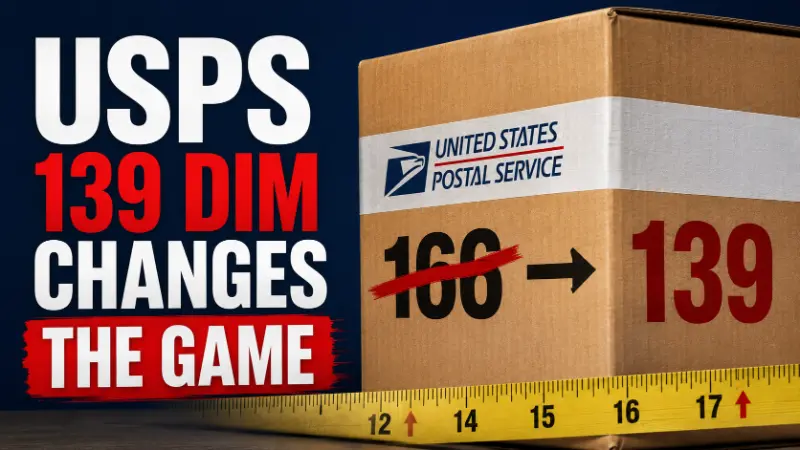
Starting July 12, USPS is changing how it calculates dimensional weight for several package services. The agency plans to move its DIM divisor from 166 to 139 and round fractional package dimensions up to the next whole inch.
That sounds like carrier math.
For ecommerce brands, it is margin math.
The change affects large, lightweight packages that exceed 1 cubic foot and are subject to dimensional weight pricing. For bulky products, the same item, in the same box, going to the same customer may be billed at a higher weight simply because the pricing formula changed.
This matters most for sellers of low-density products: ride-on toys, pillows, pet beds, backpacks, lamps, baby gear, home decor, lightweight furniture parts, and other items that take up more space than their scale weight suggests.
The practical takeaway is simple: wasted inches are becoming more expensive.
What USPS Is Changing on July 12
USPS is making two major changes to dimensional pricing for several package services.
First, USPS will begin rounding package dimensions up to the next whole inch. A side that measures 12.2 inches will be treated as 13 inches. A side that measures 16.7 inches will be treated as 17 inches.
Second, USPS will change the dimensional weight divisor from 166 to 139.
The affected services include:
- USPS Ground Advantage
- Parcel Select
- Priority Mail
- Priority Mail Express
The change applies to packages over 1 cubic foot that are subject to dimensional weight pricing.
USPS has tightened dimensional pricing before. Cahoot previously covered an earlier USPS dimensional pricing change when the agency moved toward a 166 divisor. This new update goes further by moving from 166 to 139 and adding stricter rounding rules.
Why the DIM Divisor Matters
Dimensional weight is a way for carriers to price packages based on the space they occupy, not just the package weight or the actual scale weight, and carriers bill whichever is higher.
The basic formula is:
Length × width × height ÷ DIM divisor = dimensional weight
A lower divisor creates a higher dimensional weight for the same package.
That is why the move from 166 to 139 matters. The product does not change. The box does not change. But the billed weight can increase because the formula becomes less forgiving.
If you need a deeper primer on how this works, Cahoot’s guide to dimensional weight pricing explains how carriers convert package size into billable weight.
How a 47 lb DIM Shipment Can Become 59 lb
Here is a practical ecommerce example.
Consider a toddler ride-on plastic car, such as a Cozy Coupe-style toy. The product itself is not extremely heavy, but the package is bulky.
Using package dimensions of 29.3 × 16.7 × 15.8 inches, you can figure the cubic volume from length x width x height, or length x width x height / width x height volume math as shown in the rounded example, for roughly 7,731 cubic inches before rounding.
| Scenario | Calculation | DIM Weight |
| Old USPS divisor | 7,731 ÷ 166 = 46.6 | 47 lb |
| New USPS divisor, no rounding | 7,731 ÷ 139 = 55.6 | 56 lb |
| New USPS divisor, with rounding | 30 × 17 × 16 = 8,160 ÷ 139 = 58.7 | 59 lb |
| That is the real impact. |
The same large toy package can move from a 47 lb dimensional weight to a 59 lb dimensional weight.
Nothing about the product changed. Nothing about the customer changed. Nothing about the delivery promise changed.
The package simply gets billed differently, which helps determine dimensional weight when a parcel is large but light.
That 12 lb increase in billed weight is the kind of change that can quietly turn a profitable order into a margin problem, especially for sellers offering free or flat-rate shipping.
Big Bulky Packages Were Never USPS’s Sweet Spot
The obvious 3PL takeaway is that large, bulky items were never USPS’s strongest lane to begin with.
USPS can be excellent for many ecommerce shipments, especially across many domestic services, small residential parcels, lightweight items, and certain nationwide delivery use cases. But large packages create a different network problem.
A large package consumes truck space, sortation space, and delivery vehicle capacity regardless of how little it weighs. Parcel carriers do not only manage pounds. They manage cube.
That is why this change should not be viewed only as a rate update. It is also a network signal, similar to how carriers structure pricing for shipping heavy items to maximize profit.
By moving from 166 DIM to 139 DIM and rounding package dimensions up, USPS is reducing one of the pricing advantages that may have made some bulky shipments look attractive under the old math.
The practical effect is that USPS is making large, lightweight packages less attractive to ship through its network.
That does not mean USPS is the wrong choice for every package. There are still USPS use cases that can make sense, including certain flat-rate shipping scenarios. Cahoot’s guide to USPS flat rate boxes explains when flat-rate packaging can be useful and when it may not be the best fit.
But for big bulky products, the old assumption that USPS is automatically the cheaper option deserves another look.
Why UPS and FedEx May Be Better Options for Some Bulky Shippers
UPS and FedEx are not always the most affordable option for every large package. Their published dimensional rules can also be expensive, and many bulky shipments can trigger additional handling, large package, or oversize surcharges.
But for shippers with meaningful volume, non-USPS carriers may offer more room for negotiation.
Depending on package profile, volume, zone distribution, and contract structure, shippers may be able to negotiate:
- steeper discounts for heavier or larger packages
- better minimum charge terms
- discounts or concessions on additional handling fees
- more favorable treatment for large-package surcharges
- custom incentives based on predictable shipping volume
That matters because the headline DIM factor and dim weight pricing are only one part of the total shipping cost.
For bulky products, the carrier agreement can matter as much as the formula. A shipper with poor UPS or FedEx terms may still find USPS competitive on certain lanes. A shipper with strong negotiated discounts may find that UPS, FedEx, or another carrier produces better landed cost for large-package profiles, especially when they partner with a fulfillment provider that beats traditional 3PLs as outlined in Cahoot vs. ShipMonk fulfillment comparison.
Cahoot has also covered how UPS and FedEx dimensional weight rules have changed over time, which is important context for understanding why USPS is now moving closer to private-carrier practices.
The point is not to abandon USPS across the board.
The point is to stop treating carrier selection as static.
After July 12, bulky-package shippers should rerun the math.
Which Ecommerce Products Are Most Exposed?
The most exposed products are not always the heaviest products.
They are often products with a large package cube and relatively low actual package weight.
Examples include:
- ride-on toys and large plastic toys
- pillows, bedding, and cushions
- pet beds and bulky pet products
- backpacks, bags, and luggage
- lamps and home decor
- baby gear and nursery products
- lightweight furniture parts
- foldable or assembled household products
- oversized subscription boxes
- apparel bundles shipped in oversized cartons
The shared pattern is low density.
The parcel is large and light relative to its actual package weight.
This is why ecommerce furniture and home goods sellers already feel dimensional weight pressure so heavily. Cahoot’s article on how to ship furniture without destroying margins explains why DIM weight, packaging, and fulfillment location can determine whether bulky orders remain profitable.
What Ecommerce Brands Should Audit Before July 12
Before the USPS change takes effect, ecommerce brands should identify where they are most exposed.
Start with SKUs that ship in packages over 1 cubic foot. Then calculate the new billable weight by comparing actual weight and expected DIM under the 139 divisor with rounded dimensions, and consider how packaging rules across different channels, such as Amazon’s expanded FBA box size limits, interact with USPS dimensional changes.
At minimum, shippers should audit:
- SKUs with package dimensions over 1 cubic foot, or 1,728 cubic inches
- actual weight versus dimensional weight
- old billed weight versus new billed weight, including the pound impact at the SKU level
- accurate measurement of package dimensions after you measure every side before rounding up
- USPS services currently used for bulky products
- UPS and FedEx alternatives for the same package profiles
- additional handling or large-package surcharge exposure
- shipping rules inside the OMS, WMS, or shipping platform
- free shipping thresholds and marketplace shipping promises
- SKU-level margin by channel after the new billing math
This is also a good time to revisit broader ground shipping costs. Using multi-carrier shipping software for ecommerce alongside Cahoot’s guide on how to reduce ground shipping costs covers additional ways brands can manage transportation costs without sacrificing delivery speed.
The key is to model the impact at the SKU level.
A blended shipping-cost average can hide the problem. One product may barely change. Another may jump enough to erase the margin on an entire product line.
Packaging Still Matters Even If You Change Carriers
Switching carriers does not fix bad packaging or a poor package shape.
If a product ships in an oversized carton, it will usually be expensive somewhere. UPS, FedEx, USPS, and regional carriers may price that package differently, but none of them want to move wasted air for free.
That is why brands should look at packaging before assuming the answer is only a new carrier contract.
Questions to ask include:
- Are we using the smallest box that safely protects the product? Can we trim fractions of an inch where possible, since USPS rounds up and that extra size can raise postage?
- Are warehouse teams selecting the right carton consistently?
- Do we have too many orders shipping in fallback boxes?
- Are bundles or kits creating unnecessary cube?
- Can the product packaging be redesigned to reduce empty space? For compressible goods, would mailers reduce volume?
- Do our systems recommend cartons based on actual item dimensions?
This is where cartonization becomes more than a warehouse efficiency tool. It becomes a shipping-cost control mechanism, especially when merchants use smart cartonization software to save big on shipping.
Cahoot’s article on cartonization software explains how better box selection can reduce waste, improve packing consistency, and help retailers and 3PLs control fulfillment costs.
When the DIM divisor drops, every unnecessary inch becomes more expensive.
Carrier Routing Needs to Get Smarter
The USPS change also increases the importance of carrier routing.
A shipping rule that worked under the old dimensional pricing model may not work after July 12. A service that used to be the cheapest option for a bulky package may become less competitive once the new billed weight is calculated.
That creates risk for brands relying on static shipping rules.
For example, a seller may have rules that default certain package types to USPS Ground Advantage because it historically performed well. After the divisor change, the better option may be UPS Ground, FedEx Ground, a regional carrier, or a different service depending on distance, zone, package size, promised delivery date, and negotiated discounts.
This is where ecommerce shipping software and multi-carrier logic become more important. Next-generation ecommerce shipping software for warehouse automation and Cahoot’s guide on how to save money with ecommerce shipping software explain how automation, rate shopping, and carrier selection can help brands reduce shipping costs.
But software only works if the inputs are accurate.
If item dimensions, box dimensions, product weights, or shipping rules are outdated, the system may still choose the wrong service.
The July 12 change is a good trigger to clean up the data brands need to choose the right shipping service when they send packages.
The New Fulfillment Reality: Inches Are Margin
For ecommerce brands, the USPS DIM change is not just about one carrier.
It is part of a broader shift in parcel pricing. Carriers are getting more precise about charging for the space packages occupy inside their networks.
That means shipping cost optimization cannot stop at rate negotiation.
Brands need to manage their operations with robust ecommerce fulfillment software for intelligent order routing:
- package dimensions
- carton selection
- DIM weight exposure
- carrier contracts
- surcharge rules
- shipping software logic
- fulfillment location strategy
- SKU-level profitability
The brands that handle this well will not simply look for the cheapest label. They will build fulfillment operations that reduce wasted cube, route orders intelligently, and match each package to the right carrier and service.
That is where distributed fulfillment can also matter. Placing inventory closer to customers can reduce zones, improve delivery promises, and give brands more flexibility in carrier selection. For bulky products, shorter shipping distances can help brands pay less for shipping and preserve margin.
Cahoot helps ecommerce brands reduce fulfillment and shipping costs through distributed fulfillment, intelligent order routing, and multi-carrier optimization, offering ecommerce order fulfillment services that outclass traditional 3PLs. For brands shipping large or bulky products, the goal is not just to move packages. It is to move them through a reliable network that manages large, low-density shipments at the right cost, using peer-to-peer order fulfillment services for ecommerce companies and a peer-to-peer order fulfillment network that beats old 3PLs.
The USPS change makes one thing clear:
Inches are no longer just packaging details. They are billable weight.
Frequently Asked Questions
What is USPS changing about dimensional weight pricing?
Starting July 12, USPS is moving its dimensional weight divisor from 166 to 139 for several package services and rounding fractional package dimensions up to the next whole inch. This can increase billed weight for large, lightweight packages.
Which USPS services are affected by the 139 DIM divisor change?
The change affects USPS Ground Advantage, Parcel Select, Priority Mail, and Priority Mail Express packages over 1 cubic foot when they move through the post office network to Zones 5–9 and are subject to dimensional weight pricing.
Why does moving from 166 DIM to 139 DIM increase billed weight?
Dimensional weight is calculated the way USPS measures one dimension after another in the formula: multiply length, width, and height, then divide by the DIM divisor to determine billed weight; one cubic foot equals 1,728 cubic inches. A lower divisor produces a higher dimensional weight for the same package, which can increase the billed weight.
What types of ecommerce products are most affected?
Large, lightweight products are most exposed. Examples include ride-on toys, pillows, pet beds, backpacks, baby gear, home decor, lightweight furniture parts, and other bulky products with low actual weight relative to package size.
Should ecommerce brands stop using USPS for bulky packages?
Not necessarily. USPS may still make sense for some shipments. But brands shipping bulky products should rerun the math after July 12 and compare USPS against UPS, FedEx, regional carriers, and negotiated carrier agreements.
How can ecommerce brands reduce DIM weight exposure?
Brands can reduce exposure by right-sizing packaging, improving carton selection, auditing package dimensions, using smarter carrier routing, negotiating better carrier terms, and reviewing SKU-level profitability after the new DIM math takes effect.
Written By:
Indy Pereira
Indy Pereira helps ecommerce brands optimize their shipping and fulfillment with Cahoot’s technology. With a background in both sales and people operations, she bridges customer needs with strategic solutions that drive growth. Indy works closely with merchants every day and brings real-world insight into what makes logistics efficient and scalable.
Turn Returns Into New Revenue
Related Articles
What Is Demand Planning? How It Impacts Inventory, Forecasting, and Profitability
Demand planning is the process of estimating future customer demand so that a business can align its inventory, procurement, and operations to meet that demand without carrying mor...
Why 100% P2P Adoption Is the Wrong Goal
Peer-to-peer returns let customers send eligible returned items directly to other customers instead of routing every package back through the warehouse, cutting shipping and proces...
Walmart Officially Allows Amazon Multi-Channel Fulfillment (MCF)
Big news for multichannel sellers: Walmart now officially allows Amazon Multi-Channel Fulfillment (MCF), Amazon’s service for using its fulfillment network to ship orders from mult...
What Meta Reels Product Tagging Means for Ecommerce Fulfillment

To begin using Instagram Reels product tagging, brands must first set up Instagram Shopping by connecting their Instagram account to a Facebook Commerce Manager and uploading their product catalogues. Note: It is crucial to configure in-app shopping properly to enable the purchase option, allowing users to buy products directly through the app. Instagram introduced the Shopping feature in 2017, and it has since evolved to include product tags in Reels, Stories, and posts. Now, Meta is testing product tagging directly inside Instagram Reels, enabling brands to tag products in Reels, Stories, and posts, and allowing users to shop or view product details by tapping on the tags. Creators can tag up to 30 products from a single catalogue or collection in a single video, and users can view these by tapping the ‘View Products’ link in the caption. This seamless shopping experience lets users buy products directly through the app without leaving, across posts, Stories, and IGTV. Strategic tag placement is essential to ensure product tags are visible without obstructing key visual elements, and utilizing high-quality visuals and compelling images is crucial, as low-quality, blurry videos reduce engagement and diminish the effectiveness of shoppable content. Captions can include product tags or calls to action, and product tags can also be added to Stories, enhancing brand engagement through visual storytelling and feature integrations.
Most of the coverage of this development focuses on what it means for creators, for social commerce adoption, and for Meta’s advertising revenue. That is a legitimate frame for a media story. It is not the right frame for a brand operations story.
The real question is not whether product tagging in Reels helps content convert. It is what happens downstream when it does. Because when the distance between discovery and purchase compresses, the operational system behind the purchase either holds or it does not. And it holds in much less time than brands are accustomed to recovering from.
The Compression Problem
Traditional ecommerce acquisition followed a longer arc. A consumer saw an ad or a piece of content, visited a website, browsed, maybe saved the product, returned later, and converted on a second or third touchpoint. That sequence gave brands implicit recovery time. Inventory could be thin for a few days and no one would notice. A delivery promise window could be approximate and customers rarely complained on day two.
Instagram Reels product tagging compresses that sequence. Shoppers watching a creator video see a tagged product and can click or tap on the product tag, moving instantly from discovery to checkout. Every month, 130 million Instagram users tap on a shopping post to learn more about a product, demonstrating Instagram’s effectiveness as a product discovery platform. Shoppers can take action by clicking on product tags or calls-to-action to view product details and complete a purchase directly within the app, driving higher engagement and conversions. There is no browse session, no separate app open, no link-in-bio detour. The moment of intent is closer to the moment of purchase than any prior surface in the customer journey.
That compression is what makes this an operational story. When the path from attention to transaction shortens, inventory readiness, delivery promise accuracy, and post-purchase reliability all move from back-office concerns to brand-defining moments. Brands must ensure operational readiness to keep up with the fast pace of Instagram shopping. The window in which a brand can recover from a gap in any of those areas shrinks at the same rate as the discovery-to-purchase path.
What Breaks When Commerce Compresses
Four operational failure modes become more likely and more visible when a social content surface can drive transaction velocity at speed. To ensure a seamless user experience, it is crucial to regularly check and confirm inventory levels and delivery systems. Brands must also confirm their account setup and access permissions to enable Instagram Reels product tagging features, as by default, certain permission settings may restrict product tagging until adjusted. Additionally, brands should ensure operational readiness for live video shopping events, being prepared to manage product tags and inventory during live sessions, as proper account configuration is essential for managing product tags and facilitating in-app purchases.
Stockouts After a Content Spike
A piece of Reels content going viral is not a gradual event. It is a volume event with an unpredictable onset and a peak that can arrive within hours of posting. To avoid missed opportunities, brands should upload accurate inventory data and ensure product tags are updated to reflect real-time stock levels. If a creator tags a product that the brand has not positioned well in inventory, that product can go from in-stock to sold out before the brand’s team has processed what is happening.
The problem is not simply that the product ran out. The problem is that the moment the product is out of stock, every subsequent viewer of that Reel encounters a dead end. The tagged product leads to an unavailable listing. The brand absorbs the demand miss, and the creator’s content, which was generating value, is now surfacing a broken purchase experience to everyone who sees it later.
To reduce the risk of stockouts and maximize engagement, brands can use collection and carousel features to showcase multiple products within a Reel. This approach diversifies what is promoted and helps maintain a seamless shopping experience even if one item sells out.
Stockouts after a content spike are not new. What is new is that the spike can be driven by organic Reels discovery rather than by a brand-coordinated campaign, which means the brand’s inventory planning cycle had no signal to act on in advance.
Poor Delivery Promise Accuracy
When a consumer sees a product in a Reel and converts in seconds, their expectation clock starts immediately. They did not deliberate. They did not research. They made a fast decision based on a moment of engagement, which means their tolerance for friction or disappointment in the post-purchase experience is lower than for a considered purchase.
Delivery promise accuracy, the precision between what the checkout page promised and when the package actually arrives, is one of the highest-impact drivers of post-purchase satisfaction. It is crucial to check and confirm that delivery promise data is accurate and to ensure the checkout page reflects real-time carrier performance. A brand that promises four to six business days because that is what their checkout is configured to show, without that window being grounded in actual carrier performance from their fulfillment locations, is surfacing inaccurate information to customers who made an impulse-driven decision. The resulting experience is a mismatch between expectation and reality at the most emotionally sensitive point of the purchase cycle.
On a deliberate purchase, a customer might tolerate a one-day delivery miss as a minor inconvenience. On a fast impulse purchase driven by social content, a delivery miss registers differently, as confirmation that the decision was a mistake.
Cross-Country Shipping from Poor Inventory Placement
Many ecommerce brands still fulfill from a single warehouse or from a primary fulfillment node that is not positioned for national coverage. When a Reels video tags a product and drives purchases from customers distributed across the country, those orders ship from wherever the inventory is. To ensure cost efficiency and faster delivery, brands should check that their inventory is distributed across multiple locations and regularly review shipping zones, and consider leveraging national fulfillment services that provide geographically distributed nodes. Integrating with Facebook Commerce Manager can also help manage inventory and shop features more effectively, especially when linking Instagram Reels product tagging with your Facebook account.
Cross-country shipping is slower and more expensive than regional fulfillment. It is slower for the customer, increasing the probability of a delivery expectation mismatch. It is more expensive for the brand, particularly under current carrier pricing conditions where surcharges and zone-based pricing compound the cost of long-haul parcel movement. The brand is absorbing that cost on orders they did not plan for, driven by demand they could not predict, with inventory they positioned for a different volume assumption.
This is not a shipping cost story in isolation. It is an inventory positioning story. A brand with inventory distributed across multiple fulfillment nodes can route orders to the closest node, reduce transit time, reduce zone-based shipping costs, and fulfill a delivery promise that matches actual logistics reality, which is exactly what advanced ecommerce fulfillment software for smart inventory placement is designed to enable. A brand fulfilling from a single point has no such flexibility when an unplanned demand event arrives from an unanticipated geographic distribution. Brands managing rising carrier surcharges already understand the pressure on per-shipment margins. Reels-driven demand spikes concentrated in unfavorable shipping zones make that pressure sharper, which is why mastering order fulfillment costs and ecommerce fulfillment pricing becomes strategically important. For a deeper look at how carrier cost structures are affecting ecommerce margins, major carrier peak shipping surcharges are worth studying alongside this piece.
Returns Friction After Impulse-Driven Purchases
Purchases made in seconds based on social content have different return profiles than purchases made after deliberate research. The impulse buyer is more likely to return when the product arrives and does not match the impression created by the video. The sizing is different. The color reads differently in person. The product feels smaller or less substantial than it appeared in the content.
Impulse-driven return rates are structurally higher than considered-purchase return rates. A brand that does not have streamlined, low-friction reverse logistics absorbs that return volume at a higher cost per unit than a brand that does. Return processing, restocking, and any refurbishing required before an item can reenter sellable inventory all carry labor and time costs that are hidden in aggregate but material at volume. To minimize costs and delays, it is essential to ensure a streamlined returns process, optimize reverse logistics, and regularly check reverse logistics systems for efficiency.
The downstream margin impact of a Reels-driven demand spike that carries elevated return rates is not visible in the moment of the sale. It surfaces two to four weeks later in the returns data, especially for categories vulnerable to bracketing and high return intent that require a carefully crafted e-commerce returns program. By then, the content cycle has moved on, but the operational cost remains.
Why This Is Not a Creator Story or a Social Commerce Story
There is a version of this story that focuses on creator monetization, Meta’s affiliate infrastructure, and whether Reels product tagging will change the economics of influencer marketing. That is a real story. It is not this one.
The frame that matters for ecommerce operators is simpler: any feature that accelerates the path from discovery to purchase is a feature that raises the operational stakes for every transaction that flows through it. The demand side of the equation gets faster. The supply side, inventory, fulfillment, delivery, and returns, does not automatically get faster alongside it.
Brands should learn from data and find best practices to optimize their operational systems and ensure they are ready to meet increased demand, including turning ecommerce order fulfillment into a profit driver rather than a pure cost center by leveraging innovative order fulfillment services for ecommerce companies that lower costs while improving speed. It is also important to balance product mentions with authentic content to maintain follower engagement. Increasing engagement can be achieved by incorporating user-generated content, which provides valuable social proof. Both brands and consumers love the social shopping experience and influencer collaborations, as these foster positive relationships and brand affinity. Building a loyal tribe of customers through social media engagement and leveraging creators and influencers helps foster a sense of community and advocacy around the brand.
The gap between fast demand and slow execution is where margin is lost. It shows up in stockouts that miss a conversion window, in delivery promises that do not match actual performance, in shipping costs that exceed what a distributed inventory model would have produced, and in return rates that reflect the gap between social content impression and physical product reality.
This is what agentic commerce points toward as a broader trend: when the interface between discovery and transaction becomes faster and more automated, operational readiness becomes the competitive differentiator. The brands that capture compressing purchase windows are not the ones with the best content. They are the ones with the best execution infrastructure underneath the content.
What Operational Readiness Actually Looks Like
For ecommerce brands evaluating what Instagram Reels product tagging means for their operations, the relevant questions are concrete. To ensure operational readiness, brands must check and confirm that all systems—such as inventory management, fulfillment, and account permissions for product tagging—are in place and functioning. Regularly check and confirm processes to maintain seamless product tagging and shopping experiences. Brands should create monitoring systems to track content performance and inventory in real time, ensuring quick responses to viral content and inventory shifts. It is also important to be able to select and highlight specific products during live videos or Reels, as this maximizes engagement and allows you to showcase relevant items at key moments.
Is inventory positioned nationally, or is it concentrated in a single location? A brand fulfilling from one node has no geographic flexibility when demand arrives from across the country. Multi-node fulfillment is the structural answer, whether through a network of owned warehouses, a 3PL with distributed facilities, or a cooperative fulfillment model, or by using channel-specific services such as affordable Facebook order fulfillment to support social-driven sales or broader ecommerce order fulfillment services that outclass traditional 3PLs.
Are delivery promises at checkout grounded in actual carrier performance data from actual fulfillment locations? A checkout page that shows estimated delivery windows based on assumptions rather than real-time carrier data is surfacing inaccurate information to customers making fast decisions. Delivery promise accuracy requires the checkout logic to reflect where inventory actually is and how long it actually takes to move from that location to the customer’s zip code, often by integrating directly with marketplace tools like Amazon Buy Shipping for streamlined ecommerce order fulfillment.
Is there a process for monitoring content performance and cross-referencing it against inventory levels in real time? A brand that learns about a product going viral by checking their order management system two days later has no mechanism for proactive response. Brands with creator relationships embedded in their operations can receive signals about expected content performance in advance, giving the supply chain team at least partial lead time to position inventory appropriately.
Optimizing Reel captions with relevant keywords is recommended for better visibility in search results. As of March 2022, Instagram allows all users 18+ to tag products in posts, increasing opportunities for user-generated content and expanding access to product tagging features. Businesses that consistently use product tags across formats see an average 37% increase in sales. Instagram Reels allow for product tagging, enabling users to take action and browse products directly from the video, creating quick conversion opportunities. Incorporating trending audio and styles in product tagging can aid in increasing visibility. To enhance visibility, brands should tag products frequently in their Reels, with successful Shops posting product tags at least five times per month, and align these efforts with channel-ready fulfillment like Google Shopping delivery and shipping order fulfillment services to sustain fast, affordable delivery on incremental demand.
Is the returns process fast enough to restock high-return-rate SKUs without creating a phantom inventory problem? A product that is sold through a Reels spike and returned at a 25 percent rate needs to reenter available inventory within days of the return, not weeks. Solutions like Happy Returns’ drop-off return program can help accelerate customer refunds and intake, but they come with trade-offs that must be evaluated against your broader network, as illustrated in real-world order fulfillment case studies from ecommerce brands. Slow reverse logistics creates out-of-stock conditions on paper for inventory that is physically present but not yet processed.
Frequently Asked Questions
What is Instagram Reels product tagging?
Meta is testing a feature that allows creators to tag products and add product tags directly inside an Instagram Reels video. This enables users to shop and buy products seamlessly within the app, as tagged products link to purchase pages without requiring a separate link in bio or profile visit. This reduces the number of steps between seeing a product in content and making a purchase, creating a streamlined shopping experience.
Why does Reels product tagging matter for ecommerce operations?
When the path from discovery to purchase compresses, users can take action by tapping ‘View Products’ on a Reel to view product details and complete their purchase directly within the app. This fast transaction process means operational gaps that were previously recoverable become visible faster. To maximize the effectiveness of Instagram Reels product tagging, brands must ensure operational readiness—such as maintaining accurate inventory, reliable delivery promises, and efficient fulfillment—to support seamless shopping experiences. Stockouts after a content spike, inaccurate delivery promises, cross-country shipping from poorly positioned inventory, and elevated return rates all have a greater impact on brand performance and margin when transaction velocity increases.
What is the biggest operational risk from social commerce features like this?
The largest risk is inventory readiness. Before tagging products in Instagram Reels, check and confirm that your inventory and delivery systems are prepared to handle potential demand spikes. Regularly verify stock levels and confirm your fulfillment process to ensure you can meet increased orders. The second largest risk is delivery promise accuracy, since impulse-driven buyers have lower tolerance for expectation mismatches than deliberate purchasers. Ensuring best practices in both inventory management and delivery will help maintain a seamless customer experience, including proactively managing carrier shipment exceptions that can otherwise derail delivery promises.
How can brands prepare their fulfillment for social-driven demand spikes, especially on marketplaces like Amazon where FBM shipping and order fulfillment services must keep pace with volatile social-driven order volume?
The core preparation involves uploading inventory data to your online platforms, ensuring your Instagram account is set up as a business or creator account with proper access permissions for product tagging, and distributing inventory across multiple fulfillment locations to reduce cross-country shipping. Ground delivery promise logic in actual carrier performance data, create systems to monitor and respond to demand spikes, establish monitoring for content performance that can feed signals to the supply chain team, and streamline reverse logistics to handle elevated return rates efficiently with tools such as return management platforms like Return Prime.
Does this change how brands should think about inventory positioning, particularly for Shopify merchants choosing between different Shopify order fulfillment options or evaluating the best Shopify fulfillment services for nationwide shipping?
Yes. Single-node fulfillment is exposed by demand events that are geographically unpredictable. When a Reels video drives purchases from customers distributed nationally, a brand fulfilling from one warehouse cannot route orders to minimize transit time or shipping cost. Distributed inventory is the structural response to geographically unpredictable demand. To ensure your distributed inventory is showcased and promoted effectively, use Instagram’s collection and carousel features—these allow you to tag multiple products from your catalog within a Reel or post, making it easier for customers to browse and engage with your full product range while still preserving margin by mitigating FedEx and UPS surcharges through smarter shipping strategies.
Is this primarily a paid media or advertising story?
No. The operational frame is more relevant for brands than the advertising frame. The core issue is not whether Reels drives cheaper customer acquisition. It is whether a brand’s fulfillment, inventory, and post-purchase systems can execute reliably at the velocity and geographic distribution that Reels-driven demand creates. To enable Instagram shop features and product tagging in Reels, brands must integrate with Facebook Commerce Manager and ensure their operational systems are prioritized over advertising concerns.
Written By:
Rinaldi Juwono
Rinaldi Juwono leads content and SEO strategy at Cahoot, crafting data-driven insights that help ecommerce brands navigate logistics challenges. He works closely with the product, sales, and operations teams to translate Cahoot’s innovations into actionable strategies merchants can use to grow smarter and leaner.
Turn Returns Into New Revenue
Related Articles
What Is Demand Planning? How It Impacts Inventory, Forecasting, and Profitability
Demand planning is the process of estimating future customer demand so that a business can align its inventory, procurement, and operations to meet that demand without carrying mor...
Why 100% P2P Adoption Is the Wrong Goal
Peer-to-peer returns let customers send eligible returned items directly to other customers instead of routing every package back through the warehouse, cutting shipping and proces...
Walmart Officially Allows Amazon Multi-Channel Fulfillment (MCF)
Big news for multichannel sellers: Walmart now officially allows Amazon Multi-Channel Fulfillment (MCF), Amazon’s service for using its fulfillment network to ship orders from mult...
Amazon Discover Unmet Demand: What Sellers Should Know
In this article
17 minutes
Amazon has added a Discover Unmet Demand view inside the Amazon Product Opportunity Explorer that surfaces search clusters where shoppers are clicking but converting below the expected benchmark for that category and price range. This view helps sellers analyze what Amazon customers are searching for and clicking on, uncovering product opportunities by highlighting areas where shoppers are searching but not finding what they want. The premise is straightforward: if people are searching, clicking, and not buying, something they want is not available or not well represented. Find those gaps and fill them.
That premise is not wrong. But it is incomplete in ways that matter economically. Low conversion is a signal, not a diagnosis. The difference between a signal that points toward a real market gap and one that points toward weak intent, broad browsing, or demand that cannot be profitably served is precisely the judgment that the tool does not provide. For example, shoppers may be clicking on certain clicked products but not purchasing them, indicating unmet demand or issues with the current offerings. That judgment is now the real differentiator, not access to the dashboard.
What the Feature Actually Shows
Product Opportunity Explorer has existed for several years as a way for sellers to explore search term clusters, review counts, sales velocity, and conversion patterns within Amazon’s category structure. The Discover Unmet Demand view is a filtered lens on top of that data, surfacing clusters where the click-to-purchase ratio falls below what Amazon’s systems expect given the category and price point. The tool categorizes products into niches, which are defined as collections of search terms and products that represent specific customer needs, and niche metrics are updated weekly. Sellers can analyze multiple niches to compare demand and competition across different product categories.
The intent is to highlight places where demand is being expressed but not fulfilled to an adequate standard, helping reveal what customers are looking for but not finding. Sellers can use the tool to identify unmet customer demand by analyzing niche metrics, example niches, and detailed information about product categories, which complements broader Amazon market and product research strategies focused on understanding demand, competition, and profitability. The tool helps sellers identify opportunities by revealing where customers are looking for products that are not being met. In theory, a seller looking at these clusters is seeing a prioritized list of where shoppers searched, found something close to what they wanted, clicked on it, and did not buy. The interpretation Amazon is implicitly offering is: this is where you might win.
That interpretation requires much more scrutiny than the dashboard provides, but the tool does provide valuable insights into customer search behavior and market gaps.
Why Low Conversion Is Easy to Misread
Conversion below benchmark is a compound outcome. It reflects the interaction between what shoppers were actually looking for, what listings were available, what prices were presented, and whether purchase intent existed in the first place. Analyzing what customers are searching for and the individual search terms they use can help sellers understand whether low conversion is due to unmet demand or simply weak intent. Each of those factors tells a different story about whether a gap is real and commercially actionable, and it’s crucial to look for clear signals that indicate genuine market gaps rather than weak or misleading intent.
Broad queries with weak intent produce low conversion structurally and do not indicate a product opportunity. A search term like “gifts for him under $50” generates enormous click volume across dozens of categories. Shoppers are browsing, not buying. They have not decided what they want. They may not buy anything on this session. Low conversion on a query like this is not evidence that no product meets the need. It is evidence that the need is not well-formed enough to close a transaction.
A seller who sees a high-volume, low-conversion cluster built around gift-oriented or exploratory searches and interprets it as an unmet demand opportunity is solving the wrong problem. No product, regardless of how well positioned, will convert exploratory browsing into a purchase reliably. The intent is simply not there to close.
Category-level browsing masquerading as product-level intent appears frequently in the data. A shopper searching “kitchen storage” is not necessarily looking for a specific product they cannot find. They may be early in a longer purchase journey, comparing options, or satisfying curiosity. The low conversion that results does not mean the category is underserved. It may mean the query is functioning as navigation rather than purchase intent. However, when high search volume is paired with poor conversion on specific individual search terms, it can indicate prospective niches where the products customers want are not being met. In these cases, knowing how many reviews a product has is essential for evaluating both the level of competition and the depth of customer feedback, helping sellers assess whether the demand is truly unmet or simply underserved.
Demand that exists but cannot be profitably served is a distinct failure mode that the tool cannot identify. Imagine a cluster of search terms indicating that shoppers want a specific combination of features at a specific price point. The conversion is low because current listings do not match the combination. A seller might read this as a product development opportunity. But the reason no listing matches the combination may be that it is economically impossible to produce at the price point shoppers expect. The demand is real. The gap is real. The commercial opportunity is not. Analyzing customer reviews, especially 1-star to 3-star reviews, can reveal pain points and unmet needs, helping sellers understand if the gap is due to unserviceable demand or fixable product shortcomings. At the same time, a high number of positive reviews can indicate strong product quality and a competitive market, which may raise the barrier for new entrants. Negative review mining can also reveal recurring phrases that indicate unmet consumer needs across multiple brands, signaling broader market demands.
This is the most consequential version of the misread. A seller who invests in sourcing, development, or inventory based on a signal that reflects economically unserviceable demand has made a capital allocation mistake that the data itself did not warn them about. Even when using lower-cost bulk storage options like Amazon AWD bulk storage and auto-replenishment, misunderstanding true demand can lock capital into inventory that will never turn profitably.
The Overcrowding That Follows Better Tools
Here is a dynamic that every Amazon seller using Amazon’s own demand signals should think carefully about. Leveraging up-to-date data and data-driven insights is crucial for Amazon sellers to stay ahead of the competition when using the Discover Unmet Demand feature. In fact, in 2024, 89% of Amazon sellers used AI-driven tools for advanced product research and optimization, up from 62% in 2023, highlighting the growing importance of data analysis for identifying market gaps. These AI-driven tools help sellers accelerate product research, enabling them to quickly identify high-potential products, source efficiently, and stay ahead of market competition, especially when paired with ongoing educational webinars on Amazon and ecommerce strategy.
When Amazon surfaces a Discover Unmet Demand view inside a widely used seller tool, the set of sellers reviewing those clusters is not small. Product Opportunity Explorer has been promoted through Seller Central, through Amazon’s seller education webinars, and across the seller community for years. Sophisticated Amazon sellers have been using it. Agencies have been using it. The Discover Unmet Demand overlay makes the lowest-conversion clusters more findable and easier to act on, which means more sellers will act on the same signal simultaneously. Sellers closely monitor growth and growth trends—such as increases in search volume, sales, and niche demand—to identify emerging opportunities before they become crowded.
A search cluster that appears to represent a gap today may be crowded with new product launches within two to three quarters of the feature gaining adoption. The apparent whitespace fills in. Conversion remains low because the category is now competitive rather than under-supplied. The sellers who launched into it are now in a commodity battle, not a gap market.
This is the contrarian read on better marketplace tools: they democratize intelligence in ways that reduce the durable advantage of that intelligence. When everyone sees the same signal, the signal leads to the same response, which produces crowding rather than differentiation. Monitoring growth trends can help sellers anticipate when a niche is about to become saturated, particularly around events like Prime Day where Prime Day order preparation and fulfillment choices can determine whether increased demand translates into profit or erodes margin. The sellers who benefit are those who move fastest, execute most cleanly, or bring something to the market that cannot be instantly replicated by the next seller who reads the same dashboard. Many successful Amazon sellers believe that understanding unserved niches offers a faster route to profitability, as fewer listings target these demands and increase search visibility.
What Operational Follow-Through Actually Requires
Assuming a seller identifies a cluster that reflects genuine unmet demand with real commercial intent and a serviceable price point, these steps are critical for building a successful business on Amazon. The tool’s work is done at that point. Everything that creates actual competitive advantage happens in what follows.
Sourcing and product development require lead time, supplier relationships, and capital commitment. A seller who identifies an opportunity in January and can source, develop, and list a product by March has a window before the cluster becomes crowded. A seller who identifies the same opportunity but needs nine months of sourcing time is entering a different competitive environment.
Inventory positioning determines whether a launched product can meet the demand it captures. Utilizing historical sales volume helps sellers understand seasonality and informs inventory management strategies, ensuring stock levels align with expected demand fluctuations. Choosing the right products to sell based on data-driven insights is essential for maximizing inventory efficiency and sales performance. A product that starts to convert well and runs out of stock within weeks of launch loses its momentum at the worst possible moment. Amazon’s ranking algorithms favor consistent availability. A new listing that goes out of stock loses the rank gains it earned and has to rebuild from a lower position. For more on how inventory positioning affects fulfillment economics, the patterns around Amazon’s holiday peak order fulfillment fee increases are relevant context for how rising shipping and handling costs interact with margin on new product launches.
Pricing and positioning at launch require a view of the existing competition in the cluster, not just the gap that the tool surfaced. Tracking sales history, units sold, and sales rank—such as those shown on Amazon’s Best Sellers, Movers & Shakers, and New Releases lists—enables sellers to forecast the potential success of new products and understand current market trends. Evaluating how many products are already in the niche helps assess competition and market saturation, informing pricing and positioning strategies. For some sellers, programs like Amazon Seller Fulfilled Prime (SFP) also change the pricing and positioning equation by trading FBA fees for direct control over fast shipping performance. A seller entering a cluster because conversion is low needs to understand whether the current listings are low-converting because they are priced wrong, because they have poor imagery, because they have no reviews, or because the product is genuinely inadequate. The answer determines whether a well-executed listing at the right price can win, or whether the cluster is structurally difficult regardless of listing quality. Predictive analytics using historical sales data and machine learning can also help forecast emerging trends before they saturate the market, giving sellers a competitive edge.
Merchandising and bundling can create differentiation where product parity otherwise exists. A cluster where individual items convert poorly may convert better for a thoughtfully designed bundle that solves a use case more completely than any single product in the category. Protecting those differentiated bundles from search suppression, listing hijackers, and stockouts requires proactive Amazon listing protection and stockout prevention practices that go beyond the initial product idea. That bundling decision requires judgment about the shopper’s underlying need, which is not visible in the conversion data alone.
Identifying opportunities through effective product research and operational follow-through is ultimately about discovering profitable niches and high potential products to sell. This approach enables sellers to strategically grow their business by targeting segments with strong demand and growth prospects.
Better Dashboards Do Not Create Better Decisions
The Discover Unmet Demand view is a more targeted version of the same type of signal that product research tools have been surfacing for years. Search volume, click patterns, conversion rates, and competitive density are not new data points. What changes is the accessibility of those signals directly inside Seller Central, without needing a third-party tool or a custom data pull. Leveraging resources such as Amazon’s analytics tools, webinars, seller communities, and advanced platforms with customizable filters allows sellers to gain visibility into customer frustration and prevailing search trends, making it easier to identify unmet demand and generate new product ideas from data-driven insights.
Accessibility is valuable. However, a truly data-driven approach is essential for effective product research and decision-making. The distance between having a signal and making a good decision based on it has not shrunk. That distance is filled by category expertise, customer understanding, supplier relationships, capital allocation discipline, and execution speed. None of those things are delivered by a dashboard, and many sellers ultimately need a scalable order fulfillment network for Amazon and multichannel sales to translate good product decisions into reliable delivery performance.
The pattern that plays out repeatedly when platforms give sellers more data is that the data creates the illusion of reduced uncertainty. A seller who sees a low-conversion cluster and interprets it as a validated opportunity has not done less work than before the tool existed. They have done less obvious work, which is not the same thing. The evaluation steps that convert raw demand data into a confident sourcing decision should include analyzing product listings—especially bullet points, images, and specifications—to identify gaps and improve differentiation.
This is the operational judgment problem that surfaces in agentic commerce contexts as well. Better automated signals surface more information faster, but the quality of decisions made from that information still depends on the judgment of the operator interpreting it. Access to better tools raises the floor of what sellers can see. It does not raise the ceiling of what they can execute. Optimizing your Amazon store for visibility and growth, and ensuring your product listings use clear bullet points to quickly convey product value, are crucial steps for success.
The Practical Filter Before Acting on This Data
For sellers who want to use Discover Unmet Demand responsibly, the filter before acting on any cluster is a series of questions the tool cannot answer.
Is the search intent in this cluster transactional or exploratory? Can you tell from the query structure and the click patterns whether shoppers have a specific product in mind or are browsing? If the intent is exploratory, pass.
Is the demand servable at the price point the search data implies? Do the products shoppers are clicking reflect a price expectation that leaves room for healthy margin after sourcing, fulfillment, advertising, and Amazon fees? Given current shipping cost and carrier surcharge pressures, this question carries more weight than it did in lower-cost fulfillment environments. Additionally, monitoring seasonal trends can help optimize inventory positioning and stock levels to better match demand fluctuations throughout the year.
Why are current listings converting poorly? Is it poor images, weak copy, missing reviews, incorrect price positioning, or a genuinely absent product type? Monitoring customer feedback and customer preferences—such as analyzing reviews and what shoppers are searching for—can help identify market gaps, new niches, and unmet demand. Monitoring customer reviews, especially negative ones, can reveal repeated suggestions for product improvements, indicating broader unserved market needs. If the answer is execution problems in current listings rather than an absent product, a better-executed listing wins without requiring a new product development cycle.
How long will it take to bring a product to market, and how many other sellers have access to the same signal? If sourcing takes six months and the cluster is prominently featured in a widely used seller tool, the competitive landscape in that cluster will be meaningfully different by the time a new product is ready to list. Consider timing your launch around upcoming events or micro-holidays that can drive demand in certain niches.
A seller who works through those questions honestly will pass on most of the clusters that Discover Unmet Demand surfaces. That is not a failure of the tool or of the seller. It is what responsible demand signal interpretation looks like. In competitive or emerging categories, using sponsored products ads can help increase visibility for new product launches and attract targeted traffic, while alternative fulfillment strategies—such as peer-to-peer fulfillment networks to overcome Amazon inventory limits or broader peer-to-peer order fulfillment models beyond FBA—can ensure that demand you do pursue can actually be served profitably.
Frequently Asked Questions
What is Amazon’s Discover Unmet Demand feature?
Discover Unmet Demand is a view inside Amazon’s Product Opportunity Explorer that highlights search clusters where shoppers are clicking on products but converting below the expected benchmark for that category and price range. Amazon positions it as a way for sellers to identify gaps in the product selection.
Does low conversion on a search cluster mean there is a real market gap?
Not necessarily. Low conversion can reflect weak purchase intent, exploratory browsing, overly broad queries, price expectations that make the demand unserviceable, or competitive issues with existing listings rather than an absent product type. Interpreting the signal requires additional analysis that the tool does not provide.
What are the most common mistakes sellers make with this data?
The most common mistakes are acting on clusters driven by exploratory rather than transactional intent, confusing poor listing execution by current sellers with a product-level gap, and underestimating how quickly other sellers respond to the same signals from the same tool, turning apparent whitespace into a crowded launch environment.
How does a seller know if an unmet demand signal is worth pursuing?
The evaluation requires checking whether purchase intent is transactional, whether the demand is servable at a margin-positive price point after all costs, why current listings are converting poorly, and how much time is required to bring a competitive product to market relative to how quickly the cluster will attract other sellers.
Does having access to better Amazon data create a competitive advantage?
Access to the data creates a potential advantage, but realizing it requires the judgment to interpret signals correctly, the supplier relationships to act quickly, and the operational discipline to execute at the right inventory level and price point. When many sellers have access to the same data, the advantage shifts toward those who interpret and execute better, not those who simply found the feature first.
How does this tool connect to broader fulfillment and operational decisions?
A product launch decision driven by demand data requires inventory commitment, sourcing lead time, and fulfillment cost modeling before it is complete. A seller who identifies a genuine demand gap but cannot bring product to market profitably given their current sourcing and shipping cost structure has not identified an opportunity. They have identified a situation that requires better operational infrastructure before it becomes one.
Written By:
Rinaldi Juwono
Rinaldi Juwono leads content and SEO strategy at Cahoot, crafting data-driven insights that help ecommerce brands navigate logistics challenges. He works closely with the product, sales, and operations teams to translate Cahoot’s innovations into actionable strategies merchants can use to grow smarter and leaner.
Turn Returns Into New Revenue
Related Articles
What Is Demand Planning? How It Impacts Inventory, Forecasting, and Profitability
Demand planning is the process of estimating future customer demand so that a business can align its inventory, procurement, and operations to meet that demand without carrying mor...
Why 100% P2P Adoption Is the Wrong Goal
Peer-to-peer returns let customers send eligible returned items directly to other customers instead of routing every package back through the warehouse, cutting shipping and proces...
Walmart Officially Allows Amazon Multi-Channel Fulfillment (MCF)
Big news for multichannel sellers: Walmart now officially allows Amazon Multi-Channel Fulfillment (MCF), Amazon’s service for using its fulfillment network to ship orders from mult...
Amazon’s New Coupon Display Changes How Shoppers Perceive Value
In this article
11 minutes
Within the broader e-commerce landscape, Amazon stands out as a platform that continually enhances its features to improve the customer experience and requires business adaptability from sellers. Amazon is currently testing a new coupon display that shows the final price after the coupon is applied, rather than just the discount amount or percentage. This new format aims to simplify the shopping experience by allowing customers to see the exact price they will pay without needing to calculate the discount themselves. Most brands see this update as a positive change, as it simplifies price comparison for customers and could improve click-through rates and conversions. Official updates about such changes are communicated through Seller Central, Amazon’s hub for managing seller accounts and accessing important information.
The coverage of this change has mostly focused on the mechanics: how to set up coupons, whether to adjust coupon budgets, whether Prime Exclusive Discounts behave differently. That framing treats the update as an interface tweak with some operational implications.
That framing is too narrow. This is an economics shift disguised as a display change. And the sellers who do not understand the difference will misread the consequences for months.
What the Coupon Badge Was Actually Doing
Before getting into what changes, it is worth being precise about what the green coupon badge was doing for sellers who used it.
The badge was not just communicating a discount. It was doing psychological work at the point of attention, before a shopper had made any conscious decision to engage with the listing. A green badge showing “15% off with coupon” in search results functioned as a visual cue that interrupted the scroll, signaled deal availability, and created a moment of perceived value without requiring the shopper to read a word of copy or evaluate anything about the product itself. Research indicates that the presentation of discounts significantly influences consumer behavior and conversion: ‘cents-off’ coupons allow shoppers to see their savings clearly without calculations, while ‘percent-off’ coupons may require mental computation, which can deter some buyers.
That is the behavioral mechanism behind it. Shoppers do not consciously process every element of a search results page. They respond to signals. A green discount badge is a strong signal that something has changed about a price. It activates loss aversion and deal-seeking behavior that is largely automatic. The shopper clicks not because they compared the listing carefully but because the badge told them there was a deal to investigate. A survey revealed that many shoppers prefer seeing their total savings rather than just the final price after a discount, suggesting that familiarity with traditional coupon formats can impact how likely they are to convert.
For many sellers, that badge was doing a significant portion of the click-through lift on promoted or organic listings. It was not a supplement to a strong listing. For weaker listings, it was the primary conversion mechanism at the top of the funnel. The visibility and clarity of coupon displays can significantly affect click-through and conversion rates, as clearer pricing tends to facilitate faster shopper decision-making and helps more shoppers convert.
When the Cue Weakens, the Work Shifts
When the percentage-off badge is replaced by final price presentation, the buying cue changes in a specific and consequential way.
A final product price requires a reference point to be meaningful. A shopper looking at a price of $27.49 does not know whether that is a good deal without knowing the regular price, what competitors charge, or what they expected to pay. The percentage-off badge eliminated that cognitive step. It said, in effect, this is cheaper than it usually is. That was legible in under a second.
Showing the final product price allows shoppers to understand the cost without performing mental math, making it easier to evaluate value. It is also important for shoppers to compare the final price to the recent lowest price to ensure they perceive value and to remain compliant with Amazon’s pricing policies.
A final price says, this is the price. That is not valueless information, but it requires more cognitive processing. The shopper has to compare, recall, or estimate. Shoppers who were converting on the badge alone, responding to the visual cue without deeper evaluation, now have to do more work. Some of them will not bother.
This is how marketplace surface changes reshape economics without changing a single fee structure. The shopper experience shifts, behavior changes, and the conversion math for many listings moves without a single policy document announcing it—even as Amazon FBA fees continue to increase and put additional pressure on margins.
Who Loses the Most When the Badge Fades
Not every seller is equally affected. The impact depends on what the listing was actually doing for itself before the badge was available.
Low-differentiation commodity products are most exposed. If two listings in a category are functionally identical, and one had a green badge driving click-through, that seller was winning on the cue rather than on the product. When both listings present at a final price with no badge cue, the decision logic shifts. Shoppers now evaluate more deliberately: images, reviews, review count, seller history, shipping speed, and listing copy all matter more. A commodity listing without strong fundamentals was already fragile. Losing the coupon cue makes that fragility visible.
Listings with weak imagery or thin copy were partially compensated by the badge. A product image that is not quite right for the category, a title that is functional but not compelling, a bullet point structure that is adequate but not strong: all of these weaknesses are more exposed when the conversion aid at the top of the funnel disappears. The shopper who clicked on the badge and converted despite a weak listing interior is now less likely to click at all.
New sellers and new ASINs building review velocity through coupon promotions will see less efficient use of that tactic. Strategic coupon setup and running coupons have been key for generating early traction, but this is now affected by new eligibility requirements. As of March 2024, products must have a sales history and a discount price lower than the Was Price to be eligible for a coupon. Amazon now requires a verified sales history, and the coupon price must be lower than the product’s recent lowest price to ensure authenticity. This means new ASINs cannot immediately leverage coupons for launch, impacting their ability to drive initial demand and review velocity—making pre-launch Amazon Vine reviews an increasingly important alternative for early social proof. When planning coupon setup and running coupons, sellers must also consider inventory, stock, and demand planning, as increased coupon visibility can drive higher demand and risk stockouts if inventory is not managed properly.
Established listings with strong reviews and differentiated positioning are the least affected. Their conversion drivers were never primarily the badge. Shoppers click on them because of social proof, brand recognition, or clear category positioning. The coupon badge was incremental upside for these listings, not load-bearing infrastructure.
The Misdiagnosis Problem
Here is where the operational risk compounds. Many sellers who see performance decline after this display change will not correctly identify the cause.
They will look at their advertising data first. They will see that CTR dropped and CPC stayed flat or increased, meaning they are spending the same amount to generate fewer clicks. The first instinct will be to adjust bids, change keywords, refresh ad creative, or restructure campaign structure. Some of that work may produce marginal improvement. None of it addresses the actual problem.
The actual problem is that the listing was relying on a marketplace-provided conversion cue that is no longer working the same way. The fix is not in ad management. It is in listing fundamentals: imagery, title, copy, reviews, and offer design. But sellers who are primarily optimizing ads will not see that. They will spend months chasing a performance problem with the wrong tool. Without a plan and the use of analytics tools, sellers risk flying blind—making decisions without the data-driven insights needed to adapt to changes in coupon display and performance.
This is a version of the broader pattern that applies whenever platforms change their surfaces. The change creates a new environment. Sellers who understand what the environment was doing for them can adapt. Sellers who did not understand the mechanism cannot diagnose the shift accurately—just as many misread the impact of Amazon’s “Frequently Returned Item” badge on shopper trust and listing performance.
The Contrarian View: The Badge Was a Crutch
It is worth saying explicitly what the badge enabled at scale. For many sellers, it subsidized weak listing quality. A product with mediocre imagery, ordinary copy, and a modest review count could punch above its weight in click-through by posting a visible discount. The badge was effectively doing positioning work that the listing itself was not doing.
In that sense, the change is not only a threat to sellers. It is a correction toward quality. Listings that earn clicks because they are genuinely differentiated and well-presented will now compete more effectively against listings that were winning on coupon-badge visibility alone. The Amazon marketplace has always had a stated preference for better customer experience and stronger product quality. A display environment that forces shoppers to evaluate more deliberately, and forces sellers to earn clicks on fundamentals, is directionally consistent with that. As surface-level promotional cues become less effective, optimizing for profit and maintaining healthy margins is increasingly important. Sellers must track and adjust their strategies to protect profitability as fee structures and coupon display changes impact both margins and overall profit, using pricing strategies that keep free shipping profitable as a model for balancing customer appeal with unit economics.
Sellers who have invested in strong content, clear value communication, and genuine product differentiation have less to fear from this change than the short-term performance data might initially suggest. Their click-through may dip slightly as the overall environment adjusts. But the relative competitive advantage of their fundamentals increases.
What Marketplace Surface Changes Mean at a Structural Level
The coupon display shift is one instance of a pattern that operators should expect to encounter repeatedly. Marketplaces do not only extract value from sellers through fee increases and policy changes. They also reshape the economics of selling through surface changes that alter how value is communicated, how decisions are made, and what capabilities produce results.
In this evolving landscape, marketing strategies—including the use of promos, deals, best deals, and lightning deals—are increasingly influenced by changes in Amazon’s fee model and performance metrics. Starting June 2, 2025, Amazon will introduce a performance-based coupon fee structure, replacing the previous flat fee of $0.60 per unit sold with a coupon. Under this new fee model, sellers will pay a flat fee plus a percentage of the total sales amount for coupon-discounted products, which can significantly impact profit margins, especially for higher-priced items—just as the holiday peak FBA order fulfillment fee did in prior years. This structure favors low-to-mid-priced items and high-volume coupon campaigns. Sellers can now also prevent coupon stacking, allowing them to better control promotional costs and optimize their promo strategies.
Sales performance is now a critical factor in determining the cost-effectiveness of coupons and deals. The effectiveness of marketing campaigns, including PPC (pay-per-click) advertising, is closely tied to how well coupons and promos are integrated. Optimizing PPC campaigns with targeted coupon offers can improve advertising efficiency, boost conversion rates, and support overall sales performance, just as thoughtful marketing strategies for making free shipping profitable can turn cost centers into acquisition levers.
The shift toward agentic commerce and AI-assisted purchasing is the most consequential version of this pattern on the horizon. When shopping agents filter, rank, and select products on behalf of consumers, the visual and emotional cues that badges and promotional signals provide become irrelevant. The product has to communicate value through structured data, reviews, pricing consistency, and fulfillment reliability, because there is no human attention span scanning a results page for a green badge or evaluating which order fulfillment model best meets fast-shipping expectations. The coupon display change is a small step in that same directional pressure.
Brands that are operationally dependent on a single platform’s interface choices are inherently exposed to these shifts. The coupon badge today, something else tomorrow. Each change recalibrates who benefits. Sellers with strong fundamentals across imagery, copy, reviews, pricing, and fulfillment—along with resilient fulfillment strategies like using Seller Fulfilled Prime to fight rising FBA fees—tend to benefit from changes that reduce the effectiveness of surface-level shortcuts. Sellers whose performance is built on those shortcuts tend to suffer.
Margin pressure from surface changes compounds the margin pressure that comes from rising shipping costs, carrier surcharge increases, and hidden Amazon FBA fees that many sellers overlook. The sellers who weather this environment are not the ones with the most aggressive promotional tactics. They are the ones with the tightest operational fundamentals, the cleanest cost structures, and the most durable product positioning.
What to Do Now
The practical response to the coupon display change is not to abandon coupons. Coupons still affect price presentation in search results and still provide some conversion signal. The response is to stop treating the coupon badge as a substitute for listing quality. Instead, sellers should plan each campaign carefully, establish specific objectives—such as boosting sales or increasing brand awareness—and allocate a specific coupon budget to manage costs and maximize promotional impact.
Audit your highest-traffic ASINs for listing fundamentals. Are the main images hero-quality for the category, or are they functional but not compelling? Does the title communicate a clear positioning and include relevant keywords to maximize visibility, or is it a keyword string? Do the bullet points engage the target customer and address actual buying concerns, or do they describe features the customer was not asking about? Is the review count and rating where it needs to be relative to category competition?
For new ASINs, build the listing quality before leaning on promotional mechanics to drive initial velocity. Use keyword-rich titles, engaging bullet points, and high-quality images to maximize visibility and conversion rates for products with coupons. Coupons and early promotions can supplement momentum on a strong listing. They cannot generate durable traction on a weak one.
For established ASINs where performance declines after this change, resist the instinct to immediately adjust advertising. Audit the listing first. If the listing fundamentals are weak, fix those before spending more on ads to drive more traffic to an unconverted page. Additionally, track sales and units sold to evaluate the effectiveness of your coupon campaigns, and consider A/B testing coupon values to determine whether a dollar-off or percentage-based discount drives stronger conversions for your product. Leverage marketing channels such as social media, email marketing, and paid ads to generate more traffic and further boost sales.
Frequently Asked Questions
What is the Amazon coupon display change?
Amazon appears to be testing a change in how coupon savings are presented on product listings. Some listings are showing the final price more prominently instead of the green percentage-off badge that was previously common in search results. The change affects how visible discount cues are to shoppers scanning results.
Why does the coupon display change matter for sellers?
The green coupon badge was a visual conversion cue that triggered deal-seeking behavior before shoppers consciously evaluated a listing. When that cue is less visible, shoppers have to process more information to determine if a price represents value. Listings that relied on the badge to drive click-through may see weaker performance without changing anything about their advertising or pricing.
Does removing the badge cue hurt all Amazon sellers equally?
No. Sellers with strong listing fundamentals, including high-quality imagery, differentiated positioning, and strong review counts, are less affected because their conversions were not primarily driven by the badge. However, this change is particularly impactful for certain groups, especially those who relied heavily on the coupon badge for click-through—such as sellers with weaker listings or commodity products that used the badge as a primary click-through driver.
How should sellers respond to this change?
The priority is auditing listing fundamentals: imagery, title clarity, copy quality, and review strength. Sellers who improve these elements reduce their dependency on surface-level promotional cues. Adjusting advertising without improving listing quality is likely to produce diminishing returns.
Is this change permanent or a test?
Based on available reporting, this appears to be a test that Amazon is running on some listings and categories. The full scope and permanence of the change have not been announced. However, the directional trend of platforms moving toward final price presentation and reducing explicit promotional badges reflects broader commerce interface patterns, and sellers should prepare for this environment regardless of how the specific test resolves.
What does this mean for using Amazon coupons going forward?
Coupons remain a valid promo tool on Amazon and still affect pricing presentation in results. As one type of promo available to sellers, coupons should be integrated into a broader promotional strategy. The change affects how prominently the discount cue is displayed, not whether coupons work at all. The practical implication is that coupons should be viewed as one element of a complete listing strategy rather than as a standalone conversion mechanism.
Written By:
Rinaldi Juwono
Rinaldi Juwono leads content and SEO strategy at Cahoot, crafting data-driven insights that help ecommerce brands navigate logistics challenges. He works closely with the product, sales, and operations teams to translate Cahoot’s innovations into actionable strategies merchants can use to grow smarter and leaner.
Turn Returns Into New Revenue
Related Articles
What Is Demand Planning? How It Impacts Inventory, Forecasting, and Profitability
Demand planning is the process of estimating future customer demand so that a business can align its inventory, procurement, and operations to meet that demand without carrying mor...
Why 100% P2P Adoption Is the Wrong Goal
Peer-to-peer returns let customers send eligible returned items directly to other customers instead of routing every package back through the warehouse, cutting shipping and proces...
Walmart Officially Allows Amazon Multi-Channel Fulfillment (MCF)
Big news for multichannel sellers: Walmart now officially allows Amazon Multi-Channel Fulfillment (MCF), Amazon’s service for using its fulfillment network to ship orders from mult...
What Regional Parcel Carriers Mean for Ecommerce Shipping Strategy
In this article
16 minutes
- Carrier Diversification Has Become the Default
- Reliability Has Overtaken Price
- The Orchestration Gap
- What Actually Changes When Regional Carriers Expand
- Four Ways Brands Fail to Benefit from More Carrier Options
- The Contrarian View: More Carrier Options Can Make Operations Worse
- What Brands Should Actually Do
- Frequently Asked Questions
Quick answer: Carrier diversification is no longer just a way to negotiate lower parcel rates. It has become customer-experience and resilience infrastructure. In 2026, 55% of surveyed retailers use carriers beyond UPS, FedEx, and USPS, and more than one-third shifted volume away from traditional carriers during the previous year. But signing more contracts is not a strategy by itself. Brands need order-level routing that can choose the right fulfillment node and carrier based on cost, promised delivery date, reliability, package profile, and current capacity—and reroute when performance breaks down.
The pressure is coming from both sides of the P&L. According to the AlixPartners 2026 Home Delivery Survey, 94% of consumers say free shipping affects their purchase decisions, while the expected time for free delivery has compressed from more than 3.5 days to 2.7 days. At the same time, 83% of retailers report higher home-delivery costs and 64% say home delivery is not accretive to profitability compared with an in-store transaction.
That combination changes the role of regional and alternative carriers. They are not simply cheaper substitutes for UPS or FedEx. They are additional paths through the last-mile network—paths that create value only when a brand can select and manage them intelligently.
Carrier Diversification Has Become the Default
The traditional assumption that ecommerce parcel shipping means choosing between UPS and FedEx, with USPS as a lower-cost fallback, no longer reflects the market. The AlixPartners survey found that 55% of retailers now use carriers outside those three networks, and more than one-third actively shifted volume away from traditional carriers in the past year.
The change is even clearer when looking at the complete carrier mix. FreightWaves’ analysis of the survey and parcel-market data reports that more than 90% of surveyed executives operate a mix of last-mile carriers, while 32% use four or more. What was once a negotiating hedge has become the operating model.
Parcel volume is moving accordingly. Alternative carriers—including networks such as OnTrac, Veho, UniUni, Better Trucks, Jitsu, SpeedX, and Gofo—handled 2.6 billion U.S. parcels in 2025, up 13% year over year. Their revenue increased 15.4%, even though the overall U.S. parcel market grew only 0.4%. That contrast matters: alternative carriers are gaining share in a market that is barely expanding overall.
The implication for ecommerce brands is not that every regional carrier should receive volume. It is that a shipping strategy built around one default carrier is becoming less competitive. Brands increasingly need several viable delivery paths so they can use the best-performing option for each order and shift volume when price, capacity, or service conditions change.
Reliability Has Overtaken Price
The most important finding in the AlixPartners survey is not simply that more retailers are diversifying. For the first time in the survey’s history, reliability displaced price as the leading criterion for selecting a primary carrier.
That change follows the customer. Consumers now expect free delivery in an average of 2.7 days, down from more than 3.5 days in prior years, and AlixPartners estimates that more than 20% of demand may be at risk when delivery expectations are not met. Speed created the pressure, but consistent execution determines whether the customer comes back.
More than 85% of consumers say a poor delivery experience reduces their willingness to repurchase from the retailer. Fifty-two percent would boycott a retailer after only one or two botched deliveries. And 84% say previous delivery experiences—including which carrier handled the package—influence where they choose to shop. The customer may blame the carrier first, but the retailer loses the relationship.
Retailers cannot solve this problem by simply buying faster service on every order. Home-delivery costs increased for 83% of surveyed retailers, and 64% say home delivery is not accretive to profitability compared with an in-store transaction. Brands therefore need to improve reliability while controlling an increasingly expensive cost center.
The data also points to a more nuanced answer than “ship everything faster.” More than 80% of consumers would accept slower shipping in exchange for an incentive. A mature carrier strategy should preserve premium speed where it changes the purchase decision, while offering a lower-cost no-rush option to customers who value an incentive more than speed.
The Orchestration Gap
The framing that regional carriers are simply cheaper is too shallow to be useful. A regional carrier can offer attractive economics and strong transit performance within its coverage area. But those benefits disappear when the order originates from the wrong warehouse, the package falls outside the carrier’s ideal profile, or the carrier is selected even though its recent performance in the destination market has deteriorated.
A low label price does not compensate for a missed customer promise. A carrier with competitive rates but inconsistent tracking creates customer-service costs that can erode the savings. Poorly handled delays and failed deliveries can compound the problem, making it important to understand carrier shipment exceptions and how to fix them fast.
The real question is whether a brand’s operational infrastructure can exploit carrier optionality in real time. For every order, the decision needs to consider:
- The fully landed shipping cost, including expected surcharges
- The customer’s promised delivery date and the carrier service capable of meeting it
- Recent on-time performance and exception rates for the origin-destination pair
- The fulfillment location holding inventory and its proximity to the customer
- The package’s weight, dimensions, contents, and carrier eligibility
- Current carrier capacity, service disruptions, and pickup constraints
That is the orchestration gap. A brand can possess several carrier contracts and still route poorly. A resilient multi-carrier network continuously evaluates the viable options and can shift orders away from a carrier, service, or region that is underperforming. The advantage is not having more names on a rate card. It is having more usable paths around failure.
What Actually Changes When Regional Carriers Expand
The expansion of regional carrier coverage changes the menu. It does not change the kitchen.
When regional and alternative carriers add markets, a brand with sufficient customer density in those areas gains another potential delivery path. The value of that path depends on whether the brand can make it available to the right orders without weakening the delivery promise.
To benefit from a regional carrier in a specific market, a brand needs:
- Shipping software that evaluates all eligible carrier services for each order rather than defaulting to a primary carrier
- Inventory positioned close enough to the delivery market for the carrier’s regional strength to be accessible
- Package configurations that do not trigger dimensional-weight penalties, size surcharges, or carrier restrictions that erase the advantage
- Checkout promises grounded in the carrier’s actual transit performance to the destination, not a generic estimate
- Monitoring that detects service degradation and routing logic capable of shifting future orders to another option
Consider a brand that adds a regional carrier contract but ships from one warehouse outside the carrier’s core service area. Its packaging triggers avoidable surcharges, its routing rules still default to a national carrier, and its checkout estimates are disconnected from actual carrier performance. That brand has not created a resilient network. It has added administrative complexity without capturing the economic or service benefit.
This is why inventory placement and carrier selection must work together. A regional carrier cannot create savings if inventory sits outside its useful service area. Likewise, a distributed fulfillment network cannot reach its potential if every order is routed through one default carrier regardless of destination, promise, or performance.
Four Ways Brands Fail to Benefit from More Carrier Options
Choosing the Wrong Carrier Because Decisions Are Manual
Manual carrier selection does not scale, and static rules often optimize for a simplified version of reality. An operations team working from rate sheets or general rules of thumb cannot consistently determine the best carrier for a specific package, destination, fulfillment location, delivery promise, and day.
Real-time ecommerce shipping software for warehouse automation can compare eligible services when the order is ready to ship. But the decision should not stop at the lowest displayed rate. The system also needs to account for surcharges, delivery-date feasibility, recent performance, and operational constraints. Otherwise, a brand may save on the label and lose more through refunds, support contacts, or customer churn.
Shipping from the Wrong Node and Losing the Savings
A regional carrier’s advantage is geographic. A brand with one West Coast warehouse cannot fully exploit a carrier whose strongest service area is in the Southeast. The package still needs an economically viable path from its origin to the customer, regardless of which carrier has attractive rates within the destination region.
Inventory positioning is therefore a prerequisite for carrier optionality. A distributed inventory model allows the brand to route the order from a nearby node and then select the carrier with the best combination of economics and delivery performance for that lane. Without distributed inventory, carrier choice is constrained by wherever the product happens to be stored. The relationship between inventory placement and parcel cost is explored further in Cahoot’s guide to national fulfillment services and network architecture.
Using the Wrong Package and Triggering Avoidable Cost
Carrier diversification does not fix poor packaging. An oversized box can raise the billable weight or trigger handling and size charges, eroding any advantage offered by the selected carrier. This risk has grown as UPS and FedEx dimensional-weight changes increase billable weight for many shipments.
Packaging optimization—the systematic matching of package dimensions to the products in each order—is an operating discipline that improves the economics of the entire carrier mix. It also determines whether a shipment fits a regional carrier’s accepted package profile. The connection between packaging, surcharges, and margin becomes especially important during periods of peak shipping surcharges.
Offering Weak Delivery Promises Because Systems Are Not Integrated
Adding a regional carrier without integrating its transit and performance data into checkout creates a disconnect. The carrier may be able to deliver faster in selected zip codes, but the customer still sees the same generic estimate. Or the brand may display an aggressive promise that the selected carrier cannot reliably meet.
That is especially dangerous when more than 20% of demand may be at risk if delivery expectations are missed. Brands offering expedited shipping options need promise logic that connects inventory availability, node selection, carrier eligibility, cutoff times, and real-world delivery performance.
Rate shopping, delivery promises, inventory positioning, and post-purchase communication cannot operate as isolated systems. They need to share the same view of the order and the network. That coordination is what turns carrier diversification into a customer-experience advantage.
The Contrarian View: More Carrier Options Can Make Operations Worse
More competition is good for shippers at the market level. At the individual brand level, however, more carriers can create more failure points.
Each new carrier may bring a new contract, rate card, pickup process, label integration, tracking feed, claims workflow, billing format, and set of package restrictions. If the brand’s systems cannot normalize those differences, the operations team inherits the complexity manually. The result can be slower fulfillment, inconsistent tracking, missed pickups, billing errors, and confused customer-service teams.
A static multi-carrier setup can also fail during the exact moment diversification is supposed to help. If a carrier experiences a regional disruption but routing rules continue assigning it orders, the brand has more contracts without more resilience. The network becomes resilient only when performance is monitored and orders can be shifted to a viable alternative before failures reach the customer.
That distinction matters: multiple carrier contracts create optionality; orchestration converts optionality into resilience. Brands that cannot integrate, monitor, and govern another carrier should close those gaps before adding one.
What Brands Should Actually Do
The practical response is not to sign contracts with every carrier that reaches a market where the brand has customers. It is to build a measurable multi-carrier operating model.
- Map demand against inventory and carrier coverage. Identify where order density, fulfillment nodes, and regional carrier service areas overlap. A carrier that cannot be used from the available inventory location is not a meaningful option.
- Define the delivery promise before optimizing cost. Determine which services can meet the customer’s promised date, then compare the fully landed cost among those viable options.
- Route at the order level. Evaluate origin, destination, package profile, price, service reliability, cutoff time, and capacity for every shipment rather than assigning one carrier to an entire region or channel.
- Monitor performance by lane and service. Network averages can hide local problems. Track on-time delivery, exceptions, tracking quality, claims, and customer contacts for the specific routes where each carrier receives volume.
- Build rerouting rules before disruption occurs. Set thresholds and fallback services so volume can shift when a carrier, service, or region underperforms.
- Segment speed instead of overspending on every order. Preserve faster service for orders and customers who require it, and test incentivized no-rush delivery for shoppers willing to trade speed for value.
This is where Cahoot’s combination of ecommerce order fulfillment services and intelligent shipping orchestration matters. Inventory placement determines which carrier options are physically and economically available. Automated rate shopping and routing determine which viable option should handle each order. The two decisions must work together.
The winners in the next phase of parcel diversification will not be the brands with the longest carrier lists. They will be the brands whose networks can consistently choose the right path—and change paths before a carrier failure becomes a customer failure.
Frequently Asked Questions
Are regional parcel carriers cheaper than UPS or FedEx?
They can be for the right shipment in the right market, but there is no universal savings percentage. The correct comparison includes the base rate, surcharges, package profile, fulfillment origin, destination, delivery promise, and expected service performance. A lower label price is not a savings if the shipment misses the promise or creates additional support and recovery costs.
What is the difference between regional, alternative, and national parcel carriers?
National carriers such as UPS and FedEx provide broad U.S. coverage and international services. Regional carriers specialize in defined geographic service areas. “Alternative carrier” is a broader category that can include regional parcel networks, crowdsourced or gig-based delivery platforms, and other providers outside UPS, FedEx, and USPS. Some alternative carriers combine several local networks to provide wider coverage.
Why has carrier reliability become more important than price?
Delivery performance now directly affects customer retention. More than 85% of consumers surveyed by AlixPartners say a poor delivery experience reduces their willingness to buy again, and 52% would boycott a retailer after only one or two botched deliveries. With consumers expecting free delivery in 2.7 days, retailers need carriers that can meet the promise consistently—not merely quote the lowest rate.
How does inventory positioning affect whether regional carriers are useful?
A regional carrier’s advantage is geographic. If inventory is stored outside its useful service area, the carrier may not be eligible or economical for the order. Distributed inventory allows the brand to fulfill closer to customer demand and makes more regional carrier options viable.
What should multi-carrier routing evaluate?
Order-level routing should evaluate the fulfillment origin, destination, promised delivery date, package dimensions and weight, carrier eligibility, landed cost, recent service performance, pickup cutoff, capacity, and active disruptions. Rate shopping is one part of the decision, not the entire decision.
What is the difference between having multiple carrier contracts and having a resilient carrier network?
Multiple contracts create options. A resilient network can use those options automatically. It monitors performance, identifies when a carrier or lane is underperforming, and reroutes eligible orders to another service without relying on manual intervention after customers have already been affected.
Is adding more carrier options always a good idea?
No. Each carrier adds integration, operating, billing, and performance-management requirements. A new carrier creates value only when it provides a viable service advantage and the brand can incorporate it into order-level routing, delivery promises, tracking, exception management, and fallback logic.
Written By:
Rinaldi Juwono
Rinaldi Juwono leads content and SEO strategy at Cahoot, crafting data-driven insights that help ecommerce brands navigate logistics challenges. He works closely with the product, sales, and operations teams to translate Cahoot’s innovations into actionable strategies merchants can use to grow smarter and leaner.
Turn Returns Into New Revenue
Related Articles
What Is Demand Planning? How It Impacts Inventory, Forecasting, and Profitability
Demand planning is the process of estimating future customer demand so that a business can align its inventory, procurement, and operations to meet that demand without carrying mor...
Why 100% P2P Adoption Is the Wrong Goal
Peer-to-peer returns let customers send eligible returned items directly to other customers instead of routing every package back through the warehouse, cutting shipping and proces...
Walmart Officially Allows Amazon Multi-Channel Fulfillment (MCF)
Big news for multichannel sellers: Walmart now officially allows Amazon Multi-Channel Fulfillment (MCF), Amazon’s service for using its fulfillment network to ship orders from mult...
Amazon’s 7% Slower-Delivery Discount Signals a Bigger Shift in Ecommerce
In this article
7 minutes
- The Industry Is Rewriting the Rules of Delivery
- Fast Shipping Was Always Subsidized
- The Pullback Is Industry-Wide, Not Just Amazon
- Consumers Have Already Moved On
- Speed Was Never the Real Driver
- Slower Shipping Creates Better Customers
- The Real Shift: From Speed to Control
- What Ecommerce Operators Should Do Now
- Fast Shipping Isn’t Going Away. But It’s No Longer the Default
- Frequently Asked Questions
Amazon offering discounts for slower delivery is not a feature update. It is a signal that ecommerce is being forced to correct a long-standing assumption about speed and cost.
For years, fast and free shipping was treated as a requirement. What is becoming clear now is that it was never a sustainable one. As costs rise and consumer behavior shifts, delivery is being redefined from a competitive perk into a lever for profitability and customer quality.
The Industry Is Rewriting the Rules of Delivery
The narrative often starts with Amazon offering a 7% discount to customers who choose a later delivery date. But focusing only on Amazon misses the bigger picture.
Retailers across the market are expanding “no-rush” or economy delivery options. Brands like Gap now offer multiple shipping speeds, with the slowest options often being the cheapest or free. Other merchants are pushing delivery windows out to one or even two weeks.
This is not experimentation at the margins. It is a coordinated shift in how delivery is positioned.
For years, the industry competed on speed because it believed faster delivery created better customer experiences and higher conversion. That belief is now being challenged by both economics and data.
Fast Shipping Was Always Subsidized
Fast delivery did not become standard because it was efficient. It became standard because it was subsidized.
Retailers absorbed the cost of expedited shipping as a customer acquisition strategy. Carriers expanded their networks to support higher volumes. The entire system was built around the idea that speed would drive growth.
That model is now under pressure.
Since 2020, major carriers like UPS and FedEx have raised base rates annually while adding surcharges for fuel, residential delivery, and package dimensions. Even the lowest-tier services can start at price points that make free two-day shipping difficult to justify for many products.
At the same time, carriers are becoming more selective. FedEx has been explicit that it wants to focus on higher-value shipments and is less interested in low-margin ecommerce volume.
What used to be a growth engine is now a cost center.
The Pullback Is Industry-Wide, Not Just Amazon
Amazon is not alone in adjusting its approach. In many ways, it is following a broader shift that has already taken hold across ecommerce.
Retailers are introducing slower delivery tiers, encouraging customers to choose flexible delivery windows, and experimenting with pricing incentives tied to timing.
Logistics providers are doing the same. Wider delivery windows allow carriers to consolidate shipments, improve truck utilization, and reduce per-package costs. Even small extensions in delivery timelines can meaningfully lower operating costs across a network.
The result is a system that increasingly rewards flexibility rather than speed.
Consumers Have Already Moved On
The most important shift is not happening inside logistics networks. It is happening with consumers.
Shipping cost has overtaken delivery speed as the top priority for online shoppers. A large majority of consumers now prefer free standard shipping over paying for expedited delivery, even if it means waiting several extra days.
This is a significant reversal from just a few years ago, when speed was often the deciding factor.
The rise of companies like Shein and Temu accelerated this change by normalizing longer delivery times in exchange for lower prices. Once customers experienced that tradeoff, expectations began to reset.
The market moved first. Retailers are now catching up.
Speed Was Never the Real Driver
One of the more revealing insights from recent ecommerce data is that speed was not the primary driver of conversion in the first place.
Uncertainty was.
When customers abandon carts, it is often not because delivery is too slow. It is because delivery expectations are unclear or unreliable. When timelines are communicated clearly and consistently, customers are far more willing to wait.
This distinction matters.
It means that faster shipping is not always the solution. In many cases, better communication and more predictable delivery windows can achieve the same or better outcomes at a lower cost.
Slower Shipping Creates Better Customers
There is another effect that is easy to overlook.
Slower delivery can improve customer quality.
Retailers that have extended delivery timelines are seeing lower return rates, sometimes by 20% to 30%. The reason is simple. Customers who are willing to wait tend to be more intentional in their purchases.
They are less driven by impulse. They are more aligned with the value of the product. And they are less likely to return items after receiving them.
Fast shipping, on the other hand, can encourage low-commitment buying behavior. When products arrive quickly and returns are easy, the cost of making a poor decision is low.
Slowing down the process introduces friction in a way that can actually improve profitability.
The Real Shift: From Speed to Control
What is happening is not a move toward slower shipping for its own sake. It is a shift toward control.
Delivery is becoming a lever that operators can use to manage cost, shape demand, and influence customer behavior.
Flexible delivery windows allow for smarter routing decisions. Multi-warehouse strategies can balance speed and cost depending on the order. Incentives can be used to shift demand toward less expensive fulfillment paths.
In this context, delivery is no longer just a service level decision. It is part of the pricing and margin strategy.
This is where many ecommerce operators need to rethink their approach.
Optimizing for speed alone is no longer sufficient. The goal is to optimize for outcomes, balancing cost, customer experience, and operational efficiency.
What Ecommerce Operators Should Do Now
This shift creates both risk and opportunity.
Operators who continue to treat fast shipping as a default requirement will find themselves absorbing rising costs without a corresponding increase in value.
Those who adapt can use delivery as a strategic tool.
That starts with re-evaluating shipping promises. Not every product needs to arrive in two days. In many cases, offering a slower, cheaper option can improve both margins and customer alignment.
It also requires better visibility and control over fulfillment decisions. Routing logic, carrier selection, and delivery timing should be actively managed rather than treated as fixed rules.
Finally, communication becomes critical. Customers are willing to wait, but only if expectations are clear. Transparency around delivery windows can do more for conversion than incremental speed improvements.
Fast Shipping Isn’t Going Away. But It’s No Longer the Default
There will always be cases where speed matters.
Urgent purchases, high-value items, and certain customer segments will continue to demand fast delivery. Amazon, Walmart, and others will keep investing in same-day and next-day capabilities.
But fast shipping is no longer the baseline expectation for every order.
What we are seeing is a rebalancing.
Speed is becoming one option among many, rather than the defining feature of ecommerce. Cost, flexibility, and predictability are taking on a larger role in how delivery is designed and communicated.
Amazon’s 7% discount is a visible signal of that shift. The deeper change is already underway.
Frequently Asked Questions
Why is Amazon offering a discount for slower delivery?
Amazon is incentivizing customers to choose delivery options that are less expensive to fulfill. Slower delivery allows for better route optimization and lower per-package costs.
Are consumers really willing to wait longer for delivery?
Yes. Recent data shows that most consumers prefer free standard shipping over paid expedited options, even if it means waiting several additional days.
Does slower shipping hurt conversion rates?
Not necessarily. Clear and reliable delivery expectations often matter more than speed. Many customers are willing to wait if timelines are communicated effectively.
How does slower delivery reduce returns?
Customers who choose slower delivery tend to be more intentional in their purchases. This leads to fewer impulse buys and lower return rates.
Is fast shipping becoming less important in ecommerce?
Fast shipping is still important in certain cases, but it is no longer the primary driver of customer decisions. Cost and predictability are becoming more influential.
Written By:
Rinaldi Juwono
Rinaldi Juwono leads content and SEO strategy at Cahoot, crafting data-driven insights that help ecommerce brands navigate logistics challenges. He works closely with the product, sales, and operations teams to translate Cahoot’s innovations into actionable strategies merchants can use to grow smarter and leaner.
Turn Returns Into New Revenue
Related Articles
What Is Demand Planning? How It Impacts Inventory, Forecasting, and Profitability
Demand planning is the process of estimating future customer demand so that a business can align its inventory, procurement, and operations to meet that demand without carrying mor...
Why 100% P2P Adoption Is the Wrong Goal
Peer-to-peer returns let customers send eligible returned items directly to other customers instead of routing every package back through the warehouse, cutting shipping and proces...
Walmart Officially Allows Amazon Multi-Channel Fulfillment (MCF)
Big news for multichannel sellers: Walmart now officially allows Amazon Multi-Channel Fulfillment (MCF), Amazon’s service for using its fulfillment network to ship orders from mult...