
The End of Traditional Ecommerce Returns

Last updated on February 05, 2026
In this article
 36 minutes
- PART I — THE PROBLEM
- Why Returns Didn’t Just Break — They Were Never Built for This
- PART II — WHY TODAY’S SOLUTIONS FAIL
- How Better Tools, Bigger Networks, and More Scale Preserved the Wrong System
- PART III — THE SHIFT ALREADY UNDERWAY
- Why the Old Returns Model Is Breaking Before Peer-to-Peer Even Arrives
- PART IV — PEER-TO-PEER RETURNS
- The Structural Rewrite
- PART V — LIMITATIONS, REALITY, AND CREDIBILITY
- Where Peer-to-Peer Does Not Work
- PART VI — STRATEGY & EXECUTION
- The Executive Case for Change
- PART VII — CONCLUSION
PART I — THE PROBLEM
Why Returns Didn’t Just Break — They Were Never Built for This
Returns are ecommerce’s dirty secret: a billion-dollar bonfire that most brands prefer not to look at directly.
For years, returns were framed as a customer-friendly perk — a small, acceptable cost in exchange for higher conversion rates and buyer trust. Free returns reduced friction, calmed purchase anxiety, and helped normalize buying sight unseen. In the early days of ecommerce, that tradeoff worked. Returns existed, but they were episodic. Manageable. Contained.
What changed is not that returns suddenly became a problem.
What changed is that ecommerce outgrew the system that was quietly absorbing them.
Returns didn’t just increase. They escaped the design assumptions that once kept them under control.
Returns Were Never Designed for Ecommerce at Scale
The original returns model was built for a very different version of commerce.
Early ecommerce assumed lower order volumes, fewer SKUs, and limited product complexity. Apparel was not yet dominant. Size and fit issues existed, but they were not industrialized. Purchases were made by humans, at human speed, with human hesitation. Warehouses processed returns as exceptions, not as a parallel supply chain.
In that environment, free returns made economic sense. The occasional inbound shipment could be absorbed by warehouse labor. Returned inventory could be inspected, restocked, and resold without catastrophic value loss. Reverse logistics was a nuisance, not a structural threat.
That world no longer exists.
By the mid-2020s, ecommerce had transformed into something else entirely. SKU counts exploded. Shipping networks stretched nationwide and then global. Apparel, footwear, and home goods — the categories with the highest return rates — became core growth drivers. Consumer expectations hardened around instant refunds and no-questions-asked policies. At the same time, purchasing behavior accelerated. What used to be deliberation turned into experimentation. Bracketing — buying multiple sizes or variations with the intention of returning most of them — became normalized.
Returns stopped being incidental. They became structural.
The data makes this shift impossible to ignore. In 2018, total U.S. retail returns were estimated at $396 billion. In 2019, that figure dipped to $309 billion, with $27 billion attributed to fraud and abuse. Then COVID detonated the system. In 2020, returns jumped to $428 billion, representing more than 10% of all retail sales. In 2021, they surged 78% year over year to $761 billion. By 2022, returns reached $816 billion — 16.5% of retail sales. After a brief dip in 2023, returns climbed again in 2024 to a record $890 billion.
In less than four years, returns nearly doubled — without adjusting for inflation, ecommerce penetration, or SKU growth.
This is not volatility.
It is structural escalation.
Why Free Returns Worked — Briefly
Free returns didn’t fail because they were a bad idea.
They failed because the environment underneath them changed.
COVID accelerated ecommerce adoption by years. It normalized bracketing behavior and retrained consumers to expect instant resolution. Even as shoppers returned to physical stores, online return habits stuck. By mid-2025, ecommerce stabilized at roughly 16.3% of U.S. retail — matching pandemic peaks — yet return rates remained elevated.
That contradiction matters. Ecommerce growth plateaued. Returns did not.
The industry never recalibrated free returns for this new reality. Policies designed for edge cases quietly became default behavior. What once reduced friction began quietly manufacturing loss.
The Warehouse-Centric Return Loop
At the center of the modern returns crisis sits a single, outdated assumption:
every return must go back to a warehouse.
This assumption created the canonical reverse logistics loop that still dominates today. A customer initiates a return. The item ships back to a distribution center. Warehouse staff receive it, inspect it, repackage it, and decide its fate — restock, resale, liquidation, or destruction.
Two shipping legs are unavoidable.
Labor is unavoidable.
Delay is unavoidable.
Markdown risk is unavoidable.
Most brands manage this process through Returns Management Systems. These platforms have undeniably improved the front end of returns. Customers get branded portals, faster approvals, QR codes, and cleaner communication. Operations teams gain visibility through RMAs, disposition codes, and basic analytics.
But these systems sit on top of the same warehouse-centric loop.
Inbound shipping still happens. Inspection labor still happens. Repackaging still happens. Inventory still waits. Markdown exposure still accumulates. In practice, modern returns software often accelerates volume into the most expensive part of the system.
The tools got better.
The economics did not.
Any meaningful step-change in return economics requires changing routing — not just improving policy UX.
The Hidden Economics of Returns
Returns hurt not because they exist, but because their true cost is systematically underestimated.
Most retailers track an “average cost per return.” That number is misleading. Averages flatten volatility and hide tail risk. Returns behave less like a steady expense and more like a margin-destroying outlier that compounds at scale.
Across multiple industry analyses, the cost layers stack quickly. Shipping often costs $7–$9 per leg. Warehouse labor for intake, inspection, repackaging, and restocking commonly adds $10–$15 per unit. When all operational costs are included, the average cost per return lands around $40. In many categories, returns consume 17–30% of the item’s original sale price — before markdowns, fraud, or wasted acquisition spend are considered.
Consider a $59.99 apparel item. When it sells and is kept, it might generate roughly $18 in margin. When it is returned and deemed unsellable, the loss can exceed $50. Even when it is successfully resold at a discount, the transaction often still produces a $20-plus loss once shipping, labor, and markdowns are accounted for.
And logistics is only part of the damage.
Customer acquisition costs do not reverse when an item comes back. Seasonal inventory misses its resale window. Frequent returns correlate with lower lifetime value. When CAC is included, a $100 sale can quietly turn into an $80–$90 loss.
Returns don’t nibble at margins.
They eat them alive.
Sustainability Is Not Separate From Economics
The environmental cost of returns mirrors the financial one.
Every return doubles shipping emissions. Nearly half of apparel returns never reenter inventory. Items are liquidated, incinerated, or dumped. At the same time, regulatory pressure is rising — extended producer responsibility laws, landfill restrictions, and Scope 3 emissions disclosure requirements are no longer theoretical.
Economic loss and environmental cost are two sides of the same coin. The same inefficiencies that destroy margin also generate waste.
Fraud Thrives Where Systems Are Opaque
Return fraud is often framed as a customer behavior problem. In reality, it is a systems problem.
Between 2019 and 2023, return fraud ballooned from roughly $27 billion to more than $100 billion, with projections approaching $125 billion by 2025. The reason is structural. Warehouse-centric returns create opacity. Delayed verification, multiple handoffs, and pooled inventory make abuse difficult to detect in real time.
Wardrobing, item swapping, empty-box scams, and triangulation fraud all exploit the same weakness: distance between the return event and its verification. Traditional countermeasures — serial matching, receipt validation, AI risk scoring — add friction, but they do not close the loop. Fraud adapts faster than controls.
More volume plus more handoffs equals more opportunity.
Fraud is not an anomaly in the returns system.
It is an emergent property of it.
Where This Leaves the Industry
By 2025, returns have become all of the following at once:
A margin destroyer.
A fraud accelerator.
A sustainability liability.
A trust-eroding customer experience.
This crisis did not arrive overnight. It was built year by year, through well-intentioned decisions layered onto an outdated model. To understand why today’s solutions keep falling short — and why incremental fixes cannot solve a structural problem — we need to examine how the industry tried to patch returns instead of rewriting them.
That is where the story goes next.
Make Returns Profitable, Yes!
Cut shipping and processing costs by 70% with our patented peer-to-peer returns solution. 4x faster than traditional returns.
See How It WorksPART II — WHY TODAY’S SOLUTIONS FAIL
How Better Tools, Bigger Networks, and More Scale Preserved the Wrong System
Part I showed why returns broke: ecommerce outgrew a warehouse-centric model that was never designed for volume, speed, or modern consumer behavior.
Part II explains why the industry’s response — better software, more infrastructure, and massive consolidation — has failed to fix that breakage.
Not because these efforts were naive.
But because they optimized around the problem instead of removing it.
The common failure mode is simple:
most solutions make the warehouse loop more efficient, more visible, and more palatable — without questioning whether it should exist at all.
Returns Software Is a Band-Aid
Over the last decade, returns management matured into a serious software category. What began as ad hoc workflows became full-fledged platforms promising smoother customer experiences, clearer policies, and better analytics. On the surface, this looks like progress — and in many ways, it is.
Modern returns software excels at the front end. Customers get branded portals instead of email chains. Policies are enforced consistently. Exchanges are encouraged. Labels are generated automatically. Return reasons are captured and categorized. Communication improves.
But none of this changes where returned items go.
In almost every implementation, returns software still routes inventory back to the same endpoints: brand-owned warehouses, third-party logistics providers, centralized inspection hubs, or carrier-managed reverse networks. The most expensive parts of the process — inbound freight, inspection labor, repackaging, and resale delay — remain intact.
This is the critical disconnect. Visibility is not recovery. Knowing why an item was returned does not eliminate inbound shipping. Dashboards do not reduce labor. Better UX does not prevent markdown decay. Fraud analytics do not erase the cost of delayed verification.
In fact, better tooling often increases return velocity. When returns become easier, faster, and more frictionless, volume rises. The customer experience improves — but the cost curve does not bend. In many cases, it steepens.
Returns software did exactly what it was designed to do: polish the on-ramp to a broken system. It was never built to challenge the assumption that every return must re-enter a warehouse before it can move forward again.
The tools improved.
The economics did not.
Scale Is Not a Solution
When software failed to meaningfully reduce cost per return, the industry turned to its oldest lever: scale.
More warehouses.
More drop-off locations.
More carrier partnerships.
More volume.
The belief was intuitive. If outbound fulfillment benefits from economies of scale, returns should too. Larger networks should lower unit costs, speed processing, and improve recovery.
That belief turned out to be wrong.
Returns are fundamentally different from outbound logistics. They are physical, labor-intensive, and exception-heavy. They do not flow predictably. They arrive in bursts. They require inspection, judgment, and manual handling. As volume increases, congestion increases faster than efficiency.
At scale, fixed costs rise. Labor becomes harder to staff and train. Transit distances often grow, not shrink. Inventory pooling delays increase markdown risk. Fraud detection becomes harder as identical SKUs move through anonymous intake queues.
The cost curve flattens.
It does not bend.
Scale improves throughput. It does not remove waste.
Why Carrier-Led Returns Are Symbolic, Not Structural
The consolidation of drop-off networks illustrates this failure perfectly.
Happy Returns began as a convenience innovation: box-free, label-free returns that lowered friction for customers. In 2021, PayPal acquired the company. In 2023, PayPal sold it to UPS. By 2024 and 2025, Happy Returns was fully integrated into the UPS Store network.
The network expanded dramatically. Consumer convenience improved. Adoption surged.
And yet, the underlying economics barely changed.
Returned items still entered centralized networks. They still required handling, consolidation, and downstream routing back into warehouses or resale pipelines. The innovation improved the first mile, not the entire journey.
The fact that Happy Returns now partners with returns software platforms instead of competing directly with them is telling. Its value lies in physical access points, not systemic cost elimination.
FedEx’s launch of FedEx Easy Returns in 2025 confirmed the pattern. Carriers are racing to own return entry points, not to eliminate reverse logistics itself. The industry is consolidating control over the loop — not breaking it.
Why Cost Curves Don’t Bend With Size
There is a simple reason scale fails to solve returns: physics.
Returns require space.
They require labor.
They require transport.
They require time.
No amount of software, capital, or carrier leverage removes those constraints if the item still has to travel backward through the system. Even perfectly optimized warehouses cannot escape the fact that returned goods lose value the longer they sit idle.
Returns suffer from diseconomies of scale. As volume increases, complexity multiplies faster than efficiency. Fraud increases. Inspection accuracy declines. Inventory velocity slows precisely when speed matters most.
This is why the industry’s favorite escape hatch — “we’ll fix it when we’re bigger” — keeps failing.
This realization is uncomfortable.
It removes the promise that growth alone will make the problem go away.
Sustainability and Regulation Remove Optionality
For years, returns were treated as a purely economic problem. That framing no longer holds.
Returns are now a visible sustainability liability.
Every return doubles transportation emissions. Packaging waste multiplies. Roughly 44% of apparel returns never reenter inventory. Reverse logistics emissions are increasingly captured in ESG reporting under Scope 3.
Outside the U.S., regulation has already moved. France banned the destruction of unsold non-food goods in 2022, forcing retailers to build resale, donation, and recycling pathways. The EU has advanced landfill restrictions and circular economy mandates. The UK’s right-to-repair laws have shifted how electronics returns are handled.
These policies are not abstract ideals. They impose real operational cost and reporting requirements.
The U.S. is lagging — but not idle. California has explored EU-style anti-waste legislation. Draft SEC climate disclosure rules include Scope 3 emissions. The FTC has begun scrutinizing “free returns” language where the environmental reality contradicts the marketing promise.
The direction is clear. Returns are moving from optional optimization to mandatory accountability.
Doing nothing is no longer neutral.
What This Section Proves
Despite better software, more scale, more capital, and more analytics, the industry has not materially reduced:
Cost per return.
Fraud exposure.
Environmental impact.
Time to recovery.
The failure is not execution.
It is architecture.
Modern solutions orbit the same assumption: that returns must go backward before they can move forward again. As long as that assumption remains intact, improvements will be incremental at best — and overwhelmed by volume at worst.
To move forward, the industry needs more than better tools or bigger networks. It needs a structural rewrite.
That rewrite begins by questioning whether returns need to go back at all.
PART III — THE SHIFT ALREADY UNDERWAY
Why the Old Returns Model Is Breaking Before Peer-to-Peer Even Arrives
Up to this point, the argument has been diagnostic. Returns broke because ecommerce outgrew a warehouse-centric system. Software and scale failed because they optimized around that system instead of replacing it.
Part III moves from diagnosis to inevitability.
The traditional returns model is not waiting to be disrupted. It is already cracking under pressure. Not because of one bold innovation, but because tolerance for its failures is collapsing simultaneously across platforms, retailers, carriers, regulators, investors, and consumers.
What follows are not “news events.” They are signals. And signals matter more than announcements, because they reveal where the system is no longer stable.
The Market Is Repricing Returns in Public
For most of ecommerce history, returns were invisible. Customers initiated them quietly. Brands absorbed the cost quietly. Marketplaces treated them as background noise.
That era is ending.
In 2024 and 2025, Amazon quietly began surfacing return behavior directly to shoppers. Products with unusually high return rates now carry warnings such as “Frequently Returned Item” on product detail pages. Internally, sellers with elevated return rates face penalties and scrutiny.
This is a subtle but foundational shift. Returns are no longer a private operational problem; they are a public signal of product quality, fit, and trustworthiness. High return rates are being reframed as a failure upstream, not just a downstream inconvenience.
Once returns become visible, they become reputational. And once they become reputational, they cannot be ignored or quietly subsidized.
At the same time, major apparel retailers began doing something that would have been unthinkable just a few years earlier: charging for returns.
Zara introduced return fees in multiple markets starting in 2022, typically around four dollars per return. Critics predicted backlash. It largely didn’t happen. H&M, Anthropologie, J.Crew, and others followed. What was once considered customer-hostile became normalized almost overnight.
The lesson was not that consumers suddenly enjoy paying for returns. It was that expectations reset when the entire market moves together. Free returns stopped being treated as a moral right and began to be understood as a priced service.
This matters because expectation resets are sticky. Once customers adapt to paid returns in one place, resistance elsewhere weakens. The social contract changes.
Returns are no longer sacred.
Consumers Are Adjusting Faster Than Retailers Expected
For years, the industry assumed that tightening return policies would trigger mass churn. That assumption underestimated how adaptable consumers actually are.
Today’s shoppers routinely accept shorter return windows, conditional refunds, paid returns, and slower reimbursements — as long as those constraints are applied consistently and transparently. What once felt punitive now feels normal.
At the same time, consumers have become more comfortable with “open box” and “like new” goods. Marketplaces normalized resale. Price-sensitive shoppers actively seek discounted returns. Sustainability-conscious buyers prefer reuse over waste.
The result is a paradox: customers still demand convenience, but they no longer demand that convenience be free, invisible, or wasteful.
This is a critical shift. It creates space for new return flows that would have been rejected outright five years ago.
Boards and Investors Have Stopped Treating Returns as a Footnote
Internally, the pressure is just as intense.
Returns are no longer buried inside fulfillment line items. They are showing up in board conversations about margin durability, working capital drag, fraud exposure, and sustainability risk.
Executives are asking questions that were rarely articulated before:
Why do returns cost what they cost?
Which portion of this expense is actually controllable?
What happens if return volume continues to grow faster than revenue?
How exposed are we to regulatory or disclosure risk?
These questions matter because they signal a loss of patience. When boards stop accepting “that’s just the cost of ecommerce” as an answer, the burden shifts from operations to strategy.
Returns are no longer an operational nuisance. They are a governance issue.
Convert Returns Into New Sales and Profits
Our peer-to-peer returns system instantly resells returned items—no warehouse processing, and get paid before you refund.
I'm Interested in Peer-to-Peer ReturnsSustainability Has Turned Returns Into a Liability, Not a Tradeoff
The sustainability dimension accelerated everything.
Returns are a carbon multiplier. Every additional shipment, box, and handling step compounds emissions and waste. In categories like apparel, where nearly half of returned items never reenter inventory, the optics are especially poor.
Outside the U.S., regulation has already forced action. France’s anti-waste laws prohibit the destruction of unsold non-food goods. The EU has advanced landfill bans and circular economy mandates. The UK’s right-to-repair laws are reshaping electronics returns.
These policies did not emerge in a vacuum. They reflect a growing consensus that waste at scale is no longer acceptable, regardless of convenience.
In the U.S., formal regulation lags, but the signals are unmistakable. Scope 3 emissions are creeping into disclosure frameworks. States are experimenting with extended producer responsibility rules. “Free returns” claims are facing scrutiny when the environmental reality contradicts the marketing narrative.
The direction is one-way. Returns are becoming measurable, reportable, and eventually regulated.
The Warehouse Is the Wrong Endpoint — Permanently
Taken together, these pressures expose a deeper truth: the warehouse is no longer a viable default endpoint for returns.
Warehouses made sense when return volume was low, labor was cheap, consumer patience was high, and waste was invisible. None of those conditions exist today.
No amount of software can change the physics of two shipping legs. No amount of scale can eliminate inspection labor. No amount of consolidation can prevent time from destroying resale value.
Sending goods backward through the supply chain is structurally misaligned with how modern ecommerce operates: fast, distributed, demand-driven, and increasingly conscious of waste.
This is the point of no return.
The industry has tried every way to escape without challenging this assumption. Resale, drop-offs, BORIS, exchanges, AI prevention, insurance, consolidation — each addresses a symptom. None remove the underlying cause.
They buy time.
They do not change trajectory.
Why This Moment Is Different
What makes this moment different is not innovation. It is convergence.
Platforms are making returns visible and punitive.
Retailers are pricing returns explicitly.
Carriers are consolidating without lowering cost.
Regulators are framing returns as waste.
Consumers are recalibrating expectations.
Boards are demanding accountability.
When pressure comes from every direction at once, systems don’t adapt slowly. They break.
The industry is no longer asking how to optimize returns. It is beginning to ask a more dangerous question:
Why do returns have to work this way at all?
That question is the opening peer-to-peer steps into.
PART IV — PEER-TO-PEER RETURNS
The Structural Rewrite
Up to this point, every attempt to fix returns has shared one unexamined assumption: that returned goods must travel backward through the supply chain before they can move forward again.
Peer-to-peer returns begin by rejecting that assumption.
They do not optimize the existing system. They do not make warehouses faster or returns portals friendlier. They change the direction of the flow itself.
What Peer-to-Peer Returns Actually Are
At its core, peer-to-peer returns are not a new policy or a new customer experience. They are a routing decision.
In the traditional model, a return is a detour. An item leaves the forward supply chain, enters a warehouse for inspection and processing, and only later—if it survives—reenters the market. Time, labor, and value are lost in the gap.
Peer-to-peer returns eliminate that detour.
Instead of sending an eligible return back to a warehouse, the system forwards that item directly from the returning customer to the next buyer who wants it. The return does not boomerang. It continues moving forward.
Mechanically, the process looks familiar at the surface. A customer initiates a return through a branded portal, just as they would today. Eligibility is evaluated using criteria the retailer already understands: SKU type, condition thresholds, return reason, demand signals, and regulatory constraints.
What changes happens next.
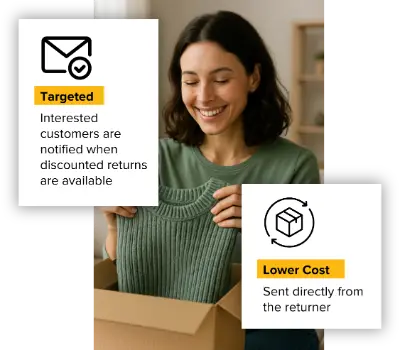
If the item qualifies, a “like new” or “open box” version of that SKU is created and surfaced directly on the same product page as the new item, clearly labeled and modestly discounted. When another customer purchases it, the original returner is issued a shipping label addressed not to a warehouse, but to that next buyer.
Once the item is shipped and delivery is confirmed, refunds, inventory records, and financials update automatically. In some implementations, returners receive small incentives for proper preparation and condition compliance, aligning behavior with outcomes.
Nothing about ecommerce needs to be rebuilt for this to work. Checkout stays the same. Customer support stays the same. Carrier infrastructure stays the same.
Only the routing logic changes.
That distinction is critical. Peer-to-peer returns are not a new stack. They are a different assumption inside the existing stack.
What Peer-to-Peer Removes From the System
The power of peer-to-peer returns comes not from what they add, but from what they remove entirely.
In the warehouse-centric model, every return enters the most expensive environment in retail. It must be received, inspected, reprocessed, re-shelved, or disposed of. Even “good” returns sit in queues, waiting for labor, losing value with each passing day.
Peer-to-peer removes warehouse intake altogether for eligible items. There is no inbound dock. No receiving crew. No inspection backlog. Returned goods never enter the costliest part of the system.
It also removes redundant shipping. Traditional returns require at least two legs: outbound to the customer, inbound back to the warehouse, and often a third leg if the item is resold or liquidated. Peer-to-peer collapses this into a forward-only flow. The return ships once more, directly to demand.
Time disappears as a cost driver. In traditional flows, delay silently destroys value through markdowns and missed selling windows. In peer-to-peer, resale happens immediately. Discounts are intentional and transparent, not reactive and compounding.
Opacity disappears as well. Instead of separating the customer experience, the physical product, and the financial settlement into disconnected timelines, peer-to-peer ties them together. Refunds are faster. Tracking is clearer. Accountability improves.
These are not efficiency gains. They are stage eliminations.
What Peer-to-Peer Adds to the System
Removing stages creates room for new advantages.
Speed is the most obvious. Items move faster. Refunds arrive sooner. Inventory velocity increases. What once took weeks compresses into days.
Recovery becomes the default outcome rather than the exception. Because items are resold before value decays, fewer products fall into liquidation or destruction. More inventory stays productive.
Accountability tightens. Direct point-to-point shipping reduces anonymous handling and shrinks opportunities for fraud. Refunds tied to confirmed delivery make abuse harder to execute quietly.
Perhaps most importantly, incentives realign. In the traditional model, returners are detached from outcomes. The item disappears into “the system.” In peer-to-peer flows, customers understand that condition matters, because another person is receiving the item. This mirrors the behavioral shift seen in ride-sharing and resale platforms, where mutual accountability reduces abuse without heavy policing.
The system becomes more human, not more bureaucratic.
The Economics of Peer-to-Peer Returns
The economic case for peer-to-peer returns follows directly from the structural changes.
In a traditional return, roughly thirty to forty dollars of value are lost for every hundred dollars of returned merchandise once shipping, labor, markdowns, and shrinkage are fully accounted for. These losses are not anomalies; they are systemic.
Peer-to-peer returns remove entire cost layers. There is no warehouse labor. No intake processing. No repeated markdown cycles. Shipping is reduced to a forward leg rather than a round trip.
In practice, this cuts average return losses by more than half for eligible items. Even conservative scenarios show losses dropping from roughly thirty-seven dollars per hundred to closer to fifteen.
This matters because returns losses are not evenly distributed. A large share of total return cost is concentrated in recoverable items that are still perfectly sellable. Peer-to-peer does not need to handle every return to deliver disproportionate value.
In real operations, routing just thirty to sixty percent of returns peer-to-peer captures most of the economic upside. The cost curve bends early.
Warehouses still exist. They simply stop being the default destination for items that never needed to go there in the first place.
Sustainability Is a Consequence, Not a Feature
Peer-to-peer returns were not designed as a sustainability initiative. Sustainability is the byproduct of removing wasteful motion.
Traditional returns multiply emissions by doubling or tripling transportation and packaging. Peer-to-peer removes at least one shipment and one box from the loop.
Across millions of returns, this reduction is material. More importantly, it is measurable. Scope 3 emissions decline in ways that can be reported, not inferred. Waste decreases because more items stay in active use.
In a regulatory environment moving toward disclosure and accountability, this matters more than green marketing ever did.
Fraud Becomes Harder Because the System Is Simpler
Fraud thrives in complexity. Every handoff, delay, and anonymous queue creates an opening.
Peer-to-peer reduces those openings. Fewer touchpoints mean fewer opportunities for swaps, wardrobing, and empty-box scams. Refunds tied to delivery confirmation close timing gaps that fraudsters exploit.
This does not eliminate fraud entirely. No system does. But it shifts the balance. Fraud prevention becomes structural rather than reactive.
Peer-to-Peer Is Not Universal — and That’s the Point
Not every SKU belongs in a peer-to-peer flow. Fragile goods, regulated products, defective items, and certain seasonal edge cases will always require centralized handling.
This is not a weakness. It is the reason the model is credible.
Peer-to-peer returns are a hybrid strategy. They coexist with warehouses. They respect constraints. They focus on the portion of returns where the waste is obvious and the economics are broken.
That restraint is precisely what makes the model scalable.
Core Takeaway
Peer-to-peer returns work because they change where returns go, not how politely they are processed.
Traditional returns turn every return into a cost center.
Peer-to-peer turns a large share of them into margin protectors.
This is not optimization.
It is escape velocity.
PART V — LIMITATIONS, REALITY, AND CREDIBILITY
If peer-to-peer returns were presented as a universal solution, it would immediately fail the credibility test.
Retail logistics does not reward absolutes. Any model that claims to work for every product, every category, and every scenario is either naïve or dishonest. Peer-to-peer returns are neither. They are powerful precisely because they are constrained.
This section exists to draw those boundaries clearly.
Where Peer-to-Peer Does Not Work
Peer-to-peer returns succeed by removing unnecessary stages. But not all returns are unnecessary, and not all products can safely bypass centralized handling.
Some goods simply cannot tolerate a second shipment when packed by consumers. Fragile items—glassware, ceramics, delicate electronics—carry an unacceptable risk of damage if they are forwarded without professional repackaging. In these cases, controlled inspection and standardized outbound protection remain the safer option. Warehouses still earn their keep here.
Regulatory constraints create another hard boundary. Categories such as cosmetics, personal care, medical devices, and consumables face legal and compliance requirements that restrict resale or re-routing. Chain-of-custody matters. Inspection is non-negotiable. Until regulations evolve, peer-to-peer adoption in these verticals will remain limited, regardless of economic appeal.
Then there are damaged or defective items. Not every return is a recoverable asset. Products that arrive broken, incomplete, or non-functional must be verified, diagnosed, and routed into repair, replacement, or claims workflows. Peer-to-peer is not designed to handle failure cases. It is designed to recover value from inventory that is still viable.
Timing matters as well. End-of-season apparel, event-driven merchandise, and trend-sensitive SKUs lose relevance quickly. If downstream demand no longer exists, forwarding offers no advantage. In those scenarios, liquidation, recycling, or disposal may still be the least bad option.
These limits do not undermine the model. They define its operating envelope. A system that knows where to stop is far more trustworthy than one that claims to replace everything.
The Hybrid Reality
No serious retailer should aim for 100% peer-to-peer adoption. And none will achieve it.
In real operations, a meaningful share of returns will always require traditional handling. Items arrive damaged. Categories are restricted. Some returns occur too late in the selling cycle to be recoverable. Expecting otherwise is fantasy.
What matters is where the losses actually live.
Across most ecommerce businesses, the majority of return-related losses are concentrated in a subset of recoverable items: products that are intact, in-demand, and returned for non-defect reasons. These are the returns that bleed margin when routed through warehouses unnecessarily.
In practice, this often represents roughly sixty percent of returns. That is where peer-to-peer delivers its leverage. The remaining forty percent continue through traditional reverse logistics, handled by warehouses that now specialize in exceptions rather than serving as default endpoints.
This hybrid model outperforms both extremes. Pure warehouse-centric systems maximize cost. Pure peer-to-peer systems are operationally fragile. Hybrid models capture the upside without overreach.
Warehouses do not disappear. Their role changes.
Common Objections — and Why They Miss the Point
Most objections to peer-to-peer returns argue against the wrong thing. They assume replacement, when the actual goal is rerouting.
The first objection is customer acceptance. The concern is that shoppers will reject anything that deviates from familiar return flows. But customer behavior has already shifted. Paid returns are now common. “Open box” goods are normalized across major marketplaces. Sustainability awareness is rising. Acceptance hinges not on routing diagrams, but on outcomes: faster refunds, clear labeling, fair pricing, and transparency.
When those conditions are met, customers respond to benefits, not backend mechanics.
Another objection is friction. The assumption is that peer-to-peer adds steps. In reality, traditional returns already impose friction—repackaging, label printing, long refund delays—much of which is invisible only because customers have been conditioned to tolerate it. Peer-to-peer can reduce steps rather than add them, particularly when refunds are faster and outcomes are clearer.
Returns software is often cited as a reason peer-to-peer is unnecessary. This misunderstands the role of software. Returns management systems optimize requests, policies, and visibility. They do not change where inventory flows. Peer-to-peer does not compete with returns software. It complements it by altering the most expensive decision the software currently does not make.
Finally, there is the belief that scale will eventually fix returns. This has already been tested. More warehouses did not reduce per-return cost. Carrier consolidation did not eliminate labor. Volume amplified fraud and markdown risk rather than containing it. Scale improves throughput. It does not remove structural waste.
Peer-to-peer does not promise infinite scale. It changes direction.
Why This Chapter Matters
This section exists to prevent overclaiming. It enables pragmatic adoption. It arms operators, executives, and boards with clear answers to predictable pushback. Most importantly, it reinforces trust with skeptical readers.
Peer-to-peer returns are not universal—and they do not need to be.
They work because they target recoverable inventory, coexist with warehouses, and eliminate entire cost layers where doing so is both safe and rational.
The question is not whether peer-to-peer replaces everything.
It is whether retailers can afford to keep sending clearly recoverable returns back to places they never needed to go.
PART VI — STRATEGY & EXECUTION
What to Do Next — and Why Delay Is the Riskiest Option
By this point, three facts should be unambiguous.
First, returns are structurally broken.
Second, incremental fixes—better software, tighter policies, more scale—have failed to correct that breakage.
Third, peer-to-peer returns represent a credible structural alternative, not because they optimize the existing system, but because they change its direction.
This section answers the only question that matters now: what should leaders actually do?
The Executive Case for Change
Returns are no longer a back-office detail. They sit at the intersection of finance, operations, customer experience, and governance. That makes them a board-level issue, whether they are discussed explicitly or not.
From a finance perspective, returns represent silent margin erosion. They introduce downside risk that is rarely modeled properly, trap working capital in slow-moving inventory, and quietly erase customer acquisition spend. CFOs care less about return rates than about fully loaded cost per return, recovery rates, and predictability of cash flow. Peer-to-peer matters here because it removes entire cost categories rather than attempting to manage them more efficiently. The financial question is no longer whether returns are expensive. It is whether the organization is structurally equipped to make them cheaper.
Operations teams feel the pressure first. Warehouse-centric returns create inbound congestion, labor volatility, exception-heavy workflows, and seasonal bottlenecks that scale poorly precisely when demand spikes. For COOs, peer-to-peer is not about replacing infrastructure. It is about protecting core operations from being overwhelmed by exceptions. By shifting recoverable returns out of centralized intake, peer-to-peer reduces operational drag where it hurts most.
Marketing leaders see returns as part of the brand experience, not a logistics afterthought. Customers increasingly expect fast refunds, transparency, and credible sustainability narratives. Defending outdated returns policies is becoming harder as waste becomes visible and fees normalize across the market. Peer-to-peer supports faster refunds, clearer messaging, and discounted “Like New” options that align price sensitivity with sustainability. For CMOs, the risk is not changing returns. The risk is explaining why nothing has changed.
At the board level, returns intersect with margin durability, regulatory exposure, ESG commitments, and long-term competitiveness. Boards are beginning to ask why return costs are rising faster than revenue, which portions of those costs are actually controllable, and what happens if regulation moves faster than internal systems. Peer-to-peer does not answer every question. But it changes the direction of travel, which is ultimately what boards care about.
No More Return Waste
Help the planet and your profits—our award-winning returns tech reduces landfill waste and recycles value. Real savings, No greenwashing!
Learn About Sustainable ReturnsA Pragmatic Adoption Roadmap
The goal is not disruption for its own sake. The goal is measurable progress with controlled risk.
Any credible adoption begins with baseline measurement. Before changing routing, organizations must understand their current returns P&L. That means breaking down cost per return into shipping, labor, markdowns, fraud, and refund cycle time. It means understanding return rates by SKU and recovery rates of returned inventory. Without this baseline, improvements remain anecdotal and ROI cannot be defended. Measurement is not a finance exercise. It is the foundation of strategic decision-making.
The next step is defining SKU eligibility. Not all products should follow the same return path. High-fit peer-to-peer candidates typically share stable resale value, durable packaging, predictable demand, and lower regulatory constraints. Fragile, regulated, custom, or perishable goods remain in traditional flows. Clear eligibility rules prevent overreach and protect customer trust.
Successful programs start with pilots, not rollouts. A disciplined pilot focuses on a narrow SKU set, limited geography, or specific customer segment. Economics, customer experience, and fraud signals are tracked closely. The goal is evidence, not optimism. Executives expand confidently when pilots produce data rather than anecdotes.
Guardrails must evolve alongside adoption. Peer-to-peer shifts where risk can occur, not whether risk exists. Effective controls include condition proof at initiation, AI-assisted risk scoring for edge cases, refunds tied to confirmed delivery, and incentives for proper preparation. These safeguards should tighten as volume grows, not lag behind it.
Once validated, expansion becomes normalization. SKU coverage increases. Geographic scope widens. Peer-to-peer becomes a default routing decision for eligible items rather than a special program. At scale, it fades into the background as infrastructure, not initiative.
The Future of Returns
Returns will evolve with or without proactive action. The question is who shapes that evolution.
In a best-case scenario, peer-to-peer adoption becomes widespread. More than half of recoverable returns bypass warehouses. Return costs shrink materially. Scope 3 emissions decline measurably. Returns become a loyalty and margin lever rather than a tolerated tax.
In a middle-case scenario—arguably the most likely—hybrid models dominate. Thirty to forty percent of returns route peer-to-peer. Warehouses handle true exceptions. Meaningful savings are achieved without full reinvention. This outcome alone represents a major improvement over today’s status quo.
The worst-case scenario is not failure of peer-to-peer. It is delay. Regulation outpaces innovation. Return restrictions tighten before systems modernize. Costs rise faster than revenue. Brands face compliance risk and margin compression simultaneously. In this world, returns remain a liability—and late adopters pay the highest price.
Delay is not neutral. Every year locks in avoidable cost, increases regulatory exposure, normalizes inefficient behavior, and weakens competitive position. Structural problems do not self-correct.
Core Takeaway
Returns are shifting from a tolerated cost to a strategic capability.
The question facing retailers is no longer, “Can we afford to change how returns work?”
It is, “Can we afford not to?”
Peer-to-peer returns are not a trend. They are a structural response to a system that no longer fits modern commerce. The companies that act early will shape the standard. Those that wait will inherit it.
PART VII — CONCLUSION
Returns Don’t Need to Go Back. They Need to Go Forward.
For more than a decade, ecommerce treated returns as a necessary inconvenience—something to be absorbed, optimized around, or hidden behind policy language. Even as return volumes exploded, margins thinned, fraud accelerated, and sustainability pressure mounted, the underlying mindset stayed intact. Returns were framed as an execution problem.
This work shows that framing was wrong.
Returns did not break because retailers executed poorly. They broke because the system they were built on no longer fits how commerce actually operates.
The original design assumptions made sense in another era: lower volumes, slower decision-making, cheaper labor, invisible waste, and centralized infrastructure that could quietly absorb exceptions. Modern ecommerce operates under none of those conditions. Yet the industry responded by layering software on top of warehouses, expanding physical networks, consolidating carriers, tightening policies, and shifting risk onto customers. Each response bought time. None changed direction.
What actually changes outcomes is not better tooling or stricter rules. It is changing the routing logic itself.
Peer-to-peer returns matter because they challenge the most fundamental assumption in reverse logistics: that goods must travel backward before they can move forward again. By rerouting eligible returns directly to the next buyer, entire cost layers disappear. Inventory velocity improves. Fraud opportunities shrink. Waste declines. Sustainability becomes measurable instead of rhetorical.
This is not optimization. It is structural realignment.
The shift toward peer-to-peer returns is not happening in isolation. It is emerging at the intersection of forces that can no longer be ignored. Platforms are making returns visible and punitive. Retailers are normalizing return fees. Carriers are consolidating without reducing cost. Regulators are targeting waste and emissions. Consumers are recalibrating expectations. Boards are asking harder questions.
Taken together, these forces mean the old model is not merely inefficient—it is unstable. Stability will not return by doing more of the same.
Peer-to-peer returns are not a feature, a tool, or a policy tweak. They represent a different way of thinking about returns: as forward-moving transactions, as recoverable value flows, as moments of shared accountability, and as strategic infrastructure rather than operational cleanup. They coexist with warehouses. They respect constraints. They do not pretend to solve everything.
That restraint is their strength.
Every retailer now faces the same decision, whether explicitly or by default. Continue absorbing return losses and hope incremental fixes keep pace—or redesign returns as a system that reflects how commerce actually works today. Doing nothing is not neutral. It is a decision to let costs, fraud, and waste compound.
Returns are no longer a back-office problem. They are a test of whether ecommerce infrastructure can evolve without breaking under its own weight.
Peer-to-peer returns do not promise perfection. They offer something more valuable: a credible path out of a system that no longer works.
Returns don’t need to go back.
They need to go forward.
Written By:

Manish Chowdhary
Manish Chowdhary is the founder and CEO of Cahoot, the most comprehensive post-purchase suite for ecommerce brands. A serial entrepreneur and industry thought leader, Manish has decades of experience building technologies that simplify ecommerce logistics—from order fulfillment to returns. His insights help brands stay ahead of market shifts and operational challenges.

Turn Returns Into New Revenue
Related Articles
Fast Delivery Isn’t the Hard Part – Inventory Decisions Are
Fast delivery is no longer a differentiator in ecommerce, it is an expectation.
Moving from Amazon 1P to 3P: What It Actually Takes to Succeed
The decision to move from Amazon Vendor Central (1P) to Seller Central (3P) usually follows months of frustration with pricing control loss, erratic purchase orders, and margin com...
Why Amazon 1P Feels Out of Control — and Why That’s Not Your Fault
When your Amazon Vendor Central account starts generating problems faster than your team can fix them, the instinct is to treat each issue as a separate operational failure.