
Warehouse Legal Liability Insurance: Does Your 3PL Actually Have It?

Last updated on November 10, 2026
In this article
 11 minutes
- Your 3PL may not carry the insurance you assumed it had
- Being owed money does not mean you will recover it
- Ask about coverage for customer goods in the warehouse’s custody
- Check whether the applicable limit fits the inventory at risk
- Natural disasters can remain your responsibility
- Get the documents before committing inventory
- Frequently Asked Questions
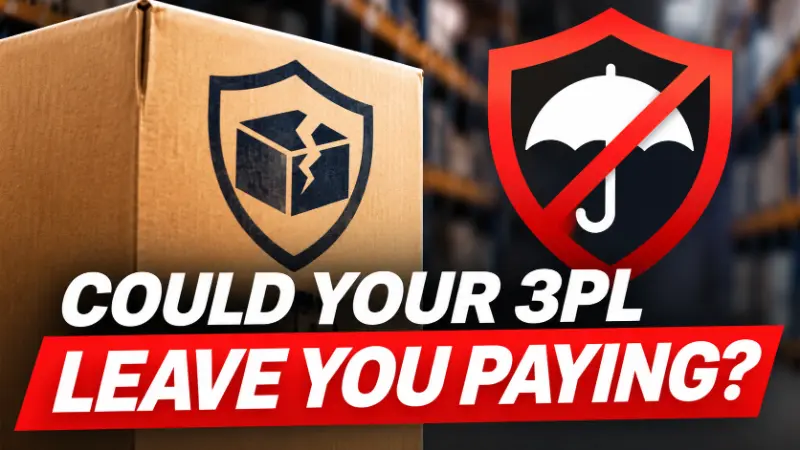
Before you send a warehouse your inventory, ask for proof of warehouse legal liability insurance. You may be surprised by the answer.
In Cahoot’s experience evaluating fulfillment warehouse partners, missing coverage is a recurring problem. If a warehouse causes a loss but has no relevant insurance and cannot afford to reimburse you, you could be funding replacement inventory while pursuing payment. A contract that makes the warehouse responsible does not put money in your bank account.
This article covers that gap, plus the separate risks that stay with you even when your warehouse is properly insured.
Your 3PL may not carry the insurance you assumed it had
Most sellers assume a warehouse that holds their goods also carries insurance for them. It is a reasonable assumption, and it is the one worth testing. Our experience evaluating fulfillment warehouse partners says you should not make it. A warehouse handling customer inventory does not automatically carry coverage for that inventory.
Warehouse legal liability insurance is the coverage built for this situation. It responds to a warehouse operator’s legal responsibility for customer goods in its care. Product features and optional extensions vary by insurer, so the actual policy matters more than the label.
When you evaluate a warehouse or compare warehousing service providers, ask this question in writing:
Do you carry warehouse legal liability insurance covering third-party goods in your care, custody, and control, and can you provide current proof of that coverage?
Two responsibilities follow from the answer. First, you verify the warehouse’s coverage before committing inventory. Second, you arrange your own protection for the risks the warehouse does not bear. The rest of this article covers both.
Being owed money does not mean you will recover it
Uninsured does not mean legally unaccountable. A warehouse that causes a loss may owe you for it. The difficulty is paying. Without relevant insurance, reimbursement depends on what the operator can fund from its own resources, and a valid claim can still sit unpaid while your replacement purchase order comes due.
The legal duty is real. The model Uniform Commercial Code provision on warehouse liability describes a duty of reasonable care and allows certain contractual limits on liability. It also contemplates customers requesting higher liability, possibly at higher rates. State enactments and applicable law control, so treat the model text as a framework, not identical law everywhere.
A right to claim is not the same as a funded claim. The illustration below separates the two.
Illustration only, not a customer case or claims forecast. Assume an inventory acquisition cost of $40,000.
| Scenario | What the seller needs to understand |
|---|---|
| Warehouse negligence causes the loss. Assume the warehouse owes $40,000 under the applicable agreement and law, has no relevant WLL coverage, and cannot fund reimbursement. | The seller can pursue the amount owed but may have to fund replacement goods while recovery remains uncertain. The contract does not itself supply the money. Seller coverage or other resources may change the outcome. |
| An unavoidable natural disaster causes the loss. Assume the warehouse met its duty of care and has no contractual responsibility for that event. | There may be no warehouse liability claim to fund. The seller needs its own policy that actually covers the relevant goods, storage site, and peril. A generic assurance of inventory insurance is insufficient. |
The example is about payment capacity and responsibility. It does not predict how any claim would end.
Ask about coverage for customer goods in the warehouse’s custody
The wording of the question matters, because “we are fully insured” can describe many things that have nothing to do with your inventory.
Three terms carry the weight:
- Third-party goods are goods the warehouse does not own. Your inventory is third-party goods from the warehouse’s point of view.
- Care, custody, and control describes goods the warehouse has taken into its possession and is responsible for handling and storing.
- Warehouse legal liability is the operator’s legal responsibility for loss or damage to those goods, which the coverage is designed to fund.
So the question stays the same:
Do you carry warehouse legal liability insurance covering third-party goods in your care, custody, and control, and can you provide current proof of that coverage?
Follow it with a request to understand the applicable limits and whether they fit the maximum inventory value you will have exposed at that warehouse, including peaks, and how those limits align with your 3PL fulfillment cost structure. Ask for evidence of coverage rather than a verbal assurance. If the answer is vague, evasive, or limited to an unspecified statement about insurance, treat that as an answer.
Check whether the applicable limit fits the inventory at risk
Coverage that exists can still be too small, too narrow, or shared in ways you did not expect. There is no universal dollar minimum that fits every seller. How much coverage makes sense depends on several factors, including inventory value and risk profile, as well as where and how the value climbs. As you choose the right 3PL company, have your broker check these points against your own exposure:
- Covered goods: Does the coverage clearly apply to the covered property and the customer goods you store there?
- Insured entity: Is the operator you contract with the party named in the coverage?
- Sites and operations: Does it apply to the specific warehouse location and the activities performed there, including overflow or subcontracted space?
- Limits: Is the limit per location, per event, or shared across the operator’s customers? Do not assume the headline limit is reserved for your goods, especially if warehouse receipts or contracts cap liability.
- Deductibles and exclusions: What is left on you before payment, and which causes of loss are carved out? Many policies can exclude climate-related losses such as flood or extreme weather, so check that expressly.
- Valuation: How is the value of lost goods measured?
- Peak values: Does the limit still fit the most inventory you will have on the floor during peak season?
Higher-value inventory and higher-risk goods can also increase premiums or 3PL insurance-related costs.
The contract matters as well. A higher policy limit does not automatically increase what the warehouse owes you, because the agreement can cap liability. Amwins illustrates the problem in its explanation of warehouse legal liability with a hypothetical: a five-pound box of microchips worth $50,000 under a per-pound cap of $0.50 produces liability of $2.50. That is an illustration, not a real claim, but it shows how a contract can undercut a strong policy.
Review liability and reimbursement terms next to the rest of the service obligations. If you are weighing a transition away from self-storage, guidance on shifting from an in-house warehouse to a 3PL can be a useful complement alongside Cahoot’s 3PL contract guide for that review.
Natural disasters can remain your responsibility
The warehouse’s coverage is aimed at what the warehouse is responsible for. Warehouse operators are commonly not responsible for unavoidable natural disasters outside their control, and catastrophic perils may be excluded from policies. Exclusions can also extend to acts of God, war-related losses, and non-fortuitous causes such as wear and tear or inherent vice. When a flood or earthquake damages your inventory and the warehouse did nothing wrong, there may be no liability claim to fund.
That risk usually sits with you. You will generally need your own first-party inventory or property arrangement for goods stored at third-party locations, and it has to actually cover the storage site and the peril. For sensitive categories such as food products, the right food grade 3PL warehouse needs both compliance and appropriate coverage. Ordinary inventory insurance does not necessarily include flood or earthquake. Ask whether theft or other damage arising from excluded causes is also outside the warehouse’s insurance policy. Ask your broker to check those perils expressly, along with any other disasters relevant to the warehouse’s region.
Keep one qualification in mind. A warehouse’s negligent contribution to a loss, or broader responsibility it accepted in the contract, can change the result. Nature does not excuse negligence, and the facts of the loss decide which coverage responds. Some policies may also help pay cleanup costs for pollutants after a covered loss, depending on policy language.
Get the documents before committing inventory
Verification should happen before the first pallet ships, not after a loss. A short checklist keeps it practical:
- Current evidence: Ask for current proof of warehouse legal liability coverage for customer goods, not an unspecified insurance statement.
- Policy wording and endorsements: Request the relevant wording so your broker can check the policy language for insured operator, sites, activities, employee-theft exclusions, mysterious disappearance, and other limits that could affect theft claims.
- Adequacy review: Have your broker compare limits, valuation, deductibles, exclusions, and any shared limits with your maximum inventory exposure, including peaks.
- Agreement check: Have your broker compare contracts, warehouse receipts, and other documentation against the policy so contractual liability or contractual obligations do not create uninsured gaps.
- Your own coverage: Use your broker to arrange suitable first-party protection for remaining risks at third-party storage sites, including flood and earthquake if relevant.
A policy may also cover legal defense costs if a claim is made against the warehouse operator.
Certificates deserve one caution. A certificate of insurance summarizes coverage and does not expand the policy. The New York Department of Financial Services made this point in a 2004 regulatory opinion stating that a certificate creates no additional rights beyond the policy. That opinion is a New York regulatory view, not nationwide legal advice, but the practical lesson holds: keep current evidence, and review the full insurance coverage with the provider and your broker rather than relying on a certificate alone.
If you are comparing providers, Cahoot’s 3PL RFP template can structure the comparison, and guidance on evaluating Amazon-focused prep and logistics services can help frame questions about how each provider handles risk. It does not already include this checklist, so add these inventory-protection questions to it yourself.
Before your next inventory shipment goes out, send the question above to every warehouse on your list. Do not move inventory until you have the answer in writing.
Frequently Asked Questions
What insurance should I ask my 3PL to carry?
Ask for warehouse legal liability insurance covering third-party goods in the warehouse’s care, custody, and control, with current proof. It is designed for a warehouse operator that helps store property for a fee and may respond when the operator is legally liable for customers goods in its care, custody, and control. For growing brands, especially those just starting with outsourced fulfillment, this fits into the broader question of choosing the best 3PL for small business. Confirm the insured entity, sites, and terms instead of accepting a general statement of insurance.
What happens if my warehouse is liable but has no insurance?
You still hold a legal claim, but payment depends on the warehouse’s ability to fund it. You may carry replacement costs while pursuing recovery. A contract assigning responsibility does not supply cash. Your own coverage or other resources may change the outcome.
How much warehouse legal liability coverage is enough?
There is no universal amount. Compare the limit with the maximum inventory value exposed at the warehouse, including seasonal peaks, and base it on factors such as the value and risk profile of the goods, the site, and any liability caps in warehouse receipts or contracts; then check valuation, deductibles, exclusions, shared limits, and contract caps. Have your broker review that exposure rather than relying on a headline number. If you run a Shopify brand, fold this into your process for choosing the best 3PL for your Shopify store. Higher-value inventory often leads to higher premiums, so review limits with your broker.
Does warehouse legal liability insurance cover natural disasters?
Do not assume it does. Warehouses are commonly not responsible for unavoidable disasters, so there may be no liability to fund, and many policies may also exclude acts of God, war-related losses, wear and tear, and inherent vice, so those causes should be checked specifically. You usually need your own coverage for goods at third-party sites and should check flood and earthquake expressly. For Amazon sellers comparing top Amazon 3PL shipping companies, include questions about how each provider insures or limits liability for stored FBA or FBM inventory. A warehouse’s negligent contribution can change the result.
Written By:

Rinaldi Juwono
Rinaldi Juwono leads content and SEO strategy at Cahoot, crafting data-driven insights that help ecommerce brands navigate logistics challenges. He works closely with the product, sales, and operations teams to translate Cahoot’s innovations into actionable strategies merchants can use to grow smarter and leaner.

Turn Returns Into New Revenue
Related Articles
Chewy Dropship Fulfillment: What to Ask Your 3PL and What to Verify
To evaluate a 3PL for Chewy dropship fulfillment, ask it to prove it can meet your current supplier requirements: written dispatch deadlines, DSCO data flows, labels on the retaile...
Amazon FBM Prepaid Return Labels What Changes December 18 and What Sellers Should Do
Starting December 18, 2026, covered US seller-fulfilled Amazon returns require a prepaid return label, and heavy and bulky items are temporarily excluded, according to a seller not...

Which SKUs Should Not Be in Seller Fulfilled Prime?
Seller Fulfilled Prime SKUs are the individual products an Amazon seller chooses for SFP based on whether each one can protect both the Prime promise and the seller’s margin.