
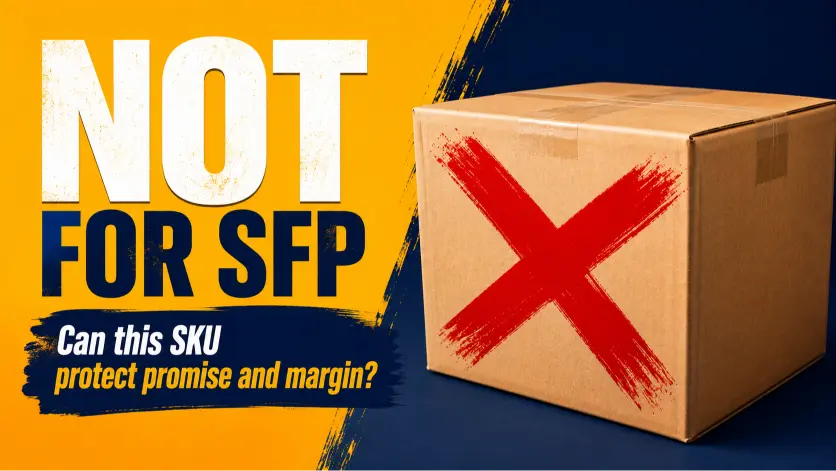
Which SKUs Should Not Be in Seller Fulfilled Prime?

Last updated on July 10, 2026
In this article
 16 minutes
- Seller Fulfilled Prime Is a SKU-Level Decision
- Keep SKUs Out of SFP When They Cannot Ship Economically Through Parcel
- Avoid SKUs Where Premium Shipping Can Wipe Out the Margin
- Be Careful With Low-Volume SKUs That Make Every Late Package Matter
- Exclude SKUs Whose Size Tier Requires More Coverage Than Your Network Can Provide
- Do Not Choose SKUs Just Because FBA Looks Expensive
- Picking the Right SKU Is Only Half the Battle
- Final Rule: Put Only Resilient SKUs Into SFP
- Frequently Asked Questions
Seller Fulfilled Prime SKUs are the individual products an Amazon seller chooses for SFP based on whether each one can protect both the Prime promise and the seller’s margin. The SKUs that should not be in Seller Fulfilled Prime are the ones that cannot do both. That usually includes SKUs that are too large for parcel shipping, too low-margin to absorb premium shipping, too low-volume to survive delivery exceptions, or too geographically demanding for the seller’s fulfillment network.
That is the mistake many Amazon sellers and e-commerce operators make when they evaluate SFP. They look at a high FBA fee, a product with decent demand, or the potential upside of the Prime badge and assume the SKU belongs in Seller Fulfilled Prime. Sometimes that is true. But sometimes the SKU that looks attractive on paper becomes the one that burns margin, creates late deliveries, or puts SFP metrics at risk.
Seller Fulfilled Prime is not a catalog-wide strategy. It is a SKU-level operating decision for sellers managing SKU selection, fulfillment operations, and margin control. The goal is not to put every possible product into SFP. The goal is to identify the SKUs that can repeatedly hit the Prime delivery promise at a sustainable cost. That means evaluating shipping feasibility, margin resilience, order volume, fulfillment footprint, and operational readiness before a SKU is enrolled. This article focuses on how to decide which SKUs should and should not be included in Seller Fulfilled Prime so you can protect Prime status, avoid performance failures, and keep SFP profitable.
Seller Fulfilled Prime Is a SKU-Level Decision
A strong Seller Fulfilled Prime strategy usually starts with exclusion, not inclusion. Before asking which products should go into Seller Fulfilled Prime (SFP), sellers should ask which products clearly should not, since seller fulfilled prime skus display the Prime badge while remaining seller fulfilled.
That filter matters because every SKU behaves differently. Two products can have the same sales velocity and completely different fulfillment profiles. One may fit neatly into a standard parcel network with predictable ground coverage. Another may require oversized packaging, special handling, premium shipping, or inventory placement across more fulfillment nodes than the seller actually has.
A SKU should not be selected for SFP only because:
- FBA fees look expensive
- The Prime badge may improve conversion
- The seller wants more inventory control
- A warehouse or 3PL says it offers two-day shipping
- The SKU sells well through another fulfillment model
Those may be reasons to investigate SFP. They are not enough to prove that SFP will work. For third party sellers, prime offers can make listings prime eligible, and seller fulfilled prime offers often have greater visibility and sales potential than standard FBM items. Each SKU still has to pass the operational test: Can this product hit the delivery promise without relying on constant exceptions, expensive upgrades, or manual heroics?
Keep SKUs Out of SFP When They Cannot Ship Economically Through Parcel
The clearest example is an extra-large product that looks expensive in FBA but does not actually fit normal parcel shipping.
Take a projector screen that is 117 inches long. At first glance, this can look like a perfect Seller Fulfilled Prime candidate. If FBA is charging more than $50 per order to fulfill the item, moving it out of FBA may seem like an obvious way to save money.
But the shipping reality changes the calculation. UPS lists a maximum package length of 108 inches, and FedEx Ground lists packages up to 108 inches in length and 165 inches in length plus girth. A 117-inch projector screen exceeds that normal parcel length limit.
That means the seller is no longer comparing FBA against ordinary parcel shipping. The real comparison is FBA versus freight, LTL, special handling, limited carrier options, or some other non-parcel shipping setup. Unless the seller has very strong LTL rates and a fulfillment process built to ship freight on every order, SFP may not be a good idea for that SKU.
This is why high FBA fees do not automatically make a product a good SFP candidate. A $50-plus FBA fee may be painful, but it can still be cheaper and more predictable than trying to force a non-parcel item into a Prime delivery promise.
For oversized and extra-large products, the first question should not be “Is FBA expensive?” It should be “Can we ship this product through a reliable carrier method, at the required speed, without destroying the margin?”
If the answer is no, that SKU should probably stay out of Seller Fulfilled Prime.
Avoid SKUs Where Premium Shipping Can Wipe Out the Margin
Some SKUs are technically shippable through parcel but still too fragile for Seller Fulfilled Prime economics.
The issue is not the average order. The issue is the exception order. A SKU may look profitable when most orders ship by ground, but SFP does not only test the easy orders. It also exposes the seller to orders that require air service, faster shipping, longer zones, or Premium Shipping options through less efficient fulfillment nodes.
A practical stress test is to model normal ground shipping around $18, then ask what happens if 2% of orders require air service at $23 to $47. Then stress-test the same SKU at 5% and 10% premium-shipping exposure.
If the SKU still works under those scenarios, it may deserve further evaluation. If the SKU only works when every order ships by cheap ground, it is too fragile for SFP.
That is especially true for low-margin products. A few premium shipments can erase the profit from many normal orders, especially because prime customers expect fast and free shipping, and when those exception shipments stack up, SFP sellers can face high shipping costs compared to FBA, with high shipping fees quickly pushing up total shipping costs. Sellers who only compare FBA fees against average ground rates may miss the real risk: Seller Fulfilled Prime economics are shaped by the expensive tail of orders, not just the average shipment.
Before enrolling a SKU, sellers should model the downside cases. What happens when the order has to go farther than expected? What happens when the nearest fulfillment node is out of stock? What happens when the delivery promise requires air? What happens when carrier pricing changes?
If the SKU cannot survive those scenarios, it should not be in SFP yet. For a deeper look at the margin side of this decision, see Cahoot’s guide to Seller Fulfilled Prime economics and profit math.
Be Careful With Low-Volume SKUs That Make Every Late Package Matter
Low-volume SKUs can create a different kind of SFP risk: metric volatility.
A SKU producing 25 SFP orders per week gives the seller very little room for delivery exceptions. One late delivery may be survivable. Two delayed packages can quickly become a metrics problem, even if the warehouse shipped the orders correctly.
That is what makes low-volume SFP selection tricky. The SKU may be operationally simple. It may fit parcel shipping. It may even have decent margin. But if the order volume is too low, every carrier issue carries more statistical weight.
This does not mean low-volume SKUs can never work in Seller Fulfilled Prime. It means sellers should be careful about using them as trial SKUs or relying on them to prove SFP performance. A small number of exceptions can make performance look worse than the underlying operation really is.
The key question is whether the SKU has enough volume to absorb normal carrier noise. No fulfillment operation can prevent every late scan, weather delay, missed pickup, or carrier issue. If one or two events can materially hurt the seller’s SFP metrics, the SKU may not be resilient enough for the program, and visible delivery misses can also hurt customer satisfaction and customer trust.
This is also where carrier performance matters. Sellers should understand how carrier on-time delivery affects Seller Fulfilled Prime metrics, but the SKU-selection takeaway is simple: avoid SFP candidates where a tiny number of delayed packages can create an outsized performance problem.
Exclude SKUs Whose Size Tier Requires More Coverage Than Your Network Can Provide
Standard-size, oversize, and extra-large SKUs are not operationally equivalent in Seller Fulfilled Prime. Size tier affects shipping cost, delivery feasibility, carrier options, inventory placement, and how much fulfillment coverage the seller may need.
This becomes even more important as Amazon tightens SFP speed requirements. Beginning July 6, 2026, the delivery-speed bar increases across key size tiers. Sellers must enable Prime shipping in their shipping template for configured delivery regions, including one-day and two-day delivery commitments, and still ship Prime orders within 2 days to qualify. Sellers should not treat that as a generic program update. They should treat it as a SKU-selection filter.
A standard-size SKU with strong ground coverage from a few nodes may be a reasonable SFP candidate. An oversize or extra-large SKU may require a much broader fulfillment footprint to offer premium shipping options across the configured delivery regions and hit the same customer promise economically. The product may not be wrong for SFP in theory, but it may be wrong for the seller’s current network.
That is where some sellers get caught. A two-warehouse setup may look sufficient on a spreadsheet, especially if the seller is only thinking about average delivery distance. But for serious Seller Fulfilled Prime coverage, some sellers may need four or more fulfillment nodes. Strong one-day coverage can require six.
The point is not that every seller needs six warehouses. The point is that the SKU’s physical profile and the seller’s fulfillment footprint have to match. If the SKU requires geographic coverage the seller does not have, or coverage that does not align with its configured delivery regions, SFP can push the operation into expensive shipping upgrades, missed promises, or both, and the Prime shipping benefits depend on matching the SKU’s size tier to coverage that supports fast and free delivery economically.
For sellers evaluating outside help, this is also why “two-day shipping” is not enough. A provider may offer fast shipping in a general sense, but Seller Fulfilled Prime requires performance against the seller’s specific SKUs, size tiers, customer geography, cutoff times, inventory placement, and margin profile. Cahoot’s guide to choosing a Seller Fulfilled Prime 3PL goes deeper on that provider-selection problem.
Do Not Choose SKUs Just Because FBA Looks Expensive
High FBA fees are a reason to investigate Seller Fulfilled Prime, not proof that SFP is better, especially since SFP listings can increase sales by over 50% on average in some cases and the economics deserve investigation rather than assumptions.
This is one of the most important SKU-selection lessons. FBA may look expensive because Amazon is absorbing complexity that the seller would otherwise have to handle. In some cases, seller fulfilled prime worth comes from better margins on certain SKUs by avoiding FBA storage fees and, at times, Amazon storage and removal fees. That complexity may come from product size, dimensional weight, delivery geography, packaging, handling requirements, or the cost of meeting a fast delivery promise.
The 117-inch projector screen example makes this clear. A $50-plus FBA fee may look like the problem. But once the seller realizes the item exceeds the normal 108-inch parcel length limit, the FBA fee starts to look different. It may be reflecting the cost and complexity of fulfilling that item at scale.
A SKU with high FBA fees may still be a bad SFP candidate if:
- It exceeds parcel length or weight limits
- It requires LTL, freight, or special handling
- It needs frequent air shipping to hit the Prime promise
- It has too little margin to absorb exceptions
- It has too little volume to absorb delivery volatility
- It requires more fulfillment coverage than the seller currently has
The better approach is to treat FBA fees as a signal, not a conclusion. If the fee is high, investigate why. If the SKU can be shipped faster and cheaper through a strong SFP network, and control across broader sales channels matters to the business, it may be worth testing. If the SKU only looks good before freight, premium shipping, or metric risk is included, keep it out.
Picking the Right SKU Is Only Half the Battle
Even after sellers exclude poor SFP candidates, SKU selection is still only the first filter. A SKU can be a good SFP candidate on paper and still fail during the trial period if the fulfillment operation is not ready for Seller Fulfilled Prime’s strict readiness standards. Sellers also need an amazon professional seller account and must pre qualify before entering the trial.
Inventory has to be received, counted, synced, and available in the right fulfillment nodes. Cutoff times and routing logic have to prevent avoidable premium-shipping decisions. Carrier on-time delivery has to protect SFP metrics even when the warehouse ships on time. Weekend operations and same-day fulfillment discipline still have to work consistently, and they are often necessary to protect timely deliveries during the 30-day trial period.
The same caution applies to fulfillment partners. A 3PL saying it offers “two-day shipping” does not automatically mean it can protect Seller Fulfilled Prime performance for the seller’s exact SKUs, customer geography, cutoff times, and margin profile.
These are not SKU-selection failures. They are readiness issues. But they still matter because the wrong operating model can make even a good SFP SKU perform badly.
Before enrolling, sellers also need a plan in seller central to identify and fulfill prime trial orders at trial volume, including weekend coverage and reliable cutoff control. Teams should look for prime trial orders there and process them correctly before cutoff. The 30-day trial requires at least 100 Prime packages with a 99% on-time shipment rate and a cancellation rate below 0.5%, and sellers can attempt it up to three times per year. Sellers should also monitor prime order volume so the operation can handle trial demand consistently. It also requires a 93.5% on-time delivery rate, a valid tracking rate above 95%, strong valid tracking, and use of amazon buy shipping services on at least 98.5% of orders so teams can buy shipping through Amazon and generate compliant shipping labels consistently. Shipping settings automation can help protect delivery promises and performance during the trial.
Once you have excluded the SKUs that clearly do not belong in Seller Fulfilled Prime, use Cahoot’s Seller Fulfilled Prime trial checklist to evaluate whether your operation is actually ready to support the SKUs that remain. The checklist covers the broader readiness questions that should come after SKU filtering, including inventory readiness, delivery promises, operational setup, and trial preparation.
Final Rule: Put Only Resilient SKUs Into SFP
A good SFP SKU is not simply a SKU with high FBA fees or high Prime upside. It is a SKU that can repeatedly hit the promise inside seller fulfilled prime sfp, let third party sellers ship prime orders directly from their own warehouse while keeping listings prime eligible, protect margin after exceptions, and fit the seller’s fulfillment footprint without constant heroics.
That is the standard sellers should use before enrolling products in Seller Fulfilled Prime. If a SKU cannot ship economically through parcel, cannot survive prime shipping exposure, has too little volume to absorb normal delivery exceptions while still meeting the promised delivery date, or requires more network coverage than the seller has, it should probably stay out of SFP, because prime eligibility depends on keeping prime offers active through resilient execution, and sellers may need to re enable prime offers after fixing performance issues if Amazon disables them.
The strongest SFP candidates are resilient. They fit the carrier network. They have enough margin to survive exceptions. They generate enough volume to make performance measurable. They match the seller’s fulfillment footprint. And they can be supported by an operating model built for Prime-level execution and ongoing Prime status.
Cahoot helps sellers evaluate and operate Seller Fulfilled Prime with distributed fulfillment, same-day order processing, and the operational discipline required to protect delivery promises. But SFP still starts with the right SKU decision. The best fulfillment network cannot make every product a good SFP candidate, though seller fulfilled prime items can create stronger visibility than standard merchant-fulfilled listings when performance is maintained.
Frequently Asked Questions
Should every SKU be enrolled in Seller Fulfilled Prime?
No. Seller Fulfilled Prime should be evaluated SKU by SKU. Unlike standard FBM, seller fulfilled prime offers are prime items that remain seller fulfilled rather than automatically Prime eligible like FBA listings. The right SFP candidates are products that can protect the Prime promise and preserve margin after shipping exceptions.
Are large and bulky products good candidates for Seller Fulfilled Prime?
Sometimes, but not automatically. Large products may have high FBA fees, which can make SFP worth investigating. But if the product exceeds parcel limits, requires freight, or needs expensive special handling, SFP may not be economical.
Why can high FBA fees still be cheaper than Seller Fulfilled Prime?
High FBA fees may reflect real fulfillment complexity. If moving the SKU to SFP requires premium shipping, freight, broader inventory placement, special handling, or a more complex operating model, the total SFP cost can exceed the FBA fee.
Are low-volume SKUs risky for Seller Fulfilled Prime?
Yes. Low-volume SKUs can be statistically fragile because one or two late deliveries can have an outsized impact on performance metrics. A SKU with only 25 SFP orders per week may not have much room for normal carrier exceptions.
What should I check after choosing potential SFP SKUs?
After choosing candidate SKUs, sellers should check inventory readiness, fulfillment-node coverage, cutoff times, carrier performance, weekend operations, and whether their internal team or fulfillment partner can fulfill orders directly from their own warehouse or node network, since Seller Fulfilled Prime allows shipping directly from sellers’ warehouses while still protecting the Prime promise through the merchant fulfilled network and approved shipping services. Amazon customer service handles customer service inquiries for Prime items even when sellers fulfill them. Sellers should also plan for general return expectations buyers will have, including return shipping labels and the configured return shipping location for seller-fulfilled returns, while noting that the return shipping label sellers must account for can affect costs and workflows, including cases where prime items past the normal window may still be accepted. SKU selection should come before a full SFP readiness review, not replace it.
Written By:

Rinaldi Juwono
Rinaldi Juwono leads content and SEO strategy at Cahoot, crafting data-driven insights that help ecommerce brands navigate logistics challenges. He works closely with the product, sales, and operations teams to translate Cahoot’s innovations into actionable strategies merchants can use to grow smarter and leaner.

Turn Returns Into New Revenue
Related Articles

Why Cross-Border DTC Brands Are Moving Fulfillment Inside the US
Cross-border ecommerce fulfillment is the process of shipping ecommerce orders across national borders—often from warehouses outside the United States to U.
Crafting a Return Policy that Drives Customer Loyalty and Reduces Returns
Let’s talk about ecommerce returns policies.

Cheapest Shipping from USA to UK: What It Really Costs
Shipping from the USA to the UK is one of the most common international routes for ecommerce brands, and it is also one of the most misunderstood from a cost perspective.