
What Is an APO/FPO Address? How Military Shipping Works

Last updated on June 15, 2026
In this article
 16 minutes
- Introduction to Military Mail
- How Military Mail Actually Works
- Address Format: What Is Required and Why It Matters
- Carrier Limitations: USPS Only
- Item Restrictions by Destination
- Regional Shipping Considerations
- Diplomatic Shipping
- Customs Forms and Documentation
- Common Ecommerce Mistakes With APO/FPO Orders
- Conclusion and Additional Resources
- Frequently Asked Questions
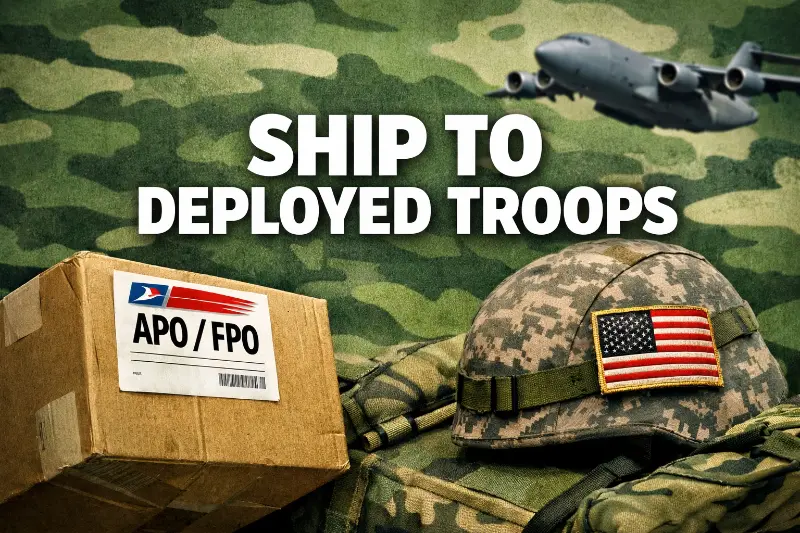
An APO/FPO address is a specialized mailing designation used by the U.S. military to deliver mail and packages to service members stationed at bases, ships, and installations around the world. APO stands for Army Post Office, used by Army and Air Force personnel. FPO stands for Fleet Post Office, used by Navy, Marine Corps, and Coast Guard personnel. A third designation, DPO (Diplomatic Post Office), covers U.S. embassy and diplomatic staff overseas.
APO and FPO are abbreviations used by the U.S. Military Postal Service to deliver mail and packages to military personnel overseas.
For ecommerce brands, these addresses appear in checkout flows more often than most operators expect. Most ecommerce businesses receive orders from customers with an APO or FPO shipping address. The U.S. maintains more than 800 military installations across more than 70 countries, and the service members and families at those locations shop online like everyone else. The difference is that shipping to them involves constraints most fulfillment systems were not built to handle out of the box. When those constraints are not accounted for, packages fail to deliver, customers are left frustrated, and the brand absorbs the operational cost of the breakdown. To avoid these issues, it is essential to comply with USPS rules and use the correct abbreviations and address formatting for APO/FPO addresses.
Introduction to Military Mail
Military mail, often referred to as armed forces mail, is a dedicated postal service that ensures military personnel and their families can reliably send and receive mail no matter where they are stationed in the world. The United States Postal Service (USPS) is the backbone of this system, connecting military bases, ships, and installations across the globe with the same efficiency as domestic mail. For ecommerce businesses, understanding military mail is crucial, as service members stationed overseas shop online just like any other customer.
There are three main types of military addresses: Army Post Office (APO) for Army and Air Force installations, Fleet Post Office (FPO) for Navy and Marine Corps units, and Diplomatic Post Office (DPO) for U.S. diplomatic staff abroad. Each address type is designed to route mail through the appropriate military or diplomatic postal service center, ensuring packages reach their intended recipients efficiently. By leveraging the USPS and these specialized address formats, military mail bridges the gap between the home front and armed forces personnel stationed around the world, making it possible for ecommerce businesses and individuals to support those serving far from home.
How Military Mail Actually Works
The defining feature of APO/FPO addresses is that they are treated as domestic destinations by the United States Postal Service, even when the physical location is overseas. This means postage is calculated at domestic rates regardless of whether the recipient is in Germany, Japan, or the Middle East. APO and FPO addresses enable the USPS to deliver mail to overseas military members through a network of military and diplomatic mail hubs.
Behind that domestic treatment is a logistics chain that is more complex than a standard USPS shipment. When a package is dropped off or picked up for an APO/FPO destination, USPS routes it through one of several military mail processing hubs, typically based in Florida, New York, or California. From those hubs, mail is loaded onto international commercial or military cargo aircraft and flown to the destination region. The Military Postal Service Agency then takes over, transporting packages to the military post office (MPO) on the base. The local MPO sorts and distributes mail to the individual service member’s unit, functioning much like a domestic post office at the final leg. The final destination is the military post office on base, where mail is sorted and delivered to the service member.
This handoff from USPS to the military postal system is the point where the domestic analogy breaks down operationally. Transit times are longer and less predictable than standard domestic delivery. Delivery windows of 7 to 21 business days are typical for Priority Mail. First-Class Mail can take up to 30 days. Tracking visibility drops significantly once a package enters the military postal system. USPS tracking may show a package as “in transit” for an extended period with no further updates until it is delivered.
Address Format: What Is Required and Why It Matters
APO/FPO addresses follow a specific format, and errors in that format are one of the most common causes of failed or significantly delayed deliveries. APO, FPO, AA, AE, and AP are abbreviations used in the address format to ensure accurate military mail delivery. The structure requires:
- Recipient’s full name, including middle name or initial (rank or grade is optional but helpful for routing)
- Unit or PSC (Postal Service Center) number and box number
- APO or FPO designation in place of the city field
- A regional abbreviation in place of the state field: AA (Americas), AE (Europe, Middle East, Africa, Canada), or AP (Pacific)
- A ZIP code, ideally the full ZIP+4 for the most accurate routing
The Department of Defense requests that senders use the service member’s full name and unit designation in the address.
A properly formatted APO address looks like this:
SGT JANE MARIE DOE PSC 1234 BOX 5678 APO AE 09123-5678
A properly formatted FPO address looks like this:
PETTY OFFICER FIRST CLASS JOHN A. SMITH UNIT 100100 BOX 4120 FPO AP 96691
The address format for APO and FPO shipments is the same as for domestic shipments.
Two formatting rules catch many shippers off guard. First, the country field on the shipping label should read “United States,” not the actual physical country where the base is located. Including a foreign country name risks routing the package into the international postal network, which bypasses the military mail system entirely and results in a failed delivery. Second, the actual base name, city, or country should never appear in the address. The ZIP code and APO/FPO designation handle routing. Proper formatting of APO and FPO addresses is crucial for successful delivery, including the recipient’s name, unit and box number, and specific APO/FPO designation with a state code and ZIP code.
Carrier Limitations: USPS Only
The most operationally significant constraint for ecommerce brands is carrier availability. USPS is the only carrier authorized to deliver directly to APO/FPO/DPO addresses. APO and FPO packages must be sent via USPS. UPS and FedEx cannot make final delivery to these destinations due to military security requirements, so you must ship to these addresses using USPS.
This creates an immediate problem for ecommerce operations that default to non-USPS carriers for all domestic shipments. If your fulfillment setup uses UPS or FedEx as the primary carrier and your system does not detect or route APO/FPO addresses to USPS, those orders will not reach the recipient. In some cases, a private carrier may offer a forwarding arrangement where they hand off to USPS partway through transit, but this adds cost and time and is not a reliable substitute for routing correctly from the origin.
For brands using 3PLs or fulfillment centers, the question to ask is whether the fulfillment partner has USPS configured for APO/FPO orders specifically and whether the warehouse management system can identify those addresses and route them correctly without manual intervention, which may prompt some merchants to explore alternatives to traditional 3PL ecommerce fulfillment.
Remember, APO and FPO shipments must be made using the United States Postal Service (USPS).
Item Restrictions by Destination
APO/FPO shipments are subject to the customs laws of the destination country, even though they move through the military mail system rather than the foreign postal system. This means what can be shipped varies depending on where the base is located, especially for international locations. All military mail between the U.S. and international locations is subject to customs inspection in the destination country, and customs documentation is typically required.
USPS maintains a country-by-country restrictions guide that covers prohibited and restricted items. Common categories that create problems include:
- Lithium batteries above 100Wh, which are prohibited entirely
- Aerosols and flammable liquids
- Alcohol and tobacco products
- Perishable food items
- Bulk quantities of certain religious or political materials for bases in the Middle East
- Electronics with GPS or radio transmission capabilities at certain locations
Certain items are prohibited from being shipped to APO/FPO addresses, such as alcohol, hazardous materials, and perishables.
The maximum weight for an APO/FPO package is 70 pounds, with a combined length and girth limit of 130 inches. Packages that exceed these limits will be refused or returned.
Shipping to military addresses involves specific USPS guidelines, including restrictions on hazardous materials, weight and size limits, and potential customs requirements.
For ecommerce brands selling electronics, supplements, or consumables, the item restriction issue is not hypothetical, especially when dealing with USPS hazardous materials shipping requirements. A customer orders a product that ships fine to a domestic address, but that same product is prohibited at their base’s ZIP code. If the brand does not check restrictions before shipping, the package may be destroyed or returned at a significant delay. Communicating clearly about restrictions and building a check into the order flow is not excessive caution. It is standard practice for anyone regularly shipping to military addresses.
Always review USPS guidelines before shipping to ensure compliance with all restrictions.
Regional Shipping Considerations
Shipping to military addresses requires careful attention to regional guidelines and restrictions to ensure packages arrive safely and on time. For example, shipments destined for Armed Forces Europe (AE) must use ZIP codes beginning with 09, while those headed to Armed Forces Pacific (AP) require ZIP codes in the 962–966 range. These regional codes are essential for accurate routing within the military postal system and help avoid unnecessary delays.
Ecommerce businesses should also be aware that each region may have its own set of restrictions based on the destination country. For instance, shipments to military personnel in Europe, Canada, or the Middle East may be subject to specific customs regulations, prohibited items, or additional documentation requirements. Reviewing these guidelines before shipping is critical, as non-compliance can result in returned or confiscated packages. By understanding and adhering to regional shipping considerations, ecommerce businesses can provide reliable service to military customers stationed around the world and reduce the risk of costly carrier shipment exceptions and delays.
Diplomatic Shipping
Diplomatic shipping is a specialized process for sending mail and packages to U.S. diplomatic personnel and embassies worldwide. Diplomatic Post Office (DPO) addresses are used exclusively for this purpose, ensuring secure and efficient delivery through the USPS. Properly formatting a DPO address and complying with postal service regulations are essential steps in the process, as diplomatic shipments often have unique requirements compared to standard military mail.
Ecommerce businesses looking to serve diplomatic staff must pay close attention to customs restrictions, especially for items like electronics or other regulated goods. Leveraging the expertise of logistics partners like ShipBob or national fulfillment providers that operate distributed networks can help navigate the complexities of diplomatic shipping, from address formatting to compliance with international and USPS guidelines, while also improving national fulfillment coverage and delivery speed. By understanding the nuances of sending mail to diplomatic post offices, businesses can confidently expand their reach to diplomatic personnel stationed around the world.
Customs Forms and Documentation
Note: Most packages sent to military addresses require a USPS Customs Form (PS Form 2976 or 2976-A), even though they are considered domestic mail.
Although APO/FPO addresses are priced as domestic mail, customs documentation is required for most packages because the shipment crosses international borders in transit. Packages under 16 ounces sent via First-Class Mail do not require a customs form. For anything heavier, USPS Form PS 2976 or PS 2976-A is required.
The customs form asks for a description of contents, weight, declared value, and the sender’s signature. The description needs to be specific. “Merchandise” or “clothing” is not sufficient. Line-item descriptions like “3 cotton t-shirts, $45” are required. Note that detailed descriptions of all items in a package are required; general terms are not acceptable. Vague or incomplete customs forms are a leading cause of delays on APO/FPO shipments.
For ecommerce operations processing APO/FPO orders at volume, generating customs forms manually for every order is not sustainable, so leveraging robust order fulfillment integrations and ecommerce partners to automate data flow is critical. Integrating USPS APIs or using shipping software that auto-generates the appropriate customs documentation based on address type removes that friction and reduces the error rate.
Common Ecommerce Mistakes With APO/FPO Orders
The predictable failure modes for ecommerce brands handling APO/FPO orders fall into a handful of categories.
Checkout systems that reject the address format. Many ecommerce platforms validate addresses against standard domestic or international patterns. An APO/FPO address with a two-letter regional abbreviation (AE, AP, AA) where a state code normally appears can trigger a validation error and prevent the customer from completing the order. This is a lost sale that the brand never sees in standard analytics because the checkout failure happens before the order is placed.
Carrier routing errors. Orders with APO/FPO addresses that flow through a default UPS or FedEx carrier configuration will either fail or incur a forwarding arrangement with additional cost and unreliable tracking. Without a carrier selection rule that recognizes these addresses and routes them to USPS, every APO/FPO order is at risk. When shipping to military addresses, USPS offers discounted shipping rates for military care packages and provides free Military Care Kits with Priority Mail.
Not including or improperly completing customs forms. Orders shipped without the required documentation are either delayed at the USPS processing hub or returned. Brands that treat APO/FPO orders as purely domestic and skip the customs documentation step will encounter this failure repeatedly.
Overpromising on delivery speed. Customers who select two-day or expedited shipping at checkout and receive a package three weeks later are not satisfied by the explanation that military mail timelines are different. Communicating realistic delivery windows specifically for APO/FPO destinations at the point of purchase manages expectations before the order is placed rather than managing a complaint after it arrives late.
Not verifying item eligibility before shipping. Sending a restricted item to an APO/FPO address results in the package being confiscated or returned. In cases where the item is destroyed at customs, there is no recovery. Checking the product category against USPS restrictions for the destination ZIP code before the shipment leaves the warehouse prevents this outcome and mirrors the diligence required when using Amazon FBA prep services and 3PL partner evaluations.
ShipBob offers solutions for APO/FPO shipping by providing custom shipping rules and real-time tracking, ensuring that businesses and families sending care packages can monitor their shipments, similar to how Amazon Buy Shipping integrations for ecommerce fulfillment centralize labeling and tracking workflows. ShipBob also integrates with major ecommerce platforms to streamline the order fulfillment process for APO/FPO shipments. Businesses can track shipments to APO/FPO addresses through USPS using the tracking number provided at shipment, and can review a log of tracking updates or service changes to stay informed throughout the delivery process.
Conclusion and Additional Resources
Successfully shipping to military and diplomatic addresses requires a thorough understanding of the military postal system, USPS regulations, and the unique needs of armed forces and diplomatic personnel. Ecommerce businesses can benefit from partnering with logistics experts like ShipBob or leveraging specialized order fulfillment services for ecommerce companies to streamline their shipping processes, ensure compliance, and avoid common pitfalls. For more information and helpful tips, the USPS website offers comprehensive guidelines on military mail and diplomatic shipping, while ShipBob’s customer support team is available to provide personalized assistance.
By mastering the essentials of military mail and diplomatic shipping and pairing them with advanced ecommerce order fulfillment services, ecommerce businesses can expand their customer base, improve shipping efficiency, and provide exceptional service to those serving around the world. Following best practices and leveraging expert resources, including strategies to manage FedEx and UPS surcharges for ecommerce shipping, ensures that every package, whether headed to a military base or an embassy, arrives safely and on time while keeping costs under control.
Frequently Asked Questions
What does APO stand for in shipping?
APO stands for Army Post Office. It is a mailing designation used to deliver mail and packages to U.S. Army and Air Force personnel stationed at bases overseas. FPO stands for Fleet Post Office and serves Navy, Marine Corps, and Coast Guard personnel.
Can UPS or FedEx deliver to APO/FPO addresses?
No. Only USPS is authorized to make final delivery to APO/FPO/DPO addresses. Private carriers such as UPS and FedEx cannot deliver directly to military postal addresses due to security requirements.
Is shipping to an APO/FPO address the same price as domestic shipping?
Yes. USPS rates for APO/FPO addresses are the same as domestic rates, regardless of where the base is physically located. A package shipped to a base in Germany costs the same as shipping to a U.S. address at the same weight and service level.
Do APO/FPO shipments require customs forms?
Most do. Packages over 16 ounces require a USPS customs form (PS 2976 or PS 2976-A) with a detailed description of contents, declared value, and the sender’s signature. Even though postage is charged at domestic rates, the package crosses international borders in transit and is subject to destination country customs inspection.
How long does shipping to an APO/FPO address take?
Delivery typically takes 7 to 21 business days via Priority Mail. First-Class Mail can take up to 30 days. Priority Mail Express Military averages 3 to 5 business days. Timelines vary by destination region, base logistics, and seasonal volume.
What items cannot be shipped to APO/FPO addresses?
Common prohibited items include lithium batteries over 100Wh, aerosols, alcohol, tobacco, perishable food, and certain electronics. Restrictions vary by destination ZIP code and destination country. USPS maintains a country-by-country guide that should be checked before shipping any product category that may be regulated.
Written By:

Indy Pereira
Indy Pereira helps ecommerce brands optimize their shipping and fulfillment with Cahoot’s technology. With a background in both sales and people operations, she bridges customer needs with strategic solutions that drive growth. Indy works closely with merchants every day and brings real-world insight into what makes logistics efficient and scalable.

Turn Returns Into New Revenue
Related Articles

Save Money With Ecommerce Shipping Software: Next-Gen Solutions
Shipping costs are one of the biggest challenges for ecommerce businesses today, and understanding them is essential to reducing expenses and increasing profit margins.

Shipping Software for Ecommerce Fulfillment: The Next Generation of Shipping Simplified
Ecommerce has transformed the way people shop, but behind every seamless online purchase is a complex fulfillment operation.

10 Best European 3PLs for Ecommerce Sellers in 2026
Bigblue is the best overall choice among the best European 3PLs in this comparison: one provider with 11 fulfilment centres across France, Spain, Italy, the UK, and Germany, its ow...