
Order Picker Software: How Pick Path Optimization Impacts Warehouse Throughput

Last updated on July 30, 2026
In this article
 31 minutes
- What order picker software actually does at a functional level
- Manual picking vs. automated picking: foundational differences and implications for software
- Pick path optimization is travel-time reduction at scale
- How software enables batch, zone, and wave picking at scale
- Congestion reduction in multi-picker environments becomes critical as volume scales
- Error-rate reduction has downstream cost impact far exceeding picking labor
- How these operational improvements translate into higher warehouse efficiency, throughput, and lower fulfillment cost
- Customer Satisfaction: The Downstream Impact of Optimized Picking
- Frequently Asked Questions
Order picker software is a warehouse execution layer that improves how warehouse workers pick orders by directing them through efficient pick paths, batching work, coordinating multiple pickers to reduce aisle congestion, and validating each pick to cut errors. For ecommerce businesses, especially those scaling online store operations, it matters because fulfillment constraints usually come from labor movement inside the warehouse—not from a lack of scanning or visibility tools alone. For mid-market Shopify brands moving from hundreds to thousands of daily orders, and for warehouse managers and operations leaders facing labor constraints and rising fulfillment costs, that distinction determines whether picker software delivers a small workflow improvement or creates real capacity for growth.
At its core, order picker software sits between a warehouse management system (WMS) and the physical picking process. As a central system, it consolidates data from scanning, order processing, and inventory management to ensure real-time accuracy and streamline operations. Key features such as integration with multiple sales channels and automated order processing are essential for optimizing the order fulfillment process, particularly for marketplaces like Amazon where Buy Shipping-integrated ecommerce fulfillment can reduce labeling errors and shipping costs. The software directs workers through optimized pick paths, consolidates orders into efficient batches, supports picking methods such as batch, zone, and wave picking, coordinates multi-picker workflows to avoid congestion, and validates each pick to reduce errors. This type of warehouse picking software also plays a vital role in streamlining the supply chain for ecommerce businesses by ensuring efficient inventory movement and fulfillment accuracy. The software does not replace warehouse labor. It reorganizes how that labor moves, what sequence it follows, and how multiple workers coordinate in shared space. The result is that the same number of workers, in the same warehouse footprint, can fulfill significantly more orders per shift without working faster or harder. They simply walk less, pick more accurately, and avoid the coordination failures that emerge when multiple pickers compete for the same aisles and inventory locations.
Optimized labor movement, reduced travel time, lower error rates, and higher throughput are the primary benefits of order picker software. These features help maximize efficiency in warehouse operations and underpin modern pick and pack fulfillment processes for ecommerce brands. Integration with WMS, ERP, and multi-channel operations ensures that picking, packing, and shipping are coordinated in real time, with seamless integration enabling unified control, lower fulfillment costs, and better customer satisfaction as order volume grows.
What order picker software actually does at a functional level
Order picker software operates as a task assignment and routing engine. The system receives customer orders often via ERP or ecommerce integrations, converting them into digital, actionable pick lists. Automated order processing and the reduction of manual data entry are key benefits, as the software automates the creation and assignment of pick lists. Integrated order management automates and streamlines the entire process, from syncing across multiple sales channels to optimizing fulfillment workflows and reducing manual errors. When orders arrive from various sales channels, the software works with existing systems to coordinate the entire fulfillment process, analyzing product locations, order contents, and current picker availability before grouping orders, assigning them to pickers, and generating optimized pick paths that minimize travel distance and time. Pickers receive instructions on mobile devices (handheld scanners, tablets, or Voice-Directed Picking devices) that display item locations, quantities, and the specific route to follow through the warehouse. Order picker software often supports mobile devices and integrates with Automated Storage and Retrieval Systems (ASRS) for enhanced automation.
The software validates each pick through barcode scanning or RFID confirmation, ensuring accuracy at each step. When a picker scans an item, the system confirms the correct product was selected, keeps inventory records cleaner through real-time validation, updates inventory in real time, and drives fewer errors. Improved inventory visibility reduces manual stock checks and helps prevent stockouts. Integrating order picking software with ERP and other existing systems provides a holistic view of the supply chain and improves operational efficiency. ERP and CRM synchronization ensures seamless data flow between warehouse operations and customer service. If the wrong item is scanned, the software immediately alerts the picker and prevents the error from progressing downstream. This validation loop is critical because picking errors that make it to packing stations require rework (opening boxes, verifying contents, pulling correct items, repacking, relabeling) that can consume 10 to 15 minutes of labor per error.
Beyond single-picker workflows, the software coordinates multiple pickers simultaneously, especially when it is tightly integrated with major ecommerce platforms, marketplaces, and shipping partners. It tracks which aisles and zones are currently occupied, assigns new pick tasks to avoid congestion, and dynamically reroutes pickers when inventory locations change or when certain areas become bottlenecks. Order picking software improves internal communications within the warehouse team, ensuring efficient coordination as order volume scales. This coordination function becomes essential as order volume scales. A warehouse with five pickers can often operate efficiently through informal coordination (verbal communication, visual awareness). A warehouse with 15 or 20 pickers cannot. Without software managing traffic and task assignment, pickers spend increasing time waiting for access to popular inventory locations, backtracking when items are out of sequence, and resolving conflicts over who picks which orders.
The software also supports different picking methods and can accommodate multiple order picking methods based on order characteristics and warehouse conditions. Cloud-based deployment makes it easier to scale users, locations, and workflows as volume grows. This flexibility is especially important when evaluating warehousing services and providers, since their infrastructure and processes must align with your preferred picking strategies. Order picking software and pack software help manage workflows across various sales channels, optimizing for different scenarios: batch picking for high-volume periods with similar orders, zone picking for large warehouses where specialization reduces training complexity, and wave picking for scheduled shipping cutoffs where all orders must be ready by a specific time.
Manual picking vs. automated picking: foundational differences and implications for software
In the world of warehouse operations, the choice between manual picking and automated picking shapes everything from labor costs to customer satisfaction. These two approaches to the picking process each bring unique strengths and challenges, and the right software can make a significant difference in maximizing warehouse efficiency and accurate order fulfillment.
Manual picking relies on warehouse staff to physically retrieve items from storage locations to fulfill customer orders. Workers use pick lists or digital instructions to navigate the warehouse, locate products, and collect them for packing and shipping. While this method offers flexibility—especially for warehouses or fulfillment centers handling a wide variety of SKUs or fluctuating order volumes—it is inherently prone to human error. Mistakes in picking can lead to inaccurate orders, increased customer support inquiries, and ultimately, diminished customer satisfaction. Manual picking also tends to require more warehouse space, as inventory must be easily accessible for workers, and it can drive up labor costs due to the time spent walking, searching, and correcting errors.
To address these challenges, picking software for manual operations focuses on streamlining the picking and packing process. Features like real time inventory management, optimized pick path routing to help workers follow the most efficient routes, barcode scanning, and voice picking support reducing walking distance while minimizing human errors in manual workflows. When paired with advanced ecommerce shipping software, these tools not only improve order accuracy but also enhance warehouse productivity by enabling staff to retrieve items more efficiently and complete multiple tasks with fewer mistakes.
Automated picking, by contrast, leverages technology such as automated storage and retrieval systems (AS/RS), robotics, and conveyor networks to handle the retrieval of items. Automated picking systems can operate continuously, significantly increasing throughput and reducing reliance on manual labor. By minimizing human intervention, these systems drastically reduce the risk of errors, leading to more accurate order fulfillment and fewer costly returns or shipping errors. Automated solutions also optimize warehouse space, allowing for denser storage and more efficient use of the facility footprint—an important consideration as ecommerce businesses scale.
While the initial setup and investment in automated picking technology can be substantial, the long-term benefits often include significant cost savings, higher warehouse productivity, and validation that helps prevent costly mistakes. Many high-volume brands complement automation with specialized order fulfillment services for ecommerce companies or peer-to-peer ecommerce order fulfillment services to extend fast, affordable delivery nationwide. Automated systems are particularly well-suited for fulfillment centers with predictable demand patterns and high order volumes, where maximizing throughput and minimizing errors are critical to maintaining customer loyalty.
The implications for software are significant. For manual picking, software solutions are designed to support warehouse staff by providing clear instructions, real time inventory updates, and validation tools to minimize errors. For automated picking, software must integrate seamlessly with enterprise resource planning (ERP) systems, manage inventory levels, and support automated replenishment that generates purchase orders based on sales trends to reduce stockouts, similar to how ecommerce fulfillment software orchestrates inventory placement and shipping decisions across a distributed network. This includes optimizing the picking strategy based on current inventory, order priorities, and shipping processes, ensuring that automated systems work in harmony with the broader fulfillment process.
Ultimately, the decision between manual and automated picking depends on the specific needs, order volumes, and growth trajectory of the warehouse or fulfillment center. Smaller operations or those with highly variable orders may find manual picking—enhanced by robust picking software—sufficient for their needs. Larger, high-volume warehouses stand to gain significant value from automated picking, especially when paired with advanced software that can orchestrate complex workflows and maintain accurate, real time inventory management. In both cases, the right software is essential for minimizing errors, controlling labor costs, and improving customer satisfaction through fast, accurate order fulfillment that supports business growth.
Pick path optimization is travel-time reduction at scale
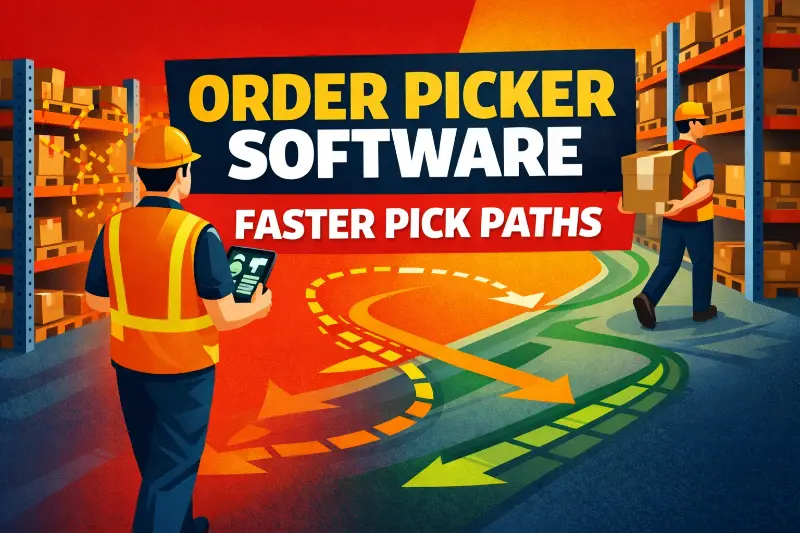
The most direct impact of order picker software is reducing the distance workers travel per order. In a manual picking operation, workers receive a pick list (paper or digital) and walk through the warehouse collecting items in whatever sequence seems logical. This intuitive approach generates inefficient paths because humans naturally optimize for immediate convenience (picking the closest item first) rather than overall route efficiency. Efficient order picking is achieved when software-driven route optimization is used, enabling warehouses to implement strategies like wave picking, zone picking, and automated release processes to enhance productivity and accuracy.
Research on warehouse operations consistently shows that travel time accounts for 50% to 70% of total picking labor time. For a picker completing 100 picks per shift in a 50,000 square foot warehouse, even small reductions in average travel distance per pick compound into meaningful time savings. If software reduces average travel distance per pick by 20% (from 200 feet to 160 feet), that picker saves 4,000 feet of walking per shift, roughly three-quarters of a mile. At an average walking speed of 3 feet per second, that represents 22 minutes of saved time per shift. Across 15 pickers, that is 330 minutes (5.5 hours) of labor capacity recovered daily, equivalent to adding nearly one additional full-time picker without increasing headcount.
Pick path optimization achieves these reductions through algorithmic routing. The software analyzes the warehouse layout, item locations, and the set of items to be picked, then calculates efficient routes through warehouse storage that visit all required locations. For single-order picking, this is a traveling salesman problem. For batch picking (where a picker collects items for multiple orders in one trip), the optimization becomes more complex because the software must also minimize the number of touches per item and ensure picked items fit in the cart or tote so that overall ecommerce order fulfillment becomes a profit driver, not just a cost center.
Digital, hands-free options—such as voice picking—support efficient routes and allow pickers to work faster, increasing the number of orders fulfilled per hour. These features help maximize productivity by enabling pickers to complete more picks in less time, directly improving order fulfillment speed and overall warehouse efficiency.
The software also incorporates warehouse-specific constraints that pure algorithmic optimization would miss. It accounts for aisle direction rules (one-way traffic in narrow aisles), vertical pick zones (high shelves versus floor-level bins requiring different equipment), and temperature zones (frozen, refrigerated, ambient). These constraints ensure the optimized path is not just mathematically shortest but operationally feasible given physical layout and equipment limitations.
How software enables batch, zone, and wave picking at scale
Single order picking is the most prevalent warehouse picking method, where workers fulfill just one order at a time. In warehouse operations, warehouses rely on different picking methods depending on order volume and facility layout, including single order picking, batch picking, zone picking, and wave picking.
Order picker software does not just optimize individual pick paths. It restructures how orders are grouped and sequenced to maximize warehouse throughput.
Batch picking allows a single picker to collect items for multiple orders in one trip through the warehouse. Instead of picking Order 1 completely, returning to the packing station, then picking Order 2 completely, the picker walks the warehouse once and collects items for Orders 1 through 10 simultaneously. This dramatically reduces travel time because the picker visits each warehouse location only once even if items from that location are needed for multiple orders. Batch order picking groups similar orders together, further reducing travel time and streamlining the handoff process to packing with barcode scans. The challenge is that the picker must track which items go to which orders, and this complexity increases error risk. Order picker software manages this by directing the picker to place items in specific totes or bins labeled by order, and by validating each placement through scanning. A related method, cluster picking, consolidates several orders in one pass while keeping them separated for scan validation. Additionally, pack software helps improve order accuracy and warehouse efficiency during the picking and packing process, reducing errors and enhancing overall fulfillment performance, especially when integrated with well-designed packing slips and shipping documentation.
Zone picking divides the warehouse into geographic zones and assigns pickers to specific zones. Each picker becomes an expert in their zone’s layout and inventory, which reduces training time, cuts walking distance in large facilities, and increases pick speed. Orders that require items from multiple zones are passed between pickers (either physically or through handoffs at zone boundaries) until all items are collected. The coordination overhead is significant without software. A manual zone picking operation requires substantial communication and physical handoffs, and orders can get lost or delayed if one zone becomes a bottleneck. Software automates this coordination by tracking order progress through zones, balancing workload across zones, and alerting supervisors when specific zones are falling behind. Pack software helps here as well by improving order accuracy and warehouse efficiency during the picking and packing process.
Wave picking groups orders into scheduled waves (for example, all orders that must ship by 2 PM constitute one wave). All pickers work on the same wave simultaneously, and the wave is complete when all orders in that wave are picked and packed. This approach aligns picking activity with shipping schedules and carrier pickup times. The operational challenge is that wave picking requires precise workload balancing. If one wave is too large, pickers cannot finish before the cutoff time. If waves are too small, warehouse capacity sits idle. Order picker software calculates optimal wave sizes based on historical pick rates, current picker availability, and inventory distribution, then dynamically adjusts wave composition as conditions change. Some operations also combine wave structure with multiple-order methods when order profiles justify it.
The ability to switch between these methodologies based on real-time conditions is where software provides the greatest value. A warehouse might use batch picking during low-volume morning hours (when fewer orders arrive but pickers have time for longer routes), shift to zone picking during high-volume midday periods (when specialized, parallel workflows maximize throughput), and switch to wave picking in the afternoon (to meet carrier cutoff times). Without software, these transitions require manual planning, communication, and coordination. With software, they happen automatically based on predefined rules and current order volume.
Congestion reduction in multi-picker environments becomes critical as volume scales
As warehouse order volume increases, the number of pickers typically increases proportionally. But throughput does not scale linearly with headcount. A warehouse that processes 1,000 orders per day with 10 pickers does not automatically process 2,000 orders per day with 20 pickers, because the pickers begin interfering with each other.
Congestion occurs when multiple pickers need to access the same aisle, shelf, or inventory location simultaneously. One picker must wait while the other completes their pick. This wait time is unproductive labor that does not contribute to order fulfillment. In a small operation with three to five pickers, congestion is minimal because the probability of simultaneous access to the same location is low. In a larger operation with 15 to 20 pickers, congestion becomes a significant drag on throughput.
Order picker software reduces congestion through spatial awareness and dynamic routing. The system tracks the real-time location of all pickers (based on their most recent scan or pick confirmation) and assigns tasks to minimize overlapping routes. If two pickers have tasks in the same aisle, the software delays one assignment until the aisle is clear, or reroutes the second picker to different items first. This coordination happens continuously and automatically, without requiring pickers to communicate or manually adjust their workflows.
The software also identifies and mitigates hotspot congestion. Certain inventory locations (fast-moving SKUs, promotional items, seasonal products) generate disproportionate pick activity. Without intervention, multiple pickers will converge on these hotspots simultaneously, creating queues. Order picker software detects hotspot formation and implements mitigation strategies: assigning a dedicated picker to high-volume locations who stages items for other pickers to collect (reducing the number of workers entering the hotspot), dynamically splitting inventory for popular SKUs across multiple locations (distributing pick activity), or temporarily rerouting pickers to alternative tasks while hotspots clear.
The throughput impact of congestion reduction is non-linear. The first five pickers added to a warehouse generate minimal congestion. The next five pickers introduce noticeable congestion but throughput still increases. Beyond 15 pickers without coordination software, congestion begins to offset productivity gains from additional headcount. At 20+ pickers, congestion can completely neutralize the benefit of adding workers. This is why warehouse managers often report that “adding more pickers doesn’t help anymore” beyond a certain threshold. Order picker software resets that threshold by managing coordination that manual processes cannot handle.
Error-rate reduction has downstream cost impact far exceeding picking labor
Order picker software reduces picking errors through validation and process control, and the financial benefit extends well beyond the picking function itself. When a picker selects the wrong item in a manual operation, the error is often not detected until the packing station (where the packer notices the item does not match the packing slip) or worse, until the customer receives the package and reports the error.
Errors caught at packing require rework: the packer must stop current work, open the box, remove incorrect items, locate and retrieve correct items (either from nearby staging or by sending the picker back into the warehouse), repack the box, print a new shipping label if dimensions or weight changed, and restart the packing process. Order picker software streamlines this by managing the printing and integration of shipping labels, allowing users to validate addresses, compare rates, select shipping services, and print shipping labels efficiently as part of integrated pack workflows, particularly when paired with multi-carrier shipping software for ecommerce. Accurate shipping details are crucial in order processing and fulfillment, as precise shipping information reduces manual data entry, speeds up shipping, and improves overall warehouse efficiency. Sorting and prioritizing orders by shipping method within the software can further streamline fulfillment, reduce errors, and prevent conflicts at the inventory level. This rework consumes 10 to 15 minutes of packing labor per error. In a warehouse packing 1,000 orders daily with a 2% picking error rate, that is 20 errors requiring 200 to 300 minutes of rework labor daily (3.3 to 5 hours), equivalent to losing half a full-time packer to error correction.
Errors that reach the customer generate even higher costs. The warehouse must process a return (receiving, inspecting, restocking), ship a replacement (picking, packing, shipping costs), and absorb customer service overhead (emails, calls, refunds or discounts). Industry benchmarks suggest each customer-facing error costs $15 to $30 in direct costs, not including the impact on customer lifetime value, repeat purchase rates, and broader fulfillment operations. For a brand shipping 30,000 orders monthly with a 2% error rate, that is 600 errors costing $9,000 to $18,000 monthly in direct error-related expenses.
Order picker software reduces error rates from typical manual picking levels (2% to 5%) to validated picking levels (0.2% to 0.5%) through real-time barcode scanning and item verification. The picker must scan each item before placing it in the order tote, and the software confirms the scanned item matches the expected item for that order. Incorrect scans trigger immediate alerts, reducing scanning errors and preventing downstream mistakes. Barcode scanning and RFID integration result in a significant reduction in errors and improved order accuracy. This ten-fold error reduction translates directly into labor savings (less rework at packing), lower return and replacement costs, reduced customer service volume, and improved customer retention.
The error-reduction benefit also enables warehouse operations to shift labor from inspection to production. In manual operations, many warehouses implement quality control checks at packing (packing staff verify picked items match packing slips before sealing boxes) or even dedicated QC stations (a separate worker inspects orders before packing). These inspection steps catch errors but do not prevent them, and they consume labor that could otherwise be used for picking or packing. Order picker software with scan validation makes inspection largely redundant, allowing warehouses to redeploy QC labor to fulfillment activities. Improving order accuracy from 97% to 99% reduces errors by 67%.
Automated replenishment triggers also notify the warehouse team to restock pick bins from bulk storage with the right material handling equipment before they run empty, further preventing errors and supporting efficient process control.
How these operational improvements translate into higher warehouse efficiency, throughput, and lower fulfillment cost
The cumulative effect of travel-time reduction, optimized picking methodology, congestion management, and error reduction is that warehouse throughput increases without proportional increases in labor, space, or equipment across the entire picking and packing cycle. This is the operational leverage that order picker software provides. Additionally, pack software integrates with order picker software to further streamline the packing process for ecommerce businesses, improving order accuracy and efficiency in distribution centers.
A concrete example illustrates the mechanics. Consider a 50,000 square foot warehouse fulfilling 2,000 orders daily with 15 pickers working 8-hour shifts. Each picker completes approximately 133 picks per shift (2,000 orders divided by 15 pickers). At 50% travel time, each picker spends 4 hours walking and 4 hours picking. If order picker software reduces travel time by 20% (from 4 hours to 3.2 hours), each picker gains 48 minutes per shift of productive picking time. With the same 15 pickers, the warehouse can now fulfill 2,300 orders daily (a 15% throughput increase) without hiring additional labor.
The cost impact is equally significant. If fulfillment labor costs $20 per hour fully loaded (wages, benefits, payroll taxes), the warehouse spends $2,400 daily on picking labor (15 pickers x 8 hours x $20). Without software, scaling to 2,300 orders daily would require 17.25 pickers ($2,760 daily labor cost). With software enabling the throughput increase with existing headcount, the warehouse saves $360 daily ($131,400 annually) in labor costs. The software subscription (typically $100 to $300 per user per month, or $18,000 to $54,000 annually for 15 users) delivers positive ROI within the first year and substantial software payback through cost savings alone, before accounting for error reduction, faster training, and improved customer satisfaction. Warehouse management systems (WMS), alongside pick and pack software, further streamline receiving, put-away, picking, packing, and shipping processes while tracking inventory levels and statuses across the entire fulfillment process as operations grow.
Beyond labor cost, throughput improvements enable growing ecommerce brands to delay or avoid warehouse expansion and address broader ecommerce supply chain obstacles and inefficiencies. Order picker software enables businesses to efficiently oversee and coordinate stock across multiple warehouses, which is especially valuable for multi-location ecommerce brands managing complex retail operations with automated fulfillment center selection, real-time inventory tracking, and split inventory management to improve shipping speed and customer satisfaction. Some merchants also supplement internal capacity with off-site bulk storage options such as Amazon AWD bulk storage or Merchant Fulfilled Prime alternatives to FBA to stage inventory cost-effectively upstream of their fulfillment network. A warehouse operating at 80% capacity can typically absorb a 25% volume increase before hitting physical space constraints. Order picker software that unlocks 15% to 20% throughput gains extends the runway before a new facility or expansion becomes necessary, deferring capital expenditure and the operational complexity of multi-facility management. Utilizing the right warehouse management software is essential to streamline operations and support workforce productivity. Performance analytics dashboards can track key performance indicators like pick rate, order cycle time, and accuracy, helping managers optimize operations. Integrating order picker software, pack software, and WMS into broader supply chain management systems is crucial for improving overall logistics efficiency and supporting scalable ecommerce business growth.
Customer Satisfaction: The Downstream Impact of Optimized Picking
Customer satisfaction is the ultimate measure of success in the order fulfillment process, and optimized picking plays a pivotal role in achieving it. By leveraging advanced picking methods such as batch picking and zone picking, warehouses can fulfill customer orders more quickly and accurately, reducing the risk of errors and delays that can erode trust and loyalty.
Real time inventory management and automated order processing are key features of modern warehouse management systems that support efficient picking processes. These tools ensure that inventory levels are always accurate, orders are processed without delay, and warehouse workers have the information they need to pick the right items every time. Staying current on innovations showcased at leading logistics and fulfillment industry events can help operations leaders choose and implement these tools effectively. As a result, labor costs are reduced, and the fulfillment process becomes more streamlined—allowing businesses to handle higher order volumes without sacrificing quality.
Optimized picking not only improves operational efficiency but also has a direct impact on customer satisfaction. When customers receive their orders on time and without errors, they are more likely to return to your online store and recommend your brand to others. By prioritizing customer satisfaction through investment in advanced warehouse management and picking solutions and learning from real-world order fulfillment optimization case studies, ecommerce businesses can enhance their reputation, increase customer retention, and drive sustainable revenue growth.
Frequently Asked Questions
What is order picker software and what does it actually do?
Order picker software is a warehouse execution layer that directs workers through optimized pick paths, consolidates orders into efficient batches, coordinates multi-picker workflows to avoid congestion, and validates each pick to reduce errors. It sits between a warehouse management system (WMS) and the physical picking process. By leveraging automated order processing, the software reduces manual data entry and streamlines the creation of digital pick lists by integrating with ERP and ecommerce systems. The software analyzes product locations, order contents, and picker availability, then generates optimized routes that minimize travel distance. Pickers receive instructions on mobile devices showing item locations, quantities, and specific routes. The system validates picks through barcode scanning, confirms correct item selection, and updates inventory in real time while preventing errors from progressing downstream.
How does pick path optimization reduce travel time and improve picks per hour?
Pick path optimization reduces the distance workers travel per order by calculating algorithmically optimal routes through the warehouse rather than relying on intuitive but inefficient manual routing. Efficient order picking is achieved through optimized routes and digital, hands-free options, allowing pickers to work faster and increase the number of orders fulfilled per hour. Travel time accounts for 50-70% of total picking labor time. A 20% reduction in average travel distance per pick (from 200 feet to 160 feet) saves roughly 4,000 feet of walking per shift per picker, equivalent to 22 minutes of labor capacity recovered. Across 15 pickers, this represents 330 minutes (5.5 hours) of labor capacity daily, equivalent to adding nearly one full-time picker without increasing headcount. The software incorporates warehouse-specific constraints like aisle direction rules, vertical pick zones, and temperature zones to ensure optimized paths are operationally feasible.
What is the difference between batch picking, zone picking, and wave picking?
Single order picking is the most prevalent warehouse picking method, where workers fulfill one order at a time. Other picking methods include batch picking, zone picking, and wave picking, each designed to optimize efficiency and accuracy in different scenarios.
Batch picking allows one picker to collect items for multiple orders in one trip (e.g., Orders 1-10 simultaneously), visiting each location once even if items from that location are needed for multiple orders. Zone picking divides the warehouse into geographic zones with dedicated pickers who become experts in their zone’s layout; orders requiring items from multiple zones are passed between pickers. Wave picking groups orders into scheduled waves (e.g., all orders shipping by 2 PM), with all pickers working the same wave simultaneously to meet carrier cutoffs. Order picker software enables switching between these picking methods based on real-time conditions: batch picking during low-volume periods, zone picking during high-volume periods for parallel workflows, and wave picking to meet shipping deadlines.
How does order picker software reduce congestion in multi-picker warehouse environments?
As picker headcount increases, congestion occurs when multiple pickers need simultaneous access to the same aisle, shelf, or inventory location, creating unproductive wait time. Order picker software tracks real-time location of all pickers (based on recent scans) and assigns tasks to minimize overlapping routes. If two pickers have tasks in the same aisle, the system delays one assignment until the aisle clears or reroutes the second picker to different items first. The software identifies hotspot congestion at fast-moving SKUs and implements mitigation: assigning dedicated pickers to stage items from high-volume locations, splitting popular SKU inventory across multiple locations, or temporarily rerouting pickers to alternative tasks while hotspots clear. This prevents throughput from plateauing as headcount scales.
How much do picking errors actually cost and how does software reduce them?
Picking errors caught at packing require 10-15 minutes of rework labor per error (opening box, removing incorrect items, retrieving correct items, repacking, and managing or printing shipping labels). At 1,000 orders daily with 2% error rate, this is 20 errors requiring 200-300 minutes of rework daily (3.3-5 hours), equivalent to losing half a full-time packer to error correction. Sorting and prioritizing orders by shipping method can further reduce errors and streamline the fulfillment process by ensuring the correct shipping options are applied and preventing inventory conflicts. Errors reaching customers cost $15-30 each in direct costs (return processing, replacement shipping, customer service) plus customer lifetime value impact. For brands shipping 30,000 orders monthly with 2% error rate, this is 600 errors costing $9,000-$18,000 monthly, eroding margins and inflating ecommerce order fulfillment costs. Order picker software reduces error rates from 2-5% (manual) to 0.2-0.5% (validated) through real-time barcode scanning that prevents incorrect picks from progressing. Barcode scanning and RFID integration result in a significant reduction in errors and improved order accuracy.
How does order picker software improve warehouse throughput without adding labor or space?
Order picker software increases throughput through cumulative operational improvements: travel-time reduction (20% reduction creates 48 minutes additional productive picking time per 8-hour shift), optimized picking methodologies (batch/zone/wave), congestion elimination (prevents throughput plateau as headcount scales), and error reduction (eliminates inspection labor), all of which are critical when evaluating Shopify order fulfillment options and strategies. Integrating pack software with order picker software further streamlines the packing process for ecommerce businesses, improving order accuracy and efficiency in distribution centers. These solutions are essential for effective supply chain management, as they automate and optimize logistics operations. Warehouse management systems (WMS) also play a key role by streamlining receiving, put-away, picking, packing, and shipping processes while tracking inventory levels and statuses. Performance analytics dashboards can track key performance indicators like pick rate, order cycle time, and accuracy, helping ecommerce businesses optimize fulfillment. Example: A warehouse fulfilling 2,000 orders daily with 15 pickers at 50% travel time can increase to 2,300 orders daily (15% throughput increase) when software reduces travel time to 40%, without hiring additional labor. This saves $360 daily in labor costs ($131,400 annually) while software subscription costs $18,000-$54,000 annually for 15 users, delivering positive ROI in year one before accounting for error reduction and delayed facility expansion.
What picking methodologies does order picker software support and when should each be used?
Order picker software supports batch picking (one picker collects items for multiple orders in one trip, optimal for high-volume periods with similar orders), zone picking (warehouse divided into zones with dedicated pickers, optimal for large warehouses where specialization reduces training complexity and enables parallel workflows), wave picking (orders grouped into scheduled waves to meet shipping cutoffs, optimal for carrier pickup deadlines), and discrete picking (one picker completes one order, optimal for high-value or complex orders requiring specialized handling). The software switches between methodologies based on order characteristics, warehouse conditions, and real-time volume, enabling automatic transitions without manual planning or coordination.
Automated picking leverages technologies like Goods-to-Person (GTP) and Person-to-Goods (PTG) systems to enhance warehouse efficiency. Goods-to-person systems, often powered by automated storage and retrieval systems (AS/RS) and robotics, bring inventory directly to stationary workers, reducing travel time and increasing productivity in warehouse picking operations. Warehouse automation solutions such as conveyor systems and AS/RS are increasingly used to improve picking efficiency.
Additionally, voice picking technology (pick-by-voice), pick-to-light systems, and augmented reality (AR) solutions provide hands-free, visual, and intuitive guidance, significantly increasing productivity and reducing picking errors. Robotic picking systems utilize advanced AI algorithms for vision and path optimization, enabling them to handle a wide variety of items and further streamline warehouse picking processes.
How quickly does order picker software deliver ROI and what are the key cost savings?
Primary ROI sources include labor cost savings (15-20% throughput increase without adding headcount saves $131,400 annually for a 15-picker warehouse at $20/hour fully loaded labor cost), error reduction (reducing 2% error rate to 0.5% saves $9,000-$18,000 monthly in direct error costs for brands shipping 30,000 orders monthly), eliminated inspection labor (scan validation makes quality control checks redundant, redeploying QC labor to production), and delayed facility expansion (20% throughput gains extend runway before warehouse expansion, deferring capital expenditure). Software subscription typically costs $100-$300 per user per month ($18,000-$54,000 annually for 15 users), delivering positive ROI within first year from labor savings alone before accounting for error reduction, faster training, and improved customer satisfaction.
Written By:

Indy Pereira
Indy Pereira helps ecommerce brands optimize their shipping and fulfillment with Cahoot’s technology. With a background in both sales and people operations, she bridges customer needs with strategic solutions that drive growth. Indy works closely with merchants every day and brings real-world insight into what makes logistics efficient and scalable.

Turn Returns Into New Revenue

Related Articles
Walmart Officially Allows Amazon Multi-Channel Fulfillment (MCF)
Big news for multichannel sellers: Walmart now officially allows Amazon Multi-Channel Fulfillment (MCF), Amazon’s service for using its fulfillment network to ship orders from mult...

Why Small Ecommerce Brands Are Winning with AI (While Enterprises Struggle)
Conventional wisdom says large companies should dominate AI adoption.

Top 12 Shipping Strategies For Making Free Shipping Profitable
For ecommerce sellers, shipping is more than just getting a package from point A to point B — it’s the invisible backbone, quietly shaping customer satisfaction, operational costs,...