
BFCM 2025 Exposed the Gap Between Brands Built for Growth and Brands Built for Scale

Last updated on December 26, 2025
In this article
 8 minutes
- Introduction
- Growth vs. Scale: What’s the Difference in Ecommerce?
- Why BFCM Exposes the Difference
- The Growth Trap: What Happens When Volume Outpaces Operations
- What Scalable Ecommerce Operations Look Like During BFCM
- The Metrics That Reveal Whether You’re Built for Scale
- How to Prepare for BFCM 2025 Without Breaking Your Business
- Conclusion: BFCM 2025 Will Reward Scale, Not Just Growth
- Frequently Asked Questions
Introduction
Black Friday Cyber Monday (BFCM) is no longer simply a seasonal sales spike—it has become a stress test for whether an ecommerce business is built for real growth or sustainable scale. Many ecommerce brands drove unprecedented sales through paid acquisition and promotional volume in 2020–2024, only to discover that scaling demand without scalable fulfillment, inventory, and shipping infrastructure produces customer friction, operational chaos, and margin destruction.
BFCM 2025 is expected to amplify this divide. Some brands will win not because they sell more, but because they can fulfill more profitably, reliably, and without breaking. Others will chase top-line growth only to experience out-of-stocks, carrier failures, late deliveries, refund requests, and return waves that erase their gains.
This article explains the fundamental difference between growth and scale in ecommerce, and how BFCM exposes which companies have truly built a scalable operation. We’ll break down common failure modes, key scaling metrics, and the operational strategies that allow brands to win the biggest shopping weekend of the year—without sacrificing customer experience or margins.
Growth vs. Scale: What’s the Difference in Ecommerce?
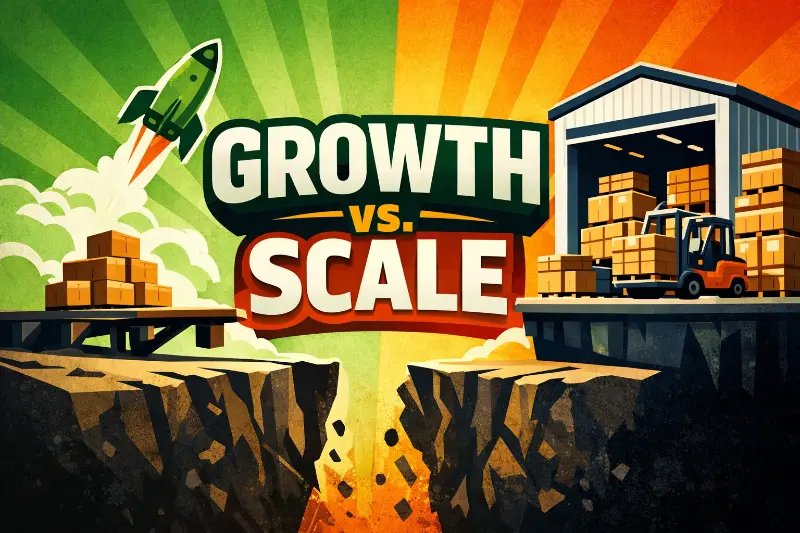
In ecommerce, growth means increasing demand—more orders, more customers, more revenue. Growth is typically fueled by marketing: paid ads, promotions, affiliate traffic, influencer campaigns, email blasts, and marketplace expansion. Growth is a top-line outcome.
Scale is different. Scale means your operation can handle more volume without a proportional increase in cost, complexity, or risk. Scaling is an operational outcome: it depends on fulfillment processes, inventory positioning, shipping strategy, systems integration, warehouse capacity, and return handling. Scale is the ability to grow profitably and consistently.
Many brands confuse the two. They assume that revenue growth equals business maturity. But BFCM reveals the truth: growth is easy to buy; scale must be built.
A simple way to think about it:
- Growth = more demand
- Scale = more volume with fewer problems
A business that grows without scaling becomes fragile. BFCM is when fragility turns into failure.
Why BFCM Exposes the Difference
BFCM creates a convergence of pressure points:
- Order volume spikes in 72 hours
- Carrier networks become congested
- Inventory accuracy matters more than ever
- Customer expectations for fast shipping increase
- Returns volume accelerates immediately after delivery
These conditions do not simply test marketing. They test the entire business system. If fulfillment is underbuilt, BFCM will overwhelm it. If inventory is mis-positioned, shipping becomes expensive and slow. If carrier strategy is weak, delivery promises collapse. If returns workflows are immature, the post-BFCM return wave becomes operational debt that drags into Q1.
Brands that are built for scale experience BFCM differently. They still feel the pressure, but they have designed systems to absorb it. Their operations do not break when demand spikes. They ship reliably. They protect margins. They deliver a customer experience that strengthens loyalty instead of damaging trust.
Let AI Optimize Your Shipping and Boost Profits
Cahoot.ai software selects the best shipping option for every order—saving you time and money automatically. No Human Required.
See AI in ActionThe Growth Trap: What Happens When Volume Outpaces Operations
Many ecommerce brands enter BFCM with a “growth-first” mindset. They focus heavily on driving demand and assume fulfillment will “figure it out.” This often produces predictable failure modes:
1. Stockouts and Inventory Inaccuracy
High-velocity demand exposes weak inventory controls. If your inventory system is not real-time and accurate, BFCM will cause:
- Overselling products that are not actually available
- Cancellations that harm marketplace performance and customer trust
- Backorders that create support tickets and refund requests
Brands built for scale use distributed inventory, tight sync, and demand forecasting. Brands built for growth alone often rely on a single node or manual inventory updates that fail under pressure.
2. Fulfillment Backlogs and Late Shipments
BFCM exposes whether your warehouse operations can handle surge throughput. Growth-first brands often face:
- Picking bottlenecks and packing shortages
- Staffing gaps and overtime cost explosions
- Orders that ship days late, missing marketplace SLAs
Late fulfillment does not just cost money—it destroys customer experience during the most visible moment of the year.
3. Margin Erosion from Panic Shipping
When orders are late or inventory is mis-positioned, brands often respond by upgrading shipping services to “save” delivery dates. This results in:
- Expedited shipping costs that wipe out promotional margins
- Zone 7/8 shipments from a single warehouse that drive cost inflation
- High surcharge exposure during peak carrier pricing windows
Brands that scale intentionally design fulfillment networks to avoid panic shipping. They route orders dynamically and position inventory closer to demand.
4. Customer Support Overload
Late shipments, stockouts, and unclear delivery promises generate customer contact volume. Growth-first brands often underestimate how fast support costs rise when operations break. The result is:
- Escalating ticket volume and response delays
- Negative reviews that permanently impact conversion
- Refund requests and chargebacks that compound margin loss
During BFCM, customer expectations are high. Failure is amplified, and damage lasts beyond the weekend.
What Scalable Ecommerce Operations Look Like During BFCM
Brands built for scale do not rely on heroics. They rely on systems. During BFCM, scalable operations show up in predictable ways:
1. Distributed Inventory and Smart Order Routing
Scalable brands avoid single-node fulfillment. They position inventory across multiple locations and use intelligent routing to ship from the best node based on:
- Customer location
- Inventory availability
- Carrier cost and performance
- Delivery promise requirements
This reduces shipping zones, lowers cost, and increases delivery speed without upgrading services.
2. Throughput-Ready Warehouse Processes
Scalable brands engineer fulfillment workflows so that doubling volume does not double complexity. They invest in:
- Batch picking and wave planning
- Pre-built kits and standardized packaging
- Labor planning and surge staffing readiness
- Automation where it matters (shipping, labeling, routing)
They do not wait until BFCM to discover bottlenecks.
3. Carrier Strategy Built for Peak Season
Scalable brands plan for peak pricing and congestion. They diversify carriers, monitor surcharge exposure, and avoid last-minute upgrades. Their shipping strategy includes:
- Multi-carrier rate shopping
- Fallback services when one network slows down
- Clear customer delivery promises that match reality
Scale means shipping remains predictable even when carrier networks are not.
ShipStation vs. Cahoot: 21x Faster, Real Results
Get the inside scoop on how a leading merchant switched from ShipStation to Cahoot—and what happened next. See it to believe it!
See the 21x DifferenceThe Metrics That Reveal Whether You’re Built for Scale
BFCM is when ecommerce metrics stop being theoretical and become real. The brands that scale are the ones that can maintain performance under pressure. Key indicators include:
- On-time shipment rate (did orders ship within promised windows?)
- On-time delivery rate (did customers receive orders when promised?)
- Cost per order shipped (did shipping costs spike under pressure?)
- Out-of-stock rate (did inventory accuracy survive demand spikes?)
- Customer contact rate (did support load stay stable?)
- Return processing time (did reverse logistics create post-BFCM operational debt?)
Brands built for growth alone often see these metrics collapse during BFCM. Brands built for scale stabilize them, even under high volume.
How to Prepare for BFCM 2025 Without Breaking Your Business
Preparing for BFCM is not just about launching a promotion. It is about ensuring the business system can survive the demand you create. Key preparation strategies include:
1. Forecast Demand and Stress Test Capacity
Forecast volume based on last year’s performance, growth rate, and planned marketing spend. Then compare forecast demand to:
- Warehouse throughput capacity
- Carrier pickup and transit capacity
- Inventory availability and replenishment lead times
If forecast demand exceeds capacity, growth will produce failure. Adjust accordingly.
2. Strengthen Inventory Positioning
Inventory that is positioned poorly becomes expensive and slow to ship. Prepare by:
- Splitting inventory closer to demand regions
- Using networked fulfillment to avoid zone inflation
- Improving inventory accuracy and real-time sync
BFCM is not the time to discover your inventory counts are wrong.
3. Build a Carrier Playbook
Carrier performance and peak surcharges shift quickly during BFCM. Build a playbook that includes:
- Primary and backup carriers by service level
- Surcharge exposure monitoring
- Rate shopping and dynamic carrier selection
- Customer messaging when networks slow down
Scale requires redundancy. Growth-only operations often have none.
Cut Costs with the Smartest Shipping On the Market
Guranteed Savings on EVERY shipment with Cahoot's AI-powered rate shopping and humanless label generation. Even for your complex orders.
Cut Costs TodayConclusion: BFCM 2025 Will Reward Scale, Not Just Growth
BFCM is not just a revenue event. It is an operational truth test. Brands that chase growth without scaling will generate volume they cannot fulfill profitably. Brands that have built scalable systems will win not only with revenue, but with customer loyalty, stronger margins, and repeat demand into Q1.
The difference is not marketing. It is operational maturity. BFCM 2025 will amplify this divide between ecommerce businesses built for growth and those built for scale—and the brands that invest in scalable fulfillment, inventory positioning, and shipping strategy will be the ones that emerge stronger.
Frequently Asked Questions
What is the difference between growth and scale in ecommerce?
Growth is increasing demand and revenue, often through marketing and promotions. Scale is the ability to handle increased volume without proportional increases in cost, complexity, or operational risk.
Why does BFCM expose operational weakness?
BFCM concentrates high volume, tight delivery expectations, carrier congestion, and inventory volatility into a short time window. Weak fulfillment, inventory, and shipping systems break under that pressure, leading to late shipments, margin loss, and customer dissatisfaction.
What metrics should ecommerce brands track during BFCM?
Key metrics include on-time shipment rate, on-time delivery rate, cost per order shipped, out-of-stock rate, customer contact rate, and return processing time.
How can ecommerce brands prepare for BFCM without destroying margins?
Brands can prepare by forecasting demand, stress testing fulfillment capacity, distributing inventory closer to demand, improving inventory accuracy, building a multi-carrier shipping strategy, and developing an operational playbook for surge conditions.
What sources were leveraged for BFCM 2025 metrics?
The Black Friday Cyber Monday 2025 metrics referenced in this article were sourced from publicly available Shopify disclosures, including Shopify’s official Newsroom recap and Shopify’s Investor Relations press release. A syndicated version of the same release distributed via Nasdaq was used for cross-verification.
- Shopify Newsroom BFCM 2025 recap: https://www.shopify.com/news/bfcm-data-2025
- Shopify Investor Relations press release: https://shopifyinvestors.com/media-center/news-details/2025/Shopify-Merchants-Achieve-Record-Breaking-14-6-Billion-in-Black-Friday-Cyber-Monday-Sales/default.aspx
- Nasdaq syndicated press release: https://www.nasdaq.com/press-release/shopify-merchants-achieve-record-breaking-146-billion-black-friday-cyber-monday-sales
Written By:

Rinaldi Juwono
Rinaldi Juwono leads content and SEO strategy at Cahoot, crafting data-driven insights that help ecommerce brands navigate logistics challenges. He works closely with the product, sales, and operations teams to translate Cahoot’s innovations into actionable strategies merchants can use to grow smarter and leaner.

Turn Returns Into New Revenue

Related Articles
The End of Traditional Ecommerce Returns
PART I — THE PROBLEM Why Returns Didn’t Just Break — They Were Never Built for This Returns are ecommerce’s dirty secret: a billion-dollar bonfire that most brands prefer not to lo...
Fast Delivery Isn’t the Hard Part – Inventory Decisions Are
Fast delivery is no longer a differentiator in ecommerce, it is an expectation.
Moving from Amazon 1P to 3P: What It Actually Takes to Succeed
The decision to move from Amazon Vendor Central (1P) to Seller Central (3P) usually follows months of frustration with pricing control loss, erratic purchase orders, and margin com...