
FedEx 2027 Rate Increase: How 5.9% Becomes 32.4% on One Package

Last updated on October 23, 2026
In this article
 11 minutes
- FedEx 2027 changes arrive on three different dates
- Existing customer ZIP codes move into more expensive tiers
- Three shipment profiles show how the increase reaches an order
- Reducing zones can offset an increase but Remote fees remain
- The same ZIP can cost more with one carrier than another
- A leaner carrier network does not guarantee a lower shipping bill
- Reprice the orders you actually ship before setting a budget
- Match each shipping cost driver to the decision that can change it
- Cahoot connects the decisions that protect order margins
- Sources and calculation method
- Frequently Asked Questions
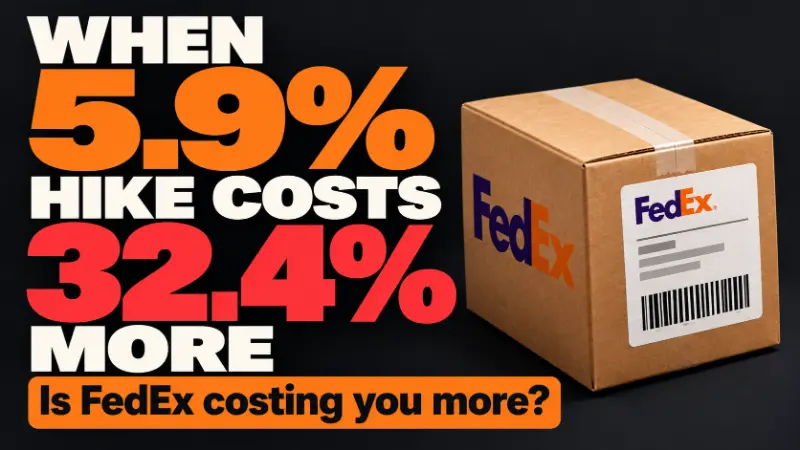
FedEx’s announced 2027 rate increase averages 5.9% on standard list package rates effective January 4, 2027, but an average is not a budget. In one modeled parcel, a 2 lb, fixed-Zone-8 Home Delivery package whose residential destination moves from Extended to Remote rises from $32.62 to $43.18, a 32.4% increase at standard list rates before fuel and account concessions.
Two responses address different cost drivers. A closer origin reduces transportation cost, while a carrier comparison tests carrier-specific destination fees, because FedEx and UPS can classify the same ZIP code differently on different dates. Understanding why shipping prices are so high helps explain why a carrier’s average increase can differ from the cost of a particular order. Carrier network consolidation is context here, not a proven cause of any ZIP change.
FedEx 2027 changes arrive on three different dates
| Effective date | Changes |
|---|---|
| January 4, 2027 | Average 5.9% standard list package-rate increase; minimums, fees, and delivery and pickup area ZIP lists change |
| January 18, 2027 | $25 Paper Document Fee; $5 Paper Air Waybill Fee; expanded international residential-charge applicability |
| February 1, 2027 | Zone classifications change for select US domestic origin and destination ZIP pairs |
The paper document fee concerns non-electronic trade documents that need manual processing, and the paper air waybill fee concerns manual paper airbills for US domestic and export shipments. International residential applicability depends on service and destination.
FedEx’s published domestic demand schedule runs through January 17, 2027, so January 4 to January 17 can combine the new annual rates with applicable demand charges. The published FedEx 2026 peak season surcharges continue into January, so separate those temporary charges from the annual rate changes. The comparisons below exclude demand charges and are not complete invoices for those dates.
Existing customer ZIP codes move into more expensive tiers
Comparing the official 2026 list (effective July 20, 2026) with the 2027 list (effective January 4, 2027) by five-digit ZIP, with leading zeros preserved, shows these contiguous US movements:
| Movement | ZIP count |
|---|---|
| Extended to Remote | 2,533 |
| Standard delivery area to Extended | 240 |
| Previously outside the lists to standard delivery area | 45 |
That is 2,773 upward reclassifications, which change the fee on a ZIP FedEx already served, plus 45 additions, which bring a ZIP into surcharge coverage. This comparison found no removals or downward moves. Standard, Extended and Remote counts go from 7,682, 14,378 and 3,591 in 2026 to 7,487, 12,085 and 6,124 in 2027. Only Remote grows. Alaska and Hawaii lists are unchanged.
ZIP 01245 is Extended in the 2026 list and Remote in the 2027 list. That establishes its surcharge category only, not its shipping zone from any origin. For a residential destination, the Extended-to-Remote fee goes from $8.80 to $17.75, adding $8.95 before fuel, per the FedEx 2027 fee changes. ZIP counts do not show what share of US packages, or of your order file, is affected.
Three shipment profiles show how the increase reaches an order
Assumptions for every model: US FedEx Home Delivery, fixed Zone 8 in both years, residential destination, standard list pricing and corrugated customer packaging. Fuel, seasonal demand fees, pickup allocations, optional services, discounts and account adjustments are excluded. Current published handling rules are held constant.
| Profile | Billable lb | 2026 subtotal | 2027 subtotal | Added cost | Increase |
|---|---|---|---|---|---|
| Compact, 10 x 6 x 4 in, 2 lb actual, no area fee | 2 | $23.82 | $25.43 | $1.61 | 6.8% |
| Same compact parcel, Extended to Remote destination | 2 | $32.62 | $43.18 | $10.56 | 32.4% |
| Long carton, 49 x 10 x 5 in, 10 lb actual, no area fee | 40 | $123.44 | $131.24 | $7.80 | 6.3% |
| Cost component | 2026 | 2027 | Applies to |
|---|---|---|---|
| Transportation at 2 lb in Zone 8 | $17.37 | $18.53 | Both compact examples |
| Transportation at 40 lb in Zone 8 | $76.24 | $80.59 | Long carton |
| Home Delivery residential fee | $6.45 | $6.90 | All examples |
| Delivery-area fee | $8.80 Extended | $17.75 Remote | Reclassified compact destination |
| Dimension handling fee in Zone 7+ | $40.75 | $43.75 | Long carton |
For the reclassified compact parcel, 2026 is $17.37 + $6.45 + $8.80 = $32.62, and 2027 is $18.53 + $6.90 + $17.75 = $43.18. The added $10.56 divided by $32.62 is 32.4%. At 1,000 identical modeled shipments, that is $10,560 before fuel, conditional arithmetic rather than an observed merchant result. Fuel applies to the net rate and specified fees under your agreement. At a constant percentage on the same components in both years, it raises the dollar gap but leaves the percentage unchanged.
Per the FedEx Service Guide, a divisor of 139 gives the compact carton a dimensional weight of 1.73 lb, rounded to 2 lb. The long carton’s dimensional weight is 17.63 lb, but its 49 inch longest side exceeds 48 inches, which triggers dimension handling and a 40 lb minimum billable weight.
Reducing zones can offset an increase but Remote fees remain
This tariff scenario holds the year at 2027 and changes only the origin, so the same compact parcel (10 x 6 x 4 in, 2 lb billed, Home Delivery, residential) moves from Zone 8 to Zone 3. It is not a verified route or customer outcome, and it is not attached to ZIP 01245 or any warehouse location.
| 2027 component | Zone 8 | Zone 3 | Reduction |
|---|---|---|---|
| Transportation at 2 lb | $18.53 | $14.98 | $3.55 / 19.2% |
| Residential fee | $6.90 | $6.90 | $0.00 |
| Subtotal with no area fee | $25.43 | $21.88 | $3.55 / 14.0% |
| Remote fee when applicable | $17.75 | $17.75 | $0.00 |
| Subtotal with Remote fee | $43.18 | $39.63 | $3.55 / 8.2% |
Each percentage uses the matching Zone 8 amount as its denominator, and none is an invoice saving. Against 2026, the ordinary parcel at Zone 3 ($21.88) lands $1.94, or 8.1%, below its 2026 Zone 8 subtotal of $23.82. The Remote parcel recovers 33.6% of its $10.56 increase but sits $7.01, or 21.5%, above its 2026 Zone 8 Extended subtotal of $32.62.
A distributed fulfillment network can place inventory closer to demand and reduce transportation distance, while a destination-based Remote fee may still apply. At 1,000 identical eligible shipments the pre-fuel reduction is $3,550, so added inbound freight, storage, pick and pack differences and inventory costs must together stay below $3.55 per eligible order. Allocate fixed costs across the orders actually moved. Two warehouses alone do not guarantee Zone 3. This merchant-origin change is separate from FedEx’s February 1 zone reclassification, so verify both zones against current carrier data before using a real lane.
The same ZIP can cost more with one carrier than another
Zone reduction lowers transportation cost. Carrier selection addresses a different driver: the destination-fee classification itself. “FedEx Remote” is not a universal geographic label. It is one carrier’s classification on one effective date.
| Destination ZIP | FedEx July 20, 2026 | FedEx January 4, 2027 | UPS current list |
|---|---|---|---|
| 04644 | Extended | Extended | Standard DAS |
| 01245 | Extended | Remote | Extended |
| 15778 | Extended | Remote | Standard DAS |
Under the current 2026 schedules, a residential delivery to 04644 carries an $8.80 FedEx Extended fee versus a $6.55 UPS standard DAS fee, per the UPS Daily Rate and Service Guide. That $2.25 gap is one surcharge component before fuel and concessions, not an all-in saving. Base charges, residential fees and contract terms can reverse which carrier is cheaper. Do not subtract a 2026 UPS charge from a 2027 FedEx charge and call it a 2027 saving. UPS 2027 classifications and prices were not verified.
The decision rule is to filter to services that meet the delivery promise, then compare each real origin and destination pair on each carrier’s own zone, billed weight, area classification, negotiated price, minimum charge, fees and fuel basis, plus pickup availability, coverage and volume commitments. Multi-carrier shipping software helps compare each eligible carrier’s destination-fee classification and total account-specific price while preserving the delivery promise. Diversification creates options, not a guaranteed UPS win. Evaluate the origin change and the carrier change separately before combining them, so the $3.55 zone reduction and any carrier saving are not double counted.
A leaner carrier network does not guarantee a lower shipping bill
FedEx’s Network 2.0 plan, as reported by Supply Chain Dive, calls for over 475 station closures by end-2027, about 30% of its footprint. That is a plan, not completed closures. FedEx’s 2026 Investor Day named premium B2B, specialized B2C and disciplined pricing as priorities. UPS’s Q1 2026 filing reports 23 buildings closed and 27 more identified, and its Q2 update stresses revenue quality. Leaner networks are consistent with pricing selectivity, but operating savings do not guarantee cheaper merchant invoices, and no source links specific closures to specific ZIP changes.
Reprice the orders you actually ship before setting a budget
Start with a recent representative shipment export, such as 13 weeks, including seasonal and product mix where material. Join it to invoice data and contract terms. Required fields:
- Origin and destination ZIP, residential or commercial classification, and service
- Actual and billed weight, measured dimensions, and SKU or carton
- Surcharge codes and amounts, net transportation, discounts and minimum-charge rules
- Fuel basis and ship date
Match destination ZIPs to the 2026 and 2027 FedEx lists, then reprice the same order mix using your actual concessions, minimum floors and surcharge rules. For alternative carriers, use each candidate’s own ship-date ZIP list, zone, billed weight and account pricing, keeping the service promise equivalent. Rank segments by added cost per shipment and total added dollars, and compute the portfolio percentage from summed costs, not an average of package percentages. Run fuel scenarios and seasonal fees separately. Add the February zone changes only after verifying the affected origin and destination pairs.
Match each shipping cost driver to the decision that can change it
Once you know which fees dominate your spend, apply the strategies to reduce UPS and FedEx surcharges that address those specific charges.
Packaging changes can reduce dimension handling
The long carton pays $43.75 in handling because of one 49 inch side. Automated cartonization can help select suitable packaging that reduces avoidable dimensional-weight or handling exposure while protecting the product. It does not remove destination fees.
Inventory placement can reduce transportation distance
A nearer origin lowers base transportation but adds inbound freight, storage and inventory fragmentation, and a valid Remote classification stays.
Carrier and contract choices must fit the delivery promise
Another service counts only if it meets the promise on actual account pricing. An invoice audit can catch a misapplied charge, but it cannot make a valid Remote classification disappear.
Cahoot connects the decisions that protect order margins
Cahoot is an end-to-end ecommerce fulfillment operations suite that links inventory placement, carton selection, multi-carrier service selection and billing verification. That supports three goals: Save Every Penny on each order, Scale Operations Without Adding Complexity as locations and carriers grow, and Outperform on Every Sales Channel without breaking the delivery promise. Find the orders where a change in origin, packaging or carrier protects margin while meeting that promise.
Sources and calculation method
Original research was checked October 1, 2026, and the Zone 3 scenario was added October 5. FedEx rates, fees and ZIP files were rechecked October 20, 2026, as were the UPS workbook and tariff. Sources: 2026 list rates (printed page 105), 2027 list rates (printed page 107), fee changes and the Service Guide. All models use fixed Zone 8, standard list pricing and current handling rules, and exclude fuel, demand fees, pickup allocations, optional services and discounts. The February zone change is provisional until actual ZIP pairs are verified. Confirm current rules before relying on any figure.
Frequently Asked Questions
Is every FedEx package increasing by 5.9% in 2027?
No. The 5.9% figure is an average standard-list-rate increase. Service, weight, zone, minimums, fees and contract terms determine the change for a particular shipment.
Which FedEx ZIP code changes can increase shipping costs in 2027?
Our comparison of the official lists found 2,533 Extended-to-Remote moves, 240 standard-to-Extended moves and 45 additions. Check the official ZIP lists against your own shipment file.
Can a closer warehouse eliminate the FedEx Remote surcharge?
No, not by itself. A closer origin may reduce transportation distance and base cost, but a surcharge set by the destination ZIP remains. Evaluate total fulfillment economics.
Can FedEx and UPS classify the same ZIP code differently?
Yes. ZIP 04644 is Extended in FedEx’s July 2026 list and standard DAS in the verified current UPS list. ZIP 01245 becomes FedEx Remote on January 4, 2027, while the current UPS list has Extended. Recheck ship-date rules and compare full net prices and service eligibility rather than assuming UPS is cheaper.
Do FedEx 2026 peak surcharges overlap the 2027 rate increase?
Yes, possibly. The published domestic demand schedule continues through January 17, while annual changes begin January 4. Applicability and account terms determine the additional charge.
Written By:

Manish Chowdhary
Manish Chowdhary is the founder and CEO of Cahoot, the most comprehensive post-purchase suite for ecommerce brands. A serial entrepreneur and industry thought leader, Manish has decades of experience building technologies that simplify ecommerce logistics—from order fulfillment to returns. His insights help brands stay ahead of market shifts and operational challenges.

Turn Returns Into New Revenue
Related Articles

Seller Fulfilled Prime for Oversized Items: The FBA vs. SFP Math Sellers Need to Run
Seller Fulfilled Prime can work for oversized and bulky items, but it is not automatically cheaper than FBA.

What Is Post-Purchase Experience in Ecommerce?
After a customer clicks “buy,” the post-purchase experience begins – it’s all the steps and interactions a shopper encounters from checkout through delivery and beyond.

Choosing a European 3PL: What US Ecommerce Brands Should Look For
US ecommerce brands should judge a European 3PL on four practical tests: the right EU and UK stock footprint, delivery coverage from named warehouses, a local customer experience, ...