
Shipping Insurance for High-Value Items: Carrier Liability vs Third-Party Coverage

Last updated on March 09, 2026
In this article
 19 minutes
- Introduction to Shipping High-Value Items
- Supply Chain Risks and Vulnerabilities
- Carrier liability is not insurance, and the distinction matters
- The $1,000 ceiling and other exclusions most merchants miss
- Why claims get denied and what the data shows
- Third-party coverage changes the cost and claims equation
- Operational requirements that determine whether claims succeed
- Customer Experience and Shipping Insurance
- Best Practices for Shipping
- Technology and Insurance Integration
- When self-insuring makes financial sense
- Frequently Asked Questions
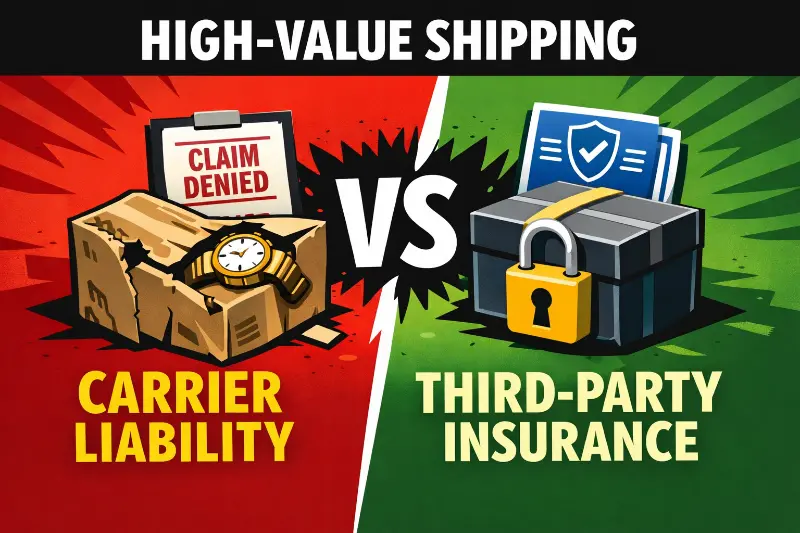
Most ecommerce losses on high-value shipments are not caused by theft. They result from mismatched liability limits, policy exclusions, and claims processes that work against the shipper. Merchants who rely on default carrier coverage typically discover the gap between what they assumed was covered and what actually gets paid only after a package is lost or damaged. Understanding the structural differences between carrier liability, declared value coverage, and third-party insurance is the single most important step an operations leader can take before shipping valuable items.
This distinction matters because the default protection included with every shipment from major carriers caps out at $100 per package. For any brand shipping high-value goods (jewelry, electronics, luxury apparel, custom products), that $100 ceiling covers a fraction of the actual replacement cost. The good news: once you understand how each layer of coverage works, building an insurance strategy that fits your product mix, volume, and risk tolerance is straightforward. Shipping insurance can provide complete coverage for a broad range of high-value items, ensuring your valuable shipments are fully protected.
Introduction to Shipping High-Value Items
Shipping high-value items is a task that demands meticulous planning and attention to detail. Whether you’re sending precious metals, luxury goods, or other valuable shipments, the stakes are high—any loss or damage can result in significant financial loss and reputational harm. That’s why shipping insurance is essential for anyone shipping high-value items. By partnering with a trusted insurance provider, shippers can secure comprehensive coverage that protects their value items from the moment they leave the warehouse until final delivery. This extra layer of protection ensures that even if the unexpected happens, your high-value shipments are covered, and your business is shielded from costly setbacks. For businesses and individuals alike, investing in shipping insurance is a proactive step to safeguard luxury goods and precious items, providing peace of mind and financial security throughout the shipping process.
Supply Chain Risks and Vulnerabilities
The journey of high-value items through the supply chain is fraught with potential risks and vulnerabilities. From the initial handoff at the warehouse to the final delivery, high-value shipments can be exposed to theft, mishandling, environmental hazards, and even customs delays. Each stage of the supply chain presents unique challenges that can jeopardize the safety of value items and result in financial loss. To protect these shipments, businesses must identify high-risk points—such as transit hubs, storage facilities, and last-mile delivery routes—and implement robust security measures. Proactive risk management, including regular audits and contingency planning, is crucial for minimizing disruptions and ensuring the safe delivery of high-value items. By understanding and addressing these supply chain vulnerabilities, businesses can better protect their valuable shipments and maintain customer trust.
Carrier liability is not insurance, and the distinction matters
Both UPS and FedEx include $100 of declared value coverage per package at no extra charge. USPS includes up to $100 of coverage for Priority Mail, Priority Mail Express, and Ground Advantage shipments. These defaults apply automatically, and for shipments under $100, they may be sufficient. Beyond that threshold, the economics and the fine print diverge quickly.
This distinction matters because the default protection included with every shipment from major carriers caps out at $100 per package. Standard carrier liability generally covers only up to $100 unless a higher declared value is paid, and you may need to purchase additional insurance for shipments valued over $100 to ensure full protection.
The critical distinction that most merchants overlook: declared value coverage is not insurance. FedEx states this explicitly in its service guide. UPS uses similar language. Declared value sets the carrier’s maximum liability, meaning it caps what the carrier will pay, not what the carrier owes. To collect on a declared value claim, the shipper must prove the carrier was at fault for the loss or damage. That burden of proof is significant. If the carrier can attribute the issue to inadequate packaging, an excluded item category, or any cause outside its direct handling, the claim gets denied. Insurance limits and maximum declared values apply, and if your shipment exceeds these limits, you must purchase additional insurance to cover the full value.
USPS is the exception among major carriers in that it uses the term “insurance” and provides indemnity coverage. However, USPS caps standard insured mail at $5,000 per package domestically (Registered Mail extends to $50,000 but requires in-person mailing and chain-of-custody protocols). International coverage varies dramatically by destination country, with some nations capping coverage well below $1,000.
For merchants shipping high-value items, the surcharge math also deserves attention. Carrier declared value fees typically run $1.05 to $1.90 per $100 of coverage above the included default. Insurance rates are typically based on the declared value and can vary depending on package type. On a $2,000 item, that translates to roughly $20 to $36 in declared value surcharges with a carrier. Third-party insurance providers, by contrast, typically charge $0.50 to $1.25 per $100 of coverage, representing savings of 50 to 80 percent on the premium alone. Many third-party providers offer competitive rates, making them a cost-effective option for insuring high-value shipments.
The $1,000 ceiling and other exclusions most merchants miss
Beyond the default $100 cap, carriers impose category-specific limits that create coverage gaps for common ecommerce products. FedEx limits declared value to $1,000 for artwork, paintings, sculptures, antiques, collectibles, fine jewelry, precious metals, furs, and musical instruments (whether they are old, customized, or both). Items shipped in a FedEx Envelope or Pak are capped at $500 regardless of actual value. UPS imposes similar restrictions, limiting international jewelry shipments to $2,500 CAD without a special high-value waiver agreement. Many carriers have coverage limits and exclusions that can expose businesses to financial risk when shipping valuable goods.
These are not obscure edge cases. A Shopify brand selling handcrafted jewelry, vintage furniture, limited-edition prints, or high-end watches will hit these limits routinely. The carrier will accept the package, charge for shipping, and even collect the declared value surcharge. But if a claim arises, the payout caps at the category limit, not the declared amount.
Several other exclusions apply universally across carriers. Consequential damages (lost revenue, business interruption, customer acquisition costs) are never covered. Losses caused by weather events, natural disasters, or civil unrest fall outside carrier liability. Coverage applies only while the package is in the carrier’s custody, meaning porch theft after confirmed delivery is excluded. And perhaps most consequentially, damage attributed to improper packaging results in automatic denial. When evaluating insurance options, keep in mind that the best shipping carrier will have insurance options to cover your most expensive SKU without exceeding its maximum value for coverage.
Why claims get denied and what the data shows
Inadequate packaging is the leading cause of claim denials across all carriers. Carriers publish specific packaging guidelines covering box strength ratings, cushioning materials, void fill, and drop-test standards. A shipment that fails to meet these requirements, even if the carrier clearly mishandled it, faces a strong likelihood of denial. USPS reports an approximate 38 percent claim rejection rate, while industry analysis suggests UPS and FedEx deny roughly 30 to 50 percent of claims depending on the type (damage claims are denied more frequently than loss claims). The claim process for shipping insurance for high-value items requires careful attention—documentation like photos and recent appraisals is crucial for claims on high-value items.
Other common denial triggers include late filing (each carrier enforces strict windows, ranging from 21 to 60 days depending on the carrier and claim type), missing documentation (no photos, no proof of value, no original packaging retained), and misdeclared value. You must provide proof of value, such as invoices or receipts, when filing a claim for high-value items, and documentation of damage at the receiving process is essential. Claims for high-value items typically have shorter filing deadlines, often between 15 to 30 days. Filing a claim after disposing of the original packaging is almost always fatal to the claim regardless of how strong the other evidence may be.
The timeline compounds the problem. Carrier claims processes typically take 30 to 90 days from filing to resolution. Shipping insurance claims can take several months to resolve, which can create financial burdens for shippers. During that period, the merchant has already absorbed the cost of a replacement or refund. For high-value shipments, that cash flow gap can be operationally significant. To file a claim for shipping insurance, you must provide essential documentation such as the value of the insured item, tracking number, carrier’s name, and a description of the contents, and you must prove the carrier is responsible for the loss or damage to receive reimbursement.
Third-party coverage changes the cost and claims equation
Third-party shipping insurance operates on a fundamentally different model. Rather than requiring proof of carrier fault, most third-party policies function as “all-risk” coverage: any cause of loss or damage during transit is covered unless specifically excluded. Selecting ‘All-Risk’ coverage offers the most comprehensive protection and complete coverage for a broad range of high-value items, including international shipments. This shifts the burden of proof from the shipper to the insurer. Coverage typically extends door-to-door rather than only while in the carrier’s possession, and most providers cover porch theft, which carrier liability does not. Third-party shipping insurance generally provides coverage for theft after delivery, which is a limitation of standard carrier options. One-time shipping insurance is also available as a straightforward, single-use coverage option that can be quickly purchased online.
Claims resolution is substantially faster. Industry benchmarks show third-party providers resolving claims in 7 to 10 business days on average, with some providers processing approvals in under 48 hours. Several providers offer paperless claims portals, eliminating the multi-step documentation processes that carriers require. Secursus.com displays an online calculator to check the price for insuring a package in real time.
For cost comparison, consider a $1,000 item. Carrier declared value surcharges run approximately $12 to $20. Third-party insurance for the same value typically costs $5 to $10. At $5,000, the gap widens further: carriers charge roughly $50 to $95 while third-party providers charge $25 to $38. Third-party insurance can be up to 50% cheaper than limited liability coverage offered by carriers, and specialized third-party insurance for shipping high-value items often provides better, more cost-effective coverage. Specialty providers serving luxury goods, fine jewelry, and high-value merchandise offer coverage up to $150,000 per package, well beyond the $50,000 ceiling that UPS and FedEx impose. Specialized third-party insurers can offer coverage limits ranging from $150,000 to $200,000 per package for high-value items, and Parcel Pro provides package insurance that aligns with the true value of your shipment, ensuring full value reimbursement in case of loss, damage, or theft. UPS Capital is a provider of specialized shipping insurance solutions, and UPS offers insurance options that can cover packages valued up to $50,000, depending on how you ship. You can insure a FedEx package for up to $50,000 with certain overnight, 2-day, or 3-day services, and FedEx has a high-value jewelry program with insurance limits of $100,000 for domestic parcels, available to shippers with a FedEx account. Package insurance is available for high-value shipments and can provide full value reimbursement in case of loss, damage, or theft.
The tradeoffs are real, though. Third-party providers maintain their own exclusion lists (perishables, cash equivalents, hazardous materials subject to USPS hazmat rules, and sometimes specific electronics categories). International coverage limits and pricing vary by provider and destination. And integration quality matters: the most effective implementations automate insurance purchasing at the label-creation stage based on order value rules, eliminating the risk of human error on high-value shipments. Many specialty providers and fulfillment centers also offer extra services such as kitting, pick and pack fulfillment, and specialized handling to enhance the customer experience and differentiate your brand.
Operational requirements that determine whether claims succeed
Successful claims depend on documentation assembled before the shipment leaves the warehouse, not after a problem arises. The operational requirements are consistent across both carrier and third-party claims:
- Photograph each order at the packing station before sealing, capturing items alongside the invoice or packing slip with serial numbers visible
- Document packaging materials and process (cushioning, void fill, box condition) with timestamped images linked to order IDs
- Retain all original packaging and damaged goods until the claim is fully resolved, as carriers may require physical inspection
- File claims within the carrier’s or insurer’s deadline (ranging from 21 to 120 days depending on provider and claim type)
- Maintain proof of value through commercial invoices, purchase receipts, detailed packing slips, or professional appraisals, particularly for items without standard retail pricing
High-value products often require special handling and meticulous receiving processes to ensure proper documentation for claims.
Warehouse teams that build these steps into standard operating procedures convert claims documentation from a reactive scramble into a routine workflow. Overhead cameras at packing stations, barcode-linked video logging, and automated claim-filing software all reduce the per-order cost of maintaining claims-ready records. Documentation, security cameras, and professional claims handling, supported by advanced ecommerce shipping software, maximize shipping insurance reimbursement and protect high-value inventory.
Customer Experience and Shipping Insurance
Delivering a positive customer experience is vital for any business, especially when shipping high-value items. Customers expect their valuable shipments to arrive safely and on time, and offering shipping insurance as part of thoughtful free shipping pricing strategies is a powerful way to meet—and exceed—those expectations. By providing insurance coverage for high-value items, businesses demonstrate a commitment to customer satisfaction and service excellence. This not only builds trust and loyalty but also supports business growth by encouraging repeat purchases and positive word-of-mouth. Shipping insurance also helps reduce the risk of disputes and costly claims, streamlining the resolution process if issues arise. Ultimately, investing in shipping insurance enhances the overall customer experience, protects your business reputation, and ensures that both you and your customers are covered when it matters most.
Best Practices for Shipping
To ensure the safe and secure delivery of high-value shipments, businesses should follow a set of proven best practices. Start by selecting a reputable shipping carrier with a strong track record for handling high-value items, and always purchase shipping insurance to protect against potential loss or damage. Use high-quality packaging materials and reinforce packages to withstand the rigors of transit, clearly labeling contents and value where appropriate. Maintain detailed records for each shipment, including tracking numbers and delivery confirmation, to facilitate quick resolution in case of shipping issues. It’s also important to have a response plan in place for any incidents, ensuring that your team can act swiftly to protect your packages and minimize disruption. By adhering to these best practices, you can significantly reduce risk and ensure your high-value items reach their destination safely.
Technology and Insurance Integration
Advancements in technology have transformed the way businesses manage high-value shipments and shipping insurance. Modern shipping platforms now offer seamless integration with insurance providers, allowing businesses to purchase coverage, factor in FedEx and UPS surcharge mitigation strategies, and track high-value shipments in real time. This integration enhances operational efficiency by automating insurance decisions based on shipment value and streamlining the claims process with digital documentation and faster approvals. Real-time tracking and automated alerts provide greater visibility and control, enabling businesses to respond quickly to any issues and deliver a superior customer experience. As technology continues to evolve, integrating shipping insurance solutions will become even more essential for protecting high-value shipments, improving service, and driving business success.
When self-insuring makes financial sense
For high-volume merchants shipping lower-value products, self-insurance deserves serious consideration. The calculation is straightforward: if your annual expected loss (total shipments multiplied by your loss/damage rate multiplied by average item value) is lower than the total annual premium you would pay for insurance, self-insuring saves money. Not everyone needs shipping insurance, but companies shipping high-value items cannot afford shrinkage as a cost.
Industry loss and damage rates for ecommerce typically fall between 1 and 3 percent of shipments, though this varies significantly by product category, carrier, packaging quality, whether you’re shipping heavy items, and season. A merchant shipping 10,000 packages per month at an average value of $40 with a 2 percent damage rate faces roughly $96,000 in annual expected losses. At $0.50 per package for third-party insurance, annual premiums would total $60,000, making insurance the better choice. But for a similar merchant shipping $15 average-value items, the expected loss drops to $36,000, and self-insuring with a reserve fund becomes more attractive.
The hybrid approach is most common among mid-market operators: self-insure items below a set threshold (often $50 to $100), purchase third-party coverage for items above that threshold, and use specialty coverage for anything above $5,000. Setting aside 1 to 3 percent of shipping spend in a dedicated reserve fund provides the financial cushion for self-insured losses.
Frequently Asked Questions
What is the difference between carrier liability and shipping insurance?
Carrier liability (also called declared value coverage) sets the maximum amount a carrier will pay for loss or damage, but requires the shipper to prove the carrier was at fault. It is not insurance. FedEx and UPS explicitly state this in their service guides. To collect on a declared value claim, shippers must demonstrate carrier negligence and meet strict packaging requirements. True shipping insurance (available from USPS or third-party providers) functions as all-risk coverage where any cause of loss or damage during transit is covered unless specifically excluded, shifting the burden of proof from shipper to insurer.
How much does carrier declared value coverage cost compared to third-party insurance?
Carrier declared value fees typically run $1.05 to $1.90 per $100 of coverage above the included $100 default. For a $2,000 item, this translates to roughly $20 to $36 in surcharges. Third-party insurance providers typically charge $0.50 to $1.25 per $100 of coverage, representing 50% to 80% savings. For a $5,000 item, carriers charge approximately $50 to $95 while third-party providers charge $25 to $38. The cost gap widens as item value increases, making third-party insurance substantially more economical for high-value shipments.
What are the category-specific coverage limits carriers impose on high-value items?
FedEx limits declared value to $1,000 for artwork, paintings, sculptures, antiques, collectibles, fine jewelry, precious metals, furs, and musical instruments. Items shipped in FedEx Envelope or Pak are capped at $500 regardless of actual value. UPS imposes similar restrictions, limiting international jewelry shipments to $2,500 CAD without special agreements. These limits apply even if you pay for higher declared value coverage. Carriers will accept the package, charge shipping and declared value surcharges, but claims payout caps at the category limit, not the declared amount.
Why do carrier claims get denied and how common are denials?
Inadequate packaging is the leading cause of claim denials. Carriers enforce strict packaging guidelines covering box strength, cushioning, void fill, and drop-test standards. Even with clear carrier mishandling, shipments not meeting these requirements face denial. USPS reports approximately 38% claim rejection rate. Industry analysis suggests UPS and FedEx deny 30% to 50% of claims depending on type (damage claims denied more frequently than loss claims). Other common denial triggers include late filing (21-60 day windows), missing documentation (no photos, no proof of value, no original packaging retained), and misdeclared value.
How long do carrier claims take to resolve compared to third-party insurance claims?
Carrier claims processes typically take 30 to 90 days from filing to resolution. During this period, merchants have already absorbed replacement or refund costs, creating significant cash flow gaps on high-value shipments. Third-party insurance providers resolve claims in 7 to 10 business days on average, with some processing approvals in under 48 hours. Several third-party providers offer paperless claims portals that eliminate the multi-step documentation processes carriers require, further accelerating resolution timelines.
What documentation is required to successfully file a shipping insurance claim?
Successful claims require documentation assembled before shipment leaves the warehouse: (1) Photographs of each order at packing station before sealing, showing items alongside invoice/packing slip with serial numbers visible; (2) Documentation of packaging materials and process (cushioning, void fill, box condition) with timestamped images linked to order IDs; (3) All original packaging and damaged goods retained until claim fully resolved (carriers may require physical inspection); (4) Proof of value through commercial invoices, purchase receipts, or professional appraisals; (5) Claims filed within deadline (21-120 days depending on provider). Filing after disposing of original packaging is almost always fatal to claims.
When does self-insuring make more sense than purchasing shipping insurance?
Self-insurance makes financial sense when annual expected loss is lower than total annual insurance premiums. Calculate: (total shipments) x (loss/damage rate) x (average item value). Industry loss/damage rates typically fall between 1% and 3% of shipments. Example: 10,000 packages/month at $40 average value with 2% damage rate = $96,000 annual expected loss versus $60,000 in third-party premiums ($0.50/package), making insurance better. At $15 average value, expected loss drops to $36,000, making self-insurance with a reserve fund more attractive. The hybrid approach is most common: self-insure items below $50-$100, purchase coverage above that threshold.
What are the main advantages of third-party shipping insurance over carrier declared value coverage?
Third-party insurance offers: (1) All-risk coverage without requiring proof of carrier fault; (2) 50%-80% lower cost per dollar of coverage; (3) Claims resolution in 7-10 days versus 30-90 days for carriers; (4) Door-to-door coverage including porch theft (excluded from carrier liability); (5) Higher coverage limits (up to $150,000 per package versus $50,000 carrier ceiling); (6) Fewer category-specific exclusions for high-value items like jewelry and artwork; (7) Paperless claims portals versus multi-step carrier processes. Tradeoffs include third-party exclusion lists (perishables, hazardous materials), variable international coverage, and integration quality requirements.
Written By:

Rinaldi Juwono
Rinaldi Juwono leads content and SEO strategy at Cahoot, crafting data-driven insights that help ecommerce brands navigate logistics challenges. He works closely with the product, sales, and operations teams to translate Cahoot’s innovations into actionable strategies merchants can use to grow smarter and leaner.

Turn Returns Into New Revenue

Related Articles
What Is Demand Planning? How It Impacts Inventory, Forecasting, and Profitability
Demand planning is the process of estimating future customer demand so that a business can align its inventory, procurement, and operations to meet that demand without carrying mor...

Why 100% P2P Adoption Is the Wrong Goal
Peer-to-peer returns let customers send eligible returned items directly to other customers instead of routing every package back through the warehouse, cutting shipping and proces...

Walmart Officially Allows Amazon Multi-Channel Fulfillment (MCF)
Big news for multichannel sellers: Walmart now officially allows Amazon Multi-Channel Fulfillment (MCF), Amazon’s service for using its fulfillment network to ship orders from mult...