
Why Returns Need to Go Forward, Not Back

Last updated on May 21, 2026
In this article
 21 minutes
- Returns Did Not Break Because Retailers Failed
- What the Industry Got Wrong About Consumer Expectations
- Why This Moment Is Different
- The Turning Point in the Returns Process Is Routing Logic
- What Peer-to-Peer Returns Process Actually Changes
- What Peer-to-Peer Actually Represents
- The Strategic Choice Ahead for Customer Loyalty
- Closing
- Frequently Asked Questions
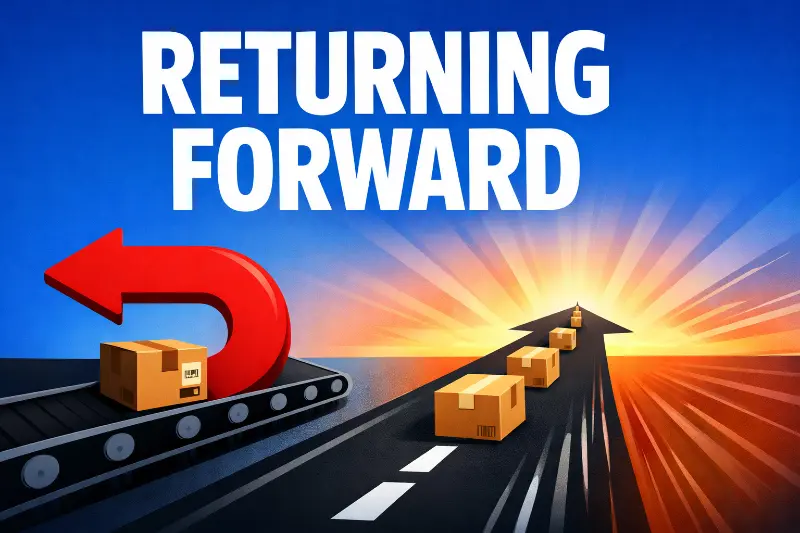
The future of ecommerce returns will not be decided by better software or bigger warehouses. It will be decided by whether the industry is willing to question the assumption that has governed reverse logistics since the beginning: that returned goods must travel backward through the supply chain before they can move forward again.
With the rapid rise of online shopping, return rates have surged, creating new challenges for ecommerce retailers. According to the National Retail Federation, nearly 30% of all online purchases are returned, compared to just 8.9% in physical stores, and in 2023, total returns for the retail industry amounted to $743 billion in merchandise. These numbers align with broader benchmarks on the average ecommerce return rate and reflect the structural forces behind the rise of e-commerce return rates.
That assumption made sense once. It no longer does. And the evidence is not subtle.
Returns Did Not Break Because Retailers Failed
This is the part most industry conversations skip.
There is a comfortable narrative in retail operations that returns became a problem because brands got too generous, or moved too fast, or failed to anticipate scale. That framing is wrong, and it matters that it is wrong, because misdiagnosing the cause leads to misaligned solutions.
Returns did not break because retailers executed poorly. They broke because the system they were built on no longer fits reality. Returns cost merchants significant amounts—reports estimate that returns cost merchants $100 for an ecommerce order, with much of the stock thrown away, donated, or sold off to liquidators, highlighting how ecommerce return rates affect profit margins.
The original return model was designed for a specific set of conditions. Returns were built for low volume, human-paced decision-making, cheap labor, invisible waste, and centralized infrastructure. Every assumption embedded in warehouse-centric reverse logistics depended on those conditions holding.
Modern commerce operates under none of them.
SKU counts exploded. Consumer expectations hardened around instant refunds and frictionless experiences. Ecommerce penetration normalized, then plateaued, while return rates stayed elevated. Fraud scaled alongside volume. Labor costs rose. Sustainability became a reporting requirement, not a PR gesture. And the economics of routing every return through a centralized distribution center quietly became untenable at scale, especially as returns fraud and refund fraud amplified the financial impact. The eCommerce returns market is projected to reach $644 billion by 2026, driven by the increasing number of online shoppers and rising customer expectations regarding returns, making it critical for merchants to develop a clear returns strategy to optimize returns and control costs.
Understanding why returns were never designed for ecommerce scale is the first step toward understanding why surface-level fixes keep falling short. The returns process was an episodic function retrofitted onto an industrial reality it was never meant to absorb.
What the Industry Got Wrong About Consumer Expectations
The industry recognized the problem. The response, however, was structural preservation dressed up as innovation.
Over the past decade, retailers and vendors pursued five primary strategies. They added software layers. They expanded warehouses. They consolidated carriers. They tightened policies. And they shifted risk to customers.
Each of these bought time. None changed the direction of the system.
Returns Management Systems improved the customer experience at the front end. Self-serve portals, branded return flows, policy automation, and analytics dashboards all represent genuine progress on UX. But they route returned items back to the same warehouses, through the same labor queues, with the same markdown exposure waiting at the end. A better on-ramp to a broken road is still a broken road.
Scale was supposed to help. The logic was intuitive: more volume should produce lower unit costs, more warehouse efficiency, better resale outcomes. The warehouse-centric return loop does not behave that way. Returns suffer from diseconomies of scale. Higher volume increases inbound congestion, makes labor harder to staff and manage, amplifies fraud exposure, and slows the inventory velocity that determines recovery value. By the time total U.S. retail returns reached $890 billion in 2024, the highest level on record, scale had proven it was not the solution. It was an accelerant.
Carrier consolidation followed the same pattern. UPS acquiring Happy Returns and its drop-off return network was the clearest signal that the industry was betting on convenience and physical reach rather than structural redesign. Drop-off networks improved the customer experience at the front of the returns process. Items still funneled back into centralized facilities. The cost structure remained.
Policy tightening, charging return fees, shortening windows, restricting eligible categories, transferred some pain from retailer to consumer. That is a real lever, and its normalization by brands like Zara and H&M demonstrated that consumers will adapt when the entire market moves together, even as free returns increasingly come to an end. However, clear and flexible return policies are crucial for building customer trust and avoiding negative reviews, as poor return experiences can quickly erode confidence and damage reputation. In fact, more than half of online shoppers have decided against making a purchase due to a company’s poor return policy, highlighting the importance of flexible and reasonable return policies in building customer loyalty. But tighter policies reduce return volume at the margins. They do not change the economics of the returns that still happen.
The result, across all of these approaches, is the same: a system that has been optimized repeatedly without being changed fundamentally.
Why This Moment Is Different
The forces now converging on returns are not cyclical. They are structural, and they are arriving simultaneously.
Platforms are making returns visible and punitive. Amazon introduced product-level visibility on frequently returned items and seller penalties tied to excessive return rates. This is not just a policy change. It is a signal that returns are becoming a reputational variable, not just an operational cost. Consumer behavior is being shaped by this visibility in ways that will compound over time.
Retailers are normalizing return fees. What began as a cautious experiment by a handful of major apparel brands has become an industry pattern. Consumers who once would have churned over a return fee now accept them as a standard part of the ecommerce returns process. That expectation reset is durable, and it signals that the social contract around free returns has been renegotiated.
Carriers are consolidating without lowering cost. FedEx launched Easy Returns in 2025, joining UPS in the race to own return entry points. The pattern is clear: carriers are competing for first-mile control, not for structural cost reduction. More drop-off locations do not eliminate the warehouse step. They extend the foyer.
Regulators are targeting waste and emissions. France has banned the destruction of unsold goods. The EU has moved against fashion landfilling. The SEC has signaled that Scope 3 emissions disclosures, which include reverse logistics, are coming for U.S. companies. Extended Producer Responsibility frameworks are spreading. For global brands, these are not future risks. They are current compliance requirements.
Consumers are recalibrating expectations. The same shoppers accepting return fees are also paying attention to sustainability. Research consistently shows that a majority of consumers say environmental impact influences purchasing decisions. Returns that visibly generate waste are a brand risk that grows over time, not one that fades.
Boards are asking harder questions. Returns now appear in conversations about margin durability, working capital efficiency, Scope 3 liabilities, and fraud exposure. The question has shifted from “how do we manage return costs?” to “why are return costs rising faster than revenue, and which portion of this is actually controllable?”
Returns have a significant impact on profitability for online retailers, with retailers typically losing 10% to 20% of the merchandise value on returns. This loss complicates pricing and discount strategies and puts additional pressure on operational efficiency, raising hard questions about the true cost and sustainability of free returns. To address these challenges, online retailers must invest in the right technology—such as ERP, OMS, and inventory management systems—to streamline returns processes and control costs. AI-driven automation is also shaping the future of ecommerce returns by reducing high logistics costs and helping meet rising customer expectations for seamless, sustainable experiences.
Taken together, these forces tell a clear story. The old model is not just inefficient. It is unstable. Instability of this kind does not resolve through incremental adjustment. It resolves through structural change.
The Turning Point in the Returns Process Is Routing Logic
Every solution covered above, from returns software to carrier drop-off networks to policy tightening, attempts to reduce pain without changing the core assumption. The assumption is that returned items must travel backward through the supply chain before they can re-enter the market.
That assumption is the problem.
The turning point is not better tooling, stricter rules, or additional warehouse capacity. The turning point is changing routing logic itself.
Peer-to-peer returns challenge the most fundamental constraint in reverse logistics by inverting the direction of flow. Instead of routing returned goods back to a warehouse for intake, inspection, repackaging, and eventual resale, P2P forwards eligible items directly from the returning customer to the next buyer. The return stops moving backward. It becomes a forward-moving transaction.
Automation streamlines handling return requests and issuing return labels, allowing customers to quickly download labels and ship items directly to the next buyer. This not only improves efficiency and customer satisfaction but also helps get items back on virtual shelves faster. Machine learning can optimize where returned goods are sent, minimizing transportation costs and improving inventory levels by ensuring returned products are routed to the most appropriate locations. These technologies help optimize returns by making the process more effective, efficient, and profitable.
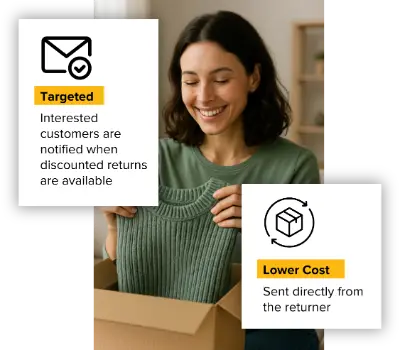
The mechanical shift is straightforward. A buyer initiates a return through a standard branded portal. The system evaluates eligibility based on SKU type, condition thresholds, return reason, and demand signals. If the item qualifies, a “Like New” listing is generated on the same product page as the new item, priced at a modest discount. The returner receives a label addressed to the next buyer, not to a warehouse. Tracking confirms delivery. Refund is issued. Inventory, financials, and order records update automatically.
What changes is where the item goes. Everything else, the branded portal, the policy logic, the carrier infrastructure, the customer communication, stays the same.
What Peer-to-Peer Returns Process Actually Changes
When routing changes, the consequences are not incremental. They are categorical.
Entire cost layers disappear. There is no inbound dock. No receiving labor. No inspection queues. No re-shelving. No redundant inbound shipment. In a traditional returns flow, every returned item accumulates cost at each stage of the reverse journey. In fact, returns can drain up to two-thirds of an item’s original value, affecting not only shipping and restocking but also causing inventory disruptions and customer dissatisfaction. In a P2P flow, those stages do not exist for eligible items. The cost is not reduced. It is removed.
Inventory velocity improves. In traditional flows, items wait days or weeks while they move through intake and inspection before becoming available for resale. During that time, seasonal demand decays and markdown pressure builds. In P2P, items move immediately to the next buyer. Value is captured once, intentionally, not eroded over time through repeated discounts. Improved inventory levels and product quality, supported by better product descriptions and enhanced product listings, can reduce returns and enhance customer satisfaction. Providing customers with detailed product information and gathering feedback helps improve product quality and reduce returns. AI can also analyze customer data to improve product descriptions and sizing charts, reducing misfit rates and further minimizing returns.
Fraud opportunities shrink. Traditional returns create fraud exposure at every handoff. Wardrobing, item swapping, and empty box scams all exploit the opacity and delay built into multi-step warehouse processing. When a return travels point-to-point, with refunds tied to confirmed delivery, the attack surface collapses. There is no anonymous warehouse queue where conditions cannot be verified. Fewer handoffs mean fewer cracks to exploit.
Waste declines. A traditional return travels twice before reaching the next buyer: outbound to the original customer, back to the warehouse, and often a third time to a resale or liquidation channel. P2P removes one full shipping leg and the associated packaging. Across millions of returns, the reduction in emissions and material waste is substantial and aligns with broader strategies for supporting eco-friendly ecommerce returns.
Sustainability becomes measurable, not rhetorical. Scope 3 emissions reporting, which increasingly includes reverse logistics, becomes a tractable problem when shipping legs are eliminated by design rather than optimized at the margins. ESG disclosures gain specificity. Regulatory narratives gain credibility. Consumer-facing sustainability claims become verifiable.
This is not optimization. It is structural realignment. The distinction matters because optimization preserves the underlying system while extracting incremental efficiency. Structural realignment changes what the system does by default.
What Peer-to-Peer Actually Represents
There is a risk of misframing peer-to-peer returns as a product feature or a policy configuration. That framing is both inaccurate and strategically unhelpful.
Peer-to-peer is not a feature. It is not a tool. It is not a policy tweak.
It represents a different way of thinking about what returns are and where they belong in the commerce cycle. In the traditional model, returns are a reversal, a transaction going backward, generating cost and consuming time before value can be recovered. In the P2P model, returns are forward-moving transactions, recoverable value flows, and shared accountability events between the returning customer, the next buyer, and the brand.
Returns become strategic infrastructure rather than operational cleanup. Optimizing returns in this way and crafting the perfect ecommerce returns program can drive long term profitability and provide a competitive advantage by reducing operational costs and enhancing customer satisfaction. Offering store credit as a resolution option can help retain customer loyalty and appeal to future customers, especially when used to address return fraud or clarify policies. Additionally, a clear and comprehensive returns policy that transparently explains fees and offers multiple options can reduce lost sales by setting realistic expectations and improving the overall customer experience.
That distinction has practical implications. It means the question facing logistics and operations teams is not “how do we process returns faster?” It is “how do we change where eligible returns go so that processing becomes unnecessary?” The question facing finance leaders is not “how do we reduce cost per return by a few dollars?” It is “how do we eliminate entire cost categories for the majority of our returns volume?” The question facing board members is not “what are our return metrics this quarter?” It is “do our returns flow in a direction aligned with how modern commerce actually works?”
There is also an important constraint embedded in this framing. P2P returns coexist with warehouses. They respect constraints. They do not pretend to solve everything.
Fragile goods that require professional repackaging still route through traditional flows. Regulated categories with chain-of-custody requirements remain warehouse-dependent. Defective items still need verification and root-cause analysis. End-of-season merchandise without downstream demand is a liquidation case, not a P2P case.
In practice, roughly 60% of returns across most ecommerce operations are viable P2P candidates. The remaining 40% continue through existing reverse logistics channels. Warehouses do not disappear. They become specialized exception handlers rather than default endpoints. That is a meaningful shift in what warehouses are for, not an elimination of what they do.
The credibility of P2P as a model rests precisely on this restraint. A system that acknowledges its boundaries is one that can be implemented with discipline.
The Strategic Choice Ahead for Customer Loyalty
Every retailer now faces a decision, whether made explicitly or by default through inaction.
Option one is to continue absorbing return losses and hope that incremental fixes keep pace with escalating costs, fraud, regulation, and competitive pressure. This means continued investment in returns software that improves UX without changing economics, warehouse capacity that scales costs alongside volume, carrier relationships that optimize convenience without eliminating structural waste, and policy adjustments that transfer pain without resolving it. Protecting margin in this scenario requires careful management of shipping costs and return shipping, as these expenses can significantly erode profits—especially considering that the cost of processing an online return averages 21% of an order’s value.
Option two is to redesign returns as a system that reflects how commerce actually works today. That means auditing return flows against fully loaded cost structures, identifying the subset of SKUs and categories where P2P economics deliver the clearest advantage, piloting with controlled scope to generate evidence rather than assumptions, and building the guardrails, condition standards, and fraud controls that make the model trustworthy at scale. Improving efficiency through technology investments and leveraging data analytics to understand customer behavior are critical to optimizing returns and reducing unnecessary costs.
Doing nothing is not neutral. Doing nothing is a decision to let costs, fraud, and waste compound.
Return losses do not stay constant while the organization evaluates alternatives. Every year of delay locks in avoidable cost, increases regulatory exposure, normalizes inefficient behavior, and weakens competitive position relative to operators who have already begun the transition. Structural problems do not self-correct. They intensify.
The companies that act early will define the standard. Those that wait will inherit it on worse terms.
For CFO-level evaluation of what this transition means for gross margin and capital efficiency, the core question is not whether returns are expensive. That has been established. The question is whether the organization is structurally equipped to reduce that expense by eliminating cost categories rather than managing them. For board-level framing, the question is whether returns are treated as a strategic capability or as a tolerated liability. Those two framings produce very different investment decisions.
Closing
Returns have been treated as a back-office problem for long enough that the assumption calcified. They are not a back-office problem. They are a test of whether ecommerce infrastructure can evolve without breaking under its own weight.
The scale is no longer deniable. The economics are no longer manageable through incremental improvement. The regulatory environment is no longer optional. The consumer expectations are no longer stable. The fraud exposure is no longer containable through reactive detection.
Peer-to-peer returns do not promise perfection. They offer something more valuable: a credible path out of a system that no longer works. One that changes direction rather than adding complexity. One that reduces cost by eliminating stages rather than optimizing them. One that turns returns from a structural liability into a structural advantage for the operators willing to rethink the routing.
A hassle-free returns process creates a positive experience, keeps customers happy, and encourages future purchases. According to a survey, 96% of shoppers are more likely to purchase again if returns are hassle-free, showing that a smooth return process can encourage customer loyalty with an exceptional returns program.
Returns don’t need to go back. They need to go forward.
Frequently Asked Questions
What does it mean to say the future of ecommerce returns requires structural change rather than optimization?
Optimization improves how the existing system performs. Structural change alters what the system does by default. The current warehouse-centric returns model can be optimized through better software, more efficient labor, and improved analytics, but the core cost drivers: two shipping legs, intake labor, inspection, repackaging, and markdown delay, remain in place regardless of how well the front end is managed. Structural change means changing routing logic so that a significant portion of returns never enter that loop at all. This includes offering flexible options such as online returns, mail-in returns, and in-store returns, where customers can return items in store regardless of their initial purchase channel (for example, buy online, return in store), enhancing convenience and reducing costs.
Why have returns management software platforms not solved the cost problem?
Returns Management Systems have meaningfully improved the customer experience and process visibility on the front end of the returns process. What they have not changed is where returned items go. In almost every case, RMS platforms still route eligible returns back to a warehouse, a 3PL, or a centralized inspection facility. The expensive steps: inbound freight, receiving labor, repackaging, restocking, and markdown exposure, remain intact. Better tooling accelerates volume into the same reverse flow. It does not remove the flow. However, many platforms now offer self-service portals for online returns, allowing customers to initiate returns, download shipping labels for mail-in returns, and track status—reducing customer service inquiries by up to 50%.
How does peer-to-peer returns work mechanically?
A buyer initiates a return through a standard branded portal. The system evaluates the item’s eligibility based on SKU type, condition, return reason, and demand signals. If eligible, a “Like New” listing is generated at a modest discount. The returning customer receives a shipping label addressed to the next buyer rather than to a warehouse. Tracking confirms delivery to the new buyer, the returner is refunded, and all inventory and financial records update automatically. The warehouse intake step is eliminated for that transaction.
Which product categories are well suited to peer-to-peer returns?
Apparel, footwear, and accessories are high-fit candidates because they carry stable resale value, tolerate consumer packaging, and generate high return rates with predictable demand. Durable home goods and non-fragile consumer items are medium-fit. Fragile goods, regulated categories such as cosmetics or medical devices, defective or damaged items, and end-of-season merchandise with limited remaining demand are not well suited. P2P is a hybrid strategy. The goal is not to route 100% of returns peer-to-peer but to identify the majority of recoverable volume where the model delivers clear advantage.
What happens to the 40% of returns that do not qualify for peer-to-peer?
They continue through existing reverse logistics channels. Warehouses do not disappear under a P2P model. They become specialized exception handlers for defective, damaged, regulated, or otherwise non-recoverable items rather than the default endpoint for all returns. The operational shift is in what warehouses are responsible for, not whether they exist.
Why is fraud exposure lower in a peer-to-peer returns model?
Traditional returns create fraud opportunities at every handoff. Wardrobing, item swapping, and empty box scams all depend on the opacity and delay built into multi-step warehouse processing. In a point-to-point flow where refunds are tied to confirmed delivery and items never pass through anonymous warehouse queues, the attack surface shrinks materially. Fewer touchpoints mean fewer opportunities to exploit gaps in condition verification.
Is the normalization of return fees by major retailers a sign that the old model is breaking?
Yes. Zara, H&M, Anthropologie, J.Crew, and others introducing paid return fees is not primarily a revenue strategy. It is a signal that the economics of free returns have become unsustainable across the industry. Consumer backlash was widely predicted and largely did not materialize, which indicates that the expectation reset is durable. The entire market moving together on fees shows that tolerance for absorbing full return costs has reached its limit, even if the structural problem underneath those costs has not yet been addressed. For low-value items, retailers are increasingly offering returnless refunds, allowing customers to keep or donate the item. At the same time, shoppers may face increased friction for returns, such as fees or mandatory use of specific drop-off locations.
How is technology being used to improve the returns process?
Retailers are leveraging self-service portals for online returns, enabling customers to initiate returns, print shipping labels for mail-in returns, and track their return status—reducing customer service inquiries by 50%. Augmented Reality (AR) tools are being used to help customers visualize products before purchasing, which has led to a 20% to 40% decrease in return rates for brands using AR. High quality images, especially in Amazon A+ Content, also help customers better understand products, reducing incorrect sizing issues and overall return rates. AI is increasingly used to create dynamic, personalized return experiences, automate return eligibility, provide instant refunds, and suggest personalized exchanges. AI also scans for return fraud, such as item swapping or serial returners, by assigning risk scores to transactions, and analyzes customer data to improve product descriptions and sizing charts, further reducing misfit rates and returns due to incorrect sizing.
Written By:

Manish Chowdhary
Manish Chowdhary is the founder and CEO of Cahoot, the most comprehensive post-purchase suite for ecommerce brands. A serial entrepreneur and industry thought leader, Manish has decades of experience building technologies that simplify ecommerce logistics—from order fulfillment to returns. His insights help brands stay ahead of market shifts and operational challenges.

Turn Returns Into New Revenue
Related Articles
Save Money With Ecommerce Shipping Software: Next-Gen Solutions
Shipping costs are one of the biggest challenges for ecommerce businesses today, and understanding them is essential to reducing expenses and increasing profit margins.
10 Best European 3PLs for Ecommerce Sellers in 2026
Bigblue is the best overall choice among the best European 3PLs in this comparison: one provider with 11 fulfilment centres across France, Spain, Italy, the UK, and Germany, its ow...
Why Returns Are Becoming a Board-Level Topic
Returns have quietly become one of the most consequential financial problems in ecommerce, and boards are finally being forced to confront what operators have known for years: retu...