
Walmart Officially Allows Amazon Multi-Channel Fulfillment (MCF)
In this article
 9 minutes
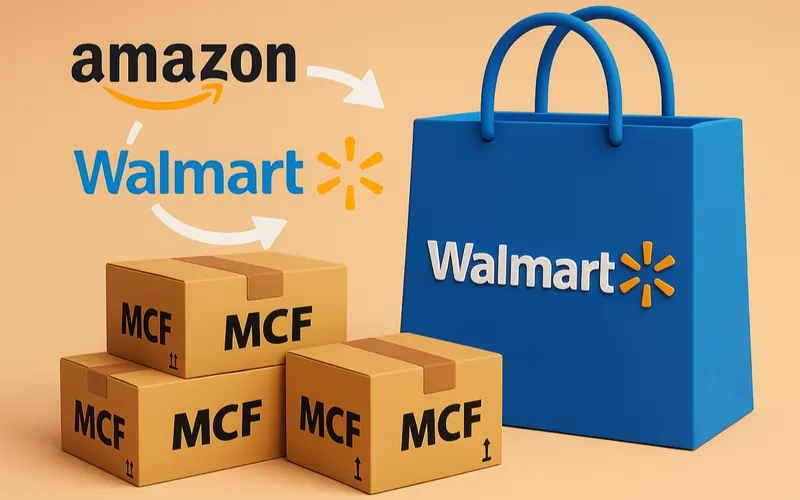
Big news for multichannel sellers: Walmart now officially allows Amazon Multi-Channel Fulfillment (MCF), Amazon’s service for using its fulfillment network to ship orders from multiple sales channels, including Walmart, when sellers follow rules such as neutral packaging and no Amazon branding. For sellers managing products across Amazon, Walmart, and other marketplaces, that opens up a practical way to streamline fulfillment, cut operational overhead, and keep delivery speed competitive without building a separate logistics stack for every channel.
The policy change also comes with tradeoffs. Below, we break down what Walmart now permits, the compliance requirements sellers need to meet, the main benefits and drawbacks of using Amazon MCF for Walmart orders, and the cost, efficiency, and customer-experience factors to weigh before making it part of your multichannel strategy.
What’s Changed?
Previously, Walmart prohibited the use of Amazon MCF for order fulfillment. However, as of May 15, 2025, Walmart’s updated Shipping & Fulfillment policy states, and this also reflects that MCF integrates with platforms like Walmart Marketplace and a Shopify store across other sales channels:
“You may use Multi-Channel Fulfillment as long as you ship in neutral packaging using unbranded delivery vehicles, which means neither can display any logos, trademarks, or branding of the other retailer.”
This policy shift allows sellers to leverage Amazon’s robust fulfillment network to process walmart marketplace orders, or compare it with Walmart Fulfillment Services (WFS), provided they adhere to the neutral packaging and carrier requirements (they don’t want Amazon logos on packaging, tape, trucks, driver uniforms, etc.).
Why Now?
Walmart’s decision reflects the evolving landscape of ecommerce, where flexibility and efficiency are paramount. By permitting Amazon MCF, Walmart acknowledges the needs of ecommerce sellers and marketplace sellers that sell on multiple channels, including their own website and other marketplaces. It also recognizes MCF as a logistics service that can streamline fulfillment and simplify ecommerce operations across those sales channels, making it a powerful tool within a broader multichannel fulfillment and sales strategy. This move aligns with broader trends in retail logistics, emphasizing interoperability and seller convenience.
What It Means for Sellers
Pro Tips for Sellers
1. Inventory Management:Maintain accurate inventory levels in Amazon’s fulfillment centers to prevent stockouts on Walmart orders. You’ll also need to send inventory into the amazon fulfillment network and watch monthly storage fees, including storage fees of $0.78 per cubic foot for standard-size items and $2.40 from October to December. Avoid committing inventory too early, since FBA inventory limits can reduce stock available for MCF orders; improving your Inventory Performance Index (IPI) score can also help ease some storage-type limits.
2. Carrier Settings: Configure your Amazon MCF settings to block Amazon Logistics for Walmart orders, complying with Walmart’s delivery requirements. In Seller Central, your seller central account is also where you manage carrier settings, submit and monitor orders, and connect an order management system for automated order processing that reduces manual data entry from non-Amazon sales channels by mapping each channel’s shipping method to Amazon’s options. MCF also connects with Shopify, BigCommerce, and WooCommerce, plus major ecommerce platforms and other ecommerce platforms through pre-built apps and APIs, so you can pair it with a hybrid FBA vs FBM fulfillment approach.
3. Packaging Compliance: Ensure all shipments to Walmart customers are in neutral packaging, devoid of any Amazon branding.
4. Cost Analysis: Regularly assess the cost-effectiveness of using Amazon MCF for Walmart orders, considering the additional surcharges and fees and whether a third-party logistics (3PL) ecommerce fulfillment alternative could lower overall costs. Review mcf pricing with Amazon’s calculator because MCF fulfillment fees and other fulfillment fees vary by order size, destination, shipping method, and multi unit orders, and MCF fulfillment fees increased by $0.30 on January 15, 2026. Also remember referral fees do not apply to MCF orders, but shipping costs, cross border fulfillment, and international shipping fees still matter, and remote-area surcharges can be steep, including 100% for standard-size shipments to Alaska and Hawaii.
5. Monitor Performance: Keep an eye on delivery times and customer feedback to ensure the fulfillment process meets Walmart’s standards. When using MCF across multiple sales channels, clearly share shipping details and expected delivery timelines with customers, and consider Merchant Fulfilled Prime or other FBA alternative fulfillment options as a contingency if MCF performance slips.
Final Thoughts
Walmart’s policy update to allow Amazon MCF is a significant development for multichannel sellers, giving eligible sellers and other online businesses a third party logistics option for orders across other sales channels. It offers an opportunity to streamline operations, reduce some overhead expenses, and enhance customer satisfaction with potentially faster delivery from distributed fulfillment; Amazon fulfillment can also support international fulfillment, with MCF supporting order fulfillment from 11 countries and posting a 97% on-time delivery rate, while solutions like Amazon FBM shipping and order fulfillment services can provide additional flexibility for non-Walmart channels, though businesses with broader supply chain needs should still compare hybrid models and alternative providers. However, it’s crucial to navigate the associated requirements carefully to fully leverage the benefits of this new fulfillment option. And fulfillment costs will need to be monitored closely to make sure that it makes sense to use MCF. If not, businesses evaluating other sales channels should compare fulfillment fees and storage fees with another distributed fulfillment provider such as Cahoot before choosing the best fit.
Frequently Asked Questions
Does Walmart allow Amazon Multi-Channel Fulfillment (MCF)?
Yes. Under Walmart’s Shipping & Fulfillment policy update effective May 15, 2025, sellers may use Amazon MCF for Walmart Marketplace orders. The policy requires neutral packaging and unbranded delivery vehicles, so neither Amazon nor Walmart logos, trademarks, or branding can appear on the shipment.
What are the compliance requirements for using Amazon MCF for Walmart orders?
Walmart orders must ship in neutral packaging with no Amazon logos, trademarks, or branding on boxes, tape, inserts, delivery vehicles, or driver uniforms. Sellers must also configure MCF to block Amazon Logistics as a carrier on those orders. Both requirements need ongoing monitoring, because a setting change or a packaging mistake can put the account out of compliance.
How do I block Amazon Logistics for Walmart orders?
You manage this in your Seller Central account, where you set carrier preferences for MCF orders. If you use an order management system or a connected platform, confirm that Walmart orders are submitted with the unbranded packaging and carrier-blocking settings applied. Test a few orders and check the carrier and packaging details before scaling volume.
Is there a surcharge for blocking Amazon Logistics?
Amazon has applied a 5% surcharge on MCF fees when sellers block Amazon Logistics. Amazon has also stated that this surcharge is waived through January 14, 2027. Because the terms can change, confirm the current surcharge status in Amazon’s MCF fee documentation before you build it into your cost model.
How much does Amazon MCF cost compared with FBA?
MCF is generally more expensive than FBA, and in many cases roughly two to three times the cost. That can be hard to justify in low-margin categories. MCF fees vary by order size, destination, shipping speed, and multi-unit orders, and they increased by $0.30 on January 15, 2026. Use Amazon’s calculator with your own catalog, and compare the result against a 3PL or Walmart Fulfillment Services.
Does Amazon prioritize FBA orders over MCF orders?
Yes. Amazon prioritizes FBA orders, so MCF orders can be delayed during peak periods. If Walmart delivery performance matters to your account, monitor on-time delivery and customer feedback closely. Keep a backup fulfillment option ready in case MCF performance slips.
Who handles customer service for Walmart orders fulfilled through Amazon MCF?
You do. Amazon handles picking, packing, and shipping, but the seller remains responsible for customer service, returns decisions, and communication on Walmart orders. You are also responsible for staying compliant with both Walmart’s and Amazon’s policies.
Is Amazon MCF the right fulfillment option for Walmart sellers?
It depends on your margins, volume, and inventory strategy. MCF can make sense if you want to consolidate inventory in Amazon’s network and keep delivery fast without adding warehouse space or staff. If higher fees, FBA inventory limits, or delivery risk are concerns, compare it with Walmart Fulfillment Services and a distributed 3PL network before committing.
Written By:

Jeremy Stewart
Jeremy Stewart leads customer success at Cahoot, helping merchants achieve high-performance logistics through smart technology and process optimization. With a background in both ecommerce operations and client services, Jeremy ensures that every merchant using Cahoot gets measurable results—whether they’re scaling from one warehouse to many or managing complex returns.

Turn Returns Into New Revenue
Related Articles
Why More Automation Didn’t Lower Return Costs
Returns automation does improve returns operations: it cuts manual touches, smooths intake, speeds sorting, and makes workflow execution more consistent.
Shopify Subscription Payment Change: Why It Could Hurt Reactivation
Shopify changed how subscription payment information is handled at cancellation.
Why Small Ecommerce Brands Are Winning with AI (While Enterprises Struggle)
Conventional wisdom says large companies should dominate AI adoption.
AI Search Optimization: How AEO and GEO Are Reshaping Ecommerce SEO

In this article
8 minutes
- What Is AEO and GEO?
- Old SEO vs. New AI Search: What’s Actually Changing
- Why This Matters for Ecommerce Brands
- What We’ve Learned from Cahoot’s Own Content Shift
- The 4 Rules of AEO-Friendly Content
- AI Search Optimization for Shopify Brands
- Where to Focus First
- Let Me Be Blunt
- Final Thoughts: The Content You Publish Now Shapes How You Show Up Later
- Frequently Asked Questions
If your SEO strategy still revolves around exact-match keywords, you’re already behind.
AI search optimization in ecommerce means adapting your content and ecommerce AI SEO strategy for answer engines and generative search, so artificial intelligence tools like Google’s AI results, ChatGPT, and Perplexity can understand, summarize, and surface your product and category pages. It’s changing everything: how your blog posts rank, whether your product pages get seen, and how AI-driven search environments replace clicks with answers. I’ve been neck-deep in ecommerce content for years, and I can tell you this shift is not incremental. It’s existential.
For ecommerce brands, Shopify sellers, marketers, and content teams, the old SEO playbook is no longer enough. This guide breaks down what AEO and GEO actually mean, how AI search differs from traditional SEO, why that shift changes ecommerce discovery and sales, and which practical moves matter first—from clearer, intent-focused copy to structured data, FAQs, and other AI SEO strategy updates that help your pages earn visibility in AI-generated results.
What Is AEO and GEO?
First, let’s unpack the acronyms everyone’s whispering about:
- AEO (Answer Engine Optimization): Optimizing for AI-generated answers, not blue links. Think Google’s AI Overview or Perplexity’s sidebar; these don’t link out unless they’re confident your content is the definitive source.
- GEO (Generative Engine Optimization): Tailoring your content to feed large language models the best possible structured, semantically rich information. GEO is about writing for the model, not just the human.
Together, these represent a massive evolution in how ecommerce content needs to be structured, written, and distributed.
Old SEO vs. New AI Search: What’s Actually Changing
Let’s say you sell eco-friendly cookware. Under traditional SEO, you’d rank by optimizing for terms like “non-toxic frying pans” or “ceramic skillet USA made.” That still matters, but not in the same way.
In AI search:
- The model decides relevance, not just keywords.
- It often summarizes your content, not just links to it.
- If you’re not structured to answer the exact intent behind the query, you don’t show up, even if you rank.
So even if your article ranks #3 in Google, the AI Overview might feature a competitor who has better contextual clarity, semantic structure, or schema.
Why This Matters for Ecommerce Brands
Ecommerce brands often underestimate how many categories, products, and help articles become part of zero-click AI summaries, and how much smarter ecommerce order fulfillment as a profit driver needs to be in that environment. Unlike traditional search engines, AI-driven search changes how product discovery happens in Google Search and other AI platforms, including conversational prompts that shape ai generated responses before a shopper ever clicks. If a shopper asks:
“Are silicone baking mats safe?”
In AI search:
- modern search bars use natural language processing to handle conversational queries, and visual search lets shoppers upload images to find similar items
- ai generated results and ai responses can appear directly in the interface, shifting ai visibility toward sources with strong citations and clear ai mentions
- user generated content like reviews, customer photos, and unboxing clips can strengthen trust and authority signals
AI Overviews and AI-generated summaries now appear in about 20% of US searches, reducing click-through rates by 58% and increasing zero-click searches, a trend that’s front and center at major ecommerce logistics and fulfillment events.
And your product page buries the answer in the 5th paragraph, or worse, doesn’t address it directly, you’re not getting surfaced. Another brand will.
Even worse? The AI might quote you but link to someone else, a review site, a Quora thread, even Reddit. That also means AI search compresses the traditional multi-touchpoint funnel, since shoppers can refine queries, compare options, and discover products without leaving the interface.
That’s what AEO punishes: weak content architecture and lack of clarity.
What We’ve Learned from Cahoot’s Own Content Shift
We started optimizing Cahoot’s ecommerce blog content for AEO/GEO in late 2024. It wasn’t about stuffing more keywords, it was about:
- Answering the core query in the first 100 words.
- Structuring posts semantically with proper H2, H3, and H4 usage and section labeling.
- Repeating intent-rich phrases like “shipment exception,” “multi-node fulfillment,” or “Walmart DSV shipping compliance” multiple times in natural ways.
- Embedding FAQs that mirror real-world queries (not just made-up ones).
The result? We’re seeing way more snippets, longer dwell times, and better AI Overview inclusion, without obsessing over backlinks.
The 4 Rules of AEO-Friendly Content
If you’re creating blog posts, product pages, shipping policy FAQs, or comparison tables, here’s what you need to bake in:
- Write Like You’re Explaining to AI
Models need clarity, consistency, and repetition. Don’t be clever, be direct. Use terms like “Walmart Fulfillment Services fees” multiple times, and make every section serve a question. - FAQs Are Gold
These are your AEO frontline. Phrase each as a real query (think: “Is FedEx Ground faster than UPS?”) and answer them in tags, not in complicated tables or drop-downs. - Don’t Hide Your Answers
Don’t bury key product differentiators or return policy rules halfway down the page. AI isn’t scrolling, it’s scanning. - Schema Still Matters
Mark up reviews, pricing, FAQs, and organization details with structured data. You’re not doing it for Google’s web crawler, you’re doing it for ChatGPT, Perplexity, Claude, and whatever next model ingests your site.
AI Search Optimization for Shopify Brands
Shopify sellers are especially vulnerable here. Why?
Because most rely on thin content + generic templates, even though strong ecommerce SEO still depends on clear product content, structured pages, and technically sound site architecture on an ecommerce site, and matching shopper intent tends to drive higher conversion rates better than chasing keywords alone, especially when supported by scalable order fulfillment services for ecommerce companies. If your product page is just:
- Title
- bullet points
- “Ships in 3–5 days”
Then AI search skips right over you, especially if your Shopify order fulfillment strategy doesn’t support fast, reliable delivery.
Add in:
- Clear long-form descriptions
- Embedded questions + answers
- Shipping and return terms in plain language that align with your eBay fulfillment and fast-shipping strategy
- Customer reviews with quoted concerns and results
For an online store, those FAQ sections should give direct answers in short paragraphs or bullet points that AI can extract easily. Don’t hide your answers lower on category pages; surface product details and core product data near the top of the page. Schema still matters, so validate it in Search Console and Google’s Rich Results Test, and keep a merchant center feed, product feed, or complete product feed aligned with on-page markup. If you sell through google shopping, keep google merchant center synced so the same product data appears consistently across the ecommerce site. That also makes user generated content easier to trust in context.
…and suddenly you’re more summarizable. More quotable. More linkable. Consistent schema helps AI rely less on crawlable URLs alone.
Where to Focus First
If you don’t have time to redo everything, prioritize:
- Help Center articles (these get quoted often)
- Shipping & Return policies (Google surfaces these directly)
- Category-level content (for “best [category] for [need]” searches)
- Comparison pages (Perplexity loves these)
Then build forward-looking posts that clearly address queries like:
- “Is Shopify or Amazon better for small brands?”
- “What is Walmart DSV?”
- “How do I create a return policy for cosmetics?”
Because guess what? AI answers those, and who it quotes is not random. That matters more as google ai overviews and other ai platforms reshape product discovery. AI-powered recommendations, behavioral data, past-purchase patterns, and automated merchandising can improve relevance and raise higher average order values, especially if you’re also mitigating rising FedEx and UPS surcharges in 2025.
Let Me Be Blunt
AI Search doesn’t reward clever. It rewards clear. It doesn’t care how beautifully your paragraph reads if it doesn’t match the user’s intent, because ai systems are looking for structure they can interpret fast.
Most ecommerce brands are still optimizing for CTR in search when the real game is placement in the AI summary. Category-level content should support product discovery and “best for” shopping queries, and product pages should give direct answers with clear specs, comparisons, and use cases.
You want to be the quote, not the footnote. Prioritize the AI platforms most likely to surface your products, including experiences tied to Google Shopping and Google AI Overviews.
Final Thoughts: The Content You Publish Now Shapes How You Show Up Later
Most LLMs ingest web content with a delay, so what you publish in August affects your visibility in October and beyond. If you’re planning for holiday, Prime Day, or peak, you need AEO-friendly content on the web today, because AI systems reward direct answers that clearly match intent, not elegant copy that avoids the point.
This is the new moat. In practice, ecommerce ai seo is less about polishing prose and more about giving machines clean, usable answers, while ai visibility becomes the discipline of tracking how often your brand is mentioned, cited, or recommended in generated results. Every article, every policy page, every FAQ that answers a real query in a structured, repetitive way, makes you more visible in the generative layer of search.
If you’re not writing for LLMs, you’re already losing traffic you never knew you were missing.
Frequently Asked Questions
What is the difference between AEO and traditional SEO?
AEO (Answer Engine Optimization) focuses on how content is summarized and surfaced in AI-generated answers, while traditional SEO focuses on ranking in search engine result pages. AEO prioritizes clarity, intent-matching, and semantic structure.
How does AI search impact ecommerce product pages?
AI search pulls from product pages that clearly answer user intent. Unlike traditional search engines that focus more on ranking links, AEO prioritizes direct answers, and both sit within a broader AI SEO approach. Thin content or vague product descriptions are ignored. Pages with detailed explanations, structured data, and embedded FAQs are favored in AI Overview and zero-click answers, but only if ai crawlers and ai bots can access product details such as price, availability, and reviews.
Why are FAQ sections so important for AI Search Optimization?
FAQs mirror how people phrase questions in AI searches and voice assistants, including conversational search. Structuring your site with keyword-rich, clearly answered FAQs improves your chances of being featured or cited in AI-generated summaries. AI crawlers and other AI bots need access to visible product details, and brands with strong E-E-A-T signals are preferred by AI crawlers because they better understand user intent.
Do I need to change my blog format for AI search optimization?
Yes. Blog articles should lead with clear answers, since conversational search lets shoppers refine questions naturally through dialogue and FAQ wording helps brands understand user intent; use consistent subheadings, add bullet points where they clarify key details, and avoid burying information. Writing for LLMs means making your content easily digestible and extractable, with direct answers that are easy for AI systems to surface.
Is structured data (schema) still relevant with AI search?
Absolutely. Structured data helps models understand your content’s context, pricing, reviews, organization, FAQs, and increases the chance of your content being quoted correctly or summarized accurately by AI tools. Use bullet points where helpful so blog posts present direct answers in extractable formats, then validate markup in google’s rich results test and search console. Also make sure ai bots and ai crawlers can access that markup by checking robots.txt, your content delivery network, and any web application firewall rules.
Written By:
Jeremy Stewart
Jeremy Stewart leads customer success at Cahoot, helping merchants achieve high-performance logistics through smart technology and process optimization. With a background in both ecommerce operations and client services, Jeremy ensures that every merchant using Cahoot gets measurable results—whether they’re scaling from one warehouse to many or managing complex returns.
Turn Returns Into New Revenue
Related Articles
Walmart Officially Allows Amazon Multi-Channel Fulfillment (MCF)
Big news for multichannel sellers: Walmart now officially allows Amazon Multi-Channel Fulfillment (MCF), Amazon’s service for using its fulfillment network to ship orders from mult...
Why More Automation Didn’t Lower Return Costs
Returns automation does improve returns operations: it cuts manual touches, smooths intake, speeds sorting, and makes workflow execution more consistent.
Shopify Subscription Payment Change: Why It Could Hurt Reactivation
Shopify changed how subscription payment information is handled at cancellation.
Amazon Prime Badge: Optimize SFP Performance
In this article
7 minutes
Seller Fulfilled Prime sounds like freedom on paper, but in reality, it’s THE toughest performance program in ecommerce. Optimizing Amazon SFP performance in 2026 means consistently hitting Amazon’s strict Seller Fulfilled Prime thresholds—on-time delivery rate of at least 93.5%, valid tracking rate of at least 99%, and cancel rate of 0.5% or less—through reliable carriers, accurate tracking, tight inventory control, fast defect resolution, and automation that keeps Prime orders moving without mistakes. One late order, one canceled shipment, and the Prime badge, along with Buy Box visibility, can vanish.
For Amazon sellers already in Seller Fulfilled Prime, or trying to qualify and stay compliant, the Prime badge isn’t just a logo; it’s shorthand for trust, speed, and credibility with millions of Prime customers. And Amazon enforces it with razor-sharp precision, which is why weak fulfillment processes quickly turn into lost visibility and lost sales.
At Cahoot, we see every day how hard it is for sellers to balance those requirements while protecting margins. That’s why it’s worth breaking down what SFP performance really means today: why the badge matters, the exact 2026 metrics Amazon is tracking, the operational fixes that prevent cancellations and delivery defects, the tools and automation that improve fulfillment, and the advanced tactics that help sellers maintain and extend Prime eligibility.
Why Seller Fulfilled Prime Badge Matters, and Why It’s Tougher in 2026
Prime customers are the holy grail: they convert higher, shop more often, and tolerate almost zero friction. Earning the Prime badge leads to higher sales due to increased visibility and trust among Prime members. Losing your Prime badge means your buy-box performance tanks, and your visibility plummets. In 2026, Amazon is watching you like a hawk: on-time delivery > 93.5%, cancel rate < 0.5%, and a lightning-fast response when a rare issue happens. Maintaining Prime eligibility and Prime status requires consistently meeting these key performance metrics to keep your products available to Prime members.
Here’s the kicker: supply chain disruptions linger, carrier delays still happen, and rate complexity trips sellers up. Amazon has seen Prime delivery complaints surge in early 2026, so they’re policing Seller Fulfilled Prime with more bots and automated reviews. To ensure customer satisfaction and provide excellent customer service, sellers must meet Prime members’ expectations for fast, reliable Prime shipping and quick issue resolution to retain the badge.
The Exact SFP Metrics That Make or Break You
Amazon mandates: were updated in 2025,including changes effective June 29, 2025:
- On-Time Delivery Rate (OTD): ≥ 93.5% – Ship late, and your badge gets flagged.
- Valid Tracking Rate (VTR): ≥ 99% – missing or late tracking? End of story.
- Pre-Fulfillment Cancel Rate: ≤ 0.5% – every cancel hurts.
- Free standard shipping to the contiguous U.S. and the District of Columbia, plus required one-day and two-day delivery-speed thresholds based on product size tier and detail-page-view coverage.
- Minimum Product Detail Page Views by product size tier
- To pass the trial, sellers must participate for 30 days and ship at least 100 Prime trial packages; ongoing enrollment also requires continued Prime-package volume and performance compliance.
To qualify for SFP, sellers must have a professional selling account and successfully complete the official trial period, meeting all required metrics.
Note: The trial lasts 30 days, but once enrolled, Amazon reviews Seller Fulfilled Prime performance on a weekly basis. One bad quarter, and you’re up for manual review, or worse, auto-suspension. Managing shipping costs is also crucial for maintaining compliance with SFP requirements.
How to Nail SFP Performance (Even With Small Team or Lean Ops)
1) Build Speed into Ops, Not Hype
- Batch-pick orders early. Always aim to pack and hand off by midday, not the end of the day, to meet Prime’s fast standards for speedy delivery and fast and reliable shipping.
- Use shipping APIs that auto-prioritize Prime lanes without manual toggles to help ensure reliable shipping practices.
- Monitor ETA cutoffs for your regular carriers and test express backups, as reliable shipping is critical for meeting Amazon’s expectations.
2) Over-Deliver on Tracking
- Auto-push tracking as soon as the label prints.
- Validate tracking format before upload; Amazon bots punish malformed data.
- If your carrier is flaky, add a second provider or backup (especially for rural destinations).
- Implement real-time inventory tracking to ensure accurate order fulfillment and prevent stockouts.
- Monitor customer feedback related to shipping and tracking to quickly identify and resolve any issues.
3) Prevent Cancels like a CEO
- Never “hope it lands.” Hope is not a strategy. Use buffer stock, or auto-route to FBA if you’re under threat.
- Effective inventory management is crucial; monitor your storage space closely to ensure you have enough stock on hand and avoid last-minute cancellations.
- Understanding product category-specific risks can help you anticipate demand fluctuations and prevent stockouts that lead to cancellations.
- If a stock issue comes up, cancel proactively before the SFP badge gets flagged, and contact buyers where possible.
- Watch the “future release risk”; don’t oversell what isn’t in your warehouse yet.
4) Fix Defects Fast
- Set alerts for negative feedback or A-to-Z claims and investigate root causes quickly. For Seller Fulfilled Prime items, Amazon handles post-order customer service, including returns, refunds, and adjustments.
- Promptly address customer service inquiries to ensure customer satisfaction and resolve issues before they escalate.
- Monitor customer messages daily and respond within minutes.
- Providing excellent customer service is key to resolving defects and maintaining Prime eligibility.
- If a product causes repeated issues, pause SFP listings on it until the root cause is solved.
5) Use Tools That Ready Your Stack
- Dashboards like Cahoot’s surface SFP metrics in real time, flag at-risk orders, and suggest next actions. Leveraging real-time inventory tracking tools within your fulfillment process helps monitor stock levels, avoid stockouts, and ensure efficient order fulfillment.
- Automate reporting: have OTD, VTR, and cancel funnel dashboards you can glance at before Amazon does. Staying ahead in the competitive landscape requires continuous monitoring and adjustment of your SFP strategies to respond to changes and maintain high performance.
Stretch Goals That Keep You Ahead of the Curve
- Test local courier options in high-risk ZIP codes for same-day assurance.
- Stagger dispatch so that slow zones don’t pile up late-hand opening issues.
- Return workflows: quick pickups with prepaid labels reduce returns drag on ODR.
- Seasonal boosts: plan staff and carrier guarantees for Prime Day and holiday surges.
What To Do Monday Morning
- Pull your last 30 days of SFP performance. If any metric is close to thresholds, act immediately.
- Review real-time inventory tracking data to quickly identify potential stockouts or overstock issues.
- Evaluate your fulfillment process for efficiency, ensuring all steps from packing to shipping meet Amazon’s requirements.
- Monitor shipping fees closely to maintain profitability and consider strategies to reduce costs or offer free delivery where possible.
- Confirm courier ETA averages vs. Amazon cutoff times. Adjust the clock.
- Embrace the tool that automates tracking validation and alerts.
- Run test orders to rural areas to audit actual delivery performance.
The Bottom Line
Maintaining the Prime badge via SFP is no mystery, it’s detail and discipline wrapped in speed. The brands that nail it aren’t the fastest; they’re the most consistent. They protect margins because they built structural resilience, not wishful workflows. Be precise, proactive, and responsive, and your Prime badge remains your best badge.
Frequently Asked Questions
How fast must I ship to keep the Prime badge?
Ideally, same-or-next-day pickup with your carrier, aiming for delivery well before the customer sees a “slower shipping” estimate. Late shipments can affect Seller Fulfilled Prime performance, but Amazon maintains separate on-time-delivery guidance and policy updates for Seller Fulfilled Prime, so sellers should review current exceptions and promise-setting rules directly in Seller Central. Buffer, even one-hour picks help.
What’s the easiest way to avoid tracking-related issues?
Use shipping tools that auto-validate tracking numbers, ensure they follow Amazon’s format, and auto-upload to Seller Central through API. Manual uploads always risk errors or mismatches.
My Amazon cancellation rate is high. How do I fix it?
Inventory buffer. Auto-route to FBA when stock dips. Or proactively cancel orders before they ship and offer a solution. One preventative cancel is better than badge loss.
What should I prioritize for SFP if I’m juggling orders and compliance?
Prioritize on-time delivery, valid tracking, cancellation control, and delivery-speed coverage. Amazon’s published requirements do not treat tracking issues as optional; valid tracking remains a core compliance metric.
Can I use multiple carriers for SFP?
Yes, and you probably should. Multi-carrier strategy protects against one carrier’s delays, system outages, or regional slowdowns. Just monitor all carrier performances vigorously.
Written By:
Jeremy Stewart
Jeremy Stewart leads customer success at Cahoot, helping merchants achieve high-performance logistics through smart technology and process optimization. With a background in both ecommerce operations and client services, Jeremy ensures that every merchant using Cahoot gets measurable results—whether they’re scaling from one warehouse to many or managing complex returns.
Turn Returns Into New Revenue
Related Articles
Walmart Officially Allows Amazon Multi-Channel Fulfillment (MCF)
Big news for multichannel sellers: Walmart now officially allows Amazon Multi-Channel Fulfillment (MCF), Amazon’s service for using its fulfillment network to ship orders from mult...
Why More Automation Didn’t Lower Return Costs
Returns automation does improve returns operations: it cuts manual touches, smooths intake, speeds sorting, and makes workflow execution more consistent.
Shopify Subscription Payment Change: Why It Could Hurt Reactivation
Shopify changed how subscription payment information is handled at cancellation.
Why Returns Need to Go Forward, Not Back
In this article
21 minutes
- Returns Did Not Break Because Retailers Failed
- What the Industry Got Wrong About Consumer Expectations
- Why This Moment Is Different
- The Turning Point in the Returns Process Is Routing Logic
- What Peer-to-Peer Returns Process Actually Changes
- What Peer-to-Peer Actually Represents
- The Strategic Choice Ahead for Customer Loyalty
- Closing
- Frequently Asked Questions
The future of ecommerce returns will not be decided by better software or bigger warehouses. It will be decided by whether the industry is willing to question the assumption that has governed reverse logistics since the beginning: that returned goods must travel backward through the supply chain before they can move forward again.
With the rapid rise of online shopping, return rates have surged, creating new challenges for ecommerce retailers. According to the National Retail Federation, nearly 30% of all online purchases are returned, compared to just 8.9% in physical stores, and in 2023, total returns for the retail industry amounted to $743 billion in merchandise. These numbers align with broader benchmarks on the average ecommerce return rate and reflect the structural forces behind the rise of e-commerce return rates.
That assumption made sense once. It no longer does. And the evidence is not subtle.
Returns Did Not Break Because Retailers Failed
This is the part most industry conversations skip.
There is a comfortable narrative in retail operations that returns became a problem because brands got too generous, or moved too fast, or failed to anticipate scale. That framing is wrong, and it matters that it is wrong, because misdiagnosing the cause leads to misaligned solutions.
Returns did not break because retailers executed poorly. They broke because the system they were built on no longer fits reality. Returns cost merchants significant amounts—reports estimate that returns cost merchants $100 for an ecommerce order, with much of the stock thrown away, donated, or sold off to liquidators, highlighting how ecommerce return rates affect profit margins.
The original return model was designed for a specific set of conditions. Returns were built for low volume, human-paced decision-making, cheap labor, invisible waste, and centralized infrastructure. Every assumption embedded in warehouse-centric reverse logistics depended on those conditions holding.
Modern commerce operates under none of them.
SKU counts exploded. Consumer expectations hardened around instant refunds and frictionless experiences. Ecommerce penetration normalized, then plateaued, while return rates stayed elevated. Fraud scaled alongside volume. Labor costs rose. Sustainability became a reporting requirement, not a PR gesture. And the economics of routing every return through a centralized distribution center quietly became untenable at scale, especially as returns fraud and refund fraud amplified the financial impact. The eCommerce returns market is projected to reach $644 billion by 2026, driven by the increasing number of online shoppers and rising customer expectations regarding returns, making it critical for merchants to develop a clear returns strategy to optimize returns and control costs.
Understanding why returns were never designed for ecommerce scale is the first step toward understanding why surface-level fixes keep falling short. The returns process was an episodic function retrofitted onto an industrial reality it was never meant to absorb.
What the Industry Got Wrong About Consumer Expectations
The industry recognized the problem. The response, however, was structural preservation dressed up as innovation.
Over the past decade, retailers and vendors pursued five primary strategies. They added software layers. They expanded warehouses. They consolidated carriers. They tightened policies. And they shifted risk to customers.
Each of these bought time. None changed the direction of the system.
Returns Management Systems improved the customer experience at the front end. Self-serve portals, branded return flows, policy automation, and analytics dashboards all represent genuine progress on UX. But they route returned items back to the same warehouses, through the same labor queues, with the same markdown exposure waiting at the end. A better on-ramp to a broken road is still a broken road.
Scale was supposed to help. The logic was intuitive: more volume should produce lower unit costs, more warehouse efficiency, better resale outcomes. The warehouse-centric return loop does not behave that way. Returns suffer from diseconomies of scale. Higher volume increases inbound congestion, makes labor harder to staff and manage, amplifies fraud exposure, and slows the inventory velocity that determines recovery value. By the time total U.S. retail returns reached $890 billion in 2024, the highest level on record, scale had proven it was not the solution. It was an accelerant.
Carrier consolidation followed the same pattern. UPS acquiring Happy Returns and its drop-off return network was the clearest signal that the industry was betting on convenience and physical reach rather than structural redesign. Drop-off networks improved the customer experience at the front of the returns process. Items still funneled back into centralized facilities. The cost structure remained.
Policy tightening, charging return fees, shortening windows, restricting eligible categories, transferred some pain from retailer to consumer. That is a real lever, and its normalization by brands like Zara and H&M demonstrated that consumers will adapt when the entire market moves together, even as free returns increasingly come to an end. However, clear and flexible return policies are crucial for building customer trust and avoiding negative reviews, as poor return experiences can quickly erode confidence and damage reputation. In fact, more than half of online shoppers have decided against making a purchase due to a company’s poor return policy, highlighting the importance of flexible and reasonable return policies in building customer loyalty. But tighter policies reduce return volume at the margins. They do not change the economics of the returns that still happen.
The result, across all of these approaches, is the same: a system that has been optimized repeatedly without being changed fundamentally.
Why This Moment Is Different
The forces now converging on returns are not cyclical. They are structural, and they are arriving simultaneously.
Platforms are making returns visible and punitive. Amazon introduced product-level visibility on frequently returned items and seller penalties tied to excessive return rates. This is not just a policy change. It is a signal that returns are becoming a reputational variable, not just an operational cost. Consumer behavior is being shaped by this visibility in ways that will compound over time.
Retailers are normalizing return fees. What began as a cautious experiment by a handful of major apparel brands has become an industry pattern. Consumers who once would have churned over a return fee now accept them as a standard part of the ecommerce returns process. That expectation reset is durable, and it signals that the social contract around free returns has been renegotiated.
Carriers are consolidating without lowering cost. FedEx launched Easy Returns in 2025, joining UPS in the race to own return entry points. The pattern is clear: carriers are competing for first-mile control, not for structural cost reduction. More drop-off locations do not eliminate the warehouse step. They extend the foyer.
Regulators are targeting waste and emissions. France has banned the destruction of unsold goods. The EU has moved against fashion landfilling. The SEC has signaled that Scope 3 emissions disclosures, which include reverse logistics, are coming for U.S. companies. Extended Producer Responsibility frameworks are spreading. For global brands, these are not future risks. They are current compliance requirements.
Consumers are recalibrating expectations. The same shoppers accepting return fees are also paying attention to sustainability. Research consistently shows that a majority of consumers say environmental impact influences purchasing decisions. Returns that visibly generate waste are a brand risk that grows over time, not one that fades.
Boards are asking harder questions. Returns now appear in conversations about margin durability, working capital efficiency, Scope 3 liabilities, and fraud exposure. The question has shifted from “how do we manage return costs?” to “why are return costs rising faster than revenue, and which portion of this is actually controllable?”
Returns have a significant impact on profitability for online retailers, with retailers typically losing 10% to 20% of the merchandise value on returns. This loss complicates pricing and discount strategies and puts additional pressure on operational efficiency, raising hard questions about the true cost and sustainability of free returns. To address these challenges, online retailers must invest in the right technology—such as ERP, OMS, and inventory management systems—to streamline returns processes and control costs. AI-driven automation is also shaping the future of ecommerce returns by reducing high logistics costs and helping meet rising customer expectations for seamless, sustainable experiences.
Taken together, these forces tell a clear story. The old model is not just inefficient. It is unstable. Instability of this kind does not resolve through incremental adjustment. It resolves through structural change.
The Turning Point in the Returns Process Is Routing Logic
Every solution covered above, from returns software to carrier drop-off networks to policy tightening, attempts to reduce pain without changing the core assumption. The assumption is that returned items must travel backward through the supply chain before they can re-enter the market.
That assumption is the problem.
The turning point is not better tooling, stricter rules, or additional warehouse capacity. The turning point is changing routing logic itself.
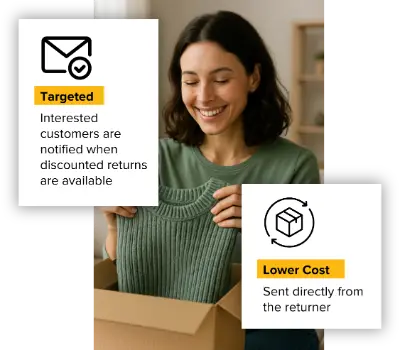
Peer-to-peer returns challenge the most fundamental constraint in reverse logistics by inverting the direction of flow. Instead of routing returned goods back to a warehouse for intake, inspection, repackaging, and eventual resale, P2P forwards eligible items directly from the returning customer to the next buyer. The return stops moving backward. It becomes a forward-moving transaction.
Automation streamlines handling return requests and issuing return labels, allowing customers to quickly download labels and ship items directly to the next buyer. This not only improves efficiency and customer satisfaction but also helps get items back on virtual shelves faster. Machine learning can optimize where returned goods are sent, minimizing transportation costs and improving inventory levels by ensuring returned products are routed to the most appropriate locations. These technologies help optimize returns by making the process more effective, efficient, and profitable.
The mechanical shift is straightforward. A buyer initiates a return through a standard branded portal. The system evaluates eligibility based on SKU type, condition thresholds, return reason, and demand signals. If the item qualifies, a “Like New” listing is generated on the same product page as the new item, priced at a modest discount. The returner receives a label addressed to the next buyer, not to a warehouse. Tracking confirms delivery. Refund is issued. Inventory, financials, and order records update automatically.
What changes is where the item goes. Everything else, the branded portal, the policy logic, the carrier infrastructure, the customer communication, stays the same.
What Peer-to-Peer Returns Process Actually Changes
When routing changes, the consequences are not incremental. They are categorical.
Entire cost layers disappear. There is no inbound dock. No receiving labor. No inspection queues. No re-shelving. No redundant inbound shipment. In a traditional returns flow, every returned item accumulates cost at each stage of the reverse journey. In fact, returns can drain up to two-thirds of an item’s original value, affecting not only shipping and restocking but also causing inventory disruptions and customer dissatisfaction. In a P2P flow, those stages do not exist for eligible items. The cost is not reduced. It is removed.
Inventory velocity improves. In traditional flows, items wait days or weeks while they move through intake and inspection before becoming available for resale. During that time, seasonal demand decays and markdown pressure builds. In P2P, items move immediately to the next buyer. Value is captured once, intentionally, not eroded over time through repeated discounts. Improved inventory levels and product quality, supported by better product descriptions and enhanced product listings, can reduce returns and enhance customer satisfaction. Providing customers with detailed product information and gathering feedback helps improve product quality and reduce returns. AI can also analyze customer data to improve product descriptions and sizing charts, reducing misfit rates and further minimizing returns.
Fraud opportunities shrink. Traditional returns create fraud exposure at every handoff. Wardrobing, item swapping, and empty box scams all exploit the opacity and delay built into multi-step warehouse processing. When a return travels point-to-point, with refunds tied to confirmed delivery, the attack surface collapses. There is no anonymous warehouse queue where conditions cannot be verified. Fewer handoffs mean fewer cracks to exploit.
Waste declines. A traditional return travels twice before reaching the next buyer: outbound to the original customer, back to the warehouse, and often a third time to a resale or liquidation channel. P2P removes one full shipping leg and the associated packaging. Across millions of returns, the reduction in emissions and material waste is substantial and aligns with broader strategies for supporting eco-friendly ecommerce returns.
Sustainability becomes measurable, not rhetorical. Scope 3 emissions reporting, which increasingly includes reverse logistics, becomes a tractable problem when shipping legs are eliminated by design rather than optimized at the margins. ESG disclosures gain specificity. Regulatory narratives gain credibility. Consumer-facing sustainability claims become verifiable.
This is not optimization. It is structural realignment. The distinction matters because optimization preserves the underlying system while extracting incremental efficiency. Structural realignment changes what the system does by default.
What Peer-to-Peer Actually Represents
There is a risk of misframing peer-to-peer returns as a product feature or a policy configuration. That framing is both inaccurate and strategically unhelpful.
Peer-to-peer is not a feature. It is not a tool. It is not a policy tweak.
It represents a different way of thinking about what returns are and where they belong in the commerce cycle. In the traditional model, returns are a reversal, a transaction going backward, generating cost and consuming time before value can be recovered. In the P2P model, returns are forward-moving transactions, recoverable value flows, and shared accountability events between the returning customer, the next buyer, and the brand.
Returns become strategic infrastructure rather than operational cleanup. Optimizing returns in this way and crafting the perfect ecommerce returns program can drive long term profitability and provide a competitive advantage by reducing operational costs and enhancing customer satisfaction. Offering store credit as a resolution option can help retain customer loyalty and appeal to future customers, especially when used to address return fraud or clarify policies. Additionally, a clear and comprehensive returns policy that transparently explains fees and offers multiple options can reduce lost sales by setting realistic expectations and improving the overall customer experience.
That distinction has practical implications. It means the question facing logistics and operations teams is not “how do we process returns faster?” It is “how do we change where eligible returns go so that processing becomes unnecessary?” The question facing finance leaders is not “how do we reduce cost per return by a few dollars?” It is “how do we eliminate entire cost categories for the majority of our returns volume?” The question facing board members is not “what are our return metrics this quarter?” It is “do our returns flow in a direction aligned with how modern commerce actually works?”
There is also an important constraint embedded in this framing. P2P returns coexist with warehouses. They respect constraints. They do not pretend to solve everything.
Fragile goods that require professional repackaging still route through traditional flows. Regulated categories with chain-of-custody requirements remain warehouse-dependent. Defective items still need verification and root-cause analysis. End-of-season merchandise without downstream demand is a liquidation case, not a P2P case.
In practice, roughly 60% of returns across most ecommerce operations are viable P2P candidates. The remaining 40% continue through existing reverse logistics channels. Warehouses do not disappear. They become specialized exception handlers rather than default endpoints. That is a meaningful shift in what warehouses are for, not an elimination of what they do.
The credibility of P2P as a model rests precisely on this restraint. A system that acknowledges its boundaries is one that can be implemented with discipline.
The Strategic Choice Ahead for Customer Loyalty
Every retailer now faces a decision, whether made explicitly or by default through inaction.
Option one is to continue absorbing return losses and hope that incremental fixes keep pace with escalating costs, fraud, regulation, and competitive pressure. This means continued investment in returns software that improves UX without changing economics, warehouse capacity that scales costs alongside volume, carrier relationships that optimize convenience without eliminating structural waste, and policy adjustments that transfer pain without resolving it. Protecting margin in this scenario requires careful management of shipping costs and return shipping, as these expenses can significantly erode profits—especially considering that the cost of processing an online return averages 21% of an order’s value.
Option two is to redesign returns as a system that reflects how commerce actually works today. That means auditing return flows against fully loaded cost structures, identifying the subset of SKUs and categories where P2P economics deliver the clearest advantage, piloting with controlled scope to generate evidence rather than assumptions, and building the guardrails, condition standards, and fraud controls that make the model trustworthy at scale. Improving efficiency through technology investments and leveraging data analytics to understand customer behavior are critical to optimizing returns and reducing unnecessary costs.
Doing nothing is not neutral. Doing nothing is a decision to let costs, fraud, and waste compound.
Return losses do not stay constant while the organization evaluates alternatives. Every year of delay locks in avoidable cost, increases regulatory exposure, normalizes inefficient behavior, and weakens competitive position relative to operators who have already begun the transition. Structural problems do not self-correct. They intensify.
The companies that act early will define the standard. Those that wait will inherit it on worse terms.
For CFO-level evaluation of what this transition means for gross margin and capital efficiency, the core question is not whether returns are expensive. That has been established. The question is whether the organization is structurally equipped to reduce that expense by eliminating cost categories rather than managing them. For board-level framing, the question is whether returns are treated as a strategic capability or as a tolerated liability. Those two framings produce very different investment decisions.
Closing
Returns have been treated as a back-office problem for long enough that the assumption calcified. They are not a back-office problem. They are a test of whether ecommerce infrastructure can evolve without breaking under its own weight.
The scale is no longer deniable. The economics are no longer manageable through incremental improvement. The regulatory environment is no longer optional. The consumer expectations are no longer stable. The fraud exposure is no longer containable through reactive detection.
Peer-to-peer returns do not promise perfection. They offer something more valuable: a credible path out of a system that no longer works. One that changes direction rather than adding complexity. One that reduces cost by eliminating stages rather than optimizing them. One that turns returns from a structural liability into a structural advantage for the operators willing to rethink the routing.
A hassle-free returns process creates a positive experience, keeps customers happy, and encourages future purchases. According to a survey, 96% of shoppers are more likely to purchase again if returns are hassle-free, showing that a smooth return process can encourage customer loyalty with an exceptional returns program.
Returns don’t need to go back. They need to go forward.
Frequently Asked Questions
What does it mean to say the future of ecommerce returns requires structural change rather than optimization?
Optimization improves how the existing system performs. Structural change alters what the system does by default. The current warehouse-centric returns model can be optimized through better software, more efficient labor, and improved analytics, but the core cost drivers: two shipping legs, intake labor, inspection, repackaging, and markdown delay, remain in place regardless of how well the front end is managed. Structural change means changing routing logic so that a significant portion of returns never enter that loop at all. This includes offering flexible options such as online returns, mail-in returns, and in-store returns, where customers can return items in store regardless of their initial purchase channel (for example, buy online, return in store), enhancing convenience and reducing costs.
Why have returns management software platforms not solved the cost problem?
Returns Management Systems have meaningfully improved the customer experience and process visibility on the front end of the returns process. What they have not changed is where returned items go. In almost every case, RMS platforms still route eligible returns back to a warehouse, a 3PL, or a centralized inspection facility. The expensive steps: inbound freight, receiving labor, repackaging, restocking, and markdown exposure, remain intact. Better tooling accelerates volume into the same reverse flow. It does not remove the flow. However, many platforms now offer self-service portals for online returns, allowing customers to initiate returns, download shipping labels for mail-in returns, and track status—reducing customer service inquiries by up to 50%.
How does peer-to-peer returns work mechanically?
A buyer initiates a return through a standard branded portal. The system evaluates the item’s eligibility based on SKU type, condition, return reason, and demand signals. If eligible, a “Like New” listing is generated at a modest discount. The returning customer receives a shipping label addressed to the next buyer rather than to a warehouse. Tracking confirms delivery to the new buyer, the returner is refunded, and all inventory and financial records update automatically. The warehouse intake step is eliminated for that transaction.
Which product categories are well suited to peer-to-peer returns?
Apparel, footwear, and accessories are high-fit candidates because they carry stable resale value, tolerate consumer packaging, and generate high return rates with predictable demand. Durable home goods and non-fragile consumer items are medium-fit. Fragile goods, regulated categories such as cosmetics or medical devices, defective or damaged items, and end-of-season merchandise with limited remaining demand are not well suited. P2P is a hybrid strategy. The goal is not to route 100% of returns peer-to-peer but to identify the majority of recoverable volume where the model delivers clear advantage.
What happens to the 40% of returns that do not qualify for peer-to-peer?
They continue through existing reverse logistics channels. Warehouses do not disappear under a P2P model. They become specialized exception handlers for defective, damaged, regulated, or otherwise non-recoverable items rather than the default endpoint for all returns. The operational shift is in what warehouses are responsible for, not whether they exist.
Why is fraud exposure lower in a peer-to-peer returns model?
Traditional returns create fraud opportunities at every handoff. Wardrobing, item swapping, and empty box scams all depend on the opacity and delay built into multi-step warehouse processing. In a point-to-point flow where refunds are tied to confirmed delivery and items never pass through anonymous warehouse queues, the attack surface shrinks materially. Fewer touchpoints mean fewer opportunities to exploit gaps in condition verification.
Is the normalization of return fees by major retailers a sign that the old model is breaking?
Yes. Zara, H&M, Anthropologie, J.Crew, and others introducing paid return fees is not primarily a revenue strategy. It is a signal that the economics of free returns have become unsustainable across the industry. Consumer backlash was widely predicted and largely did not materialize, which indicates that the expectation reset is durable. The entire market moving together on fees shows that tolerance for absorbing full return costs has reached its limit, even if the structural problem underneath those costs has not yet been addressed. For low-value items, retailers are increasingly offering returnless refunds, allowing customers to keep or donate the item. At the same time, shoppers may face increased friction for returns, such as fees or mandatory use of specific drop-off locations.
How is technology being used to improve the returns process?
Retailers are leveraging self-service portals for online returns, enabling customers to initiate returns, print shipping labels for mail-in returns, and track their return status—reducing customer service inquiries by 50%. Augmented Reality (AR) tools are being used to help customers visualize products before purchasing, which has led to a 20% to 40% decrease in return rates for brands using AR. High quality images, especially in Amazon A+ Content, also help customers better understand products, reducing incorrect sizing issues and overall return rates. AI is increasingly used to create dynamic, personalized return experiences, automate return eligibility, provide instant refunds, and suggest personalized exchanges. AI also scans for return fraud, such as item swapping or serial returners, by assigning risk scores to transactions, and analyzes customer data to improve product descriptions and sizing charts, further reducing misfit rates and returns due to incorrect sizing.
Written By:

Manish Chowdhary
Manish Chowdhary is the founder and CEO of Cahoot, the most comprehensive post-purchase suite for ecommerce brands. A serial entrepreneur and industry thought leader, Manish has decades of experience building technologies that simplify ecommerce logistics—from order fulfillment to returns. His insights help brands stay ahead of market shifts and operational challenges.
Turn Returns Into New Revenue
Related Articles
Walmart Officially Allows Amazon Multi-Channel Fulfillment (MCF)
Big news for multichannel sellers: Walmart now officially allows Amazon Multi-Channel Fulfillment (MCF), Amazon’s service for using its fulfillment network to ship orders from mult...
Why More Automation Didn’t Lower Return Costs
Returns automation does improve returns operations: it cuts manual touches, smooths intake, speeds sorting, and makes workflow execution more consistent.
Shopify Subscription Payment Change: Why It Could Hurt Reactivation
Shopify changed how subscription payment information is handled at cancellation.
A Pragmatic Roadmap for Redesigning Returns

In this article
24 minutes
- Starting From Where the Evidence Actually Lands
- Why This Decision Belongs in the Boardroom
- Crafting a Clear Returns Policy
- Implementing a Returns Management System
- Managing Returned Items Effectively
- Product Roadmap Alignment
- The Five-Step Returns Process Adoption Roadmap
- Three Scenarios for the Future of Reverse Logistics and Returns
- Returns as a Growth Loop
- Frequently Asked Questions
The future of returns will not be defined by bold declarations. It will be defined by disciplined execution. Most conversations about redesigning returns stall at the diagnosis stage, cycling through the same data points without ever reaching a question that executives actually need answered: what do we do, in what order, and how do we measure whether it is working? Creating effective roadmaps as dynamic, strategic tools is essential for guiding your returns strategy and aligning stakeholders toward measurable results.
This article is an answer to that question. It is grounded in one core conviction: measurable progress with controlled risk is more valuable than radical reinvention that never ships. Making the mindset shift from diagnosis to execution is crucial for teams to implement change and achieve results. If your organization is ready to move from awareness to action, this is your returns strategy roadmap—a guide to navigating the broader world of returns strategy and its impact.
Starting From Where the Evidence Actually Lands
Before any roadmap makes sense, three facts need to be in the room. Not debated. Not relitigated. Accepted.
First, returns are structurally broken. The warehouse-centric model was built for a retail environment that no longer exists. Low volumes, cheap labor, patient customers, and invisible waste were the conditions under which “return everything to a DC” made economic sense. None of those conditions apply today. Customers’ expectations have evolved, and unmet expectations often lead to returns, making it crucial to optimize product listings and align with what customers anticipate. Most retailers implement return policies as a strategy to reduce customer risk and encourage purchases, carefully balancing customer satisfaction and business protection.
Second, incremental fixes have failed. Better portals, more drop-off locations, smarter fraud scoring, carrier consolidation — these investments have improved parts of the experience without changing the underlying cost structure. The per-return loss has not materially declined. The fraud exposure has not closed, and unchecked returns fraud and refund fraud can silently erode profit at a scale many retailers underestimate. The sustainability footprint has not shrunk. Tools got better. Economics did not. In fact, 67% of shoppers check the return policy before making a purchase, and a well-crafted return policy can build trust and reduce hesitation among customers.
Third, peer-to-peer returns represent a credible structural alternative. By rerouting eligible returned items directly to the next buyer rather than backward through a warehouse, entire cost categories are removed rather than managed. This is not optimization. It is a different routing assumption built into the same operational infrastructure you already have.
These three facts position what follows not as a new thesis, but as a logical continuation. The argument has been made. This article is about execution.
Why This Decision Belongs in the Boardroom
Returns have lived too long in operations. They are not an operations problem. They are a cross-functional strategic issue that now carries implications for finance, operations, marketing, and governance simultaneously. Any returns strategy roadmap must address all four dimensions and clearly communicate strategic initiatives that require cross-functional alignment to ensure buy-in and effective execution.
When designing adaptable returns processes, it is essential to create environments that support efficient decision making, especially in areas such as returns storage, sorting, inspection, and routing. Effective decision making in these processes streamlines operations, reduces processing times, and improves overall returns management.
If returns are not addressed as a strategic issue, there is a significant risk of misaligned priorities, where teams may work on conflicting or unfocused initiatives, leading to wasted resources and friction with stakeholders.
The CFO Lens: Margin Protection and Capital Efficiency
Finance leaders feel returns as margin erosion and capital drag. The cost of a return is not what most companies are measuring. Averaged figures obscure the real structure of the loss. What a CFO actually needs to understand is the fully loaded cost per return, broken down into its components: shipping, labor, markdown, and fraud. Each category behaves differently and responds to different interventions.
Beyond the per-return figure, the CFO concerns that matter most are the gross margin impact of elevated return rates, the recovery rate of returned inventory once it enters the reverse logistics flow, the predictability of return-related cash flows across seasonal cycles, and the amount of working capital sitting idle in slow-moving returned inventory that has not been inspected, restocked, or resold.
Peer-to-peer returns reframe this entire picture. They do not make returns cheaper to process. They eliminate entire processing stages for eligible items. That distinction matters to a finance leader because it changes the shape of the cost curve, not just the height of a single data point.
The COO Lens: Operational Resilience
Operations teams experience returns as friction that compounds under pressure. The specific pain points are familiar: inbound congestion at receiving docks during peak season, labor volatility tied to unpredictable return volumes, exception-heavy workflows that require human judgment at every step, peak-season bottlenecks that force tradeoffs between outbound fulfillment and inbound returns processing, and the broader warehouse throughput pressure that makes the returns flow feel like it is always competing with forward operations for the same resources. To handle returns efficiently, whether through in-house processes or by outsourcing to third-party providers, is essential for minimizing these operational disruptions.
The warehouse-centric model does not scale gracefully. It scales expensively. More volume means more congestion, more labor, more errors, and more exceptions. A returns strategy roadmap that shifts a meaningful share of returns away from the inbound dock entirely does not just reduce cost. It protects the operational capacity that outbound fulfillment depends on. Automated reverse logistics processes are vital for efficiently receiving, inspecting, and processing items back into inventory. Standardized inspection protocols should categorize returns quickly for either restock, refurbish, recycle, or dispose.
For COOs, the case for peer-to-peer is not about technology. It is about protecting the core operation from being overwhelmed by an exception-handling workflow that was never designed to absorb this much volume. To manage returns effectively is now a core operational capability, and the ultimate goal is to create a well oiled machine in returns management.
The CMO Lens: Trust, Customer Satisfaction, and Loyalty
Marketing leaders are increasingly accountable for the post-purchase experience, even though they rarely control it. Returns are where brand promises get tested, and improving customer satisfaction is a key marketing goal. A customer who receives a fast refund with clear communication is far more likely to purchase again. A transparent returns process can build customer trust and encourage repeat purchases—92% of customers will buy from a brand again if the returns process is easy, and an exceptional returns program that prioritizes loyalty turns every return interaction into a chance to deepen the relationship. A customer who waits three weeks for a refund while tracking a package in reverse logistics limbo is quietly disengaging.
The specific pressures marketing leaders face include rising expectations for faster refunds, growing scrutiny on sustainability claims (particularly as younger consumers actively evaluate whether brands are responsible or performative), transparency expectations across the full return journey, and Gen Z value alignment, which increasingly connects brand loyalty to how a company handles its environmental and ethical commitments.
Peer-to-peer supports all of these. Faster refunds become structurally easier when items do not wait in warehouse queues, and issuing a credit to a customer’s account can streamline the refund process, improve transparency, and enhance customer experience. Sustainability narratives become credible when fewer items travel redundant miles and fewer items enter liquidation. And a returns experience framed as forward-moving rather than bureaucratic lands differently with a generation that has already normalized secondhand markets.
Giving customers clear options and incentives in the returns process—such as a well-defined exchange policy or offering store credit instead of refunds—can improve customer experience, keep money within the business, and encourage future purchases. The importance of a clear exchange policy as part of the returns strategy cannot be overstated, as it provides structure and incentives for both the customer and the business.
For the CMO, the risk is not changing how returns work. The risk is defending outdated return policies that feel misaligned with what the brand claims to stand for.
Board-Level Implications for Returns Strategy
At the governance level, returns intersect with four areas that boards now scrutinize directly: margin durability, regulatory exposure, ESG commitments, and long-term competitiveness. Boards are increasingly interested in how a returns strategy can generate new customer leads and drive business growth, making returns management a key lever for strategic advantage.
Boards are asking why return costs are rising faster than revenue. They are asking which portion of that cost is actually controllable and what the operational plan is if regulation moves faster than internal systems can adapt. They are asking whether sustainability disclosures are backed by measurable operational changes or just positioned as marketing.
Returns sit at the intersection of all of these questions. A returns strategy roadmap that reaches the board level is not a logistics proposal. It is an answer to how the business intends to remain competitive, compliant, and financially sound as the environment around it continues to shift. Defining and measuring success for stakeholders is essential to ensure alignment and to track progress toward strategic goals. Optimizing returns can also create new opportunities for the business, enabling continuous improvement and growth.
Crafting a Clear Returns Policy
A clear returns policy is the foundation of a trustworthy customer relationship and a critical component of an effective returns process. Customers expect transparency and simplicity when it comes to returning products, and a well-communicated policy can make all the difference in their purchase decisions. To build trust and reduce the likelihood of unnecessary returns, your returns policy should be easy to locate—featured prominently on your website, product pages, order confirmation emails, packaging, and in-store signage.
The policy itself should provide a clear understanding of the return window, outline any restocking fees, and detail the step-by-step process for initiating a return. It’s equally important to specify which items are final sale and non-returnable, so customers know exactly what to expect before making a purchase. By setting clear expectations, you empower customers to make informed decisions, which can reduce returns and improve overall customer satisfaction.
Offering free returns where feasible can further enhance customer loyalty, but even when that’s not possible, clarity and fairness in your returns policy will help build long-term trust while also helping you manage the rise of e-commerce return rates driven by changing shopper behavior. Ultimately, a transparent and accessible returns policy not only streamlines the returns process but also encourages repeat business, turning a potential pain point into a competitive advantage.
Implementing a Returns Management System
A robust returns management system is essential for transforming returns from a costly necessity into a strategic asset. By leveraging returns management software to automate and streamline the returns process, businesses can significantly reduce associated costs and improve customer satisfaction. Key features of an effective returns management system include online return initiation, automated return shipping label generation, and real-time tracking of returned items.
Beyond operational efficiency, a well-oiled returns management system provides valuable insights into return rates, reasons for returns, and customer behavior, especially when you implement best-in-class returns management software that centralizes data and workflows. These insights can inform business strategy, helping you identify patterns, address root causes, and refine your approach to returns management. With the right system in place, your team can focus on delivering a superior customer experience rather than getting bogged down in manual processes.
The result is a smoother, faster returns process that enhances customer loyalty, boosts conversion rates, and drives revenue growth. By treating returns management as a core business function—rather than an afterthought—you position your company to respond proactively to customer needs and market changes, turning returns into a source of competitive strength.
Managing Returned Items Effectively
Effectively managing returned items is key to minimizing waste and protecting your bottom line. Every returned item represents both a cost and an opportunity. By implementing a structured process for inspecting returned items, businesses can determine whether products can be restocked, refurbished, or resold, reducing losses and supporting sustainability goals as part of a broader effort to optimize reverse logistics end-to-end.
Offering store credit or exchanges instead of automatic refunds can further reduce the financial impact of returns and encourage customers to make another purchase, strengthening customer relationships and retention. For example, if a customer returns a product due to sizing issues, providing an easy exchange process or store credit can turn a potentially negative experience into a positive one.
Analyzing data on returned items also enables businesses to spot trends—such as high return rates for specific products or categories—and make targeted improvements to product descriptions, sizing guides, or quality control. By proactively addressing these issues, you can reduce returns over time and enhance the overall customer experience.
Product Roadmap Alignment
Aligning your product roadmap with your returns strategy is a powerful tool for driving customer satisfaction and achieving business goals. By prioritizing initiatives that address customer pain points—such as enhancing product descriptions, simplifying the returns process, and offering multiple return options—you create a clear understanding of your objectives and ensure that resources are allocated where they will have the greatest impact, especially when crafting the perfect e-commerce returns program to balance cost and loyalty.
A customer-centric product roadmap not only improves the returns process but also strengthens the overall customer experience, leading to higher conversion rates, increased loyalty, and greater revenue. For example, investing in more accurate product descriptions can reduce the likelihood of returns, while providing flexible return options can meet diverse customer expectations and build trust.
Ultimately, a well-aligned product roadmap enables your business to adapt to changing market conditions, respond to customer feedback, and maintain a competitive edge. By making returns management a strategic priority within your product development process, you turn a traditional pain point into a driver of growth and customer retention.
The Five-Step Returns Process Adoption Roadmap
The goal is not disruption. The goal is measurable progress with controlled risk. Creating a returns strategy roadmap is a 6–12 month iterative process focused on reducing return rates and accelerating the speed of restocking. The following five steps are not theoretical. They are the sequence that turns a structural argument into an operational reality.
After completing these five steps, quarterly reviews of the returns strategy roadmap should assess KPIs like return rates and customer satisfaction scores. Collecting and analyzing returns data can unveil patterns, highlight issues, and guide ongoing strategic decisions.
Step 1: Baseline Measurement
Nothing that follows is defensible without this step. Before any routing changes, eligibility decisions, or pilot designs, the organization must establish a clear and honest baseline.
That baseline includes cost per return broken down by its actual components: shipping costs in and out, labor for intake, inspection, repackaging, and restocking, markdown exposure for items that lose value during the return cycle, and fraud-related losses that are currently being absorbed without clean attribution. It also includes refund cycle time from initiation to settlement, return rate by SKU category, and the recovery rate of returned inventory once it enters the warehouse.
Without a baseline, gains appear anecdotal. ROI cannot be defended in a board presentation or a budget conversation. Scaling decisions lack credibility because there is no before-and-after to point to. Baseline measurement is not a finance exercise. It is the foundation of every decision that follows.
Step 2: SKU Eligibility Definition
Not all products should follow the same return path. This step is where discipline matters more than enthusiasm. The temptation is to identify P2P as the new default and push as many SKUs into it as possible. That is the wrong instinct. Eligibility definition is about finding the right cohort, not the largest one.
Organizations can reverse engineer their reverse logistics processes to optimize SKU routing, analyzing existing returns data and workflows to systematically plan which SKUs are best suited for each return path.
High-fit P2P candidates typically share a set of characteristics: stable resale value that does not decay quickly, durable packaging that can support a second shipment without professional repackaging, higher return rates that make demand signals easier to match, predictable buyer demand for the item in a like-new condition, and lower regulatory constraints that do not restrict resale or require chain-of-custody documentation.
Low-fit SKUs remain in traditional flows. Fragile items that require controlled inspection and professional repackaging belong in the warehouse. Regulated goods with resale restrictions, custom or made-to-order items, and perishable or consumable products are all natural exceptions. These SKUs do not undermine the model. They define its realistic operating envelope.
Discipline in eligibility protects customer trust and prevents the kind of overreach that creates a bad experience in the early days of a pilot, when the program is most vulnerable to internal skepticism.
Step 3: Pilot Design
Successful adoption starts small. A pilot that tries to cover too many SKUs, too many markets, or too many customer segments at once will not produce clean evidence. It will produce noise.
Best practice is to select a narrow SKU set or limit by geography or customer segment, then track three categories of signal closely: the economics (cost per return, recovery rate, refund cycle time), the customer experience (feedback, repeat purchase behavior, satisfaction signals), and the fraud indicators (abuse patterns, condition disputes, delivery exceptions), ideally supported by a flexible platform like the Return Prime returns solution for test-and-learn pilots.
As part of the pilot, consider including an onboarding flow specifically designed for new users. Designing a new onboarding flow should focus on outcome-based metrics, such as increasing user retention or engagement, rather than just launching a feature. It is important to track the experience of new users during the pilot to measure the effectiveness of the onboarding process and its impact on overall returns strategy roadmap outcomes.
The framing matters. A pilot is not a rollout. It is a live experiment designed to produce evidence. Executives who commission a pilot looking for confirmation rather than data will misread the results. The evidence a disciplined pilot produces is the currency needed to expand confidently and defend the decision at every level of the organization.
Step 4: Guardrails and Controls
Peer-to-peer changes where risk occurs. It does not eliminate risk. Any returns strategy roadmap that presents P2P as a fraud-free system is either uninformed or overselling. The honest framing is that risk shifts, and guardrails must be built to match the new risk profile from the beginning.
Effective guardrails for a P2P returns system include photo or condition proof required at the point of return initiation, AI-assisted risk scoring for orders that fall outside normal parameters, refunds tied to confirmed delivery to the next buyer rather than to the moment of shipment, incentives for proper preparation (clear packaging, accurate condition representation), and defined penalties for abuse to prevent the system from being gamed once it becomes familiar. Offering flexible return options, such as drop-off locations, carrier pickup, or in-store returns, or leveraging networks like Happy Returns drop-off Return Bars, can also serve as a guardrail by increasing customer convenience and reducing friction. Additionally, implementing self-service portals empowers customers to manage their own returns and can significantly reduce customer service inquiries related to returns.
These guardrails should evolve alongside adoption. The risk profile in a narrow pilot is different from the risk profile at scale. Controls that are appropriate in month three may need to be recalibrated in month twelve. Building the governance infrastructure to monitor and adjust is as important as building the routing logic itself.
Step 5: Expansion and Normalization
Once a pilot has produced real evidence of economics, experience, and fraud performance, expansion becomes a structured decision rather than a leap of faith. SKU coverage expands to include more of the high-fit cohort. Geographic scope widens based on where demand signals and logistics infrastructure align. P2P becomes integrated into standard returns policy rather than operating as a parallel track. As part of a comprehensive returns strategy roadmap, brands can also offer exchanges and in store returns, providing customers with flexible options such as store credit and alternative to refunds. Competitor return policies often span return windows from 30 to 90 days, and studying leaders like Amazon’s returns policy can help benchmark expectations, while speed to resale aims to make returned items available for resale within 24 hours of receipt to minimize depreciation.
At scale, the objective is for P2P to function as an invisible routing decision. The customer does not need to know which path their return takes. The operations team does not need to treat it as a special program with its own set of exceptions. It becomes a default path for eligible items, a structural advantage embedded in the policy and infrastructure, and a routine outcome rather than a celebrated experiment.
This is what normalization looks like. Not a press release. A well-functioning system operating quietly in the background.
Three Scenarios for the Future of Reverse Logistics and Returns
Returns will evolve. The question is not whether the system will change. It is who is positioned to shape that change and who will be reacting to it under pressure. Brands that proactively develop a returns strategy roadmap can turn returns into strategic opportunities for business growth, customer satisfaction, and competitive advantage by optimizing returns management and leveraging flexible storage solutions.
In the best-case scenario, peer-to-peer adoption becomes widespread across the industry. More than half of recoverable returns bypass warehouse processing. Return costs decline materially. Scope 3 emissions drop measurably. Returns evolve from a cost center into a loyalty and margin lever for brands that implement the model well.
The middle-case scenario is more likely in the near term, and it is still a significant improvement over the status quo. Hybrid models dominate. Somewhere between 30 and 40 percent of returns route peer-to-peer, with warehouses handling the genuine exceptions: defective items, regulated categories, and end-of-cycle inventory with no downstream buyer. Brands that reach this level of adoption achieve meaningful savings without requiring full operational reinvention. This is not a consolation prize. It is a material shift in the economics of returns for companies willing to do the work.
In the worst-case scenario, regulation moves faster than internal systems. Return restrictions increase before companies have modernized their routing. Costs rise faster than revenue. Brands face compliance risk and margin compression at the same time. In this scenario, returns remain a growing liability, and the brands that delayed adaptation pay the highest price in capital, reputation, and competitive position.
The cost of delay is not abstract. Every year without a returns strategy roadmap locks in avoidable cost that compounds. It increases regulatory exposure as the gap between current operations and emerging compliance requirements widens. It normalizes inefficient behavior inside operations teams that come to treat the broken model as the natural state of things. It also creates operational constraints, as the majority of reverse logistics partners have long contracts, making it vital to sort out existing contracts before making changes. And it weakens competitive position relative to brands that have already begun building a structural advantage.
Structural problems do not self-correct.
Returns as a Growth Loop
The final reframe is the most important one, and it is the one most often lost in the operational detail.
Returns have been treated as a necessary evil for so long that most organizations have stopped asking whether that framing is still accurate or useful. It is neither. Aligning your returns strategy roadmap with broader product goals ensures that your approach supports not just operational efficiency, but also the achievement of key business objectives.
When returns are redesigned with the right routing logic, they generate a compounding effect. Lower costs free up margin. Faster refunds improve the customer experience, especially at first glance—when customers initially evaluate your returns process, a clear and hassle-free policy can make a strong positive impression. Better customer experience drives higher loyalty. Higher loyalty produces more sales. More sales produce more data on return patterns, which improves eligibility decisions and routing logic. The loop reinforces itself.
This is not a diagram that needs to be overengineered. The logic is straightforward: lower costs lead to faster refunds, faster refunds drive higher loyalty, and higher loyalty creates more sales. What matters is that this loop exists, that it is measurable, and that it requires a deliberate returns strategy to set it in motion.
The brands that recognize returns as a strategic capability rather than an operational cost center will build this loop. Those that continue to treat returns as a back-office cleanup function will continue absorbing losses that are, at this point, largely avoidable.
The question facing every retailer is no longer whether the returns system needs to change. That question has been answered. The question now is whether the organization is ready to move from understanding the problem to executing against it.
The companies that act now will define the standard. Those that wait will inherit it on worse terms.
Frequently Asked Questions
What does a returns strategy roadmap actually include?
A returns strategy roadmap includes five core phases: establishing a cost baseline broken down by shipping, labor, markdown, and fraud; defining SKU eligibility for peer-to-peer routing versus traditional warehouse handling; designing and running a controlled pilot with clear economic and experience metrics; building guardrails and controls to manage shifted risk; and expanding peer-to-peer to normalized policy at scale. Each step is sequential and builds on the evidence produced by the prior one.
Why do CFOs need to be involved in a returns redesign initiative?
Returns carry direct implications for gross margin, working capital, and cash flow predictability. The fully loaded cost per return is rarely visible in averaged reporting, and the recovery rate of returned inventory affects inventory planning and capital efficiency. CFOs who are not involved in returns strategy tend to inherit the cost without the tools to address it structurally.
What is the most realistic near-term outcome for peer-to-peer returns adoption?
Based on current industry conditions, the most likely near-term outcome is a hybrid model where 30 to 40 percent of returns route peer-to-peer and warehouses handle genuine exceptions. This level of adoption still produces material savings in shipping, labor, and markdown exposure without requiring full operational reinvention.
How does a returns strategy roadmap connect to sustainability goals?
Every return routed directly to the next buyer rather than backward through a warehouse eliminates at least one shipping leg, reduces packaging waste, and removes warehouse handling energy from the equation. At scale, this produces measurable reductions in Scope 3 emissions and provides defensible data for ESG disclosures and regulatory reporting requirements that are increasingly mandatory in major markets.
What guardrails are needed when implementing peer-to-peer returns?
Effective controls include requiring photo proof at the point of return initiation, applying AI-assisted risk scoring for flagged orders, tying refunds to confirmed delivery rather than shipment, offering incentives for customers who prepare returns correctly, and enforcing penalties for abuse. Risk in a peer-to-peer system does not disappear; it shifts, and guardrails must be designed to match the new exposure profile from the start.
What happens operationally if a company delays building a returns strategy?
Delay locks in avoidable costs that compound annually, increases exposure to regulatory requirements that are already in motion in international markets and trending toward the U.S., normalizes inefficient warehouse-centric behavior that becomes harder to change the longer it persists, and weakens competitive position relative to brands that begin capturing the structural advantages of forward-moving returns models earlier.
Written By:
Manish Chowdhary
Manish Chowdhary is the founder and CEO of Cahoot, the most comprehensive post-purchase suite for ecommerce brands. A serial entrepreneur and industry thought leader, Manish has decades of experience building technologies that simplify ecommerce logistics—from order fulfillment to returns. His insights help brands stay ahead of market shifts and operational challenges.
Turn Returns Into New Revenue
Related Articles
Walmart Officially Allows Amazon Multi-Channel Fulfillment (MCF)
Big news for multichannel sellers: Walmart now officially allows Amazon Multi-Channel Fulfillment (MCF), Amazon’s service for using its fulfillment network to ship orders from mult...
Why More Automation Didn’t Lower Return Costs
Returns automation does improve returns operations: it cuts manual touches, smooths intake, speeds sorting, and makes workflow execution more consistent.
Shopify Subscription Payment Change: Why It Could Hurt Reactivation
Shopify changed how subscription payment information is handled at cancellation.
B2B Ecommerce Fulfillment: How 3PLs Deliver Bulk Orders & Custom Packaging

Most people think ecommerce fulfillment is about one box, one customer. B2B stands for business-to-business, and B2B ecommerce fulfillment refers to transactions between one business and another. B2B ecommerce fulfillment flips that script; now it’s pallets, custom packaging, multi-SKU coordination, and one order worth tens of thousands of dollars. The key difference between B2B and B2C fulfillment is that B2B involves more complex, customized logistics, while B2C is more standardized. If you treat that like a B2C shipment at scale, you’re setting yourself up for disaster.
Here’s the reality: B2B fulfillment isn’t harder because it’s “bigger.” It’s harder because the stakes are higher; relationships, service levels, and reputational risk hinge on every single shipment. B2B ecommerce fulfillment is a multifaceted process involving complex logistics, inventory management, and order handling. So let’s talk about how 3PLs that know what they’re doing handle bulk orders, custom packaging, and why it matters for your business growth.
Why B2B Ecommerce Fulfillment Is a Different Beast
B2B fulfillment isn’t just “more volume.” Unlike B2C, B2B fulfillment involves transactions between other businesses rather than individual consumers. Here are the key differences between B2B and B2C fulfillment:
- Bulk orders with complexity: Multiple SKUs per order, different pack-out requirements, and scheduled delivery windows. Miss one spec, and you’re issuing credits or losing a contract.
- Custom packaging for business clients: These aren’t unboxing videos; these are brand impressions for their customers. B2B fulfillment is tailored to the specific business needs of clients. Botch the branding, and you look unprofessional to their buyers.
- Strict service-level agreements (SLAs): On-time and accurate aren’t suggestions; they’re contractual. B2B fulfillment often involves shipments to retail stores or business locations, unlike B2C, which serves individual consumers. One missed SLA could mean financial penalties or worse.
- Integration with business systems: You’re not emailing updates; you’re syncing with EDI, ERPs, and procurement platforms.
A third-party logistics provider (3PL) must be built for this complexity, or you’ll end up firefighting every month.
How 3PLs Handle Bulk Orders Without Dropping the Ball
1) Advanced Order Management
Top-tier B2B fulfillment partners use order management systems designed for business clients, emphasizing efficient management to meet the complex needs of B2B order fulfillment:
- Aggregate multi-line orders accurately and manage orders efficiently through a centralized dashboard.
- Allocate inventory across fulfillment centers with precision.
- Flag exceptions early, before they become missed SLAs, to minimize errors in the fulfillment process.
2) Dedicated Account Management
B2B relationships live and die on communication. The best 3PLs:
- Provide a dedicated account manager who knows your business inside and out.
- Offer proactive updates on order statuses, potential delays, and performance metrics.
- Escalate issues before they hit the customer’s desk.
3) Bulk Handling Expertise
Bulk isn’t just “more boxes.” It’s about handling wholesale orders with specialized bulk handling expertise, including:
- Pallet optimization: stacking configurations to minimize freight costs and damage risk.
- Kitting and assembly: pre-building kits for business promotions or seasonal needs, these are value-added services that 3PLs offer to enhance supply chain operations.
- Labeling precision: adhering to retail or distributor compliance requirements, GS1 labels, ASN accuracy (Advance Shipping Notice), and meeting the specific packaging and shipping protocols required by big box stores. For Walmart fulfillment, current WFS guidance requires each sellable unit to carry a readable GTIN (14 digits) or UPC (12 digits), each shipment to include receiving labels with shipment ID, shipment ID barcode, box or pallet ID, GTIN, and quantity, and each item to be clearly and permanently marked with its country of origin.
4) Custom Packaging Done Right
Custom packaging isn’t fluff; it’s a B2B competitive advantage:
- Reflects your client’s branding standards exactly and can be tailored to customer preferences for branding and presentation.
- Supports sustainability mandates (eco-friendly materials, minimal waste).
- Adjusts quickly to changes, new designs, temporary campaigns, or client-specific configurations.
5) Inventory Visibility & Control
B2B clients need real-time visibility into stock levels and order statuses, making advanced inventory management systems essential for efficient operations. Modern 3PLs deliver:
- Live dashboards: with stock, order progress, fulfillment KPIs, and real-time monitoring of inventory levels.
- Automated replenishment alerts: preventing stockouts and missed POs.
- Analytics: so you can forecast demand, optimize inventory investment, and prevent supply chain disruptions by identifying risks early.
How Businesses Should Prepare for B2B Fulfillment Success
Even with a great 3PL, your success depends on how you partner. Building a successful partnership with your 3PL is essential for smooth logistics operations and long-term growth:
- Share accurate forecasts and upcoming campaign details early.
- Standardize product data, labeling, and packaging specs.
- Build strong relationships with your account manager, treat them like a fulfillment partner and an extension of your team.
- Audit your 3PL’s operational excellence: error rates, on-time performance, and compliance metrics to ensure you have chosen the right fulfillment provider for your business.
- Remember, effective partnerships are key to empowering businesses to focus on growth and core operations.
Real-World Example: When It All Clicks
A mid-sized skincare brand, operating as an ecommerce business, scaled to major retail partners by leveraging a 3PL that:
- Integrated with their ERP for seamless order flow.
- Provided expertise in b2b order fulfillment for ecommerce businesses, handling bulk seasonal launches with custom display packaging.
- Maintained 99.95% on-time fulfillment across 4,000+ monthly B2B orders.
- Result: fewer chargebacks, happier retail partners, and a stronger bottom line.
What To Do Next
- Review your current fulfillment SLAs; are they being met consistently?
- Ask your 3PL how they handle custom packaging changes mid-campaign.
- Demand real-time inventory visibility if you don’t have it already.
- Run a mock bulk order audit, track how long it takes from receipt to ship, and whether it hits compliance standards.
- Review your 3PL’s service offerings and whether they provide a comprehensive suite of solutions, including returns management, kitting, and custom packaging. For a structured process, see the RFP Template for 3PL Partner Evaluation.
- Evaluate the 3PL’s technological capabilities and their ability to provide seamless integration with your ecommerce platform for real-time data exchange, order tracking, and inventory management.
The Bottom Line
B2B ecommerce fulfillment is where logistics meets reputation, supporting sustainable growth and operational efficiency for your business. Bulk orders, custom packaging, and high-stakes SLAs demand a level of precision most B2C-focused providers can’t match. Partnering with a specialized 3PL offers numerous benefits, including cost efficiencies through freight consolidation and exceptional service that meets the unique demands of B2B buyers. Choose the right partner, and you’ll not only meet expectations, you’ll turn fulfillment into a competitive weapon that drives higher customer satisfaction.
Frequently Asked Questions
How Is B2B Ecommerce Fulfillment Different from B2C?
B2B involves bulk shipments, strict SLAs, custom packaging, and system integrations like EDI. The key difference between B2B and business-to-consumer (B2C) fulfillment is that B2B focuses on bulk shipments to other businesses, while B2C serves individual consumers with individual orders. B2C fulfillment often deals with unpredictable demand, requiring flexible logistics to meet the needs of individual consumers. The key differences between these two models include order size, demand patterns, shipping methods, and customer expectations. It’s less about one-off orders and more about reliability and compliance at scale.
Why Is Custom Packaging Important in B2B?
It ensures your brand (or your client’s brand) meets professional presentation standards and compliance requirements, which can directly impact client retention and satisfaction. Many fulfillment services include custom packaging as part of their service offerings, allowing businesses to enhance their brand image and meet specific B2B requirements through their chosen fulfillment service.
What Metrics Should I Monitor for B2B Fulfillment?
Key metrics include on-time delivery rate, order accuracy, error rate per line item, and compliance adherence for packaging and labeling. Additionally, monitoring supply chain metrics is essential to ensure resilience and efficiency. It’s important to track potential supply chain disruptions, as well as analyze market trends and future trends, to anticipate changes and adapt your strategies accordingly.
Do I Need a Dedicated Account Manager?
Yes. Complex accounts require a single point of contact to coordinate logistics, handle escalations, and maintain proactive communication. A dedicated account manager also helps streamline processes, improving fulfillment efficiency and ensuring smoother operations.
How Do I Choose the Right 3PL for B2B Ecommerce?
Look for experience with bulk orders, proven SLA adherence, real-time inventory visibility, and strong references from other B2B clients. Evaluate fulfillment providers and the fulfillment company’s track record in handling complex B2B logistics. It’s important to choose a fulfillment provider that can efficiently serve the receiving business and other businesses, ensuring fast, accurate shipping and meeting the unique needs of B2B operations.
Written By:
Jeremy Stewart
Jeremy Stewart leads customer success at Cahoot, helping merchants achieve high-performance logistics through smart technology and process optimization. With a background in both ecommerce operations and client services, Jeremy ensures that every merchant using Cahoot gets measurable results—whether they’re scaling from one warehouse to many or managing complex returns.
Turn Returns Into New Revenue
Related Articles
Walmart Officially Allows Amazon Multi-Channel Fulfillment (MCF)
Big news for multichannel sellers: Walmart now officially allows Amazon Multi-Channel Fulfillment (MCF), Amazon’s service for using its fulfillment network to ship orders from mult...
Why More Automation Didn’t Lower Return Costs
Returns automation does improve returns operations: it cuts manual touches, smooths intake, speeds sorting, and makes workflow execution more consistent.
Shopify Subscription Payment Change: Why It Could Hurt Reactivation
Shopify changed how subscription payment information is handled at cancellation.
Shipping Rate Negotiation: Small Businesses Winning Better Rates in 2025

I’ve been talking to small business owners lately, brands pushing $200K/year in shipping, and guess what? They’re getting discounts once reserved for Amazon-level volume. Yep, FedEx and UPS are wooing smaller shippers these days, because parcel volumes are dropping and carriers need your business. That means you can play a smarter game: negotiate shipping rates with data, with options, with confidence, not by chance. Freight rate negotiation is now a strategic process accessible even to smaller shippers, allowing them to secure more favorable rates through preparation and informed discussions.
Let’s dig into how shipping rate negotiation really works. This is not your grandpa’s negotiation; data, technology, market leverage, and clear processes are your weapons. These tools give small businesses a competitive edge in negotiations. And I’ll show you how to use them.
Before we dive in, remember: having a clear shipping strategy is essential to maximizing your negotiation outcomes.
Why Now Is A Sweet Spot for Negotiation
Here’s a little nugget from the Wall Street Journal: FedEx and UPS are now offering meaningful discounts, even to shippers with under $500K in annual spend, because parcel volume has dipped, and they want to woo volume with rates, not rocket fuel. In fact, they dropped ground parcel prices by 2.5% in the latest quarter, thanks to lighter packages and aggressive targeting of small businesses. The main focus of these negotiations is the freight rate, which determines your overall shipping costs.
This matters because you’re not too small anymore. If you can articulate your shipping profile, volume, box size, lane mix, and distance traveled, you’re at the negotiation table. Carriers consider various factors such as volume, box size, and distance traveled when determining your eligibility and leverage. And they’re listening. That’s your edge.
The Data Strategy That Will Win You Rates
You can’t negotiate what you can’t measure. That means build a shipping profile:
- Monthly and seasonal volumes
- Average weights, dimensions
- Delivery zones (local vs residential vs international)
- Service mix (Ground, Express)
- Historical surcharges exposure
- Detailed data on shipments and costs
- Historical rates for similar shipments
Providers like TransImpact and Cahoot help you package that data in tables and visuals that carriers understand instantly. These platforms also provide insights into your shipping patterns and costs.
Armed with that, you’re not guessing; you’re showing them they’ll win by giving you better terms, especially when you include carrier performance metrics to strengthen your negotiation position.
Secrets for Smarter Negotiation (Not Just Talking)
When negotiating shipping contracts, understanding what negotiation takes, such as thorough preparation, leveraging accurate data, and understanding carrier priorities, can make a significant difference in your outcomes.
1. Benchmark your rates – See what peers are paying. Use industry groups or public references to position your ask (“My competitor in XYZ is getting 8% off freight, can you match?”). Focus your negotiation efforts on key spend areas to maximize impact.
2. Understand carrier cost logic – Fuel surcharges, DIM weight, remote zones. Knowing these gives you angles to push: “If you waive DIM on a 12-inch item, I can drop 5% overall spend.”
3. Negotiate accessorials separately – Detention fees, address correction, liftgate. Carriers love bundling; you should unbundle.
4. Use multi-carrier leverage – If USPS is cheaper for your light parcels, say so. Let UPS/FedEx know; they don’t like losing lanes to postal networks. Negotiating rates with multiple carriers can help you secure lower rates (more favorable rates) for your shipments.
5. Watch contract terms – Commit to a carrier for a volume guarantee in exchange for a better base rate or waived surcharges. Be crystal clear on the term, volume, and exit right. Negotiate for more favorable terms, including payment terms, service agreements, and volume discounts as part of your long-term agreements.
Always aim for the best possible terms and seek rate reductions where possible to optimize your shipping costs.
Ongoing Tactics That Multiply the Savings
- Rate shop regularly – Rates shift weekly. Monitor and push adjustments mid-contract. Compare multiple carriers and different carriers to secure more competitive rates, leading to significant savings.
- Invoice audits = hidden gold – Use tools or 3PL data to catch surcharges, billing errors, and renegotiate or reclaim them. Auditing shipping invoices helps reduce costs and control shipping expenses.
- Test regional or hybrid carriers – They often undercut national carriers, especially for local or B-city lanes. A/B test them quietly, and consider different transportation modes for a cost-effective way to optimize operating costs.
- Cheaper packaging saves percentage points – Cut DIM weight with smarter materials and save postage with no change to shipping speed.
These ongoing tactics drive cost savings (significant savings) over time. Leveraging technology and process improvements can also streamline operations and enhance shipping operations for even greater efficiency.
When to Walk Away
If your baseline margin is too thin, even a “discounted” rate still kills profit; it’s fine to say no. Your goal isn’t just “save on shipping,” it’s “protect the margin.” Be ready to walk. This can put you in a stronger position during negotiations, especially if you have a deep understanding of your shipping needs and costs before making the decision to walk away. It refocuses carriers on your value, not desperation.
What To Do First Thing Monday
- Pull your last 6 months of shipping data and sketch a profile to identify opportunities for negotiation and cost reduction.
- Use rate-shopping software or Cahoot-like platforms to auto-compare.
- Email your carrier account manager: “Let’s review my T1 rates. I’m seeing aggressive pricing in the market for small shippers.”
- Ask for accessorial waiver proposals or season-based incentives.
- Audit your last month of bills for unexpected surcharges or weight adjustments.
Bottom Line
Your shipping rate negotiation isn’t about volume; it’s about value. You bring well-packaged data, clear lane logic, and a willingness to shift to whichever carrier rewards you with better terms. The playing field is tilted your way right now. Use it; these strategies set you up for successful negotiations and better outcomes.
Frequently Asked Questions
What’s the single most important prep for negotiating shipping rates?
Build a shipping profile that outlines your volume, zones, surcharge history, and service mix. Data is your ticket to credibility at the negotiation table.
Can really small businesses get discounts too?
Yes. Carriers like FedEx and UPS are offering discounts to smaller shippers (<$500K spend) right now; they need the volume, you need the edge.
Should I commit to one carrier long-term for better rates?
Only if you’re confident you hit forecasted volume and get a rate break or surcharge waiver. Make the terms explicit: volume thresholds, penalties, and exit clauses. While committing to a single carrier can simplify operations and potentially secure better rates, relying solely on a single carrier may reduce your flexibility and negotiation power compared to a multi-carrier approach.
How often should I renegotiate?
Every quarter, if possible. Rates and surcharges move fast. Quarterly check-ins and invoice audits help you catch leaks and push for adjustments mid-cycle.
What’s better: deepest rate or multi-carrier flexibility?
Start with the deepest rate per lane, but build flexibility. Always seek the best rate for each shipment to ensure cost-effectiveness. Carriers love loyalty, but over-dependence locks you in. Rate shop dynamically to maximize savings.
Written By:
Jeremy Stewart
Jeremy Stewart leads customer success at Cahoot, helping merchants achieve high-performance logistics through smart technology and process optimization. With a background in both ecommerce operations and client services, Jeremy ensures that every merchant using Cahoot gets measurable results—whether they’re scaling from one warehouse to many or managing complex returns.
Turn Returns Into New Revenue
Related Articles
Walmart Officially Allows Amazon Multi-Channel Fulfillment (MCF)
Big news for multichannel sellers: Walmart now officially allows Amazon Multi-Channel Fulfillment (MCF), Amazon’s service for using its fulfillment network to ship orders from mult...
Why More Automation Didn’t Lower Return Costs
Returns automation does improve returns operations: it cuts manual touches, smooths intake, speeds sorting, and makes workflow execution more consistent.
Shopify Subscription Payment Change: Why It Could Hurt Reactivation
Shopify changed how subscription payment information is handled at cancellation.
Subscription Box Fulfillment Services: How to Scale with Reliable 3PL Solutions

In this article
8 minutes
- What Makes Subscription Box Fulfillment Special
- What Subscription Commerce Logistics Must Deliver
- Real-World Scenarios Where Subscription Fulfillment Isn’t “Same as Ecommerce”
- What I’d Ask Before Signing with a 3PL For Subscription Fulfillment
- What You Can Implement Right Now
- The Bottom Line
- Frequently Asked Questions
I used to think fulfillment is fulfillment; until I helped a subscription business through a crash and burn because their 3PL treated “recurring shipment” like one-off orders. It wasn’t meager: wrong items, late boxes, branding mismatches. Cancelling subscriptions was faster than refunding half the month’s payments. Trust me, subscription box fulfillment services require a whole different playbook. Subscription box fulfillment demands a specialized fulfillment process designed to handle the unique needs of recurring shipments and ensure accuracy and consistency every cycle.
So let me walk you through the real-life, “don’t learn this the hard way” guide, how subscription commerce logistics differs, what recurring shipment 3PL solutions should offer, and how you keep customer loyalty at peak by consistently meeting or exceeding customer expectations, even when inventories wobble or your curation changes week to week.
What Makes Subscription Box Fulfillment Special
Subscription box fulfillment is not just sending parcels, it’s about rhythms and relationships:
- Recurring shipment expectations: Subscribers expect that box, every cycle, on a recurring basis. Miss it twice and you’re not a brand; you’re spam.
- Inventory choreography: You’re juggling curated kits, limited-run add-ons, and rolling replenishment. Managing inventory levels and stock levels is crucial; one SKU out of stock means a box looks incomplete (and customer loyalty cracks).
- Packaging equals brand identity: Those custom-branded packaging costs matter. A branded box is a key element that reinforces your brand identity. Miss the design or quality? It’s a crash to your reputation.
- Fulfillment visibility: You need real-time visibility so you can control expectations and de-escalate delays fast.
As your subscriber base grows, scaling fulfillment operations becomes essential to maintain service quality and customer satisfaction.
Slugging through all this yourself? That’s why you need subscription box fulfillment services that are tailored, not generic.
What Subscription Commerce Logistics Must Deliver
1) Predictable, Time-Sensitive Execution
A solid subscription fulfillment partner understands the tick-tock: you need pick-and-pack on day X, shipped on day Y, in customers’ hands on day Z. Even a 24-hour slip shrinks the window to delight. Timely deliveries and timely and accurate deliveries are crucial for customer satisfaction, as subscribers expect their products to arrive on schedule. Accurate deliveries are also essential to maintaining trust and retention.
They deal with buffer stock options, seasonal surges, and replenishment pulls without the chaos, efficiently managing order volume to ensure scalable solutions. You don’t get a “boys will be boys” excuse, just consistent flow.
2) Spot-On Inventory Management
Recurring orders mean forecast sensitivity. Look for 3PLs with real-time inventory tracking, robust warehouse management, and advanced systems that support low-stock alerts and auto-reorder thresholds for components, especially with curated subscription boxes that change each cycle. Advanced technology can further optimize inventory management and ensure accuracy throughout the fulfillment process. Leveraging data-driven insights also helps improve forecasting and inventory decisions.
You’ll retain customers when every box feels fresh and fully stocked, not “I’ll order again if and when they have everything.”
3) Branded and Custom Packaging That Doesn’t Hurt Your Margins
Subscription box fulfillment companies must marry design and cost control:
- Offer branded boxes, inner sleeves, stickers, filler, eco-friendly packaging materials, and custom boxes, but help you source them.
- Balance quality control so your boxes feel premium, but also let you tweak or swap designs mid-season, contributing to a memorable unboxing experience.
- And handle supply chain surprises, if your eco-friendly material runs out, they suggest equivalent substitutions, not “ship plain boxes.”
Creating a unique unboxing experience is essential for fostering customer loyalty and differentiating your brand.
4) Real-Time Tracking & Communication
One bad experience: a lovely unboxing disrupted by “shipment delayed” with no update. Your fulfillment provider must:
- Offer real-time tracking to your system and the customer’s inbox, including sharing order details for transparency.
- Push automated updates, and alert you proactively if one batch falls behind.
- Let your dashboard show you shipment progress and exceptions in seconds, as proactive communication is essential for meeting customer expectations.
5) Data-Driven Logistics to Improve Retention
Subscription isn’t set-it-and-forget-it. The smart fulfillment partners:
- Give you metrics on box fill rate, promise vs actual ship date, and inventory tracking, all of which are crucial for improving customer retention.
- Help you use that data to make informed decisions that reduce costs and improve efficiency: if custom packaging isn’t helping retention, redesign. If a certain kit item underperforms, swap it next cycle.
Leveraging data-driven logistics not only enhances performance but also helps lower operational costs for subscription box businesses.
Real-World Scenarios Where Subscription Fulfillment Isn’t “Same as Ecommerce”
- Curation pivot mid-cycle: You sell out of a featured item and need to substitute. For any subscription box business or subscription box service, this is a common challenge. Your 3PL handles the swap, updates customers, and reroutes without chaos.
- Sudden inventory shift: Your coffee subscription’s East Coast warehouse runs low on finished product due to a supplier delay. Instead of leaving orders unfilled, your fulfillment partner reallocates stock from your West Coast facility or another pre-approved partner site within their network. The order ships on time, inventory records stay accurate, and your customers never see a hiccup.
- Quality surprise: A season’s custom tissue paper arrives misprinted. A good provider tags, rejects, sources replacements, and keeps fulfillment on track, even while you redesign. Maintaining quality control in these situations is essential for protecting your brand reputation and the brand’s reputation.
What I’d Ask Before Signing with a 3PL For Subscription Fulfillment
When evaluating each fulfillment company, it’s important to understand how most fulfillment companies handle key issues like shipping costs, hidden costs, and their experience as a third-party logistics partner for subscription box businesses. Here are some essential questions to ask:
1. How do you handle recurring shipment scheduling’s effect on labor and box cuts?
2. What’s your inventory alert logic? Can it prevent the dreaded “out of stock surprise”?
3. Custom packaging: Can you swap designs mid-series without excess waste or cost spikes?
4. Dashboard and comms: are delays visible and notifications automated?
5. What data do you report on: fill rate, mispacks, customer feedback loops?
6. Are there any hidden costs or fees in your pricing structure?
7. How do you manage shipping cost and shipping costs, and do you offer strategies to minimize these expenses?
8. What is your experience as a third-party logistics partner specifically for subscription box businesses?
What You Can Implement Right Now
- Audit your current fulfillment workflow, time from pick to delivery versus brand loyalty threshold, and identify areas to save time and improve efficiency.
- Ask your 3PL how they measure on-time delivery % specifically for recurring orders.
- Demand custom packaging change flexibility (mini-runs, design swaps, samples).
- Set up real-time dashboard alerts for inventory dips during order processing.
- Run a quarterly “what if” box, simulate a substitution or shortage, and timeline the customer experience.
- Consider outsourcing fulfillment or choosing to outsource fulfillment to a specialized provider to scale efficiently and streamline operations.
The Bottom Line
Subscription box fulfillment isn’t “shipping”; it’s choreography, communication, brand experience, and retention economy. For subscription businesses, just “handling orders” isn’t enough: you need subscription fulfillment partners that think ahead, swap fast, and protect your brand every shipment. Effective subscription box fulfillment not only supports a reliable revenue stream but also helps build meaningful connections with your customers, fostering loyalty and long-term engagement.
Do fulfillment thoughtfully, and your IT system becomes invisible; your customer thinks “they’ve got me.” Screw it up, or do the same as B2C, and you just burn renewable revenue. These strategies are essential for any subscription service, subscription services, or ecommerce businesses looking to scale recurring revenue and stand out in a competitive market.
Frequently Asked Questions
How Is Subscription Box Fulfillment Different from One-Off Ecommerce?
Fulfillment services for subscription boxes manage recurring shipments, evolving inventory, and branded consistency across cycles, whereas traditional ecomm is more ad hoc and SKU-stable.
Are Branded Boxes Worth the Cost?
Absolutely. Custom packaging shapes brand perception. A memorable unboxing contributes to customer loyalty and justifies premium pricing, or helps prevent churn.
How Can I Ensure I Don’t Run Out of Critical Inventory?
Partner with a 3PL that offers real-time inventory alerts and auto-reorder thresholds. You should be alerted to low stock long before the last master case is opened, not after.
Can Packaging Designs Really Be Swapped Mid-Season?
Yes, good fulfillment centers support flexible packaging runs. Ask for ability to pilot new designs or move to fallback options without cost cliffs or downtime.
What Metrics Should I Track for Subscription Fulfillment Success?
Track on-time delivery rate, box fill accuracy, customer re-order rate, and return or complaint reasons. Weekly reporting on these helps shape product, design, and supply planning.
Written By:
Jeremy Stewart
Jeremy Stewart leads customer success at Cahoot, helping merchants achieve high-performance logistics through smart technology and process optimization. With a background in both ecommerce operations and client services, Jeremy ensures that every merchant using Cahoot gets measurable results—whether they’re scaling from one warehouse to many or managing complex returns.
Turn Returns Into New Revenue
Related Articles
Walmart Officially Allows Amazon Multi-Channel Fulfillment (MCF)
Big news for multichannel sellers: Walmart now officially allows Amazon Multi-Channel Fulfillment (MCF), Amazon’s service for using its fulfillment network to ship orders from mult...
Why More Automation Didn’t Lower Return Costs
Returns automation does improve returns operations: it cuts manual touches, smooths intake, speeds sorting, and makes workflow execution more consistent.
Shopify Subscription Payment Change: Why It Could Hurt Reactivation
Shopify changed how subscription payment information is handled at cancellation.
Freight Fraud: Why Logistics Professionals Need to Stay Vigilant
In this article
9 minutes
- The Freight Industry’s New Risk Math
- How The Most Common Scams Really Work (And Where Teams Trip)
- What I’d Implement Tomorrow If I Owned Your Brokerage (Or Fleet)
- Why The Fraud Curve Keeps Rising (And How To Bend It)
- Tools And Practices I Trust (And How I Deploy Them)
- What To Update In Your Contracts
- The Bottom Line
- Frequently Asked Questions
Freight fraud isn’t one scam; it’s a whole category of criminal business models feeding on a hyper-competitive, digitized freight industry. I’m talking identity theft of legitimate carriers, double brokering that ends in non-payment, fake profiles on load boards, and cargo theft that disappears shipments and dollars annually. If you touch loads, broker, carrier, or shipper, you’re in the blast radius.
I run logistics with a simple rule: assume bad actors are probing your systems every week. Not because you’re special, but because the freight industry itself is a target-rich environment. Fragmented systems, undertrained teams, pressure to cover loads now, and lots of sensitive information moving through email. That’s catnip for fraudsters.
The Freight Industry’s New Risk Math
Everyone feels the squeeze: rates down, fuel up, customers impatient. Hyper-competition creates more opportunities for shortcuts. Shortcuts create more openings for fraud. The logistics industry isn’t dealing with one-off incidents anymore; we’re living with a persistent threat where sophisticated schemes evolve faster than most companies update their practices.
Let’s call it what it is: freight fraud costs are rising, and the fraudsters are getting bolder. Double brokering, payment fraud, cargo theft, and identity theft now show up in various forms, and the FBI now classifies strategic cargo theft as fraud-based theft that can involve identity theft, fictitious pick-ups, account takeovers, double brokering scams, fraudulent carriers, and cyber cargo theft. The logistics sector’s old playbook, trust the paperwork, move the load, no longer maps to reality.
How The Most Common Scams Really Work (And Where Teams Trip)
1. Double brokering that turns into non-payment
A re-broker posts a fake or hijacked load, books a real carrier, and either never pays the carrier or swaps in a ghost carrier midstream. You’ll see mismatched domains, urgent tone, vague driver information, and last-minute banking changes. Freight brokers fall when the verification process is rushed or when one person is allowed to override policy “this one time.”
2. Carrier identity theft and fake profiles
Fraudsters impersonate legitimate carriers, sometimes with real DOT/MC details and a cloned website. They’ll provide doctored insurance and driver info, then vanish after pickup. Tell-tale signs: phone numbers that don’t match official listings, Gmail addresses on “legitimate carriers,” and COIs that don’t verify with the insurer.
3. Cargo theft with clean paperwork
Organized groups use social engineering to become the real broker on paper, then redirect a shipment to a shell yard. Legitimate carriers get stuck in the middle, shippers blame “the broker,” and recovery becomes a long shot. Metals, consumer electronics, food and beverage, apparel, high-value, easy-to-fence categories are red hot again.
4. Payment fraud that drains financial stability
BEC-style email compromises reroute payments. Fraudsters slip into threads, swap ACH details, and collect. If your AP team isn’t verifying identities with out-of-band call-backs, your “real broker” might be paying the wrong account for months.
What I’d Implement Tomorrow If I Owned Your Brokerage (Or Fleet)
FMCSA’s 2025 fraud guidance says fraud and identity theft occur when an entity uses another motor carrier’s USDOT number without authorization or acts as a broker without FMCSA registration.
This isn’t theory. It’s a practical verification process that protects operations without killing speed. Train employees; write it down; audit it monthly.
1. Identity and intent verification (every new partner, every time)
- Verify carrier identity from official sources, not the email signature. Use FMCSA SAFER, the carrier’s own website, and insurer call-backs to numbers you locate, not numbers they provide, because FMCSA’s 2025 fraud guidance says fraud and identity theft occur when a party uses another motor carrier’s USDOT number without authorization or acts as a broker without FMCSA registration.
- Require real-time photo ID for the driver and dispatcher on video. Keep the call recording with the load file.
- Confirm COI straight with the insurance agent, not a PDF attachment. No exceptions.
- If the email domain is generic (Gmail, Yahoo), treat it as high risk even if everything “checks out.”
2. Dedicate one person to kill switches
- No last-minute banking or payment changes without an out-of-band phone verification to a known number on file.
- Suspend credit immediately if a partner refuses insurance verification or won’t do a quick video handshake.
- Lock payment terms until a first successful shipment clears without incident.
3. Secure your systems like you secure your yard
- MFA everywhere: TMS, load boards, factoring portals, email, cloud storage. If a login doesn’t support MFA (Multi-Factor Authentication), replace it.
- Restrict who can view full load details. Use role-based access so a compromised seat can’t harvest your entire book.
- Monitor for exposed credentials. If a password shows up in a breach, rotate immediately and re-train the user.
- Backstop with an allowlist of company-approved tools. No rogue spreadsheets with driver information on personal devices.
4. Tighten the load board workflow
- Build a “trust tier” for carriers, legitimate carriers you’ve vetted get first look at freight. New or unverified carriers go through the long-form checklist every time.
- Use watchlists and industry networks to screen for known bad actors. Share your own intel back to the network.
- Hide certain sensitive information in initial posts. Reveal pickup location and shipper name only after verification.
5. Pick up security measures at the dock
- Two-factor pickup: photo ID matches the driver’s info on file, and the truck’s plate matches what dispatch provided earlier.
- Geofence the pickup and capture a geo-tagged arrival photo in your app.
- Use one-time PINs at handoff. Record BOL photos and seal numbers in the app; require the driver to sign digitally.
- Train warehouse staff on scripts and escalation. If anything smells wrong, the shipment waits. Period.
6. Payment controls that actually prevent loss
- Micro-deposit verification for new bank accounts and changes to vendor records.
- Segregate duties: the person who verifies bank changes is not the person who releases payments.
- Factor with visibility. If you factor, require that your factor run separate fraud checks on re-brokers and carriers.
7. Tabletop drills and train employees quarterly
- Run 60-minute fraud drills every quarter: fake COI, spoofed phone, urgent re-route request. Measure time-to-catch.
- Post a one-page “what to do if you suspect fraud” near every ops seat and warehouse desk.
- Celebrate the catches; don’t shame false positives. The goal is culture: stay vigilant.
Why The Fraud Curve Keeps Rising (And How To Bend It)
CISA’s May 2025 advisory warned that a Russian GRU campaign targeted Western logistics entities and technology companies.
First, the logistics industry has gone fully digital, but most companies still work like it’s 2015. Multiple sites, remote teams, and outsourced partners create more seams for fraudsters to pry open. Second, identity makes or breaks almost every scheme. If you get good at verifying identities, people, companies, and vehicles, you defang most fraudulent activities before they start. Third, speed pressure. When the supply chain is tight and customer SLAs are aggressive, a fake “carrier with a truck nearby” looks like a gift. That urgency is the weapon.
The counterplay isn’t fancy. It’s repeatable verification, security measures that are boring on purpose, and an operations culture that rewards caution. Industry networks help too. When brokers and carriers share signals, bad phone numbers, fake profiles, and stolen driver information, the whole community gets harder to crack. I’ll always choose a slightly slower start to a shipment over paying for a stolen load later.
Tools And Practices I Trust (And How I Deploy Them)
- Identity-centric platforms: Tools that cross-check DOT/MC, insurance, safety, equipment, and contact footprints help spot anomalies fast. Use them to flag identity theft and double brokering in real time.
- Risk dashboards: Cargo theft heat maps and alerts inform pickup scheduling, route choices, and parking policies. Think night pickups, high-value corridors, and urban pinch points.
- Device-based tracking: For sensitive shipments, add a breadcrumb, IoT trackers that phone home if a seal breaks or a trailer detours.
- Payment monitoring: Set rules that flag payments to newly created vendors or accounts changed this week.
- Annual security reviews: Audit your verification process, contracts, and training every year; refresh your playbook as schemes evolve.
What To Update In Your Contracts
- Clear language that prohibits re-brokering without written consent; define “unlawful brokerage” and spell out remedies.
- Explicit requirements for driver verification, equipment photos, and geofenced check-ins at pickup and drop.
- COI verification requirements (direct with insurer) and minimum limits by commodity.
- A right to withhold payment pending investigation if identity or paperwork is suspect.
- Data handling and privacy clauses so sensitive information isn’t scattered across freelancers and random portals.
The Bottom Line
Freight fraud is a logistics industry problem, not a single-department issue. If you’re a broker, you’re steering risk on every tender. If you’re a carrier, you’re a target for identity theft and non-payment. If you’re a shipper, your supply chain and financial stability ride on how well your partners verify identities and protect shipments. This isn’t about being paranoid; it’s about being professional.
One last thing. None of this works if leadership treats fraud like an ops headache. It’s a business risk. Train employees; fund the tools; make “verify first” the default. You’ll protect your carriers and your shippers, because you’ll show up as the real broker, the one that pays, the one that ships, the one that protects the load.
Frequently Asked Questions
What’s the single fastest way to cut freight fraud risk this quarter?
Put a hard stop on any banking change, COI swap, or pickup reroute without an out-of-band call-back to a known number on file. One policy change, massive impact.
How do I verify a legitimate carrier without slowing down?
Use a verification workflow: FMCSA/SAFER check, direct insurer call-back, video handshake with the dispatcher, and a quick driver ID match. Do it once, then tier your partners so legitimate carriers move fast on future loads.
What should warehouse staff look for at pickup?
License plate and driver ID must match your file; seal and BOL photos captured in your app; one-time PIN used at handoff; no “my boss said change the address” moves. If something feels off, the shipment does not leave.
Are load boards still safe to use?
Yes, with guardrails. Hide sensitive information up front, screen carriers through your identity tools, and use watchlists to spot re-brokers and fake profiles. Treat open boards as top-of-funnel, not as your verification system.
How do I keep my team from falling victim to BEC and payment fraud?
MFA on email and finance systems; train AP to validate account changes with voice verification to a known number; run monthly reports of “new vendor, new bank” and review them. No screenshots as proof. Only call-backs.
What freight tools or networks should I use or join?
Join the industry networks that share fraud intel and theft alerts; use risk dashboards for route and parking decisions; consider identity-centric platforms for real-time verification. The mix matters less than the habit of checking.
What should my customers hear from me about freight security?
Explain your verification process, your preventative measures, and how you protect sensitive information. It builds trust, and it wins freight.
Written By:
Jeremy Stewart
Jeremy Stewart leads customer success at Cahoot, helping merchants achieve high-performance logistics through smart technology and process optimization. With a background in both ecommerce operations and client services, Jeremy ensures that every merchant using Cahoot gets measurable results—whether they’re scaling from one warehouse to many or managing complex returns.
Turn Returns Into New Revenue
Related Articles
Walmart Officially Allows Amazon Multi-Channel Fulfillment (MCF)
Big news for multichannel sellers: Walmart now officially allows Amazon Multi-Channel Fulfillment (MCF), Amazon’s service for using its fulfillment network to ship orders from mult...
Why More Automation Didn’t Lower Return Costs
Returns automation does improve returns operations: it cuts manual touches, smooths intake, speeds sorting, and makes workflow execution more consistent.
Shopify Subscription Payment Change: Why It Could Hurt Reactivation
Shopify changed how subscription payment information is handled at cancellation.
The Ecommerce Playbooks That Broke in 2025 (from Ugly Talk NYC)

If you’re still running your brand like it’s 2020: open rates as your North Star, Pixel-only attribution, and “more SKUs = more sales”, you’re not just leaving money on the table; you’re flying blind.
This piece is a field guide to what stopped working and what operators are doing instead in 2025. It’s tough love, drawn from the Ugly Talk NYC session, “Building Profitable Ecommerce in a Downward Market”, held at NomadWorks in Times Square, New York, in August 2025, and validated with industry data, so founders can course-correct in a market that’s very different from five years ago.
Speakers at Ugly Talk NYC — Meet the Panelists Featured Here
- Manish Chowdhary — Founder & CEO, Cahoot (panel moderator)
- London Glorfield — Founder, Kickback (screenless electronics)
- Maya Juchtman — Senior Director, Marketing & Partnerships, Roswell NYC
- Sabir Semerkant — Founder, Growth by Sabir, helped drive $1B+ in ecommerce growth
(Detailed bios appear at the end of this article.)
1) Meta Over-Reliance Collapsed
The narrative is overly simplified to “iOS killed Facebook tracking.” The real story: compounding privacy changes across devices and browsers eroded deterministic tracking and last-click storytelling:
- Apple’s App Tracking Transparency (ATT) made cross-app tracking opt-in in 2021, permanently constraining the signal from iOS users. Meta publicly acknowledged conversion under-reporting after ATT (roughly ~15% at first, later ~8% as fixes rolled out).
- Browser defaults now block cross-site tracking whether you run apps or not: Safari’s Intelligent Tracking Prevention has fully blocked third-party cookies since 2020; Firefox’s Enhanced Tracking Protection blocks cross-site tracking by default (with Total Cookie Protection rolled out to all users in 2022).
- Chrome in 2025: After years of Privacy Sandbox testing, Google pivoted: Chrome is not proceeding with a one-size cookie phase-out, moving instead to a user-choice model, removing the “hard stop” many hoped would normalize alternatives. Regulators also signaled they no longer need ongoing commitments tied to deprecation. Translation: third-party cookies persist, but fragmentation is the new normal.
When you depend on one channel’s pixel to tell you the truth, you get whipsawed by platform and policy shifts. As Sabir framed it, treat channels like a diversified portfolio, shift dollars in real-time as signal or platform risk changes, not months later.
“Remember that right after the election, right, that weekend, there were so many creators in tears saying goodbyes on TikTok. And then that Saturday night into Sunday, it was turned back on, right? So that kind of stuff, your business cannot rely on those kinds of things. If that were to happen to me, I would say, ‘Okay, you know what, doesn’t matter. I’m gonna shift my attention over here, right, and I’m gonna just reallocate my time, my energy, my budget towards this, this other set. I don’t have to worry about this one issue that’s happening because it doesn’t have to be a full-on shutdown like TikTok, right? It could be just TikTok rolled out an update, and there was a problem. — Sabir.
What replaces Pixel-only?
A hybrid tracking stack: platform pixel + server-side signals.
- Meta Conversions API (CAPI): Send deduplicated events server-to-server with event_id so the same conversion isn’t counted twice. This is now baseline, not “advanced.”
- Google Enhanced Conversions / offline imports: Hash first-party emails/phones when a purchase happens to improve match rates and bidding; Google is continuing to add flexibility to conversion imports. If you target the EEA/UK/CH, Consent Mode v2 (with a certified CMP) is required to maintain ad features.
Also, remember the baseline privacy gap; roughly a third of internet users use ad blockers at least sometimes, further degrading client-side measurement.
Bottom line: You can’t manage what you can’t measure. Build server-side redundancy, deduplicate, and expect platform models to “fill in” gaps, then validate with lift tests and surveys.
2) Email Marketing’s Illusion
Email is still a profit engine, but the scoreboard you’ve been staring at is broken.
- Apple Mail Privacy Protection (MPP) preloads tracking pixels regardless of actual opens, thereby inflating open rates and obscuring location and timing data. Apple’s own documentation and reputable email firms agree that opens are no longer a reliable metric. Litmus estimates that over half of opens happen on devices with MPP enabled.
- That’s why operators see 30 – 35% “opens” but real engagement is more like ~10%, exactly what came up at Ugly Talk. The fix: stop optimizing to opens, and tighten to engagement segments.
What to do instead:
- Track clicks, placed orders, and revenue per recipient; use click-to-delivered and unengaged suppression to protect deliverability. Postmark and Constant Contact both emphasize the shift away from open-driven automations.
- If your ESP supports it, use first-party events (add-to-cart, checkout started) as triggers and zero-party data to personalize; no pixel required.
Spray-and-pray is a deliverability death spiral. Trim dead weight and measure behavior, not proxy opens. (Learn more about retention math and LTV/CAC loops.)
3) SKU Bloat Drains Cash and Focus
In a world of higher shipping, tariffs, and tighter cash, SKU creep kills margins and operational agility. The panel’s blunt take: brands with 30 orders and 300 SKUs are waving red flags, and “16 colors doesn’t make you a better parent.” Focus on a hero, then earn the right to expand.
“If you have a brand that you think that, oh, I should have 16 colors, like, why. Why would you? Oh, because I did Semrush and my competitive Google shopping. The intern I hired gave me a report stating that we have three colors, while our competitors have 16 to 32 colors. On average, they have about 24 colors. We have only three. Maybe that’s the problem. So, let’s add 16 other colors to our list to at least be in the playing field. It’s like having 16 more children, but you think that’s going to make you a better parent? It doesn’t make you a better parent at all. In fact, the unit economics: now you have to pay square footage to put that inventory in a warehouse. You have to pay for fuel to transport it from its source to the transfer point. And now, what did you do? You went, you took out a loan to buy that inventory, and now that inventory is dead, sitting over there with nobody buying it. Nobody cares. Remember, there’s one great quote by Henry Ford, the founder of the car company: “The consumers can have any color car they want as long as it’s black”. — Sabir.
Why the old playbook broke:
- Fragmented demand inflates MOQs, inventory carrying, returns complexity, and content ops (photos, PDP copy, reviews).
- Stockouts reset ad learning and nuke momentum; you pay twice when campaigns relearn.
What to do instead:
- Ruthless SKU rationalization: keep hero velocity > everything. Tie launch cadence to supply certainty and gross margin thresholds.
4) AI Content Flood = Diminishing Returns
London pointed out: “More posts” is not the strategy. Consumers, especially Gen Z, spot AI instantly and are rewarding thoughtful, crafted pieces over volume. One handcrafted video outperformed 300 AI-generated videos by 100 times in the panel’s experience.
AI is an accelerant, not an autopilot. Sabir advises sellers to treat it like brilliant interns from MIT, who still need direction. Use AI to draft, summarize, and QA, but creative judgment, community intimacy, and context are the moat.
The New Playbook: Measurement and Focus
Here’s the operator checklist our team sees working right now:
A. Rebuild tracking for reality
- Meta: Pixel + CAPI with event_id deduplication; maximize Event Match Quality.
- Google: Turn on Enhanced Conversions (account-level now supported); if you have EEA/UK/CH traffic, implement Consent Mode v2 with a certified CMP.
- Channel diversification: Shift budgets when platform risk arises (policy shifts, bugs, legal issues). Manage channels like a portfolio—reallocate, don’t react months later.
B. Replace “opens” with engagement
- KPIs: unique clicks, placed orders, rev/recipient, unsub rate, inbox placement.
- Maintain unengaged suppression and sunset rules; rebuild win-backs around clicks or site behavior, not opens.
C. Fewer, better SKUs
- Tie assortment decisions to fully loaded unit economics (landed cost, packaging, mailers, warehouse space). Kill variants that stall; scale what compounds.
D. Aim content at “would-watch even if it wasn’t branded”
- Scripted, functional pieces beat floods of AI filler. Utilize AI to expedite specific parts of the workflow.
E. Validate beyond platforms
- Use post-purchase surveys, geo-lift, and holdout tests where possible to sanity-check modeled platform ROAS.
Frequently Asked Questions
Did iOS “kill” Facebook ads?
No, but it killed the old measurement playbook. ATT cut cross-app tracking; browsers block cross-site cookies by default; ad blockers further reduce client-side signals. Meta added CAPI and modeling to compensate, but you must send server-side events and validate with incrementality tests.
Are open rates dead?
For decision-making, yes. MPP preloads images, inflates open times, and hides geolocation/time. Track clicks, orders, and rev/recipient; rebuild automations around behavior, not opens.
Should I still prepare for third-party cookies to vanish?
You should prepare for fragmentation rather than a single cutover. Safari and Firefox already block cross-site tracking by default; Chrome abandoned a hard deprecation and is shifting to user choice. Either way, hybrid measurement and first-party data win.
Where does CAC fit in 2025?
CAC isn’t one number anymore; it’s layered by funnel position, creative, and channel.
Speaker Bios
Manish Chowdhary — Manish Chowdhary is the Founder & CEO of Cahoot, the most comprehensive post-purchase logistics platform for ecommerce brands. We help merchants scale profitably with a bundled suite of services that includes:
- Fast, cost-effective fulfillment (1-day and 2-day nationwide coverage)
- AI-powered multi-warehouse shipping software that selects the cheapest label automatically
- An industry-first peer-to-peer returns solution that eliminates return shipping and restocking costs
With over 100 warehouses and advanced shipping automation, we help brands maintain control, boost speed, and cut logistics costs without the overhead of traditional 3PLs. I’m passionate about helping ecommerce businesses grow smarter. If you’re looking to improve your margins, delight customers, and future-proof your logistics, let’s connect.
My work has been recognized with multiple industry accolades, most recently winning the SaaStock USA Global Pitch Competition 2024. I’m passionate about leveraging technology and collaboration to push the boundaries of e-commerce and logistics, creating new opportunities for merchants worldwide.
London Glorfield — London is a founder and creative strategist who’s built at the intersection of culture and product his entire career. A former RCA-signed artist, he previously ran a creative direction firm and a Squarespace-style software startup. He is currently reimagining consumer electronics with Kickback.world, a fashion-forward audio brand rooted in youth culture and design.
Maya Juchtman — Maya is a creative marketing strategist and partnerships leader known for blending brand storytelling with performance. As Senior Director of Marketing & Partnerships at Roswell NYC, a Webby Award–winning Shopify Plus agency, she’s helped brands like Brixton, Hyperlite, and Curious Elixirs scale through thoughtful strategy and standout campaigns. With a background in customer experience and leading brands through start-up to acquisition, she brings a human-first, culturally aware lens to every project, building community, driving growth, and pushing the boundaries of what digital marketing can be.
Sabir Semerkant — Sabir is the go-to eCommerce growth strategist, credited with over $1B in revenue for 200+ brands from Canon to Sour Patch Kids. Backed by Gary Vee and Neil Patel, Sabir’s Rapid 2X method delivers 2X growth in 12–18 months profitably. Since 2024, it’s powered 70+ brands across 17 industries with an average 108% lift. His Rapid 2X Protocol is the unfair advantage for any eCom brand with product–market fit, engineered to scale revenue and profit even in down markets. Want real talk? Sabir reveals why most brands will fail in 2025 and exactly how to make sure yours isn’t one of them.
Written By:
Jeremy Stewart
Jeremy Stewart leads customer success at Cahoot, helping merchants achieve high-performance logistics through smart technology and process optimization. With a background in both ecommerce operations and client services, Jeremy ensures that every merchant using Cahoot gets measurable results—whether they’re scaling from one warehouse to many or managing complex returns.
Turn Returns Into New Revenue
Related Articles
Walmart Officially Allows Amazon Multi-Channel Fulfillment (MCF)
Big news for multichannel sellers: Walmart now officially allows Amazon Multi-Channel Fulfillment (MCF), Amazon’s service for using its fulfillment network to ship orders from mult...
Why More Automation Didn’t Lower Return Costs
Returns automation does improve returns operations: it cuts manual touches, smooths intake, speeds sorting, and makes workflow execution more consistent.
Shopify Subscription Payment Change: Why It Could Hurt Reactivation
Shopify changed how subscription payment information is handled at cancellation.