
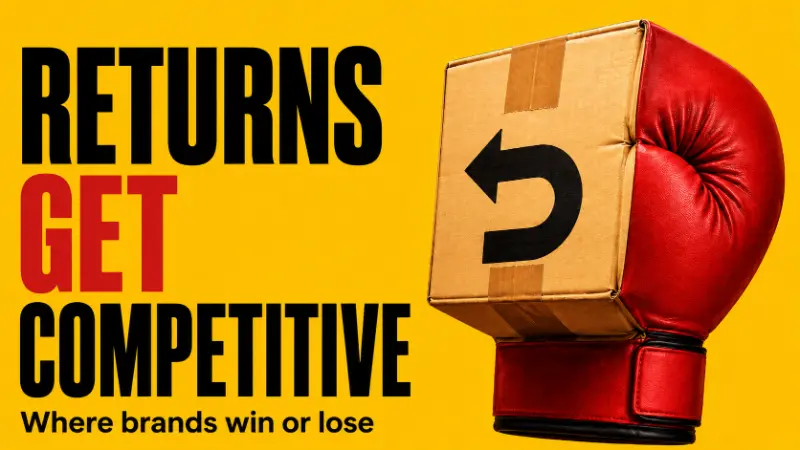
Why Returns Are the Next Battleground in Retail

Last updated on June 25, 2026
In this article
 12 minutes
- Introduction
- Returns Moved From Back-Office Problem to Strategic Pressure Point
- Returns Now Sit Where Margin, Fraud, and Customer Satisfaction Collide
- Carriers and Platforms Are Already Fighting for the Reverse Logistics Post-Purchase Layer
- Retailers Are Already Competing Through Return Economics, Policy, and the Returns Management Process
- Returns Are Becoming the Next Battleground Because Easier Levers Are Weaker
- The Brands That Solve Returns Better Will Gain a Competitive Advantage
- Frequently Asked Questions
Introduction
The next battleground in retail is not at checkout. It is what happens after the sale goes wrong. U.S. retail returns are on track to hit $849.9 billion in 2025, roughly 15.8% of total sales, and the brands competing for that ground already know what most operators are still figuring out: returns management is no longer back-office cleanup.
For most of the last decade, returns were treated as a tax on growth. Returns management refers to overseeing returned products from authorization through restocking or disposal, making the returns management process central to product returns. Returns management focuses on customer satisfaction, while reverse logistics handles the operational aspects of moving goods back through the supply chain. Something to absorb. Something the warehouse handled while the rest of the business focused on acquisition, conversion, and AOV. That framing held up while easier levers were still working. It does not hold up now. Acquisition costs are climbing, discounting has limits, and the obvious places to defend margin have already been squeezed. Returns are one of the largest under-managed intersections of cost, fraud, customer trust, and differentiation left in retail. That is exactly why they are about to be contested.
Returns Moved From Back-Office Problem to Strategic Pressure Point
Start with the size of the room. $849.9 billion in projected U.S. returns for 2025 is not a line-item rounding error. In 2023, consumers returned retail purchases worth $743 billion, or about 14.5% of all sales, showing this pressure has been building. At about 15.8% of retail sales, returns are now a category of activity nearly as large as some entire retail verticals. A function that consumes one out of every six dollars of sales is not operational. It is strategic.
The shift in framing matters more than the number itself. When returns were 5% to 8% of sales, an “average cost per return” calculation could absorb them quietly. At 15.8%, the financial impact is visible in EBITDA, and every percentage point of improvement or deterioration affects profit margins. Finance teams notice. Boards notice. This is part of why returns are becoming a board-level topic, and it is also why operational reframing is happening internally. The internal reframing of returns as a margin lever, not a cost center, is one thread of that shift, because efficient return management helps reduce costs and strengthen customer loyalty. The strategic-competition thread is the one that matters here: when something is this large and this leaky, it does not stay uncontested for long, and a stronger returns management process also improves inventory management and operational efficiency.
Returns Now Sit Where Margin, Fraud, and Customer Satisfaction Collide
The reason returns are becoming the next battleground is that they have stopped being a single-purpose function. They now combine four pressures that used to be handled separately.
- Margin defense. Two shipping legs, intake labor, inspection, repackaging, and markdown decay stack into a fully-loaded cost most retailers underestimate.
- Fraud control. Nearly 9% of returned items are expected to be fraudulent. U.S. retailers lost nearly $25.3 billion to fraudulent returns in 2020, showing how much returns fraud and refund fraud can drain profitability. That is not a service problem. That is a loss-prevention problem riding inside a customer experience flow, especially when teams must review suspicious return requests.
- Customer trust. Roughly one in five online purchases are returned. The return experience is no longer the exception path. It is a core part of how customers evaluate a brand. Clear, proactive customer communication, including confirmation that an item was received and updates on refund timelines, helps boost customer satisfaction, encourage customer loyalty with an exceptional returns program, and protect brand reputation.
- Differentiation. Speed of refund, ease of return, condition transparency on resold goods, all of these now show up in reviews, social posts, and repeat-purchase rates. Streamlining refund processing and processing refunds quickly can improve customer satisfaction.
That combination is what makes returns competitive terrain. A function that touches margin, abuse control, trust, and brand perception in one workflow is not a function any serious retailer can afford to ignore. Strong communication around returns management can improve customer satisfaction and customer loyalty, while delayed refunds and weak updates drive customer dissatisfaction.
Carriers and Platforms Are Already Fighting for the Reverse Logistics Post-Purchase Layer
The clearest evidence that returns are contested terrain is that the largest logistics and platform players are already moving for position.
UPS-owned Happy Returns now operates at more than 8,000 locations, having been folded into UPS Store coverage after UPS acquired it from PayPal. FedEx launched FedEx Easy Returns in 2025 to compete directly for that same drop-off footprint. Amazon has expanded boxless and label-free returns through Kohl’s, UPS Stores, Whole Foods, and Amazon-owned locations. USPS has rolled out its own label-free return options.
This is not a coincidence of product roadmaps. When four of the largest logistics networks in the country simultaneously invest in owning the return entry point, they are signaling that the post-purchase layer has strategic value. That value also comes from returns management software that helps streamline returns through self-service portals, so customers can manage returns and routine return requests without contacting the customer service team, with options ranging from enterprise platforms to Shopify-focused tools like Return Prime returns solutions. It can issue return labels, route items to the right fulfillment center across sales channels, and track patterns that help flag suspicious behavior. They want the data, the customer touchpoint, the consolidation economics, and the relationship with the retailer that pays for the lane. None of that happens around a function that is genuinely back-office.
The post-purchase layer is being claimed. The same automation reduces work that is otherwise time-consuming for support and warehouse teams, while tying returns more tightly to order fulfillment. The question for individual brands is whether they participate in shaping how it works for their customers, or accept whatever shape it takes.
Retailers Are Already Competing Through Return Economics, Policy, and the Returns Management Process
The same pattern is visible on the retailer side. Brands that spent a decade competing on free returns are now competing on the design of paid returns. A clear and concise returns policy should spell out acceptable reasons, time windows, and any potential fees to meet customer expectations.
A short, telling list:
- PrettyLittleThing introduced a £1.99 return fee.
- ASOS charges £3.95 in the UK and applies a $4.95 deduction per returned parcel in the U.S.
- H&M rolled out return fees in several markets.
- Zara charges for mailed returns while keeping store returns free, steering customers toward the lower-cost channel.
The broader trend confirms this is not a handful of outliers. Roughly 40% of retailers are now charging return fees, up from 31% the year before, with typical fees in the $3.99 to $9.99 range, underscoring that the era of free returns coming to an end is reshaping expectations on both sides of the transaction. Paid returns can protect margins, but the cost of free returns remains a central question even as free return shipping is a proven way to build trust, lower barriers to purchase, and encourage future purchases. This is the visible surface of why retailers are quietly tightening returns policies across the industry. Each of these moves is small in isolation. Together, they describe a market actively redesigning return economics in real time. Fee structure, channel steering, window length, condition requirements, and restocking deductions are all now levers brands are pulling against one another. A strong returns strategy can also use exchanges or store credit to retain revenue and support repeat business instead of defaulting every return to a refund. That is what competition on a function looks like before it becomes table stakes.
Returns Are Becoming the Next Battleground Because Easier Levers Are Weaker
None of this would matter as much if the rest of the P&L still had easy answers. It does not.
Customer acquisition costs have risen sharply across most paid channels. Organic reach has compressed on every major platform. Discounting works but trains customers and erodes brand. Supply-side savings are largely tapped out for brands that have already optimized sourcing and 3PL contracts. The obvious moves have been made. For online shoppers, returns happen at far higher rates: roughly 20–30% of online purchases come back, versus 8.89% in physical stores, reflecting the broader rise of e-commerce return rates.
That is the strategic context returns walk into. When the easy levers are weaker, attention shifts to the levers that have been under-managed. Effective returns management has to balance customer satisfaction with fraud prevention and cost-efficiency if brands want to cut costs, reduce costs, and protect profit margins while improving operational efficiency and lowering operational costs, from detecting and preventing ecommerce returns fraud step-by-step to addressing the nuances between ecommerce return fraud vs. refund fraud. Returns are arguably the largest of these. A function representing 15.8% of sales, with ~9% fraud exposure on returned items, that simultaneously touches customer retention and Scope 3 reporting, is not a small lever. It is one of the few large ones still sitting in plain sight.
This is part of the reason sustainability didn’t kill returns — economics did. The pressure on returns is not coming primarily from ESG mandates. It is coming from the basic arithmetic of running a retail business when growth is harder to buy, because faster, more efficient processing also lowers shipping, labor, and storage expenses.
The Brands That Solve Returns Better Will Gain a Competitive Advantage
The competitive logic from here is straightforward.
A brand that handles returns poorly loses money on the return itself, loses trust with the customer, loses inventory value to delay and markdown, and absorbs fraud it cannot see. A brand that handles returns better protects margin on the same revenue, retains customers who would otherwise churn, recovers inventory value faster, and surfaces abuse earlier. Brands also compete better when they reduce returns upstream through stronger quality control, better product quality, accurate product descriptions, and detailed size guides that set expectations correctly. Same function. Different outcome.
The advantage compounds because each piece reinforces the others. Faster recovery improves cash flow, which improves the ability to invest in further improvement. Better fraud signals improve policy design, which improves margin. Better use of returns data helps teams identify trends, spot recurring defects, separate buyer’s remorse from fulfillment mistakes in order fulfillment, and prevent future returns. Cleaner post-purchase experience improves repeat rates, which improves CAC payback, which improves the willingness to invest in better returns infrastructure. This is the underlying logic behind treating returns as a margin lever, not a cost center, and it is also why the broader argument that returns need to go forward, not back is gaining traction operationally. Once a function is competitive terrain, the cost of treating it as a back-office process is not a static disadvantage. It widens every quarter against brands that are actively building capability there.
Returns are not becoming important. They have been important. What is changing is that the market has finally noticed, and the brands that move first will set the standard the rest of the industry has to react to. Better disposition decisions across the reverse logistics process—restock, refurbish, recycle, or resale—help recover more revenue while supporting sustainable returns and environmental responsibility.
Frequently Asked Questions
Why are returns considered the next competitive battleground in retail?
Because returns now combine financial leakage, fraud exposure, customer trust, and brand differentiation in a single function, at a scale of roughly $849.9 billion and 15.8% of U.S. retail sales. That mix of pressure, at that size, makes returns one of the largest under-managed areas left in retail, which is exactly the kind of function that attracts competitive attention.
How big is the U.S. returns problem in 2025?
U.S. retail returns are projected to reach $849.9 billion in 2025, equal to about 15.8% of total retail sales. Roughly one in five online purchases is returned, and nearly 9% of returned items are expected to be fraudulent.
Why are major carriers competing for return drop-off networks?
UPS-owned Happy Returns operates at more than 8,000 locations, FedEx launched FedEx Easy Returns in 2025, and Amazon and USPS continue to expand boxless return options. Carriers and platforms are competing to own the post-purchase layer because it carries strategic value: data, customer touchpoints, consolidation economics, and embedded relationships with retailers.
Why are retailers introducing return fees now?
About 40% of retailers are charging return fees, up from 31% the previous year, with typical fees between $3.99 and $9.99. Brands including PrettyLittleThing, ASOS, H&M, and Zara have introduced fees or channel-based pricing. The shift reflects active competition on return economics as easier margin levers elsewhere in the business have weakened.
Does this mean free returns are over?
Not entirely. It means free returns are no longer a default entitlement. They are increasingly treated as a priced service, a loyalty perk, or a channel-specific option, depending on the brand’s strategy. The competitive question is no longer whether returns are free, but how return economics are designed.
What should retailers do first if returns are becoming competitive terrain?
Establish a real baseline. That means a fully-loaded cost per return broken out by shipping, labor, markdown, and fraud, plus return rate by SKU and recovery rate of returned inventory. As part of returns management best practices, include tracking return reasons and regularly reviewing progress against those metrics. The returns process should cover initiation, return labels, processing refunds, and final disposition such as restocking or recycling. Transparency and multi-channel customer communication across email, phone, and live chat improve customer satisfaction by keeping shoppers informed about status and timing. Without that baseline, any policy or process change is anecdotal. With it, returns can be managed as a strategic lever rather than an absorbed cost.
Written By:

Manish Chowdhary
Manish Chowdhary is the founder and CEO of Cahoot, the most comprehensive post-purchase suite for ecommerce brands. A serial entrepreneur and industry thought leader, Manish has decades of experience building technologies that simplify ecommerce logistics—from order fulfillment to returns. His insights help brands stay ahead of market shifts and operational challenges.

Turn Returns Into New Revenue
Related Articles
Save Money With Ecommerce Shipping Software: Next-Gen Solutions
Shipping costs are one of the biggest challenges for ecommerce businesses today, and understanding them is essential to reducing expenses and increasing profit margins.
10 Best European 3PLs for Ecommerce Sellers in 2026
Bigblue is the best overall choice among the best European 3PLs in this comparison: one provider with 11 fulfilment centres across France, Spain, Italy, the UK, and Germany, its ow...
Why Returns Are Becoming a Board-Level Topic
Returns have quietly become one of the most consequential financial problems in ecommerce, and boards are finally being forced to confront what operators have known for years: retu...