
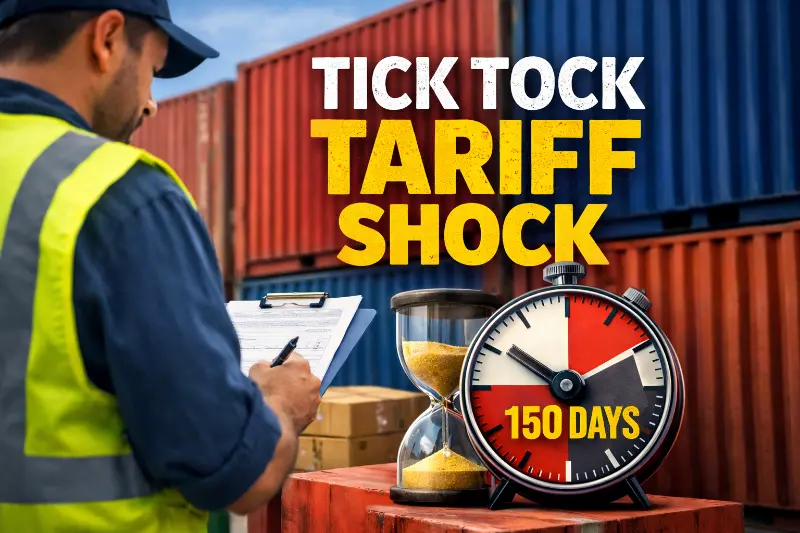
15% Global Tariff After Supreme Court Ruling: What Ecommerce Brands Must Do in the Next 150 Days

Last updated on February 24, 2026
In this article
 21 minutes
- Introduction to the New Tariff System
- What Actually Changed: The Legal Mechanism Matters More Than the Rate
- The Refund Situation: Do Not Build a Budget Around It
- What Comes After Day 150: The Replacement Risk Is Real
- What This Means for Landed Cost and Unit Economics
- The Next 150 Days: 10 Moves to Protect Margin
- How Fulfillment Strategy Connects to Tariff Management
- Frequently Asked Questions
A major U.S. tariff policy shift just happened, and the headline is not the most important part.
Yes, the global tariff rate being discussed is 15%. But the real operational change is this: the legal basis for broad tariffs has shifted, and the replacement tool is time-bounded. That means tariff policy can change faster than your inventory turns, your POs arrive, or your pricing updates take effect.
For ecommerce brands, this is no longer a finance-only problem. It is an operating system problem. The brands that win will treat tariffs as a variable that can be managed through landed-cost math, PO timing, SKU-level margin rules, and shipping decisions. The brands that lose will treat tariffs like a one-time surcharge and hope it stabilizes.
This guide breaks down what changed, why the next 150 days matter, and exactly what operators should do now to protect margin.
Introduction to the New Tariff System
The Supreme Court’s recent ruling has triggered a seismic shift in the United States’ approach to tariffs, fundamentally altering the legal and operational landscape for importers and ecommerce brands. By declaring the International Emergency Economic Powers Act (IEEPA) tariffs unconstitutional, the Court has forced a rapid pivot in U.S. trade policy. In response, President Trump invoked Section 122 of the Trade Act of 1974, a rarely used provision designed to address fundamental international payments problems and balance of payments deficits.
Under this new authority, the administration has imposed a temporary import duty—a 15% global tariff, which is the statutory maximum allowed by Section 122. This tariff is not open-ended: it is explicitly capped at 150 days unless Congress votes to extend it, making the current tariff regime both sweeping and time-limited. The stated rationale is to counteract the United States’ current account deficit and trade deficit, and to prevent significant depreciation of the dollar in foreign exchange markets. However, this justification is already facing scrutiny, as critics argue that the present economic conditions do not meet the traditional definition of a balance of payments deficit required by the statute.
The United States Trade Representative (USTR) has moved quickly to outline the next phase of tariff policy. Plans are underway to launch Section 301 investigations targeting unfair trade practices by major trading partners. These investigations are expected to pave the way for more targeted, potentially higher, and longer-lasting tariffs once the Section 122 window closes. As a result, the average effective tariff rate has climbed to approximately 14.5%, though certain categories—such as pharmaceuticals, electronics, and agricultural products—are exempt under the current proclamation.
This rapid shift in the tariff regime has far-reaching implications for international trade, market access, and investment deals. The USTR has emphasized the need to address unfair trade practices and protect American businesses, but the new approach also introduces uncertainty for trading partners and global supply chains. Countries in Central America, the Dominican Republic, Costa Rica, and beyond are closely monitoring the situation, as changes to the harmonized tariff schedule and privileged foreign status could impact their export competitiveness and trade relations with the U.S.
Legal challenges are already brewing, with questions about whether the administration’s invocation of Section 122 truly meets the statutory requirements for a balance of payments deficit. The Supreme Court ruling has set a precedent for closer judicial scrutiny of executive tariff authority, and further litigation is likely as the administration seeks to maintain tariffs under the Trade Act of 1974.
The global economy is watching closely, as the imposition of new tariffs and the potential for significant depreciation of the dollar could ripple through foreign exchange markets and affect global trade balances. The Federal Reserve is actively monitoring these developments, aware that shifts in U.S. trade policy can have profound effects on foreign reserves, net income, and the stability of international payments systems.
For businesses and investors, the message is clear: the current tariff regime is in flux, and the next 150 days will be critical. With the possibility of tariff cuts, increases, or further legal challenges on the horizon, staying informed and agile is essential. As the United States Trade Representative and the administration chart the next phase of trade policy, ecommerce brands and importers must be ready to adapt to a rapidly changing international trade environment.
What Actually Changed: The Legal Mechanism Matters More Than the Rate
On February 20, 2026, the U.S. Supreme Court ruled 6-3 that the International Emergency Economic Powers Act, or IEEPA, does not authorize the president to impose tariffs. That ruling invalidated the legal foundation for the sweeping tariffs the Trump administration had applied to most of the country’s trading partners, including the reciprocal tariffs announced in April 2025 and the fentanyl-related tariffs on Canada, Mexico, and China. The Supreme Court’s decision clarified that IEEPA does not permit the President to impose tariffs, which led to the invocation of Section 122 for new tariffs.
The administration’s tariffs are now being justified under Section 122 of the Trade Act of 1974, contrasting with the previous reliance on IEEPA. Section 122 is rarely used and is generally limited to balance-of-payments crises, making its current application by the administration unprecedented and potentially subject to legal challenges.
The administration responded within hours. President Trump issued a proclamation imposing tariffs under Section 122 immediately following the Supreme Court decision, directing agencies to terminate IEEPA tariff collection and pivot to this different legal tool.
Within 24 hours, the Section 122 tariff started at 10% and was raised to 15%, the statutory maximum, via a Truth Social post. President Trump announced a 10 percent tariff under Section 122, which was raised to 15 percent the following day (the earlier date). That 15% rate is now active on most imports from all countries. President Trump imposed a 15 percent tariff under Section 122 for a 150 day period beginning February 24, 2026. The Section 122 tariffs will take effect on February 24, 2026, and will remain in place for 150 days unless extended by Congress. No president has used Section 122 until now, making its application unprecedented and potentially subject to legal challenges.
Why the legal basis matters operationally
For operators, the distinction between IEEPA and Section 122 is not a legal technicality. It is a planning constraint with a hard deadline attached.
IEEPA was an open-ended emergency authority. There was no expiration date. Section 122 is structurally different. It is a temporary balance-of-payments authority that explicitly caps tariffs at 15% and limits their duration to 150 days without a congressional vote to extend. The exemption and implementation structure of Section 122 also draws some parallels to the IEEPA framework, particularly in how exemptions are granted and how non-stacking of duties is managed, though Section 122 applies these rules to specific product categories and under more defined conditions. The 150-day clock on the current proclamation runs out on July 24, 2026.
That clock is the single most important operational fact for any ecommerce brand importing goods right now.
What Section 122 is and is not
Section 122 of the Trade Act of 1974 was written for a different era, specifically for a world of fixed exchange rates and gold-pegged currencies. It authorizes the president to impose across-the-board temporary import duties when the United States faces a large and serious balance-of-payments deficit or an imminent and significant depreciation of the dollar in foreign exchange markets.
The authority was never used before now. Legal experts at Peterson Institute for International Economics and the Council on Foreign Relations have noted that applying Section 122 to today’s floating-rate economy is legally questionable and that new court challenges are likely. Some analyses indicate that more than half of the tariffs imposed may not be legally justified under Section 122, highlighting the legal constraints and scrutiny. Additionally, Section 122 is viewed as a temporary measure to act as a bridge to more permanent trade actions, such as those under Section 301. Legal experts also suggest that Section 122 may not apply in the current context because the U.S. trade deficit does not qualify as a balance-of-payments deficit. However, those challenges will almost certainly not resolve within 150 days, which means the Section 122 tariff will likely either lapse, get replaced by other authorities, or face a congressional vote before any court decision arrives.
Unlike IEEPA tariffs, Section 122 is nondiscriminatory by design. It applies across the board at a flat rate rather than targeting specific countries with different rates. That limits the administration’s ability to use it as leverage in bilateral deal-making, which is a meaningful change in how tariff pressure gets applied.
What is still in place from before
The Supreme Court ruling and the Section 122 replacement did not touch everything. Several major tariff regimes remain fully intact:
- Section 232 tariffs on steel, aluminum, and copper continue in full force.
- Section 301 tariffs on Chinese goods, the backbone of U.S. trade pressure on China since 2018, are unaffected.
- Heavy-duty trucks and buses, already subject to 25% Section 232 tariffs, are exempt from the new 15% surcharge; such products are specifically excluded from the Section 122 tariff.
- The suspension of de minimis treatment for shipments under $800 has been explicitly continued under the new proclamation.
- USMCA-compliant goods from Canada and Mexico remain duty-free under the new framework.
The Section 122 proclamation also carves out certain critical minerals, energy products, pharmaceutical ingredients, passenger vehicles, and aerospace products. Such products are exempt from the new 15% across-the-board rate. Brands in apparel articles, consumer goods, textiles, and general merchandise categories are most directly affected by the new 15% across-the-board rate.
In addition, goods admitted under privileged foreign status or domestic status, as defined in customs regulations and the harmonized tariff schedule, may be subject to different classification or treatment under Section 122.
Let AI Optimize Your Shipping and Boost Profits
Cahoot.ai software selects the best shipping option for every order—saving you time and money automatically. No Human Required.
See AI in ActionThe Refund Situation: Do Not Build a Budget Around It
One of the most operationally dangerous assumptions brands can make right now is that IEEPA refunds will arrive quickly and predictably.
The legal picture for refunds is clear: because the Supreme Court’s ruling was unambiguous, importers who paid IEEPA tariffs are entitled to refunds plus interest on entries where those duties were collected. A recent decision by the Court of International Trade affirms that U.S. Customs and Border Protection has no basis to deny such protests.
The operational picture is much less clear.
The government has not outlined a refund mechanism or timeline. The Court’s ruling did not address what happens to the more than $130 billion already collected in IEEPA tariffs. CBP will likely need to issue public guidance on the protest process, and the sheer volume of entries involved means delays are virtually certain. For entries that have already been liquidated, importers may need to file administrative protests within 180 days of the liquidation date. That is a hard deadline that requires prompt action from your customs broker, not a passive wait.
For budget planning purposes, treat any IEEPA refund as potential upside at some undefined future date, not a cash-planning assumption. Brands that model refund proceeds into near-term operating budgets are making an assumption that no one in the legal or customs community can currently validate.
What Comes After Day 150: The Replacement Risk Is Real
The administration has been explicit about its intentions after the Section 122 window closes. The U.S. Trade Representative has announced plans to initiate Section 301 investigations “in short order” against most major trading partners, covering areas including industrial excess capacity, forced labor, and pharmaceutical pricing practices.
Section 301 investigations are not capped at 15% and have no 150-day expiration. But they do require a formal investigation process that typically takes months. The administration’s stated plan is to use the Section 122 window as a bridge while Section 301 cases build their evidentiary record.
Congressional extension of Section 122 is viewed by most analysts as unlikely. Both the House and the Senate have passed bills disapproving of IEEPA tariffs. House Speaker Mike Johnson acknowledged in a public statement that finding congressional consensus on tariffs would be “a challenge.” Polls consistently show American voters oppose tariffs at roughly a 2-to-1 ratio, a difficult environment for legislators heading into a midterm election cycle with a razor-thin House majority.
This creates three plausible paths for what happens on July 25, 2026 and after:
The Section 122 tariffs lapse because Congress declines to extend them, while Section 301 investigations are still underway and not yet producing new tariffs. Operators in this scenario face a sudden rate reduction followed by an uncertain re-escalation timeline. The administration initiates another declared balance-of-payments emergency and attempts to restart the Section 122 clock. Legal experts note that nothing in the statute explicitly forbids this, though it would face severe separation-of-powers challenges. Section 301 tariffs on specific countries and categories begin arriving before or shortly after the Section 122 expiration, producing a patchwork of category- and country-specific rates that replaces the flat 15% with something more complex.
None of these paths is stable. All of them argue for the same operational response: build flexibility into your cost structure now, because tariff policy can flip faster than your supply chain can adapt.
ShipStation vs. Cahoot: 21x Faster, Real Results
Get the inside scoop on how a leading merchant switched from ShipStation to Cahoot—and what happened next. See it to believe it!
See the 21x DifferenceWhat This Means for Landed Cost and Unit Economics
The freight market reacted immediately to the ruling, and upcoming logistics and fulfillment events for ecommerce brands will inevitably focus on these tariff-driven shocks. FreightWaves CEO Craig Fuller noted that importers would surge goods ahead of any new rate implementation, adding that transborder shipping was “about to go nuts.” That kind of surge is already moving: bonded warehouse activity spiked in the days following the ruling as importers evaluated timing strategies before the Section 122 effective date.
For ecommerce brands, the landed cost equation has just changed again, and it will change at least one more time before July 24, which makes specialized order fulfillment services for ecommerce companies even more critical to protect margin.
Landed cost at the SKU level now includes the 15% Section 122 surcharge (unless your product is in an exempt category), plus any continuing Section 232 or Section 301 duties, plus brokerage, drayage, and inbound freight. The Section 122 surcharge is treated as a regular customs duty for import valuation and duty calculations. Charges applicable to imported goods now include the Section 122 tariff in addition to other duties, taxes, and fees. If your team is still working from the pre-ruling cost sheet, every margin assumption you have is wrong. Section 301 duties on Chinese goods remain in place, which means brands sourcing from China are not seeing the dramatic effective tariff reduction that applies to goods from other countries.
When classifying products, it is important to reference the applicable HTSUS subheading, as modifications to these subheadings can directly impact the tariffs or import procedures for your goods.
Yale Budget Lab estimated that the post-ruling effective tariff rate dropped from 16.9% to 6.7% on a pre-substitution basis once IEEPA tariffs are removed. But that figure applies before the Section 122 replacement takes full effect. With 15% Section 122 tariffs active, the estimated average effective tariff rate rises to approximately 13.7%. The new global 15 percent tariff under Section 122 brings the average effective tariff rate to 14.5 percent. For brands with significant China exposure, the effective rate remains substantially higher due to layered Section 301 and Section 232 duties.
The Next 150 Days: 10 Moves to Protect Margin
- Rebuild landed cost at the SKU level. Update your true cost per SKU including duty, brokerage, drayage, and inbound freight. If you cannot see landed cost by SKU, you cannot price correctly.
- Set a tariff “variance band.” Decide what percent change in landed cost triggers an automatic action: price update, promo pause, reorder delay, or supplier negotiation.
- Stop quoting static margins. Move to margin rules that tolerate volatility (for example: minimum contribution per order, not just margin percent).
- Re-time purchase orders. If tariffs are time-bounded, the timing of customs entry matters. Review when your POs land and when entries will clear, not just when you place the PO.
- Renegotiate Incoterms and surcharge structure. If you are paying duty, confirm who carries the risk. If suppliers are paying duty, confirm how they are passing cost back. Eliminate vague “tariff surcharge” language.
- Pressure-test your top 20 SKUs for price elasticity. Identify which SKUs can take a price increase without collapsing conversion. Separate “traffic drivers” from “profit drivers.”
- Reduce inventory bets where demand is uncertain. A volatile tariff environment punishes overbuying. Shift toward smaller, more frequent replenishment where possible.
- Audit HTS classification and documentation. Misclassification risk is expensive during volatility. Confirm HTS codes for top import SKUs and ensure your customs broker documentation is clean.
- Plan for refund uncertainty, not refund hope. Do not build budgets around tariff refunds arriving quickly. If refunds happen, treat them as upside later, not a cash-plan assumption now.
- Make shipping and fulfillment decisions cost-aware. Tariffs hit unit economics, so every downstream cost matters more. Use routing and carrier selection that minimizes total cost-to-serve per order, not just postage. This is where automation matters, because manual rule stacks do not adapt fast enough when inputs keep changing—especially for channels like Google Shopping delivery and shipping fulfillment, where fast, low-cost delivery strongly influences conversion.
Cut Costs with the Smartest Shipping On the Market
Guranteed Savings on EVERY shipment with Cahoot's AI-powered rate shopping and humanless label generation. Even for your complex orders.
Cut Costs TodayHow Fulfillment Strategy Connects to Tariff Management
Tariffs affect unit economics at the point of import. But they also change the relative weight of every downstream cost decision. When your landed cost per unit increases by 15%, the difference between a Zone 3 and a Zone 7 shipment stops being a rounding error and starts being a material margin event.
This is where fulfillment architecture becomes a cost management tool, not just a logistics function, especially when it’s built on a collaborative order fulfillment company model that shares resources across merchants.
Brands running from a single warehouse node have no ability to route around carrier zone costs. Every order ships from the same location regardless of cost. A multi-node fulfillment setup, whether owned, 3PL-based, or some combination, allows routing decisions to be made at the order level based on actual cost-to-serve. When tariffs are compressing margin at the top of the unit economics stack, reducing carrier zone exposure at the bottom and tightening order fulfillment costs for ecommerce can be the difference between a profitable order and a loss.
This is what Cahoot’s ecommerce fulfillment software is built for: helping operators route orders intelligently across warehouse nodes, so that cost-aware fulfillment decisions happen automatically at scale. Manual rule stacks do not adapt quickly enough when input costs are shifting every few weeks. Automated, national multi-node fulfillment creates the operational flexibility that the next 150 days of tariff volatility will demand.
The same logic applies to inventory placement. If Section 301 investigations produce new tariffs by category and country of origin later this year, some SKUs will be more affected than others, and operators may need to contact an order fulfillment specialist for a customized plan to re-balance their network and costs. Brands that can see landed cost by SKU, tied to their active fulfillment nodes, will be able to make routing and replenishment decisions in near real time by leveraging ecommerce order fulfillment services that outclass traditional 3PLs. Brands that cannot see that data will be reacting weeks late.
Frequently Asked Questions
What is the Section 122 tariff?
Section 122 of the Trade Act of 1974 is a balance-of-payments authority that allows the president to impose temporary, across-the-board import tariffs when the United States is experiencing a large and serious balance-of-payments deficit or a significant depreciation of the dollar. The tariff is capped at 15% and expires after 150 days unless Congress votes to extend it. The authority was invoked for the first time on February 20, 2026, within hours of the Supreme Court ruling that struck down IEEPA tariffs.
Why did the Supreme Court strike down the IEEPA tariffs?
The Court ruled 6-3 that the International Emergency Economic Powers Act does not authorize the president to impose tariffs. The majority held that the power to tax, which includes imposing tariffs, belongs to Congress under the U.S. Constitution, and that IEEPA’s language authorizing the president to “regulate importation” does not extend to tariff imposition. The ruling was based on statutory interpretation and did not address broader constitutional questions.
How is the Section 122 tariff different from the IEEPA tariffs it replaced?
IEEPA tariffs were open-ended, could be set at any rate, and could differ by country. Section 122 tariffs are capped at 15%, apply uniformly across all trading partners, and expire automatically after 150 days without congressional authorization to continue. The nondiscriminatory nature of Section 122 also limits the administration’s ability to use tariff rates as bilateral negotiating leverage.
When does the Section 122 tariff expire?
The current Section 122 proclamation covers goods entering the United States from February 24, 2026, through July 24, 2026. After that date, the tariffs lapse unless Congress passes legislation to extend them, or the administration establishes a new tariff basis under other authorities such as Section 301 or Section 232.
Will IEEPA tariff refunds be paid, and how quickly?
Importers who paid IEEPA tariffs are legally entitled to refunds plus interest because the Supreme Court’s ruling was unambiguous that those tariffs were never valid. However, the Court did not establish a refund mechanism or timeline, and the government has not yet issued guidance. For liquidated entries, importers may need to file administrative protests within 180 days of the liquidation date. Given that the government collected over $130 billion in IEEPA tariffs, delays in processing refunds are widely expected. Operators should not build near-term budgets around refund proceeds.
What tariffs remain in place after the Supreme Court ruling?
Section 301 tariffs on Chinese goods, which have been in place since 2018, are unaffected. Section 232 tariffs on steel, aluminum, and copper continue in full force. The suspension of de minimis treatment for shipments under $800 has been explicitly continued. USMCA-compliant goods from Canada and Mexico remain duty-free. The Section 122 tariff applies on top of any remaining Section 301 and Section 232 duties for affected product categories.
What categories are exempt from the Section 122 tariff?
The Section 122 proclamation carves out several categories, including USMCA-compliant goods from Canada and Mexico, certain critical minerals, energy products, pharmaceutical ingredients, passenger vehicles, heavy-duty trucks, buses, and aerospace products. Goods already subject to Section 232 tariffs are exempt from the Section 122 surcharge. Brands in apparel, textiles, general consumer goods, and accessories are among those most directly affected by the 15% rate. Confirming your specific HTS code exemption status with your customs broker is advisable before making any planning assumptions.
What should ecommerce brands do right now about HTS classification?
Verify HTS codes for your top-volume import SKUs immediately. Misclassification errors that were manageable at lower tariff rates become significantly more expensive at 15%. Confirm with your customs broker that your entry documentation is accurate and that any exemption categories you believe apply to your goods are properly documented. This is also a good time to confirm Incoterms with suppliers and eliminate any vague “tariff surcharge” language that may obscure who carries duty liability in your purchase agreements.
What happens to tariffs after the 150-day Section 122 window closes?
The administration has publicly stated its intention to file Section 301 investigations against most major trading partners, covering issues including industrial excess capacity and forced labor practices. Section 301 tariffs are not capped at 15% and do not expire after 150 days, but they require a formal investigation process that takes months. Congressional extension of the Section 122 tariffs is considered unlikely given the political dynamics. The most probable outcome is a period of transition after July 24 during which some Section 122 tariffs lapse while Section 301 cases are still underway, followed by new, category-specific tariff structures as those investigations conclude.
Written By:

Rinaldi Juwono
Rinaldi Juwono leads content and SEO strategy at Cahoot, crafting data-driven insights that help ecommerce brands navigate logistics challenges. He works closely with the product, sales, and operations teams to translate Cahoot’s innovations into actionable strategies merchants can use to grow smarter and leaner.

Turn Returns Into New Revenue
Related Articles
GST in Ecommerce: What It Is, How It Works, and Why Sellers Get Confused
Goods and Services Tax (GST) is frequently misunderstood by ecommerce sellers because it behaves differently across borders, platforms, and transaction types.

Seller Fulfilled Prime Requires the Right Operating Model — Not the “Perfect” 3PL
Seller Fulfilled Prime doesn’t fail because sellers lack speed or good warehouses.

Seller Fulfilled Prime Works — But Only With the Right Operating Model
Seller Fulfilled Prime is attractive for very rational reasons.