
3PL vs In-House Logistics: How to Shift From In-House Warehouse to a 3PL | Cahoot
In this article
 14 minutes
- Understanding In-House Logistics and 3PL
- Definition of In-House Logistics
- Definition of Third-Party Logistics (3PL)
- Advantages and Disadvantages of In-House Logistics
- 5 Signs It’s Time to Switch to an Outsourced Third-Party Logistics Company
- How to Shift From In-House Warehouses to an Outsourced 3PL
- In-House or Outsourced? Cahoot Lets You Do Both
- Frequently Asked Questions
As your ecommerce business grows, the operations behind it become more complex. One of the most significant is warehousing and order fulfillment, which must scale alongside sales and customer growth to remain profitable.
While in-house order fulfillment may be cost-effective initially, those expenses can skyrocket as you need more warehousing space, on-demand workers, and closer relationships with shipping providers. The decision-making process of 3pl vs. in-house becomes critical as you weigh factors like control, scalability, cost, and business needs to determine the most suitable fulfillment method for your company.
For most growing ecommerce businesses, handling order fulfillment is a large and time-consuming role that they didn’t sign up for. Instead, many merchants are outsourcing this task to reliable third-party logistics (3PL) providers. In this article, we’ll discuss the benefits of working with an order fulfillment partner and quick steps on how to outsource your logistics.
Understanding In-House Logistics and 3PL
As ecommerce businesses grow, understanding the logistics options available becomes crucial. Two primary approaches are in-house logistics and third-party logistics (3PL). Each has its unique benefits and challenges, and choosing the right one can significantly impact your business’s efficiency and customer satisfaction.
Definition of In-House Logistics
In-house logistics refers to the management and execution of logistics operations within a company’s own facilities and resource constraints. This approach involves handling all aspects of the supply chain internally, including inventory management, order fulfillment, warehousing, and transportation. By keeping these operations in-house, businesses maintain complete control over their logistics processes, allowing them to tailor their operations to meet specific customer needs and expectations. This level of control can lead to more personalized service and potentially higher customer satisfaction, as businesses can directly oversee every step of the order fulfillment process. But it’s inherently more expensive.
Slash Your Fulfillment Costs by Up to 30%
Cut shipping expenses by 30% and boost profit with Cahoot's AI-optimized fulfillment services and modern tech —no overheads and no humans required!
I'm Interested in Saving Time and MoneyDefinition of Third-Party Logistics (3PL)
Third-party logistics (3PL) involves outsourcing logistics operations to a specialized provider. A 3PL provider manages and executes logistics functions on behalf of a business, including warehousing, inventory management, order fulfillment, and transportation. By leveraging the expertise and resources of a 3PL provider, businesses can optimize their supply chain operations and improve customer satisfaction through improved fulfillment reliability. This approach allows companies to benefit from the advanced technology, infrastructure, and industry knowledge that 3PL providers offer, often resulting in more efficient and cost-effective logistics operations. These benefits extend to the use of “Micro-Fulfillment Centers” strategically located to enable even faster, more localized delivery. Cahoot’s massive nationwide local reach can be considered the top option in this category.
Advantages and Disadvantages of In-House Logistics
When deciding between in-house logistics and outsourcing to a 3PL provider, it’s essential to consider the pros and cons of each approach. In-house logistics offers certain advantages but also comes with its own set of challenges.
Pros of In-House Logistics:
- Complete Control: Businesses have full control over their logistics processes, allowing for customization and direct oversight.
- Tailored Operations: Companies can tailor their logistics operations to meet specific customer needs and expectations, potentially enhancing customer satisfaction.
- Direct Management: In-house logistics enables direct management of inventory and warehouse operations, which can lead to more efficient order fulfillment, but more importantly, inventory accountability.
Cons of In-House Logistics:
- Higher Costs: Managing logistics in-house can be expensive, requiring significant investment in warehouse space, technology, and staff (which can be unpredictable).
- Resource Intensive: In-house logistics demands substantial resources, including time, personnel, and capital, which can strain a growing business.
- Scalability Issues: As order volumes increase, scaling in-house logistics operations can be challenging and may lead to inefficiencies or delays.
By weighing these pros and cons, businesses can make an informed decision about whether to keep logistics operations in-house or outsource to a 3PL provider.
5 Signs It’s Time to Switch to an Outsourced Third-Party Logistics Company
If you face logistics and shipping issues, reexamine how you ship. Aligning logistics strategies with evolving customer expectations is crucial for business growth. As you analyze your operations, keep the following five indicators in mind to determine if you should outsource order fulfillment.
1) Your Logistics are Hindering Your Growth
Today’s consumers place significant demands on logistics. For many small ecommerce businesses, that means scaling at the pace of your fulfillment. If you’re canceling orders because you can’t keep up with the logistics, or your sales are limited by your order fulfillment capacities, it’s time to invest in an outsourced 3PL company.
Similarly, if your organization’s in-house logistics management is bottlenecking and you’re slowing the growth of your ecommerce company to invest in internal fulfillment services, consider whether a 3PL is a better and ultimately cheaper solution.
2) Items are Getting Lost
As order volume rises, so do the chances of mistakes, especially if you’re unable to expand your warehousing capacity quickly enough. Orders get missed or lost, items get delivered late, and tasks fall through the cracks.
Outsourcing logistics operations to a third-party logistics provider (3PL) can mitigate these issues. A 3PL company typically uses some form of distributed order management software to monitor inventory and shipments, which greatly reduces the occurrence of order errors.
Beyond that, packages have a higher tendency of getting lost or stolen when shipped to big city addresses, so hiring a 3PL provider with consistent shipping insurance options and Shipment Insights will avoid the expenses associated with missing items and help your customer service team offer better resolutions.
3) You’re Relying on Manual Order Tracking
Many ecommerce stores start out processing orders manually: You place an incoming order into a spreadsheet, pack it, and manually update shipping. From there, you write down the actual cost of packaging, postage, and other details.
This process is slow, requires significant human effort, and introduces human error. It also fails to provide the metrics and insights obtained with automation. Additionally, managing in-house operations involves substantial investment in advanced fulfillment technology, which can be a significant challenge and cost for businesses. A modern 3PL company will have the shipping software in place using blockchain technology for supply chain transparency, including up to the minute tracking with precise current package locations. Intelligent software also automatically collates costs, expenses, and revenue to better project profitability, increasing trust and collaboration between businesses and their fulfillment partners, leading to more efficient and reliable operations.
4) Deliveries are Late
More than 90% of Americans expect a shipment to arrive within two to three days. However, if your warehousing and shipping network is overburdened, you’ll likely be unable to keep up with projected shipping deadlines.
Rising shipping costs can significantly impact profitability, but a 3PL can help mitigate these costs through efficient distribution centers and optimized shipping methods.
If your shipments are increasingly falling behind, that’s a good indication you lack the infrastructure to keep up with current demand. A 3PL, on the other hand, will have that infrastructure in place for accurate tracking and delivery projection timelines so customers won’t be disappointed due to poor order fulfillment.
5) Order Fulfillment Costs are Too High
Handling order fulfillment in-house means negotiating your own contracts and potentially missing out on savings that come from large volumes. By collaborating with 3PL providers that specialize in supply chain management, businesses can improve their efficiency and reduce costs. When you work with a 3PL that can leverage economies of scale, they often can negotiate more favorable pricing on packaging, storage, as well as shipping.
In addition to better rates, working with a 3PL may help eliminate other overhead expenses, such as the need to hire, train, and manage warehouse staff, as well as rent your own prep and storage locations.
Finally, if you ship from a single location—as is common with many in-house order fulfillment setups—you may be overspending on expensive shipping for orders far away from your warehouse. Working with a fulfillment partner that has locations on both the West and East Coasts, for example, can help shorten the distance items need to travel and allow for more ground shipping while meeting shipping speed service level agreements.
Looking for a New 3PL? Start with this Free RFP Template
Cut weeks off your selection process. Avoid pitfalls. Get the only 3PL RFP checklist built for ecommerce brands, absolutely free.
Get My Free 3PL RFPHow to Shift From In-House Warehouses to an Outsourced 3PL
Partnering with a 3PL provider can remove the burden of warehousing overhead and infrastructure, freeing your organization to focus on sales, production, and growth.
While there are numerous benefits, including potential cost savings, reduced carbon footprint, and faster, more reliable shipping, keep in mind that outsourcing order fulfillment is a complex process.
Below are our suggestions for making the switch.
1) Pick a Reliable 3PL Company
Knowledge is power, and researching the best 3PL company for your unique brand is half the battle in making a smart, strategic switch.
Outsourcing logistics to third-party logistics providers offers significant advantages, including their expertise, scalability, and cost-effectiveness, which can enhance operational efficiency and customer satisfaction compared to managing logistics in-house.
There are tens of thousands of 3PL providers on the market, but finding a good fit for your ecommerce business requires effort. Choose a 3PL partner that matches your business growth, technology needs, and distribution needs.
Ask yourself:
- Does the 3PL provider have geolocations that match your customer base?
- Can you scale with this 3PL provider, or will you quickly outgrow them?
- Are they small enough to be a partner?
- Do they offer customization or services like packing slips, marketing material, etc.?
- Do they support all of your channels?
- Do they support the circular economy (growing emphasis on sustainability and reverse logistics, product repair, and remanufacturing)?
- Do they have a history of operation and a stable client base?
- Does their software integrate with yours?
- Does the 3PL provider meet all of your needs (fulfillment, reverse logistics, kitting, subscription boxes, etc.)?
- Do they have security in place? What about certifications like FDA or DEA? Do you need HAZMAT?
- What’s their customer service like?
Order fulfillment is a critical component of your success, so take your time choosing the right 3PL for your business.
2) Do a Test Run
Generally, it’s smart to try out the 3PL with a small amount of inventory or a few products. This gives you the chance to get to know the 3PL provider before committing all of your inventory to their care. For this test run, it’s helpful to choose a fast-moving product that you know will sell quickly. (You may also want to order a few products yourself to see how they arrive.)
Route a few orders to the 3PL warehouse and monitor their performance to decide if they’re a good fit for your ecommerce business.
For example, do orders arrive on time? Are customers happy with how orders arrive? How is their tracking system? Is inventory management complicated or easy to use? Do they employ order routing?
Make the most of this hands-on trial run so you know what you’re getting into and feel confident you’ve chosen the right 3PL partner.
3) Send in Your Inventory for Inventory Management
Arrange distribution with your 3PL company. You may have existing warehoused inventory you want to ship directly to the 3PL. Other times, you’ll want to keep that inventory and simply route all new deliveries from your suppliers or manufacturers directly to the 3PL warehouse.
The option you choose will depend on total inventory, its movement speed, and how much inventory you want to send to the 3PL.
Tip: Don’t send in aged or deadstock. If you don’t foresee the items selling in the future, it will just cost you more to send into your order fulfillment center and you’ll end up having to pay long-term storage fees.
Scale Faster with the World’s First Peer-to-Peer Fulfillment Network
Tap into a nationwide network of high-performance partner warehouses — expand capacity, cut shipping costs, and reach customers 1–2 days faster.
Explore Fulfillment Network4) Decide How to Split Inventory
A recommended best practice is to keep some inventory on hand. This is important whether you handle returns yourself or outsource to a 3PL.
Maintaining a small amount of inventory allows you to take care of emergencies and provides a safety net in case problems arise with distribution. Often, an 80/20 split (with 80% of inventory at the 3PL) is a safe bet, but it’s important to do the math yourself to decide if you need to split inventory and how much.
You might want to retain more inventory in certain situations. For example, if you have stock that’s large and slow moving, you may decide to keep it in house. This will alleviate most of the pressure from your own warehousing without incurring extra storage costs with slow-moving products.
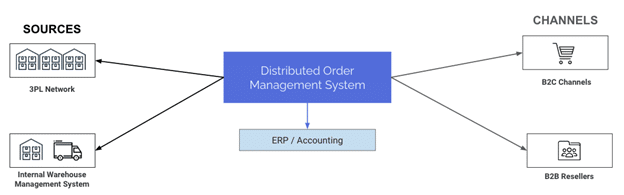
Leverage a distributed order management system when splitting inventory between your own internal warehouses and 3PL warehouses. This tool will help ensure accurate counts across different inventory locations and strategic order routing depending on availability, location, sales channel, and more.
5) Monitor and Refine
Your 3PL must be able to adapt to your growing ecommerce business. Partnering with a 3PL company is a long-term commitment, which means keeping an eye on data, communicating with your 3PL provider, and growing together.
In turn, your partner has to adjust to your expansion, add capabilities to meet your growing needs and offer the data you require to track stock and order performance.
In-House or Outsourced? Cahoot Lets You Do Both
What if you already have invested significant time and energy into your own operations, and don’t want to give up on that entirely when moving to an outsourced partner? Most 3PLs aren’t optimized to work alongside merchant-owned order fulfillment, but Cahoot has rewritten the rules with a flexible fulfillment network and shipping software.
Cahoot enables merchants with in-house ecommerce order fulfillment to strategically add Cahoot locations across the country as they expand while retaining their existing operations.
Deploy inventory in Cahoot locations along with your own facility, and then let the intelligent, automated Cahoot shipping software rate shop for labels and choose the best facility to fulfill each order as it comes in. If the order comes in near your facility, you’ll fulfill it. If it’s near a Cahoot location that you’re using, they’ll fulfill it. You get the benefits of nationwide USA order fulfillment centers while still making the most of the investment you’ve put into your existing facility.
Of course, if this article has convinced you that it’s time to move on from managing your own order fulfillment entirely, Cahoot will happily work with you to take all of your inventory and power your online channels with low cost and fast delivery.Want to learn more? Contact Cahoot to access affordable, flexible order fulfillment for merchants of all sizes.
Frequently Asked Questions
What is in-house logistics?
In-house fulfillment refers to the management and execution of logistics activities or operations within an organization’s facilities or infrastructure, rather than outsourcing these functions to external third-party logistics (3PL) providers or logistics companies. With in-house storage, you as an entrepreneur have full control over your goods and store your items in your own company building instead of having them stored by an external service provider.
What are the disadvantages of in-house fulfillment?
While outsourcing critical activities might lead to a loss of operational control, in-house fulfillment faces the risk of over-reliance on internal resources, which may not always be sufficient or optimal.
What is the difference between logistics and third-party logistics?
While contract logistics companies typically help arrange transportation and routes, a 3PL company handles much more than just transportation; 3PLs provide a full suite of logistics services, from warehousing and order fulfillment, to inventory management and automated shipping.
Written By:

Rachel Go
This is a guest post from Rachel Go. Rachel is a content marketer and strategist at Flxpoint, an enterprise ecommerce operations platform. Flxpoint enables merchants and brands to unify and automate every aspect of your ecommerce operations and scale without manual processes or custom development slowing you down.
Turn Returns Into New Revenue
Related Blog Posts
What are National Fulfillment Services?
In this article
12 minutes
What are national fulfillment services?
In theory, any fulfillment provider can offer national fulfillment services – after all, carriers like FedEx and UPS will happily ship parcels across the entire United States (and charge a boatload for it). However, fulfilling nationally from one or two locations is costly and slow due to inefficient fulfillment processes and exorbitant shipping costs. So businesses are left with smaller margins and disgruntled customers waiting too long for packages.
A truly nationwide fulfillment solution has warehouses strategically placed across the entire United States, and it will distribute inventory across those multiple locations. With this strategy, there’s inventory close to all customers, so no matter where in the country the order comes from, it ships quickly and cheaply. In this article, we’ll cover when growing ecommerce businesses should switch to a nationwide network and provide advice on how to choose the right provider.
Defining Order Fulfillment
Order fulfillment is the backbone of any successful ecommerce operation. It encompasses the entire process of receiving, processing, and shipping customer orders in a timely and efficient manner. This multifaceted process includes several critical activities: managing inventory to ensure products are in stock, processing orders accurately, packaging items securely, and shipping them promptly. Each step is vital to ensuring that customer orders are fulfilled correctly and on time, which in turn drives customer satisfaction and loyalty. Effective order fulfillment is not just about moving products from point A to point B; it’s about creating a seamless experience that meets or exceeds customer expectations.
Importance of Order Fulfillment in Ecommerce
In the fast-paced world of ecommerce, order fulfillment is a key determinant of customer satisfaction and business success. When orders are fulfilled quickly and accurately, customers are more likely to have a positive experience, leading to repeat business and word-of-mouth referrals. On the other hand, delays, errors, or damaged goods can result in negative reviews and lost customers. Clear customer communication can help mitigate this, but that’s just a delaying action; improving the fulfillment process and increasing prompt delivery is the foundation of success. Therefore, ecommerce businesses must prioritize efficient and reliable order fulfillment processes. Investing in robust order fulfillment systems and partnering with reliable fulfillment centers can significantly enhance customer satisfaction, build a positive reputation, and ultimately drive business growth.
Slash Your Fulfillment Costs by Up to 30%
Cut shipping expenses by 30% and boost profit with Cahoot's AI-optimized fulfillment services and modern tech —no overheads and no humans required!
I'm Interested in Saving Time and MoneyHow National Fulfillment Services Work
National fulfillment services are designed to support a nationwide shipment network; shipping orders same-day to help save on shipping and fulfillment costs while maintaining prompt delivery to American customers no matter where they are.
Here’s an overview of how national fulfillment services work:
Order Receipt and Processing
When a customer places an order on an ecommerce platform, it is sent to the fulfillment center’s system, which then triggers the processing of the order. The order is reviewed for accuracy and any discrepancies or issues are addressed promptly. The fulfillment center’s team then picks and packs the ordered items, ensuring that they are properly packaged and labeled for shipping. This meticulous order fulfillment process ensures that customer orders are handled with care and precision, minimizing errors and enhancing customer satisfaction.
Inventory Management and Storage
National fulfillment services also involve the management and storage of inventory at each warehouse location. The fulfillment center stores the business’s products in a secure and climate-controlled environment, ensuring that they are protected from damage and deterioration. The fulfillment center’s inventory management system tracks the levels of inventory, ensuring that the business is notified when stock levels are low, and reordering should be initiated. This proactive approach to managing inventory helps businesses maintain optimal stock levels and avoid stockouts, which can disrupt the fulfillment process and negatively impact customer satisfaction, while at the same time minimizing costs of storing heaps of items in long-term storage.
Shipping and Delivery
Once the order is processed and packaged, it is shipped to the customer via a reliable shipping carrier. National fulfillment services often have partnerships with multiple shipping carriers, ensuring that the best rates and delivery times are secured. The fulfillment center’s system tracks the shipment, providing real-time updates on the status of the order. This comprehensive shipping service ensures that customer orders are delivered promptly and accurately, further enhancing the overall customer experience.
Warehouse Management System (WMS)
A Warehouse Management System (WMS) is a software application that manages and controls the day-to-day operations of a warehouse or fulfillment center. The WMS tracks inventory levels, monitors order processing, and optimizes warehouse operations. National fulfillment services use a WMS to ensure that orders are processed efficiently and accurately, and that inventory levels are always up-to-date.
The WMS is integrated with the business’s ecommerce platform, ensuring that orders are received and processed in real-time. The WMS also integrates with shipping carriers, ensuring that shipments are tracked and updated in real-time. This integration enables national fulfillment services to provide real-time updates on order status, ensuring that customers are always informed. By leveraging advanced technology and integration, national fulfillment services can provide businesses with a scalable and efficient order fulfillment solution, enabling them to focus on growth and customer satisfaction.
By incorporating these features, national fulfillment services can streamline logistics operations, reduce errors, and enhance overall efficiency. A national fulfillment service is a crucial edge for businesses looking to stay competitive in the fast-paced world of ecommerce.
When Should a Business Upgrade to a National Fulfillment Solution?
Businesses that start out on Amazon usually have a ready-made option for national fulfillment in Fulfillment By Amazon (FBA). Amazon has famously built its fulfillment network to massive proportions, and they have the most ecommerce fulfillment locations across the United States. For all non-FBA orders, the business is likely shipping out of either their own small warehouse, a small single 3PL, or even just a garage. Small, single operations like these don’t have the scale to match larger networks for efficiency.
It’s surprising how easy it is to gain value from a nationwide network – and how soon it can be done. At just a few hundred orders per month, businesses reach the point of enough scale to distribute inventory to multiple locations across the country. The benefits of national fulfillment will far outweigh the small increase in inventory needed to supply multiple locations.
The one caveat to this guidance is that if a business has very high SKU diversity, they’ll benefit most from outsourcing their high volume SKUs only. Low volume, “long tail” SKUs benefit much less from distributed fulfillment.
Looking for a New 3PL? Start with this Free RFP Template
Cut weeks off your selection process. Avoid pitfalls. Get the only 3PL RFP checklist built for ecommerce brands, absolutely free.
Get My Free 3PL RFPBenefits of National Fulfillment Services
National fulfillment services are vital for ecommerce businesses that want to boost revenue growth and protect margins. Fulfillment companies play a crucial role in providing order fulfillment services, especially for international sellers entering the U.S. market.
Utilizing a network of fulfillment centers across various countries allows businesses to reach a worldwide customer base quickly and economically. Global fulfillment enhances shipping efficiency and reduces costs for ecommerce businesses.
1. Nationwide Fulfillment Boosts Revenue Growth
“Fast and free” shipping badges are one of the single most effective growth tools in the ecommerce industry. Amazon metrics show that adding a Prime badge to a product for the first time improves conversion by 50%, and Walmart similarly found that their TwoDay badge drives a 50% lift. Every major marketplace and shopping cart now has their own version of the Prime badge, and each finds a big revenue boost from using the badge.
If a business is shipping out of one or two locations, it can qualify for fast and free shipping badges simply by paying express carrier rates – but what’s the point of revenue growth if shipping costs more than the product itself? Nationwide fulfillment networks unlock profitable revenue growth through fast shipping by placing inventory across the country. By leveraging nationwide fulfillment locations, every order will be fulfilled by a nearby location, so the cheap shipping options still deliver within 1 or 2 days. Turn on those badges across all channels and reap the rewards of better search rankings and higher conversion while still saving money on shipping.
2. Minimize Shipping Costs
Businesses shipping from just one or two locations will often see half or more of their orders shipping to Zone 5 and up. Compared to shipping out of a single location, national fulfillment distributes inventory more efficiently across the country through multiple warehouse locations, so orders are shipped from a starting point much closer to their destination.
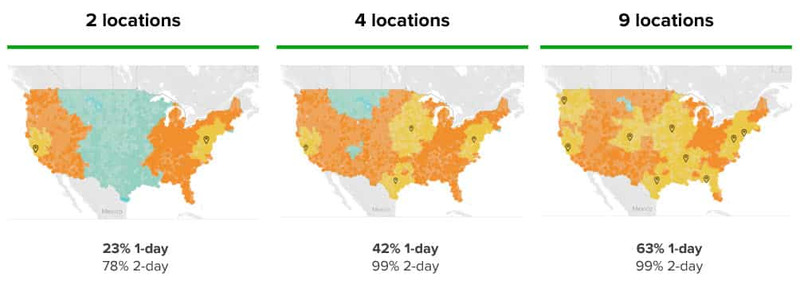
Placing inventory in 3-5 locations all but eliminates the need to ship above Zone 4, cutting a business’s average zone profile by multiple zones. Every one of those shipping dollars saved goes straight to the bottom line; saving a few shipping zones on every order means saving a few dollars on every order. Imagine $2.00 more profit on every order.
3. Reduce Supply Chain Risk
Capacity is strained at every point of the supply chain, from international shipping to last mile delivery. Capacity isn’t crunched equally across the country though, which means that a nationwide network can significantly reduce the risk that all available inventory will be stuck in the same massive delay.
If there’s a delay in the supply chain affecting a region, inventory located at warehouses in other regions can pick up the slack. With only one or two small warehouses that might not be an option. Inclement weather is another common cause of regional disruption. If the only warehouse is closed due to hurricanes, snow, fire, or other natural cause then fulfillment may be completely frozen.
If that happens then selling because they had no way to fulfill orders. If they had a nationwide network, they would have kept on selling even as one part of the country shut down.
Additionally, a nationwide network allows inventory management across multiple locations through a single dashboard, enhancing operation scaling and improving customer service.

Cahoot National Fulfillment Services
Cahoot’s nationwide network of over a hundred warehouses provides affordable national fulfillment solutions for ecommerce business. Businesses with just one or two locations need to ship express to cover 99% of Americans with 1- and 2-day shipping, so fulfillment across the US is surprisingly expensive with two-coast providers. On the other hand, Cahoot will strategically distribute inventory to a truly national footprint so that a business can ship to 99% of the country in 1- and 2-days but always pay lower cost, ground shipping, rates.
Unlike other providers, Cahoot has the flexibility to upgrade a business’s existing warehousing and fulfillment services. If a business is fulfilling out of one or two warehouses, Cahoot can add a few fulfillment locations to seamlessly extend the network into a nationwide footprint. With this approach, businesses can continue to get value out of existing assets while enjoying the benefits of a nationwide network.
Getting started with Cahoot is surprisingly easy – with pre-built integrations for major ecommerce channels like Amazon, Walmart, Shopify, and BigCommerce, businesses can boost growth with fast shipping badges in under two weeks.
Contact Cahoot today to learn more about how our nationwide fulfillment network can be the key that unlocks profitable ecommerce growth.
Scale Faster with the World’s First Peer-to-Peer Fulfillment Network
Tap into a nationwide network of high-performance partner warehouses — expand capacity, cut shipping costs, and reach customers 1–2 days faster.
Explore Fulfillment NetworkConclusion
Selecting the right fulfillment company is a critical decision for any ecommerce business. A comprehensive national fulfillment center offers a wide range of services, including warehousing, packaging, and shipping, which can streamline logistics operations and improve overall efficiency. When evaluating potential fulfillment centers, it’s important to consider the breadth of services they provide. A center that can handle everything from inventory management to last-mile delivery can be a valuable partner in ensuring smooth operations and high customer satisfaction.
Location is another crucial factor. A fulfillment center with multiple strategically placed facilities across the USA can significantly reduce transit times and shipping costs. This geographic advantage ensures that customer orders are shipped from the nearest location, leading to faster delivery times and lower shipping expenses. Additionally, a fulfillment center with a robust network of warehouses and distribution centers can offer more flexible and responsive logistics operations, allowing businesses to adapt quickly to changing market conditions.
Advanced technology is also a key consideration. Fulfillment centers equipped with automated sorting and packing systems can enhance efficiency and accuracy, reducing the likelihood of errors and delays. By leveraging technology, fulfillment centers can provide faster and more reliable service, which is essential for maintaining high levels of customer satisfaction.
Ultimately, the right fulfillment center for an ecommerce business will depend on its specific needs and requirements. By carefully evaluating the range of services, locations, and technology offered by different fulfillment centers, businesses can make an informed decision and choose a fulfillment partner that aligns with their goals and helps them achieve operational excellence.
Frequently Asked Questions
What is order fulfillment?
Order Fulfillment is the part of ecommerce relating to shipping products to customers. This starts with inventory management, going through processing orders at shipping locations, until products arrive at the customer’s doorstep.
What are nation-wide fulfillment centers?
Technically a fulfillment center is only a single location, so a fulfillment service needs multiple centers/warehouses to be considered nation-wide.
How many fulfillment centers are needed to provide 2 day ground shipping nation-wide?
This depends on several factors, but with 4+ fulfillment locations, 99% of the US population can be reached in 2 days via ground shipping. Cahoot has over 100 fulfillment locations to help deliver to US customers across the country.
Are nationwide fulfillment centers 3PL or 4PL?
A 3PL can support nationwide fulfillment, but the more locations a 3PL has, the closer they are to becoming a 4PL.
Written By:

Indy Pereira
Indy Pereira helps ecommerce brands optimize their shipping and fulfillment with Cahoot’s technology. With a background in both sales and people operations, she bridges customer needs with strategic solutions that drive growth. Indy works closely with merchants every day and brings real-world insight into what makes logistics efficient and scalable.
Turn Returns Into New Revenue
Related Articles
Fast Delivery Isn’t the Hard Part – Inventory Decisions Are
Fast delivery is no longer a differentiator in ecommerce, it is an expectation.
Moving from Amazon 1P to 3P: What It Actually Takes to Succeed
The decision to move from Amazon Vendor Central (1P) to Seller Central (3P) usually follows months of frustration with pricing control loss, erratic purchase orders, and margin com...
Why Amazon 1P Feels Out of Control — and Why That’s Not Your Fault
When your Amazon Vendor Central account starts generating problems faster than your team can fix them, the instinct is to treat each issue as a separate operational failure.