
Amazon’s Big-Box Store Signals the Rise of No-Wait Commerce

Last updated on January 19, 2026
In this article
 24 minutes
- Introduction to Instant Commerce
- What Amazon's Big-Box Concept Actually Enables
- This Is Not About Faster Shipping
- No-Wait Commerce as a New Tier
- How This Differs from Whole Foods and Lockers
- Shopping Habits in the Age of No-Wait Commerce
- Customer Experience in the Instant Commerce Era
- Demand and Growth of Instant Commerce
- Logistics and Operations Behind Instant Access
- Technology Infrastructure Powering No-Wait Commerce
- Challenges and Opportunities for Retailers
- Which Merchants Benefit and Which Feel Pressure
- What This Means for Brand Placement and Selection
- The Competitive Context Shift
- Best Practices for Succeeding in Instant Commerce
- A Grounded Takeaway
- Frequently Asked Questions
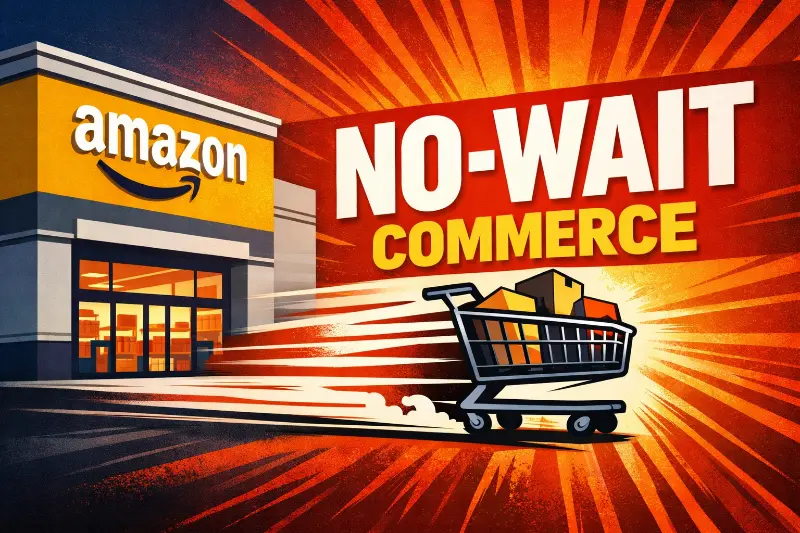
Amazon’s proposed 229,000-square-foot retail store in suburban Chicago is not about shipping faster or expanding delivery capacity. It introduces a new tier of ecommerce where customers can buy from Amazon’s catalog and take possession immediately, without waiting for delivery windows, checking locker availability, or tracking packages. This “no-wait” model reshapes how urgency, access, and competition work in ecommerce, and it rewards a very specific type of merchant.
Instant commerce was created rapidly as a disruptive retail model, with companies quickly developing and implementing new ways for consumers to shop and receive products. The swift establishment of instant commerce has transformed traditional retail, setting new expectations for speed and convenience. Many customers are already familiar with the concept of instant commerce through services like Uber Eats, Instacart, or DoorDash, which have made quick delivery options a recognized part of everyday life.
The concept, now under local approval review in Orland Park, Illinois, represents Amazon’s most significant physical retail experiment since acquiring Whole Foods in 2017. But understanding what this store actually enables requires looking beyond the square footage and grocery aisles to see the fulfillment architecture underneath.
The development of automation and artificial intelligence has made distribution and delivery systems increasingly sophisticated, enabling faster and more efficient order fulfillment.
China has been a leader in instant commerce, with intense competition among technology giants driving innovation. Chinese consumers can expect to receive their orders within an hour, thanks to advanced logistics, a reliable transport network, and sophisticated distribution systems. However, the rapid growth of instant commerce in China has also led to criticism of the working conditions for delivery workers, who often face insufficient and excessively demanding environments.
Instant commerce typically focuses on delivering everyday essentials, groceries, and medicines within 10-60 minutes.
Introduction to Instant Commerce
Instant commerce is redefining the way consumers interact with ecommerce brands, setting a new standard for speed and convenience in shopping online. At its core, the instant commerce model is built on the promise of delivering products to customers with unprecedented speed—sometimes within hours of placing an order. This shift is powered by advanced delivery networks, robust fulfillment systems, and the strategic use of artificial intelligence to optimize every step of the process.
Retailers and companies are investing heavily in technology to provide a seamless customer experience, from the moment a product is added to the cart to the instant it arrives at the customer’s door. The integration of real-time data analytics and AI-driven logistics allows businesses to anticipate demand, manage inventory efficiently, and ensure that fast shipping is not just an option, but an expectation. As a result, consumers now enjoy the ability to order groceries, electronics, and everyday essentials online and receive them the same day or even within hours, making shopping online more convenient and reliable than ever before.
The rise of instant commerce is not just about speed—it’s about meeting the evolving needs of customers who value both time and convenience. Retailers are building sophisticated fulfillment networks and partnering with logistics providers to ensure they can provide the level of service today’s consumers demand. As technology continues to advance, the instant commerce model will only become more integral to the way we shop, transforming the retail landscape for both businesses and consumers.
To learn more about instant commerce, AI tools, and integrated ecommerce solutions, explore additional resources and further reading to deepen your understanding of these rapidly evolving technologies.
What Amazon’s Big-Box Concept Actually Enables
According to planning documents reviewed by multiple news outlets, the proposed store combines in-person shopping with digital ordering and immediate curbside pickup. Customers can browse physical aisles for groceries and general merchandise while simultaneously ordering items from Amazon’s broader catalog through an app or in-store kiosk. Those items get pulled from back-of-house inventory and prepared for pickup before the customer finishes shopping.
Optimizing the checkout process is crucial in instant commerce environments. Implementing simplified checkout forms or a single-page form can significantly reduce customer churn and improve conversions. A streamlined checkout page also plays a key role in increasing conversion rates and minimizing cart abandonment.
The store design dedicates substantial floor space to fulfillment operations rather than retail displays. Planning documents describe separate access points for retail customers and delivery drivers, dedicated queuing areas for order pickup, and a layout optimized to support both in-store shopping and rapid order assembly. A customer could walk into the store, order a sweater in a different color than what is on the rack, and pick it up at the front counter before leaving.
This is not the same as existing pickup options. Amazon already offers next-day pickup at some locations and grocery collection within 30 minutes at Whole Foods. Reports indicate Amazon is also developing a “rush” pickup service that would allow customers to collect orders from its stores within an hour, combining online marketplace items with in-store inventory in a single unified order.
The big-box format scales this capability dramatically. The store’s back-of-house operations can support a vastly larger product selection than any current Amazon physical location, bridging the gap between the convenience of a neighborhood store and the depth of Amazon’s online catalog.
This Is Not About Faster Shipping
Amazon’s delivery network already works well for most customers. Same-day delivery reaches thousands of cities. Prime members can get household essentials and fresh groceries delivered in under an hour through the recently launched Amazon Now service in test markets. Two-day shipping feels almost quaint compared to what the company can now execute.
The breakthrough here is not incremental speed improvement. It is skipping delivery entirely.
Delivery, no matter how fast, still involves waiting. Even a one-hour delivery window means staying home, watching for notifications, and being present when the package arrives. Traditionally, e-commerce delivery times were much longer, often taking several weeks or at least 1-7 days across broader regions. Instant commerce has drastically shortened these long wait times, shifting consumer expectations from weeks or days to just minutes or a couple of hours. Lockers solve the availability problem but add another stop. The no-wait model eliminates all of that. You order, you drive, you have it.
This distinction matters because it changes which shopping occasions Amazon can capture. Some purchases do not tolerate any delay. The ingredient missing from tonight’s dinner. The charger needed for tomorrow’s trip. The birthday gift discovered too late for shipping. These moments currently default to physical retail because the alternative requires waiting.
Slash Your Fulfillment Costs by Up to 30%
Cut shipping expenses by 30% and boost profit with Cahoot's AI-optimized fulfillment services and modern tech —no overheads and no humans required!
I'm Interested in Saving Time and MoneyNo-Wait Commerce as a New Tier
Same-day delivery compressed the ecommerce timeline from days to hours. No-wait commerce compresses it further, from hours to minutes. The limiting factor is no longer logistics speed but physical proximity.
This creates a new competitive tier above same-day delivery. Click-and-collect sales in the United States are projected to reach nearly $113 billion this year, growing 17% from 2023. Research firm eMarketer estimates approximately 153 million Americans will use click-and-collect services in 2025, representing about 68% of online buyers. Walmart currently leads this category with projected sales of $38.5 billion, leveraging more than 4,600 U.S. stores that can reach roughly 95% of households within three hours.
The difference between retailers who expand their reach by leveraging omnichannel strategies and marketplaces and those who do not is significant—those using established marketplaces and robust omnichannel management can facilitate same-day or even instant commerce, while others risk falling behind. Major retailers and marketplaces like DoorDash, Uber Eats, Amazon, Walmart, and Instacart now offer instant commerce options for a variety of businesses, including grocery stores and restaurants, further accelerating the shift toward rapid fulfillment.
Amazon’s big-box concept positions the company to compete directly in this space, but with a catalog advantage no grocery-focused retailer can match. A customer picking up milk and eggs could also grab electronics, home goods, clothing, and items from third-party sellers, all in one stop, all without waiting.
The implications extend beyond convenience. No-wait commerce shifts purchasing decisions. When customers know they can have something in their hands within an hour of wanting it, the calculus around impulse purchases, urgent needs, and last-minute shopping changes fundamentally.
How This Differs from Whole Foods and Lockers
Amazon already operates physical retail through Whole Foods, Amazon Fresh, and Amazon Go locations. It already offers pickup through lockers at thousands of locations. The big-box concept differs from all of these in purpose and capability.
Whole Foods serves a specific grocery customer seeking organic, premium products. Its stores are designed for browsing and discovery, not rapid fulfillment of general merchandise. Amazon Fresh focuses on everyday grocery needs with tech-enabled checkout but limited selection beyond food and household staples. Amazon Go prioritizes convenience and speed for grab-and-go purchases but operates at small scale.
Lockers solve a different problem entirely: receiving packages when you are not home. They extend delivery flexibility but do not eliminate waiting. You still order, wait for fulfillment, wait for shipping, and then retrieve.
The big-box format is purpose-built for a different use case. Planning documents describe it as a “fulfillment-first retail layout” where back-of-house operations support both in-store shopping and pickup orders simultaneously. The design separates delivery vehicle traffic from customer pickup lanes, creating dedicated infrastructure for rapid order handoff.
This is not a grocery store with Amazon products added. It is a fulfillment node with a retail front end, designed to serve customers who want immediate possession without the constraints of traditional retail inventory.
Shopping Habits in the Age of No-Wait Commerce
The instant commerce model is fundamentally reshaping how consumers approach shopping online. Today’s customers expect not just a wide selection, but also the ability to receive their purchases with unprecedented speed and convenience. Recent surveys reveal that convenience is the top reason consumers choose to shop online, with 76% citing it as their primary motivator. Fast shipping is no longer a luxury—66% of shoppers now consider it a basic expectation.
This shift in consumer mindset is driving ecommerce brands and businesses to rethink their fulfillment strategies. Companies are investing heavily in delivery networks and logistics infrastructure to meet the demand for rapid delivery. The rise of services like Uber Eats, which now deliver not only restaurant meals but also groceries and everyday essentials, exemplifies how the instant commerce model is expanding across categories.
For many ecommerce brands, partnering with third-party delivery services has become a strategic necessity to offer customers the speed and convenience they expect. Whether it’s groceries, household items, or last-minute gifts, the ability to provide fast, reliable delivery is a key differentiator in a crowded marketplace. As a result, businesses are constantly refining their fulfillment processes to ensure they can meet customer needs at any hour, reinforcing the central role of convenience in the modern shopping experience.
Looking for a New 3PL? Start with this Free RFP Template
Cut weeks off your selection process. Avoid pitfalls. Get the only 3PL RFP checklist built for ecommerce brands, absolutely free.
Get My Free 3PL RFPCustomer Experience in the Instant Commerce Era
In the era of instant commerce, delivering an exceptional customer experience has become the top priority for ecommerce brands. Today’s consumers expect more than just fast delivery—they want a seamless, personalized, and intuitive shopping journey from start to finish. Companies are leveraging artificial intelligence and advanced technology tools to create dynamic product pages, offer tailored recommendations, and streamline the checkout process, ensuring that every interaction feels effortless and engaging.
Industry leaders like Uber Eats and Amazon have set the benchmark for what customers expect when shopping online, offering reliable delivery services that consistently meet or exceed expectations. Real-time order tracking, instant notifications, and easy-to-navigate interfaces are now standard features, providing consumers with transparency and control over their purchases. Retailers are investing in building robust technology infrastructure to support these services, recognizing that a superior customer experience is essential for retaining loyalty and driving repeat business.
Artificial intelligence plays a crucial role in this transformation, enabling companies to analyze customer behavior, predict preferences, and optimize every touchpoint along the shopping journey. By harnessing these tools, retailers can offer services that not only meet but anticipate customer needs, from personalized product suggestions to proactive customer support. In the instant commerce era, the brands that invest in technology and prioritize customer experience are the ones best positioned to thrive.
Demand and Growth of Instant Commerce
The demand for instant commerce is surging as more consumers embrace the convenience of shopping online and expect their purchases to arrive with lightning speed. Fast shipping has evolved from a competitive advantage to a baseline expectation, with 66% of shoppers now considering it a necessity. Convenience remains the primary reason consumers choose to shop online, cited by 76% in recent surveys, underscoring the importance of rapid and reliable delivery services.
Retailers and companies are responding by investing in advanced fulfillment systems and expanding their delivery networks to meet these heightened expectations. The instant commerce market is projected to grow faster than traditional retail, fueled by the increasing adoption of mobile devices and the rise of on-demand services. In China, for example, ecommerce giants like Alibaba and JD.com have set the standard by offering same-day delivery in major cities, demonstrating what’s possible when technology, logistics, and consumer demand align.
As more retailers build out their instant commerce capabilities, the market is poised for continued expansion. The ability to provide fast, convenient delivery is becoming a key differentiator, driving competition and innovation across the industry. For consumers, this means greater choice, more flexibility, and the assurance that their needs can be met quickly—no matter where they shop or what they buy.
Logistics and Operations Behind Instant Access
Delivering on the promise of instant access requires a sophisticated logistics and operations backbone. Ecommerce brands must develop robust delivery networks that can handle high order volumes and tight turnaround times. This often involves leveraging artificial intelligence and advanced data analytics to optimize delivery routes, predict demand spikes, and allocate inventory efficiently.
Retail locations are increasingly being reimagined as fulfillment hubs, not just points of sale. These sites serve as critical nodes in the instant commerce ecosystem, enabling businesses to stage inventory closer to customers and facilitate rapid order pickup or delivery. Seamless integration between ecommerce platforms and logistics systems is essential, allowing for real-time order tracking, inventory updates, and customer notifications.
Industry leaders like Amazon and Alibaba are at the forefront of these operational innovations. They are experimenting with new fulfillment methods, such as dark stores—retail spaces dedicated solely to online order processing—and highly automated warehouses that can process and dispatch orders within minutes. These advancements enable companies to provide a superior customer experience, ensuring that products are available when and where consumers need them. As the competition intensifies, businesses that invest in cutting-edge logistics and fulfillment technology will be best positioned to thrive in the era of instant commerce.
Technology Infrastructure Powering No-Wait Commerce
At the heart of the instant commerce model lies a powerful technology infrastructure that enables ecommerce brands to deliver on the promise of no-wait shopping. Advanced tools and platforms are essential for managing online stores, processing orders, and coordinating delivery across multiple channels. A builder platform allows ecommerce brands to quickly create and customize online storefronts, supporting advanced headless commerce solutions with cutting-edge technology. Artificial intelligence is a game-changer in this space, optimizing everything from product pages to logistics workflows.
AI-driven analytics help businesses predict customer behavior, personalize shopping experiences, and streamline fulfillment operations. For example, intelligent algorithms can recommend products based on browsing history, adjust inventory levels in real time, and even automate customer service through chatbots and virtual assistants. These tools not only enhance the customer experience but also allow companies to manage their operations more efficiently.
Mobile-first technology is another critical component, as more consumers prefer to shop and track their orders on smartphones and tablets. Ecommerce brands are investing in responsive platforms and apps that make it easy for customers to browse, buy, and manage their accounts from anywhere. It is important to adjust marketing and email automation to account for changes in fulfillment and delivery times within an instant commerce model, allowing customers to manage their account settings accordingly. Additionally, implementing post-purchase marketing triggers and post-purchase email automation is crucial for enhancing the customer experience after the sale is completed, ensuring continued engagement and satisfaction. The growing adoption of AI-powered support services ensures that help is always available, further reducing friction in the buying process.
Investors are taking note of these trends, with significant funding flowing into companies developing innovative solutions for instant commerce. As the market continues to evolve, businesses that leverage the latest technology and AI-driven tools will be able to provide faster, more reliable service—meeting the high expectations of today’s consumers and setting new standards for the future of ecommerce.
Challenges and Opportunities for Retailers
The rise of instant commerce presents both significant challenges and exciting opportunities for retailers. Building and maintaining a delivery network capable of supporting same-day or next-day fulfillment requires substantial investment in technology, logistics, and skilled personnel. Retailers must ensure that their fulfillment systems are agile enough to handle fluctuating demand and deliver orders quickly and accurately, all while maintaining a seamless customer experience.
To meet these challenges, companies are turning to artificial intelligence and advanced analytics to optimize their supply chains, predict order volumes, and allocate resources efficiently. Real-time order tracking, personalized product recommendations, and streamlined checkout processes are now essential components of the customer experience, requiring ongoing investment in technology and infrastructure.
Despite these hurdles, the opportunities for growth are immense. Retailers that successfully implement instant commerce can increase sales, improve customer satisfaction, and gain a competitive edge in an increasingly crowded market. By leveraging cutting-edge technology and building robust delivery networks, businesses can provide the fast, reliable service that today’s consumers expect—positioning themselves for long-term success in the evolving world of ecommerce.
Which Merchants Benefit and Which Feel Pressure
The no-wait model creates clear winners and losers among product categories and merchant types. Building a market-leading company in instant commerce requires developing new infrastructure and networks from scratch or through integration. Understanding this dynamic matters for anyone selling on Amazon or competing with it.
Products that win on immediacy gain the most. Consumables, replacement items, and anything purchased to solve an immediate problem benefit from no-wait availability. Phone chargers, batteries, cleaning supplies, cooking ingredients, and everyday household items all fit this profile. When a customer needs something now, the merchant who can deliver possession fastest wins. Modern consumers have become spoiled by the convenience of instant commerce, expecting near-instant gratification and setting new standards for customer expectations.
Brands with high-velocity SKUs positioned for impulse purchase also stand to gain. The customer browsing the store for groceries might add a new kitchen gadget, a seasonal decoration, or a trending product they saw online. This cross-category exposure creates opportunities for products that benefit from physical proximity to other purchases.
Companies that have gained traction in instant commerce are those that have adapted quickly to changing consumer expectations, leveraging speed and convenience to capture market share.
The pressure falls differently. Products that depend on storytelling, configuration, or extended consideration face a compressed decision window. Complex electronics, customized items, and products requiring research do not gain much from no-wait availability because the purchase decision itself takes time. A customer will not impulse-buy a laptop while picking up groceries.
Premium and differentiated brands also face a new competitive context. When a category becomes available for immediate possession, the brand that happens to be in stock wins over the brand that requires shipping. This advantages commodity products and private labels that can be present in back-of-house inventory over specialized products that require fulfillment from distant warehouses.
Operational efficiency in instant commerce can reduce fulfillment costs by up to 75% per order compared to centralized warehouses. Consumers can access a curated selection of 2,000-4,000 SKUs per location, and many are willing to pay a premium for faster delivery.
What This Means for Brand Placement and Selection
Merchants should understand that Amazon’s big-box concept does not guarantee shelf space or even in-store presence in the traditional sense. The store’s back-of-house inventory model means products might be available for immediate pickup without ever appearing on a retail display. It is important for merchants to understand the factors that influence product placement and selection in instant commerce, as these can directly impact their visibility and sales opportunities. Additionally, customer demographics play an important role in shaping demand for instant commerce services, influencing which products are prioritized for rapid fulfillment.
Amazon controls which products get stocked in these locations, how they are categorized, and whether they appear in app-based or kiosk ordering. This is not a consignment model where brands secure shelf placement through negotiation. It is an extension of Amazon’s existing marketplace dynamics, where the platform decides what inventory to position for rapid fulfillment based on demand signals, margin considerations, and operational efficiency.
For merchants, this means access to no-wait commerce runs through Amazon’s existing seller relationships and inventory systems. Products with strong sales velocity and Prime eligibility are more likely candidates for local stocking. But the decision remains Amazon’s, not the seller’s.
The visibility implications are significant. A product available for one-hour pickup will likely receive algorithmic preference over products requiring standard shipping, particularly for searches with urgency signals. This creates a new dimension of competitive advantage that depends on physical proximity rather than just price, reviews, or advertising.
Scale Faster with the World’s First Peer-to-Peer Fulfillment Network
Tap into a nationwide network of high-performance partner warehouses — expand capacity, cut shipping costs, and reach customers 1–2 days faster.
Explore Fulfillment NetworkThe Competitive Context Shift
Amazon’s big-box experiment reflects a broader recognition that ecommerce and physical retail are converging rather than competing. In today’s world, commerce is more interconnected and global than ever, with instant and omnichannel approaches catering to a worldwide consumer base and meeting diverse expectations. Consumer Intelligence Research Partners analysts noted that 93% of Amazon customers also shop at Walmart, suggesting the battle is not for exclusive loyalty but for share of each shopping occasion.
For multichannel sellers, this shift means evaluating which products and which moments each channel serves best. No-wait commerce captures urgency-driven purchases that might otherwise go to a local retailer. Instant commerce relies on dense urban networks for logistics to enable rapid fulfillment, while traditional ecommerce employs scalable logistics models to serve planned purchases where delivery timing is flexible. Physical retail captures discovery and experience-driven shopping.
The merchants best positioned for this environment are those who can serve multiple purchase contexts rather than optimizing for a single channel. A product available for immediate pickup at an Amazon big-box location, same-day delivery through Prime, and discovery through a brand’s own retail presence covers more customer moments than any single-channel strategy.
This is not a call to action or a required playbook. Amazon’s big-box concept remains in early planning stages, with local approval still pending and no confirmed timeline for additional locations. But the direction is clear: the line between ecommerce and physical retail continues to blur, and the merchants who understand how each channel serves different customer needs will navigate the shift most effectively.
Best Practices for Succeeding in Instant Commerce
Succeeding in the instant commerce model requires businesses to place convenience, speed, and a superior customer experience at the heart of their operations. As consumers increasingly expect to receive products within hours, ecommerce brands must rethink every aspect of their delivery networks and fulfillment strategies. Leveraging artificial intelligence is essential—not only for optimizing logistics and inventory management but also for enhancing product pages and personalizing the shopping journey.
To build a robust instant commerce ecosystem, companies should invest in advanced technology that streamlines order processing and enables real-time tracking. AI-driven tools can analyze consumer behavior, predict demand, and automate key processes, ensuring that delivery is both fast and reliable. Retailers and merchants who collaborate closely with logistics partners and technology providers are better positioned to meet the evolving needs of their customers.
Another best practice is to focus on seamless integration across all touchpoints. This means creating intuitive product pages, simplifying checkout processes, and providing instant support to address any issues that may arise. Businesses should also prioritize transparency, offering clear communication about delivery times and order status to build trust with consumers.
Building strong relationships with retailers, merchants, and consumers is vital for long-term success. By fostering open communication and aligning on shared goals, ecommerce brands can create a network that delivers on the promise of instant commerce. Ultimately, those who invest in speed, convenience, and customer-centric solutions will stand out in a competitive marketplace and grow faster in the world of instant commerce.
A Grounded Takeaway
Amazon’s big-box store signals that the company sees physical retail not as a retreat from ecommerce but as an extension of it. The goal is not to replace delivery with stores but to capture purchase occasions that delivery cannot serve well.
For sellers, this represents a shift in competitive context rather than a required strategic pivot. It is crucial for ecommerce businesses to assess whether they are ready to meet the demands of instant commerce, as near-instantaneous shopping and delivery experiences require new levels of operational preparation. Products that benefit from immediacy may find new advantages. Products that depend on differentiation, storytelling, or extended consideration will continue to compete on those dimensions regardless of fulfillment speed.
By 2026, instant commerce will have expanded from niche grocery services to a mainstream retail channel, covering categories like electronics and beauty. The rise of no-wait commerce does not invalidate existing strategies. It adds a new dimension to how customers evaluate options and make decisions. Understanding that dimension, even without acting on it immediately, positions merchants to adapt as the retail landscape continues evolving.
Frequently Asked Questions
What is no-wait commerce?
No-wait commerce describes a purchasing model where customers buy products online and take physical possession immediately through curbside pickup or in-store collection, eliminating delivery windows entirely. It represents a tier above same-day delivery, where the limiting factor is physical proximity rather than logistics speed.
How does Amazon’s big-box store differ from Whole Foods or Amazon Fresh?
The proposed big-box format is designed as a fulfillment-first retail layout with substantial back-of-house operations supporting both in-store shopping and rapid order pickup. Unlike Whole Foods or Amazon Fresh, which focus primarily on grocery retail, the big-box concept would offer Amazon’s broader catalog of general merchandise available for immediate collection.
Does this mean Amazon delivery is getting slower?
No. Amazon’s delivery network continues to expand and accelerate, with same-day and even sub-hour delivery available in many markets. The big-box concept addresses a different customer need: immediate possession without any waiting, which delivery cannot provide regardless of speed.
Will my products be available in Amazon’s big-box stores?
Amazon controls inventory selection and placement in its physical retail locations. Products with strong sales velocity and Prime eligibility are more likely candidates for local stocking, but the decision rests with Amazon based on demand signals and operational considerations, not seller negotiations.
What types of products benefit most from no-wait commerce?
Products purchased to solve immediate needs benefit most: consumables, replacement items, last-minute gifts, and impulse purchases. Products requiring extended research, customization, or storytelling gain less advantage from immediate availability because the purchase decision itself takes time.
When will Amazon’s big-box store open?
The proposed store in Orland Park, Illinois, is still awaiting final local approval. If approved, local officials estimate a potential opening in late 2027. Amazon has not announced plans for additional locations or a broader rollout timeline.
Written By:

Rinaldi Juwono
Rinaldi Juwono leads content and SEO strategy at Cahoot, crafting data-driven insights that help ecommerce brands navigate logistics challenges. He works closely with the product, sales, and operations teams to translate Cahoot’s innovations into actionable strategies merchants can use to grow smarter and leaner.

Turn Returns Into New Revenue
Related Articles
Shipping Labels Explained: What They Include, How They Work, and Common Mistakes
Shipping labels are the operational backbone of ecommerce fulfillment, a small piece of paper that determines whether packages reach customers successfully or trigger costly failur...
USPS Click-N-Ship Explained: How It Works, Costs, and When Sellers Should Use It
USPS Click-N-Ship is the postal service’s free online label-printing tool, and for most Shopify sellers shipping more than 50 packages monthly, it’s already time to move beyond it....
USPS Tracking Explained: What Each Status Means and How Sellers Should Respond
The “if it fits, it ships” model offers compelling economics for heavy items traveling cross-country, but costs Shopify brands up to 175% more than alternatives for lig...