
Amazon FBA Peak Season Fees: A Deep Dive

Last updated on July 28, 2026
In this article
 17 minutes
- Key takeaways
- Amazon's 2026 holiday fees run from October 15 to January 14
- The 3.5% surcharge changes the all-in peak fee
- Holiday promotion fees can add another $100 plus 1.5% of sales
- Earlier inbound deadlines make the fee decision operational
- Model peak fees by SKU, not with one blended average
- FBA, FBM, and SFP should be compared SKU by SKU
- 2026 Amazon holiday planning checklist
- Frequently Asked Questions
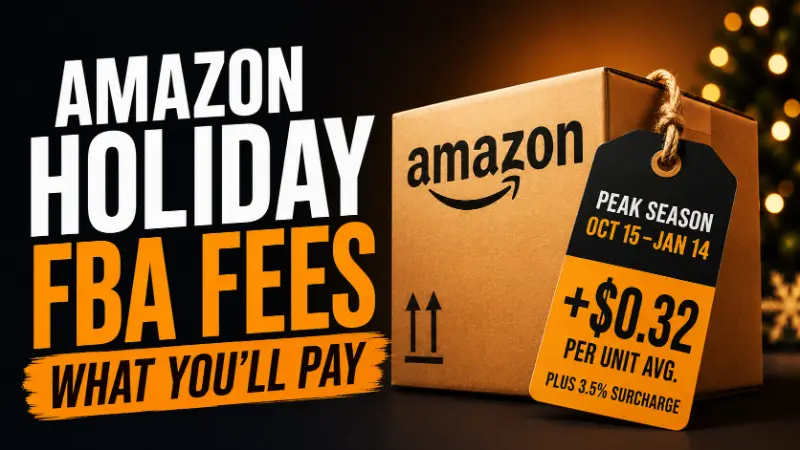
Amazon’s 2026 holiday peak fulfillment fees run from October 15, 2026 through January 14, 2027 and apply to FBA, Remote Fulfillment with FBA, Multi-Channel Fulfillment (MCF), and Buy with Prime. For Amazon sellers using those programs, the average seasonal increase is $0.32 per unit over non-peak rates, and a year-round 3.5% fuel and logistics-related surcharge still applies on top of both peak and non-peak fulfillment fees during that window.
According to Amazon’s July 7 announcement, the surcharge that started April 17, 2026 for US FBA does not go away during peak. The correct all-in formula is published peak fee × 1.035, and the incremental holiday cost versus the already-surcharged non-peak period equals (peak fee − non-peak fee) × 1.035. Below, you’ll see the 2026 peak fee schedules and dates, how to model the increase at the SKU level, how promotion fees and inbound inventory deadlines affect holiday planning, and when it may make sense to compare FBA with FBM or Seller Fulfilled Prime. If you plan Q4 margin using only the $0.32 headline, you will underprice every SKU that ships between mid-October and mid-January, especially bulkier products where the fee delta can erase profit.
Key takeaways
- Peak window: October 15, 2026 to January 14, 2027, covering FBA, Remote Fulfillment with FBA, MCF, and Buy with Prime.
- Amazon’s stated average increase is $0.32 per unit, but the actual seasonal delta varies from roughly $0.20 on small standard SKUs to $2.91 on 50-70 lb items after the 3.5% surcharge.
- The 3.5% fuel and logistics-related surcharge is a year-round charge, not a holiday-only add. It multiplies both non-peak and peak fulfillment fees.
- The ship date from the fulfillment center determines peak pricing, not the customer order date.
- Promotion fees add $100 upfront plus 1.5% of promotional sales, with the variable portion capped at $5,000. Early deal submissions save $50.
- FBA inbound deadlines start September 2 for AWD and end October 28 for FBA with Amazon-optimized shipment splits.
Amazon’s 2026 holiday fees run from October 15 to January 14
Amazon posted the holiday peak fulfillment fee announcement in Seller Forums on July 7, 2026. The 92-day peak window runs from October 15, 2026 through January 14, 2027 and covers four programs: Fulfillment by Amazon (FBA), Remote Fulfillment with FBA, Multi-Channel Fulfillment (MCF), and Buy with Prime. Amazon says peak fees apply to shipments processed during that window because fulfillment center teams focus on receiving holiday shipments and processing customer orders at scale, and the seasonal per-unit uplift funds that surge in labor and network capacity.
Timing is a common trap. FBA fulfillment fees are calculated and charged when the unit ships from the fulfillment center, not when the customer places the order. A unit ordered on October 12 that leaves the fulfillment center on October 16 pays the peak rate. A unit ordered on January 13 that ships January 15 pays the peak rate too. When you model October and January cutovers, look at the shipped-units forecast, not the order-date forecast.
The affected programs each have separate fulfillment fees under their own published schedules. FBA and Remote Fulfillment peak rates are visible in the 2026 US FBA fee schedule, the Revenue Calculator, the Profit Analytics dashboard, and the Fee and Economics Preview Report. MCF rates and Buy with Prime rates are published on their own pages. Model each program separately if you use more than one.
The 3.5% surcharge changes the all-in peak fee
The 3.5% fuel and logistics-related surcharge started on April 17, 2026 for US FBA and on May 2, 2026 for MCF and Buy with Prime. It is not a peak-only fee. It applies year-round to the applicable fulfillment fee, and during the holiday window it applies to the published peak fee. The correct math is multiplicative, not additive:
- All-in peak fulfillment fee = published peak fee × 1.035
- True seasonal increment vs. surcharged non-peak = (peak fee − non-peak fee) × 1.035
Two common mistakes to avoid. First, do not add 3.5 percentage points to the $0.32 average uplift. The surcharge is applied to the fulfillment fee, not to the seasonal delta on its own. Second, do not treat the surcharge as a new holiday cost. Sellers have been paying it since April on non-peak rates, so the incremental Q4 pain point is the peak uplift, not the surcharge itself.
Four real SKU examples show a $0.20 to $2.91 seasonal increase after surcharge
These four examples use published Amazon fee rows and the exact 3.5% multiplier. The published rates are Amazon’s; the all-in and seasonal delta values are Cahoot calculations.
| Example SKU | Size tier | Non-peak fee (Amazon) | Peak fee (Amazon) | Published peak uplift | Peak × 1.035 (Cahoot) | Non-peak × 1.035 (Cahoot) | All-in seasonal delta (Cahoot) |
| Mobile device case | Small standard | $2.49 | $2.68 | $0.19 | $2.77 | $2.58 | $0.20 |
| T-shirt | Large standard | $6.14 | $6.53 | $0.39 | $6.76 | $6.35 | $0.40 |
| Baby cot | Small bulky | $10.21 | $11.25 | $1.04 | $11.64 | $10.57 | $1.08 |
| TV, 50 to 70 lb | Extra-large | $48.57 | $51.38 | $2.81 | $53.18 | $50.27 | $2.91 |
Working the mobile device case row by hand: $2.68 × 1.035 = $2.7738, which rounds to $2.77. The non-peak comparison is $2.49 × 1.035 = $2.57715, which rounds to $2.58. The all-in seasonal delta is $2.77 − $2.58 = $0.20, or equivalently $0.19 × 1.035 = $0.19665, which rounds to $0.20. Round only at the end. Rounding mid-formula introduces cent-level errors that compound across tens of thousands of units.
The pattern matters for pricing. Compact standard SKUs see a seasonal delta of roughly $0.20 to $0.40 per unit, which most sellers can absorb or price against without changing strategy. Bulky and extra-large SKUs see $1 to nearly $3 per unit. On a low-margin oversized product, that seasonal delta can flip the SKU from profitable to unprofitable during the exact 92 days when order volume peaks. This is where dimensional weight, size tier, and channel choice deserve a fresh look before Q4.
The average peak increment becomes $331.20 per 1,000 units after the surcharge
Amazon’s $0.32 per unit average is useful as a directional planning number, but only for the seasonal delta between non-peak and peak. It is not the full FBA fee, and it is not a substitute for SKU-level modeling. Applied to shipped-unit volume and then multiplied by 1.035 for the surcharge, the average peak increment looks like this:
| Peak shipped units | Headline seasonal uplift ($0.32 × units) | All-in seasonal uplift (× 1.035) |
| 1,000 | $320.00 | $331.20 |
| 10,000 | $3,200.00 | $3,312.00 |
| 100,000 | $32,000.00 | $33,120.00 |
Treat this table as a rough sanity check on total seasonal exposure across the account. It measures only the average incremental cost from non-peak to peak. It does not include referral fees, monthly storage fees, aged inventory surcharges, low-inventory-level fees, inbound placement fees, manual processing fees, advertising, or returns—or any major carrier peak shipping surcharges you may be paying outside of FBA. If your mix skews toward small bulky or oversized SKUs, the real seasonal uplift will be materially higher than the $0.32 average implies.
Holiday promotion fees can add another $100 plus 1.5% of sales
Prime Big Deal Days, Black Friday Week, and Cyber Monday deals carry their own fee stack that sits alongside fulfillment fees. Each deal costs a $100 upfront promotion fee plus 1.5% of promotional sales, with the variable portion capped at $5,000. Amazon offers a $50 early submission discount for Prime Big Deal Days deals submitted by August 5 and for Black Friday Week or Cyber Monday deals submitted by September 5.
Peak season surcharges aren’t the only FBA cost lever worth watching heading into 2026. Sellers launching new ASINs should also review the updated Amazon FBA New Selection Program for 2026, which offers fulfillment fee discounts and free monthly storage on qualifying new parent ASINs. Layering New Selection incentives against seasonal fee increases can meaningfully change the landed-cost math on inventory you’re planning to send in before Q4.
The submission windows are:
- Prime Big Deal Days: July 8 to September 8
- Black Friday Week and Cyber Monday: July 8 to October 20
A few worked examples so finance owners can budget accurately:
- $10,000 in promotional sales: $150 variable + $100 upfront = $250 total, or $200 with the early discount.
- $100,000 in promotional sales: $1,500 variable + $100 upfront = $1,600 total, or $1,550 early.
- $333,333.33 or more: variable hits the $5,000 cap, so the deal costs a maximum of $5,100 standard or $5,050 early.
Layer this on top of the fulfillment fee math. A promoted SKU during peak pays the surcharged peak fulfillment fee on every shipped unit and the promotion fee on the sales that come through the deal. During the holiday season, high competition can also push advertising costs up, so include that in your profitability check. If your deal sales convert at unusually low margins, run the numbers on whether the deal earns the placement; the original Amazon holiday peak fulfillment fee rollout in 2022 is a good reminder of how quickly seasonal fees can squeeze margins if you do not reprice.
Earlier inbound deadlines make the fee decision operational
Amazon’s holiday inbound calendar has hardened. If your inventory does not arrive by the published cutoff, it will not be receivable in time for the event and may miss peak-window Prime eligibility.
Prime Big Deal Days inbound deadlines:
- September 2: Amazon Warehousing and Distribution (AWD)
- September 9: FBA with minimal shipment splits
- September 16: FBA with Amazon-optimized shipment splits
Black Friday Week and Cyber Monday inbound deadlines:
- October 14: AWD
- October 21: FBA with minimal shipment splits
- October 28: FBA with Amazon-optimized shipment splits
Amazon-optimized shipment splits give sellers the latest cutoff because Amazon controls destination assignments. Minimal shipment splits give the seller more control and a slightly earlier deadline. AWD sits earliest because units still need to flow into FBA after arrival. Choose the inbound route that matches how much you need to control destinations versus how much lead time you have, and remember that Amazon AWD bulk storage is primarily designed for low-cost long-term and seasonal inventory.
Amazon reports that sellers enrolled in AWD in Q4 2025 experienced over 13% more shipped units and more than a 30% reduction in out-of-stock days. That figure is Amazon’s, not independent third-party data. Amazon also states that AWD inventory with automatic replenishment to FBA keeps the off-peak monthly storage rate through October 31, 2026, even though monthly storage fees rise significantly from October through December. If storage rates are a meaningful line item in your Q4 P&L, that off-peak rate window is worth modeling against your reorder cadence for extra inventory and any steps you are taking to improve your IPI score and storage limits. Accurate demand forecasting is critical during peak season so you place enough stock without overexposing yourself to storage costs. Our Amazon AWD vs. FBA breakdown covers the trade-offs in more detail.
Model peak fees by SKU, not with one blended average
The $0.32 average hides a wide distribution. Small standard SKUs move by cents. Small bulky moves by a dollar. Extra-large moves by nearly three dollars per unit before you have counted the surcharge on the underlying fee. A blended average across a broad catalog will overstate margin on your heavy SKUs and understate margin on your light ones. Build the model at the SKU level, because Amazon’s fee structure changes annually and models should be refreshed each year.
For each SKU in your peak-window forecast, capture:
- Size tier: Small standard, large standard, small bulky, large bulky, or extra-large. This drives the base fba fulfillment fee; when excluding apparel, model clothing separately because fulfillment fees are higher than non-apparel.
- Unit weight and dimensional weight: Amazon uses the greater of unit weight or dimensional weight to determine shipping weight for calculating fees. A light but bulky SKU can price like a heavier one.
- Non-peak fee, peak fee, and all-in peak fee: Pull the first two from the fee schedule and calculate the third with the × 1.035 formula.
- Shipped-unit forecast for the peak window: Focus on the units that will ship between October 15 and January 14, not units sold.
- Contribution margin at peak: Selling price, minus referral fee, minus all-in peak fulfillment fee, minus landed cost, minus expected returns cost.
- Promotion fee exposure: Deal fees on any SKU you plan to feature during Prime Big Deal Days, Black Friday Week, or Cyber Monday.
For apparel, fees move in half-pound increments above 3 lb.
Then rank SKUs by margin risk. The ones that need attention are usually oversized items with thin margins, low-price SKUs where the surcharged peak fee eats a meaningful percentage of the retail price, and promoted SKUs where the deal fee stacks on top of an already tighter peak margin. Amazon’s 2026 US FBA fee schedule is the reference source for fee rows. For historical context on how regularly Amazon adjusts its rate cards, see our breakdown of Amazon FBA fee increases in 2022, and for a broader view of the FBA fee stack, our overview of Amazon FBA fees explained covers the items outside this narrow holiday article.
FBA, FBM, and SFP should be compared SKU by SKU
FBA remains the lowest-cost option for many compact, high-velocity SKUs where Amazon’s fulfillment network absorbs unit costs at scale. Small standard SKUs with steady demand and a $0.20 seasonal delta usually stay in FBA without a second thought. That is the honest answer for a large share of catalogs.
Where the math shifts is on SKUs where dimensional economics, storage, control, or channel strategy change the answer. Oversized items with high dimensional weight are the most common example. A $2.91 all-in seasonal delta on a 50 to 70 lb SKU compounds fast across the 92-day peak window. If you can access competitive freight rates and hold Prime eligibility through Seller Fulfilled Prime for oversized items, the SFP math is worth running, and resources like our webinar on using Amazon SFP to fight rising FBA fees can help frame the trade-offs. Even if FBA still wins, having a modeled alternative gives you a fallback if capacity limits tighten.
Other cases where a SKU-level comparison pays off—and where alternatives like merchant-fulfilled Prime networks can change the answer on specific SKUs—include:
- Low-velocity, high-value SKUs where FBA storage fees, aged inventory surcharges, and low inventory level fee exposure can outweigh fulfillment fee savings, so inventory management affects more than storage and capacity.
- SKUs that consistently hit lower capacity limits and need overflow into a non-FBA channel during peak; keep fba inventory at least 28 days of supply to reduce fee risk when customer demand spikes.
- Multi-channel SKUs where MCF fees make cross-channel fulfillment expensive and a merchant-fulfilled node is cheaper across the total volume, especially when different fulfillment types create different margin outcomes; in these cases, it’s worth revisiting what Amazon Multi-Channel Fulfillment (MCF) actually costs relative to your alternatives.
Practical comparisons live in these deeper reads: Amazon FBA vs. FBM, Amazon FBA vs. 3PL cost, and, for sellers evaluating an SFP-capable operator, Seller Fulfilled Prime 3PL. The right answer is almost never “move everything.” It is “move the SKUs where the math changes” and align channel choice with your pricing strategy when peak fees materially change unit economics.
2026 Amazon holiday planning checklist
Work through this list before the first inbound deadline lands:
- Size tier audit: Confirm every top-100 SKU’s current size tier and dimensional weight. Reconfirm any SKU whose packaging changed in 2026.
- Shipped-unit forecast: Forecast units that will ship between October 15 and January 14, separated from units sold. Layer in expected deal-driven spikes.
- SKU-level margin model: Calculate all-in peak fulfillment fee (published peak × 1.035) for every meaningful SKU. Recompute contribution margin at peak.
- Promotion fee budget: Decide which SKUs get Prime Big Deal Days, Black Friday Week, or Cyber Monday deals, using your broader Prime Day and peak-order planning playbook as a reference. Model the $100 + 1.5% deal fee against expected promoted sales. Submit early if the SKU is committed.
- Inbound route decision: AWD, FBA minimal splits, or FBA optimized splits. Match the route to lead time and destination control.
- Fallback fulfillment plan: Identify which SKUs move to FBM or SFP if FBA capacity limits, low-inventory fees, or storage rates compress margin below your threshold, and document which Amazon FBM shipping and fulfillment service you’ll lean on if you need to divert volume quickly.
None of these steps require abandoning FBA. They protect margin on the SKUs where the peak window bites hardest and give you a modeled Plan B for the SKUs where it might.
Frequently Asked Questions
When do Amazon’s 2026 holiday peak fulfillment fees begin and end?
Amazon’s 2026 holiday peak fulfillment fees apply to units that ship from fulfillment centers between October 15, 2026 and January 14, 2027, a 92-day window announced by Amazon on July 7, 2026.
Which Amazon fulfillment programs have 2026 holiday peak fees?
Peak fees apply to four programs: Fulfillment by Amazon (FBA), Remote Fulfillment with FBA, Multi-Channel Fulfillment (MCF), and Buy with Prime. Each program has its own published fee schedule.
How much is Amazon’s 2026 holiday peak fulfillment fee?
Amazon says the average seasonal increase is $0.32 per unit over non-peak rates. Actual per-SKU increases vary widely by size tier, and the exact FBA fulfillment fee also depends on size tier and shipping weight, from roughly $0.19 published ($0.20 all-in) on small standard SKUs to $2.81 published ($2.91 all-in) on 50 to 70 lb extra-large SKUs, with low price FBA rates potentially relevant for items priced under $10 if that fits your catalog.
Does Amazon’s 3.5% fuel and logistics surcharge apply to peak fees?
Yes. The 3.5% fuel and logistics-related surcharge started April 17, 2026 for US FBA and May 2, 2026 for MCF and Buy with Prime. It applies year-round and multiplies both non-peak and peak fulfillment fees. The all-in peak fee equals the published peak fee × 1.035.
Is the peak fee based on the Amazon order date or the fulfillment-center ship date?
The fulfillment-center ship date controls the fee. FBA fulfillment fees are calculated and charged when the unit ships from the fulfillment center, so a unit that ships on or after October 15 is subject to peak pricing even if the customer ordered earlier.
What are Amazon’s 2026 holiday inbound inventory deadlines?
For Prime Big Deal Days: September 2 for AWD, September 9 for FBA with minimal shipment splits, and September 16 for FBA with Amazon-optimized shipment splits. For Black Friday Week and Cyber Monday: October 14 for AWD, October 21 for FBA with minimal shipment splits, and October 28 for FBA with Amazon-optimized shipment splits. Sellers can use Capacity Manager to monitor limits or request more FBA space during the holiday peak season, and using Amazon Warehousing and Distribution to stage extra inventory can reduce stockout risk before those inbound deadlines hit.
How should sellers calculate the 2026 peak fee for a SKU?
Pull the published non-peak and peak fulfillment fees for the SKU’s size tier from Amazon’s 2026 fee schedule, and sellers should analyze fees by SKU before calculating fees for peak season. Amazon calculates fulfillment fees from size tier and shipping weight, and for very heavy extra-large items the schedule can extend to 203.46 0.19 lb above 151 lb; some oversized categories also use higher per-pound adds such as 0.38 lb in published rate tables, so check the fee calculator. Multiply the peak fee by 1.035 for the all-in peak fulfillment fee. For the true seasonal increment versus surcharged non-peak, calculate (peak fee − non-peak fee) × 1.035. Round only the final currency result to cents, and use Amazon’s calculator or fee tools to analyze fees before repricing.
Can Seller Fulfilled Prime or FBM avoid Amazon FBA holiday peak fees?
Seller Fulfilled Prime and FBM do not use FBA’s fulfillment fee schedule, so they avoid the FBA peak uplift and the 3.5% surcharge on that fee. Whether that saves money depends on the SKU, and merchant-fulfilled options may reduce shipping costs for some oversized or cross-channel SKUs. For compact, high-velocity items, FBA often remains the cheapest option. For oversized SKUs with high dimensional weight or slow-moving SKUs with high storage fees, SFP or FBM can be worth modeling at the SKU level, especially when additional fees, Amazon fulfillment centers, and broader supply chain and ecommerce fulfillment economics are compared alongside Amazon fees.
Written By:

Jeremy Stewart
Jeremy Stewart leads customer success at Cahoot, helping merchants achieve high-performance logistics through smart technology and process optimization. With a background in both ecommerce operations and client services, Jeremy ensures that every merchant using Cahoot gets measurable results—whether they’re scaling from one warehouse to many or managing complex returns.

Turn Returns Into New Revenue

Related Articles

How Much Does Seller Fulfilled Prime Cost? Calculate It for Your SKU
Seller Fulfilled Prime sounds attractive until you start thinking about the bill.
Amazon AWD Size Limits Changed: What Bulky Sellers Must Do Before Q4 2026
Beginning July 31, 2026, Amazon AWD stopped accepting new sortable sellable units at or above 18x14x8 inches or 20 lb, so any unit that meets or exceeds those thresholds is no long...

Why Even a 4:30 PM Cutoff Cannot Solve Amazon’s 40% One-Day SFP Rule
An established ecommerce merchant shipping more than 20,000 monthly orders from Pennsylvania had already pushed its cutoff to 4:30 PM Eastern Time and was willing to use Next Day A...