
Residential Surcharge vs Delivery Area Surcharge: Why You May Pay Both

Last updated on July 27, 2026
In this article
 20 minutes
- Residential Surcharge vs Delivery Area Surcharge: The Short Answer
- Residential Surcharge vs Delivery Area Surcharge Comparison Table
- Consumer Brands Should Treat Residential Pricing as the Normal Case
- A Low Negotiated Base Rate Can Hide the Real Shipping Cost
- Delivery Area Surcharge Depends on the Carrier's ZIP-Code List
- Check the Latest UPS and FedEx DAS ZIP Codes
- Residential and Delivery Area Surcharges Can Stack
- Four Scenarios: Residential Only, DAS Only, Both, or Neither
- Delivery Area Does Not Necessarily Mean Rural
- How to Calculate Your Residential and DAS Exposure
- What 10,000 Monthly Orders Could Look Like
- Why a 20% DAS Exposure Can Change SKU Margin
- How to Model the Fees During Carrier Negotiations
- How Ecommerce Brands Can Reduce the Impact
- How Cahoot Uses Destination-Level Data to Select Shipping Services
- Frequently Asked Questions
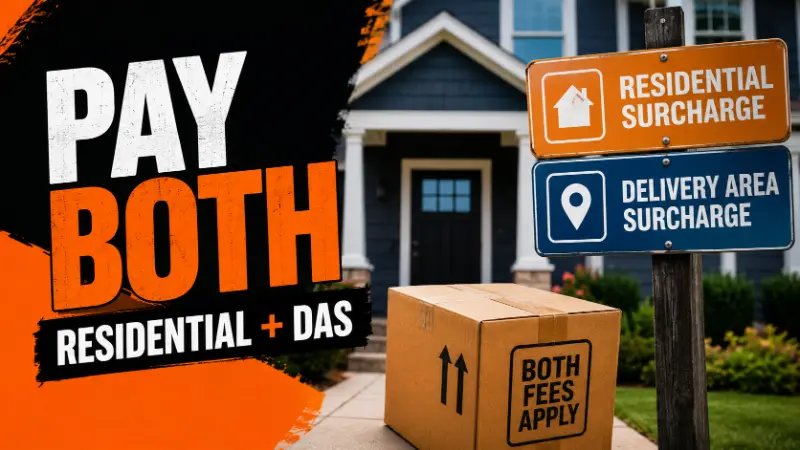
A residential surcharge is a per-package fee based on delivery destination type: it applies when a carrier classifies the address as residential or home-based. A delivery area surcharge is a separate per-package fee based on destination ZIP code: it applies when that ZIP code appears on the carrier’s current DAS, extended-area, or remote-area list. The two are not interchangeable, and they can stack on the same shipment, so a package going to a home in a designated DAS ZIP code may carry both charges on top of the base transportation rate and fuel.
For consumer brands—especially DTC ecommerce operators and the supply chain teams managing parcel spend and carrier contracts—this is not a small rate-card detail. Residential delivery is the default shipment profile for many brands, which means these surcharges can materially change landed shipping cost, SKU margins, and the accuracy of pricing and profitability models. This comparison breaks down how residential and delivery area surcharges differ, when each applies, how to estimate your exposure, where they show up in contract analysis, and what to do in negotiation or network design to reduce them before the numbers on a carrier proposal turn into higher invoice costs.
Residential Surcharge vs Delivery Area Surcharge: The Short Answer
A residential surcharge is a per-package fee that carriers apply when the delivery destination is classified as residential. The carrier’s classification controls, not the merchant’s description of the address. A home, an apartment, a condo, a dorm, and many home-based businesses can all trigger the fee.
A delivery area surcharge, or DAS, is a per-package fee that carriers apply when the destination ZIP code appears on the carrier’s current surcharge list. UPS and FedEx each publish and periodically update their own ZIP-code files. The lists include multiple categories, such as DAS, DAS Extended, and Remote, and each category has separate residential and commercial rates.
The two fees answer different questions. Residential asks, what kind of address is this? DAS asks, where is this address? A single shipment can be both residential and inside a DAS ZIP code, in which case both fees apply. This is why many ecommerce operators see carrier accessorial fees compound in ways the base rate does not predict.
Residential Surcharge vs Delivery Area Surcharge Comparison Table
| Attribute | Residential Surcharge | Delivery Area Surcharge |
| Basic trigger | Address classification | ZIP-code classification |
| Destination factor | Type of delivery location | Geographic location |
| Residential address | Applies | May apply if ZIP is on the list |
| Commercial address | Does not apply | May apply if ZIP is on the list |
| ZIP-code dependency | Not the primary driver | Primary driver |
| Rural-only misconception | Not applicable | DAS is not limited to rural areas |
| Ability to stack | Yes, with DAS | Yes, with residential surcharge |
| Home-based business | Often classified as residential | Same DAS rules apply |
| Carrier-list dependency | Carrier address database | Carrier ZIP-code file |
| Rate variability | Varies by carrier, service, and contract | Varies by carrier, category, service, and contract |
| Best method to estimate exposure | Historical residential share of shipments | Historical destinations matched to current carrier ZIP file |
Consumer Brands Should Treat Residential Pricing as the Normal Case
For most consumer-facing brands, residential shipments are not an edge case. They are the entire shipping profile.
In Cahoot’s experience reviewing consumer-brand shipping patterns, residential destinations can represent close to 99% of shipments for some DTC brands. This is not an industry-wide benchmark. Each brand should calculate its own residential share using its historical shipment data. But when the residential share is that high, the practical implication is straightforward: because residential deliveries are often less efficient than deliveries to commercial locations, the residential surcharge is a standard cost input, not an accessorial that appears occasionally.
That changes how you evaluate carrier proposals. A discount on the base transportation rate that ignores residential pricing does not describe your actual cost. If 99 out of every 100 shipments receive the residential fee, the residential fee is effectively part of your rate. It belongs in every model, every SKU margin calculation, and every free-shipping threshold review. Residential delivery surcharges became common in the early 2000s as e-commerce and home deliveries expanded, which is why building a more cost efficient model matters.
The same logic applies to service selection. Services that price residential delivery differently, including hybrid last-mile options like UPS Ground Saver, can change your effective all-in cost for eligible orders, but they are not universal replacements.
A Low Negotiated Base Rate Can Hide the Real Shipping Cost
Carrier proposals often lead with a headline transportation discount. That number is useful, but it is not the number that ends up on your invoice.
The final shipment invoice can include the base transportation charge plus the full range of shipping surcharges and additional fees that show up beyond it, including the residential surcharge, a delivery area surcharge, an extended or remote area charge, fuel surcharges, demand or peak surcharge, dimensional-weight adjustment, additional handling, large package or oversized package surcharges, address correction, and other accessorials the carrier applies. Not every shipment receives every fee, but the base transportation number rarely represents the true cost. This is one of the main reasons shipping prices are so high relative to what a rate card suggests.
The takeaway for contract analysis: a large transportation discount does not necessarily produce the lowest all-in shipping expenses if residential and delivery-area charges apply to a large share of the brand’s orders. Re-rate your historical shipments under each proposed contract to see what the invoice would have been.
Delivery Area Surcharge Depends on the Carrier’s ZIP-Code List
DAS is not derived from any single public geographic classification. DAS emerged in the late 1990s to help carriers cover rural delivery costs. Each carrier maintains its own list of surcharge ZIP codes and its own category structure. Categories can include DAS, DAS Extended, Remote, Alaska, Hawaii, and separate rates for residential and commercial destinations within each.
UPS and FedEx use separate ZIP-code lists, and classifications may change. That helps explain why das exists: these fees are commonly tied to destinations with low package delivery volume and limited infrastructure, which raise operational costs. A ZIP that is on one carrier’s list may not be on the other’s, and a ZIP that was classified as standard DAS in a previous cycle may move to Extended, Remote, or off the list entirely in a later update. Do not assume the two carriers agree, and do not assume last year’s file still describes your exposure.
The practical consequence is that DAS analysis is carrier-specific. If you ship with both UPS and FedEx, run the exposure calculation twice, using each carrier’s current file.
Check the Latest UPS and FedEx DAS ZIP Codes
Use current official carrier resources, not saved copies from a previous negotiation cycle.
- UPS Shipping Costs and Rates: https://www.ups.com/us/en/support/shipping-support/shipping-costs-rates
- UPS Area Surcharge ZIP Codes: https://www.ups.com/media/en/xarea_x.pdf
- FedEx Shipping Rate Changes and DAS ZIP Lists: https://www.fedex.com/en-us/shipping/rate-changes.html
Check the current lists before modeling your shipping cost. UPS and FedEx may add, remove, or reclassify ZIP codes. A file saved during a previous contract negotiation may no longer reflect current exposure. Record the effective date or the date you downloaded each list, and refresh at least annually and before each major contract negotiation. Rates and ZIP files referenced in this article should be verified against the carriers’ current published documents.
Residential and Delivery Area Surcharges Can Stack
The two conditions are independent. An address can be residential without being in a DAS ZIP. An address can be in a DAS ZIP without being residential. And an address can be both, which is common in DTC.
When a residential destination sits in a DAS, extended, or remote ZIP code, the carrier can apply residential delivery surcharges, which commonly run about $4 to $6 per package before any contracted discount, and the applicable residential area surcharge to the same package, creating real extra costs. Fuel may also apply to one or both of those charges depending on the carrier’s current fuel-table treatment. This stacking is a routine reason invoices exceed the base rate, and it is one of the main levers behind residential delivery fees to address when working to reduce ground shipping costs.
Four Scenarios: Residential Only, DAS Only, Both, or Neither
The table below summarizes the four common combinations. These are not the only possible carrier outcomes, but they cover the majority of cases and illustrate how the two fees interact.
| Scenario | Destination Type | ZIP on DAS List | Likely Charges |
| Residential Only | Suburban home | No | Residential surcharge only |
| DAS Only | Commercial facility | Yes | Commercial delivery area surcharge only |
| Both | Residential | Yes | Residential surcharge plus applicable residential area surcharge; fuel or other charges may also apply |
| Neither | Commercial | No | Neither residential nor delivery area surcharge; other charges may still apply |
Delivery Area Does Not Necessarily Mean Rural
One of the most common misconceptions about DAS is that it only applies to rural or hard-to-reach areas. The carrier’s current ZIP list controls, not intuition about the destination.
Urban, suburban, and exurban ZIP codes can appear on carrier surcharge files. Customers living in those areas rarely think of themselves as remote, and merchants looking at a shipping address in a metropolitan region often assume DAS does not apply. Commercial addresses can also receive DAS, since geographic classification is independent of address type. Different carriers may classify the same area differently. Some separate standard DAS, extended DAS, and remote areas based on how destination ZIP codes fall within their current das zones, so a ZIP that avoids DAS with one carrier may trigger it with another.
The operational implication: do not rely on address appearance to estimate exposure. Match your historical destinations against each carrier’s current file.
How to Calculate Your Residential and DAS Exposure
Exposure calculations are simple arithmetic once you have your shipment history and the current carrier ZIP files.
Residential Exposure Rate Residential shipments ÷ Total shipments × 100
DAS Exposure Rate Shipments to current carrier DAS ZIP codes ÷ Total shipments × 100
Stacked Exposure Rate Residential shipments to current DAS ZIP codes ÷ Total shipments × 100
Estimated Monthly Residential Cost Residential shipments × Contracted residential surcharge
Estimated Monthly DAS Cost DAS shipments × Applicable contracted DAS rate
Run separate calculations for UPS and FedEx, review your shipping invoices, and separate surcharge exposure by service, category, destination type, residential and commercial, DAS and Extended, Remote, Alaska, and Hawaii where relevant so brands can see true parcel spend. This makes it easier to measure overall parcel spend and avoids a single blended number that obscures real differences in cost between categories and between carriers.
What 10,000 Monthly Orders Could Look Like
Suppose a consumer brand ships 10,000 orders per month. Using Cahoot’s operator observations only as planning assumptions:
- 10,000 × 99% = 9,900 residential shipments
- 10,000 × 20% = 2,000 DAS-exposed shipments
Approximately 9,900 orders may receive residential pricing under carrier services where that fee applies. Approximately 2,000 destinations may fall within DAS ZIP codes. For a heavily DTC brand, many of the DAS orders may also be residential and therefore may receive both charges on the same shipment.
The exact overlap depends on the specific mix of destinations and cannot be assumed to be 2,000 stacked cases in every brand’s data. The brand must replace these assumptions with its own shipment data. What the model illustrates, however, is scale. When residential is nearly universal and DAS applies to a meaningful minority, the surcharge cost each month is not a rounding error against transportation spend.
Why a 20% DAS Exposure Can Change SKU Margin
In some Cahoot analyses, approximately 20% of shipment destinations have fallen within carrier surcharge ZIP codes. The exact percentage varies by carrier, customer geography, service, and the carrier’s current ZIP-code definitions. This is an anecdotal observation, not a universal benchmark.
At that level, DAS is not a minor accessorial. It is large enough to affect contribution margin, SKU pricing, and free-shipping decisions, and it can materially increase higher costs across lightweight or low-AOV shipments. A SKU that looks profitable under the base label rate can become marginal or unprofitable once frequent destination surcharges are included. That is especially true for lightweight, low-AOV items where the surcharge represents a larger share of the total shipping cost.
Model surcharge exposure by SKU or by shipping profile, considering package weight, package dimensions, average zone, residential percentage, DAS percentage, stacked exposure, average discounted residential fee, average discounted DAS fee, fuel, average order value, gross margin, contribution margin, free-shipping threshold, carrier alternative, and service alternative, and use that modeling to inform broader shipping strategy, including pricing strategies for making free shipping profitable. Two SKUs with identical base transportation costs can have materially different all-in costs once destination fees are applied.
How to Model the Fees During Carrier Negotiations
A carrier proposal should be evaluated on total cost, not headline discount. When you are comparing UPS and FedEx contracts, or a proposed renewal against your current terms, work through this checklist:
- Base transportation rate
- Minimum charge
- Residential surcharge
- Discount on residential surcharge
- DAS
- DAS Extended
- Remote Area
- Discounts on area fees
- Fuel surcharges applied to surcharges
- Demand or peak surcharges
- Zone distribution
- Package-weight distribution
- Relevant weight thresholds that trigger added handling or oversized fees
- DIM-weight profile
- Earned discounts
- Service mix
- Treatment across specific ups services
- Total shipment cost
A large transportation discount does not necessarily create the lowest all-in shipping cost if residential and delivery-area charges apply to a large share of the brand’s orders. The reliable way to compare proposals is to re-rate 60 to 90 days of historical shipments under each contract’s full fee schedule, including residential, DAS, fuel treatment, any demand surcharges, and opportunities for discounted rates on residential and DAS categories. The proposal that produces the lowest actual invoice, not the highest transportation discount, is the one worth signing; brands that need help quantifying this can contact Cahoot for a customized quote. There are additional levers to mitigate UPS and FedEx surcharges beyond the negotiated schedule itself, and those should be part of the same review.
How Ecommerce Brands Can Reduce the Impact
There is no single strategy that eliminates residential or delivery area charges, and the goal is usually to save money on recurring fees rather than remove every charge. There is a set of strategies that, used together, can meaningfully reduce exposure and cost.
- Negotiate specific discounts on residential and DAS categories, not just the base rate
- Analyze historical ZIP exposure separately for UPS and FedEx
- Compare carrier classifications for the same ZIP codes to identify carrier arbitrage opportunities
- Use multi-carrier rate shopping at the label-generation stage
- Compare the United States Postal Service or another postal service where the service level and destination make it appropriate
- Evaluate hybrid services for eligible residential orders, including UPS SurePost as a historical example alongside current carrier options
- Use right size packaging and smart cartonization software to reduce dimensional weight and related surcharge risk
- Improve inventory placement to shorten average distance to customers
- Reduce average zones through better fulfillment-node distribution
- Consider regional carriers as another cost effective option for some destination profiles and review how to ship heavy items profitably when large or dense products drive additional fees
- Adjust free-shipping thresholds to reflect true all-in shipping cost
- Apply SKU-specific shipping policies for items with unfavorable dimensional or destination profiles so that order fulfillment costs and ecommerce fulfillment pricing stay aligned with contribution margins
- Audit address classifications where residential fees appear to be applied incorrectly
- Review carrier invoices for errors in common shipping surcharges and additional handling surcharges, then file disputes where warranted
- Avoid assuming a single carrier is best for every destination
Distributed fulfillment can reduce distance and transportation cost, but it does not automatically change a carrier’s ZIP-code surcharge classification, and modern order fulfillment services for ecommerce companies are most effective when they factor DAS exposure into network design. A closer origin does not remove a destination ZIP from the carrier’s DAS list. What distributed fulfillment can do is lower zone-based transportation costs and open up more service-level options, which together may offset some of the surcharge impact, especially when paired with ecommerce order fulfillment services that outclass traditional 3PLs. For a fuller view of levers, see the broader Cahoot guidance on how to lower shipping costs.
How Cahoot Uses Destination-Level Data to Select Shipping Services
Cahoot approaches shipping-service selection using package attributes, order attributes, destination ZIP, carrier options, service levels, route optimization, and inventory location together, rather than defaulting to a single carrier or a single service, and multi-carrier shipping software for ecommerce makes that level of decisioning practical at label time. Because residential classification and DAS classification are destination-level facts, the label decision is made with them in view rather than after the fact, and integrations like Amazon Buy Shipping for ecommerce order fulfillment help apply those rules consistently on marketplace orders.
That approach can help identify cases where a different carrier avoids a DAS classification on the same ZIP, and comparing other carriers can reduce delivery-area exposure on some ZIPs and improve cost efficient service selection, where a hybrid service changes the residential fee structure, or where a different origin location changes the zone enough to justify a service change. It does not eliminate carrier surcharges, but it puts the surcharge picture into the label decision rather than leaving it as a line item to reconcile on the invoice. The same ecommerce shipping software logic supports the distributed fulfillment side, where inventory placement can shorten zones for a meaningful share of orders, with label choices also reflecting major delivery routes or distribution hubs when those network differences affect classification logic, and dedicated ecommerce fulfillment software can orchestrate these decisions across nodes.
Frequently Asked Questions
What is a residential delivery surcharge?
A residential delivery surcharge, sometimes called residential delivery fees, is a per-package fee that a carrier applies when it classifies the delivery destination as residential, because deliveries to residential addresses are usually less dense than commercial stops. Houses, apartments, condominiums, dormitories, and many home-based businesses are commonly classified as residential. The carrier’s classification controls, not how the merchant describes the address.
What is a delivery area surcharge?
A delivery area surcharge, or DAS, is a per-package fee that a carrier applies when the destination ZIP code appears on the carrier’s current surcharge list, and some carriers also classify certain destinations under remote area surcharges in addition to standard DAS categories. Carriers publish and periodically update these lists, which can include categories such as DAS, DAS Extended, Remote, Alaska, and Hawaii, with separate rates for residential and commercial destinations; these charges are often a flat fee per package based on destination ZIP-code classification and service level.
What is the difference between residential surcharge and delivery area surcharge?
Residential surcharge is based mainly on the type of delivery address. Delivery area surcharge is based mainly on the destination ZIP code. Residential surcharge answers what kind of address the destination is. DAS answers where the destination is located.
Can residential surcharge and delivery area surcharge both apply?
Yes. The two conditions are independent, and both fees can apply to the same package. A residential destination inside a DAS, extended, or remote ZIP code may receive the residential surcharge and the applicable residential area surcharge on the same shipment.
Can a commercial address receive delivery area surcharge?
Yes. DAS is driven by the destination ZIP code, not by whether the address is residential or commercial. A commercial address in a DAS ZIP code may receive the commercial version of the delivery area surcharge.
Does delivery area surcharge only apply to rural ZIP codes?
No. Carrier ZIP files can include urban, suburban, and exurban ZIP codes. Customers in those areas may not consider the destination remote, and merchants may be surprised to see DAS applied to metropolitan addresses. The carrier’s current published list is the source of truth. In practice, DAS reflects changing delivery patterns and delivery density, not just whether an area feels rural to the recipient.
How do I check whether a ZIP code receives DAS?
Check the current official carrier documents. UPS publishes shipping cost information and an area surcharge ZIP-code file, and FedEx publishes rate change materials that include DAS ZIP lists. Because UPS and FedEx use separate lists and update them periodically, check each carrier separately.
How often should brands update their DAS ZIP files?
At minimum, refresh the files annually and before each major carrier contract negotiation. Carriers can add, remove, or reclassify ZIP codes during their rate cycles, and a saved file from a previous negotiation may no longer reflect current exposure.
How should DTC brands model residential surcharge?
Because residential shipments can represent the large majority of orders for consumer brands, residential surcharge should be modeled as a standard cost input rather than an occasional accessorial. Include it in carrier proposal analysis, SKU margin calculations, and free-shipping threshold reviews, and re-rate historical shipments under each proposed contract.
How can ecommerce brands reduce these charges?
Negotiate specific residential and DAS discounts, analyze historical ZIP exposure, use multi-carrier rate shopping, use business addresses where appropriate to help eliminate residential delivery surcharges, evaluate hybrid economy services for eligible residential orders, improve inventory placement to reduce zones, adjust free-shipping thresholds, apply SKU-specific shipping policies, and audit carrier invoices for classification errors. No single tactic eliminates the fees, since residential routes often involve fewer packages per stop, but together they can meaningfully reduce exposure.
Does UPS Ground Saver avoid residential surcharge?
UPS Ground Saver has its own fee structure and service rules, and as one of UPS’s hybrid services—historically including UPS SurePost—it may treat residential pricing differently than standard UPS Ground for eligible shipments. It is not a universal replacement for standard ground service. Whether it produces a lower all-in cost depends on package characteristics, destination, and current contract terms, so verify treatment against the current UPS documentation and your negotiated schedule; for eligible residential orders, it can be a cost effective option compared with standard UPS Ground.
Does distributed fulfillment eliminate delivery area surcharge?
No. Distributed fulfillment can reduce distance and transportation cost by shortening zones, and new distribution centers can lower transportation distance even though they do not remove DAS classification, but the destination ZIP code’s DAS classification is set by the carrier, not by the shipment’s origin. A closer fulfillment node does not remove a ZIP code from a carrier’s DAS list. What it can do is lower the underlying zone-based cost and open up more service options, which can offset part of the surcharge impact. In practice, distribution centers can change the economics around shipping expenses, but the carrier’s destination ZIP rules still control DAS.
Written By:

Rinaldi Juwono
Rinaldi Juwono leads content and SEO strategy at Cahoot, crafting data-driven insights that help ecommerce brands navigate logistics challenges. He works closely with the product, sales, and operations teams to translate Cahoot’s innovations into actionable strategies merchants can use to grow smarter and leaner.

Turn Returns Into New Revenue
Related Articles

Why Cross-Border DTC Brands Are Moving Fulfillment Inside the US
Cross-border ecommerce fulfillment is the process of shipping ecommerce orders across national borders—often from warehouses outside the United States to U.
Crafting a Return Policy that Drives Customer Loyalty and Reduces Returns
Let’s talk about ecommerce returns policies.

Cheapest Shipping from USA to UK: What It Really Costs
Shipping from the USA to the UK is one of the most common international routes for ecommerce brands, and it is also one of the most misunderstood from a cost perspective.