
Amazon 2026 Holiday Fulfillment Fees: What FBA Sellers Will Actually Pay

Last updated on July 29, 2026
In this article
 21 minutes
- Key Takeaways
- Amazon's revised New Selection Program launches July 30
- The 2026 program protects more units but gives sellers less time
- Fee credits can reach $450 on a $30 product with a 15% referral fee
- The 120-day clock changes the product-launch decision
- Not every new SKU is a new-to-FBA parent ASIN
- Use a Day 0-to-Day 120 operating plan
- The revised program favors fast-validation products
- Amazon reduces launch cost, not product risk
- Frequently Asked Questions
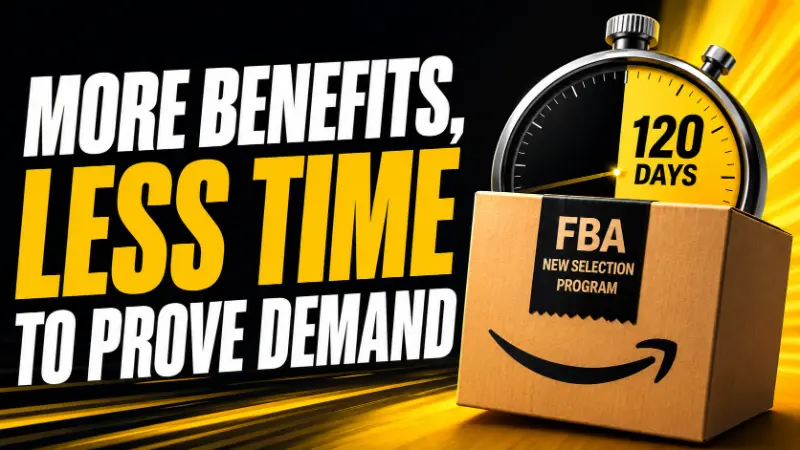
Amazon’s revised Amazon FBA New Selection Program launches July 30, 2026, replacing the current version on the same day and applying to eligible branded new-to-FBA parent ASINs. The revised program protects the first 200 units of a qualifying parent ASIN for the first 120 days with free monthly storage, free customer returns, and free liquidations, plus instant fee credits that cap referral fees at 10% on units 1-100 and 5% on units 101-200, $50 in coupon variable-fee credits, and $75 in Vine middle-tier enrollment-fee credits within the first 60 days. The tradeoff is that the former return-processing and liquidation window lasted 180 days from the first inventory-received date. Sellers now have 60 fewer days to prove demand before protection expires.
The tradeoff is that the former return-processing and liquidation window lasted 180 days from the first inventory-received date, so sellers now have 60 fewer days to prove demand before protection expires. That makes eligibility, product qualification, and launch timing more important: the details determine which ASINs actually qualify, how the 2026 benefits compare with the former program, when the fee credits are worth using, and which products are the best fit for a shorter 120-day testing window.
Key Takeaways
- The 2026 program launches July 30, 2026, and the existing program ends the same day.
- Benefits cover the first 200 units for 120 days from the first inventory-received date, not the listing-creation date.
- Instant fee credits replace the former monthly ~10% rebate: 10% referral-fee cap on units 1-100, 5% cap on units 101-200, plus $50 in coupon credits and $75 in Vine credits usable within 60 days.
- The former 180-day return-processing and liquidation window is now 120 days, so the launch-decision clock is shorter.
- Only branded new-to-FBA parent ASINs qualify. A parent ASIN is new-to-FBA only if no seller shipped it through FBA in the previous 12 months.
- 200 units is a benefit ceiling, not a recommended opening order. Treat the program as a controlled 120-day experiment with a predetermined decision on Day 120.
Amazon’s revised New Selection Program launches July 30
Amazon announced the revision on June 17, 2026. The new program takes effect July 30, 2026, and the existing program ends that day. Sellers already enrolled in the existing program automatically receive 2026 benefits for qualifying new branded FBA ASINs launched between July 30 and October 31, 2026. To continue receiving benefits after October 31, current participants must confirm enrollment in the revised program.
Seller eligibility follows Amazon’s eligibility requirements: a Professional selling plan, FBA enabled for eligible ASINs, and, if an Inventory Performance Index score has been assigned, a maximum trailing six-month Amazon Inventory Performance Index of at least 300; eligibility status is assessed daily based on that IPI score. Sellers struggling to stay above that threshold should focus on improving their IPI score and inventory health before banking on New Selection benefits for a launch. Product eligibility is limited to branded new-to-FBA parent ASINs, defined by Amazon as parent ASINs with no FBA shipment by any seller in the preceding 12 months. Both standard-size and non-standard-size products can qualify. A few categories, including video game consoles, video game accessories, apparel and shoes categories, and some media categories, have historically been treated differently under FBA program benefits, so sellers should confirm category treatment in the live Amazon help page before assuming eligibility. A professional seller account is required to meet the selection program’s basic eligibility requirements.
Two mechanics are worth flagging upfront. First, benefits activate from the first inventory-received date at an Amazon fulfillment center, not the day the listing goes live. Second, 2026 New Selection benefits do not stack with New Seller Incentives. When a seller qualifies for both, New Seller Incentives are applied first, and New Selection Program benefits apply to remaining eligible activity. Existing sellers can enroll in the program by selecting “Enroll now” on the program page when they need to confirm participation in the revised version. Enrollment also unlocks the FBA New Selection dashboard, and the program details note that FBA New Selection benefits apply across a seller’s global Amazon accounts once enrolled.
The 2026 program protects more units but gives sellers less time
The revised program raises the ceiling on protected units and adds new fee-related credits, but it also compresses the timeline for return and liquidation protection. The table below compares the former program with the 2026 version on the benefits sellers use most.
| Benefit | Former program | 2026 program | Seller implication |
| Standard-size free storage | First 100 units for 120 days | First 200 units for 120 days | Doubles the protected quantity at the same time window. |
| Non-standard-size free storage | First 50 units for 120 days | First 200 units for 120 days | Fourfold increase in protected units, most valuable for bulky items. |
| Free return processing | Up to 20 standard-size units received back within 180 days of first inventory-received date | First 200 units within 120 days | More units protected, but the window is 60 days shorter. |
| Free liquidation and removal | First 100 standard-size or first 50 non-standard-size within 180 days | First 200 units within 120 days | Higher unit ceiling, but exit must be executed 60 days sooner. |
| Fee reduction mechanism | Average ~10% rebate on qualifying sales, varying by category from 0% to 12%, applied to next month’s fulfillment fees | Instant credits: referral-fee cap of 10% on units 1-100, 5% on units 101-200 (or existing rate if lower) | Predictable per-unit economics instead of a variable, delayed rebate. |
| Vine benefit | 25% enrollment discount for 3-10 units per parent ASIN | $75 credit toward Vine middle-tier enrollment fee, usable within first 60 days | Flat-dollar credit is easier to model but only helps if Vine is used. |
| Coupon credit | None | $50 in coupon variable-fee credits within first 60 days | Small but useful for early promotional activity. |
| Low-inventory-level fee | Applied normally | Does not apply to first 200 units for first 120 days | Reduces launch-phase fee risk if velocity is uneven. |
| Storage utilization surcharge | Applied normally | Does not apply to first 200 units for first 120 days | Helps sellers with slower initial sell-through. |
| Vine Pre-launch | Not specified | 45-day extension on the listed benefits | Meaningful for sellers building reviews before general availability. |
| Product scope | Branded and non-branded new-to-FBA parent ASINs | Branded new-to-FBA parent ASINs | Excludes generic/unbranded launches. |
The 2026 program increases the quantity protected but shortens the return and liquidation window by 60 days. Sellers gain more room to fail cheaply on inventory volume and lose room to wait out slow demand.
Standard-size storage protection doubles to 200 units
Under the former program, the first 100 standard-size units received free monthly storage for 120 days. The 2026 program doubles that ceiling to 200 units per standard size parent ASIN while keeping the 120-day window. For a seller launching a mid-sized housewares or electronics accessory, that means twice as much cushion against monthly storage fees during the validation phase. Even the first unit must be received at a fulfillment center before the storage-fee waiver begins.
Keep in mind that New Selection fee discounts don’t shield eligible units from other seasonal cost pressures. If you’re planning to send qualifying inventory into FBA during Q4, model your landed cost against the current Amazon FBA peak season fees as well, since those surcharges apply on top of standard fulfillment rates and can erode a meaningful share of the New Selection savings on high-volume SKUs.
Non-standard-size storage protection increases from 50 to 200 units
The bigger structural change is for oversize and non-standard products. The former ceiling was 50 units for 120 days. The revised program applies the same 200-unit / 120-day protection regardless of size tier. For bulky products, where cubic-foot storage costs are the dominant fee line during a slow start, this is one of the more consequential changes in the update, especially when combined with low-cost bulk options like Amazon AWD long-term storage.
Returns and liquidations cover more units but lose 60 days
The former program covered up to 20 standard-size units of free return processing, including waived return processing fees, and free liquidation on the first 100 standard or 50 non-standard units, each within 180 days of the first inventory-received date. The revised program protects the first 200 units for 120 days across both categories, and that window can waive return processing fees for qualifying units while also covering liquidation fees for eligible inventory. The unit ceiling is materially higher and the size distinction is gone. The tradeoff is time: a seller who used to have six months to decide whether to liquidate now has four. If the product is a slow validator, the free-liquidation exit ramp closes before the decision would normally be made. Cahoot recommends sellers analyze Amazon FBA returns at the ASIN level early in the window to gauge whether the return profile makes continued FBA fulfillment viable, and high-return ASINs may also benefit from Amazon’s invite-only FBA Return Expert Service or, where appropriate, routing unsellable units into FBA Grade and Resell for value recovery.
For these fee waiver benefits to apply, the new to FBA ASIN or eligible parent ASINs must be received at fulfillment centers within the eligibility window.
Fee credits can reach $450 on a $30 product with a 15% referral fee
The following is a Cahoot calculation based on Amazon’s stated caps, not an Amazon case study, and unlike the old monthly average rebate, the current structure applies savings as instant credits. Assume a $30 product in a category with a 15% referral fee. The normal referral fee is $4.50 per unit.
- Units 1-100: the 10% cap equals $3.00 per unit, so the potential credit is $1.50 per unit, or $150 across 100 units.
- Units 101-200: the 5% cap equals $1.50 per unit, so the potential credit is $3.00 per unit, or $300 across 100 units.
- Total potential fee credits across the first 200 units: $450.
Adding the $50 in coupon variable-fee credits and $75 in Vine middle-tier enrollment-fee credits brings the total known potential credits to $575, before valuing free storage, free returns, free liquidations, or the low-inventory-level and storage-utilization exemptions.
The formulas are:
- Units 1-100 credit = price × [normal referral rate – min(10%, normal referral rate)] × qualifying units
- Units 101-200 credit = price × [normal referral rate – min(5%, normal referral rate)] × qualifying units
These are fee credits, not cash. Actual value depends on selling price, the product’s normal referral rate, the seller’s qualification for each benefit, actual sales within the window, whether other qualifying fees are incurred, and any Amazon time limits. Rebate amounts expire one year after being applied. These credits cannot be combined with other Amazon bonuses. If the normal referral rate is at or below a cap, that tier’s credit is smaller or zero. A product with an 8% referral rate, for example, generates no benefit from the 10% cap tier and only a small benefit from the 5% cap tier. Sellers should model their own category’s Amazon referral and FBA fees before assuming the $450 figure applies, including less obvious cost lines and hidden charges surfaced by an FBA fee calculator and hidden-fee analysis, and understand how prior and upcoming Amazon FBA fee increases change the value of New Selection incentives.
The 120-day clock changes the product-launch decision
The most consequential change is not the higher unit ceiling. It is the compressed timeline. The former 180-day window on returns and liquidations gave sellers roughly six months to build reviews, absorb advertising inefficiency, and observe repeat-purchase behavior before making a keep-or-exit call. The 2026 window is 120 days. A new FBA seller should treat that as a fixed test period, not an open-ended launch runway. That is enough time for many fast-validation products (single-purchase decisions, low consideration, straightforward category), but it is not enough time for products that require sustained ad investment to reach review thresholds or that depend on seasonal peaks arriving late in the window.
The practical implication is that the 200-unit ceiling should not be read as a recommended opening order. It is a benefit ceiling. Even if the program supports an unlimited number of launches or ASINs, ordering 200 units on Day 1 without validated demand still exposes the seller to the exact scenario the compressed window makes harder: inventory that has not sold enough by Day 100 to justify a replenishment order but cannot be liquidated free of charge after Day 120.
A more defensible approach is to size the initial inbound based on realistic 60-to-90-day demand estimates, reserve the option to send additional units if early signals are strong, and use the 120-day window as a hard decision date rather than a runway.
Not every new SKU is a new-to-FBA parent ASIN
Amazon’s eligibility rule is precise, and the language creates traps: not every new parent or newly created parent ASIN qualifies just because the listing is new.
- A new listing you created is not automatically an eligible new-to-FBA parent ASIN. Amazon defines a new-to-FBA parent ASIN as one with no FBA shipment by any seller in the preceding 12 months. Qualification depends on the parent ASIN’s shipment history, not your catalog history. If any seller, including you, shipped that parent ASIN through FBA in the last 12 months, it does not qualify.
- New child ASINs under an existing parent ASIN do not qualify if the parent ASIN itself has FBA shipment history within the 12-month window.
- New to Amazon and new to your account are not the same as new-to-FBA. A product you have never sold may still be ineligible if another seller shipped the same parent ASIN through FBA in the last year.
- Branded requirement. The 2026 wording specifies branded parent ASINs. Sellers relying on generic or unbranded listings under the former program will not receive the new benefits. Amazon’s Brand Registry is not stated in the announcement as a hard requirement, but being a brand owner or one of the new brand owners in Brand Registry may affect access to certain incentives tied to branded product sales, so sellers should confirm the live program terms before assuming eligibility for a specific parent ASIN.
Before committing manufacturing capital, verify eligibility inside Seller Central for the specific parent ASIN, not just the child ASIN or SKU. A misread here means paying full storage, referral, and return fees on inventory that was planned around a subsidized launch. Also verify whether the first buyable ASIN is tied to an eligible parent structure before assuming benefits.
Use a Day 0-to-Day 120 operating plan
Treating the program as a controlled experiment requires a written plan with predetermined decision points. The following schedule is a starting template.
| Milestone | Actions |
| Before inbound | Confirm enrollment status, including whether you still need to enroll in the FBA workflow or were automatically enrolled within 90 days of listing or after creating a shipment within 90 days. Verify parent-ASIN eligibility and 12-month FBA shipment history. Model unit economics with and without the fee credits. Set the initial test quantity based on realistic 60-90 day demand, not the 200-unit ceiling. Define the maximum acceptable launch loss and the exit criteria in writing. Confirm FBA preparation requirements and costs so units are not rejected at receiving, and consider whether outsourcing prep to a specialized Amazon FBA prep service makes sense for your catalog and volume. |
| Day 0 | First eligible inventory received at an Amazon fulfillment center. For a new seller, this receipt is the practical trigger point after enrollment timing has been established. The 120-day clock starts. |
| Days 1-30 | Activate eligible Vine and coupon benefits and confirm they are being applied. Launch initial advertising. Monitor for listing errors, Buy Box issues, or category classification problems that would blunt the fee credits. |
| Days 30-60 | Review conversion rate, advertising cost of sales, return rate, sell-through, and early customer feedback. Calculate inventory turnover and days to sell using observed velocity, not forecast velocity. |
| Days 60-75 | Reforecast days-to-sell using actual data. Resist automatic over-replenishment: a strong Week 4 does not guarantee a strong Week 12. |
| Days 75-90 | Choose one of four paths: replenish (demand validated, unit economics acceptable), maintain (uncertain, extend observation but do not add inventory), discount (accelerate sell-through while free returns and liquidations still apply), or exit (initiate free liquidation while the window is open). |
| Before Day 120 | Complete the appropriate free liquidation or removal action while protection is still active. Sellers who wait past Day 120 pay standard removal and disposal fees. Plan the exit to prevent a failed product test from becoming dead stock. |
| Day 120 onward | Assume normal fees resume unless Amazon confirms a specific extension (for example, Vine Pre-launch’s 45-day extension). Standard storage, referral, low-inventory-level, and storage-utilization fees apply from this point. |
The revised program favors fast-validation products
Not every product benefits equally. The 120-day window rewards categories where demand can be evidenced quickly and punishes those that need time to build.
Strong candidates:
- Branded products with a normal 15% referral rate, which maximize the value of the 10% and 5% caps.
- Products for which 200 units is a meaningful test quantity, not a rounding error against monthly demand or a multi-year supply.
- Non-standard-size items that benefit disproportionately from the fourfold storage-quantity increase.
- Products with meaningful return or exit risk, where fee waivers and free return processing on 200 units offset a real cost line.
- Products that can generate reliable demand evidence within 60 to 90 days: single-purchase categories, clear use cases, low consideration.
- Sellers prepared to activate Vine Pre-launch and coupon credits immediately, capturing the $75 and $50 credits inside the 60-day window, and to use pre-launch Vine reviews to seed social proof before the main demand test.
- Products that benefit from a reduced Vine enrollment fee or similar seller incentives Vine benefit, especially when early reviews materially affect conversion.
Weak candidates:
- Unbranded or generic products, which are excluded under the 2026 wording.
- Highly seasonal products whose peak demand arrives late in the 120-day window or after it closes.
- Products that need more than 120 days to accumulate reviews, ranking, or repeat purchases before demand stabilizes.
- Products with manufacturing minimums that force order quantities well above the 200-unit ceiling.
- Low-margin products dependent on prolonged advertising subsidies to reach breakeven.
- Sellers who cannot remain eligible under the program’s ongoing requirements and should not model their launch around the incentives, and who may be better served by building a Prime offer through Seller Fulfilled Prime for greater control or by using SFP strategically to offset rising FBA fees while maintaining fast shipping.
- Products whose parent ASIN had any FBA shipment by any seller in the previous 12 months, which disqualifies them regardless of how new the child ASIN or listing is.
Amazon reduces launch cost, not product risk
The 2026 program is a meaningful update. Doubling protected storage on standard-size units, quadrupling it on non-standard-size units, converting the delayed rebate into predictable per-unit fee caps, adding $125 in coupon and Vine credits, and exempting protected units from the low-inventory-level fee and storage utilization surcharge all reduce the cost of learning whether a product deserves a permanent slot in FBA through fee relief, not through any separate monthly subscription fee structure.
The 60-day cut to the return and liquidation window is the real cost of the trade. It moves the burden of proof onto the seller earlier and rewards products, categories, and launch strategies that can generate signal quickly. These are operational cost reductions, not a new seller incentives bonus or guarantee of profitable demand. Sellers who plan their launch around the 200-unit ceiling instead of realistic demand, or who assume the fee credits guarantee profitability, will find that the program reduces the cost of a bad launch without changing the underlying odds.
Amazon has lowered the cost of a controlled experiment. It has not lowered the cost of a bad product decision. Sellers who write down the decision criteria before Day 0, use the 120-day window as a hard deadline rather than a runway, and treat the fee credits as a modeled offset rather than a promise, will get the most from the revised program. Those who read 200 units as an order size and 120 days as breathing room will discover that the compressed window is the mechanic that matters most.
Frequently Asked Questions
What is the Amazon FBA New Selection Program (2026)?
It is Amazon’s revised program of launch-phase benefits for eligible branded new-to-FBA parent ASINs. Amazon continues to handle customer service and returns for FBA orders. On the first 200 units received into an Amazon fulfillment center, and for 120 days from the first inventory-received date, sellers receive free monthly storage, free customer returns, free liquidations, exemption from the low-inventory-level fee and storage utilization surcharge, instant fee credits that cap referral fees at 10% on units 1-100 and 5% on units 101-200, and $50 in coupon variable-fee credits plus $75 in Vine middle-tier enrollment credits within the first 60 days.
When does Amazon’s 2026 New Selection Program begin?
July 30, 2026. The existing program ends the same day. Amazon announced the revision on June 17, 2026.
What must current participants do by October 31, 2026?
Sellers already enrolled in the existing program automatically receive 2026 benefits for qualifying new branded FBA ASINs launched between July 30 and October 31, 2026. To continue receiving benefits after October 31, they must confirm enrollment in the revised program.
Which products qualify for the 2026 FBA New Selection Program?
Only branded new-to-FBA parent ASINs qualify. Amazon defines a new-to-FBA parent ASIN as one with no FBA shipment by any seller in the preceding 12 months. Both standard-size and non-standard-size products can qualify. Some categories have historically been treated differently, so sellers should confirm eligibility for a specific parent ASIN in the live Amazon help page. Only eligible new to FBA parent structures qualify, and a new-to-FBA ASIN must be attached to the correct eligible parent status.
How do the 10% and 5% fee caps work?
The caps apply as instant fee credits, not as permanent referral-rate changes. For units 1-100 of a qualifying parent ASIN, the effective referral fee is capped at 10% of the sale price or the seller’s normal referral rate, whichever is lower. For units 101-200, the cap is 5% or the normal rate, whichever is lower. On a $30 product with a 15% normal referral rate, that is a potential $1.50 credit per unit on the first 100 and $3.00 per unit on the next 100, or $450 in potential credits. If the normal referral rate is already at or below a cap, that tier’s credit is smaller or zero.
How long do the 2026 New Selection benefits last?
Benefits apply to the first 200 units for the first 120 days from the first inventory-received date at an Amazon fulfillment center. The $50 coupon credit and $75 Vine credit are usable within the first 60 days.
Does Vine Pre-launch extend the benefits?
Amazon states that Vine Pre-launch provides a 45-day extension on the listed benefits. Sellers planning to use Vine Pre-launch should confirm the extension mechanics inside Seller Central before relying on the added time.
Can New Selection benefits stack with New Seller Incentives?
No. 2026 New Selection benefits do not stack with New Seller Incentives. When a seller qualifies for both, New Seller Incentives are applied first, and New Selection Program benefits apply to remaining eligible activity.
Is 200 units the recommended launch quantity?
No. 200 units is a benefit ceiling, not a recommended opening order. The right test quantity depends on realistic 60-to-90-day demand estimates, unit economics, manufacturing minimums, and the maximum launch loss the seller is willing to accept. Sizing the initial inbound to the ceiling exposes sellers to the exact risk the compressed 120-day window makes harder: unsold inventory that cannot be liquidated free of charge after the window closes.
Written By:

Rinaldi Juwono
Rinaldi Juwono leads content and SEO strategy at Cahoot, crafting data-driven insights that help ecommerce brands navigate logistics challenges. He works closely with the product, sales, and operations teams to translate Cahoot’s innovations into actionable strategies merchants can use to grow smarter and leaner.

Turn Returns Into New Revenue
Related Articles
Why Returns Look Manageable Until They Suddenly Aren’t
Returns management is the retail process of handling customer returns across reverse logistics, cost control, and customer experience—and it rarely fails the way leadership expects...

The Economics of Peer-to-Peer Returns
Traditional returns management has one fundamental flaw: it optimizes a process that should not exist in its current form.

The Myth of “Efficient” Reverse Logistics
Efficient reverse logistics is treated as a goal worth chasing.