
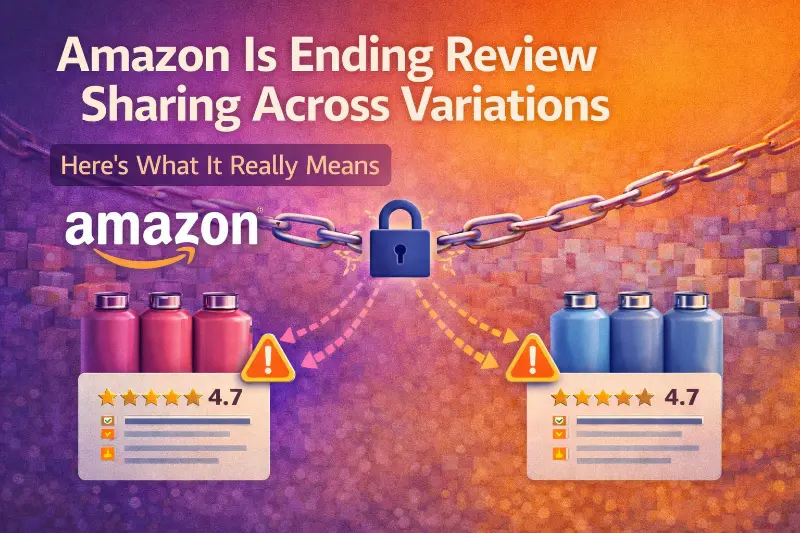
Amazon Is Ending Review Sharing Across Variations — Here’s What It Really Means

Last updated on January 20, 2026
In this article
 29 minutes
- Introduction
- Understanding Amazon Variations
- Parent Child Relationship
- What Is Changing on February 12, 2026?
- Why Is Amazon Making This Change?
- Review Sharing and SEO
- Why This Is a Big Deal for Sellers and Conversion Rates
- Common Mistakes to Avoid
- Embracing the Change – A New Mindset for Sellers
- Troubleshooting and Support
- Frequently Asked Questions
Introduction
Nearly all shoppers read product reviews before buying – up to 98% of consumers check reviews and take star ratings at face value. On Amazon, those stars heavily influence purchase decisions. Amazon product variations are the system for grouping related products – such as different sizes, colors, or styles – under a single listing, which has traditionally benefited both customers and sellers by improving the shopping experience and boosting sales and search ranking. That’s why Amazon’s latest policy update is such a game-changer: starting February 12, 2026, Amazon will no longer broadly share reviews across all variations of a product. When this change takes effect, each variation (size, color, flavor, model, etc.) will increasingly stand on its own merits and reviews. The implementation of the new policy will be gradual, and sellers will receive 30 days’ notice before their products are affected. This marks one of the biggest shifts in Amazon’s approach to customer trust and conversion in years. Amazon’s update is designed to reward brands that have built variation families correctly and to penalize those who used variations as a shortcut to scale social proof.
For sellers who relied on pooled reviews – where a strong “hero” variation’s 5-star rating lifted the weaker variants – this change could sting. A child ASIN that used to show hundreds of shared reviews might suddenly display only a handful of its own reviews, potentially dropping its conversion rate overnight. But Amazon’s goal isn’t to hurt sellers; it’s to make reviews more accurate for customers. In the long run, this review transparency could reduce returns and reward sellers who maintain honest, precise product listings. In this article, we’ll break down exactly what’s changing, why Amazon is doing it, which variations will (and won’t) still share reviews, and how you can adapt to avoid conversion loss.
Understanding Amazon Variations
Amazon variations are a cornerstone of successful selling on the platform, offering both sellers and customers a streamlined way to navigate multiple options of the same core product. By grouping similar items – such as a t-shirt available in different sizes or colors – under a single parent listing, sellers create what’s known as a variation family. This approach is part of Amazon’s listing variations system, a structured method for organizing similar products under a parent-child relationship. This not only enhances the customer experience by making it easier to compare and select the right product, but also helps boost sales and visibility in search results.
To set up variation relationships, sellers must first determine if their products qualify based on Amazon’s guidelines for the relevant product category. Eligible products typically differ only in minor, non-functional ways – think color, pattern, or size – while maintaining the same product type and core functionality. For example, a set of phone cases in multiple colors or a t-shirt offered in various sizes are perfect candidates for a variation listing. However, products that differ in model, design, or features should be listed separately to avoid confusing customers and risking policy violations.
Creating a variation listing in Seller Central involves establishing a parent-child relationship. The parent ASIN acts as the umbrella listing, containing the main product details, while each child ASIN (also referred to as a child item in Amazon’s system) represents a specific variation, such as a particular size or color. Variation attributes must be used accurately to reflect the true product differences, ensuring that customers can easily compare options without feeling overwhelmed or misled. Consistency in product data across all child listings is crucial for maintaining customer confidence and a seamless shopping experience.
Sellers can add a new variation to an existing listing or create new variation families, and this can be done one at a time or in bulk using Amazon’s product templates or the Variation Wizard.
One of the key advantages of variation listings is the ability to share reviews across child ASINs – provided the variations are truly similar. This means that positive or negative reviews can impact all variations within the family, making it essential for sellers to monitor review counts and star ratings closely. Addressing customer feedback promptly and ensuring product quality across all variations can help maintain strong ratings and drive purchase decisions.
To optimize your variation listings, regularly review your product data to ensure it accurately reflects the differences between each child ASIN. Keep an eye on review sharing, as negative reviews for one variation can affect the entire family. Staying fully compliant with Amazon’s policies is also vital – avoid grouping unrelated products, and make sure each child ASIN is correctly linked to the parent ASIN. Non-compliance can lead to listing suppression or other penalties, which can hurt sales and visibility.
Mastering Amazon variations is about more than just creating one listing for multiple products – it’s about leveraging the right variation attributes, maintaining accurate product details, and fostering customer confidence through transparency. Whether you’re selling clothing, phone cases, or any product with multiple sizes or colors, understanding how to create and manage variation relationships can give you a competitive edge. By staying compliant and proactive, you’ll not only improve the customer experience but also unlock greater sales potential and long-term growth on Amazon.
Let AI Optimize Your Shipping and Boost Profits
Cahoot.ai software selects the best shipping option for every order—saving you time and money automatically. No Human Required.
See AI in ActionParent Child Relationship
On Amazon, the parent-child relationship is the backbone of how product variations are organized and presented to customers. This structure allows sellers to group similar products – like a t-shirt available in different sizes or colors – under one parent listing, with each specific option represented as a child product. The parent product acts as the main listing that customers see in search results, while the child listings offer the various choices, such as different sizes, colors, or even patterns.
Creating a parent-child relationship not only streamlines the shopping experience for customers but also helps sellers boost sales by consolidating all variations into one listing. For example, instead of creating separate listings for a t-shirt in small, medium, and large, a seller can create a single parent listing and add each size as a child product. This makes it easier for customers to find the exact variation they want without having to sift through multiple listings. It also means that all the traffic and sales are funneled through one parent product, increasing visibility and improving the chances of winning the Buy Box.
For sellers, leveraging the parent-child relationship is a powerful way to showcase a full range of options, keep inventory organized, and provide a better customer experience. When customers can easily compare and select from different sizes or colors on one page, they’re more likely to make a purchase. Ultimately, creating well-structured parent-child relationships is essential for maximizing sales and ensuring your products stand out in Amazon’s crowded marketplace.
What Is Changing on February 12, 2026?
On Feb 12, 2026, Amazon is fundamentally changing how reviews are displayed on variation listings. Currently, if you have a parent product with multiple variations (for example, a shirt in 5 colors or a gadget in two different models), all reviews are pooled together on the product page regardless of which variation the review was for. That means a review written for the blue variant of a product also appears under the red variant, and vice versa. Amazon has acknowledged this leads to reviews that “don’t accurately reflect the specific variation a customer is considering.” In other words, shoppers might be reading feedback about a different size, flavor, or version than the one they’re actually looking to buy.
Starting February 12, that changes. Reviews will only be shared between variations that have very minor, non-functional differences. If the differences between variations affect functionality, performance, formulation, or intended use, reviews will no longer be shared across those variations. Amazon will continue sharing reviews for variations where the differences are purely cosmetic or structural, not functional. Each child ASIN will primarily display the reviews relevant to that specific variation. This could affect overall star ratings and review counts on some listings, since many products will lose the boost (or drag) from reviews of their siblings. Amazon is rolling out the change gradually on a category-by-category basis from Feb 12 through May 31, 2026. Sellers will get a 30-day advance email notice before their category is affected, so you’ll have some warning to prepare. By June 1, 2026, the new review display rules should be in effect across virtually all categories on Amazon.
Variations That Will Continue to Share Reviews
Not every kind of variation is losing shared reviews. Amazon will continue to aggregate reviews for variations that are essentially the same core product with only superficial differences. According to Amazon’s announcement, reviews will still be shared in cases of minor, non-functional variation types:
- Color or pattern differences of the same product (e.g. a t-shirt offered in blue, red, and green). A blue shirt and a red shirt that are otherwise identical will still pool their reviews, since the only difference is the color.
- Size variations with the same function, such as a product available in small, medium, and large, or queen vs. king bedding in the same style. As long as the size change doesn’t introduce new features or uses (it just changes dimensions), Amazon treats it as the same item.
- Pack size or quantity variations (e.g. a 2-pack vs. 6-pack of the exact same item). Customers expect a multi-pack to be the same product, just more of it, so those reviews remain relevant across those quantity options.
- Secondary scent or flavor variations when scent/flavor is not the primary product feature. For example, a household cleaner that comes in “unscented” and “lemon scent” will share reviews – the cleaning function is the same, and scent is a secondary preference. (In contrast, if scent or flavor is the main point of the product, that’s treated differently, as we’ll see below.)
- Different model fitments for the same product type, like a phone case sold in variations to fit different phone models. If you sell a single phone case design with versions for iPhone vs. Samsung, those can still share reviews because the only difference is the device compatibility – the product’s purpose and quality are effectively the same.
In summary, if your variations only differ in cosmetic or non-functional ways (color, pattern), in purely proportional ways (size or quantity), or in device-specific fit while the product is otherwise identical, then they will retain shared reviews. Amazon considers these differences minor enough that a review of one variant is still perfectly relevant to another.
Variations That Will No Longer Share Reviews
The big change is that variations with any substantive differences will no longer share reviews. Amazon wants to isolate reviews whenever a variant’s attributes could affect the customer’s experience or the product’s functionality. Here are the types of variation differences that will not have shared reviews going forward, with examples:
- Performance or power variations: If one version of a product has different performance specs or power capacity than another, their reviews will be separated. Example: A laptop model with an 8GB RAM/256GB SSD configuration and another with 16GB RAM/512GB SSD will no longer pool reviews, since their performance differs significantly. Similarly, an appliance offered in a 500-Watt vs. 1000-Watt option should have distinct review sets. These kinds of differences directly impact functionality.
- Different models or generations: A product line that has newer vs. older generation models (with feature changes) can’t share reviews now. Example: If you sold a 2025 edition of a gadget and a redesigned 2026 edition as two variations under one listing, each model’s reviews will stand alone. Reviews for the older model won’t carry over to the new model, and vice versa, because they are essentially different products.
- Bundle vs. standalone: Variations where one is a bundle or kit and another is the base product will not share reviews. Example: A camera sold alone versus a “camera + accessories bundle” were sometimes listed as variations to share reviews. Under the new policy, that bundle’s reviews won’t mix with the single product’s reviews, since the purchase contents differ.
- Flavor as a primary factor: When flavor or taste is a core product attribute (common with food, drinks, supplements, etc.), those variations get separated reviews. Example: A protein powder in Chocolate flavor versus Vanilla flavor will not share reviews. Customer satisfaction can vary greatly by flavor – a review saying “tastes terrible” for chocolate might not apply to vanilla at all. Amazon explicitly gave the chocolate vs. vanilla protein powder case as not eligible for review sharing because flavor directly impacts the user’s experience.
- Primary scent differences: Similarly, if a product’s scent is a primary feature (think perfumes, scented candles, or flavored consumables), each scent variant will have its own reviews. Example: A candle offered in “Lavender” vs. “Vanilla Bean” scents should not share reviews, since someone who loves the lavender scent might hate the vanilla – reviews aren’t one-size-fits-all in this case.
- Material or construction differences: Variations made of different materials or with distinct build qualities will have separated reviews. Example: A water bottle available in plastic vs. stainless steel, or a sofa sold in genuine leather vs. fabric upholstery, will not share reviews. The durability, feel, and quality can differ with material, so each version needs its own feedback.
- Fit or design variations that alter the product’s use or fit: If two variations have different fit, cut, or design that affects how the product works or fits the user, their reviews won’t mix. Example: A shirt sold in “Slim Fit” vs “Relaxed Fit” or a shoe available in two different designs (one with laces, one slip-on) should be evaluated separately by customers. A review complaining that the slip-on shoe’s elastic is too tight shouldn’t influence the laced version’s rating.
- Intended use or functionality differences: Any variation that serves a different use-case or has a different feature set is no longer eligible for shared reviews. Example: A kitchen mixer that comes in two variants – one that includes additional attachments for pasta making and one that doesn’t – should not share reviews, because the presence/absence of those attachments significantly changes the product experience. Essentially, if one variation could deliver a different outcome or solve a different problem than another, Amazon will treat them as separate products for review purposes.
In short, if a variation changes anything fundamental about the product’s performance, flavor/scent, functionality, or package contents, Amazon will isolate its reviews to that specific ASIN. This is a hard break from the old approach where even very different versions could ride on the coattails of the top variation’s rating. Amazon is drawing a clear line: only truly equivalent products can share in the same pool of social proof. Everything else must earn its own reputation.
ShipStation vs. Cahoot: 21x Faster, Real Results
Get the inside scoop on how a leading merchant switched from ShipStation to Cahoot—and what happened next. See it to believe it!
See the 21x DifferenceWhy Is Amazon Making This Change?
Amazon’s decision to stop broad review sharing is rooted in one major goal: increasing the accuracy of reviews and customer trust in those reviews. When reviews are shared across dissimilar variations, it can mislead shoppers. They might read glowing reviews that actually refer to a different model or flavor, or see criticisms that don’t apply to the variation they’re viewing. Amazon recognized that this undermines the reliability of the review system. The official announcement states the intent clearly: it’s meant “to improve accuracy and help customers make more informed purchasing decisions,” giving shoppers product-specific feedback that increases trust and potentially decreases returns.
In essence, Amazon wants each product variation’s star rating and review list to reflect that exact item – nothing more, nothing less. By doing so, customers will know exactly what they’re getting, and won’t be swayed by reviews about a different version. This aligns with Amazon’s long-standing focus on customer experience. Irrelevant or misleading reviews don’t just confuse buyers; they lead to disappointment, bad reviews, and ultimately higher return rates when a product doesn’t meet expectations. By ensuring reviews match the precise item, Amazon expects fewer unhappy surprises (“Oh, this red version is made of a different material than the blue one I read reviews for!”) and thus fewer returns due to unmet expectations.
There’s also a crack-down element here on certain seller tactics. In the past, some sellers abused variation listings by grouping unrelated products together just to consolidate reviews (a practice against Amazon policy, often called “variation abuse”). This update effectively kills the incentive for that: if the products aren’t truly similar, they won’t share reviews anymore, eliminating the benefit of creating artificial variation families. Amazon’s broader trend in recent years has been stricter enforcement of listing quality and variation rules. The new policy is an extension of that – making sure each review is relevant to the product it’s attached to, and stopping any misleading aggregation that could boost sales unfairly. As one Amazon strategist noted, it’s hard to argue the change “isn’t beneficial to customers… [it] could also fight against variation abuse patterns.”
Ultimately, Amazon is prioritizing long-term customer trust over short-term convenience. By forcing honesty in how reviews are attributed, the platform aims to maintain credibility. From Amazon’s perspective, a more transparent review system means shoppers can buy with confidence, which is good for the ecosystem in the long run – even if it means some sellers have to adjust their tactics.
Review Sharing and SEO
Review sharing is a key feature of Amazon’s variation relationships, especially when products within a variation family are essentially the same item with only minor differences – like color or size. When a customer leaves a review for one child product, such as a blue t-shirt, that review is shared across all other child products in the same parent-child relationship, like the red, green, or yellow versions. This approach helps build customer confidence, as shoppers can see a larger pool of feedback for the same product, making it easier to trust the quality and make a purchase decision.
From an SEO perspective, review sharing can significantly improve the visibility of your products in Amazon’s search results. Listings with higher review counts and better star ratings tend to rank higher, attracting more clicks and conversions. To maximize these benefits, it’s crucial that your variation attributes – such as size, color, or pattern – accurately reflect the minor differences between child products. This ensures that reviews remain relevant and helpful, and prevents customer confusion.
Sellers can further optimize their variation listings for SEO by incorporating relevant keywords into the product title, description, and variation attributes. For example, including terms like “men’s t-shirt, multiple colors, all sizes” can help your parent listing appear in more search queries. By maintaining accurate variation relationships and leveraging review sharing, you not only enhance the customer experience but also improve your chances of standing out in Amazon’s competitive marketplace.
Why This Is a Big Deal for Sellers and Conversion Rates
For many Amazon sellers, this policy change might feel like the rug is being pulled out from under some of your listings. That’s because shared review pools have been a major conversion driver on Amazon. If you had one top-selling variant with lots of positive reviews, it effectively bolstered the credibility of every variant under that parent ASIN. A weaker variation could still display a 4.5-star rating with hundreds of reviews, borrowing social proof from its siblings. Now, those weaker variants will be exposed – they’ll show only the reviews they actually earned. Some child products that enjoyed a high star rating may see it plummet (or their review count drop to near-zero) once the unrelated reviews are stripped away.
In the short term, sellers should brace for some turbulence in conversion metrics. Lower visible review counts on certain variations are likely, and with fewer reviews comes lower buyer confidence. Shoppers often use review volume and rating as a quick trust signal. Suddenly seeing, say, “5 reviews” where there used to be “105 reviews” on a given variant can give buyers pause. Conversion rates on those variants may dip until they gather more of their own reviews. Newer or previously low-traffic variations that piggybacked on a top variation’s reviews will feel this the most – they’ll need to build up credibility from scratch. Additionally, any negative reviews that were drowned out in a big pool will now be highly visible on the specific product they apply to. For example, if one color of a product had a manufacturing flaw and got a bunch of 1-star reviews, those used to be diluted by positive reviews of the other colors. Not anymore – that variant might show an honestly lower rating, which could hurt its sales (while arguably protecting customers from buying a subpar option).
However, it’s not all downside. In the long run, this change can benefit both customers and diligent sellers. For one, good variations won’t be dragged down by issues from other versions. If you have one variant that’s truly excellent and another that had problems, the problematic one’s reviews won’t tank the rating of the good one. Each product stands on its own merit, which is more fair for sellers who maintain quality. Also, customer trust in reviews will likely improve when buyers realize the reviews they’re reading are specific to the exact item they’re interested in. Greater trust can mean more conversions overall, even if each ASIN has to work harder to earn it. And importantly, fewer customers will end up feeling “tricked” by a product page, so over time you could see a reduction in returns and negative feedback. When expectations match reality, customer satisfaction goes up. Some sellers are even optimistic about this shift: one forum commenter gave the example that now if a dog food comes in wild rabbit vs. chicken flavor, dog owners can clearly see which flavor dogs preferred, instead of seeing an aggregate rating that masks those differences – “that doesn’t give me a clue,” they noted, but now I could see what taste other dogs really prefer.”
Think of it this way: previously, Amazon’s variation system often masked the truth of which specific product a customer was evaluating. Now, the truth is coming to the surface for each variation. In the short run that truth might hurt (as shortcomings can no longer hide), but in the long run it rewards accuracy and quality. Sellers who have been bundling semi-different products under one listing will no longer get a free ride on reviews – they’ll need to ensure every variation is up to par and attract its own positive reviews. On the upside, if you’ve done a great job with one version of your product, its reputation won’t be tarnished by an underperforming sibling. Conversion rates might dip initially, but as each ASIN builds its own social proof and as shoppers trust what they see, the playing field evens out. We may also see improved conversion in cases where previously hesitant customers held off purchase due to irrelevant negative reviews (now those irrelevant reviews won’t be on the page to scare them off).
Common Mistakes to Avoid
When setting up variation relationships on Amazon, it’s easy to make mistakes that can hurt your sales and customer satisfaction. One common error is not accurately reflecting product differences in the variation attributes. For instance, if you create a variation family for phone cases in different colors but fail to specify the correct color for each child listing, customers may receive the wrong product, leading to confusion and negative reviews.
Another frequent mistake is creating separate listings for products that should be grouped together as a variation family. This can fragment your sales, reduce visibility, and even lead to listing suppression if Amazon’s systems flag your listings as duplicates. On the flip side, some sellers try to group unrelated products under one parent listing – such as combining a phone case and a screen protector – just to share reviews. This overwhelms customers, makes it harder for them to find what they want, and violates Amazon’s policies.
To avoid these pitfalls, always ensure your variation relationships accurately reflect the real product differences and that your products qualify for variation listings. Carefully review Amazon’s guidelines, use the correct variation attributes, and never group unrelated products together. By following best practices, you’ll create a smoother shopping experience for customers, reduce the risk of negative reviews, and protect your listings from suppression or removal.
Cut Costs with the Smartest Shipping On the Market
Guranteed Savings on EVERY shipment with Cahoot's AI-powered rate shopping and humanless label generation. Even for your complex orders.
Cut Costs TodayEmbracing the Change – A New Mindset for Sellers
This review policy update calls for a fundamental mindset shift in how sellers approach Amazon listings. Many sellers face significant challenges with Amazon’s complex variation policies, which can make compliance and adaptation difficult. Rather than viewing it as a punishment or a loss, savvy sellers should view it as Amazon forcing a dose of transparency and truth into the marketplace. Going forward, you can’t rely on a one-star variation hiding in a five-star family, nor can a mediocre product hitch a ride on the acclaim of a superior variant. Each child ASIN needs to earn trust on its own. Here’s how to adapt:
First, ensure your variation groupings are truly logical and compliant. Amazon itself advises reviewing your catalog now to confirm that every variation is an appropriate one. Use the correct variation themes for genuine product differences (e.g. don’t misuse a “color” variation to cover up a version that actually has a different feature set). If some of your products were variated incorrectly or in ways that will no longer share reviews, consider reworking those listings. In some cases, it might make sense to split a variation family apart into separate listings if the products are substantially different – especially if one variant has been overshadowing others. Remember, Amazon will re-share reviews for eligible products if you update the variation themes later to a valid format. That means if you correct an improper variation grouping (for example, separating a bundle from a single product, or moving a flavor into its own listing), any reviews that should be shared under the new structure will be, and the ones that shouldn’t will stay with their product. Essentially, fixing your variation structure can help you salvage the correct reviews where they belong.
Next, treat each variation like its own product when it comes to marketing and review generation. Going forward, your strategy can’t be “launch one variant and let it accumulate 100 reviews, then just add new variants to piggyback on those.” If you’re launching a new color or a new flavor, you might need to invest in programs like Amazon Vine for that specific ASIN, ramp up requests for reviews from buyers of that variant, or provide stellar customer service to encourage positive feedback. Each child item’s review count will start to matter much more for its success. This is a good time to bolster the content on each variant’s detail page as well – make sure descriptions and images highlight what’s unique about that variant and set correct expectations (since you can’t rely on generic reviews to do that job). If one variation historically had higher return rates or more complaints, address those issues head-on or consider discontinuing it, because its reviews will now broadcast those issues loud and clear just for that item.
Importantly, don’t panic. While you should prepare for some short-term adjustment, this change isn’t the end of your Amazon business. Your existing reviews aren’t being deleted; they’re simply being allocated to the right products. Amazon isn’t “out to get sellers” here or to strip away hard-earned social proof arbitrarily – it’s trying to ensure accurate social proof. Sellers who focus on product quality, proper listing practices, and customer satisfaction will still thrive. In fact, those who have been truly listening to their reviews and improving each variation accordingly might find themselves in a stronger position once the dust settles. Sellers are often left feeling unsupported and unheard when navigating the complex process of listing variations. You’ll finally see which of your variations are truly winners in the eyes of customers, and which were perhaps coasting by. Use that information. Double down on the products that customers love (now clearly evidenced by their standalone reviews) and re-work or reconsider the ones that aren’t up to snuff.
In the big picture, Amazon’s move could usher in a healthier marketplace. It encourages accurate listings, honest reviews, and better products. Sellers who adapt will be aligning with what Amazon has always wanted: a great experience for shoppers. By embracing this mindset – that each product must stand on its own merit – you not only comply with the new rules, but you also set your brand up for more sustainable success. Trust built on authenticity tends to last. So, take a deep breath, audit your product variations, and commit to making each one as review-worthy as the next. In a world where “review sharing was masking product truth,” it’s time to let the truth speak for each item you sell. Your future customers (and your honest competition) will thank you.
Troubleshooting and Support
If you encounter issues with your Amazon variation relationships – such as child listings not appearing on the detail page, reviews not being shared correctly, or listings being suppressed – there are several steps you can take to resolve them. First, check your product data for accuracy and consistency across all child listings. Using flat files to manage your inventory can help you spot and correct discrepancies in variation attributes or parent-child relationships.
Sometimes, Amazon’s automated systems may flag your variation relationships as invalid, leading to listing suppression or removal from the detail page. In these cases, you can contact Amazon seller support for assistance. Be prepared to provide evidence that your variation relationships are valid and fully compliant with Amazon’s guidelines. If necessary, you can appeal the decision and submit updated product data to restore your listings.
To streamline the process, consider using Amazon’s Variation Wizard or third-party software tools to help create and manage your variation relationships. These tools can help ensure your listings are set up correctly, optimize your product data for SEO, and improve your overall sales performance. By staying proactive and following Amazon’s best practices, you can troubleshoot issues quickly, maintain healthy listings, and deliver a seamless shopping experience for your customers.
Frequently Asked Questions
When does Amazon stop sharing reviews across variations?
Amazon’s new policy takes effect on February 12, 2026, and rolls out gradually by category through May 31, 2026. After your category’s rollout date, reviews will only be shared between very similar variations (minor differences) and not across fundamentally different product variations.
Will my existing reviews disappear?
No, Amazon is not deleting your reviews. However, each review will only show on the specific variation it was written for. This means some variations on your listing may suddenly display fewer reviews (only the ones they actually earned). Reviews that were previously pooled from other variants will no longer appear on those variant pages, but they remain visible on the appropriate product’s page. Essentially, your total review count per variant may drop, but the reviews still exist on their respective products.
Can reviews be re-shared if I change variation themes?
Yes. If you update or correct your variation themes (the way your products are grouped) after the change, Amazon will re-share reviews for products that become eligible under the new grouping. In practice, this means if you regroup products into proper variation families (or split out ones that shouldn’t be together), any reviews that qualify to be shared in the new arrangement will start showing up again. It’s important that your variations use only valid themes (e.g. don’t group a flavor as a “color” just to share reviews) – only eligible variations will share reviews going forward.
Does this apply to all categories on Amazon?
Yes, the new review sharing rules are Amazon-wide, but the implementation is staggered by category. Between February and May 2026, Amazon will phase in the change across all product categories that use variations. Every category that allows variation listings (from electronics to apparel to grocery and beyond) is slated to be included. Amazon will notify sellers 30 days before their specific category is affected, so you can expect to be informed ahead of time. By the end of May 2026, all categories should be under the new policy.
Are variation listings being split up or removed?
No, Amazon is not eliminating variation listings themselves. Your parent-child variation structure will remain intact – customers will still see one product page with options for different variations (size, color, etc.). The change is only in how reviews are displayed. Each child ASIN in the variation will show its own rating and review count, rather than all sharing one aggregated set of reviews. So your variations stay linked as a family, but their social proof will be variation-specific going forward.
Written By:

Manish Chowdhary
Manish Chowdhary is the founder and CEO of Cahoot, the most comprehensive post-purchase suite for ecommerce brands. A serial entrepreneur and industry thought leader, Manish has decades of experience building technologies that simplify ecommerce logistics—from order fulfillment to returns. His insights help brands stay ahead of market shifts and operational challenges.

Turn Returns Into New Revenue

Related Articles
Shipping Labels Explained: What They Include, How They Work, and Common Mistakes
Shipping labels are the operational backbone of ecommerce fulfillment, a small piece of paper that determines whether packages reach customers successfully or trigger costly failur...
USPS Click-N-Ship Explained: How It Works, Costs, and When Sellers Should Use It
USPS Click-N-Ship is the postal service’s free online label-printing tool, and for most Shopify sellers shipping more than 50 packages monthly, it’s already time to move beyond it....

USPS Tracking Explained: What Each Status Means and How Sellers Should Respond
The “if it fits, it ships” model offers compelling economics for heavy items traveling cross-country, but costs Shopify brands up to 175% more than alternatives for lig...