
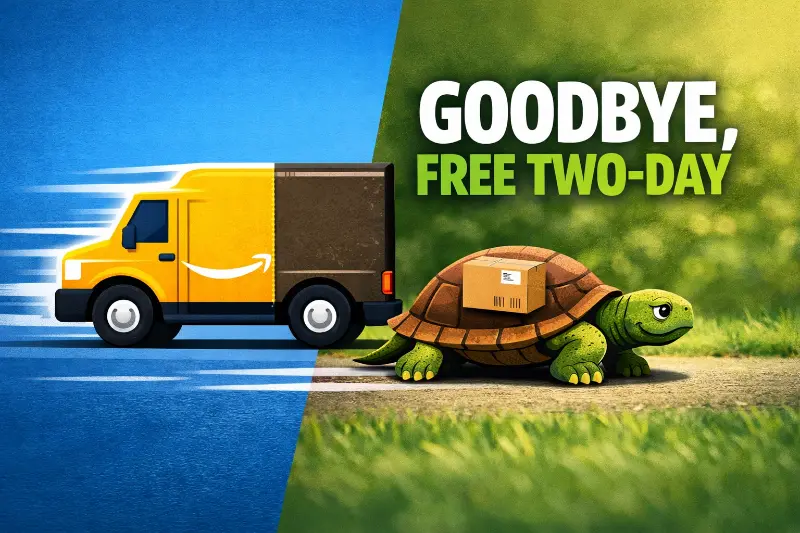
Amazon’s 7% Slower-Delivery Discount Signals a Bigger Shift in Ecommerce

Last updated on March 30, 2026
In this article
 7 minutes
- The Industry Is Rewriting the Rules of Delivery
- Fast Shipping Was Always Subsidized
- The Pullback Is Industry-Wide, Not Just Amazon
- Consumers Have Already Moved On
- Speed Was Never the Real Driver
- Slower Shipping Creates Better Customers
- The Real Shift: From Speed to Control
- What Ecommerce Operators Should Do Now
- Fast Shipping Isn’t Going Away. But It’s No Longer the Default
- Frequently Asked Questions
Amazon offering discounts for slower delivery is not a feature update. It is a signal that ecommerce is being forced to correct a long-standing assumption about speed and cost.
For years, fast and free shipping was treated as a requirement. What is becoming clear now is that it was never a sustainable one. As costs rise and consumer behavior shifts, delivery is being redefined from a competitive perk into a lever for profitability and customer quality.
The Industry Is Rewriting the Rules of Delivery
The narrative often starts with Amazon offering a 7% discount to customers who choose a later delivery date. But focusing only on Amazon misses the bigger picture.
Retailers across the market are expanding “no-rush” or economy delivery options. Brands like Gap now offer multiple shipping speeds, with the slowest options often being the cheapest or free. Other merchants are pushing delivery windows out to one or even two weeks.
This is not experimentation at the margins. It is a coordinated shift in how delivery is positioned.
For years, the industry competed on speed because it believed faster delivery created better customer experiences and higher conversion. That belief is now being challenged by both economics and data.
Fast Shipping Was Always Subsidized
Fast delivery did not become standard because it was efficient. It became standard because it was subsidized.
Retailers absorbed the cost of expedited shipping as a customer acquisition strategy. Carriers expanded their networks to support higher volumes. The entire system was built around the idea that speed would drive growth.
That model is now under pressure.
Since 2020, major carriers like UPS and FedEx have raised base rates annually while adding surcharges for fuel, residential delivery, and package dimensions. Even the lowest-tier services can start at price points that make free two-day shipping difficult to justify for many products.
At the same time, carriers are becoming more selective. FedEx has been explicit that it wants to focus on higher-value shipments and is less interested in low-margin ecommerce volume.
What used to be a growth engine is now a cost center.
The Pullback Is Industry-Wide, Not Just Amazon
Amazon is not alone in adjusting its approach. In many ways, it is following a broader shift that has already taken hold across ecommerce.
Retailers are introducing slower delivery tiers, encouraging customers to choose flexible delivery windows, and experimenting with pricing incentives tied to timing.
Logistics providers are doing the same. Wider delivery windows allow carriers to consolidate shipments, improve truck utilization, and reduce per-package costs. Even small extensions in delivery timelines can meaningfully lower operating costs across a network.
The result is a system that increasingly rewards flexibility rather than speed.
Consumers Have Already Moved On
The most important shift is not happening inside logistics networks. It is happening with consumers.
Shipping cost has overtaken delivery speed as the top priority for online shoppers. A large majority of consumers now prefer free standard shipping over paying for expedited delivery, even if it means waiting several extra days.
This is a significant reversal from just a few years ago, when speed was often the deciding factor.
The rise of companies like Shein and Temu accelerated this change by normalizing longer delivery times in exchange for lower prices. Once customers experienced that tradeoff, expectations began to reset.
The market moved first. Retailers are now catching up.
Speed Was Never the Real Driver
One of the more revealing insights from recent ecommerce data is that speed was not the primary driver of conversion in the first place.
Uncertainty was.
When customers abandon carts, it is often not because delivery is too slow. It is because delivery expectations are unclear or unreliable. When timelines are communicated clearly and consistently, customers are far more willing to wait.
This distinction matters.
It means that faster shipping is not always the solution. In many cases, better communication and more predictable delivery windows can achieve the same or better outcomes at a lower cost.
Slower Shipping Creates Better Customers
There is another effect that is easy to overlook.
Slower delivery can improve customer quality.
Retailers that have extended delivery timelines are seeing lower return rates, sometimes by 20% to 30%. The reason is simple. Customers who are willing to wait tend to be more intentional in their purchases.
They are less driven by impulse. They are more aligned with the value of the product. And they are less likely to return items after receiving them.
Fast shipping, on the other hand, can encourage low-commitment buying behavior. When products arrive quickly and returns are easy, the cost of making a poor decision is low.
Slowing down the process introduces friction in a way that can actually improve profitability.
The Real Shift: From Speed to Control
What is happening is not a move toward slower shipping for its own sake. It is a shift toward control.
Delivery is becoming a lever that operators can use to manage cost, shape demand, and influence customer behavior.
Flexible delivery windows allow for smarter routing decisions. Multi-warehouse strategies can balance speed and cost depending on the order. Incentives can be used to shift demand toward less expensive fulfillment paths.
In this context, delivery is no longer just a service level decision. It is part of the pricing and margin strategy.
This is where many ecommerce operators need to rethink their approach.
Optimizing for speed alone is no longer sufficient. The goal is to optimize for outcomes, balancing cost, customer experience, and operational efficiency.
What Ecommerce Operators Should Do Now
This shift creates both risk and opportunity.
Operators who continue to treat fast shipping as a default requirement will find themselves absorbing rising costs without a corresponding increase in value.
Those who adapt can use delivery as a strategic tool.
That starts with re-evaluating shipping promises. Not every product needs to arrive in two days. In many cases, offering a slower, cheaper option can improve both margins and customer alignment.
It also requires better visibility and control over fulfillment decisions. Routing logic, carrier selection, and delivery timing should be actively managed rather than treated as fixed rules.
Finally, communication becomes critical. Customers are willing to wait, but only if expectations are clear. Transparency around delivery windows can do more for conversion than incremental speed improvements.
Fast Shipping Isn’t Going Away. But It’s No Longer the Default
There will always be cases where speed matters.
Urgent purchases, high-value items, and certain customer segments will continue to demand fast delivery. Amazon, Walmart, and others will keep investing in same-day and next-day capabilities.
But fast shipping is no longer the baseline expectation for every order.
What we are seeing is a rebalancing.
Speed is becoming one option among many, rather than the defining feature of ecommerce. Cost, flexibility, and predictability are taking on a larger role in how delivery is designed and communicated.
Amazon’s 7% discount is a visible signal of that shift. The deeper change is already underway.
Frequently Asked Questions
Why is Amazon offering a discount for slower delivery?
Amazon is incentivizing customers to choose delivery options that are less expensive to fulfill. Slower delivery allows for better route optimization and lower per-package costs.
Are consumers really willing to wait longer for delivery?
Yes. Recent data shows that most consumers prefer free standard shipping over paid expedited options, even if it means waiting several additional days.
Does slower shipping hurt conversion rates?
Not necessarily. Clear and reliable delivery expectations often matter more than speed. Many customers are willing to wait if timelines are communicated effectively.
How does slower delivery reduce returns?
Customers who choose slower delivery tend to be more intentional in their purchases. This leads to fewer impulse buys and lower return rates.
Is fast shipping becoming less important in ecommerce?
Fast shipping is still important in certain cases, but it is no longer the primary driver of customer decisions. Cost and predictability are becoming more influential.
Written By:

Rinaldi Juwono
Rinaldi Juwono leads content and SEO strategy at Cahoot, crafting data-driven insights that help ecommerce brands navigate logistics challenges. He works closely with the product, sales, and operations teams to translate Cahoot’s innovations into actionable strategies merchants can use to grow smarter and leaner.

Turn Returns Into New Revenue
Related Articles

Target Vendor Portal Explained: What Brands Actually Have to Manage
The Target vendor portal is not an admin dashboard.
Why Returns Are Becoming a Board-Level Topic
Returns have quietly become one of the most consequential financial problems in ecommerce, and boards are finally being forced to confront what operators have known for years.
USPS Price Increase 2026: Why “Temporary” Shipping Costs Don’t Stay Temporary
Introduction to USPS Price Increase 2026 USPS is proposing an 8% price increase on key shipping services starting April 2026.