
Why Amazon FBA Hazmat Shipments Often Get Routed Across the Country

Last updated on March 30, 2026
In this article
 8 minutes
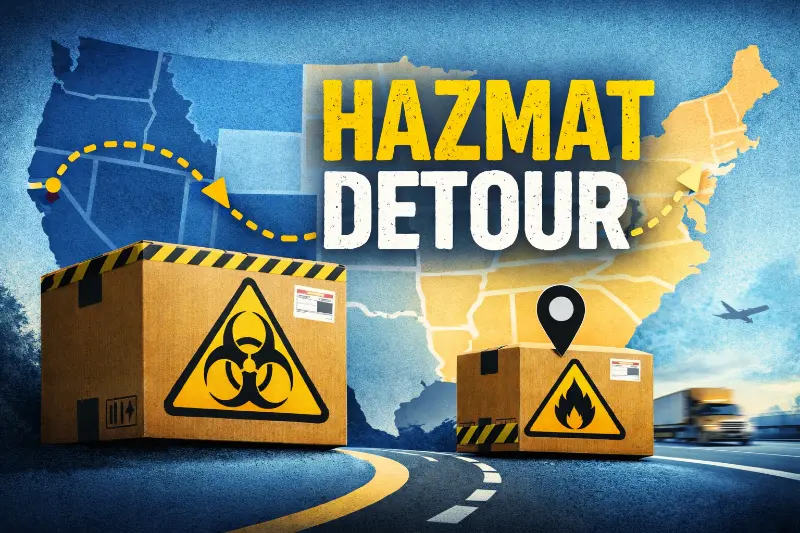
Some sellers believe Amazon only has one hazmat warehouse. That is not true, but the experience of shipping hazmat through FBA can make it feel that way.
If you have ever created a hazmat shipment and been forced to send it to a single facility across the country, you know the frustration. This often happens when products are classified as hazardous products and flagged for special handling. Instead of multiple inbound options, you get one destination. In some cases, the system shows no available fulfillment centers at all. For sellers trying to maintain steady inventory flow, that feels restrictive and confusing.
The real issue is not the number of warehouses. The real issue is how hazmat space is allocated inside them.
Understanding Dangerous Goods Hazmat
Selling on Amazon opens up opportunities, but it also comes with responsibilities—especially when it comes to hazardous materials. Dangerous goods hazmat refers to products that contain hazardous substances, which can pose health, safety, or environmental risks if not handled correctly. These include items like cleaning products, flammable liquids, battery powered devices, pressurized containers, and more.
To help sellers navigate these risks and recent regulatory changes that hold Amazon accountable for unsafe products, Amazon has established the FBA Dangerous Goods Program. This program is designed to ensure that all dangerous goods are handled, stored, and transported safely and in compliance with strict safety regulations. If you want to sell dangerous goods through FBA, you must provide accurate and complete information about your products, including a Safety Data Sheet (SDS) or, in some cases, exemption sheets. The safety data sheet SDS is a critical document that details the composition, hazards, and safe handling procedures for each product.
Proper documentation is not just a formality—it’s a requirement for participating in the dangerous goods program. Amazon uses this information to classify your products, determine the correct storage and transportation methods, and ensure compliance with all relevant regulations. Failing to provide a complete safety data sheet or exemption sheet can delay your hazmat review, prevent your products from being listed, or even result in removal from the FBA program.
By understanding what qualifies as dangerous goods and following the proper procedures for documentation and compliance, sellers can safely and successfully participate in the FBA dangerous goods program. This not only protects your business but also helps Amazon maintain the highest safety standards for customers, employees, and the environment.
What Sellers Are Actually Seeing
Many sellers report that FBA assigns only one hazmat destination at a time. In forum posts, you’ll find examples like, “Why is FBA making me send all my HAZMAT to Dupont WA,” even when the seller is located on the opposite coast.

Other sellers encounter a more severe message: “No fulfillment centers are currently available to receive dangerous goods.” That error effectively shuts down inbound shipments until capacity reopens.
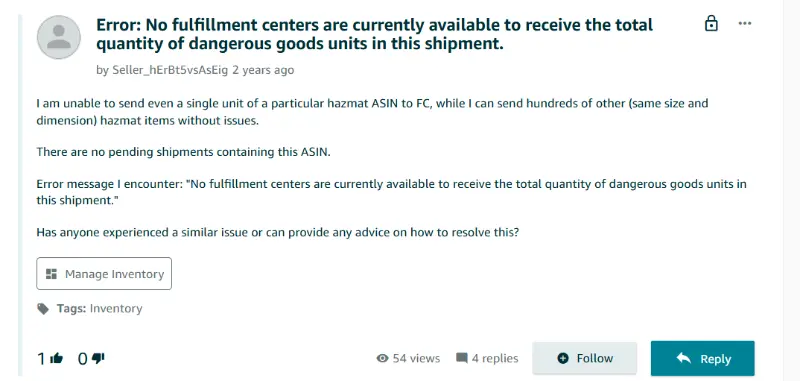
These experiences create the impression that hazmat fulfillment is centralized in one place. In reality, what sellers are running into is limited hazmat capacity, not a single warehouse. FBA inventory for hazardous products is managed across multiple FBA warehouses and FBA facilities, each with its own capacity constraints and specific requirements for storing dangerous goods.
How Hazardous Materials Space Actually Works Inside FBA
Hazmat inventory is typically stored inside regular Amazon fulfillment centers. To safely store hazardous materials, it is essential to follow proper hazmat packaging requirements that comply with regulations and prevent accidents.
Within those fulfillment centers, hazmat products are kept in segregated zones. Those zones are designed to meet safety, compliance, and insurance requirements, which means they cannot be expanded freely or mixed with standard inventory. Unlike standard fulfillment, hazmat storage is subject to strict limits on quantities and packaging to ensure safe handling and regulatory compliance.
A former Amazon operations employee familiar with fulfillment center design confirmed that hazmat is usually co-located with normal inventory, but the dedicated space is limited and tightly controlled. That space must comply with strict safety rules, and it represents a higher operational cost than standard shelving.
When space is limited and expensive, intake has to be managed carefully. Amazon cannot simply accept unlimited quantities of hazmat inventory without risking congestion or compliance issues. Limited quantities are enforced to ensure safe storage and handling within FBA facilities.
Why Hazmat Space Fills Up and Stays Full
Hazmat inventory often turns slower than standard goods. Hazmat items and other hazardous goods are subject to stricter storage and handling requirements, which can impact how quickly they are sold through the platform. Many dangerous goods categories have lower sales velocity or stricter storage requirements, which means units sit longer before selling.
Safety rules also reduce storage density. Products cannot always be stacked or positioned as tightly as non-hazmat inventory, and certain classes of goods must be separated.
Slower turnover means space does not free up quickly. When hazmat zones remain full for longer periods, Amazon must throttle new inbound shipments to avoid overfilling those areas.
That is when sellers start seeing limited destination options or temporary shutdown messages. The system is not broken. It is protecting constrained space, but it can still trigger shipping issues and carrier exceptions that sellers must resolve quickly. The consequence is not just inconvenience. It is reduced distribution flexibility.
The Real Limitation Is Distribution Flexibility
The biggest impact of limited hazmat space is reduced distribution flexibility. With standard inventory, Amazon can spread units across multiple regions to balance coverage.
With hazmat inventory, sellers may only be able to send units to the facility that currently has room. This directly affects how hazmat products are shipped, as inventory may only be shipped to specific fulfillment centers, which can limit nationwide coverage. That facility may be concentrated in one region of the country.
When inventory is concentrated geographically, nationwide coverage becomes harder to achieve cleanly. Replenishment planning becomes less predictable, and sellers lose some control over how inventory is positioned.
You are not placing inventory strategically. You are placing it wherever capacity allows.
Why It Feels Arbitrary
From a seller’s perspective, hazmat routing can feel random. Amazon does not provide visibility into hazmat capacity levels or allocation logic.
Capacity may fluctuate based on internal thresholds, safety reviews, or storage turnover. Because sellers cannot see those constraints, routing decisions appear inconsistent.
That lack of visibility is what fuels the rumor that there is only one hazmat warehouse. In reality, there may be multiple fulfillment centers with hazmat capability, but only a limited number of open slots at any given time.
What Hazmat Reveals About Control
Hazmat inventory exposes what happens when inventory placement is dictated by a single operator’s internal capacity constraints. When space tightens, flexibility narrows.
In FBA, sellers cannot activate alternative nodes, bring their own compliant warehouse online, or redirect routing strategy when hazmat zones fill up. They ship where space exists.
For most sellers, high-velocity products move through the system smoothly. But for regulated or slower-turning inventory, placement flexibility becomes strategic rather than automatic. The key issue is not central coordination. The key issue is whether sellers retain the ability to add nodes, diversify storage, or adjust routing when constraints appear.
Hazmat simply makes that distinction visible.
When inventory placement depends entirely on one operator’s internal capacity, flexibility becomes conditional rather than guaranteed, which is why some sellers explore Merchant Fulfilled Prime alternatives to FBA. For brands that carry regulated or slower-moving SKUs, adding additional fulfillment nodes alongside FBA can reduce exposure to single-network constraints.
FAQ
Does Amazon have only one hazmat warehouse?
No. Hazmat inventory is typically stored in segregated areas inside multiple fulfillment centers. However, available capacity may be limited at any given time, which can result in only one inbound destination appearing.
Why does FBA sometimes show only one hazmat destination?
When hazmat space is constrained, Amazon may direct inbound shipments to the facility with available capacity. Sellers do not choose from multiple options if only one location has open hazmat space.
What does “no fulfillment centers available” mean?
This message usually indicates that hazmat storage zones are temporarily full or restricted. Inbound shipments may resume once space becomes available.
Is it harder to achieve nationwide coverage with hazmat SKUs?
It can be. If hazmat inventory is concentrated in one region due to capacity limits, sellers may not achieve the same geographic distribution as standard inventory.
Written By:

Rinaldi Juwono
Rinaldi Juwono leads content and SEO strategy at Cahoot, crafting data-driven insights that help ecommerce brands navigate logistics challenges. He works closely with the product, sales, and operations teams to translate Cahoot’s innovations into actionable strategies merchants can use to grow smarter and leaner.

Turn Returns Into New Revenue
Related Articles

The Shipping Speed Paradox: Why DTC Brands Are Slowing Down
Everyone’s talking about faster delivery.

Why Cross-Border DTC Brands Are Moving Fulfillment Inside the US
Cross-border ecommerce fulfillment is the process of shipping ecommerce orders across national borders—often from warehouses outside the United States to U.

Shopify Estimated Delivery Date: A Complete Guide for Ecommerce Stores
A Shopify estimated delivery date is the specific arrival date or date range shown on a product page before purchase, so shoppers know when an order is expected to arrive.