
Ecommerce Fulfillment Is Becoming a Demand Accelerator in 2026

Last updated on January 28, 2026
In this article
 23 minutes
- Introduction to Ecommerce Fulfillment
- Ecommerce Fulfillment Models
- Delivery speed now directly determines customer satisfaction and whether customers buy
- Marketplace algorithms now treat fulfillment as a ranking signal
- Geographic inventory management and placement constrain or enable growth
- Stock-outs trigger algorithmic penalties that compound lost sales
- AI shopping agents evaluate fulfillment as primary selection criteria
- Speed and reliability standards have become non-negotiable table stakes
- Distributed fulfillment networks require sophisticated orchestration technology
- Ecommerce Fulfillment Provider Selection
- Outsourcing Fulfillment and Costs
- Operational consequences of fulfillment operations failures compound rapidly
- Frequently Asked Questions
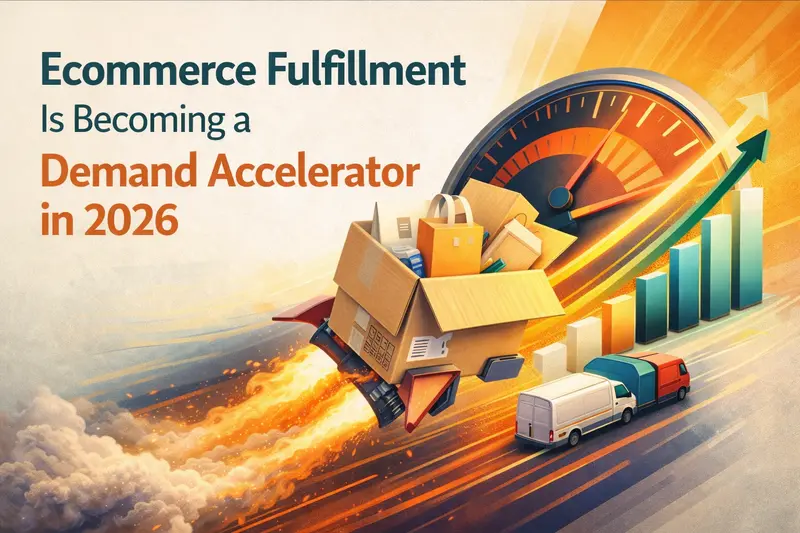
The era when fulfillment was merely an operational expense is over. In 2026, fulfillment performance directly shapes marketplace visibility, conversion rates, and customer lifetime value, functioning as either a demand accelerator or a demand suppressor. Data shows that 2-day or faster delivery options correlate with a 10.5% conversion rate uplift and an 8.9% increase in repeat purchases, while slow shipping causes 21-23% of all cart abandonments. With AI shopping agents now processing over 50 million shopping queries daily and evaluating delivery speed as a primary ranking criterion, fulfillment reliability has transformed from a back-office function into the decisive factor separating growing brands from those losing ground.
Ecommerce fulfillment refers to the entire supply chain process involved in delivering online orders to customers. Ecommerce fulfillment is the process of getting orders to customers who make purchases online.
This structural shift means ecommerce operators can no longer treat logistics as separate from demand generation. As Digital Commerce 360 declared in their 2026 trends analysis: “The battlefront has moved away from the front end and marketing promises to inventory and data flow. The trend shows it is less about getting customers but more about how you can fulfil the promises.” For mid-market to enterprise operators, understanding this evolution and acting on it has become essential for competitive survival.
Introduction to Ecommerce Fulfillment
Ecommerce fulfillment is the backbone of any successful online business, shaping both customer satisfaction and long-term loyalty. The ecommerce fulfillment process encompasses every step from receiving and storing inventory, to picking, packing, and shipping orders directly to customers’ doors. As online shopping continues to accelerate, the efficiency and reliability of your fulfillment process can make or break the customer experience.
A well-optimized ecommerce fulfillment process ensures that orders are shipped accurately and on time, directly impacting customer satisfaction and repeat business. Effective inventory management is essential, allowing businesses to maintain the right stock levels, avoid costly stockouts, and streamline the entire fulfillment process. Whether you’re managing fulfillment in-house or working with a fulfillment partner, choosing the right approach is critical for scaling your online business.
There are several ecommerce fulfillment models available, each with its own advantages and challenges. Understanding these models—and how they align with your business goals—will help you develop a fulfillment strategy that supports growth, controls costs, and consistently meets customer expectations. In this guide, we’ll explore the key models, the importance of inventory management, and how to select the right fulfillment partner to support your business as it evolves.
Ecommerce Fulfillment Models
Ecommerce brands have a range of fulfillment models to choose from, each designed to support different sales channels and business needs. The most common approaches include in-house fulfillment, outsourced fulfillment through third-party logistics (3PL) providers, hybrid models, and dropshipping.
In-house fulfillment gives brands direct control over the pick, pack, and ship process, making it easier to maintain quality and customize the customer experience. However, as order volumes grow or sales channels diversify, managing fulfillment internally can become complex and resource-intensive.
Outsourced fulfillment, often managed by specialized 3PLs, allows ecommerce brands to leverage external expertise and infrastructure. This model is especially effective for businesses selling across multiple sales channels, as fulfillment providers can efficiently pick, pack, and ship orders from strategically located warehouses.
Hybrid models combine elements of both in-house and outsourced fulfillment, enabling brands to retain control over certain products or regions while scaling with external partners elsewhere. Dropshipping, meanwhile, allows brands to sell products without holding inventory, with suppliers handling the shipping process directly to customers.
Choosing the right fulfillment model depends on your business size, product mix, and growth ambitions. The ability to efficiently pick, pack, and ship across all your sales channels is essential for delivering a seamless customer experience and supporting business expansion.
Slash Your Fulfillment Costs by Up to 30%
Cut shipping expenses by 30% and boost profit with Cahoot's AI-optimized fulfillment services and modern tech —no overheads and no humans required!
I'm Interested in Saving Time and MoneyDelivery speed now directly determines customer satisfaction and whether customers buy
The relationship between fulfillment performance and conversion has become mathematically predictable. Research from Jitsu and Coresight found that retailers offering 2-day or faster delivery see conversion rates climb 10.5% compared to standard shipping options. The impact compounds: companies implementing same-day delivery report 66% conversion rate improvements, a 77% increase in net-new sales, and 78% improvement in repeat purchases.
Amazon’s dominance illustrates this dynamic. The platform maintains conversion rates of 10-13%, roughly five times the global ecommerce average of 1.65-3%, with Prime members converting at even higher rates due to fast, reliable shipping and frictionless checkout. This performance gap creates pressure across the entire market: 63% of consumers now expect two-day delivery as standard, with 86% defining “fast delivery” as two days or less.
Cart abandonment data reveals the cost of falling short. Baymard Institute’s 2025 analysis of 50 studies found global cart abandonment averaging 70.22%, with 21% directly citing slow delivery and 39% abandoning over extra costs including shipping fees. Capital One Shopping research found that 43% of shoppers have abandoned a cart or retailer entirely due to slow shipping speeds, and 63% choose a different retailer for future purchases when shipping exceeds two days.
The customer lifetime value impact proves even more significant. Shoppers receiving their first order within two days demonstrate 40% higher CLV over 12 months, while Bain & Company research shows that a 5% increase in customer retention can boost profits by 25-95%. Fast and accurate fulfillment is crucial for customer satisfaction and encourages repeat purchases. Efficient, reliable fulfillment helps build customer trust and brand loyalty. Fast fulfillment doesn’t just close sales, it builds the foundation for repeat business by helping meet customer expectations and fostering customer loyalty.
Marketplace algorithms now treat fulfillment as a ranking signal
Fulfillment metrics have become core inputs to the algorithms determining product visibility on major marketplaces. On Amazon, where over 82% of sales flow through the Buy Box, delivery speed now “trumps fulfillment type” according to recent algorithm analysis, meaning even merchant-fulfilled sellers can win if regional delivery matches or exceeds FBA performance. Products with FBA enrollment rank 3-7 positions higher on average than equivalent merchant-fulfilled listings and convert 1.5-2x better. Fulfillment by Amazon FBA is an ecommerce fulfillment service that gives you access to Amazon’s vast logistics network. With FBA, products are sent directly to Amazon fulfillment centers, where Amazon handles storage, packing, shipping, and customer service, enabling fast Prime shipping and improved ranking potential.
Amazon’s performance thresholds enforce this reality with severe consequences. Sellers must maintain Order Defect Rates below 1%, Late Shipment Rates below 4%, Valid Tracking Rates above 95%, and On-Time Delivery Rates above 90% to avoid account suspension. Premium shipping eligibility requires even tighter tolerances: On-Time Delivery above 93.5%, Cancel Rate below 0.5%, and Valid Tracking at 99%.
Walmart’s marketplace has implemented similar structures, with sellers using Walmart Fulfillment Services seeing a 50% GMV lift on items tagged “Walmart Fulfilled” with “2-Day Shipping” badges. The platform now requires On-Time Delivery Rates above 90%, Valid Tracking Rates above 99%, and will introduce a 2% Negative Feedback Rate threshold in early 2026. Non-compliant sellers face listing suppression, suspension, or termination, with termination appeals explicitly not accepted.
The buy box calculation extends beyond speed to include pricing within 5% of the lowest offer, consistent inventory availability, geographic proximity to customers, and performance history. Sellers experiencing stockouts face immediate Buy Box loss, potential search result suppression, and for products with three or more stockouts in 90 days, extended ranking suppression that can take 3-4 weeks to recover.
Looking for a New 3PL? Start with this Free RFP Template
Cut weeks off your selection process. Avoid pitfalls. Get the only 3PL RFP checklist built for ecommerce brands, absolutely free.
Get My Free 3PL RFPGeographic inventory management and placement constrain or enable growth
Where inventory sits determines what delivery promises are possible, which directly impacts conversion and marketplace visibility. A fulfillment warehouse plays a crucial role in managing and storing inventory, ensuring efficient order processing and integration with ecommerce platforms. Maintaining well-organized store inventory and optimal inventory levels across multiple locations is essential for fast, reliable ecommerce fulfillment. An inventory management system helps track and manage inventory across fulfillment warehouses, providing real-time visibility and preventing stockouts or overstocking. The process of receiving inventory involves inspecting, counting, and logging products into a Warehouse Management System (WMS), which supports accurate inventory control and streamlined operations. Analysis from ShipBob shows that distributing inventory across multiple fulfillment centers reduces shipping times by 71%, while strategic placement enables 45% more in-region orders and average shipping cost savings of 6.25% per order.
The mathematics of shipping zones explain this relationship. A 5-pound FedEx Ground package costs $11.98 in Zone 2 but $18.42 in Zone 8, a 54% increase. Transit times range from 1-2 days for Zones 1-2 to 5-6+ days for Zones 7-8. For businesses shipping 1,000 packages monthly, the difference between serving customers in Zones 2-3 versus 7-8 can exceed $100,000 annually in additional shipping costs alone.
The conversion impact proves equally stark. Case studies document the consequences: Our Place reduced delivery times from 5-6 days to 2.5 days by expanding from two to four fulfillment centers, saving $1.5 million in freight costs while improving 98% of parcels to Zones 1-6. Aroma360 cut EU delivery from 25 days (shipping from Miami) to 3 days using UK-based fulfillment, an 88% reduction that transformed European market viability.
Network design research indicates that three strategically positioned warehouses can enable 98% of U.S. customers to receive 2-day ground shipping nationwide. Optimal locations include Ohio (central access, high-volume throughput), Texas/Atlanta (southern coverage reaching both coasts), California (West Coast and import operations), and Pennsylvania/New Jersey (Northeast density). For businesses with sufficient volume, zone skipping (consolidating shipments destined for the same region into truckloads that bypass multiple sorting facilities) delivers 30-50% shipping cost reductions on applicable routes.
Stock-outs trigger algorithmic penalties that compound lost sales
The immediate revenue loss from inventory unavailability represents only a fraction of the total cost. Marketplace algorithms actively penalize inconsistent availability, creating compounding effects that persist long after stock returns. To avoid these issues, it is essential to manage inventory effectively across all fulfillment centers, using technology and warehouse management systems to monitor and optimize stock levels.
On Amazon, a 7-day stockout reduces organic ranking by 30-50%, with recovery requiring 3-4 weeks of consistent inventory. Products experiencing three or more stockouts in 90 days face extended ranking suppression that demands higher CPC bids and promotional spending to regain visibility. Survey data from 240 sellers found that Amazon stockouts resulted in an average of $18,000 in lost revenue per incident, accounting for ranking drops, missed Buy Box time, and slow recovery.
Inventory management is critical to growing an ecommerce business and involves tracking and controlling stock levels to meet demand. The Inventory Performance Index (IPI) creates additional pressure. Amazon’s current minimum threshold of 400 (on a 0-1,000 scale) triggers immediate storage restrictions and capacity limits when breached. As of April 2025, long-term storage fees now apply at 271 days (reduced from 365), while holding 26+ weeks of inventory triggers Storage Utilization Surcharges of up to $10 per cubic foot on excess inventory.
Pattern’s “Ecommerce Equation” framework (Revenue = Traffic × Conversion × Price × Availability) captures this dynamic. As their analysis states: “You can fully optimize your traffic, conversion, and price, but without having product available to sell, you can’t grow revenue for your brand.” Availability isn’t merely a sub-component of conversion; it’s a standalone revenue lever that can zero out all other optimization efforts.
AI shopping agents evaluate fulfillment as primary selection criteria
The rise of AI-mediated commerce introduces a new set of buyers who evaluate fulfillment programmatically. ChatGPT now processes over 50 million shopping-related queries daily from 800+ million weekly users, with OpenAI’s November 2025 launch of Shopping Research and Instant Checkout enabling direct purchases within the interface. Perplexity’s Buy with Pro offers one-click checkout with memory-driven personalization. Google’s AI Mode in Search, powered by Gemini 2.5 and a Shopping Graph of 50+ billion product listings refreshed 2 billion times hourly, can complete purchases via agentic checkout with user confirmation.
These agents evaluate products differently than human browsers. BCG research confirms that AI agents “prioritize price, user ratings, delivery speed, and real-time inventory over brand familiarity or loyalty.” When two sellers offer similar products, the agent selects based on shipping speed, reviews, and availability, even if title, image, and structured data are otherwise identical. According to Mastercard’s analysis, agents “evaluate shipping times, return policies and other logistical details” as core selection criteria. AI agents also process online orders by analyzing fulfillment options and selecting the most efficient provider to ensure timely delivery.
An efficient supply chain is critical for meeting the criteria set by AI agents, as it impacts delivery speed, inventory accuracy, and overall customer satisfaction. Automation and multi-carrier software are essential for efficient ecommerce fulfillment, especially in meeting customer demands.
This shift reduces merchant control over the customer journey. Retailers face what BCG describes as “loss of direct traffic, reduced insight into customer behavior and weakened brand loyalty as agents compare products based on a narrow set of criteria.” AI agents may break up multi-item purchases across retailers to optimize price per item, making cross-selling and upselling significantly harder.
The technical requirements for AI visibility are becoming clear. OpenAI’s product feed specification requires merchants to provide shipping methods, costs, and estimated delivery times; seller identification and policy links; return windows; and aggregated review statistics. Machine-readable schema markup for shipping details, return policies, and real-time inventory status determines whether AI agents can even evaluate a listing. Products with missing GTINs or stale availability data may be skipped entirely.
McKinsey projects the U.S. B2C retail market could see up to $1 trillion in orchestrated revenue from agentic commerce by 2030, with global projections reaching $3-5 trillion. While current adoption remains modest (ChatGPT referrals accounted for just 0.82% of ecommerce sessions over Thanksgiving weekend), the trajectory is clear. Businesses with subscription models stand to benefit particularly, given agents’ ability to manage replenishable recurring purchases autonomously.
Scale Faster with the World’s First Peer-to-Peer Fulfillment Network
Tap into a nationwide network of high-performance partner warehouses — expand capacity, cut shipping costs, and reach customers 1–2 days faster.
Explore Fulfillment NetworkSpeed and reliability standards have become non-negotiable table stakes
Same-day delivery has crossed from competitive advantage to consumer expectation. The global same-day delivery market reached $14.7 billion in 2025, growing at 20.8% annually toward projected values of $66-83 billion by 2033. Consumer surveys show 80% now expect retailers to offer same-day options, 67% of U.S. consumers expect same-day delivery availability, and 28% have abandoned purchases specifically because they needed items sooner than the provided delivery estimate.
The operational requirements to meet these expectations are precise. Amazon requires On-Time Delivery Rates above 90% (increased from prior thresholds in September 2024), Valid Tracking Rates above 95%, and Order Defect Rates below 1%. Walmart demands On-Time Delivery above 90%, Valid Tracking above 99%, Cancellation Rates below 2%, and Refund Rates below 6%. Target Plus requires shipping within 24 hours of order placement with delivery within 5 days, and no dropshipping allowed. Shipping delays are a key challenge in ecommerce fulfillment, often caused by errors in order processing, picking, packing, and managing high order volumes, which can hinder delivery times and customer satisfaction.
Industry benchmarks for order accuracy set the bar even higher. Best-in-class operations target 99.5-99.9% accuracy rates, with the WERC benchmark median at 99.6%. Inventory accuracy standards similarly require 99.5%+ for reliable fulfillment, though average retail accuracy without RFID sits at just 65%. The gap between leaders and laggards creates real competitive separation.
Returns processing has emerged as an equally critical standard. Research shows 72% of online customers expect refund credits within 5 days, and 88% would limit or stop shopping with merchants that take longer. With 24.5% of online sales returned (versus 8.9% in physical stores) at a cost of approximately $100 per ecommerce order, returns processing speed directly impacts both customer retention and operational costs. Returns management is an integral part of the ecommerce fulfillment process, involving the handling of returned items and issuing refunds or exchanges.
Distributed fulfillment networks require sophisticated orchestration technology
Building a multi-node fulfillment network demands more than additional warehouse space. Effective distributed fulfillment requires Distributed Order Management (DOM) systems capable of intelligent routing based on customer proximity, real-time inventory availability across all nodes, shipping cost optimization, service level requirements, and carrier performance data.
The technology stack encompasses Order Management Systems (OMS) for central processing, Warehouse Management Systems (WMS) for per-node operations, Transportation Management Systems (TMS) for carrier selection and rate shopping, and the DOM layer for orchestration. A warehouse management system plays a critical role in managing inventory, streamlining warehouse operations, and improving scalability for businesses operating their own warehouses or using hybrid fulfillment models. Order processing is a key component of distributed fulfillment, involving the steps of receiving, reviewing, and preparing customer orders to ensure timely and accurate shipments. A fulfillment solution provides a comprehensive system for managing fulfillment activities such as inventory management, order processing, and shipping, and can integrate with various ecommerce platforms and channels to streamline operations and support growth. These systems collectively manage ecommerce fulfillment operations, which include receiving inventory, storing and packing products, shipping orders, and handling customer service and returns. Leading DOM vendors include Fluent Commerce, SAP Order Management, Manhattan Associates, and ecommerce-focused options like ShipBob and Extensiv. Integration requirements span ecommerce platforms (Shopify, BigCommerce, Magento), marketplaces (Amazon, Walmart, TikTok Shop), ERP systems (NetSuite, SAP), carrier APIs, and returns platforms.
The ROI from proper orchestration is substantial. Freedom Australia reduced order cancellation rates by 85% using DOM capabilities, increasing stock availability 10x for online business. Zone skipping implementations deliver 30-50% shipping cost reductions on applicable routes, with ShipBob documenting savings of $3,000 on 2,000-package shipments from Philadelphia to Minneapolis.
However, the complexity costs deserve honest assessment. Multi-warehouse operations increase total safety stock requirements, raise inbound freight costs to multiple locations, create duplicate storage and handling fees, and demand significant technology and integration investment. Analysis of mid-sized sellers (1,000 orders/month) found that using two warehouses saved only 10% on shipping but added approximately 25% more total cost, around $48,000 annually in overhead. The calculus only works at sufficient volume.
Ecommerce Fulfillment Provider Selection
Selecting the right fulfillment partner is a pivotal decision for any ecommerce business aiming to scale efficiently. The ideal fulfillment partner should align with your current needs and future growth plans, offering the flexibility and service levels required to support your evolving fulfillment strategy.
Key considerations include the size and complexity of your business, the range of fulfillment services offered, technology integration capabilities, and the provider’s geographic reach. A robust fulfillment partner should offer advanced inventory management systems, real-time order tracking, and seamless integration with your ecommerce platforms and sales channels.
When evaluating potential partners, ask targeted questions about their experience with similar businesses, their ability to handle seasonal spikes, and their approach to customer service and returns. Assess whether their fulfillment operations can scale with your business and if their technology stack supports your order management and reporting needs.
Timing is also crucial—many brands wait too long to outsource, resulting in operational bottlenecks and missed growth opportunities. By proactively seeking the right fulfillment partner, you can streamline your fulfillment process, reduce operational headaches, and focus on growing your online business.
Outsourcing Fulfillment and Costs
Outsourcing fulfillment operations to a third-party logistics provider (3PL) can be a strategic move for ecommerce brands looking to accelerate business growth and expand into new markets. A professional 3PL brings expertise, technology, and a network of fulfillment centers to efficiently manage the entire order fulfillment process, from inventory storage to shipping orders.
However, it’s essential to understand the full scope of ecommerce fulfillment costs before making the leap. Typical expenses include storage fees for inventory, pick and pack charges for each order, shipping costs based on destination and package size, and additional service fees for value-added services like branded packaging or returns management. Some providers may also charge setup or integration fees, so it’s important to review contracts carefully.
While outsourcing can reduce operational costs and free up resources for core business activities, brands should evaluate the total cost of fulfillment—including hidden fees and the impact on customer experience. The right fulfillment partner will offer transparent pricing, scalable solutions, and the operational excellence needed to support your business growth without sacrificing quality service or customer satisfaction.
Operational consequences of fulfillment operations failures compound rapidly
Poor fulfillment performance triggers cascading effects that extend far beyond immediate order problems. Failed deliveries cost an average of $17.78 per attempt and account for 8-20% of shipments depending on geography. Late delivery correlates with a 1.1% increase in returns for every day late. And 69% of consumers blame the brand, not the carrier, for poor delivery experiences.
Customer lifetime value takes direct hits. Research shows 58% of consumers will stop doing business after a bad service experience, 32% leave after a single negative interaction, and lost customers now cost an average of $29 each, up from $9 a decade ago. Repeat customers spend 67% more than first-time buyers and are 60% less likely to churn than dissatisfied customers. Every fulfillment failure potentially eliminates that future value.
The competitive context makes these failures particularly costly. Industry-wide average delivery time improved 27% year-over-year to 3.7 days in late 2024, meaning the threshold for acceptable performance keeps rising. Amazon has normalized 2-day shipping and now pushes same-day and 1-day as the new standard. Carriers implemented 5.9% rate increases in 2024 with additional surcharges for peak seasons, rural areas, and oversized packages. Operators falling behind face both margin pressure and market share erosion. Inefficiencies in fulfilling orders can drive up your fulfillment cost, directly impacting your bottom line through inefficient, day-to-day execution. Comparing fulfillment costs and optimizing the process of fulfilling orders is essential to remain competitive and profitable.
During peak season, these challenges intensify. Holiday 2024 saw on-time performance drop to approximately 84%, return rates surge from 17.6% to 20.4%, and up to 7% of packages reported damaged or lost. Brands utilizing two or more last-mile partners experienced 27% fewer delivery failures, suggesting that carrier diversification has become a necessary resilience strategy.
Frequently Asked Questions
How does delivery speed affect conversion rates?
Retailers offering 2-day or faster delivery see conversion rates increase by 10.5% compared to standard shipping. When a customer places an order, it initiates the ecommerce fulfillment process, which consists of several distinct steps: receiving, storing, picking, packing, shipping, and returns processing. Efficient management and quick processing of customer orders are crucial for meeting delivery speed expectations. Same-day delivery implementations report 66% conversion improvements, 77% increases in net-new sales, and 78% improvement in repeat purchases. Cart abandonment data shows 21% of abandoned carts cite slow delivery as the reason, while 43% of shoppers abandon retailers entirely due to slow shipping. The impact on customer lifetime value is equally significant, with customers receiving first orders within two days showing 40% higher CLV over 12 months.
What marketplace performance metrics determine seller visibility and Buy Box eligibility?
Amazon requires Order Defect Rates below 1%, Late Shipment Rates below 4%, Valid Tracking Rates above 95%, and On-Time Delivery Rates above 90% to avoid suspension. Premium shipping eligibility requires On-Time Delivery above 93.5%, Cancel Rate below 0.5%, and Valid Tracking at 99%. Walmart demands On-Time Delivery above 90%, Valid Tracking above 99%, Cancellation Rates below 2%, and Refund Rates below 6%.
Ecommerce logistics play a crucial role in meeting these strict marketplace performance metrics, as they ensure smooth order processing and timely delivery. Efficient logistics provide a significant competitive edge in ecommerce.
Products with FBA enrollment rank 3-7 positions higher and convert 1.5-2x better than merchant-fulfilled equivalents, though delivery speed now matters more than fulfillment type.
How do stockouts impact marketplace rankings and revenue?
A 7-day Amazon stockout reduces organic ranking by 30-50%, with recovery requiring 3-4 weeks of consistent inventory. Timely ship inventory processes are crucial to prevent stockouts and maintain sales momentum. Products with three or more stockouts in 90 days face extended ranking suppression requiring higher CPC bids to regain visibility. Survey data shows average revenue loss of $18,000 per stockout incident when accounting for ranking drops, missed Buy Box time, and slow recovery. Accurate fulfillment is associated with higher customer lifetime value and reduces costly returns. Sellers also risk falling below Amazon’s IPI threshold of 400, triggering storage restrictions and capacity limits.
What are the cost and conversion benefits of distributed fulfillment networks?
Distributing inventory across multiple fulfillment centers reduces shipping times by 71%, enables 45% more in-region orders, and saves an average of 6.25% per order on shipping costs. A 5-pound package costs $11.98 in Zone 2 versus $18.42 in Zone 8, meaning geographic placement can save businesses shipping 1,000 packages monthly over $100,000 annually. Case studies show Our Place saved $1.5 million in freight costs while improving 98% of parcels to Zones 1-6 by expanding from two to four fulfillment centers. However, ecommerce fulfillment cost in distributed networks depends on several factors, including order volume, product size, storage requirements, and value-added services. Smaller operations may find the overhead (25% higher total costs) outweighs the 10% shipping savings.
How do AI shopping agents evaluate fulfillment when making purchase decisions?
AI agents prioritize price, user ratings, delivery speed, and real-time inventory over brand familiarity or loyalty. When two sellers offer similar products, agents select based on shipping speed, reviews, and availability. In an ecommerce store, AI agents evaluate fulfillment options by analyzing available shipping methods, costs, and estimated delivery times to ensure a seamless order processing workflow. Customers increasingly expect same-day or next-day shipping as a baseline requirement. OpenAI’s product feed specification requires merchants to provide shipping methods, costs, estimated delivery times, return windows, and aggregated review statistics. Products with missing GTINs or stale availability data may be skipped entirely. Machine-readable schema markup for shipping details, return policies, and real-time inventory status determines whether AI agents can evaluate a listing.
What technology stack is required for an effective ecommerce fulfillment process in multi-warehouse fulfillment?
Effective distributed fulfillment requires Distributed Order Management (DOM) systems for intelligent routing, Order Management Systems (OMS) for central processing, Warehouse Management Systems (WMS) for per-node operations, and Transportation Management Systems (TMS) for carrier selection. Leading DOM vendors include Fluent Commerce, SAP Order Management, Manhattan Associates, ShipBob, and Extensiv. Integration requirements span ecommerce platforms (Shopify, BigCommerce, Magento), marketplaces (Amazon, Walmart, TikTok Shop), ERP systems (NetSuite, SAP), carrier APIs, and returns platforms. A good fulfillment partner can provide access to advanced technology and infrastructure that may be too costly for a business to develop in-house. With a dedicated account manager, businesses receive hands-on support in managing fulfillment technology, ensuring smooth integration and ongoing optimization. The technology investment becomes cost-effective only at sufficient order volumes.
Written By:

Rinaldi Juwono
Rinaldi Juwono leads content and SEO strategy at Cahoot, crafting data-driven insights that help ecommerce brands navigate logistics challenges. He works closely with the product, sales, and operations teams to translate Cahoot’s innovations into actionable strategies merchants can use to grow smarter and leaner.

Turn Returns Into New Revenue
Related Articles
Inventory Turnover Ratio: What It Is, How to Calculate It, and How Ecommerce Brands Improve It
Inventory turnover ratio (also called stock turnover) measures how many times a company sells and replaces its inventory during an accounting period.
FIFO Inventory Explained: What It Means for Ecommerce, Warehousing, and Profitability
FIFO (First In, First Out) is the dominant inventory method for ecommerce brands for good reason: it prevents obsolescence, aligns with international accounting standards, and deli...
HTS Code Explained: What It Is, Why It Matters, and How Ecommerce Brands Use It
Cost of Goods Sold (COGS) represents the direct costs attributable to producing the goods a company sells during an accounting period.