
Extended Producer Responsibility (EPR): How Peer-to-Peer Returns Solve for It

Last updated on August 20, 2026
In this article
 6 minutes
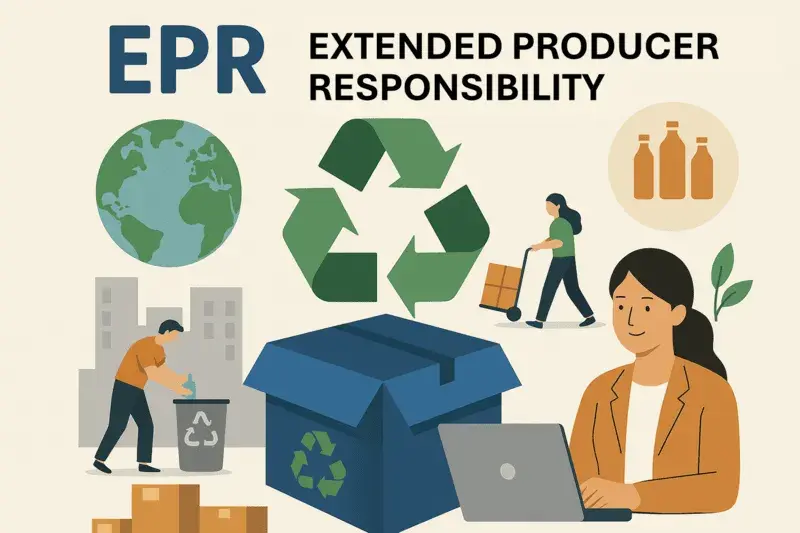
The way we deal with waste is changing fast. Governments around the world are done letting brands ship products with zero thought about what happens when they break, expire, or get returned. Enter Extended Producer Responsibility (EPR), a policy model that makes producers financially and operationally accountable for their products’ full life cycle, including after consumers are done with them.
And while most ecommerce operators are bracing for the added costs, smart brands are already asking a different question: What if we could turn EPR compliance into a competitive advantage?
Let’s dig into how EPR works, what’s shifting globally, and how Cahoot’s peer-to-peer returns program just might be the most elegant solution ecommerce sellers never saw coming.
What Is Extended Producer Responsibility?
Extended Producer Responsibility, or EPR, is a policy approach that shifts the financial responsibility and logistical burden for waste management away from governments and consumers and places it squarely on the shoulders of producers. That means brand owners, manufacturers, and importers must now manage the end-of-life of their products. Whether it’s packaging waste, electronics, beverage containers, or textiles, producers are expected to pay for or directly handle the collection, reuse, recycling, or disposal of their waste.
And it’s not optional anymore. EPR programs have already been implemented or introduced in many countries, from Canada to the EU to parts of the U.S. EPR has been widely adopted across the OECD and beyond, and the scope continues to grow. Even developing countries are starting to adopt similar policy approaches to address waste management, limited resources, and environmental impacts.
The idea is simple:
If you make it, you should figure out how to unmake it.
Why EPR Matters for Ecommerce (and Fast)
The EU’s Packaging and Packaging Waste Regulation (PPWR) generally began applying on August 12, 2026. But not every requirement started on that date. The regulation phases in major obligations through 2028 and 2030, so ecommerce brands need to distinguish what applies now from what they should prepare for next.
What Applies Now: PPWR Compliance and PFAS Restrictions
As of August 12, 2026, the PPWR applies across the EU. The most immediate product-level change is a restriction on per- and polyfluoroalkyl substances (PFAS) in food-contact packaging. Packaging placed on the EU market on or after that date cannot contain PFAS at or above the limits established by the regulation: 25 parts per billion for any individually measured PFAS, 250 parts per billion for the sum of measured PFAS, or 50 parts per million for total PFAS, including polymeric PFAS.
These restrictions can affect grease- or water-resistant packaging such as takeaway containers, fast-food wrappers, microwave popcorn bags, bakery paper, and pizza boxes. Brands, importers, and packaging suppliers should confirm material specifications and retain the technical documentation needed to demonstrate compliance. Food-contact packaging placed on the EU market before August 12, 2026 may remain on the market, but packaging manufactured earlier and first placed on the market after that date must comply. The full PFAS limits and documentation requirements are set out in Article 5 of the PPWR.
Other baseline PPWR duties also apply now. Packaging placed on the EU market must comply with the requirements currently applicable to its materials and intended use, including the regulation’s general recyclability and reusability rules. Manufacturers and importers must also meet the conformity-assessment, technical-documentation, declaration, and traceability duties that apply to their roles. That does not mean the detailed 2030 recyclability grades or the later recycled-content and waste-reduction targets have started early.
What Changes in 2028: Harmonized Packaging Labels
Beginning in 2028, packaging sold in the EU is scheduled to use a harmonized labelling system that identifies material composition and helps consumers sort packaging correctly. Corresponding labels will also appear on waste receptacles. Under the PPWR, the packaging requirement applies from August 12, 2028 or 24 months after the relevant implementing rules enter into force, whichever is later. Ecommerce brands should use the lead time to map packaging materials, collect supplier data, and prepare artwork and product-information systems for the new labels.
What Changes in 2030: Recyclability, Recycled Content, and Waste Reduction
From 2030, the PPWR begins applying several of its most consequential circular-packaging measures. Packaging will need to meet design-for-recycling criteria and qualify within the permitted recyclability grades. Minimum recycled-content requirements will begin for specified plastic packaging. The EU will also introduce limits on excessive empty space, restrictions on certain single-use plastic packaging formats, and reuse targets for selected packaging categories. Exact obligations and exemptions depend on the packaging type, business role, and secondary rules adopted by the European Commission.
Packaging Is Not the Only EPR Change
The EU’s revised Waste Framework Directive entered into force on October 16, 2025 and requires every Member State to establish an EPR scheme for textile and footwear products. Member States have 30 months from the directive’s entry into force to establish those schemes, so implementation will arrive through national laws rather than as one EU-wide obligation beginning on a single date.
Most ecommerce brands don’t manufacture the products they sell, but that doesn’t necessarily mean they’re off the hook. Depending on the law and sales model, the responsible “producer” may be the brand owner, manufacturer, importer, distributor, or a seller supplying customers across borders. If you sell to consumers in EU countries, existing national EPR schemes may already require registration, fees, and reporting even while later PPWR requirements are still being phased in.
A few examples:
- France requires REP producers to obtain a unique IDU and submit annual declarations; Germany requires registration with the LUCID Packaging Register, system participation for packaging subject to system participation, and regular volume reporting; Austria has packaging EPR schemes managed through collection and recovery systems.
- As of July 1, 2025, covered producers in Oregon must register with an approved Producer Responsibility Organization, report data to the PRO, and pay membership fees under the Recycling Modernization Act.
Bottom line: the legislation is no longer just about compliance; it’s reshaping how brands think about production, materials, costs, and returns.
The Challenge: EPR Compliance Is Complex, Costly, and Ongoing
Here’s the hard truth: complying with EPR is expensive. Brands must:
- Register in each country or state
- Report SKU-level data on materials used
- Pay eco-modulation fees based on how sustainable the product or packaging is
- Handle logistics for collection, reuse, or recycling
- Prove proper disposal through auditable documentation
- Comply with applicable marketplace EPR rules to avoid suspension or deactivation of non-compliant listings on Amazon Germany.
This is a ton of work. And worse, it’s ongoing; producers must continually track and report quantities sold, what was returned, how it was processed, and where the materials went. For ecommerce operators already dealing with slim margins and tight cash flow, EPR can feel like an existential threat.
So what’s a brand to do?
Enter Cahoot: Turning Returns into an EPR Compliance Asset
Here’s where Cahoot’s peer-to-peer ecommerce returns solution changes the game.
Returns are one of the biggest blind spots in EPR. Returned goods often fall through the cracks of reuse and recycling programs, creating waste and compliance headaches. Traditionally, a returned item is shipped back to a warehouse, inspected, and often discarded or sent to liquidation, especially in fast fashion or electronics. That’s a wasted product, wasted materials, and additional shipping, all of which hurt your EPR score.
But what if that returned product could skip the warehouse altogether and get shipped directly to the next buyer?
That’s exactly what Cahoot’s peer-to-peer returns model does.
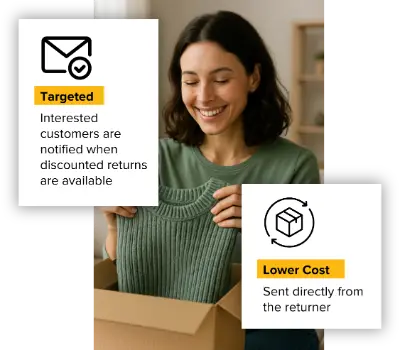
Instead of bringing a return back into centralized inventory, Cahoot reassigns it in real-time to the next customer who wants it. The return is rerouted, minimizing extra handling, materials, and emissions. And yes, it’s fully traceable for EPR reporting.
Here’s How Cahoot Solves for EPR:
1. Reduces Waste and Increases Reuse
Returned products are resold, not discarded. That extends product life, lowers end-of-life management costs, and keeps items out of landfills, key outcomes for EPR compliance.
2. Cuts Down on Packaging Waste
Because the return never goes back to the original warehouse, the need for repackaging is eliminated. That’s less packaging waste and fewer new materials in circulation.
3. Minimizes Reverse Logistics Emissions
No second trip across the country. No return to origin. Just direct-to-new-customer fulfillment. This slashes the carbon footprint of the return journey and helps brands meet sustainability targets.
4. Enhances Product Stewardship Reporting
With Cahoot, returns are tracked from the original buyer to the next. That data visibility gives brands a documented chain of custody they can use for EPR program reporting.
5. Avoids Fees and Penalties
Many EPR shifts include eco-modulated fees, meaning the greener your product’s life cycle, the less you pay. Cahoot helps brands reduce costs by showing responsible, circular product management.
EPR and Returns: A Match Made for Reinvention
Let’s be honest, most brands aren’t thinking about returns when they think about EPR legislation. But they should be. A returned product that gets trashed is the ultimate EPR failure. One that gets rerouted and reused? That’s a policy win, an environmental win, and a cost-saving win.
What’s more, Cahoot gives ecommerce operators a rare opportunity: To not just comply with EPR, but to lead.
Final Thoughts: Don’t Just Comply, Differentiate
EPR isn’t going away. In fact, it’s spreading fast, and consumers are paying attention. Brands that embrace reuse, reduction, and responsibility will earn trust. Those who treat returns like an afterthought may face penalties, bad PR, or worse, delisting from key markets.
The good news? Cahoot’s peer-to-peer returns solution is already helping brands across categories, from apparel to electronics, cut costs, reduce environmental impacts, and prove EPR compliance in a way that scales with growth.
That’s not just smart compliance, that’s smart business.
Written By:

Manish Chowdhary
Manish Chowdhary is the founder and CEO of Cahoot, the most comprehensive post-purchase suite for ecommerce brands. A serial entrepreneur and industry thought leader, Manish has decades of experience building technologies that simplify ecommerce logistics—from order fulfillment to returns. His insights help brands stay ahead of market shifts and operational challenges.

Turn Returns Into New Revenue
Related Articles
Save Money With Ecommerce Shipping Software: Next-Gen Solutions
Shipping costs are one of the biggest challenges for ecommerce businesses today, and understanding them is essential to reducing expenses and increasing profit margins.
10 Best European 3PLs for Ecommerce Sellers in 2026
Bigblue is the best overall choice among the best European 3PLs in this comparison: one provider with 11 fulfilment centres across France, Spain, Italy, the UK, and Germany, its ow...
Why Returns Are Becoming a Board-Level Topic
Returns have quietly become one of the most consequential financial problems in ecommerce, and boards are finally being forced to confront what operators have known for years: retu...