
What Is Kitting? How It Improves Fulfillment Efficiency

Last updated on June 04, 2026
In this article
 18 minutes
- Kitting vs Bundling: Why the Difference Matters Operationally
- How the Kitting Process Works in a Warehouse
- Kitting Services: In-House vs Outsourced Solutions
- Pick and Pack Efficiency Gains
- Inventory Management Implications
- Labor Costs and Workforce Optimization in Kitting
- Types of Kitting Applications
- Managing Excess Inventory Through Kitting
- When Kitting Makes Sense and When It Does Not
- Frequently Asked Questions
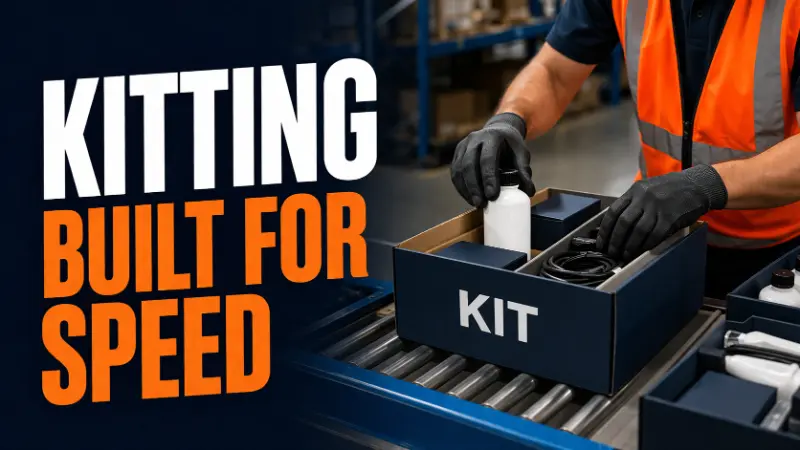
Kitting is a fulfillment process in which individual items or components are pre-assembled into a single packaged unit containing all the components needed for the product or offer before an order is placed. The resulting kit is stored, picked, and shipped as one SKU rather than as multiple separate items. The work of combining those components happens upstream of the order, during a dedicated assembly step, so that when a customer order arrives, the pick-and-pack workflow treats the kit as a single unit. Kitting specifically defines a set of complementary items that can be sold as a new product, while bundling is a broader term applied to any grouping of items.
That distinction, doing the assembly work in advance rather than at the point of pick, is what separates kitting from simple product bundling as a concept. Kitting can enhance the customer experience by providing a complete kit that is ready to ship, while bundling typically requires assembling items after an order is placed. Pre-assembling items that are frequently bought together allows for quicker order fulfillment and improved customer satisfaction. The operational impact on fulfillment speed, error rates, and labor costs depends on whether that upstream assembly step is actually built into the warehouse workflow or whether the bundling is left to be handled per order at the packing station.
Kitting vs Bundling: Why the Difference Matters Operationally
The terms kitting and bundling are used interchangeably in many ecommerce and marketing contexts, but operationally they describe two different approaches.
Bundling refers to a commercial decision to sell multiple products together as a group, often at a combined or discounted price. A bundle can be created at the point of sale as a virtual grouping, where the individual component SKUs are picked separately and assembled during packing, or it can be pre-assembled as a kit. The bundle is the offer. Kitting is the physical process of creating that bundled unit ahead of time.
Kitting refers specifically to the physical assembly of individual components into a single packaged unit before the order is fulfilled. A kit has its own SKU. It is received, stored, and counted in the inventory system as a single unit, distinct from its components. When a customer orders a kit, the warehouse picks one unit rather than three or four individual items. Kitting can help increase average order value by combining popular items with less-trendy products, encouraging customers to purchase more items at once.
The operational consequence of this difference is significant. Consider subscription boxes containing five items. Subscription boxes are a practical application of kitting, where curated products are assembled into a single package for recurring delivery. If the subscription box is sold as a virtual bundle, each order triggers five separate picks across five different warehouse locations, followed by assembly at the packing station. If the subscription box is kitted in advance, each order triggers one pick of a pre-assembled unit. The second approach is faster, generates fewer errors, and scales more cleanly as order volume grows. Kitting is commonly used for curated subscription boxes, promotional offers, or gift sets.
For operations leaders, the question is not whether to call a multi-product offer a kit or a bundle. It is whether the assembly work happens before or during order fulfillment, and which approach produces better outcomes given the order volume, product mix, and warehouse configuration. When customers receive a pre-assembled kit, kitting can create a delightful unboxing experience, as they receive a well-packaged kit that includes all necessary items, enhancing their overall satisfaction with the purchase.
How the Kitting Process Works in a Warehouse
A product kitting workflow involves a distinct set of steps that sit between inbound receiving and the standard pick-and-pack process. Understanding the flow helps operations teams evaluate whether product kitting is structured correctly in their facilities. Establishing a workflow for kitting is essential, as it helps to scale kit assembly and ensures that the process is clear and efficient.
Component procurement and receiving. The individual items that will make up the kit are received into the warehouse system as their own inventory. Each component has a location, a count, and a record in the WMS. At this stage, the components are still managed individually.
Kit assembly scheduling. Based on anticipated order volume, historical sales data, or a forecast tied to a promotional calendar, the warehouse plans a kitting run. This involves determining what the kit will comprise, how many kits to assemble, pulling the required quantities of each component from storage, and staging them at a dedicated kitting or assembly area. Key steps in the kitting process include determining the contents of the kit, deciding who will assemble the kit, assigning a new SKU, organizing the items, and preparing for assembly.
Physical assembly. A kitting team or assembly line works to create kits by combining all required items according to a defined process, which may include inserting items into a specific box configuration, adding insert cards or promotional materials, applying kit-specific labels, and sealing the finished unit. Quality control steps verify that each kit contains the correct components before it is placed into finished kit storage. The kitting process acts as an additional quality check, identifying defective or mismatched parts early. Kitting improves accuracy by reducing errors during assembly or fulfillment and can cut assembly errors by 30–50% by ensuring the correct components are verified before reaching the production line. Kitting also reduces assembly time by up to 30%, leading to higher throughput and shorter work cycles.
Kit storage and inventory management. Completed kitted items and kitted products are assigned their own SKU, counted into the WMS, and stored in a designated location. From this point forward, the kit is managed as a single inventory unit. The WMS also typically tracks a bill of materials relationship between the kit SKU and its component SKUs, allowing the system to understand the inventory implications of assembling or disassembling kits. Kitting increases efficiency by streamlining packing processes and reduces picking and packing time significantly by minimizing travel distance and manual handling.
Order fulfillment. When a customer order arrives for the kit SKU, the streamlined order fulfillment process allows the pick to be a single unit from the kit storage location. The packing step is minimal because the kit is already assembled. The label is applied and the shipment is released. The shipping process is accelerated due to pre-assembled kits, and total touch time per order is dramatically reduced compared to picking and assembling the same components individually.
Kitting Services: In-House vs Outsourced Solutions
When it comes to managing the kitting process, businesses have two primary options: handling kitting services in-house or outsourcing to a third-party logistics (3PL) provider. In-house kitting gives companies direct control over every aspect of the process, from sourcing components to assembling kits within their own warehouse or manufacturing facility. This approach can be ideal for businesses with unique assembly requirements or those needing tight oversight, but it often requires significant investment in specialized equipment, dedicated labor, and ongoing training. Additionally, in-house kitting can put pressure on warehouse space, especially as order volumes grow or product lines expand.
On the other hand, outsourcing kitting services to a 3PL can deliver substantial cost savings and operational efficiencies. 3PL providers typically have access to advanced technology, specialized equipment, and experienced teams that can streamline the kitting process. By leveraging a 3PL’s expertise, companies can reduce labor costs, free up valuable warehouse space, and scale their kitting operations quickly to meet changing demand. Outsourcing also allows businesses to focus on core activities while benefiting from the flexibility and efficiency of a partner dedicated to fulfillment operations. When deciding between in-house and outsourced kitting, companies should carefully weigh factors such as labor costs, available warehouse space, the complexity of their kitting process, and the need for specialized equipment.
Pick and Pack Efficiency Gains
The efficiency benefit of kitting operates through two mechanisms: reduced pick complexity per order and reduced assembly time at the packing station.
In a warehouse where kitting has not been implemented, a five-item bundle requires five discrete picks. The picker navigates to five separate locations in the warehouse, retrieving one unit at each stop. If those five items are stored in different zones or aisles, the travel time between picks accumulates across every order. At 100 orders per day, the inefficiency is manageable. At 1,000 orders per day, the cumulative travel time represents a material labor cost.
When those five items have been pre-assembled into a kit with its own storage location, each order requires a single pick. The picker retrieves one unit from one location. The packing station does not need to assemble anything. Labor per order drops substantially, and throughput capacity increases with the same headcount. Kitting leads to lower labor costs by requiring fewer picking steps per order and standardizing assembly processes, which increases productivity and efficiency.
Kitting also helps businesses save time and money by allowing them to pre-assemble items into bundles that can be shipped together, rather than picking and packing items individually. This optimization not only streamlines order fulfillment but also reduces the need for additional storage, contributing to overall saving money on warehousing costs.
Error rates also decline. Every additional pick step is an opportunity for a picker to select the wrong item, pick the wrong quantity, or skip an item entirely. A five-item bundle assembled per order has five opportunities for pick error before the box is sealed. A kit assembled upstream has those same error opportunities concentrated in the kitting run, where quality control is applied before the unit enters finished goods storage. Post-assembly QC on kits is more systematic and more effective than attempting to verify a multi-item pack at the packing station during high-volume fulfillment.
For operations teams tracking error rates per order, kitting typically produces a measurable reduction in packing errors because the verification step is decoupled from the time pressure of order fulfillment. In summary, kitting contributes to saving money through reduced labor, improved workflow, and more efficient use of warehouse space.
Inventory Management Implications
Kitting introduces a layer of inventory management complexity that requires businesses to manage kitting carefully to maintain accurate inventory records and deliberate configuration in the WMS to handle correctly.
The primary challenge is maintaining accurate visibility into both component inventory and kit inventory simultaneously. When a kitting run converts 500 units each of five components into 500 assembled kits, the component inventory must decrease by 500 units each and the kit inventory must increase by 500 units. If the WMS does not handle this transaction correctly, either through a proper bill of materials relationship or through manual adjustment, the component counts become inaccurate, which creates planning problems for replenishment. To ensure efficiency and accuracy, companies need to implement kitting processes within their inventory management systems or ecommerce fulfillment workflows.
Over-kitting is a specific risk. If a warehouse assembles 1,000 kits based on an optimistic demand forecast and actual orders are 400, 600 kits are sitting in finished kit storage. Those kits tie up the component inventory they contain, which means the components cannot be used for other purposes or sold individually without first disassembling the kits. Disassembly is a labor cost that was not in the original plan.
Under-kitting creates fulfillment gaps. If kit demand exceeds the assembled quantity and the warehouse does not have the time or labor to run an emergency kitting session, orders for the kit SKU cannot ship. The kit will show as out of stock in the inventory system even though all the component parts may be physically present in the warehouse.
Tracking one kit SKU instead of thousands of individual parts simplifies inventory audits and provides better visibility into actual usage.
Managing this balance requires connecting kitting schedules to demand planning. The quantity of kits assembled in any given run should be grounded in a realistic forecast of how many orders will arrive in the period until the next kitting run can be completed.
Efficient kitting strategies have been reported to lead to a 20% reduction in overall inventory costs.
Labor Costs and Workforce Optimization in Kitting
Labor costs are a major factor in the overall efficiency and profitability of the kitting process. By implementing a well-designed kitting process, companies can significantly reduce the time and labor required to fulfill orders, as assembling kits in advance streamlines the fulfillment process and minimizes repetitive picking and packing tasks. This not only lowers labor costs but also allows the kitting team to focus on value-added tasks and manage higher order volumes without increasing headcount.
Optimizing workforce efficiency in kitting involves more than just assembling products—it requires thoughtful planning, effective training, and the use of technology to automate repetitive steps and reduce human error. For example, clear assembly instructions, standardized workflows, and barcode scanning can help the kitting team work faster and with fewer mistakes. Companies that outsource kitting services to a 3PL can also benefit from their expertise in workforce management, as 3PLs are skilled at adjusting labor resources to match demand and leveraging automation to further reduce labor costs. Ultimately, effective labor management in kitting leads to a more agile fulfillment process, lower costs, and higher customer satisfaction.
Types of Kitting Applications
Kitting is applied across several distinct ecommerce and manufacturing contexts, each with its own workflow characteristics.
Subscription box kitting is among the most operationally intensive applications because the kit changes each cycle, requires sourcing a new set of components per period, and must be assembled in volume before the subscription shipment date. Subscription kitting runs are large batch events where the assembly workflow must scale to produce thousands of units within a short window.
Gift set kitting supports seasonal or promotional offerings where multiple complementary products are packaged together for purchase as a set. Gift sets assembled in advance of peak season allow the warehouse to process orders during high-volume periods without the packing station bottleneck of assembling individual gift sets per order.
Promotional or limited-edition kitting bundles a hero product with accessory or companion items to increase average order value. The kit is created for the duration of the promotion and disassembled or revised when the promotion ends.
Manufacturing kitting—also known as material kitting—plays a crucial role in the manufacturing process and production process by supplying production lines with pre-staged sets of raw materials and components required to make specific products. In manufacturing, kitting involves compiling all the raw materials and components needed for a particular assembly job into a single kit, ensuring the production team has everything necessary for efficient workflow. This approach eliminates the need for workers to search for individual components, saving time and reducing errors in picking and assembly. Material kitting helps reduce order picking time, improve inventory organization, and increase the efficiency of the assembly process by grouping individual components required for specific manufacturing tasks into pre-packaged kits.
Warehouse kitting refers to assembling these kits within the warehouse environment, which helps manufacturers simplify and accelerate product assembly while using warehouse space more efficiently. By grouping necessary components together, warehouse kitting streamlines inventory management and facilitates faster order fulfillment. Kitting is commonly used for complex assemblies in industries such as electronics and automotive, where organized packages are needed for just-in-time production.
Kitting is also widely used in various industries, including e-commerce, manufacturing, and retail, to streamline operations and improve customer satisfaction by providing ready-to-ship kits. Integrating kitting into the broader supply chain—whether during manufacturing, warehousing, or fulfillment—optimizes costs and efficiency throughout the entire production and distribution workflow.
Managing Excess Inventory Through Kitting
Kitting is a powerful inventory management technique for ecommerce businesses and online stores looking to address excess inventory and boost sales. By using inventory kitting to bundle slow-moving products with popular or complementary items, companies can create attractive pre-assembled kits that appeal to customers and help clear out excess stock. This approach not only generates revenue from products that might otherwise become dead stock but also increases sales volume by offering unique product combinations.
Pre-assembled kits require less storage space than storing individual components separately, allowing businesses to optimize warehouse space and reduce storage costs. Kitting also helps maintain healthy inventory levels by turning excess inventory into new sales opportunities, improving inventory turnover, and reducing the risk of obsolete stock. For online stores, this strategy can lead to higher customer satisfaction, as customers receive greater value and variety in a single package. By implementing a kitting process focused on managing excess inventory, companies can increase sales, generate revenue from underperforming products, and make better use of their available storage space.
When Kitting Makes Sense and When It Does Not
Kitting enables many benefits for businesses, including increased efficiency and customer satisfaction. Kitting improves efficiency when order volume for the bundled product is high enough that the assembly labor investment is recovered in pick time savings, when the component mix is stable enough that the assembly process does not change frequently, and when the kit has a predictable demand pattern that allows kitting runs to be planned in advance. Kitting can increase average order value by combining multiple items into a single purchase, which customers may perceive as a better deal. Additionally, kitting reduces inventory clutter and improves space utilization by combining items into single kits. Kitting can also decrease the likelihood of errors in order fulfillment, as pre-assembled kits reduce the complexity of picking and packing individual items.
Kitting creates overhead when order volume for a given kit is too low to justify a dedicated assembly run, when the product mix changes frequently and assembled kits must be disassembled before the next configuration is assembled, or when component lead times are inconsistent and kitting runs cannot be planned reliably.
For operations leaders evaluating whether to kit a specific product, the calculation is straightforward: compare the labor cost of pre-assembling a batch of kits against the labor savings from reduced per-order pick and pack time over the anticipated selling period. When the savings exceed the assembly cost, kitting is the right approach. When they do not, per-order assembly is more efficient.
Frequently Asked Questions
What is kitting in fulfillment?
Kitting is the process of pre-assembling multiple individual items or components into a single packaged unit before customer orders arrive. The resulting kit contains all the components needed for the product or offer, ensuring completeness and convenience. It is assigned its own SKU and managed as a single inventory unit, allowing it to be picked and shipped as one item rather than as multiple separate picks.
How is kitting different from bundling?
Bundling is a commercial decision to sell multiple products together. Kitting is the physical process of assembling those products into a pre-packaged unit in advance. A bundle can be assembled per order at the packing station or pre-assembled as a kit. Kitting specifically refers to the pre-assembly approach, which is more efficient at scale.
What are the main benefits of kitting?
There are many benefits to kitting, including cost savings, improved efficiency, and higher customer satisfaction. The primary benefits are reduced pick time per order, lower packing station labor, fewer fulfillment errors, and faster order processing. By converting multiple picks into a single pick, kitting increases throughput without adding headcount. It also concentrates quality control at the assembly stage rather than the packing stage.
What are the risks of kitting?
The main risks are over-kitting, where too many kits are assembled relative to demand and component inventory is tied up in unsold kits, and under-kitting, where assembled kit quantities are exhausted before the next kitting run is complete. Both require accurate demand forecasting and a WMS configured to track the relationship between kit and component inventory correctly.
How does a WMS support kitting?
A warehouse management system supports kitting by helping businesses manage kitting and implement kitting processes efficiently. It maintains a bill of materials relationship between the kit SKU and its component SKUs, automatically adjusts component inventory when kits are assembled or disassembled, tracks finished kit inventory separately from component inventory, and provides visibility into kit demand relative to available kit and component stock.
When should a business use kitting?
Kitting makes operational sense when order volume for a bundled product is high enough that the upfront assembly labor is recovered in per-order pick time savings, when the kit configuration is stable across a selling period, and when demand is predictable enough to plan kitting runs in advance. Kitting enables ecommerce businesses to streamline order fulfillment and improve efficiency by pre-assembling product kits, which results in faster processing, improved customer experience, and more efficient warehouse operations. Low-volume or frequently changing kit configurations are often better handled with per-order assembly at the packing station.
Written By:

Indy Pereira
Indy Pereira helps ecommerce brands optimize their shipping and fulfillment with Cahoot’s technology. With a background in both sales and people operations, she bridges customer needs with strategic solutions that drive growth. Indy works closely with merchants every day and brings real-world insight into what makes logistics efficient and scalable.

Turn Returns Into New Revenue

Related Articles

Why Cross-Border DTC Brands Are Moving Fulfillment Inside the US
Cross-border ecommerce fulfillment is the process of shipping ecommerce orders across national borders—often from warehouses outside the United States to U.

Shopify Estimated Delivery Date: A Complete Guide for Ecommerce Stores
A Shopify estimated delivery date is the specific arrival date or date range shown on a product page before purchase, so shoppers know when an order is expected to arrive.
Next-Gen Warehouse Automation Software for Ecommerce: Fulfillment Efficiency
Ecommerce order fulfillment is more than just packing and shipping — it’s about precision, speed, and cost efficiency.