
Why Reverse Logistics Innovation Plateaued

Last updated on June 03, 2026
In this article
 14 minutes
- Introduction
- The Returns Industry Really Did Innovate the Reverse Logistics Process
- But the Warehouse Stayed the Default Endpoint
- Most Innovation in Returns Management Improved Symptoms, Not Structure
- The Industry's Favorite Alternatives in the Reverse Supply Chain Still Clustered in the Bottom Half
- UPS + Happy Returns and FedEx Easy Returns Prove the Pattern
- These Tools Bought Time, But They Didn't Rewrite the System or Address Environmental Impact
- Conclusion
- Frequently Asked Questions
Introduction
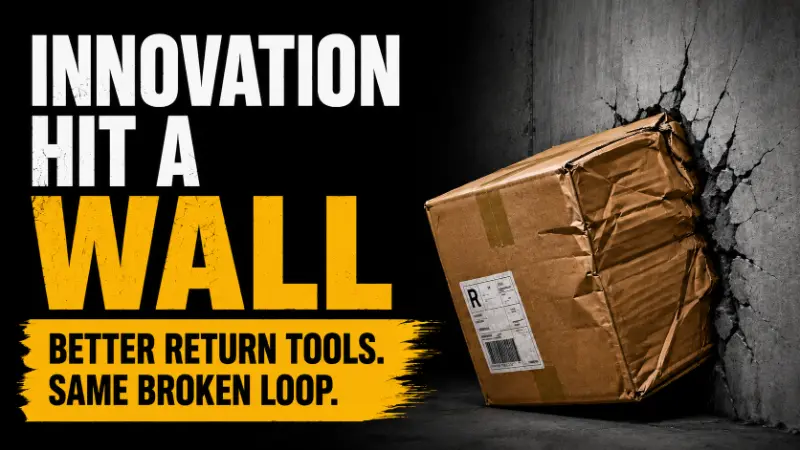
Reverse logistics innovation did not stall because the industry stopped trying. It stalled because nearly every improvement happened inside the same warehouse-first box, which meant the tools got better while the economics did not. Software matured, drop-off got easier, fraud modules multiplied, and carrier networks expanded. None of it changed the one thing that drives the cost of a return: the assumption that the item must travel backward to a central node before it can move forward again.
That distinction matters operationally because it explains why a decade of investment left cost per return roughly where it started. If you run ecommerce ops, finance, or supply chain, you have probably bought several of these improvements and watched your returns line item keep climbing anyway. This article explains why. The short version is that the industry mostly treated symptoms instead of structure, and symptom relief, however polished, is transitional rather than transformational.
The Returns Industry Really Did Innovate the Reverse Logistics Process
It would be dishonest to claim the returns industry sat still. Reverse logistics refers to managing goods as they move back from the end consumer through the reverse supply chain after purchase. It has been busy, and a lot of the work was genuinely good.
Returns Management Systems matured into a crowded, capable market. Modern platforms deliver branded return portals, policy automation, exchange flows, return-reason analytics, label generation, and customer communications. These are real improvements to customer experience and process visibility. Shoppers get self-serve flows and faster approvals; ops teams get RMAs, disposition codes, and basic analytics they never had before. This software layer also supports reverse logistics management within broader supply chain management and inventory management workflows, illustrating many of the top benefits of using returns management software.
The convenience layer expanded too. Box-free, label-free drop-off networks made the first mile dramatically easier for customers. Carriers integrated returns into their footprints. Fraud modules appeared across the major platforms, adding risk scoring, serial binding, and refund gating. Recommerce partnerships gave brands a way to resell returned goods and tell a circular-economy story. Larger players consolidated reverse logistics to coordinate more of the journey under one roof. The global market for reverse logistics operations was valued at $768.59 billion in 2023 and is projected to reach $1.17 trillion by 2032.
So this is not a story about stasis. The point is not that nothing happened. For e commerce businesses, that investment makes sense: worldwide returns reached $1.8 trillion in 2022, more than double the level of less than a decade earlier. The point is what kind of thing happened, and where it stopped.
But the Warehouse Stayed the Default Endpoint
Here is the center of the problem. Almost every one of those improvements was built to sit on top of warehouse-centric logistics, not to challenge it. In nearly every case, the returned item still routes back to a brand-owned warehouse, a 3PL, a centralized inspection facility, or a carrier-managed reverse logistics hub—the default endpoint in the reverse logistics process, unlike forward logistics in traditional logistics where goods move out toward the customer.
When the endpoint stays the same, the cost logic stays the same. The Returns Bible research states it plainly: warehouses remain the default endpoint, labor and time remain unavoidable, fraud detection remains delayed, and sustainability costs remain externalized. The tools get better. The economics do not. Effective reverse distribution depends on streamlined handling that recovers value quickly from returned, damaged, or end of life products.
This is why better visibility never translated into better margins. Knowing why an item was returned does not eliminate inbound freight, remove inspection labor, prevent markdown decay, reduce waste, or stop fraud. Rapid disposition matters because the less time items spend in limbo, the more asset recovery improves when they are routed immediately to the right destination. The reverse logistics process also often spans inspection, testing, repackaging, repair, and resale channels, which adds coordination demands across supply chain operations. In some cases, smoother tooling actually increases return velocity, which feeds more volume into the most expensive part of the system faster. A polished portal can become a faster on-ramp to an expensive engine. That is the trap that the myth of “efficient” reverse logistics keeps brands stuck in: optimizing a flow whose direction is the actual cost driver.
Most Innovation in Returns Management Improved Symptoms, Not Structure
The cleanest way to understand the plateau is to separate the benefits of reverse logistics described on paper from the limited structural change achieved in practice.
What clearly improved:
- Convenience, through box-free and label-free drop-off
- Visibility, through tracking, dashboards, and return-reason data
- Control, through policy automation and refund rules
- Physical access, through wider drop-off coverage
- Fraud screening, through reactive scoring and gating, even as e-commerce return rates continue to rise due to issues like bracketing, sizing problems, and changing shopper behavior
What did not change structurally:
- The endpoint, which is still a centralized node
- The direction, which is still backward
- The timing, since recovery still happens late, after handling and consolidation
- The underlying warehouse-first logic that sets the cost floor
Across the common types of reverse logistics, including returns management, remanufacturing, packaging management, unsold goods, delivery failure, rental equipment, repairs and maintenance, and end-of-life processing, most flows still route through the same centralized logic.
Symptom relief gets mistaken for transformation because it is visible and immediate. A faster refund feels like progress. A cleaner portal feels like progress. But the question that determines economics is not “how smoothly did this return get processed,” it is “where did the item go within the product life cycle, and how long did it take to recover value,” because delayed recovery weakens potential cost savings. On those dimensions, most innovation left the system exactly where it found it. Improvements in execution are not the same as a change in architecture, which is also why more automation didn’t lower return costs in any structural way.
The Industry’s Favorite Alternatives in the Reverse Supply Chain Still Clustered in the Bottom Half
When you map the major alternatives against adoption and impact on core economics, a pattern emerges. They cluster in the bottom half. Adoption varies, but structural impact stays low.
- Recommerce: medium adoption, low impact. It extends product life and earns sustainability headlines, but every resale still costs intake, inspection, and markdown, and some returned or excess inventory ends up in secondary markets when it is not suitable for regular stock.
- Drop-off networks: high adoption, medium impact. They are convenient and cut packaging waste in ways that reduce packaging materials use and save costs, but items still funnel back to DCs.
- Refurbish and recycle: low adoption, low impact. Expensive, slow, and still niche at scale, even when recycling programs recover raw materials and support environmental sustainability.
- BORIS, or buy online return in store: medium adoption, medium impact. It works for store-heavy retailers and is a non-starter for DTC-first brands.
- “Shop now” exchanges: medium adoption, low impact. They retain revenue, but the returned item still goes through the same warehouse slog.
Reverse logistics can reduce waste and minimize environmental impact by reusing products and materials, extending their life cycle, and lowering demand for natural resources.
Effective reverse logistics also helps companies comply with environmental rules through proper disposal and other sustainable practices, especially when teams focus on optimizing reverse logistics with better routing, technology integration, and data-driven decisions.
The takeaway is not that any of these is useless. Each solves one or two real pain points. The takeaway is that none of them fundamentally changes the cost structure, because none of them changes the endpoint. They remained transitional, not transformational. This is the same pattern behind why scale and consolidation failed to reduce returns and why drop-off networks improve UX but don’t fix economics: the loop got more sophisticated without getting fundamentally different.
The Bible’s framing is blunt, and worth borrowing once: these are not innovations, they are anesthetics. They dull the pain, but the patient is still bleeding out.
UPS + Happy Returns and FedEx Easy Returns Prove the Pattern
If you want the clearest single example of scale without structural change, look at Happy Returns. It was acquired by PayPal in 2021, sold to UPS in 2023, and folded into the UPS Store network through 2024 and 2025. The product improved drop-off convenience. It did not improve return economics, a pattern that becomes clearer when you examine the advantages and disadvantages of Happy Returns.
The mechanics are the proof. Items dropped off through Happy Returns still enter a centralized network, still require handling and consolidation, and still flow back into warehouses or resale pipelines. The fact that Happy Returns now partners with other RMS platforms rather than competing with them is telling: its value is physical convenience, not systemic cost reduction. These networks still depend on fulfillment centers and conventional logistics management to process returns.
FedEx’s launch of FedEx Easy Returns in 2025 confirms where the industry’s energy is going. Carriers are racing to own return entry points, not to eliminate reverse logistics. Entry-point control is a land grab for the front of the loop. It is not loop replacement.
This is the difference that gets blurred in vendor messaging. Owning the drop-off bar, the locker, or the label is a convenience play. It can be a good business. But it leaves the expensive steps in the return process, including inbound transport, inspection, customer returns handling, repackaging, restocking, and markdown risk, fully intact. That may save money at the front end through convenience, but it does not help a business save money structurally because the reverse logistics strategy remains unchanged. The same dynamic explains why returns outsourcing didn’t solve the problem: transferring ownership of the loop is not the same as redesigning it.
These Tools Bought Time, But They Didn’t Rewrite the System or Address Environmental Impact
Put the pieces together and the plateau makes sense. Despite better software, more scale, more capital, and more analytics, the industry has not meaningfully reduced cost per return, fraud exposure, environmental impact, or time to recovery. The failure is not execution. It is architecture. Even a solid reverse logistics plan still depends on clear return policies, automated RMA tracking, routing rules, and similar tactics to optimize reverse logistics operations, but those do not fix the structural problem.
Symptom relief is valuable, but it is not enough, because the constraints that drive return cost are physical. Distance, time, labor, and handling compound regardless of how clean the interface is. Reverse logistics is bi-directional, so it also depends on the right infrastructure and software to track each step across the reverse flow, as well as a thoughtful approach to crafting an effective e-commerce returns program that balances customer expectations with cost. No amount of volume or software removes those constraints if the item still has to go backward through the system. That is why the cost curve flattened instead of bending.
Here is the simple test for any returns improvement. A platform can add fraud scoring, easier drop-off, box-free returns, deeper carrier integration, analytics that systematically categorize the root cause of returns, and recommerce partnerships to improve the common reverse logistics process. Those are real features. Teams also use KPIs such as return cycle time, processing cost per item, and salvage value recovery to optimize reverse logistics, and many of the best returns management software options for 2025 highlight these metrics. But if the returned item still enters a centralized reverse logistics chain before its value is restored, the system has become more sophisticated without becoming fundamentally different. Sophistication inside the same box is the definition of the plateau.
This is also why the more interesting question is no longer “how do we optimize returns” but “why do returns have to work this way at all.” Streamlining reverse logistics processes with a customer-centric returns policy helps meet customer expectations, protect customer satisfaction, and drive repeat business, especially when 84% of consumers say they will not shop again after a bad returns experience. That pressure is especially acute in e-commerce, where shoppers expect returns to be fast and seamless, and where an exceptional returns program can drive loyalty rather than just absorb cost. That question is what the argument that returns need to go forward, not back steps into, and it is the natural next read once the inside-the-box ceiling becomes obvious.
Conclusion
The returns industry did innovate. It built better portals, easier drop-off, smarter fraud modules, and bigger networks, and many of those improvements were worth buying. The plateau happened anyway, because nearly all of that effort stayed inside the same warehouse-first box instead of replacing it. The tools got better. The economics did not.
That is the realization worth carrying forward. Convenience, visibility, and control are not the same as structural change, and treating them as equivalent is how a decade of investment produced a flatter cost curve instead of a lower one. The ceiling on returns innovation was never a lack of tools. It was the unquestioned assumption that returns must travel backward at all.
Frequently Asked Questions
What does it mean that reverse logistics innovation plateaued?
It means the rate of meaningful improvement in return economics flattened even as the volume of new tools increased. The industry kept adding software, convenience layers, and fraud controls, but cost per return, recovery time, and fraud exposure stayed roughly where they were because the underlying warehouse-first architecture never changed. Here, reverse logistics refers to the movement of goods back through the supply chain after purchase.
Did returns software actually improve anything?
Yes. Returns Management Systems genuinely improved customer experience and process visibility through branded portals, policy automation, exchange flows, and analytics. Many also connect with inventory tools and a warehouse management system to support warehouse workflows. Solutions like the ZigZag returns management platform show how far this digital layer has come, even as physical logistics remain separate. The limitation is that they optimize the front end of returns while still routing items back to a centralized endpoint, so they rarely change cost per return, which is what matters to finance teams.
Why didn’t drop-off networks fix return costs?
Drop-off networks improved first-mile convenience and reduced packaging waste, which is why adoption is high. When customers initiate a return, the process often includes scheduling return shipments, but the item still funnels back to distribution centers for handling and consolidation. Convenience improved; the endpoint and the cost structure did not, and many RMS tools, such as the Return Prime returns solution, explicitly stop at digital orchestration rather than owning that physical loop.
What is the difference between symptom relief and structural transformation in returns?
Symptom relief improves how a return feels or how smoothly it is processed, things like faster refunds, cleaner tracking, and easier drop-off. Structural transformation changes where the item goes and how quickly value is recovered. A simple case is reverse return logistics, where an item can go back into stock for resale without extra processing, like an unworn clothing return. Most returns innovation delivered the former while leaving the latter untouched.
Does the UPS acquisition of Happy Returns prove the point?
It illustrates it well. Happy Returns improved drop-off convenience and gained scale through PayPal and then UPS, but returned items still enter a centralized network and flow back into warehouses or resale pipelines. As one of several reverse logistics examples, it shows how brands can streamline entry points without changing the downstream path. FedEx Easy Returns follows the same logic, with carriers competing to own entry points rather than eliminate reverse logistics.
If the tools work, why hasn’t the cost of returns gone down?
Because returns are physical. Shipping legs, inspection labor, repackaging, restocking, and markdown risk are driven by distance, time, and handling. In 2022, U.S. consumers returned 14.5% of purchases, costing retailers an estimated $743 billion in lost revenue, which shows why effective execution matters and why understanding the true cost of “free” returns is critical for long-term sustainability. More than 80% of shoppers review return policies before buying, tying seamless returns to customer loyalty and customer demand. Software can reorder and optimize those steps, but it cannot remove them while the item still travels backward to a central node. That is the structural limit the industry kept running into.
Written By:

Manish Chowdhary
Manish Chowdhary is the founder and CEO of Cahoot, the most comprehensive post-purchase suite for ecommerce brands. A serial entrepreneur and industry thought leader, Manish has decades of experience building technologies that simplify ecommerce logistics—from order fulfillment to returns. His insights help brands stay ahead of market shifts and operational challenges.

Turn Returns Into New Revenue
Related Articles
Crafting a Return Policy that Drives Customer Loyalty and Reduces Returns
Let’s talk about ecommerce returns policies.

Cheapest Shipping from USA to UK: What It Really Costs
Shipping from the USA to the UK is one of the most common international routes for ecommerce brands, and it is also one of the most misunderstood from a cost perspective.

Why Faster Refunds Made Returns More Expensive
Introduction Faster refunds feel like obvious progress.