
OpenAI ACP vs Google UCP: What’s the Difference?

Last updated on January 27, 2026
 17 minutes
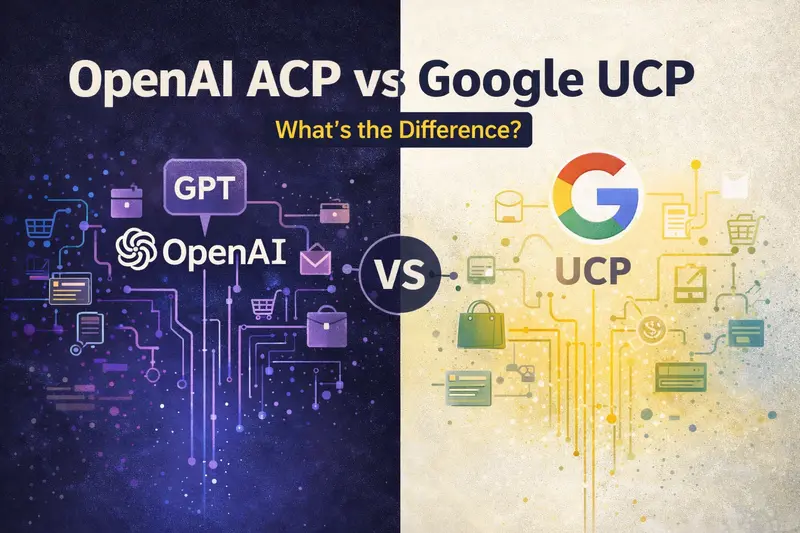
AI commerce protocols are not all trying to solve the same problem. OpenAI ACP vs Google UCP is a useful comparison because it separates decision-making from transaction execution. As agentic commerce evolves, new protocols are emerging to address the unique challenges of AI-driven ecommerce, and there is a growing need for an open standard to ensure interoperability between agents, systems, and services. If you run ecommerce operations, that distinction matters more than the branding, because it determines where your systems will need to integrate and what you can expect to control.
The confusion happens because both protocols sit under the umbrella of agentic commerce, and both are described as enabling AI agents to buy things. But they operate at different layers of the commerce lifecycle. ACP focuses on enabling an AI assistant to act as the shopping interface and coordinate purchasing decisions with merchants. UCP focuses on creating a common language for checkout flows so consumer surfaces can execute transactions reliably across many retailers, payment providers, and business backends. There are real differences between ACP and UCP in terms of their underlying philosophies, ecosystems, and control mechanisms, which can significantly impact which protocol best aligns with a merchant’s strategy. Once you see the layering, the “protocol wars” framing becomes less useful. These are not mutually exclusive building blocks. They can coexist in the same shopping journey.
Despite their architectural differences, both protocols share the same goal: enabling secure, tokenized payments efficiently and reliably within agent-driven retail environments.
What is OpenAI’s Agentic Commerce Protocol (ACP)?
OpenAI’s ACP, or OpenAI’s Agentic Commerce Protocol, is a protocol shaped around the idea that an AI assistant can guide a user through product discovery, selection, and delegated purchase actions. OpenAI’s ACP is an open, cross-platform protocol released under the Apache 2.0 license, allowing businesses to implement the specification for any AI assistant or payment processor. Launched in September 2025, ACP powers ‘ChatGPT Instant Checkout’, enabling seamless transactions directly within ChatGPT. ACP is primarily concerned with enabling AI agents to do three things cleanly:
- Retrieve structured product data so the agent can recommend items without guessing
- Confirm user intent and finalize what is being purchased
- Send an order and payment authorization to the merchant in a way that is secure and bounded
Merchants using ACP must support high-quality, structured product data, product feeds, endpoints, and webhooks to enable agent-initiated checkout and agentic payments. ACP is designed for broad adoption, independent of any single user interface, platform, or distribution surface.
The key concept is the agent as the interface. ACP assumes the user is inside an AI assistant experience, and the assistant is actively participating in the buyer journey. That includes conversational discovery, comparisons, and narrowing options. In that world, the protocol is a way to translate the agent’s “decision” into an executable order that a merchant can fulfill.
For merchants, ACP is essentially a way to accept orders that originate from an AI agent while preserving the merchant’s core responsibilities: pricing, inventory truth, order management, fulfillment, returns, and post-purchase support. ACP is not a marketplace model where the agent becomes the seller. It is a protocol for agent mediated ordering.
Let AI Optimize Your Shipping and Boost Profits
Cahoot.ai software selects the best shipping option for every order—saving you time and money automatically. No Human Required.
See AI in ActionWhat is Google’s Universal Commerce Protocol (UCP)?
Universal Commerce Protocol is Google’s answer to the challenge of standardizing checkout and transaction execution across many consumer surfaces and merchant systems. UCP is primarily concerned with making the act of completing checkout less bespoke across the commerce ecosystem.
UCP is implemented within Google-owned surfaces, including Search AI Mode, the Gemini App, and Google Shopping. Google AI Mode plays a key role in enhancing product discoverability and visibility in these AI-powered environments. UCP is built on Merchant Center feeds and schemas, making it structured data-first and optimized for AI-enhanced discovery inside Google surfaces.
In practical terms, UCP is designed to create a common language between:
- Consumer surfaces such as search, shopping, and AI mode experiences
- Merchants and their business logic systems
- Payment providers and payment authorization flows
- Order management and status updates
UCP is compatible with existing protocols, including Google’s own Agent Payments Protocol (AP2), and was announced in January 2026. Merchants can customize their UCP integration and declare which payment methods they support, benefiting from reduced checkout friction. The model context protocol is also part of this open standard approach, enabling seamless shopping experiences across Google’s platforms.
Launch partners such as Lowe’s, Michaels, Poshmark, and Reebok have been early collaborators in deploying Google’s AI shopping assistants, helping to integrate UCP within Google Search and related surfaces.
The key concept is interoperability. UCP is not primarily about an agent making taste-based recommendations. It is about reliably completing checkout across different retailers and reducing integration complexity. It sits closer to the transaction layer than the preference formation layer.
For operators, UCP reads like a standardization effort that tries to make “complete checkout” and “complete transactions” consistent across platforms, rather than forcing every merchant to build a custom integration for every surface.
ACP is centered on the decision layer
When people say ACP is designed for AI agents making purchasing decisions, they are usually pointing to the workflow ACP prioritizes:
- The user expresses intent in an AI assistant
- The AI assistant discovers products using structured product data and user intent
- The AI assistant helps the user choose and confirms the purchase
- The AI assistant triggers a delegated payment and transmits an order to the merchant
ACP preserves merchant control over pricing, inventory, and fulfillment throughout this process, allowing merchants to maintain autonomy over their operations.
In other words, ACP optimizes the handoff from “the agent decided this is what you want” to “the merchant can now fulfill it.” It is closer to commerce discovery and conversational discovery than to generic payment rails. Structured product data is crucial here, as AI agents prioritize it over traditional SEO factors when making recommendations. Merchants should optimize their product data for agent consumption to improve visibility in AI-driven shopping. Agentic commerce opens new ways to connect with high-intent shoppers.
UCP is centered on the execution layer
When people say UCP focuses on standardizing checkout, they are usually pointing to the workflow UCP prioritizes:
- A consumer surface identifies a high intent shopper
- The surface needs to execute checkout with minimal friction
- The surface needs a consistent way to communicate with merchants and payment methods
- The merchant needs to execute order creation and update status through a standardized interface
UCP operates within a walled garden – a controlled, closed ecosystem tightly integrated with Google-owned platforms. Aggregator platforms may benefit from UCP’s omnichannel integration and the ability to leverage Google Shopping data.
In other words, UCP optimizes the handoff from “the user is ready to buy” to “the transaction is executed correctly across different merchants.” It is closer to the transaction data layer than to preference formation.
A simple mental model: who is the product interface?
A useful way to compare OpenAI ACP vs Google UCP is to ask: who owns the shopping interface at the moment of selection?
- With ACP, the AI assistant is explicitly the shopping interface. The user is talking to an agent. The agent is selecting products to show and guiding the decision. High-quality product feeds are essential for accurate product selection by AI agents.
- With UCP, the consumer surface is the shopping interface. The surface may have AI assistants embedded, but the core emphasis is that the surface can execute a purchase across many merchants consistently.
This is why the protocols can coexist. The agent can be where the user decides, and a standardized transaction protocol can be how the purchase is executed. Merchants need to prepare for both ACP and UCP, as they represent different demand channels in agentic commerce.
ShipStation vs. Cahoot: 21x Faster, Real Results
Get the inside scoop on how a leading merchant switched from ShipStation to Cahoot—and what happened next. See it to believe it!
See the 21x DifferenceDiscovery and consideration
ACP is more directly tied to discovery because it assumes the agent is helping the user discover products. That pulls in requirements around structured product data, product schema, and merchant feeds. Merchants should monitor product visibility, not just brand mentions, to understand their performance in AI shopping. It’s important for merchants to track product visibility across AI shopping surfaces, as the brands that win in agentic commerce will be those visible to AI agents during the discovery phase.
UCP can participate in discovery, but its clearer value is enabling commerce surfaces to transact. UCP is often discussed alongside consumer surfaces like search and shopping where high intent shoppers are already in motion.
Checkout and payment authorization
UCP is explicitly concerned with checkout execution and payment authorization across platforms and payment providers. If you think about the complexity of payment methods, fraud controls, tax calculations, and multi-item carts, this is where standardization offers real leverage.
ACP also deals with payment authorization, but typically through a delegated payments approach that keeps the user in control while letting the agent complete checkout. ACP’s payment posture is designed to be secure and bounded to the user’s intent.
Order management and post purchase support
UCP tends to extend naturally into order management, status updates, and post purchase support because a consistent transaction protocol often needs a consistent way to handle order state.
ACP can still support post purchase, but its defining feature is the agent driven decision and purchase initiation. The merchant still owns fulfillment and customer experience after the order is placed.
Transport and interoperability: how ACP and UCP connect with existing systems
When it comes to enabling agentic commerce at scale, the way protocols connect with existing systems – known as transport and interoperability – can make or break adoption. Both the universal commerce protocol (UCP) and agentic commerce protocol (ACP) are designed to let AI agents interact with merchants, products, and payments, but they take different technical paths to get there.
OpenAI’s Agentic Commerce Protocol (ACP) keeps things simple by relying exclusively on REST APIs for communication. This approach is familiar to most digital commerce teams and makes it straightforward to plug ACP into existing ecommerce stacks. For merchants and developers, this means less time spent wrestling with new integration patterns and more focus on providing clean product data and supporting agentic commerce. However, the REST-only approach can be limiting for organizations with more complex or modern architectures that might prefer gRPC or GraphQL for efficiency or flexibility.
Google’s Universal Commerce Protocol (UCP), on the other hand, is built for maximum adaptability. UCP supports multiple transport methods – including REST, gRPC, and GraphQL – so it can fit into a wider range of merchant and platform environments. This flexibility is especially valuable for larger retailers or platforms with diverse technical resources and legacy systems. The trade-off is that supporting multiple protocols can add complexity to implementation and ongoing maintenance, especially for teams less familiar with these technologies.
On the interoperability front, both protocols are designed to create a common language for commerce. ACP’s delegated payments system enables secure, tokenized transactions initiated by AI assistants, while UCP’s Agent Payments Protocol standardizes payment authorization and security across Google Pay, payment networks, and merchant systems. This ensures that, whether a user is checking out via an AI assistant or through Google Shopping, payment flows remain secure and consistent.
Structured data is another cornerstone of both protocols. ACP leans on product schema and structured product data to help AI agents understand and recommend products accurately, supporting robust commerce discovery and user intent matching. UCP leverages Google Merchant Center feeds, allowing merchants to provide detailed, up-to-date product information that powers Google Search, Google Shopping, and AI mode experiences. This structured approach is critical for AI shopping, as it ensures that product discovery and instant checkout are based on reliable, real-time data.
The visibility layer – how AI agents and surfaces discover and interact with merchants – also differs. ACP’s open web model allows AI assistants to discover products and merchants across the entire web, supporting a broad, decentralized approach to commerce discovery. In contrast, UCP’s integration with Google Search, Merchant Center, and the Gemini app creates a more curated, structured experience, where merchants can control how their products appear across Google’s AI surfaces and shopping journeys.
Ultimately, both the agentic commerce protocol and universal commerce protocol are designed to support the full commerce lifecycle, from product discovery to payment authorization and post-purchase support. The choice between them often comes down to your technical environment and strategic priorities: ACP offers simplicity and a direct path for AI assistants to interact with merchants, while UCP provides flexibility and deep integration with Google’s commerce ecosystem.
For merchants and developers, the key is to ensure your systems are ready to provide structured data, support secure payment flows, and integrate with the visibility layers that matter most for your audience. By understanding the transport and interoperability differences between ACP and UCP, you can make informed decisions about how to support agentic commerce and stay ahead in the evolving world of digital commerce.
Practical implications for ecommerce operators
If you are deciding where to invest attention, separate the integration problem from the operating problem.
Your product data becomes more critical, regardless of protocol
Both protocols depend on the merchant’s ability to provide accurate product data. In the AI shopping context, poor product data becomes a decision-quality problem, not just a listing quality problem. That includes:
- Consistent attributes and variation handling so the agent does not confuse options
- Accurate pricing, promotions, and availability
- Clear fulfillment promises and return policies
Shopify merchants, in particular, face unique analytics and attribution challenges when preparing for protocol pluralism and supporting high-quality product feeds. Addressing these challenges is essential to ensure accurate representation and performance tracking across multiple AI shopping protocols.
If your catalog is messy, the agent layer will make messy decisions. If your catalog is clean, agents and surfaces can represent you accurately.
Your fulfillment and post purchase execution still determines retention
Neither protocol fulfills orders for you. Operations leaders should treat these protocols as additional order sources, not as operational outsourcing. Your differentiation surface remains execution:
- Availability and inventory accuracy
- Fulfillment speed and reliability
- Exception handling and customer service throughput
- Returns, refunds, and post purchase trust
If agentic commerce increases the number of orders that happen without a user visiting your site, you will have fewer opportunities to correct misunderstandings. That raises the operational importance of accurate product data and predictable fulfillment.
Your channel mix may shift, but the constraints stay familiar
ACP aligns with the rise of AI assistants as a new discovery channel. For example, when a shopper asks an AI assistant to recommend running shoes, the AI can query product data and facilitate a direct purchase, making it crucial for merchants to optimize for this emerging channel. Merchants must also support product feeds and agent-initiated checkout for OpenAI’s ACP implementation, ensuring seamless order processing.
UCP aligns with large consumer surfaces reducing friction at checkout. If platforms can complete checkout without sending users through fragile handoffs, UCP style workflows change how you should think about conversion rate optimization.
In both cases, the core operator question is the same: can your stack accept orders cleanly and can your operations deliver the promise consistently.
Consider how you will measure performance without overclaiming visibility
Operators often ask what transaction data they receive and what visibility layer they lose. That depends more on the surface than the protocol. Protocols standardize how systems talk. They do not guarantee you will receive rich behavioral context. If the decision happened inside an AI assistant, you may not get the full shopping journey transcript. If the decision happened inside a platform surface, you may get aggregated signals rather than individual level pathing.
That is not a reason to avoid the channel. It is a reason to get comfortable measuring what you can reliably measure: order outcomes, return rates, cancellation drivers, and service performance.
Cut Costs with the Smartest Shipping On the Market
Guranteed Savings on EVERY shipment with Cahoot's AI-powered rate shopping and humanless label generation. Even for your complex orders.
Cut Costs TodayACP and UCP are not mutually exclusive
This is the most important clarification for reference use.
ACP and UCP can operate in different layers of the same journey:
- A user can discover and decide through an AI assistant using an ACP style interaction.
- The eventual checkout and transaction execution can still benefit from standardized execution patterns that look like UCP.
- A merchant can support both without treating them as a binary choice, because they address different moments in the commerce lifecycle.
In practice, you should expect multiple protocols in the ecosystem. That does not imply fragmentation is fatal. It implies you should design your commerce systems to be modular. A protocol is just a contract for how systems communicate. If your order management and checkout architecture is brittle, every new interface is painful. If it is modular, adding new order sources becomes manageable.
A grounded operator way to decide what matters
The best way to evaluate OpenAI ACP vs Google UCP is to start from your operating reality.
If your business depends on commerce discovery and customer acquisition, ACP matters because it represents the agent layer where discovery and selection happen. It is a new distribution surface for demand.
If your business depends on converting high intent shoppers efficiently, UCP matters because it targets checkout execution across platforms. It is a mechanism for reducing friction at the transaction point.
For most mid-market operators, the correct answer is not “pick one.” The correct answer is:
- Make your product data, inventory truth, and order handling robust enough to plug into both
- Treat each protocol as a potential order source, and focus on operational readiness
- Stay neutral and factual about what each protocol claims to do, and avoid assuming maturity until your partners confirm it for your exact stack
That is how operators avoid getting distracted by branding and stay focused on where AI actually intersects with commerce execution.
Frequently Asked Questions
What is OpenAI ACP?
OpenAI ACP is a protocol designed to let an AI assistant coordinate product discovery and a delegated purchase flow so an AI agent can place an order with a merchant on the user’s behalf.
What is Google UCP?
Google UCP is a protocol designed to standardize checkout and transaction execution across consumer surfaces, merchants, and payment providers using a common commerce language.
What is the main difference between OpenAI ACP vs Google UCP?
ACP is primarily oriented around the agent layer that helps users decide what to buy and then initiates a purchase. UCP is primarily oriented around standardizing how checkout is executed across platforms and merchants.
Do ACP and UCP solve the same problem?
They overlap in enabling AI driven commerce, but they solve different problems. ACP focuses on agent mediated buying decisions and order initiation. UCP focuses on transaction execution standardization and interoperability.
Are ACP and UCP mutually exclusive?
No. ACP and UCP are not mutually exclusive because they can operate in different layers of the same shopping journey, with an agent handling decision-making and a standardized protocol handling checkout execution.
What do ecommerce operators need to change to support these protocols?
Operators should focus on accurate structured product data, inventory truth, reliable order management integration, and fulfillment execution that can meet the promises represented by AI assistants and commerce surfaces.
Do these protocols replace a merchant’s existing checkout and OMS?
No. They are communication standards that connect external surfaces and agents to merchant systems. Merchants still own pricing, inventory, order processing, fulfillment, returns, and post purchase support.
Written By:

Rinaldi Juwono
Rinaldi Juwono leads content and SEO strategy at Cahoot, crafting data-driven insights that help ecommerce brands navigate logistics challenges. He works closely with the product, sales, and operations teams to translate Cahoot’s innovations into actionable strategies merchants can use to grow smarter and leaner.
Turn Returns Into New Revenue
Related Articles
HTS Code Explained: What It Is, Why It Matters, and How Ecommerce Brands Use It
HTS codes (Harmonized Tariff Schedule codes) are standardized numerical classifications that identify imported products for U.
Inventory Turnover Ratio: What It Is, How to Calculate It, and How Ecommerce Brands Improve It
Inventory turnover ratio (also called stock turnover) measures how many times a company sells and replaces its inventory during an accounting period.
HTS Code Explained: What It Is, Why It Matters, and How Ecommerce Brands Use It
Cost of Goods Sold (COGS) represents the direct costs attributable to producing the goods a company sells during an accounting period.