
What Are Peer-to-Peer Returns?

Last updated on April 10, 2026
In this article
 19 minutes
- Why the Core Assumption Is the Problem
- How Peer-to-Peer Returns Actually Work
- What Changes and What Does Not
- What Peer-to-Peer Removes From the System by Bypassing Traditional Financial Institutions
- What Peer-to-Peer Adds to the System
- The Economics: A Side-by-Side Comparison
- Partial Adoption Is Still Meaningful Adoption
- Sustainability: Fewer Trips, Less Waste, Better Reporting
- Fraud: Complexity Is Where Fraud Lives
- Implementing Peer-to-Peer Returns
- Quality Control in Peer-to-Peer Returns
- Measuring Success in Peer-to-Peer Returns
- Where P2P Fits and Where It Does Not
- The Core Takeaway
- Frequently Asked Questions
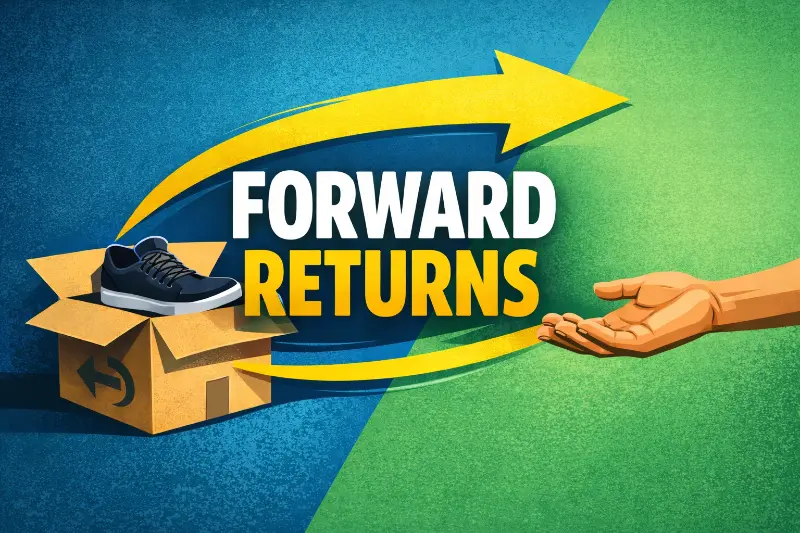
Peer-to-peer returns are a fundamentally different routing model for ecommerce: instead of sending returned goods backward through a warehouse, the system forwards them directly from the returning customer to the next buyer. As an innovative solution within the broader context of personal finance and ecommerce returns, peer-to-peer returns help streamline customer returns, reduce costs, and improve efficiency for both retailers and consumers. This is not a feature added to the existing returns process. It is a replacement of the process’s most expensive assumption.
Traditional customer returns are built on a single premise that has gone largely unquestioned since the early days of ecommerce: goods must travel backward through the supply chain before they can move forward again. Every return goes to a distribution center, goes through intake, inspection, and repackaging, and then waits to be resold. That loop is where margin disappears, fraud hides, and inventory loses value.
Peer-to-peer returns invert that assumption. Returns stop boomeranging. They become forward-moving transactions. Peer-to-peer returns allow customers to return unwanted items to other customers rather than back to the retailer.
If you’re not familiar with why the traditional returns model broke down in the first place, start with the canonical Returns Bible overview at Cahoot.
Why the Core Assumption Is the Problem
The traditional reverse logistics loop for ecommerce returns is not broken because people manage it poorly. It is broken because it requires steps that add cost without adding value. Two shipping legs are unavoidable. Labor is unavoidable. Delay is unavoidable. Markdown risk is unavoidable. Ecommerce returns are a significant challenge for retailers, with return rates exceeding 20%.
Returns Management Systems have improved the front-end experience. Portals are cleaner. Approvals are faster. Policy logic is more sophisticated. But every one of those improvements still routes inventory into the same expensive back-end. The tooling is better. The economics are not.
Peer-to-peer does not try to optimize that loop. It removes the warehouse as the default endpoint entirely for eligible returns. The item does not go backward. It goes to the next person who wants it.
How Peer-to-Peer Returns Actually Work
The mechanical sequence matters here because P2P is often described in abstract terms. In practice, the flow is specific and sequential.
Step one: The customer initiates a return. The buyer requests a return through the brand’s website or existing portal, exactly as they would in a traditional flow. Nothing about the customer-facing experience changes at this stage.
Step two: The system evaluates eligibility. The platform assesses whether the item qualifies for peer-to-peer routing based on SKU type, return reason, condition thresholds, demand signals for that product, and any applicable regulatory constraints. Not every return passes this screen, and that is by design.
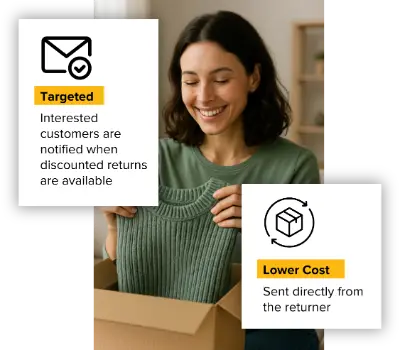
Step three: A Like New or Open Box SKU is created. If the item qualifies, a new listing is generated and placed on the same product detail page as the new item. It is priced at a modest discount, typically in the 10 to 20 percent range, and clearly labeled so the next buyer understands what they are purchasing. Transparency is not optional here. It is structural.
Step four: Direct forwarding is triggered. Instead of receiving a label back to a warehouse, the returning customer gets a shipping label addressed directly to the next buyer. The retailer manages the returns process and provides the shipping label, but the customers take care of returning the items to one another. The item travels one leg forward, not one leg backward.
Step five: Confirmation and settlement close the loop automatically. Tracking confirms delivery to the new buyer. The original returner receives their refund upon confirmed shipment or delivery. Inventory records, financials, and order data update without manual intervention. In some implementations, returners receive a small cash incentive for proper preparation and condition compliance, which creates a behavioral feedback loop that improves outcomes over time.
What Changes and What Does Not
This distinction is critical and often misunderstood. Peer-to-peer returns do not require a new ecommerce stack or a rip-and-replace approach. They rewire one assumption inside the existing infrastructure.
What stays the same:
- The branded returns portal customers already interact with
- Policy enforcement and eligibility logic
- Refund logic and customer support workflows
- Carrier infrastructure
What changes:
- Routing logic, items move forward, not backward
- Inventory flow, goods bypass centralized intake
- Cost structure, entire stages are removed
- Fraud exposure, fewer handoffs reduce attack surfaces
- Sustainability footprint, fewer shipments and less packaging waste
The operational layers that connect with your WMS, your carrier, and your ERP do not need to be rebuilt. The routing decision is what shifts.
What Peer-to-Peer Removes From the System by Bypassing Traditional Financial Institutions
The economic case for P2P is not about doing things more efficiently. It is about removing entire stages from the process.
Warehouse intake disappears. There is no inbound dock, no receiving labor, no inspection queue, no reshelving. Returned items never enter the most labor-intensive environment in retail. That is not a marginal improvement. It is the elimination of a cost category.
Redundant shipping is eliminated. Traditional returns require one outbound shipment, one inbound return shipment, and often a third shipment for resale or liquidation. Peer-to-peer requires one outbound shipment and one forward shipment to the next buyer. One leg is removed entirely, which also reduces packaging waste.
After eliminating warehouse intake and redundant shipping, peer-to-peer returns decrease packaging waste and reduce the number of items sent to landfills, supporting more eco-friendly returns practices.
Markdown drag is cut. Time is the silent killer of return value. In traditional flows, items wait days or weeks for inspection while seasonal demand decays and discounting pressure builds. In a P2P model, items are resold almost immediately. Discounts are intentional and one-time, not the result of sitting in a pipeline.
Delay and opacity collapse. Traditional returns separate the customer experience, the physical product, and the financial settlement into disconnected timelines. P2P collapses all three into a single flow. Faster resolution, clearer visibility, and less trust erosion on both sides of the transaction.
What Peer-to-Peer Adds to the System
The model is not purely subtractive. Removing stages creates structural advantages that accumulate over time.
Speed improves across every dimension. Resale happens faster. Refunds are processed sooner. Inventory velocity increases because goods are not sitting idle in a return pipeline. Time-to-recovery shrinks from weeks to days.
Recovery rates improve because fewer items spend time in transit or idle in queues where damage, loss, or value erosion can occur. More inventory stays sellable. Less ends up in liquidation channels or destroyed. Recovery becomes the default outcome rather than the exception.
Accountability is built into the transaction structure. When shipping is point-to-point rather than routed through anonymous warehouse handling, there are fewer opportunities for goods to go missing, be swapped, or degrade without documentation. The chain of custody is tighter.
Incentive alignment changes behavior. Returners are no longer detached from what happens to the item after they send it back. When customers understand the item is going to another person and that their preparation affects the outcome, behavior improves. This mirrors how mutual accountability functions in peer-driven platforms in other industries. When stakes are visible, abuse becomes harder to rationalize.
The Economics: A Side-by-Side Comparison
The numbers in this model come directly from analysis of traditional reverse logistics cost structures and returns management, and should not be averaged out or softened.
In a traditional returns model, the average loss per $100 returned product breaks down as follows:
- Shipping, two legs at roughly $8 each: approximately $16
- Labor and processing, receiving, inspection, repackaging, system updates: approximately $7
- Markdowns, goods lose value while sitting, blended average: approximately $10
- Fraud and shrinkage including wardrobing, swaps, and abuse: approximately $4
Total average loss: approximately $37 per $100 return.
In a peer-to-peer model, the cost structure looks materially different:
- Shipping, one forward leg only, net of the return leg eliminated: approximately $8
- Labor and processing, no warehouse intake: $0
- Markdowns, open box pricing that is intentional rather than reactive: approximately $7
- Fraud and shrinkage, materially reduced due to fewer touchpoints: negligible
Total average loss: approximately $15 per $100 return.
Effective returns management in ecommerce impacts profitability and operational efficiency.
Run that across 1,000 returns on $100 items. The traditional model produces roughly $37,000 in losses. The P2P model produces roughly $15,000 in losses. The difference is $22,000 preserved on a small sample. Scale that to a million dollars in returned merchandise and the margin protection approaches a quarter million dollars per year before accounting for secondary effects like faster working capital cycles and reduced storage costs.
The Lifecycle Comparison
Visualizing this as a sequence makes the difference concrete.
In the traditional flow: warehouse ships to customer, customer ships back to warehouse, warehouse processes the return, warehouse ships again to the next buyer or liquidation channel. Three legs. Multiple handoffs. Compounding cost and delay at each stage.
In the peer-to-peer flow: warehouse ships to customer, customer ships directly to next buyer. Two legs total. One handoff. No intake labor, no inspection queue, no markdown pressure.
The goods stop going backward. The economics follow.
Partial Adoption Is Still Meaningful Adoption
Peer-to-peer returns are not an all-or-nothing proposition. Not every SKU qualifies. Not every return will find a waiting buyer. That is expected and does not undermine the model.
In practice, roughly 30 to 60 percent of returns across most ecommerce operations are viable P2P candidates. That first cohort delivers the majority of the savings. The remainder, items that are damaged, defective, regulated, or simply do not have a ready buyer, can continue flowing through traditional reverse logistics infrastructure without disrupting the broader operation.
Warehouses do not disappear in a hybrid model. They become specialized handlers for genuine exceptions rather than the default endpoint for everything. That is a more rational use of infrastructure, not an elimination of it.
Scalability is a challenge for peer-to-peer returns, as managing returns becomes more complex with business growth and high-volume SKUs. The cost curve bends early. Even a 30 percent P2P routing rate on a meaningful volume of returns produces real margin impact. The hybrid model is how P2P scales without requiring organizational transformation.
Sustainability: Fewer Trips, Less Waste, Better Reporting
The environmental case for peer-to-peer returns follows directly from the operational structure. Fewer shipments mean fewer truck trips. One fewer box means one fewer set of packaging materials, tape, inserts, and filler. Across millions of returns, those reductions compound into measurable emissions decreases, specifically reducing carbon emissions.
Traditional reverse logistics produces a multiplied carbon footprint. The item ships once to the customer, ships back to the warehouse, and then often ships again to a secondary buyer or liquidation channel. That is three legs of transportation for a single product. Peer-to-peer reduces that to two legs, cutting the return portion of the trip entirely. Peer-to-peer returns significantly lower shipping carbon emissions by reducing travel distances for returns.
This matters beyond operational cost because regulatory scrutiny of Scope 3 emissions is increasing. The EU’s Corporate Sustainability Reporting Directive already requires Scope 3 disclosures for companies in scope, and similar frameworks are advancing elsewhere. Reverse logistics is a meaningful contributor to Scope 3, and organizations that cannot demonstrate improvement in that category will face growing reporting pressure.
P2P gives brands a trackable, measurable way to reduce emissions that can be documented in ESG reporting and communicated to consumers and investors. This is not a sustainability claim built on assumption. It is a direct consequence of routing fewer packages across fewer miles.
Roughly 44 percent of apparel returns never reenter inventory through traditional channels. They are liquidated, incinerated, or disposed of. Peer-to-peer, by moving items directly to the next buyer, keeps more goods in active use and out of waste streams. That reduction is real and documentable.
Fraud: Complexity Is Where Fraud Lives
Return fraud grew from $27 billion in 2019 to over $100 billion by 2023. The traditional warehouse-centric model creates the conditions fraud thrives in: anonymous handling, multiple touchpoints, delayed verification, and pooled inventory where item-level accountability is difficult to maintain.
Wardrobing exploits the gap between use and inspection. Item swapping works at scale because multiple identical SKUs move through intake without granular verification. Empty box scams persist because point-of-condition proof is lagging rather than contemporaneous.
Peer-to-peer changes the structural conditions. Refunds are tied directly to confirmed delivery rather than initiated upon return request. Shipping is point-to-point rather than routed through anonymous warehouse queues. Fewer touchpoints mean fewer moments where something can be swapped, misrepresented, or lost in a way that benefits the bad actor.
Fraud does not disappear in a P2P system, but its attack surfaces shrink. The complexity that creates opportunity is reduced by design.
Implementing Peer-to-Peer Returns
Implementing peer-to-peer returns starts with a strategic integration of technology and process. Ecommerce brands can leverage peer-to-peer returns software that seamlessly connects with their existing returns management systems. This software acts as a matchmaking engine, pairing customers who want to return items with those actively seeking them—much like a rideshare app, but for products. By bypassing traditional financial institutions and the conventional logistics chain, brands can dramatically reduce shipping costs, labor costs, and packaging waste, similar to how peer-to-peer fulfillment networks streamline order shipping.
The peer-to-peer model empowers ecommerce brands to streamline the returns process, making it more efficient and customer-centric. Instead of routing every return through a warehouse, the system forwards eligible items directly to the next customer, cutting out unnecessary steps and expenses. This approach not only saves money but also provides valuable insights into customer behavior and preferences. For example, by analyzing return data, brands can identify root causes—such as sizing issues or unclear product descriptions—and implement targeted improvements to reduce return waste in the future.
Ultimately, adopting peer-to-peer returns allows ecommerce brands to enhance the customer experience, optimize financial outcomes, and build a more sustainable operation by minimizing the environmental and economic costs associated with traditional returns, reinforcing how an exceptional returns program drives loyalty.
Quality Control in Peer-to-Peer Returns
Quality control is essential to the success of peer-to-peer returns, ensuring that each returned item meets the expectations of the next customer. Ecommerce brands can implement robust quality control measures such as identity verification, real-time inspections, and customer reviews to maintain high standards throughout the peer returns process. Identity verification helps confirm that both the sender and recipient are legitimate, reducing the risk of fraud and ensuring accountability.
Clear guidelines and instructions for preparing returned items are crucial. By educating customers on how to properly package and describe returned items, brands can minimize the chances of damaged or defective goods reaching the next buyer. If an issue does arise, offering store credit or exchanges can help resolve complaints quickly, boosting customer satisfaction and loyalty and supporting a well-crafted e-commerce returns program. For instance, ecommerce brands can deploy AI-powered chatbots to provide instant support, answer questions, and facilitate resolutions, ensuring a smooth experience for all parties involved.
By prioritizing quality control, ecommerce brands can build trust in the peer-to-peer model, protect their reputation, and deliver a consistently positive experience for every customer in the returns chain.
Measuring Success in Peer-to-Peer Returns
To measure the success of peer-to-peer returns, ecommerce brands need to track a set of key performance indicators that reflect both operational efficiency and customer satisfaction, including how ecommerce return rate affects profit margins. Monitoring metrics such as return rates, customer satisfaction scores, and shipping costs provides a clear picture of how well the peer-to-peer returns process is performing. Data analytics play a crucial role, offering valuable insights into customer experience and highlighting areas for continuous improvement.
Brands can analyze customer feedback and reviews to understand pain points and refine their returns process. Tracking reductions in packaging waste and return waste, as well as decreases in carbon emissions, allows brands to quantify the environmental impact of their peer returns program and compare it to alternative reverse logistics solutions like Happy Returns. For example, measuring the drop in shipping costs and the increase in customer retention rates can demonstrate the tangible benefits of the peer-to-peer approach.
By future-proofing their returns strategy with peer-to-peer returns, ecommerce brands not only improve operational efficiency but also strengthen customer loyalty and position themselves as leaders in sustainable, customer-focused ecommerce. This data-driven approach ensures that brands can adapt to changing consumer expectations and regulatory requirements, securing long-term success in a competitive market.
Where P2P Fits and Where It Does Not
Peer-to-peer returns are selective by architecture. Understanding where the model applies, and where it does not, is what makes implementation credible. However, there are challenges associated with peer-to-peer returns, particularly in ensuring consistent quality control.
High fit categories include apparel, footwear, and accessories. These items hold resale value well, have predictable demand, and are generally durable enough to survive a second consumer-packed shipment.
Medium fit categories include durable home goods and non-fragile consumer items where condition is more variable but resale is still viable with appropriate screening.
Low fit categories include fragile items like glassware and delicate electronics, custom or made-to-order goods, and regulated or perishable products where chain of custody, tamper evidence, or legal constraints make direct forwarding impractical or prohibited.
One significant challenge in peer-to-peer returns is quality control, as the process often relies on technology and inexperienced human feedback to evaluate the condition of returned items. This can lead to inconsistencies and potential issues with resale quality.
Acknowledging these limits is not a weakness in the model. It is what makes the model implementable. A credible routing system knows where to apply itself and where to stop. P2P routes eligible inventory forward and defers the rest to infrastructure that handles it better.
The Core Takeaway
Peer-to-peer returns work because they change where returns go, not how politely they are processed.
Traditional returns transform every returned item into a cost center. Warehouse intake, redundant shipping, markdown delay, and fraud exposure stack up before the item reaches its next buyer. The average loss is not a rounding error. It is a structural drain.
Peer-to-peer reroutes that same item directly to demand. It removes cost categories instead of managing them. It shrinks fraud exposure instead of adding detection layers on top of a vulnerable system. It produces a sustainability outcome instead of generating it as a reporting obligation.
This is not a marginal improvement. It is a different direction. Returns that stop going backward and start going forward recover more value, create less waste, and demand less from the infrastructure absorbing them.
Frequently Asked Questions
What are peer-to-peer returns in ecommerce?
Peer-to-peer returns are a routing model where returned items are forwarded directly from the original customer to the next buyer, bypassing the warehouse entirely. Instead of traveling backward through the supply chain, the returned item moves forward to someone who already wants it. This peer-to-peer model is similar to how peer-to-peer lending connects individual borrowers with investors, streamlining the process by cutting out traditional intermediaries.
How is a P2P return different from a traditional return?
In a traditional return, the item ships back to a warehouse, goes through inspection and repackaging, and is eventually resold. In a P2P return, the item ships directly to the next buyer. The warehouse intake stage, the redundant shipping leg, and the markdown delay are all eliminated.
Does peer-to-peer returns require replacing existing returns software?
No. P2P rewires the routing logic inside existing infrastructure. The branded portal, policy enforcement, refund logic, and carrier infrastructure remain in place. What changes is where the item goes after the return is initiated, not how the return request is handled.
What is the financial difference between traditional and P2P returns?
On average, traditional returns produce a loss of approximately $37 per $100 returned item when shipping, labor, markdowns, and fraud are fully accounted for. P2P reduces that to approximately $15 per $100 return by eliminating warehouse intake and redundant shipping legs. Peer-to-peer returns can cut shipping and processing costs significantly compared to traditional returns.
Do all returns qualify for peer-to-peer routing?
No. Roughly 30 to 60 percent of returns are viable P2P candidates. High-fit categories include apparel, footwear, and accessories. Fragile goods, regulated products, custom items, and defective returns still route through traditional channels. The model is hybrid by design.
How does peer-to-peer returns reduce fraud exposure?
Fraud in traditional returns exploits anonymous warehouse handling, delayed inspection, and multiple handoffs. P2P reduces these by tying refunds to confirmed delivery, limiting the number of touchpoints, and making item-level accountability more direct. Fewer handoffs mean fewer places for fraud to occur.
What is the sustainability impact of peer-to-peer returns?
Each P2P return eliminates one shipping leg and one round of packaging compared to traditional reverse logistics. Across high return volume, this produces a measurable reduction in carbon emissions and packaging waste. This reduction is trackable for Scope 3 reporting under frameworks like the EU’s Corporate Sustainability Reporting Directive.
Is peer-to-peer returns a good fit for apparel brands specifically?
Yes. Apparel is one of the highest-fit categories for P2P routing because items hold resale value, return rates are elevated, and demand for open-box or like-new apparel is established across marketplaces. The combination of high volume and strong eligibility makes the economics particularly compelling for apparel operators.
Written By:

Manish Chowdhary
Manish Chowdhary is the founder and CEO of Cahoot, the most comprehensive post-purchase suite for ecommerce brands. A serial entrepreneur and industry thought leader, Manish has decades of experience building technologies that simplify ecommerce logistics—from order fulfillment to returns. His insights help brands stay ahead of market shifts and operational challenges.

Turn Returns Into New Revenue
Related Articles

Why Returns Look Manageable Until They Suddenly Aren’t
Returns management is the retail process of handling customer returns across reverse logistics, cost control, and customer experience—and it rarely fails the way leadership expects...

The Economics of Peer-to-Peer Returns
Traditional returns management has one fundamental flaw: it optimizes a process that should not exist in its current form.

The Myth of “Efficient” Reverse Logistics
Efficient reverse logistics is treated as a goal worth chasing.