
SLA Meaning in Logistics: What Service Level Agreements Actually Guarantee (and What They Don’t)

Last updated on February 19, 2026
In this article
 20 minutes
- Introduction to Service Level Agreements in Logistics
- Types of SLAs in Logistics and Fulfillment
- How SLAs actually function as contractual frameworks between the service provider and client
- Understanding the SLA, SLO, and KPI hierarchy
- What logistics SLA metrics actually measure and what they don't
- How 3PL contracts structure SLAs and service credits
- The exclusions and loopholes that limit SLA protection
- Why meeting SLA thresholds doesn't guarantee customer satisfaction
- How to evaluate proposed SLAs before signing
- Monitoring performance beyond what your 3PL reports
- Frequently Asked Questions
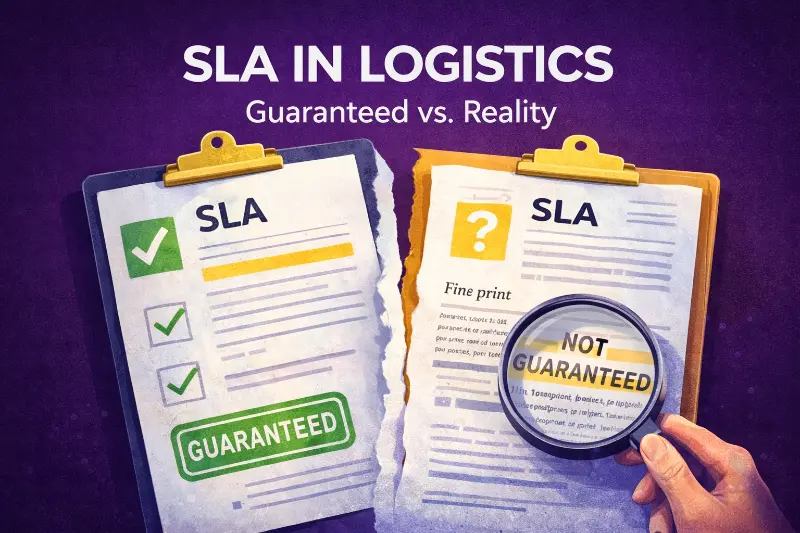
The gap between what 3PL providers promise in SLA marketing (“99.9% accuracy guaranteed!”) and what’s actually enforceable in contracts is vast, and understanding this gap is essential for operations leaders building reliable fulfillment. SLAs are price adjustment mechanisms, not performance guarantees; they provide remedies after failures occur rather than preventing them. A 3PL can repeatedly miss SLA targets and simply pay modest credits indefinitely, with no obligation to actually fix underlying problems. For mid-market Shopify brands, the key insight is this: SLA compliance does not equal good customer experience, and building resilient operations requires looking far beyond contractual thresholds. SLAs establish clear expectations, hold service providers accountable, and provide structured recourse if commitments aren’t met.
This reality shapes everything from vendor evaluation to daily monitoring. When a 3PL achieves 98% on-time delivery, that still means 2% of customers experience failures, potentially thousands of late orders monthly for high-volume brands. Each individual failure is 100% failure for that customer, and they don’t care about aggregate statistics. The brands that succeed build operations that don’t rely solely on SLA enforcement, treating these agreements as baselines rather than safety nets. A strong SLA is a sign of commitment to quality and can lead to new business opportunities by demonstrating reliability and consistency.
While this article focuses on logistics, SLAs are also critical in the technology industry, where they help establish trust, clarify service expectations, and foster transparency between vendors and clients.
Introduction to Service Level Agreements in Logistics
A Service Level Agreement (SLA) is the backbone of any successful logistics partnership, providing a clear, contractual framework that defines what both the service provider and the customer can expect from each other. In logistics and fulfillment, a service level agreement SLA spells out the specific service levels that must be met—such as delivery timelines, inventory accuracy, and order processing standards—ensuring that customer expectations are transparent and measurable from the outset.
When a service provider agrees to an SLA, they commit to achieving defined performance metrics in exchange for payment and, often, the opportunity to earn additional incentives. These metrics might include on-time shipping rates, order accuracy percentages, or inventory management benchmarks. By setting these standards, the SLA not only clarifies the responsibilities of both the service provider and the customer, but also establishes a baseline for operational efficiency and accountability.
Ultimately, a well-crafted service level agreement helps prevent misunderstandings, supports business objectives, and provides a mechanism for addressing service failures if they occur. For logistics operations, this means smoother service delivery, improved trust, and a shared commitment to meeting or exceeding agreed-upon service levels.
Types of SLAs in Logistics and Fulfillment
Logistics and fulfillment operations rely on several distinct types of SLAs, each designed to address different business scenarios and relationships. Understanding these variations is essential for both service providers and customers aiming to align on expectations and measure performance effectively.
A customer based SLA is tailored to the unique requirements of a single client, detailing the specific services provided and the exact service levels expected. This approach allows for customization based on the customer’s business model, order volume, or special handling needs, ensuring that the service provider’s performance is directly aligned with the customer’s priorities.
In contrast, a service based SLA focuses on a particular service or set of services—such as warehousing, transportation, or returns processing—regardless of which customer is using them. This type of agreement standardizes service levels across all clients for that service, making it easier for the service provider to manage multiple customers while maintaining consistent quality.
Multi-level SLAs are used in more complex logistics environments involving multiple parties, such as the service provider, the customer, and third-party vendors or carriers. These agreements coordinate service levels across the entire supply chain, clarifying roles and responsibilities for each stakeholder and ensuring that agreed upon service levels are met throughout the process.
Internal SLAs, meanwhile, are used within an organization to define expectations between different departments or teams—such as logistics and customer service—helping to drive operational efficiency and accountability internally.
Across all these SLA types, key performance indicators (KPIs) such as order fulfillment rates, shipping times, and inventory accuracy are used to measure the service provider’s performance. By tracking these metrics, all parties involved can verify that the agreed upon service levels are being met, supporting continuous improvement and business success in logistics and fulfillment.
How SLAs actually function as contractual frameworks between the service provider and client
A Service Level Agreement is a formal contract between a service provider and their client defining expected service levels, performance metrics, and remedies for non-compliance. In logistics specifically, SLAs govern third-party logistics relationships by establishing accountability for delivery accuracy, shipping timelines, and handling efficiency. SLAs also clarify the roles and responsibilities of all stakeholders, as well as processes and channels for troubleshooting issues and handling disputes. But their legal nature exists in a nuanced space between enforceable contracts and performance guidelines.
SLAs become legally binding when incorporated into a Master Service Agreement (MSA), and their terms and penalties are then enforceable in court. SLAs outline penalties and remedies when service levels are not met, and penalties for failing to meet SLA terms are typically structured as service level credits. However, any legal processes involved in enforcing an SLA tend to be extremely lengthy and costly, which is why most remedies flow through service credits rather than litigation. Service level credits are financial or service-based compensations provided to the client when the provider fails to meet agreed-upon service levels. Some vendors may negotiate earn-back clauses that allow them to regain service level credits if they maintain performance above required levels for a specified period, helping them avoid ongoing penalties. The more detailed an SLA is, the more likely it is to be enforced, but vague penalty clauses that lack clear definitions often fail judicial scrutiny.
Internal SLAs (between departments within an organization) function as service guidelines without strict legal repercussions, while external SLAs with 3PL vendors carry potential penalties or contract termination rights for non-compliance. Courts scrutinize SLA penalties based on proportionality, clarity, and mutual agreement, distinguishing between legitimate pre-estimated damages and punitive measures intended only to punish.
Understanding the SLA, SLO, and KPI hierarchy
The terminology confusion around service levels creates real operational problems. An SLA is the promise you make to customers or receive from vendors (contractual, with consequences), while service level objectives (SLOs) are specific performance benchmarks within an SLA, such as error rates, request latency, or uptime, that set performance baselines for evaluating whether service providers meet the agreed standards. A Service Level Indicator (SLI) is the actual measurement, what you achieved. Key Performance Indicators (KPIs) measure broader strategic business goals like customer lifetime value or cost per order.
The practical hierarchy works like this: if your SLA promises 99% order accuracy to customers, your internal SLO should target 99.5% to build buffer for inevitable variations. A service level objective (SLO) is an agreement within an SLA about a specific metric like response time or uptime. You measure actual performance (SLI) against that target, and track broader KPIs to understand business impact. This distinction matters because SLOs are vastly inferior to SLAs. They lack enforceable consequences, yet many 3PLs offer SLOs while marketing them as performance guarantees.
The concept of “error budgets” links these together practically. If your SLA allows 1% order errors over 30 days and you’ve used only 0.3% by day 15, you have remaining error budget that might permit riskier process changes. But if you’ve already hit 0.9% by day 10, operations need to lock down. This framework empowers teams to balance innovation against service commitments.
Performance metrics are agreed upon by both parties in an SLA to track service performance.
Let AI Optimize Your Shipping and Boost Profits
Cahoot.ai software selects the best shipping option for every order—saving you time and money automatically. No Human Required.
See AI in ActionWhat logistics SLA metrics actually measure and what they don’t
On-time shipping measures the percentage of orders handed to carriers by committed deadlines. Critically, this measures “shipped on time,” not “delivered on time.” The distinction matters enormously: once packages leave the warehouse, liability typically transfers to carriers, introducing the possibility of unexpected shipment exceptions; yet customers blame the brand, not the carrier. Industry standard thresholds run 95-98% for acceptable performance, with best-in-class providers achieving 99.5-99.8%. Red Stag Fulfillment reported 99.993% on-time shipping in 2024 as a benchmark.
Same-day shipping cutoff times typically range from noon to 6 PM local time, with noon being most common and later cutoffs considered premium service. Order processing is measured from order receipt into the Warehouse Management System to ship confirmation/carrier handoff, typically excluding weekends and holidays. For B2C fulfillment, same-day processing for orders before cutoff with 98%+ compliance is standard; B2B standards allow 2 business days for standard parcel orders.
Pick accuracy rates reveal warehouse operational quality. Industry average runs 97-98%, while best-in-class achieves 99.5-99.9%, and over 35% of warehouses have picking error rates of 1% or more. Inventory accuracy SLAs typically require 97%+ minimum, with top 20% of companies achieving 99.888% according to WERC benchmarking. The Perfect Order Rate, measuring orders delivered on time, complete, damage-free, with accurate documentation, has a median performance of only 90%, with best-in-class targeting 95%+.
Returns processing timeframe SLAs run 24-48 hours from receipt as industry standard, with best-in-class providers completing processing within 24 hours. System uptime SLAs commonly guarantee 99.9% service availability (allowing approximately 8.76 hours of annual downtime) with 99.99% representing high availability for critical applications. Uptime or availability is often expressed in ‘nines’, such as 99.9% or 99.999% uptime, to indicate the level of service reliability expected. SLAs define expectations around service availability, set policies for downtime, and lay out procedures for failure and disaster recovery to ensure consistent performance and operational stability. Customer service response time standards run 24 hours for standard priority, with 1-4 hours expected for critical issues. ShipBob reports an average response time of 1.23 hours.
SLAs often include documentation on security measures, data protection, and disaster recovery.
How 3PL contracts structure SLAs and service credits
Standard 3PL contracts structure on-time shipping SLAs around thresholds like “98%+ of orders received by cutoff ship same-day during normal operations,” with seasonal adjustments dropping to 97-98% during peak periods and 95-97% during Cyber Week. Accuracy SLAs typically guarantee 99.5-99.99% pick/order accuracy and 97-99.8% inventory accuracy, with inventory shrinkage allowances of 0.5-0.65% where clients absorb the first 0.5% and 3PLs absorb excess. Service tracking is essential for monitoring service quality and ensuring that the service levels outlined in SLAs are consistently met.
Service credits are calculated as a percentage of monthly service fees, graduated by severity of breach. Typical credit structures range from 5% for minor misses to 25% for severe underperformance, with monthly credit caps commonly set at 5-20% of aggregate monthly fees. Some contracts put 10% of monthly fees “at risk” with credits drawn from this pool. The critical limitation: if a 3PL failure causes $100,000 in lost sales and brand damage, a 10% credit on a $5,000 monthly fee ($500) provides meaningless compensation. An SLA should include a section that defines the penalties that either side will incur should they not fulfill the terms of the agreement. It should also clearly define how penalties are calculated to prevent disputes.
Beyond credits, 3PL contracts may include financial penalties for repeated failures, reship costs for correcting errors, and inventory loss compensation above shrinkage allowances. Termination rights typically trigger after Tier-1 SLA failures for 3 consecutive months or 4 months in any 6-month period, or when service credits equal 20%+ of monthly service fees for 2+ consecutive months. Cure periods run 30-60 days for most material breaches, with 90-150 days for complex issues requiring remediation plans.
The multi-party complexity of brand to 3PLs to carrier relationships creates accountability gaps. 3PLs are responsible for order fulfillment, meeting ship cutoffs, and inventory management, but explicitly disclaim liability for carrier mistakes in final delivery. This means a 3PL can achieve 100% SLA compliance while customers experience significant delivery failures. The 3PL measures “ship date” while customers experience “delivery date.”
The exclusions and loopholes that limit SLA protection
Force majeure clauses have expanded dramatically beyond traditional “acts of God” to include war, natural disasters, government actions, pandemics, cyberattacks, and port closures. Many force majeure provisions include vague catch-all language like “any event beyond reasonable control” which can excuse virtually any service failure. Weather exclusions routinely appear but rarely define what constitutes “extreme.” Predictable seasonal patterns like winter storms may be excluded even when foreseeable.
Peak season carve-outs effectively modify SLAs when they matter most. During Black Friday/Cyber Monday when order volumes spike 300-500%, fulfillment systems are often exempted from normal SLA targets. 3PLs may maintain “SLA compliance” by adjusting what counts as on-time rather than actually meeting original standards. Carrier delay exclusions transfer risk once packages leave warehouses, and system outage exclusions cover scheduled maintenance (often with unlimited windows), “emergency maintenance” (provider-defined), and third-party platform failures.
The language loophole “commercially reasonable efforts” deserves special attention. Legal analysis confirms this is the weakest standard, allowing providers to give “reasonable consideration to their own interests” and abandon efforts when economically unfeasible. Salesforce’s Master Subscription Agreement, for example, doesn’t guarantee specific uptime, instead offering a vague promise to use “commercially reasonable efforts” to maintain service continuity. When evaluating SLAs, reject this language and insist on specific performance obligations with measurable criteria.
Why meeting SLA thresholds doesn’t guarantee customer satisfaction
Measurement methodology issues allow aggregate metrics to mask individual failures. A 95th percentile response time of 3 seconds means 5% of customers experience worse performance, potentially thousands of orders daily for high-volume brands. If a 3PL achieves 95% on-time delivery across all customers, some customers may get 99% while others get 80%; the aggregate hides individual customer experience entirely.
Reporting period definitions significantly affect compliance calculations. Lengthening measurement periods dilutes problems. A 10-hour outage spread over a month has lesser percentage impact than over a week. Monthly averages can hide weekly disasters. Volume threshold requirements mean smaller brands may find their SLAs effectively unenforceable if credits only apply above certain order volumes.
Service credit caps, typically 5-25% of monthly fees, fail to compensate actual damages. Credits don’t cover lost sales revenue, customer acquisition costs wasted on churned customers, brand reputation damage, emergency expedited shipping costs, marketplace seller rating impacts, or chargeback processing. “Sole and exclusive remedy” clauses, the most dangerous SLA provision, bar claims for actual damages and prevent contract termination for SLA failures, eliminating negotiating leverage entirely.
The fundamental gap: SLAs measure what’s easy to measure, not what matters. System uptime percentage doesn’t capture customer order delivery experience. Average response times don’t reflect individual customer impact. Ticket closure rates don’t mean problems are actually resolved. A 3PL can be technically compliant while customers have consistently poor experiences.
ShipStation vs. Cahoot: 21x Faster, Real Results
Get the inside scoop on how a leading merchant switched from ShipStation to Cahoot—and what happened next. See it to believe it!
See the 21x DifferenceHow to evaluate proposed SLAs before signing
During 3PL evaluation, demand actual metrics with documented evidence for accuracy rates, on-time shipping, and inventory accuracy. Ask how uptime is calculated, what exclusions apply, who captures and reports data, and how often performance data will be shared. The measurement period (monthly vs. quarterly) and what constitutes a “failure” under each metric must be defined explicitly in writing.
Red flags in SLA language include vague performance exclusions like “vendor may modify service at any time,” weak remedies with credits capped at 10-20% with no termination rights, unclear measurement methodologies, auto-renewal traps with short notice periods, and unreasonably low liability caps. When vendors claim SLAs are “non-negotiable,” they typically mean procedural terms like uptime percentages. Legal terms including definitions, exclusions, credits, and termination provisions remain negotiable.
Key negotiation targets include pushing for higher accuracy commitments (99.0% to 99.5% to 99.9%), requesting automatic service credits rather than requiring claim submissions, establishing termination rights for repeated failures, negotiating higher liability caps targeting 12 months of fees for business-critical operations, and securing root cause analysis requirements after any failure. A 30-60 day ramp-up period where SLA is measured but not penalized during onboarding protects both parties during transition.
Your 3PL’s SLA must exceed your customer-facing promise to build buffer for carrier delays. If promising 2-day delivery, your 3PL needs same-day fulfillment plus 1-2 day transit, with 15-20% additional buffer for carrier variability. Set 3PL SLAs one tier higher than minimum acceptable customer experience.
Monitoring performance beyond what your 3PL reports
Real-time monitoring requirements include inventory levels updated as orders ship, immediate order status visibility post-fulfillment, automated exception alerts for failed deliveries and stalled shipments, and integration health monitoring. Periodic reporting should run daily for order accuracy and on-time shipping, weekly for carrier performance and exception trends, monthly for full KPI dashboards and SLA compliance summaries, and quarterly for strategic business reviews with 3PL leadership.
Build independent tracking rather than relying solely on 3PL self-reported data, which has inherent conflicts of interest. Essential capabilities include monthly mystery shopping with test orders to validate picking accuracy, exception dashboards tracking customer complaints by category, NPS correlation linking delivery performance to satisfaction trends, and independent carrier scorecards. Track the flow from orders placed to orders shipped same-day to orders delivered on-time to customer satisfaction score by week.
Deploy independent verification when error rates are reported below 1% but support tickets tell a different story, when your 3PL can’t explain discrepancies between their data and yours, when monthly reviews feel like “everything is fine” but customers complain, or when revenue impacts (returns, churn) aren’t reflected in operational reports. Methods include third-party audits for inventory counts, independent carrier tracking, customer surveys with delivery-specific questions, and unannounced facility visits during peak periods.
Frequently Asked Questions
What does SLA mean in logistics and fulfillment?
SLA (Service Level Agreement) is a formal contract between a service provider and client defining expected service levels, performance metrics, and remedies for non-compliance. One common type is the customer service level agreement, which specifically outlines performance standards, response times, and remedies between a business and an external service provider to ensure service quality in customer relationships. In logistics, SLAs govern 3PL relationships by establishing accountability for delivery accuracy, shipping timelines, and handling efficiency. SLAs are also an important part of outsourcing and information technology (IT) vendor contracts, providing an end-to-end view of the working relationship. However, SLAs are price adjustment mechanisms, not performance guarantees. They provide remedies after failures occur (typically service credits equal to 5-25% of monthly fees) rather than preventing failures. A 3PL can repeatedly miss SLA targets and simply pay modest credits indefinitely with no obligation to fix underlying problems, meaning SLA compliance does not equal good customer experience.
What’s the difference between internal SLAs and vendor SLAs?
Internal SLAs are service commitments between departments within an organization that function as guidelines without strict legal repercussions or financial penalties. Vendor SLAs are contractual commitments from external service providers (like 3PLs) that become legally binding when incorporated into Master Service Agreements, carrying potential penalties, service credits, or contract termination rights for non-compliance. The critical distinction is enforceability: internal SLAs rely on organizational accountability, while vendor SLAs include remedies and legal recourse. However, enforcement through litigation is extremely lengthy and costly, so most vendor SLA remedies flow through service credit mechanisms rather than courts.
What are common SLA metrics in ecommerce fulfillment?
Common fulfillment SLA metrics include on-time shipping (95-98% industry standard, 99.5-99.8% best-in-class, measuring orders handed to carriers by deadline, not delivery), pick accuracy (97-98% average, 99.5-99.9% best-in-class), inventory accuracy (97%+ minimum, 99.888% top 20%), order processing time (same-day for orders before cutoff with 98%+ compliance for B2C), returns processing (24-48 hours standard, 24 hours best-in-class), Perfect Order Rate (90% median, 95%+ best-in-class for on-time, complete, damage-free with accurate documentation), system uptime (99.9% common allowing 8.76 hours annual downtime), and customer service response time (24 hours standard, 1-4 hours for critical issues).
Business process metrics are also used as key performance indicators (KPIs) within service level SLAs to assess broader business success and ensure effective monitoring of service quality. A service-level SLA is a contract that details a defined service provided to multiple customers, specifying the expected level of service and support.
Why doesn’t meeting an SLA guarantee good customer experience?
SLAs measure aggregate performance that can mask individual failures. While an SLA defines the specific service expected by establishing clear, measurable metrics and remedies, a 95% on-time delivery SLA means 5% of customers experience failures, potentially thousands of late orders monthly for high-volume brands. Each individual failure is 100% failure for that customer regardless of aggregate statistics. Additionally, most logistics SLAs measure “shipped on time” not “delivered on time.” Once packages leave the warehouse, carrier liability transfers, but customers blame the brand. A 3PL can achieve 100% SLA compliance (shipping on time) while customers experience significant delivery failures. Measurement periods also dilute problems: monthly averages hide weekly disasters, and 95th percentile metrics ignore the worst 5% of experiences.
SLAs help businesses maintain operational efficiency and improve customer satisfaction by keeping services reliable and responsive, but meeting SLA targets alone does not always guarantee a positive customer experience.
What are common SLA loopholes and exclusions brands should watch for?
Common exclusions include force majeure clauses with vague catch-all language like “any event beyond reasonable control” that excuse virtually any service failure, peak season carve-outs that modify SLAs during Black Friday/Cyber Monday (when performance matters most), carrier delay exclusions transferring risk once packages leave warehouses, weather exclusions without defining “extreme,” system outage exclusions for unlimited “scheduled maintenance” and provider-defined “emergency maintenance,” and “commercially reasonable efforts” language allowing providers to abandon efforts when economically unfeasible. Service credit caps (typically 5-25% of monthly fees) fail to compensate actual damages, and “sole and exclusive remedy” clauses bar claims for lost sales, brand damage, or contract termination.
It is important to review service warranties within the SLA, as indemnification clauses can protect the customer by requiring the service provider to compensate for breaches of these warranties, including covering litigation costs and damages. Additionally, an SLA should not be viewed as a static document; it should evolve with business needs, technology changes, and market shifts to stay relevant.
How should brands evaluate and negotiate 3PL SLAs?
Demand actual metrics with documented evidence during evaluation, not just promised percentages. Ask how metrics are calculated, what exclusions apply, who captures data, and how often performance reports are shared. Red flags include vague exclusions, weak remedies (credits capped at 10-20% with no termination rights), unclear measurement methodology, and “commercially reasonable efforts” language.
When working with service providers, including cloud service providers, it is important to scrutinize and negotiate SLAs carefully, as these agreements define the expected service levels and remedies for failures. Most service providers have standard SLAs that can be a good starting point for negotiation.
Negotiation targets include pushing for higher accuracy (99.0% to 99.5% to 99.9%), automatic service credits without claim submissions, termination rights for repeated failures (e.g., 3 consecutive months missing Tier-1 SLAs), higher liability caps (12 months of fees for critical operations), and root cause analysis requirements after failures. Your 3PL’s SLA must exceed your customer-facing promise by 15-20% to build buffer for carrier delays and variability.
Written By:

Indy Pereira
Indy Pereira helps ecommerce brands optimize their shipping and fulfillment with Cahoot’s technology. With a background in both sales and people operations, she bridges customer needs with strategic solutions that drive growth. Indy works closely with merchants every day and brings real-world insight into what makes logistics efficient and scalable.

Turn Returns Into New Revenue
Related Articles
Seller Fulfilled Prime Works — But Only With the Right Operating Model
Seller Fulfilled Prime is attractive for very rational reasons.
HTS Code Explained: What It Is, Why It Matters, and How Ecommerce Brands Use It
HTS codes (Harmonized Tariff Schedule codes) are standardized numerical classifications that identify imported products for U.
Inventory Turnover Ratio: What It Is, How to Calculate It, and How Ecommerce Brands Improve It
Inventory turnover ratio (also called stock turnover) measures how many times a company sells and replaces its inventory during an accounting period.