
USPS Click-N-Ship Explained: How It Works, Costs, and When Sellers Should Use It

Last updated on February 11, 2026
In this article
 18 minutes
- What Click-N-Ship actually does and how it evolved
- The step-by-step workflow for creating labels
- Available services span domestic and international shipping
- How Click-N-Ship compares with shipping software for ecommerce sellers
- The pricing reality has changed significantly
- The hidden cost equation goes beyond postage rates
- When Click-N-Ship genuinely makes sense for sellers
- Where Click-N-Ship breaks down for growing brands
- A decision framework for choosing shipping tools
- Frequently Asked Questions
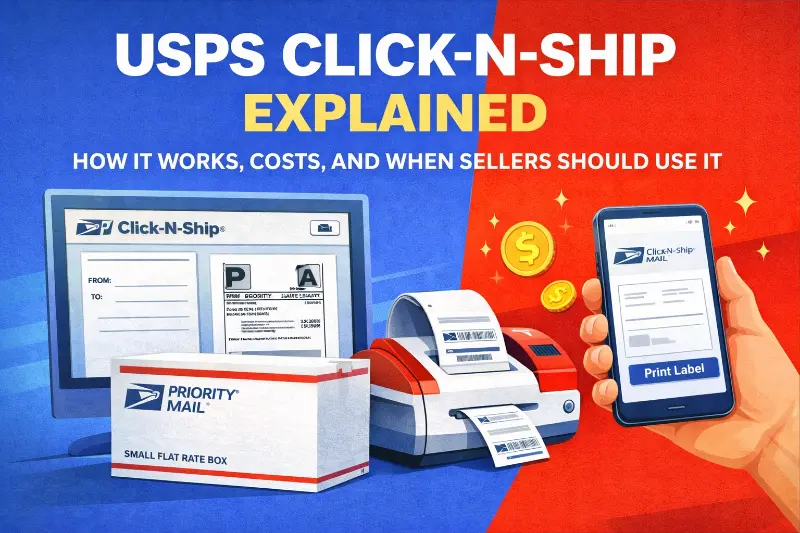
USPS Click-N-Ship is the postal service’s free online label-printing tool, and for most Shopify sellers shipping more than 50 packages monthly, it’s already time to move beyond it. While Click-N-Ship underwent a significant upgrade in July 2024 that added commercial pricing and batch capabilities, the platform still lacks the ecommerce integrations, automation, and multi-carrier options that growing brands require. Click-N-Ship is a great option for small businesses, craft sellers, and frequent shippers who want to enjoy convenient online shipping, discounted pricing, and free shipping supplies. The strategic question isn’t whether Click-N-Ship works, it’s whether the time spent on manual workflows costs more than free alternatives like Pirate Ship or paid platforms like ShipStation that deliver the same discounts with far greater efficiency.
This matters because shipping costs typically consume 8-15% of ecommerce revenue, and the gap between retail and commercial USPS rates ranges from 15-40% depending on service and package size. A seller shipping 200 packages monthly at retail rates instead of commercial rates loses roughly $400-800/month in unnecessary postage, before accounting for the labor cost of manual data entry. The tools you choose shape your margins, customers’ satisfaction, customer experience, and operational scalability, including strategies for making free shipping profitable.
What Click-N-Ship actually does and how it evolved
USPS Click-N-Ship allows anyone to create prepaid shipping labels from home with a free USPS.com account, avoiding post office lines entirely. Users must create a free USPS.com account to start using Click-N-Ship. Users enter package details, select services, purchase shipping labels and additional services such as insurance or signature confirmation, pay online, and print the shipping label on standard paper or thermal printers. The service has existed since before 2004, when the Postal Service marketed it as “bringing the Post Office to your desktop.”
The platform underwent its most significant transformation on July 14, 2024, when USPS launched Enhanced Click-N-Ship (CNSv2). This upgrade added commercial pricing for all users (previously restricted to business accounts) along with batch label creation, file upload capabilities, expanded payment options including Apple Pay and Click-to-Pay, and the ability to manage up to 1,000 addresses in an online address book. In February 2025, USPS discontinued the legacy version entirely, migrating all users to the enhanced platform.
These improvements matter, but context is essential: Click-N-Ship generated 32 million labels and nearly $385 million in sales in 2024, demonstrating its scale while highlighting that the average label value was approximately $12, consistent with occasional shippers sending Priority Mail packages rather than high-volume ecommerce operations.
The step-by-step workflow for creating labels
Creating a Click-N-Ship label involves entering your return address, recipient address (with USPS validation), package dimensions and weight, then selecting from available services. The system displays pricing, allows adding extras like insurance or signature confirmation, and processes payment through one of seven accepted methods: credit/debit cards, PayPal, Apple Pay, Click-to-Pay, or USPS Enterprise Payment System for businesses. You can print shipping labels until 11:59 PM CST of the designated shipping date, ensuring you are ready to ship on your preferred schedule. Users are only charged when they complete the purchase or print the label.
Labels generate as 8.5” x 11” PDFs that can be trimmed and taped to packages, or sellers can convert them for 4×6 thermal printing. For those without printers, USPS offers Label Broker (free in-store printing with a QR code) and Label Delivery Service (a $1.65 fee to receive a printed label by mail). After affixing the label, customers can ship a package by dropping it in a USPS collection box or bringing it to a post office for drop off. USPS Click-N-Ship includes delivery confirmation numbers to track the date and time of delivery.
Free package pickup scheduling through USPS.com allows you to schedule pickups up to three months ahead, with carriers collecting parcels during normal mail delivery, a genuine advantage for home-based sellers. If you’re looking to understand more about processes like pick and pack fulfillment, which are essential for efficient shipping operations, you can find more information online. Once you are ready with your labeled package, you can easily drop it off or schedule a pickup for added convenience.
The Enhanced version added a Label Manager for organizing unpurchased labels with bulk editing, a 12-month Shipping History for reprinting and tracking, and a “Ship Again” feature for repeat shipments. These improvements bring Click-N-Ship closer to third-party software functionality, though meaningful gaps remain.
Let AI Optimize Your Shipping and Boost Profits
Cahoot.ai software selects the best shipping option for every order—saving you time and money automatically. No Human Required.
See AI in ActionAvailable services span domestic and international shipping
Click-N-Ship supports Priority Mail Express (1-3 day delivery with money-back guarantee), Priority Mail (2-3 business days with flat rate options), USPS Ground Advantage (2-5 business days), and Parcel Select for larger packages. International options include Priority Mail Express International, Priority Mail International, and First-Class Package International Service to approximately 180 countries.
When preparing your shipment, you can easily create and print a shipping label through USPS Click-N-Ship. Self-adhesive shipping labels are compatible with Click-N-Ship and can be printed easily at home or at the post office. Shipping labels for USPS Click-N-Ship can be printed on standard 8.5″ x 11″ sheets, with two labels per sheet. The adhesive on self-adhesive shipping labels is strong and designed not to fall off in transit, reducing the risk of lost or delayed items. Using self-adhesive labels can also save time and money compared to using regular paper and tape. Properly affixed and clearly addressed shipping labels are essential, as items with unclear addresses or poorly attached labels are often lost or delayed in the mailing process. For written communication or addressing packages, including a clear letter with the correct recipient information helps ensure proper identification and tracking.
Extra services available through Click-N-Ship include insurance up to $5,000 (Priority Mail and Ground Advantage include $100 free coverage), Signature Confirmation, Adult Signature Required, USPS Tracking Plus (10-year tracking history), and delivery instructions. These cover most standard ecommerce shipping needs adequately.
However, several services remain unavailable. Media Mail (critical for book sellers) cannot be purchased through Click-N-Ship and requires post office visits or third-party platforms like Pirate Ship. Certified Mail, Registered Mail, Library Mail, and Bound Printed Matter also require alternative purchasing methods. Notably, Global Express Guaranteed (GXG) was removed from Click-N-Ship in July 2024, forcing international premium shippers to use stamps or permit imprints at the post office.
How Click-N-Ship compares with shipping software for ecommerce sellers
The fundamental distinction between Click-N-Ship and third-party shipping platforms isn’t pricing (Enhanced Click-N-Ship now offers commercial rates comparable to most alternatives). The differences lie in integration, automation, multi-carrier support, and scalability.
Click-N-Ship is perfect for individual sellers, small eBay shops, or Etsy stores who need a straightforward way to print USPS labels without complex integrations. However, it has no native integration with Shopify, WooCommerce, Amazon, eBay, or Etsy. Every order requires manual address entry or file upload. Shipping software platforms connect directly to stores, automatically importing orders, populating shipping details, syncing tracking numbers back to marketplaces, and triggering customer notifications. ShipStation alone offers 300+ integrations spanning ecommerce platforms, marketplaces, ERPs, and accounting systems.
Batch processing illustrates the efficiency gap. Click-N-Ship now supports multi-label creation and file uploads, but the system maxes at 10 domestic labels per credit card transaction and lacks sophisticated bulk editing. ShipStation processes 500 labels simultaneously with automated carrier selection, weight assignment based on SKU, and rules-based service selection. Pirate Ship offers unlimited batch shipping with spreadsheet imports. Cahoot offers multi-carrier shipping software with fully automatic label generation and lowest cost labels for all your orders.
Automation rules represent perhaps the starkest contrast. ShipStation users create if-this-then-that logic: orders over 5 pounds automatically assign to UPS Ground, products containing “fragile” SKUs automatically add insurance, international shipments auto-generate customs documentation. Click-N-Ship offers none of this. Every decision requires human input.
Multi-carrier access matters because USPS isn’t always optimal. For packages over 10 pounds, UPS Ground frequently beats USPS pricing, particularly for longer zones. FedEx may offer better regional coverage or faster options for specific destinations. Click-N-Ship is USPS-only by design. Platforms like ShipStation compare rates across 100+ carriers in real-time, while Pirate Ship offers USPS and UPS comparison. Rate shopping at checkout ensures sellers never overpay on individual shipments.
The pricing reality has changed significantly
The 2024 Enhanced Click-N-Ship update shifted the pricing equation substantially. Users now receive commercial rates automatically, the same tier previously requiring approved postage vendors. For Priority Mail, this means approximately 18-24% off retail rates. Ground Advantage savings range from 15-33% depending on weight and zone.
However, Pirate Ship and select platforms access an even deeper discount tier: USPS Connect eCommerce, introduced in 2022. This tier sits below standard commercial pricing and delivers additional savings of 5-15% on Ground Advantage and Priority Mail. Pirate Ship passes these rates through with zero markup and no monthly fees, making it objectively cheaper than Click-N-Ship for the same services.
Concrete price comparisons illustrate the stakes. A Priority Mail Small Flat Rate Box costs approximately $10.40 retail at the post office, $8.50 with commercial pricing through Click-N-Ship, and potentially lower through Connect eCommerce via Pirate Ship. For Ground Advantage packages under 1 pound, savings range from $2.14-$5.52 compared to retail. Priority Mail Cubic (available only through commercial accounts, not at post office counters) offers up to 40% savings on small, heavy packages, a service Click-N-Ship supports but many sellers don’t realize exists.
For frequent shippers or small businesses printing a lot of shipping labels, these savings add up quickly. Buying and printing labels in a lot not only streamlines the process but also maximizes cost efficiency, especially when handling bulk shipments.
Platform costs vary considerably. Click-N-Ship and Pirate Ship charge $0 monthly with $0 per-label fees. Shippo’s starter tier charges $0.05 per label. ShipStation ranges from $9.99/month (50 shipments) to $399.99/month (unlimited), with per-shipment costs dropping to approximately $0.08 at higher tiers.
The hidden cost equation goes beyond postage rates
Manual workflow costs matter more than subscription fees for growing sellers. Professional data entry benchmarks suggest 2-5 minutes per label for manual Click-N-Ship entry including address typing, rate checking, and printing. Shipping software with auto-imported orders reduces this to 15-30 seconds per label, a 15x efficiency gain by ShipStation’s measurement.
At 100 packages monthly, manual entry consumes approximately 5-8 hours of labor. At minimum wage equivalent of $15/hour, that’s $75-120 in time cost alone, before accounting for the cognitive load of context-switching between order management systems and USPS. Paid platforms eliminate this friction while delivering equal or better rates.
Human error compounds the cost. Manual data entry carries a 1-4% error rate industry-wide. At 1,000 annual shipments, even 1% errors means 10 misrouted packages requiring reshipping, customer service time, and potential refunds. Industry estimates place correction costs at $50-150 per error, translating to $500-1,500 in annual error costs for a modest-volume seller making the common mistake of manual entry at scale. If errors or shipping issues occur, USPS staff can assist by helping resolve claims, tracking lost packages, and providing guidance to ensure problems are addressed quickly.
If a package is misdelivered, contact the local Postmaster as soon as possible to verify delivery details and initiate a search. If the package cannot be located and is insured, a claim can be filed. However, if a package is delivered to the correct address but is missing, it is likely stolen and an insurance claim may not be honored. Some Postmasters will assist in approving claims, but their approval may be overturned by upper management.
ShipStation vs. Cahoot: 21x Faster, Real Results
Get the inside scoop on how a leading merchant switched from ShipStation to Cahoot—and what happened next. See it to believe it!
See the 21x DifferenceWhen Click-N-Ship genuinely makes sense for sellers
Click-N-Ship remains appropriate for specific profiles. Sellers shipping 1-10 packages weekly (under 50 monthly) without ecommerce platform integration needs find reasonable value in the tool’s zero-cost simplicity. The free package pickup scheduling provides genuine convenience for home-based businesses avoiding post office trips, while those who prefer can easily drop off packages at their local post office for added flexibility. Sellers already using USPS exclusively with predictable Priority Mail shipments face minimal friction.
International shipping for occasional sellers represents another valid use case. Click-N-Ship handles customs documentation reasonably well for Priority Mail International to 180 countries, and small-volume international shippers may not need the sophisticated landed-cost calculators that platforms like Easyship provide.
The “Ship Again” feature creates value for repeat shipments. Sellers regularly sending to the same addresses can replicate past labels quickly. The 12-month shipping history with reprint and refund request capabilities provides adequate record-keeping for low-volume operations.
One-off scenarios outside normal ecommerce operations also fit Click-N-Ship well: sending samples to influencers, shipping returns to suppliers, or handling ad-hoc B2B shipments that don’t flow through standard order management.
Where Click-N-Ship breaks down for growing brands
Several volume thresholds trigger the case for migration. At 50+ packages monthly, the manual entry time cost begins exceeding any conceivable software subscription fee. At 200+ monthly, sellers without automation are losing meaningful competitive ground on fulfillment speed and customer experience. At 500+ monthly, operating without shipping software represents clear operational negligence.
Integration limitations create hard constraints. Sellers on Shopify, WooCommerce, or marketplaces cannot sync orders automatically, requiring copy-paste workflows or file exports that introduce delay and error risk. Tracking numbers must be manually entered back into selling platforms, creating customer service gaps when buyers check order status. Multi-channel sellers face exponentially worse friction managing orders across platforms without unified shipping software.
Rate comparison absence means sellers lack visibility into whether USPS actually represents the best option for each shipment. For packages over 10 pounds or traveling across multiple zones, UPS Ground frequently undercuts USPS pricing, but Click-N-Ship users have no way to know without separately checking carrier websites.
Service gaps matter for specific verticals. Book sellers needing Media Mail cannot use Click-N-Ship at all. Sellers requiring proof of mailing through Certified Mail must visit post offices. The removal of Global Express Guaranteed eliminated the fastest international option for time-sensitive cross-border shipments.
The batch processing ceiling of 10 labels per transaction creates bottlenecks during peak periods. Black Friday sellers manually creating hundreds of labels face hours of repetitive work that software handles in minutes.
When it comes to lost or misdelivered packages, resolving the issue can be unpredictable—sometimes, finding a resolution depends on luck. Even with customer service efforts, the outcome may not always be certain.
Cut Costs with the Smartest Shipping On the Market
Guranteed Savings on EVERY shipment with Cahoot's AI-powered rate shopping and humanless label generation. Even for your complex orders.
Cut Costs TodayA decision framework for choosing shipping tools
The decision matrix hinges on three variables: monthly volume, platform complexity, and carrier diversification needs.
For sellers shipping under 50 packages monthly with single-platform operations using USPS exclusively, Click-N-Ship or Pirate Ship (free, same commercial rates) both work, though Pirate Ship’s Connect eCommerce pricing makes it marginally cheaper while adding basic Shopify/Etsy integration.
At 50-200 packages monthly, free platforms with integrations become essential. Pirate Ship, Shippo’s free tier, or ShippingEasy’s free option for under 50 orders monthly provide commercial rates plus order sync without subscription costs. Shopify’s built-in shipping also warrants consideration here, offering up to 88% carrier discounts within the platform sellers already use.
Crossing 200 packages monthly generally justifies paid software. ShipStation Starter at $29.99/month for 500 shipments costs approximately $0.06 per package, a fraction of the time savings from automation. The ROI becomes obvious: if automation saves 1 minute per label, 200 labels monthly saves 3+ hours, worth far more than $30 at any reasonable labor cost.
At 500+ monthly volume, advanced features like inventory management, multi-warehouse support, branded tracking pages, and API access drive software selection beyond basic shipping needs. ShipStation, Shippo Pro, or direct negotiations with carriers become appropriate.
Frequently Asked Questions
What is USPS Click-N-Ship and how does it work?
USPS Click-N-Ship is a free online tool that allows anyone with a USPS.com account to create prepaid shipping labels from home without visiting the post office. You enter your return address, recipient address, package dimensions and weight, select a service (Priority Mail, Ground Advantage, etc.), and purchase your shipping label online. During the purchase process, you can also buy additional services such as insurance and signature confirmation. All labels created with Click-N-Ship include delivery confirmation numbers for tracking. The Enhanced version launched in July 2024 added commercial pricing for all users (18-24% off retail rates), batch label creation, and 12-month shipping history. Labels print as 8.5” x 11” PDFs or can be converted for 4×6 thermal printing.
What USPS services are available through Click-N-Ship?
Click-N-Ship supports Priority Mail Express (1-3 day), Priority Mail (2-3 day), USPS Ground Advantage (2-5 day), and international services to 180 countries including Priority Mail International and First-Class Package International. Extra services include insurance up to $5,000, Signature Confirmation, and delivery instructions. However, Media Mail, Certified Mail, Registered Mail, Library Mail, and Bound Printed Matter are NOT available through Click-N-Ship and require post office visits or third-party platforms like Pirate Ship.
How does Click-N-Ship compare to shipping software like Pirate Ship or ShipStation?
The fundamental distinction between Click-N-Ship and third-party shipping platforms isn’t pricing (Enhanced Click-N-Ship now offers commercial rates comparable to most alternatives). The differences lie in integration, automation, multi-carrier support, and scalability.
Click-N-Ship is perfect for individual sellers, small eBay shops, or Etsy stores who need a straightforward way to print USPS labels without complex integrations. However, it has no native integration with Shopify, WooCommerce, Amazon, eBay, or Etsy. Every order requires manual address entry or file upload. Shipping software platforms connect directly to stores, automatically importing orders, populating shipping details, syncing tracking numbers back to marketplaces, and triggering customer notifications. ShipStation alone offers 300+ integrations spanning ecommerce platforms, marketplaces, ERPs, and accounting systems.
Batch processing illustrates the efficiency gap. Click-N-Ship now supports multi-label creation and file uploads, but the system maxes at 10 domestic labels per credit card transaction and lacks sophisticated bulk editing. ShipStation processes 500 labels simultaneously with automated carrier selection, weight assignment based on SKU, and rules-based service selection. Pirate Ship offers unlimited batch shipping with spreadsheet imports. Cahoot offers multi-carrier shipping software with fully automatic label generation and lowest cost labels for all your orders.
Automation rules represent perhaps the starkest contrast. ShipStation users create if-this-then-that logic: orders over 5 pounds automatically assign to UPS Ground, products containing “fragile” SKUs automatically add insurance, international shipments auto-generate customs documentation. Click-N-Ship offers none of this. Every decision requires human input.
Multi-carrier access matters because USPS isn’t always optimal. For packages over 10 pounds, UPS Ground frequently beats USPS pricing, particularly for longer zones. FedEx may offer better regional coverage or faster options for specific destinations. Click-N-Ship is USPS-only by design. Platforms like ShipStation compare rates across 100+ carriers in real-time, while Pirate Ship offers USPS and UPS comparison. Rate shopping at checkout ensures sellers never overpay on individual shipments.
At what volume should I upgrade from Click-N-Ship to shipping software?
The migration threshold is 50 packages monthly. Below 50 monthly, Click-N-Ship or free alternatives like Pirate Ship work adequately. At 50-200 monthly, free platforms with integrations (Pirate Ship, Shippo free tier, Shopify Shipping) become essential to avoid manual entry costs that exceed any subscription fee. Manual entry takes 2-5 minutes per label versus 15-30 seconds with automation. At 100 packages monthly, manual workflows consume 5-8 hours of labor costing $75-120, making free integrated alternatives obvious. At 200+ monthly, paid platforms like ShipStation ($29.99+/month) deliver automation ROI that far exceeds subscription costs.
Does Click-N-Ship offer commercial pricing or just retail rates?
As of the July 2024 Enhanced Click-N-Ship upgrade, all users receive commercial pricing automatically (the same tier previously requiring approved postage vendors). This provides approximately 18-24% off retail Priority Mail rates and 15-33% off Ground Advantage depending on weight and zone. However, platforms like Pirate Ship access an even deeper USPS Connect eCommerce tier that saves an additional 5-15% on the same services. A Priority Mail Small Flat Rate Box costs approximately $10.40 retail, $8.50 commercial through Click-N-Ship, and potentially lower through Connect eCommerce via Pirate Ship.
What are the main limitations of Click-N-Ship for ecommerce sellers?
Click-N-Ship’s critical limitations include zero ecommerce platform integration (no Shopify, WooCommerce, Amazon, eBay, or Etsy sync), USPS-only service (no UPS or FedEx rate comparison for packages where other carriers would be cheaper), 10-label batch processing maximum (versus 500+ in ShipStation), no automation rules (every decision requires manual input), unavailable services like Media Mail for book sellers, and 1-4% manual data entry error rates creating $50-150 correction costs per mistake. At 200+ monthly packages, these limitations compound into thousands in unnecessary labor and postage costs annually.
Written By:

Indy Pereira
Indy Pereira helps ecommerce brands optimize their shipping and fulfillment with Cahoot’s technology. With a background in both sales and people operations, she bridges customer needs with strategic solutions that drive growth. Indy works closely with merchants every day and brings real-world insight into what makes logistics efficient and scalable.

Turn Returns Into New Revenue
Related Articles
USPS Tracking Explained: What Each Status Means and How Sellers Should Respond
The “if it fits, it ships” model offers compelling economics for heavy items traveling cross-country, but costs Shopify brands up to 175% more than alternatives for lig...
USPS Tracking Explained: What Each Status Means and How Sellers Should Respond
USPS tracking messages are wrong 64% of the time, a startling finding from a 2023 USPS Office of Inspector General audit that examined 500 packages.
3PL Returns: How Outsourced Returns Actually Work and Where Brands Lose Money
Most brands outsource returns to a 3PL expecting cost savings, but returns fail when disposition rules, SLAs, and audit controls are undefined.