
USPS Ground Advantage vs Priority Mail: Which Shipping Service Should Ecommerce Sellers Use?

Last updated on July 14, 2026
In this article
 14 minutes
- USPS Ground Advantage vs Priority Mail: The Short Answer
- USPS Ground Advantage vs Priority Mail Comparison Table
- What Is USPS Ground Advantage?
- What Is Priority Mail?
- Ground Advantage Usually Wins on Cost When Delivery Is Flexible
- Priority Mail Is Worth Considering When Speed or Packaging Matters
- Flat Rate Packaging Can Change the Cost Equation
- Do Both Services Include Tracking and Insurance?
- Accurate Dimensions Matter More Than Sellers Think
- How Ecommerce Sellers Should Choose Between Ground Advantage and Priority Mail
- Why Service Selection Should Not Be Manual at Scale
- Frequently Asked Questions
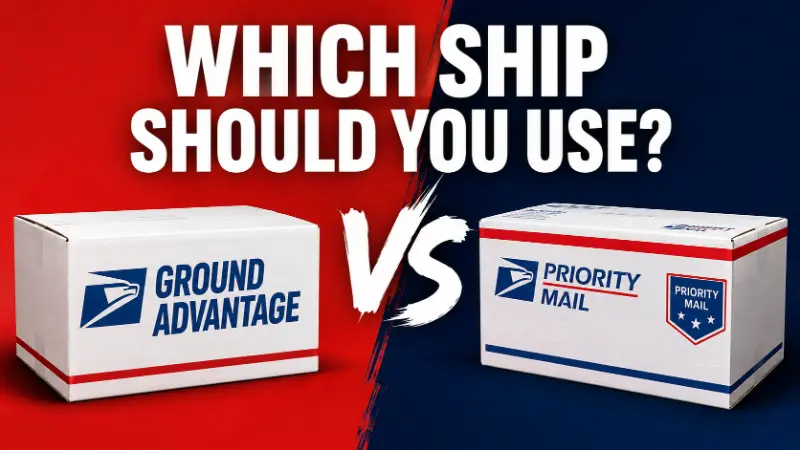
For most ecommerce sellers, USPS Ground Advantage is the more economical default for lightweight, non-urgent domestic parcels with a 2 to 5 business day delivery window, while Priority Mail is the better fit when faster delivery is needed, Flat Rate packaging lowers the cost, or a customer is paying for expedited shipping. Neither service wins every order. The right pick depends on package weight, dimensions, zone, delivery promise, and margin.
That is the operational reality behind the usps ground advantage vs priority mail decision. Choosing the wrong service affects shipping cost, delivery speed, and customer satisfaction, so small pricing mistakes can turn into lower margins or delayed orders at scale. This comparison is written for ecommerce sellers who need a practical way to choose between the two for domestic parcels, including delivery speed, pricing, Flat Rate boxes, tracking and insurance, best use cases, and how to select the right service based on the order and the customer expectation.
USPS Ground Advantage vs Priority Mail: The Short Answer
Ground Advantage is usually the cheaper choice for standard domestic parcels when a 2 to 5 business day delivery window is acceptable. Priority Mail is usually the better choice when the delivery promise is tighter, when the customer is paying for expedited shipping, or when a heavy but compact item fits inside Flat Rate packaging that flattens the zone-based math.
Neither service is universally superior. Both include USPS Tracking and up to $100 of insurance on most shipments. Both can handle packages up to 70 lbs. The difference shows up in delivery speed, packaging options, and how the rates behave against your specific weight, dimensions, and zone.
USPS Ground Advantage vs Priority Mail Comparison Table
| Feature | USPS Ground Advantage | USPS Priority Mail |
| Delivery speed | 2 to 5 business days | Typically 2 to 3 business days |
| Cost tendency | Often lower for standard parcels with flexible delivery | Often higher, but can win with Flat Rate or small dense packages |
| Weight limit | Up to 70 lbs | Up to 70 lbs on most shipments |
| Tracking | Included | Included |
| Insurance | Up to $100 included | Up to $100 included on most shipments |
| Flat Rate packaging | Not available | Flat Rate envelopes and boxes supported |
| Best use cases | Lightweight parcels, non-urgent orders, margin-sensitive SKUs, returns | Speed-sensitive orders, heavy items in Flat Rate, small dense products |
| Main seller caveat | Delivery window is a range, not a promise | Cost can climb quickly with weight and distance without Flat Rate |
What Is USPS Ground Advantage?
USPS Ground Advantage is a domestic shipping service, and USPS launched Ground Advantage by consolidating older economy options into one product. It replaced First-Class Package Service, USPS Retail Ground, Parcel Select Ground, and other retail ground offerings. It handles parcels up to 70 lbs with an expected delivery window of 2 to 5 business days, and it includes USPS Tracking and up to $100 of insurance at no extra cost. It is the only USPS service for certain hazardous materials that must travel by ground, including lithium batteries.
For ecommerce sellers, Ground Advantage is the workhorse service for orders where the customer does not need it tomorrow. It typically wins on cost for the kinds of parcels most online retailers ship every day: lightweight, standard-shaped, and destined for residential addresses. Because tracking and basic insurance are included, sellers do not have to bolt on extra services to get the visibility their customers expect, which is especially important on marketplaces like Google Shopping where delivery and shipping order fulfillment performance directly influences conversion.
What Is Priority Mail?
Priority Mail is USPS’s faster domestic package service because priority mail delivers sooner by using air and ground transportation, typically arriving in 1 to 3 business days. Like Ground Advantage, it includes USPS Tracking and up to $100 of insurance on most shipments, and it supports packages up to 70 lbs.
What sets Priority Mail apart is flat rate shipping. USPS provides free Priority Mail boxes and a USPS flat-rate envelope with flat rate pricing, so those packages ship at a fixed price regardless of weight within the package limit or destination zone. For heavy or dense products that fit those packages, Flat Rate can dramatically undercut what weight-based pricing would produce. Sellers also use Priority Mail when a marketplace expects faster delivery, when the buyer paid for expedited shipping, or when a tighter delivery promise justifies the higher base cost. If you buy labels directly from USPS, the process is covered in more detail in our USPS Click-N-Ship guide. It is the better shipping option when faster delivery times matter.
Ground Advantage Usually Wins on Cost When Delivery Is Flexible
The pattern most ecommerce operations settle into is that Ground Advantage handles the bulk of standard orders, and Priority Mail handles the exceptions. That works because the shipments Ground Advantage is designed for line up neatly with what most online retailers actually ship, making it a preferred shipping option for non urgent shipments when shipping costs start at $4.75 at retail.
- Lightweight parcels that used to move under First Class Package Service, alongside the broader class mail and USPS First Class Mail category sellers often compared historically, including USPS First Class for letters and small mailpieces.
- Non-urgent orders where the customer has not paid for faster delivery.
- Margin-sensitive SKUs where every dollar of shipping cost matters.
- Free shipping offers, where the seller is absorbing the label cost.
- Returns, where speed is less critical than keeping the reverse logistics affordable.
USPS Ground Advantage packages typically move in 2 to 5 business days; ground advantage packages also support saturday delivery, but usps ground advantage deliver schedules do not include Sundays.
Returns are worth calling out separately. When a customer sends an item back, the delivery window is rarely the deciding factor, and cost usually is. Ground Advantage often makes the most sense for prepaid return labels, though the mechanics of setting those up are covered in more depth in our guide on how return shipping labels work.
Priority Mail Is Worth Considering When Speed or Packaging Matters
Priority Mail earns its cost when this shipping service can justify higher rates through faster delivery times, packaging advantages, or tighter promises that support customer satisfaction.
- Tighter delivery promises, such as a two-day expectation on a product page or checkout page.
- Customer-paid expedited shipping, where the buyer chose and paid for the faster option.
- Marketplace delivery expectations that lean toward faster service levels.
- Heavier products that fit inside a Priority Mail Flat Rate box.
- Small dense products that price well under Priority Mail’s cubic-based commercial options because of package volume.
Small dense items are the classic case where Priority Mail can quietly beat expectations. A five-pound product in a compact box may cost more under weight-based pricing but qualify for Priority Mail Cubic pricing under commercial plans, changing the math entirely.
Flat Rate Packaging Can Change the Cost Equation
Priority Mail Flat Rate is one of the most misunderstood tools in USPS pricing. The rule is simple: if it fits in the box, and it is within the weight limit, it ships at the same price to any domestic zone. That fixed-price model contrasts with zone based pricing, where cost changes by distance and weight, so the advantage depends on how far the package is going and how heavy it is.
A dense five- or ten-pound product that fits in a medium Flat Rate box can ship to the other side of the country at a price that weight- and zone-based services simply cannot match. A USPS flat-rate envelope can also beat weight-based pricing for compact, heavy items that fit within its limits. On short zones with lighter items, Flat Rate almost always loses. The trick is knowing which SKUs actually benefit, and packing them accordingly. Our breakdown of USPS Flat Rate Boxes walks through the box sizes and the scenarios where each one earns its keep.
Do Both Services Include Tracking and Insurance?
Yes. USPS Ground Advantage and Priority Mail both include USPS Tracking and up to $100 of insurance on most shipments, with no extra charge and no separate purchase required. For most ecommerce orders, that baseline is enough.
Sellers should still pay attention to a few practical details. The $100 included coverage will not be enough for high-value items, and additional insurance coverage can be purchased up to $5,000 when it makes sense. Claims require proof of value and evidence of loss or damage, so keeping order records and packaging photos accessible is worth the small operational effort. If proof of mailing or delivery documentation matters, services such as certified mail may also be available separately depending on the shipment type. For a deeper look at how the tracking data flows and how to use it in customer communications, see our USPS Tracking explained article, and many merchants also review order fulfillment services reviews when evaluating partners to help manage these shipping and claims workflows.
Accurate Dimensions Matter More Than Sellers Think
Package dimensions are quietly one of the biggest drivers of shipping cost accuracy. Package size limits still apply, and the maximum combined length and girth is 130 inches. Dimensional weight, or DIM weight, is the pricing model carriers use to charge for the space a package occupies rather than just its physical weight. A light but bulky box can end up priced as if it weighed several pounds more. Ground Advantage and Priority Mail both use dimensional pricing above certain size thresholds, so understating the dimensions of a package can produce label prices that do not match what USPS actually charges.
This matters even more now that USPS is expanding requirements for accurate parcel dimensions in shipping manifests, with updated dimension reporting requirements taking effect July 12, 2026. Sellers who have been rounding down, guessing, or reusing old dimension data on their SKUs will want to clean up their product data before those changes tighten. Beyond compliance, accurate dimensions produce accurate rate shopping, which is the foundation of every automated service selection decision downstream. This is a common area where hidden shipping fees quietly erode margin.
How Ecommerce Sellers Should Choose Between Ground Advantage and Priority Mail
The decision is easier when comparing USPS Ground Advantage for shipping decisions through a few operational checks rather than relying on a general preference for one service, especially when you are already using multi-carrier shipping software for ecommerce to automate rate comparisons.
- Start with the promised delivery date on the order. If the buyer expects delivery in three business days or less, Priority Mail is often the safer choice because faster delivery times usually matter most.
- Check actual package weight and dimensions, not estimates. The right service can flip on a single pound or a single inch.
- Compare zone and commercial rates for the specific shipment, whether you buy labels online or drop off at the post office. Ground Advantage often wins on short zones, but not always.
- Test Flat Rate when the item is heavy and compact. If it fits, run the numbers before defaulting to weight-based pricing.
- Consider customer expectations and margin. A low-margin order with a flexible delivery window is a Ground Advantage candidate. A customer-paid expedited order is a Priority Mail candidate.
- Use shipping software or fulfillment logic instead of choosing manually. Rate shopping across services and carriers on every order is only realistic through automation, and a streamlined shipping process with ecommerce fulfillment software can improve customer satisfaction for ecommerce businesses and ecommerce sellers.
It is also worth remembering that USPS is not the only economical ground option. For some shipments, alternatives like UPS Ground Saver deserve a spot in the rate shopping comparison, especially at higher volumes or on specific lanes. That is also useful when comparing USPS Ground Advantage against other low-cost services for non-urgent shipments.
Why Service Selection Should Not Be Manual at Scale
Choosing between USPS Ground Advantage and Priority Mail on a single order is straightforward. Doing it correctly across thousands of orders a day, with different weights, dimensions, zones, marketplaces, delivery promises, and margin profiles, is not something a human should be doing order by order, and free package pickup through USPS Package Pickup can also support higher-volume operations without extra trips; many brands instead rely on order fulfillment services for ecommerce companies to handle this complexity.
At any real volume, service selection belongs to shipping rules and rate shopping logic. For automation-focused teams, that pickup convenience matters too because it removes manual handoff steps from shipping decisions. That means clean product dimension and weight data, accurate delivery promises tied to each order source, real-time rate comparison across carriers and service levels, and the ability to route each order to the fulfillment location that produces the best combination of cost and delivery date. Platforms that provide ecommerce order fulfillment services help ecommerce brands make those fulfillment and shipping decisions automatically based on inventory location, package profile, carrier options, and delivery promises, so the right USPS service (or non-USPS service) gets chosen on every order without a human deciding one label at a time.
Frequently Asked Questions
Is USPS Ground Advantage cheaper than Priority Mail?
Ground Advantage is usually cheaper for standard parcels when a 2 to 5 business day delivery window is acceptable. At retail, USPS Ground Advantage starts at $4.75, so shipping costs are often lower, while Priority Mail may still win when Flat Rate pricing benefits the shipment. Priority Mail can still be cheaper on heavy items that fit Flat Rate packaging, and on some small dense parcels priced under commercial cubic rates.
Is Priority Mail faster than Ground Advantage?
Yes, typically. Priority Mail is positioned around a 2 to 3 business day delivery timeframe and uses air and ground transportation, while Ground Advantage is 2 to 5 business days and relies on ground transportation and ground transport. Neither is a guaranteed delivery date. Priority Mail is usually the better choice for urgent orders, while Ground Advantage fits non-urgent shipments.
Does USPS Ground Advantage include tracking?
Yes. USPS Tracking is included with Ground Advantage at no additional cost.
Does Priority Mail include insurance?
Most Priority Mail shipments include up to $100 of insurance at no extra cost. Additional coverage can be purchased for higher-value items.
Can I use Priority Mail Flat Rate boxes with Ground Advantage?
No. Flat Rate packaging is a Priority Mail feature. Ground Advantage uses your own packaging priced by weight, dimensions, and zone. It does not support flat rate shipping or a USPS flat-rate envelope.
Which USPS service is better for ecommerce sellers?
Neither service is universally better. Ground Advantage is often the default for lightweight, non-urgent orders, and it is often the better choice for USPS Ground Advantage packages going to PO Boxes, military addresses, and military bases when speed is not urgent. Priority Mail is a better fit when speed, Flat Rate packaging, or tighter delivery promises are involved. For ecommerce sellers, the right choice also affects shipping costs and customer satisfaction. The best approach is automated rate shopping on every order.
Is USPS Ground Advantage good for returns?
Yes. Returns rarely require fast delivery, so Ground Advantage often makes sense on prepaid return labels where cost is the priority.
Should ecommerce sellers use USPS for every order?
No. USPS is competitive on many lightweight and residential parcels, but not every lane or package profile. Some sellers still compare Ground Advantage with older USPS services at the post office, but current shipping decisions should be based on live rates and delivery needs. Sellers at scale should rate shop across USPS and other carriers rather than defaulting to a single provider, and many rely on a distributed network of US fulfillment centers for ecommerce fulfillment services to keep parcels close to customers while controlling costs.
Written By:

Indy Pereira
Indy Pereira helps ecommerce brands optimize their shipping and fulfillment with Cahoot’s technology. With a background in both sales and people operations, she bridges customer needs with strategic solutions that drive growth. Indy works closely with merchants every day and brings real-world insight into what makes logistics efficient and scalable.

Turn Returns Into New Revenue
Related Articles

Why Cross-Border DTC Brands Are Moving Fulfillment Inside the US
Cross-border ecommerce fulfillment is the process of shipping ecommerce orders across national borders—often from warehouses outside the United States to U.
Crafting a Return Policy that Drives Customer Loyalty and Reduces Returns
Let’s talk about ecommerce returns policies.

Cheapest Shipping from USA to UK: What It Really Costs
Shipping from the USA to the UK is one of the most common international routes for ecommerce brands, and it is also one of the most misunderstood from a cost perspective.