
What Is Cross Docking? How It Works and When to Use It

Last updated on April 24, 2026
In this article
 16 minutes
- How Cross Docking Works: Step by Step
- Pre-Distribution vs. Post-Distribution Cross Docking
- The Impact on Inventory Holding Costs
- Supply Chain Efficiency with Cross Docking
- When Cross Docking Makes Sense vs. Traditional Warehousing
- The Real Coordination Risk in Cross Docking
- Cross Docking in Ecommerce Contexts
- Frequently Asked Questions
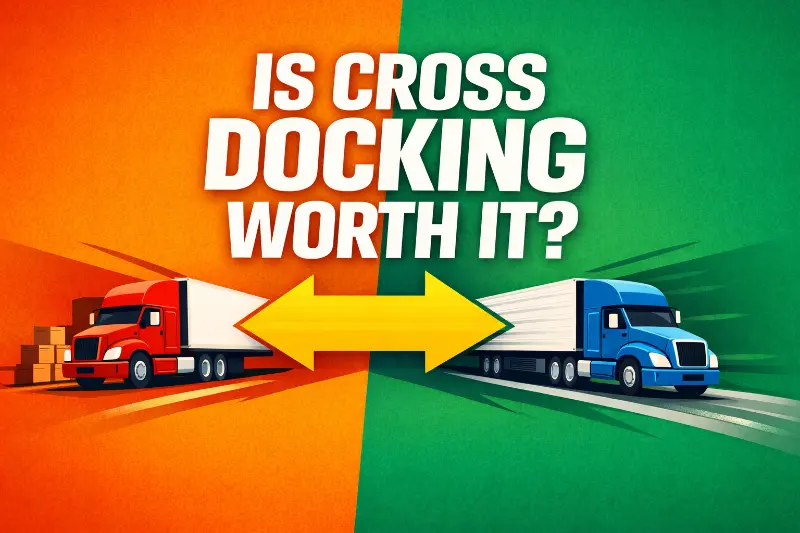
Cross docking is a logistics strategy where inbound shipments are unloaded at a facility, sorted, and immediately reloaded onto outbound vehicles with little or no time spent in storage. The goods cross from one dock door to another, hence the name, and the facility functions as a transfer point rather than a storage location.
The advantages of cross docking include increased supply chain efficiency, cost and time savings, and streamlined operations.
For operations teams and ecommerce brands evaluating their distribution network, the cross docking system is worth understanding not just as a definition but as a structural choice with real tradeoffs, often discussed at major logistics and fulfillment industry events. As a logistics strategy, it streamlines the movement of goods through centralized handling. It reduces inventory holding costs and accelerates delivery when conditions support it. When those conditions are not met, the absence of a storage buffer makes the entire network brittle.
Cross-docking typically requires less space and fewer resources for storage compared to traditional warehousing.
Additionally, cross-docking reduces the risk of product damage by minimizing manual handling compared to traditional warehousing operations.
How Cross Docking Works: Step by Step
A cross docking operation follows a compressed sequence where timing and coordination matter more than in traditional warehousing.
Inbound arrival. Trucks, containers, or other transport vehicles arrive at the cross docking terminal from suppliers, manufacturers, or upstream distribution centers. The physical layout of the facility is designed to handle simultaneous inbound and outbound activity, with separate inbound docks for receiving goods and a dedicated shipping dock for dispatching outbound shipments. This design helps prevent cross-traffic and streamlines the flow of goods.
Unloading and verification. Goods are unloaded at the receiving dock and immediately checked for accuracy and condition. This step involves scanning, labeling, and confirming quantities against the purchase order or advance shipping notice. In food and pharmaceutical supply chains, this is also where temperature compliance and shelf life are assessed. The verification step has to be fast, but it cannot be skipped. Errors caught here cost minutes. Errors that pass through undetected cost far more downstream.
Sorting and allocation. Items are sorted by destination. In pre-distribution cross docking, the destination of each item is already known before the truck arrives. Labels or documentation from the supplier designate where each unit is going, and the receiving team simply routes accordingly. In post-distribution cross docking, allocation decisions are made at the facility after arrival, which requires real-time demand data and routing logic to work correctly.
Staging and consolidation. Sorted goods move to staging areas near the outbound dock doors. Where multiple suppliers are contributing to the same outbound route, consolidation happens here. Shipments headed to the same retail outlet, distribution center, or region are grouped into outbound loads. By consolidating shipments, cross docking enables the use of fewer vehicles for outbound transport, reducing transportation costs and improving efficiency. This is where cross docking delivers one of its most significant cost advantages: outbound vehicles leave with full or near-full loads rather than partially loaded trucks making fragmented deliveries.
Outbound loading and departure. Consolidated shipments are loaded onto outbound vehicles and dispatched as part of outbound transport to their next destination. In a true cross docking operation, this entire sequence from inbound arrival to outbound departure completes within hours. Some operations target a maximum dwell time of under four hours. Others operate on a continuous flow basis where inbound and outbound vehicles are synchronized so goods essentially never stop moving.
This process enables a seamless inbound to outbound transfer of goods, with efficient management of incoming and outgoing vehicles through strategic dock placement and facility layout. The primary difference between cross-docking and traditional warehousing is the length of time products are stored in the facility—cross docking minimizes or eliminates storage time, while traditional warehousing involves longer-term storage.
Pre-Distribution vs. Post-Distribution Cross Docking
The distinction between these two approaches has meaningful operational implications.
In pre-distribution cross docking, the supplier or manufacturer assigns final destinations before the goods ship. When the truck arrives at the cross dock facility, the routing work is already done. This approach works best when demand is stable and predictable, and when the supplier relationship is tight enough to support coordinated labeling and documentation. It minimizes decision-making time at the facility and supports the fastest possible throughput.
In post-distribution cross docking, goods arrive at the facility without pre-assigned destinations. The allocation decision is made on-site, based on current inventory levels, store demand, or order data. This approach offers more flexibility but demands more from the facility’s technology and staff. Without a warehouse management system feeding real-time routing instructions, post-distribution cross docking quickly becomes a coordination problem.
Most ecommerce operations that adopt cross docking gravitate toward pre-distribution models because they offer more predictability, which is especially important for Amazon-focused 3PL shipping companies. Post-distribution is more common in large retail supply chains where demand signals are continuously updated and the technology infrastructure exists to act on them in real time.
The Impact on Inventory Holding Costs
The most straightforward financial case for cross docking is the reduction in inventory carrying costs and reducing inventory costs. When goods do not sit in storage, you are not paying for the space, labor, insurance, or capital tied up in that inventory.
Inventory holding costs in traditional warehousing typically run between 20 and 30 percent of inventory value annually, depending on the product category and the cost of warehouse space in your market. For high-velocity, predictable products, those holding costs add up without generating any operational value. The goods are simply waiting, leading to higher storage costs. Cross docking benefits include reducing storage costs, especially in industries like food, retail, automotive, chemicals, and pharmaceuticals, by minimizing storage time and enhancing efficiency.
Cross docking eliminates most of that wait time. Goods that transit a cross dock facility within hours rather than sitting in racked storage for days or weeks generate dramatically lower carrying costs per unit. For operations managing large volumes of consistent, fast-moving products, this difference has a material impact on gross margins. Cross docking benefits also include improved product handling by reducing the need for manual handling, which minimizes the risk of damage.
There is also an indirect benefit in capital efficiency. Inventory held in storage is capital that is not available for other uses. Faster throughput means faster inventory turns, which means the same working capital supports more revenue over a given period. Additionally, cross docking allows companies to optimize shipments, ensuring full truckloads and reducing environmental impact through fewer emissions, while careful management of carrier shipment exceptions prevents delays from undermining those gains.
Supply Chain Efficiency with Cross Docking
Cross docking is a powerful logistics strategy that can dramatically enhance supply chain efficiency for businesses of all sizes. By enabling the direct transfer of goods from inbound delivery vehicles to outbound vehicles with little or no storage time, cross docking reduces the need for traditional warehousing and associated warehousing services and the associated storage costs, labor costs, and inventory carrying costs. This streamlined approach allows companies to move products quickly and efficiently from suppliers to their final destination, supporting rapid delivery and better inventory management when combined with robust ecommerce fulfillment software.
One of the key ways cross docking boosts supply chain efficiency is by minimizing storage time and handling. Instead of goods sitting idle in a warehouse, they are sorted and consolidated at a cross docking facility and then shipped directly to retail stores, distribution centers, or customers. This direct transfer reduces operational costs and helps businesses respond swiftly to changes in demand, making it especially valuable for products with steady demand or short shelf lives.
There are several types of cross docking that support different supply chain needs. Pre-distribution cross docking involves sorting and allocating goods to their final destination before they arrive at the cross docking terminal, which is ideal for high-volume, predictable shipments and supports efficient inventory management. Post-distribution cross docking, on the other hand, allows allocation decisions to be made after goods arrive at the facility, providing flexibility for businesses that need to adapt to real-time demand fluctuations. Continuous cross docking takes efficiency a step further by maintaining a constant flow of goods through the cross dock warehouse, ensuring that products spend minimal time in the facility and are quickly loaded onto outbound vehicles.
The physical layout of a cross docking facility is designed to maximize efficiency, with multiple dock doors for simultaneous inbound and outbound shipments, ample staging areas for sorting, and optimized workflows that minimize handling. By reducing the number of touchpoints and storage time, cross docking reduces inventory costs, lowers the risk of product damage or obsolescence, and frees up capital that would otherwise be tied up in excess inventory.
Cross docking offers significant cost savings by reducing the need for warehouse storage and the labor required for inventory handling. It also helps businesses reduce transportation costs by consolidating shipments and ensuring outbound vehicles leave fully loaded, especially when leveraging innovative peer-to-peer order fulfillment services. This not only improves supply chain efficiency but also supports timely delivery and higher customer satisfaction—key factors in today’s competitive market for sellers using tools like Amazon Buy Shipping-integrated fulfillment.
In summary, cross docking is a logistics strategy that enables businesses to streamline their supply chain operations, reduce operational and inventory costs, and achieve faster, more reliable delivery. Whether using pre-distribution, post-distribution, or continuous cross docking, companies can leverage this approach to gain a competitive edge, optimize warehouse space, and meet evolving customer expectations with greater agility and efficiency.
When Cross Docking Makes Sense vs. Traditional Warehousing
Cross docking is not a universal improvement over traditional warehousing. It is a deliberate tradeoff that works well in specific conditions and creates fragility in others.
Cross docking performs best when:
- Demand is high-volume and predictable. Cross docking eliminates the buffer stock that absorbs demand variability. If you cannot forecast with confidence, the absence of safety stock becomes a liability rather than a cost saving.
- Products have short shelf lives or time-sensitivity. Perishable goods, seasonal items, and trend-sensitive products with a short shelf life all benefit from the faster throughput that cross docking enables. Reducing storage time preserves product quality and extends the effective selling window.
- Inbound shipments are already sorted or pre-labeled. Pre-distribution cross docking runs most efficiently when the supplier has done the allocation work upstream. If every inbound shipment requires extensive sorting at the facility, the labor savings from eliminating storage may be partially offset by increased handling time at the dock.
- Outbound routes are consolidated and consistent. Cross docking creates the most cost efficiency when outbound loads can be consolidated from multiple suppliers heading to the same destination. Fragmented outbound routes with small drops reduce the consolidation benefit.
- Industries such as department stores, retail, e-commerce, and manufacturing use cross docking to efficiently move goods through the supply chain and reduce costs. In manufacturing, cross docking supports just-in-time workflows by delivering components directly to production lines, reducing storage needs and waste.
You should use cross docking when you have fast-moving, time-sensitive shipments, reliable suppliers, and the ability to consolidate outbound routes. Specialized facilities are often used for efficient goods transfer in these scenarios.
Traditional warehousing is the better choice when:
- Demand is irregular or unpredictable. Safety stock exists specifically to absorb variability. Removing it in favor of cross docking eliminates your operational buffer and exposes the network to stockouts when demand spikes or supplier deliveries run late.
- Products have long shelf lives and slow velocity. The holding cost savings from cross docking are most significant for high-turn products. For slow-moving inventory, the coordination overhead of cross docking may not justify the cost reduction.
- Your supplier base is unreliable or fragmented. Cross docking depends on inbound shipments arriving on schedule. A supplier network with inconsistent lead times and frequent delays will regularly create situations where outbound vehicles are ready and waiting, but the inbound freight has not arrived.
- Traditional warehousing focuses on storage and inventory management, catering to longer-term stockholding needs.
It is important to note that a high initial investment is necessary to design and implement a functional cross-docking terminal, requiring specialized infrastructure.
The Real Coordination Risk in Cross Docking
Cross docking is sometimes described as a “lean” approach to distribution, and that framing is accurate in both the positive and negative sense of the word. Lean systems are efficient when operating as designed and fragile when a variable falls out of alignment.
The fundamental operational risk is timing. Cross docking requires inbound and outbound vehicles to be synchronized. Outbound trucks cannot load if inbound freight has not arrived. Inbound freight cannot unload efficiently if outbound capacity is not ready. When either side of that equation is disrupted, goods pile up in the staging area, and the cross dock facility starts behaving like an unplanned warehouse with none of the infrastructure for organized storage.
Demand forecasting errors compound this problem. Because cross docking operates with minimal buffer stock, any significant deviation between forecasted and actual demand has no inventory cushion to absorb it. An unexpected demand surge at a retail destination cannot be satisfied by pulling from safety stock at the cross dock. The problem travels upstream to procurement, which is a longer resolution path than simply releasing units from a reserve.
Labor and system dependencies are also concentrated risk points. A cross docking operation relies on warehouse management systems, carrier scheduling platforms, and supplier advance shipping notices functioning accurately in near-real time. A system outage, a missed ASN, or a carrier showing up outside their scheduled window introduces disruption that ripples through the entire flow for the duration of the shift.
For operations leaders evaluating cross docking, the question is not whether the cost savings are real. They are. The question is whether your supply chain has the predictability, supplier reliability, and technology infrastructure to sustain the coordination requirements consistently.
Cross Docking in Ecommerce Contexts
In ecommerce, cross docking appears in several practical scenarios that differ from traditional retail distribution.
One common application is inbound freight consolidation. An ecommerce brand sourcing from multiple suppliers can direct all inbound shipments to a cross docking facility where they are consolidated into optimized outbound loads to fulfillment centers or third-party logistics (3PL) locations. This reduces the number of inbound shipments each fulfillment location has to receive and process, cutting receiving labor costs and improving throughput at the destination.
Another application is commerce cross docking as a logistics strategy for online retailers. Products arriving in bulk from a manufacturer transit a cross dock facility where they are counted, labeled for Amazon or Walmart requirements, repackaged if necessary, and dispatched within 48 to 72 hours. The facility adds value during the brief dwell time rather than simply passing goods through, which is sometimes called a value-added cross dock model.
A third scenario is seasonal or promotional surge management. Rather than holding peak-season inventory in a primary fulfillment location at full storage cost, brands can stage inventory at a cross dock facility closer to the peak window and move it through into fulfillment centers rapidly as demand activates. This compresses the period during which peak inventory is accumulating holding costs at the more expensive fulfillment location.
One of the key benefits of cross docking for ecommerce brands is faster, expedited shipping options. By moving goods quickly from suppliers through cross dock facilities to fulfillment centers, brands can reduce delivery times and better meet customer expectations for rapid order fulfillment.
Overall, cross docking supports supply chain management in ecommerce by optimizing the flow of goods, reducing costs, and improving delivery speed throughout the logistics process, especially when paired with specialized order fulfillment services for ecommerce companies.
Frequently Asked Questions
What is cross docking in simple terms?
Cross docking is a logistics method where goods arrive at a facility, are sorted, and are immediately loaded onto outbound vehicles without being placed into storage. The facility acts as a transfer point rather than a warehouse. The goal is to reduce handling time, eliminate storage costs, and accelerate delivery to the final destination.
What is the difference between pre-distribution and post-distribution cross docking?
In pre-distribution cross docking, the final destination of each item is determined before the goods arrive at the facility, typically by the supplier. In post-distribution cross docking, allocation decisions are made at the cross dock after arrival, based on current demand data. Pre-distribution is faster and simpler to execute. Post-distribution offers more flexibility but requires better technology and real-time data.
What are the biggest risks of cross docking?
The primary risks are timing failures and demand forecasting errors. Cross docking eliminates buffer stock, so any disruption to inbound supply or unexpected demand variability has no inventory cushion to absorb it. Carrier delays, supplier timing failures, and system outages can all cause goods to pile up at the facility and disrupt outbound schedules.
Is cross docking suitable for ecommerce operations?
It depends on the product and demand profile. Cross docking works well for high-velocity, predictable SKUs and products with short shelf lives. It is less suitable for brands with irregular demand, a fragmented supplier base, or limited technology infrastructure to manage real-time coordination between inbound and outbound schedules.
How does cross docking reduce inventory holding costs?
By eliminating or minimizing the time goods spend in storage, cross docking removes the space, labor, insurance, and capital costs associated with holding inventory. Goods that transit a cross dock facility in hours instead of sitting in racked storage for days or weeks generate substantially lower carrying costs per unit, which directly improves margin on high-volume products.
What infrastructure is required to run a cross docking operation?
A cross docking facility needs a physical layout with separate inbound and outbound dock doors, staging areas between them, and sufficient floor space to sort and consolidate goods without creating bottlenecks. On the technology side, a warehouse management system, carrier scheduling integration, and reliable advance shipping notices from suppliers are all necessary to maintain the timing coordination that cross docking depends on.
Written By:

Indy Pereira
Indy Pereira helps ecommerce brands optimize their shipping and fulfillment with Cahoot’s technology. With a background in both sales and people operations, she bridges customer needs with strategic solutions that drive growth. Indy works closely with merchants every day and brings real-world insight into what makes logistics efficient and scalable.

Turn Returns Into New Revenue

Related Articles
Walmart Officially Allows Amazon Multi-Channel Fulfillment (MCF)
Big news for multichannel sellers: Walmart now officially allows Amazon Multi-Channel Fulfillment (MCF), Amazon’s service for using its fulfillment network to ship orders from mult...

Why Small Ecommerce Brands Are Winning with AI (While Enterprises Struggle)
Conventional wisdom says large companies should dominate AI adoption.

Top 12 Shipping Strategies For Making Free Shipping Profitable
For ecommerce sellers, shipping is more than just getting a package from point A to point B — it’s the invisible backbone, quietly shaping customer satisfaction, operational costs,...