
What Regional Parcel Carriers Mean for Ecommerce Shipping Strategy

Last updated on August 20, 2026
In this article
 16 minutes
- Carrier Diversification Has Become the Default
- Reliability Has Overtaken Price
- The Orchestration Gap
- What Actually Changes When Regional Carriers Expand
- Four Ways Brands Fail to Benefit from More Carrier Options
- The Contrarian View: More Carrier Options Can Make Operations Worse
- What Brands Should Actually Do
- Frequently Asked Questions
Quick answer: Carrier diversification is no longer just a way to negotiate lower parcel rates. It has become customer-experience and resilience infrastructure. In 2026, 55% of surveyed retailers use carriers beyond UPS, FedEx, and USPS, and more than one-third shifted volume away from traditional carriers during the previous year. But signing more contracts is not a strategy by itself. Brands need order-level routing that can choose the right fulfillment node and carrier based on cost, promised delivery date, reliability, package profile, and current capacity—and reroute when performance breaks down.
The pressure is coming from both sides of the P&L. According to the AlixPartners 2026 Home Delivery Survey, 94% of consumers say free shipping affects their purchase decisions, while the expected time for free delivery has compressed from more than 3.5 days to 2.7 days. At the same time, 83% of retailers report higher home-delivery costs and 64% say home delivery is not accretive to profitability compared with an in-store transaction.
That combination changes the role of regional and alternative carriers. They are not simply cheaper substitutes for UPS or FedEx. They are additional paths through the last-mile network—paths that create value only when a brand can select and manage them intelligently.
Carrier Diversification Has Become the Default
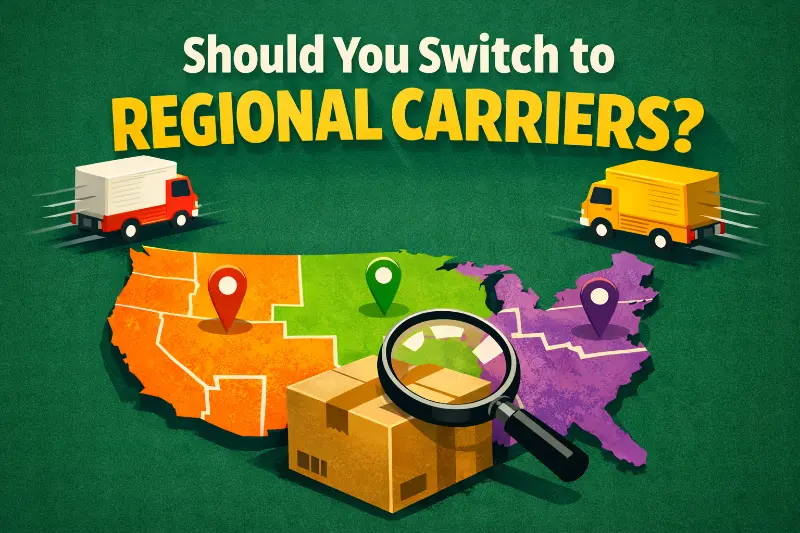
The traditional assumption that ecommerce parcel shipping means choosing between UPS and FedEx, with USPS as a lower-cost fallback, no longer reflects the market. The AlixPartners survey found that 55% of retailers now use carriers outside those three networks, and more than one-third actively shifted volume away from traditional carriers in the past year.
The change is even clearer when looking at the complete carrier mix. FreightWaves’ analysis of the survey and parcel-market data reports that more than 90% of surveyed executives operate a mix of last-mile carriers, while 32% use four or more. What was once a negotiating hedge has become the operating model.
Parcel volume is moving accordingly. Alternative carriers—including networks such as OnTrac, Veho, UniUni, Better Trucks, Jitsu, SpeedX, and Gofo—handled 2.6 billion U.S. parcels in 2025, up 13% year over year. Their revenue increased 15.4%, even though the overall U.S. parcel market grew only 0.4%. That contrast matters: alternative carriers are gaining share in a market that is barely expanding overall.
The implication for ecommerce brands is not that every regional carrier should receive volume. It is that a shipping strategy built around one default carrier is becoming less competitive. Brands increasingly need several viable delivery paths so they can use the best-performing option for each order and shift volume when price, capacity, or service conditions change.
Reliability Has Overtaken Price
The most important finding in the AlixPartners survey is not simply that more retailers are diversifying. For the first time in the survey’s history, reliability displaced price as the leading criterion for selecting a primary carrier.
That change follows the customer. Consumers now expect free delivery in an average of 2.7 days, down from more than 3.5 days in prior years, and AlixPartners estimates that more than 20% of demand may be at risk when delivery expectations are not met. Speed created the pressure, but consistent execution determines whether the customer comes back.
More than 85% of consumers say a poor delivery experience reduces their willingness to repurchase from the retailer. Fifty-two percent would boycott a retailer after only one or two botched deliveries. And 84% say previous delivery experiences—including which carrier handled the package—influence where they choose to shop. The customer may blame the carrier first, but the retailer loses the relationship.
Retailers cannot solve this problem by simply buying faster service on every order. Home-delivery costs increased for 83% of surveyed retailers, and 64% say home delivery is not accretive to profitability compared with an in-store transaction. Brands therefore need to improve reliability while controlling an increasingly expensive cost center.
The data also points to a more nuanced answer than “ship everything faster.” More than 80% of consumers would accept slower shipping in exchange for an incentive. A mature carrier strategy should preserve premium speed where it changes the purchase decision, while offering a lower-cost no-rush option to customers who value an incentive more than speed.
The Orchestration Gap
The framing that regional carriers are simply cheaper is too shallow to be useful. A regional carrier can offer attractive economics and strong transit performance within its coverage area. But those benefits disappear when the order originates from the wrong warehouse, the package falls outside the carrier’s ideal profile, or the carrier is selected even though its recent performance in the destination market has deteriorated.
A low label price does not compensate for a missed customer promise. A carrier with competitive rates but inconsistent tracking creates customer-service costs that can erode the savings. Poorly handled delays and failed deliveries can compound the problem, making it important to understand carrier shipment exceptions and how to fix them fast.
The real question is whether a brand’s operational infrastructure can exploit carrier optionality in real time. For every order, the decision needs to consider:
- The fully landed shipping cost, including expected surcharges
- The customer’s promised delivery date and the carrier service capable of meeting it
- Recent on-time performance and exception rates for the origin-destination pair
- The fulfillment location holding inventory and its proximity to the customer
- The package’s weight, dimensions, contents, and carrier eligibility
- Current carrier capacity, service disruptions, and pickup constraints
That is the orchestration gap. A brand can possess several carrier contracts and still route poorly. A resilient multi-carrier network continuously evaluates the viable options and can shift orders away from a carrier, service, or region that is underperforming. The advantage is not having more names on a rate card. It is having more usable paths around failure.
What Actually Changes When Regional Carriers Expand
The expansion of regional carrier coverage changes the menu. It does not change the kitchen.
When regional and alternative carriers add markets, a brand with sufficient customer density in those areas gains another potential delivery path. The value of that path depends on whether the brand can make it available to the right orders without weakening the delivery promise.
To benefit from a regional carrier in a specific market, a brand needs:
- Shipping software that evaluates all eligible carrier services for each order rather than defaulting to a primary carrier
- Inventory positioned close enough to the delivery market for the carrier’s regional strength to be accessible
- Package configurations that do not trigger dimensional-weight penalties, size surcharges, or carrier restrictions that erase the advantage
- Checkout promises grounded in the carrier’s actual transit performance to the destination, not a generic estimate
- Monitoring that detects service degradation and routing logic capable of shifting future orders to another option
Consider a brand that adds a regional carrier contract but ships from one warehouse outside the carrier’s core service area. Its packaging triggers avoidable surcharges, its routing rules still default to a national carrier, and its checkout estimates are disconnected from actual carrier performance. That brand has not created a resilient network. It has added administrative complexity without capturing the economic or service benefit.
This is why inventory placement and carrier selection must work together. A regional carrier cannot create savings if inventory sits outside its useful service area. Likewise, a distributed fulfillment network cannot reach its potential if every order is routed through one default carrier regardless of destination, promise, or performance.
Four Ways Brands Fail to Benefit from More Carrier Options
Choosing the Wrong Carrier Because Decisions Are Manual
Manual carrier selection does not scale, and static rules often optimize for a simplified version of reality. An operations team working from rate sheets or general rules of thumb cannot consistently determine the best carrier for a specific package, destination, fulfillment location, delivery promise, and day.
Real-time ecommerce shipping software for warehouse automation can compare eligible services when the order is ready to ship. But the decision should not stop at the lowest displayed rate. The system also needs to account for surcharges, delivery-date feasibility, recent performance, and operational constraints. Otherwise, a brand may save on the label and lose more through refunds, support contacts, or customer churn.
Shipping from the Wrong Node and Losing the Savings
A regional carrier’s advantage is geographic. A brand with one West Coast warehouse cannot fully exploit a carrier whose strongest service area is in the Southeast. The package still needs an economically viable path from its origin to the customer, regardless of which carrier has attractive rates within the destination region.
Inventory positioning is therefore a prerequisite for carrier optionality. A distributed inventory model allows the brand to route the order from a nearby node and then select the carrier with the best combination of economics and delivery performance for that lane. Without distributed inventory, carrier choice is constrained by wherever the product happens to be stored. The relationship between inventory placement and parcel cost is explored further in Cahoot’s guide to national fulfillment services and network architecture.
Using the Wrong Package and Triggering Avoidable Cost
Carrier diversification does not fix poor packaging. An oversized box can raise the billable weight or trigger handling and size charges, eroding any advantage offered by the selected carrier. This risk has grown as UPS and FedEx dimensional-weight changes increase billable weight for many shipments.
Packaging optimization—the systematic matching of package dimensions to the products in each order—is an operating discipline that improves the economics of the entire carrier mix. It also determines whether a shipment fits a regional carrier’s accepted package profile. The connection between packaging, surcharges, and margin becomes especially important during periods of peak shipping surcharges.
Offering Weak Delivery Promises Because Systems Are Not Integrated
Adding a regional carrier without integrating its transit and performance data into checkout creates a disconnect. The carrier may be able to deliver faster in selected zip codes, but the customer still sees the same generic estimate. Or the brand may display an aggressive promise that the selected carrier cannot reliably meet.
That is especially dangerous when more than 20% of demand may be at risk if delivery expectations are missed. Brands offering expedited shipping options need promise logic that connects inventory availability, node selection, carrier eligibility, cutoff times, and real-world delivery performance.
Rate shopping, delivery promises, inventory positioning, and post-purchase communication cannot operate as isolated systems. They need to share the same view of the order and the network. That coordination is what turns carrier diversification into a customer-experience advantage.
The Contrarian View: More Carrier Options Can Make Operations Worse
More competition is good for shippers at the market level. At the individual brand level, however, more carriers can create more failure points.
Each new carrier may bring a new contract, rate card, pickup process, label integration, tracking feed, claims workflow, billing format, and set of package restrictions. If the brand’s systems cannot normalize those differences, the operations team inherits the complexity manually. The result can be slower fulfillment, inconsistent tracking, missed pickups, billing errors, and confused customer-service teams.
A static multi-carrier setup can also fail during the exact moment diversification is supposed to help. If a carrier experiences a regional disruption but routing rules continue assigning it orders, the brand has more contracts without more resilience. The network becomes resilient only when performance is monitored and orders can be shifted to a viable alternative before failures reach the customer.
That distinction matters: multiple carrier contracts create optionality; orchestration converts optionality into resilience. Brands that cannot integrate, monitor, and govern another carrier should close those gaps before adding one.
What Brands Should Actually Do
The practical response is not to sign contracts with every carrier that reaches a market where the brand has customers. It is to build a measurable multi-carrier operating model.
- Map demand against inventory and carrier coverage. Identify where order density, fulfillment nodes, and regional carrier service areas overlap. A carrier that cannot be used from the available inventory location is not a meaningful option.
- Define the delivery promise before optimizing cost. Determine which services can meet the customer’s promised date, then compare the fully landed cost among those viable options.
- Route at the order level. Evaluate origin, destination, package profile, price, service reliability, cutoff time, and capacity for every shipment rather than assigning one carrier to an entire region or channel.
- Monitor performance by lane and service. Network averages can hide local problems. Track on-time delivery, exceptions, tracking quality, claims, and customer contacts for the specific routes where each carrier receives volume.
- Build rerouting rules before disruption occurs. Set thresholds and fallback services so volume can shift when a carrier, service, or region underperforms.
- Segment speed instead of overspending on every order. Preserve faster service for orders and customers who require it, and test incentivized no-rush delivery for shoppers willing to trade speed for value.
This is where Cahoot’s combination of ecommerce order fulfillment services and intelligent shipping orchestration matters. Inventory placement determines which carrier options are physically and economically available. Automated rate shopping and routing determine which viable option should handle each order. The two decisions must work together.
The winners in the next phase of parcel diversification will not be the brands with the longest carrier lists. They will be the brands whose networks can consistently choose the right path—and change paths before a carrier failure becomes a customer failure.
Frequently Asked Questions
Are regional parcel carriers cheaper than UPS or FedEx?
They can be for the right shipment in the right market, but there is no universal savings percentage. The correct comparison includes the base rate, surcharges, package profile, fulfillment origin, destination, delivery promise, and expected service performance. A lower label price is not a savings if the shipment misses the promise or creates additional support and recovery costs.
What is the difference between regional, alternative, and national parcel carriers?
National carriers such as UPS and FedEx provide broad U.S. coverage and international services. Regional carriers specialize in defined geographic service areas. “Alternative carrier” is a broader category that can include regional parcel networks, crowdsourced or gig-based delivery platforms, and other providers outside UPS, FedEx, and USPS. Some alternative carriers combine several local networks to provide wider coverage.
Why has carrier reliability become more important than price?
Delivery performance now directly affects customer retention. More than 85% of consumers surveyed by AlixPartners say a poor delivery experience reduces their willingness to buy again, and 52% would boycott a retailer after only one or two botched deliveries. With consumers expecting free delivery in 2.7 days, retailers need carriers that can meet the promise consistently—not merely quote the lowest rate.
How does inventory positioning affect whether regional carriers are useful?
A regional carrier’s advantage is geographic. If inventory is stored outside its useful service area, the carrier may not be eligible or economical for the order. Distributed inventory allows the brand to fulfill closer to customer demand and makes more regional carrier options viable.
What should multi-carrier routing evaluate?
Order-level routing should evaluate the fulfillment origin, destination, promised delivery date, package dimensions and weight, carrier eligibility, landed cost, recent service performance, pickup cutoff, capacity, and active disruptions. Rate shopping is one part of the decision, not the entire decision.
What is the difference between having multiple carrier contracts and having a resilient carrier network?
Multiple contracts create options. A resilient network can use those options automatically. It monitors performance, identifies when a carrier or lane is underperforming, and reroutes eligible orders to another service without relying on manual intervention after customers have already been affected.
Is adding more carrier options always a good idea?
No. Each carrier adds integration, operating, billing, and performance-management requirements. A new carrier creates value only when it provides a viable service advantage and the brand can incorporate it into order-level routing, delivery promises, tracking, exception management, and fallback logic.
Written By:

Rinaldi Juwono
Rinaldi Juwono leads content and SEO strategy at Cahoot, crafting data-driven insights that help ecommerce brands navigate logistics challenges. He works closely with the product, sales, and operations teams to translate Cahoot’s innovations into actionable strategies merchants can use to grow smarter and leaner.

Turn Returns Into New Revenue
Related Articles

Save Money With Ecommerce Shipping Software: Next-Gen Solutions
Shipping costs are one of the biggest challenges for ecommerce businesses today, and understanding them is essential to reducing expenses and increasing profit margins.
Shipping Software for Ecommerce Fulfillment: The Next Generation of Shipping Simplified
Ecommerce has transformed the way people shop, but behind every seamless online purchase is a complex fulfillment operation.

10 Best European 3PLs for Ecommerce Sellers in 2026
Bigblue is the best overall choice among the best European 3PLs in this comparison, while everstox, Paxon (including Active Ants), Fulfillment-Box, and Bleckmann are stronger picks...