
How AI-Powered Returns Management Fights Ecommerce Fraud in 2026

Last updated on August 20, 2026
In this article
 9 minutes
- The Real Cost of Returns Fraud
- What Changed in 2026: AI Is Industrializing Fraud
- How AI Detects Fraud Across the Returns Process
- Where Cahoot Fits: Verify Earlier and Route Intelligently
- Six Actions Merchants Should Take Now
- How AI Can Preserve Customer Trust
- Final Thoughts: The Returns Fraud Fight Is Now an AI Arms Race
- Frequently Asked Questions
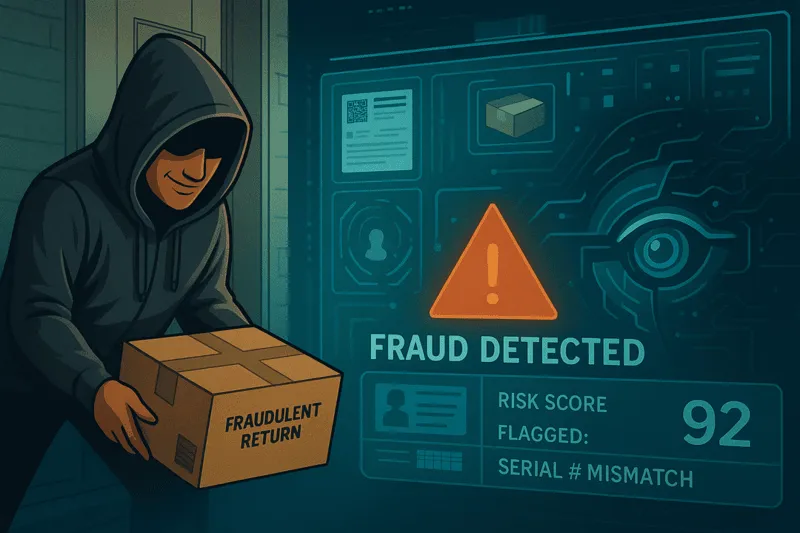
AI is changing ecommerce returns fraud in two directions at once. Merchants are using machine learning to identify suspicious behavior, but fraudsters are using generative AI to create convincing receipts, product photos, identities, and scripts at far greater speed and scale.
That arms race is already visible in the data. Signifyd’s 2026 State of Fraud Report found that ecommerce fraud pressure in North America increased 33% year over year during the first four months of 2026. Account takeover attempts rose 78%, card-testing attacks surged 175%, and “item not as described” claims increased 49%.
The lesson for merchants is not simply to add another fraud rule at checkout. Fraud now moves across the customer lifecycle—from account access and payment through fulfillment, delivery claims, returns, and refunds. Effective fraud prevention has to connect those stages while keeping the return experience fast for legitimate customers.
The Real Cost of Returns Fraud
Returns are already a major expense before fraud enters the picture. The NRF 2025 Retail Returns Landscape projected that 19.3% of online sales would be returned and found that 9% of all returns were fraudulent. At the same time, 82% of consumers said free returns were an important consideration when deciding where to shop.
That leaves retailers with a difficult balancing act: absorb losses from abuse or add friction that may drive away good customers. Common schemes include:
- Wardrobing: Using an item and returning it as new.
- Switch fraud: Keeping the authentic or higher-value item and returning a counterfeit, older, or cheaper substitute.
- Empty-box fraud: Sending back an empty package or low-value filler while claiming the correct item was returned.
- False condition claims: Claiming an item arrived damaged, defective, or not as described to obtain a refund or concession.
- False delivery claims: Reporting that a delivered order never arrived.
- Quantity fraud: Returning fewer units than the customer claims to have sent.
Not every expensive returns behavior is fraud. Bracketing—ordering multiple sizes or colors with the intention of keeping one—is generally a shopping behavior, not a fraudulent return. The distinction matters because an overly aggressive system can mistake a valuable customer for a bad actor.
What Changed in 2026: AI Is Industrializing Fraud
Older fraud programs often treated payment fraud, account takeover, fulfillment abuse, and return fraud as separate problems. Signifyd’s latest data shows why that model is breaking down.
- Fraud pressure increased 33%: Signifyd recorded a 33% year-over-year rise in North American fraud pressure from January through April 2026.
- Account takeover rose 78%: Automated credential attacks make it easier to enter established customer accounts that already appear trustworthy.
- Card testing surged 175%: Automation lets criminals test stolen payment credentials at high speed before using the valid cards for larger purchases.
- BOPIS fraud increased 65%: Buy online, pick up in-store programs can be exploited to collect merchandise quickly or convert fraudulent purchases into store credit through returns.
- First-party fraud and consumer abuse increased 9%: Abuse by legitimate cardholders is growing alongside organized criminal activity.
- “Item not as described” claims rose 49%: Generative AI can produce realistic-looking images of damaged or defective merchandise, lowering the effort required to make a false post-purchase claim.
What the 33% figure does—and does not—mean: It is a year-over-year increase in fraud pressure, not a claim that 33% of ecommerce orders are fraudulent. Signifyd defines its Fraud Pressure Index around the share of orders judged very high risk and presumably fraudulent across its commerce network. The report analyzed transaction data from thousands of merchants and 950 million-plus unique digital wallets.
The most important development for returns teams is that customer-submitted evidence can no longer be trusted in isolation. A photo is still useful, but a realistic image is no longer proof that the pictured damage happened to the purchased item—or that the image is authentic at all.
How AI Detects Fraud Across the Returns Process
AI-powered returns management combines order data, return behavior, customer history, fulfillment events, delivery tracking, and submitted evidence to estimate risk. No single signal should decide the outcome. The advantage comes from comparing multiple signals in context.
1. Treat Photo Evidence as a Signal, Not Proof
Image analysis can help compare a submitted product with catalog images, identify visible wear or missing components, and detect inconsistencies with the stated return reason. But the rise of AI-generated damage photos means merchants also need to evaluate how the evidence was captured and how it fits the rest of the transaction.
Stronger workflows can require photos for each physical unit, request specific angles or packaging details, compare repeated submissions, and escalate ambiguous cases. For high-value or serialized products, image evidence may need to be paired with serial-number, barcode, or warehouse inspection data.
2. Connect Account, Order, and Return Behavior
An apparently valid return can look very different when viewed alongside the customer’s broader activity. Useful signals include sudden address or password changes, unusual device behavior, use of stored payment methods after an account change, repeated high-value returns, multiple “not received” claims, and abrupt changes from the customer’s normal purchase pattern.
This matters because an account takeover may begin before checkout but surface later as a delivery dispute, return request, or chargeback. Teams that examine each event separately can miss the connection.
3. Find Patterns Across Customers and Channels
Machine learning can identify repeated addresses, devices, payment instruments, tracking behavior, return reasons, and claim language across many transactions. It can also detect patterns too subtle for fixed rules, such as groups of accounts making similar claims against the same products or routing refunds through the same destinations.
For omnichannel merchants, online orders, store pickup, store credit, mail returns, and warehouse receipts should feed the same risk view. Signifyd’s finding that BOPIS fraud rose 65% shows why post-purchase and store operations cannot remain isolated from ecommerce fraud controls.
4. Analyze Return Reasons and Claim Language
Natural language processing can surface repeated vague explanations, highly similar descriptions across accounts, or claims that conflict with order and tracking data. Language alone should not trigger an automatic denial, but it can help determine when the merchant should request more evidence or conduct a manual review.
5. Use Risk-Based Outcomes Instead of One Policy for Everyone
A useful risk score does more than label a return “good” or “bad.” It helps choose the appropriate next step. A low-risk customer may receive a fast, convenient experience, while an unusual or high-value request may require additional photos, a warehouse inspection, or a delayed refund. The decision should be explainable and subject to review.
Where Cahoot Fits: Verify Earlier and Route Intelligently
Cahoot’s Peer-to-Peer Returns platform moves condition verification earlier in the return journey. Instead of treating every return as an identical box that must travel back to a warehouse, the workflow can collect item-level photos and condition information before determining the next step.
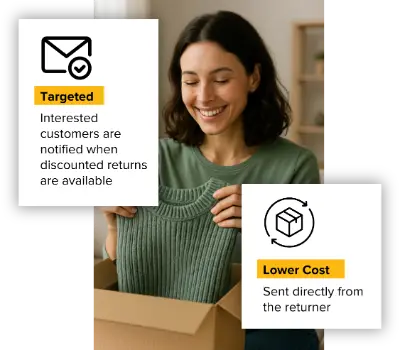
Eligible, like-new merchandise can be offered to another shopper and shipped directly from the returner to the new buyer, while items that do not qualify can follow the merchant’s standard warehouse-return process. That makes accurate eligibility and condition decisions essential: the platform must protect the next customer as well as the merchant.
AI-assisted analysis can help organize and compare submitted evidence, transaction history, and shipping data, while merchant-defined rules and human review provide control over uncertain or high-risk cases. The goal is not to assume that every claim is fraudulent. It is to apply more scrutiny where the combined evidence warrants it and less friction where it does not.
This is especially important in 2026. Because generative AI can fabricate convincing damage evidence, photo collection by itself is no longer enough. It has to be part of a layered decision that considers the specific unit, order history, account behavior, fulfillment records, and the consequences of getting the decision wrong.
Six Actions Merchants Should Take Now
- Join pre-purchase and post-purchase risk data. Account, payment, fulfillment, delivery, return, refund, and chargeback events should contribute to one customer and order history.
- Strengthen evidence capture. Ask for item-specific photos and condition details, but do not treat a single uploaded image as conclusive evidence.
- Protect customer accounts. Monitor unusual login, credential, device, address, and stored-payment activity before it becomes a fraudulent order or return.
- Review refund triggers. Decide when a carrier scan is sufficient and when a high-risk or high-value item requires verification before the refund is released.
- Close omnichannel loopholes. Examine how BOPIS, mail returns, store credit, instant refunds, and in-store returns can be combined in the same abuse pattern.
- Measure false positives. Track approvals, denials, manual reviews, reversals, customer complaints, and repeat-purchase behavior so fraud controls do not punish profitable customers.
How AI Can Preserve Customer Trust
Blanket restrictions are easy to administer, but they make every customer pay for the behavior of a small minority. Risk-based returns management can preserve convenience by fast-tracking routine requests, limiting added verification to cases that warrant it, and escalating uncertain decisions rather than automatically rejecting them.
That balance matters commercially. NRF found that 71% of consumers are less likely to shop with a retailer again after a poor returns experience. Fraud prevention and customer experience therefore cannot be managed as opposing goals. The best system reduces loss while making legitimate returns feel predictable and fair.
Final Thoughts: The Returns Fraud Fight Is Now an AI Arms Race
The 2026 data changes the conversation. AI is not only helping merchants detect fraud; it is also helping attackers manufacture evidence, automate credential abuse, and connect schemes across checkout, fulfillment, and returns.
Merchants will not solve that problem with a stricter return policy or a photo-upload field alone. They need layered evidence, connected data, risk-based workflows, and a clear path for human review. Applied carefully, AI-powered returns management can protect margin without turning every good customer into a suspect.
Frequently Asked Questions
How much did ecommerce fraud increase in 2026?
Signifyd reported that fraud pressure in North America increased 33% year over year from January through April 2026. That does not mean 33% of orders were fraudulent; it means the share of orders assessed as very high risk increased relative to the same period in 2025.
How is generative AI being used in return fraud?
Generative AI can create realistic receipts, product images, and written explanations that support false damage, defect, or delivery claims. Signifyd reported that “item not as described” claims in North America rose 49% year over year during the first four months of 2026.
Are customer-submitted photos still useful for return verification?
Yes, but a photo should be treated as one signal rather than definitive proof. Merchants can strengthen the process by requiring item-specific views, comparing the evidence with order and customer history, checking for repeated submissions, and escalating high-risk cases for inspection or manual review.
What is the difference between return fraud and return abuse?
Return fraud generally involves intentional deception, such as sending back a counterfeit item or making a false damage claim. Return abuse is a broader category of behavior that exploits a merchant’s policy, sometimes by a legitimate cardholder. Bracketing, however, is not automatically fraud; it is often a normal consequence of shopping for size or fit online.
How can AI reduce fraud without hurting good customers?
AI can combine multiple risk signals to apply extra verification selectively instead of imposing the same restrictions on everyone. Low-risk returns can move quickly, while unusual or high-value cases receive additional review. Merchants should also monitor false positives and provide a way to correct mistaken decisions.
Written By:

Indy Pereira
Indy Pereira helps ecommerce brands optimize their shipping and fulfillment with Cahoot’s technology. With a background in both sales and people operations, she bridges customer needs with strategic solutions that drive growth. Indy works closely with merchants every day and brings real-world insight into what makes logistics efficient and scalable.

Turn Returns Into New Revenue
Related Articles
What Is Demand Planning? How It Impacts Inventory, Forecasting, and Profitability
Demand planning is the process of estimating future customer demand so that a business can align its inventory, procurement, and operations to meet that demand without carrying mor...

Why 100% P2P Adoption Is the Wrong Goal
Peer-to-peer returns let customers send eligible returned items directly to other customers instead of routing every package back through the warehouse, cutting shipping and proces...
Walmart Officially Allows Amazon Multi-Channel Fulfillment (MCF)
Big news for multichannel sellers: Walmart now officially allows Amazon Multi-Channel Fulfillment (MCF), Amazon’s service for using its fulfillment network to ship orders from mult...